



Meet Daily Point of Light Award honoree Kate Casciato. Read her story, and nominate an outstanding volunteer or family as a Daily Point of Light.
It is often assumed that everyone knows how to swim at a certain age, but that’s not always the case. Geographic location, historical segregation laws, financial barriers, and other factors can all play a part in why a child might not be safe in the water. Seventeen-year-old Kate Casciato is dedicating her life to changing that, starting with childhood education, where feet are firmly on dry land.
When Kate was a toddler, a close family member nearly drowned in a riptide, and it shaped how her parents raised their kids. They enrolled her and her four brothers in swimming lessons from a very early age and strictly enforced safety rules. While they can all swim well, Kate has become a competitive swimmer. In fact, she loves anything to do with water, which is why it saddens her to see so many accidents happen to young children who haven’t been taught to safely interact with it.
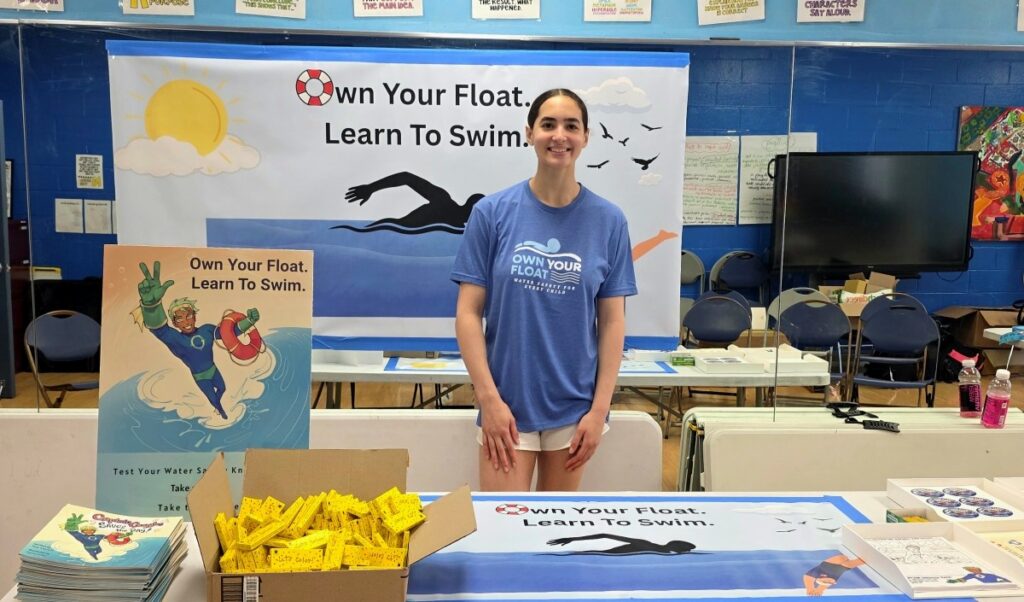
In 2022, Kate decided to take things into her own hands. She founded Own Your Float to bring water safety education into preschool and elementary classrooms across New York City and spends 15 to 20 hours each week running programs with 40 volunteers. Swimming lessons can be hard to access, but thanks to Kate, knowledge isn’t. The organization has also distributed nearly 3,000 pairs of goggles and swim caps with partner companies.
Own Your Float has reached over 1,200 students, and Kate has published op-eds in The Washington Times and other national outlets on the topic. As part of her advocacy, Kate has also co-chaired Turning the Tide, a friend’s initiative, organizing logistics and helping raise $140,000 for swim lessons for underserved swimmers.
What inspires you to volunteer?
My parents were always talking about water safety, and it always interested me. I used to hand out booklets outside pools as a kid. I wanted to do something about it, but I hadn’t really volunteered before this.

Tell us about your volunteer role with Own Your Float.
I started by asking schools if I could talk about water safety. Many said no, because they didn’t want to scare the children. Eventually, after really writing countless emails and using every connection I could, I got into classrooms and assemblies, Boys and Girls Clubs, and camps. Now, I do lesson prep and, during lessons themselves, read a water safety book and use scenario-based poster boards to help kids spot danger.
That’s our main focus, but I also solicit donations to help us distribute goggles and swim caps as an avenue into talking about safety. I’ve negotiated a wholesale equipment partnership with FINIS, Inc. and Speedo. We hope goggles in their child’s hand are a reminder to parents to sign them up for a swim lesson.
The last part of what we do involves librarians. I wrote a children’s book called Captain Goggles Saves the Day! that I self-published about water safety, because the books I read didn’t represent the diverse children I see. By contacting state librarians, we were able to send free copies of my book or another one on the topic to around 270 libraries across five states. We help librarians build engagement around the books using activities I created with downloadable sheets. And we’ve launched a middle school club with students who will hopefully take over after I graduate.
I also volunteer every Sunday most of the year as a swim instructor with the Swim Strong Foundation for children from low-income circumstances. My organization focuses on education, but a child that has a swimming lesson is 88% less likely to drown, so that’s a big part of the solution, too.
You advocated for state bill S. 9480 to mandate water safety in schools. Why is that important?
The goal is to get water safety required in classrooms. Only Louisiana has implemented this so far. We should be teaching children to respect the water without being fearful of it. So, I went to Albany to meet with the Director of the State Education Committee, find out the status of the bill, and share what I’m seeing in classrooms and swim lessons.
What inspired you to get started with this initiative?
I grew up understanding that anyone can drown and everyone eventually encounters water, whether you’re swimming, on a boat, or in a flood. It was always in the back of my mind.
As I got older, I got invited to talk about being a competitive swimmer and noticed the children I spoke with had little understanding of water safety. I realized that was why you can’t pick up a newspaper in the summer without seeing a tragedy of a child who snuck into a neighbor’s pool or was swept away on a beach.
We have to talk to kids about water safety like we do about fire and lockdown drills. The sooner we reach them, the better. Many tragedies are preventable, but it’s not as simple as telling people to get a lesson. There are barriers, and that’s why I want to study public policy. I’m just getting started.
What’s been the most rewarding part of your work?
It’s when a kid confirms they’ll follow the rules and a teacher decides to incorporate water safety into their curriculum. This work is so much more than one person. It’s going to take a movement.
Why is it important for others to get involved with causes they care about?
We owe it to each other. We’re part of this world, and no one can get by without help from other people. If you can contribute, you have an obligation to. Plus, it makes you feel good. Nothing makes me feel better than helping somebody.
What do you want people to learn from your story?
There’s no substitute for a swim lesson, but anyone involved in a child’s life can talk about water safety. Education is an easy part of the solution that we’re ignoring. You don’t need a pool. Children are already in classrooms. Why can’t we get this done?
Do you want to make a difference in your community like Kate? Find local volunteer opportunities.