HandsOn Tech Detroit compiled stories from AmeriCorps Alums in the Detroit area to highlight the work they did during their year of service. There is a lot of great work being done by AmeriCorps members in Detroit, and many of those who serve in the area stick around to contribute to the Detroit community after their year of service. We wanted to make sure their inspirational stories of service were shared.
Meet Isaac Gilman
Where did you serve (program/ location / year)?
I served in Michigan’s AmeriCorp program, through the Regents of the University of Michigan, during the summer of 2011. I served in Southwest Detroit for
(UNI), a small neighborhood nonprofit organization, for a total of 450 hours during that summer.
Describe your service – what population did you serve? What were the goals of your service year?
My service was amazing. Southwest Detroit is a unique area of the city because of its rich Hispanic culture and overall diversity in the area. I was specifically located in the Springwells Village Neighborhood which borders Dearborn on the west, Delray from the south, Chadsey-Condon from the north, and the Vernor/Mexican Town area on the east.
UNI asked me to coordinate a youth bike club that ran for six weeks during their summer program. The bike club was very grassroots, mainly coordinated by a community volunteer and a social work intern in the past. The mission of the bike club was to teach young neighborhood kids how to maintain and repair bikes. Further, the kids learned about the benefits of riding bikes and the importance of riding safely on the street.
When I started in May 2011, it was clear to me the small, young program had great potential. When I first began, I tried to learn as much as I could about the neighborhood, kids that I came in contact with, and especially the bike program. The program was about three years old as of May 2011. It was originally started by a group of kids who showed interest in customizing bikes. The kids would work out of the UNI Garage, and just fiddled around with their bikes. Structure was added over time, with lesson plans focused on repairing specific parts of the bike so kids learned how to properly maintain them. A few small grants were received to purchase proper bike tools and supplies.
When I started, I built off the foundation that was there for me. I added structure to the program by building additional lesson plans and keeping the shop open more hours per week. I saw a lot of success the first summer I coordinated the shop. We averaged 15 kids twice a week for six weeks; some days we had as many as 35 kids and other days (usually rainy days), only 5-10. It was clear to me the kids really liked learning about how to fix their bikes, and they wanted to keep doing it. In fact, at the end of the program, we went on a group ride to Clark Park, utilizing the bike lanes along West Vernor Highway. The kids loved it!
At the end of August 2011, my AmeriCorp service officially ended, but my vision for the shop grew stronger. A long term goal was to eventually build out a retail bike shop in the neighborhood, embedding the current education principles with youth entrepreneurship philosophies into the future shop. I’m proud to say we’ve made real progress towards reaching this goal. In the summer of 2012, I volunteered my time twice a week to work on opening the shop and build off the momentum that was created in 2011. Summer 2012 proved to be another huge success with similar demand and more exposure in the neighborhood.
This year, a team of six adults (including myself) created a business plan, started a fundraising campaign, found space for the shop, and plan to open Southwest Rides: Boards and Bikes Shop in southwest Detroit in summer 2013. The process has been long and taxing, but well worth it. I don’t expect to make huge profits or become famous, but
I do intend to continue to make an impact in Springwells Village and Detroit as a whole.
What was your biggest take-away from your year of service?
My biggest take away was seeing how much I could make a difference in the kids’ lives in such a short period of time. Within three months, I connected with almost every kid who came in to the bike shop. Whether they just wanted to learn how to fix bikes, or they were looking to earn a bike, every kid was eager to listen and learn. The kids really loved the shop as it provided an educational opportunity that they could not get in the K-12 school system.
How did your year of service help you grow personally and/or professionally? Where are you working now & how did your year of service help you get there (if applicable)?
My AmeriCorp placement is the reason I am living, working, playing, and giving in Detroit today.
When I was in school at the University of Michigan, I knew little about Detroit but became interested as soon as I visited the city for the first time. Now two years later, my amazing UNI experience showed me that like the bike shop’s potential, Detroit’s potential is amazingly endless.
Currently I am participating in the inaugural class of
. Challenge Detroit is a national initiative focused on revitalizing Detroit by retaining and attracting top talent to bring their intellectual capital to the city. There are 30 fellows and each fellow works four days a week at their host company. I work for a financial software company called
. When we are not at our host companies we come together to help various nonprofits fix some of the challenges that Detroit is struggling with today.
HandsOn Tech is a national program sponsored by a partnership between Google and Points of Light. This program is focused on increasing the nonprofit sector’s effective use of technology to increase community resources and improve outcomes for low-income communities. Serving in seven cities across the country, HandsOn Tech Detroit is one of the sites working to provide pro bono technology assessments, develop technology plans, and offer professional consulting, training, and resources to build capacity and support for qualified nonprofits. Click here for more information about HandsOn Tech Detroit.
Change Notes: It just takes a minute to join the largest commitment of pro bono service in history
Friends,
This story doesn’t start well.
Here’s the headline from the Chronicle of Philanthropy: “Foundation Giving Won’t Rise Much this Year.”
And here’s the lead quote from Florence Davis, president of the Starr Foundation: “The global economy is unstable, the markets are irrational, Washington is paralyzed. Need I say more?”
The point is a familiar one: Companies and foundations seek to expand impact while their foundation dollars remain constant.
The solution, as is so often the case, doesn’t get much attention in the story. Beyond writing a check, what can companies and their foundations do to help nonprofits tackle the increased demands for services coupled with the stresses of reduced funding and declining government support?
They can give their time and talent.
According to True Impact, a research and consulting firm that helps organizations measure the social and business impact of their programs, the value of skilled support can be 500 percent greater than the value of traditional volunteering.
Points of Light is the proud home of A Billion + Change, a national campaign to encourage the largest commitment of pro bono service in history. In just a short time, more than 300 of America’s favorite brands have pledged to donate nearly $2 billion worth of time to tackle tough problems in their communities and around the world.
More than 300 companies are making this a better story, but our goal is 500 pledge companies by June.
Has your nonprofit received pro bono support from a business? Or does your company lend its talent and expertise to a local nonprofit? Tell us about it.
If you introduce these pro bono leaders to A Billion + Change, we’ll share a pro bono hero’s story each day on the Billion + Change blog and thank a lucky nonprofit with a free trip to Points of Light’s biggest annual event, the Conference on Volunteering and Service in Washington, D.C., June 19 – 22.
Today’s guest post comes from Sally Hallingstad. Sally is Director of Events & Marketing at Metro Volunteers, a HandsOn Volunteer Action Center in Denver. Through generationOn’s What Will You Bring to the Table? initiative, Sally and her team are engaging youth in taking action against child hunger. Today, Sally offers four ways adults can support youth in tackling hunger through hands-on volunteer projects.
Create Partnerships.
Often-times, in a youth/adult relationship there is an unspoken rule that the adults make all the decisions of where to go, what to do, etc. Many times, this is needed in order to be productive and efficient; however, in order for a youth to find his/her passion for community, adults need to learn to let go of the dictatorship and allow them the option to explore different ideas and ways to make our world a better place. Brainstorming is a great opportunity to let the youth have their voice while allowing the adult to show support while implementing a certain amount of guidance.
Create Awareness.
Child hunger is a prominent, global topic that is relayed with television ads and billboard campaigns raising funds for children in developing countries. What many youth don’t realize is how close to home hunger really is. Take the time to research facts about child hunger in your community; this ultimately will make it a more “real” issue to them if they understand that child hunger is local and could easily be affecting someone they know.
Create Action.
There are a number of hunger-focused organizations across our nation that do an amazing job of engaging volunteers in their mission. Because of them, volunteerism can come in many forms, whether it’s giving time to a food pantry, serving a meal at a soup kitchen or participating in a national campaign like What Will You Bring to the Table? By encouraging youth to give their time to a cause, adults are helping them understand that no matter how old they are or how much time/money they have they are able to fight hunger in their own way.
Create Voices.
The most powerful tool an individual has is their voice. Encourage youth to talk about their experiences to their families and classmates. The more people that become aware of the needs in their community, the greater chance we have of engaging people in the fight against child hunger.
Through April 30, you can engage youth in tackling child hunger through generationOn’s What Will You Bring to the Table? Through hands-on projects, food drives and advocacy, 1 million meals will be generated for children who are hungry. Click here for GenerationOn’s age-appropriate resources to educate youth about hunger and guide them in taking action through easy-to-implement projects.
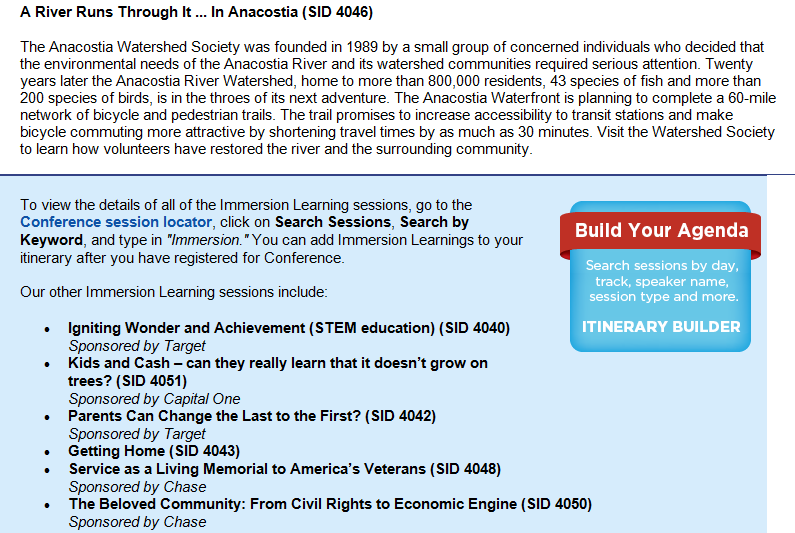
Conference Immersion Learnings back by popular demand! Register today.
How will Conference be a Change Point for you?
Today’s post is written by Amy Lytle from HandsOn Northwest North Carolina. Amy attended her first Conference in New Orleans at the tender age of 24. She has leveraged her conference experiences in building a 15+ career in the field of volunteer engagement, and was hired as the first-ever Executive Director of HandsOn Northwest NC in 2007. Attending conference is part of her 2013 resolution to practice “radical self-care” in hopes of being the best leader she can be. And she’s serious about the cool beverages.
By now, I hope you all have heard about the upcoming Conference on Volunteering and Service set for June 19-22nd in Washington, DC. You may be thinking, DC in JUNE? Are you nuts? 90 degrees and 100% humidity? Why would I want to do that?
You want to do it because attending conference can be transformational, especially if you work for or with a HandsOn affiliate. I would especially encourage all affiliates to attend the Affiliate-Only Sessions, scheduled for the Friday afternoon and Saturday after conference. I’ve attended all but two conferences since I started my career in volunteer engagement in 1998. (Yes, I entered the field at a ridiculously young age, why do you ask?) I make this investment in time and money–and for me now, as the ED of a relatively small and relatively new affiliate, it’s a significant investment–because I know that my ROI will be great. At each conference, I’ve built and nurtured relationships that have sustained me throughout my career in the field. I’ve honed my skills in numerous areas, and learned best practices that have brought immediate value when taken home.
Conference is more than just the sessions you attend, it’s about the people you’ll meet and the conversations you’ll have. There are some colleagues that I see only at conference, but I know that I can pick up the phone any time and get advice and support from them. I’ve picked their brains, “borrowed” their ideas, and learned from their experience. None of this knowledge would have been available to me had I decided to sit in my office alone. As an affiliate leader, I’ve learned that creating and strengthening my peer network has been crucial to my success, both personally and organizationally.
My goal for each conference is always the same: at least one new idea I can instantly implement when I get back home and one new colleague who I feel I can count on in the future. I really should create stronger “stretch” goals, because, in reality, both of these are easy to fulfill. In past conferences, I’ve gotten key advice about implementing HandsOn Connect, learned how to build a managed projects program, and I gained confidence in working with corporate partners. As a member of the “Dream Team,” (hey, I didn’t name it that–HandsOn Network staff did!) I’m proud that the affiliate-oriented sessions have been created by and for affiliate leaders. The partnership between the HandsOn Network/ Points of Light staff and us affiliates is strengthened by the conference experience, building a stronger network for service and engagement that benefits us all.
So, yes–it’s DC in June. The hotels won’t be cheap, but the registration is reasonable. I’m thinking of bringing my spouse and my six-year-old daughter, so I can hear the stories of their adventures while I’m in sessions. (In NYC, during conference in 2010, they explored the High Line, Central Park, and Rockefeller Center, among other things.) Sure I’ll be jealous of their explorations, but I know that what I’ll bring home from my conference adventure will be just as compelling. I hope I’ll be able to see you there. The cool beverages will be on me!
More than 16 million children in America are at risk of hunger. That’s more than 1 in 5.
1 in 2 children in the City of Detroit face hunger. That’s half.
But the flyer doesn’t stop there. A second column is titled “Solutions” and has just four words in it.
The solution is you.
Students at Loyola High School in Detroit, Michigan, created the flyer as part of What will you bring to the table? a national campaign led by Points of Light’s youth service division, generationOn.
What will you bring to the table? is empowering young people across the country to take action to help end child hunger in their communities.
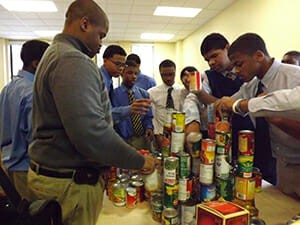
Loyola High School students in Detroit collected 1,000 cans for food banks in their community.
At Loyola High School, students designed and constructed a community table that served as both a starting and a focal point for their project. They hosted a forum during lunch periods around the table, and shared materials they’d created – like the flyer that made its way into my hands. They also collected 1,000 cans of food for local food banks.
Over the next month, youth-led activities like this one are taking place in communities across the country to raise awareness, food and funds to help end child hunger.
What will you bring to the table? has another big goal: to generate 1 million meals for children in need. Thanks to generationOn’s partners – ConAgra Foods, Hasbro, Hilton Worldwide, Arby’s and the Arby’s Foundation, the Hub Network, C & S Grocers, and the National Turkey Federation – every action counts. If you raise awareness, write a blog, convene a group discussion — when you report those actions on the campaign website your efforts will be matched with a meal donation by the campaign partners.
Make sure you visit the Washington Mall! The National Mall is the first stop on most sightseeing tours of Washington DC and most of the attractions are free.10 Things to Know About the Mall in Washington DC
Destination DC’s “Show Your Badge” program is designed for you to enjoy world-class restaurants, attractions and performing arts while you are in D.C. To participate, simply show your Conference/convention badge to any of the participating partners and receive exclusive discounts.
Visit our FAQ page for more information about to secure a “family badge” and how your family can take advantage of the discounts offered by the “Show Your Badge” program. Make sure to reserve your family badges through Conference registration. Did we mention there are 100 free (or almost free) things to do in DC? Visit our Explore Washington, DC. page for more information.
Utilize the Metro
The Washington Metropolitan Area Transit Authority, also known as the Metro, serves 86 stations and 106 miles of track in the Washington, D.C. area. Taking the Metro is a cheaper solution to getting around in DC. Visit the Metro’s website to plan your trip.
Take Advantage of the Conference Travel Discounts
The Conference on Volunteering and Service has secured several travel discounts for our attendees:
United Airlines is pleased to offer discounts of 2% to 10% off published fares. Save an additional 3% off by booking your own reservations at www.united.com. Choose your flight times, and access your meeting discounts by inserting ZPRV460636 in the Offer Code box. Or Call your travel professional or United Meetings at 800-426-1122 for reservations. Refer to Z Code ZPRV and Agreement Code: 460636.
Save 10% when you book your travel with Amtrak — To use the discount you must make your reservation by phone at 1-800- 872-7245. Amtrak Convention Fare Code number is X97M-964. Travel must be made to Washington, D.C. between June 16 and June 25, 2013.
Save 5% – 40% when you book your rental car with Avis — visit the website Avis created for our Conference to make your reservation and use the Avis Worldwide Discount (AWD) number D028440. Or, call 1-800-525-7537 ext. 35003 to reserve your rental car.
Save 5% when you book your air travel with American Airlines — visit www.aa.com/group and enter promotion code: 5763DU.
Today’s blog is reposted from Business4Better blog, published on March 20, 2013.
Do you have busy employees that can’t give large amounts of time for charitable volunteering due to other commitments and a busy lifestyle?
Then try micro-volunteering.
Micro-volunteering leverages employees’ skills and can be done entirely online via a laptop or even smartphone in increments as small as 15 minutes.
Here is how it works: A non-profit posts a small project or question that requires professional expertise. The request must be something that can be solved online, able to be completed in less than 3 hours and have a clear deliverable: Think marketing or communications projects, a finance problem or a graphic design need. Through a platform delivered by Sparked.com, the request is then routed to individuals or groups of individuals that have an expertise or interest in that area. Volunteers can jump in.
The beauty of the platform is that through crowdsourcing the non-profit can get their challenge solved and even get more than they originally asked for, explains Chris Jarvis, Co-Founder and Partner for Realized Worth. “A lot of work is done in a short period of time. Non-profits can quickly get a range of responses that were outside the original problem but it can also give the non-profit a broader context and bring new issues to light,” says Jarvis.
“Crowds are smarter than any one of us,” he adds.
United Healthcare piloted the Sparked.com platform and micro-volunteering to their employees in 2011. The program involved a group of 60 college hires who had joined the company within the past three years. Each employee was expected to fulfill at least three to five challenges and complete a feedback survey about their experience.
“I thought it would appeal to our employees. This is a very performance-driven organization but many don’t have the time to volunteer and 25 percent of the workforce is locked to their desk, explains Susan Osten, Director of Office of Social Responsibility for United Healthcare. In total 1,447 people completed the 800 challenges. Eighty-three percent of respondents who participated in the program said they would recommend micro-volunteering to others.
Osten explains how one woman went above and beyond all expectations. This United Healthcare employee is a single parent with five children who could never get out to volunteer with all her responsibilities at home. During her lunch hour and in other small increments, has completed almost 60 challenges. This type of inspirational micro effort can indeed have a macro impact for non-profits in need.
For more on micro-volunteering and the opportunity it presents, attend the Business4Better Conference & Expo in Anaheim on May 1st and 2nd. Chris Jarvis and others will be discussing Skilled and Micro-volunteering Programs: High Impact, High Innovation.
Change Notes: Points of Light and the Pursuit of Happiness
Friends,
When I first met President George H. W. Bush, the honorary chair of Points of Light, six years ago, I was struck by three things: his deeply felt sense that a meaningful life must include service to others, his gracious humility and the fact that he ordered dessert at lunch and encouraged all present to do the same.
When President Bush decided not to write a memoir, he was talked into publishing a book of letters, beginning with a letter he wrote to his parents as an 18-year-old Navy pilot in World War II. All the Best, George Bush: My Life in Letters and Other Writings was published originally in 1998. This month, Scribner released a new edition.
My favorite letter in the new volume was written by President Bush in 2001 to journalist Carl Cannon for his book, The Pursuit of Happiness in Times of War. Here’s an excerpt:
You ask about The Pursuit of Happiness at a good time in my life.
I have pursued life itself over many years now and with varying degrees of happiness.
But now at 77, I find that I am perfectly content to let history be the judge of those things I got right, and of my mistakes in life as well.
All through those business and political years I was pursuing goals, trying to accomplish things, trying to have my life be one that would benefit others.
Now, I no longer pursue happiness. I have happiness – great happiness.
Some of my happiness still comes from trying to be in my own small way a true “point of light.” I believe I was right when I said, as President, there can be no definition of a successful life that does not include service to others. So I do that now, and I gain happiness….
For those not quite there yet I can say “Pursue happiness until you find it. The pursuit must include helping others, giving of yourself to a cause bigger than yourself, and it must surely include love of family.”
Some think there is no pot of gold at the end of that striking rainbow. Life is that rainbow and, having pursued happiness during my life, I have found it; and it will be mine until the day I die.
For more great letters, order All the Besthere. All author proceeds from this edition will go to the Bush School of Government and Public Service at Texas A&M University.
For more inspiration, celebrate the people in your life who find happiness through serving others. Nominate them for a Daily Point of Light Award here. I think it would make President Bush – who created that award more than 20 years ago – a tad happier.
In service,
Michelle Nunn
CEO, Points of Light
Risks, Possibilities and Growth
Today’s post is written by Laura Nutty, an AmeriCorps VISTA and the Youth Service Program Manager at HandsOn Charlotte.
Life begins at the end of your comfort zone.
This quote by Neale Donald Walsch has been my motto to live by over the past few years, and is something I feel adequately defines the experiences as an AmeriCorps member.
My name is Laura Nutty and I am currently serving as an AmeriCorps VISTA member with Hands On Charlotte in Charlotte, North Carolina. Last year, I served with AmeriCorps National Civilian Community Corps (NCCC) in the Pacific Region. The year before that I served as an AmeriCorps State and National member in Rochester, New York. My decision to serve in AmeriCorps was largely based on the fact that I did not know what I wanted to do after graduating college, and I was so unsure of myself and what career option I wanted to pursue. AmeriCorps was the answer for me at the time, and proved to be the best decision that I could have made.
While each branch of AmeriCorps is very different from each other, there is one common link; you are not only serving with others in the community you are in, but you are serving yourself along the way. I not only served communities by cutting down trees on fuel reduction projects, and shingling a roof on a historical building during NCCC, but I also learned how to conquer fears and take risks. I not only managed volunteers for a family program or built planter benches for a local school during my VISTA year this year, but I also learned how to better communicate with community members and build valuable networking skills.
Each year, presented a new challenge. Whether it was my initial decision to serve in AmeriCorps, moving 3,000 miles away from home and living with 10 strangers for 10 months, or moving to a new city, to a new position for a year, I definitely stepped outside of my comfort zone each time. Once the initial shock and fright of the new situation subsided, I blossomed and really took advantage of the opportunities. I felt an increase in self-confidence and self-esteem after each year as a result of being able to tackle each challenge successfully.
The people you meet along the way in AmeriCorps are not only inspiring, but also motivating. As AmeriCorps members, we also step outside of our comfort zone with the people we surround ourselves with everyday. AmeriCorps places us in environments that most of us did not previously have exposure to before we started serving. These environments can include people who are our teammates, our staff members, or the community members we aim to serve with. The people that we engage with teach us about ourselves, and make us better versions of ourselves in the process. Through my experiences in different cities and neighborhoods, with different kinds of personalities and work styles, I have certainly learned how to be more patient, to be a better listener, and because of that to be a better communicator. I have learned to take each struggle and each challenge, along with each triumph, as a way to learn and grow.
My current term as an AmeriCorps VISTA member has been challenging in different ways. However, because of my past two years with AmeriCorps, I knew that it would be worth the risk in the end. This year with Points of Light and the Hands On Network I was given the opportunity to once again push myself, and step outside of my comfort zone to not only better myself, but better the community I am serving with.





 Points of Light is the proud home of


 You ask about The Pursuit of Happiness at a good time in my life.