I’ve been there and done that (when it comes to strategic volunteering), and I’m thrilled to share best practices at my workshop:
Strategic Volunteering: Preparing Your Organization to Meet the Demand
on Tuesday, June 7th @ 8:30 AM. (Session ID: 5354)
While I typically concentrate on helping professionals utilize the strategic volunteering concept to advance their career goals, this workshop gives me the opportunity to build the capacity of nonprofit organizations to meet the need of those interested in applying this concept.
Why should strategic volunteering matter to nonprofit organizations?
This program helps organizations remain relevant and competitive in the volunteer community.
You can provide a significant ROI for volunteer time and talent and differentiate your organization amongst a vast pool of options. Utilizing this program within my own nonprofit, I find that it helps increase our recruiting and retention of volunteers.
We strive to provide meaningful volunteer placements and clearly link those to their professional goals.
Your organization is also provided an opportunity to enhance your corporate relationships.
One of the golden rules that we learn in the nonprofit world is that engagement leads to financial support.
Strategic volunteering provides a unique way to both engage and support corporate volunteers.
Step One…We Can Have Lots of Fun
If you don’t have one already, your organization should create a volunteer application.
Having an application process helps with the placement process and “weeds out” those with only a mild interest in participating.
My experience proves that if a potential volunteer will take the time to complete and return an application – that volunteer is MUCH more likely to have an effective level of engagement when placed in a role.
And engaged volunteers make our lives so much easier, right?!
Step Two…There’s So Much We Can Do
(or need done)
Of course, volunteers can’t make informed decisions if they don’t know what volunteer opportunities are offered by your organization, so be sure to make that information readily available.
Consider including your placement process, volunteer program philosophy, important deadlines, job descriptions, corresponding time commitments, and paths to leadership.
Employ technology when possible.
In my workshop, I’ll go into more depth about the process of developing the tools to succeed – including the development of the “skills matrix”, a useful tool for matching professional skill-sets with your organization’s volunteer needs.
(Special kudos to anyone who can name the song that inspired by Step One and Step Two titles!)
Heather S. Rocker joined Women in Technology (WIT) in March 2007 as the organization’s first-ever executive director.
Heather’s story and advice are profiled in the book Change Your Career: Transitioning to the Nonprofit Sector, and she is contributing author to the recently published book CLIMB: Leading Women in Technology Share Their Journeys to Success.
She currently authors a blog about strategic volunteering and speaks to nonprofit and corporate groups about incorporating this concept into their leadership development plans.
This year at NCVS, session content is organized across a series of issue areas so that attendees can tailor their schedules to meet their learning and networking needs.
Fire up your smart phone, start thinking in 140 characters and check out all of the sessions associated with…
Optimizing Technology and Media
HandsOn Connect Technology Tour
Monday, June 6, 2011 1:00 PM – 2:30 PM
Session ID: 5007
Speakers: Matthew Nelson
Twitter Hashtag: #NCVSHON
technology team to learn more about the next generation volunteer management platform, HandsOn Connect.
HandsOn Connect is a full lifecycle volunteer management platform that expands your capability to manage, track and report on people, programs, trainings and volunteer opportunities in real time.
HandsOn Connect uses
, the leader in web-based CRM (Customer Relationship Management), to support the broadest model of volunteer management in the marketplace.
It’s available to any organization that wants a comprehensive data management system for volunteer engagement and project management without the need to buy and update software or hardware.
Information to Impact: Tracking your Action
Monday, June 6, 2011 1:00 PM – 2:30 PM
Session ID: 5301
Speakers: George Weiner
Twitter Hashtag: #NCVS5301
Session will cover streamlined field reporting, surveying so results can be quickly aggregated and analyzed. Tips on collecting photos and anecdotes from the field will be shared.
The session also covers how to look at website Google Analytic data.
Designing a Mobile App for Volunteering and Service
Tuesday, June 7, 2011 7:00 AM – 8:00 AM
Session ID: 5744
Join the team from the Motorola Mobility Foundation to discuss an open source mobile app for volunteering and service.
This is your chance to help build an Android app that will benefit our field.
Attendees have a chance to win a mobile device.
Continental breakfast will be served.
Bringing Community Organizing Into Online Campaigns
Tuesday, June 7, 2011 8:30 AM – 10:00 AM
Session ID: 5341
Speakers: Debra Askanase, Amy Sample Ward
Twitter Hashtag: #NCVS5314
Explore ways to translate community organizing principles into online community-building.
, Matthew Nelson & Melinda Chang
Twitter Hashtag: #NCVS5033
Join the Interactive Strategy Forum to explore interactive strategies to recruit, retain and recognize volunteers.
Have you already started using interactive strategies only to discover you have 1,000 questions?
The Interactive Strategy Forum will feature 20+ tables, all staffed by leaders in nonprofit tech, leading relevant and timely discussions and Q&A sessions on topics you care about.
You’ll be able to rotate to different tables/topics during the session, learn best practices & innovative approaches, hear about new tools and get answers to burning questions.
Additionally, experienced table hosts will provide session take away materials.
Making Volunteer Management More Efficient and Cost-Effective With Cloud Computing
Tuesday, June 7, 2011 4:00 PM – 5:30 PM
Session ID: 5463
Speaker: Mark Sirois
Twitter Hashtag: cloudfornpos
Come hear how you can use the flexibility and cost-effectiveness of cloud computing to develop a 360-degree view of your volunteer programs from volunteering to donations to service use.
In a world of mobile and social, learn how you can take your management systems on the go and integrate with leading social computing/social media platforms to monitor conversations and better communicate internally.
Mark Sirois of the Salesforce.com Foundation will demonstrate how to use these technologies to transform your programs using examples of nonprofits, higher education and social enterprises that have developed constituent management solutions using cloud computing.
Are you collaborating, innovating, and sharing best practices with others in your organization?
In your area of service?
In your profession?
Don’t reinvent the wheel!
Learn to leverage online social and collaborative tools to maximize impact.
We will explore the how and why of online communities of practice using hands on exercises, and key examples from the national service and nonprofit sectors.
Whether you want to start a community, revitalize an existing one, or find places where your peers already share, this session will help you clarify your strategy and choose the human resources and tools to support your community.
How Does Your Community Support Military Families?
So, you want to support military families but you don’t know where to start, think it’s too expensive or complicated, or even time consuming?
Well, we have a simple, easy answer for you!
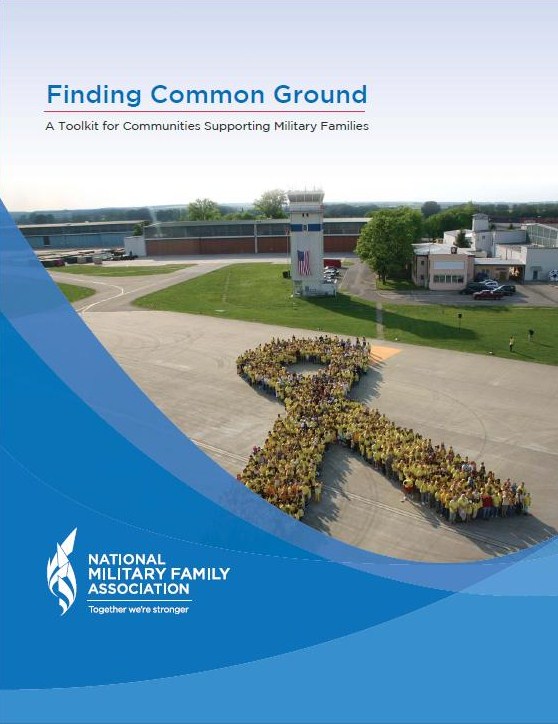
Finding Common Ground: A Toolkit for Communities Supporting Military Families is a new resource from the National Military Family Association.
This toolkit is the product of our Association’s summit, “When Parents Deploy: Understanding the Experiences of Military Children and Spouses,” at which we gathered the leading experts in the fields of military family support, childhood development, women’s issues, and behavioral health.
This toolkit suggests easily-achievable action items and useful resources to guide anyone who wants to support military families, but doesn’t know where to start.
This toolkit provides an answer to the question “What can I do to help?”
Using and sharing the information in this toolkit is easy.
, identify yourself in one of the communities, and read about ideas and resources that can start conversations and stimulate action.
Then, take some time to explore the other toolkit links. Print pages of the toolkit or use your online social networks to share the information with your friends.
Supporting military families doesn’t need to be complicated or expensive.
The toolkit provides examples of how easy it is to help military families – from having coffee with a service member’s parent to youth organizations looking for ways to include military families as part of the curriculum.
Share how you’re supporting military families in your community!
By Bailey Bernius, Public Relations Specialist, National Military Family Association
In communities all over the world, military families are living a unique lifestyle in order to serve our country alongside their service member.
It can be difficult for those not familiar with the military to understand this lifestyle and to figure out their role in helping military families in a time of need.
Everyone has a role to play in supporting military families – not just their friends and neighbors. Employers, educators, community leaders, government leaders, and health care professionals can all help support military families in unique ways.
Here are some simple ways civilian families can help the military families who are living right in their own communities.
Hang out: Where appropriate, invite the spouse of a deployed service member to go out to dinner, see a movie, or go to a concert. Getting out of the house is a great stress reliever during a lonely time.
Be yourself: Look for opportunities to help by matching your own talents and resources with the needs of another.
Volunteer: Organizations all over the country are helping military families. Whether it is with time, money, or talents, it is the volunteers that keep these much-needed services running. Check out your state volunteer website or use the search engine on Serve.gov.
Provide a helping hand: When a service member you know is deployed, offer a play date for their kids, run errands, assist with home repair, mow the lawn, cook dinner, or help with anything else that is so much easier to do when there are two parents in the home.
Show your appreciation: Business owners can offer military discounts for service members and their families.
Give a taste of home: Bake or cook for single military personnel who are living in the barracks or invite them over for a holiday when they’re stationed away from home.
Be a friend: Having a spouse deployed is extremely difficult and having a shoulder to lean on eases the hardship.
Be understanding: Civilians can offer employment opportunities to military spouses and understand that their lifestyle may cause time gaps in a military spouse’s resume. It can be hard to establish a career while having to move to a new duty station every few years. Co-workers can rally behind the family of a deployed service member, providing a close-to-home support group.
Help make a house a home: Organize your neighborhood association to make newly-arrived military families welcome in your community.
Support education: Make military children feel welcome when they arrive in your children’s schools. When possible, be lenient with tryout dates and admission cut-offs. Recognize their achievements at other schools and find the best fit for them to thrive.
Be a proud American: Through actions and words, at every opportunity, support the men and women of the military. Never take for granted the individual freedoms these service members work tirelessly to safeguard and defend, often at great personal risk and sacrifice. They do it not only for themselves, but for their family members who support them daily in their patriotic service and privilege.
Keep your flag flying high!
* This information was gathered from more than 4,000 military spouses surveyed by the National Military Family Association.
HandsOn Network Excitement at NCVS!
by Gary Renville, Vice President for Affiliate Advancement, HandsOn Network
Connecting to HandsOn Action Centers from throughout the Network; connecting to service in the community; and connecting to opportunities for professional development, inspiration and fun will all be made possible through my attendance at the upcoming National Conference on Volunteering and Service.
Just thinking about it has kept a smile on my face for months – and I can hardly wait for the time to finally arrive.
I’m really looking forward this year to speaking at, learning from and observing our Affiliate-only pre-conference track (Sessions 5705, 5706 and 5630) which runs from Sunday June 5 to Monday June 6.
I’m thrilled that our Affiliates participating in
Equip
track have the opportunity for an off-site training entitled:
Learn It! Do It! Lead It!
(Session 5736).
These participants will spend time at stations learning the trade and tips of basic volunteer project elements and then join other volunteers on site to refurbish one of many parks throughout the New Orleans area.
This year’s Affiliate experience at the NCVS really will be like no other.
For the first time there are 3 separate learning tracks – developed by and for Affiliate leaders from a wide cross section of Affiliates from around the world.
Together this amazing team supported by the HandsOn Network staff of Candi Williams, Zack Brown and Alison Doerfler are ensuring that there really is “something for everyone” from the most experienced HandsOn Affiliate Executive Director to the newest of Affiliate program staff.
Michelle Nunn, David Ray and Peter York are just a few of our featured speakers that Affiliates will have the pleasure to hear from in our “
Inspire
” track.
Participants here will discuss topics such as strategic planning and capacity building.
Larry Deckel, Matt Cavell, Jamie Denniston-Merced and others headline our “
Equip
” track where Affiliates will learn about HandsOn Connect, use of social media, how to plan and lead basic volunteer projects and much more.
Our “
Moblize
” track participants will benefit from a grant writing workshop led by Khyati Desai, Kris Tecce and Zack Brown; explore the very best of corporate project execution with Curtis Cannon, Katie Stearns and Sherrie Fazio; and further explore the many tools and resources available to Affiliates throughout the Network.
For all of those who have attended conference – we all know how busy the time can be.
From rushing to sessions to ensure a front-row seat, to exploring the exhibit hall area to tasting all of the delicious food a new city has to offer – there never seems to be enough time to do it all.
So I’m particularly pleased – that in the hustle and bustle of all that is about to come – our Affiliate Only Lounge will provide a more quite space for Affiliates who want to “just get away” or to engage in 1:1 or small group discussions.
This room will also be visited by most if not all of the
, to public policy and advocacy, to technology, September 11 National Day of Service and Remembrance and more!
Connecting to HandsOn Action Centers from throughout the Network; Connecting to service in the community and Connecting to opportunities for professional development, inspiration and fun – I CAN’T WAIT and I hope to see you in New Orleans!
Three simple ways to be a social affiliate at #NCVS 2011
If you’re a HandsOn Network Affiliate staff member attending The National Conference on Volunteering and Service, here are 3 simple ways you can use social media to enhance your conference experience.
1. Be part of the group
We made a list on twitter – A list that follows everyone who is at conference.
I believe the great majority of us would love to know that our lives matter.
“What positive difference am I making with my life?”
It’s a good question to ask now…if only to avoid regrets later.
Dr. Anthony Campolo asked 50 people over the age of 95: “If you could live your life over again, what would you do differently?”
The top three answers he received:
1. “I would reflect more.”
2. “I would risk more.”
3. “I would do more things that would live on after I am dead.”
First…let’s cross our fingers and hope we make it to 95. Second…let’s understand that the time to guard against future regrets is NOW.
Here’s a tool to help avoid your own future regrets. I call it the OUTRAGEOUS HOUR!
The OUTRAGEOUS HOUR is a designated time period (either daily or weekly) where you brainstorm, and then focus effort on following through with really HUGE ideas that could be life-changing.
It doesn’t matter if the idea is a super stretch. If it excites you…why not go for it?
(Hey, I’m a believer in Walt Disney’s maxim “If you can dream it…you can do it!”)
During the OUTRAGEOUS HOUR, set time aside to think of OUTRAGEOUSLY positive experiences you and your organization could go for that would make your organization more effective…and would bring more value to others.
Personally, I think of ideas that give me butterflies.
You know the type; the ones that make you smile and get nervous at the same time.
Then, during this same designated period, I begin to take action on working towards the brainstorms.
Use the OUTRAGEOUS HOUR for personal goals.
Use it for work.
Just give it a try.
Why not brainstorm ways to take your organization to another level?
Why not think of ways to make your life more awesome?
We all want both. Right?
So go bold…and tell me…how can you take success up another notch and go OUTRAGEOUS?
This post comes from Shawn Anderson, ShawnAnderson.com, five-time author, corporate trainer and national speaker on the topics of “possibility thinking and creating opportunity.”
He is also the Founder of the Extra Mile America Foundation, ExtraMileAmerica.org, a non-profit organization empowering people to “go the extra mile” in life.
In 2010, the Foundation led the charge in motivating 116 mayors in 45 different states to declare November 1, 2010, as “Extra Mile Day”…a day to recognize those in the local community going the extra mile.
In 2011, over 200 city mayors in all 50 states are expected to do the same.
Join Shawn on Wednesday, June 8th, from 10:30 AM to 12:00 PM, for his session titled The Power of “What if…?” Extra Mile America: Stories of Inspiration, Possibility and Purpose.
Leveraging Partnerships at NCVS!
This year at NCVS, session content is organized across a series of issue areas so that attendees can tailor their schedules to meet their learning and networking needs.
Check out all the sessions associated with
Leveraging Partnerships
!
The Third Generation Nonprofit
Business | Relationships | Evolved
Monday, June 6, 2011 1:00 PM – 2:30 PM
Session ID: 5342
In this workshop, you’ll learn how to develop an actionable plan for building “Third Generation” nonprofit-corporate partnerships which participants can readily understand and adopt.
In these rapidly changing times, many businesses are increasingly interested in real partnerships that inspire them to give because they believe in your cause, have confidence that their investment will be well managed, and are inspired to engage their employees.
Learn to identify organization’s assets, learn new strategies for cultivating corporate relationships, and realize how to benefit from partnerships. Learn skills to successfully build partnerships that are immediately implementable.
Building a State-Wide Community of Service Tuesday, June 7, 2011 8:30 AM – 10:00 AM Session ID: 509
Interested in developing or strengthening partnerships with higher education institutions and volunteer connector agencies?
Come learn about the Michigan model involving collaborative efforts among Michigan Campus Compact, Volunteer Centers of Michigan and Michigan Nonprofit Association.
This unique perspective will help you identify your own strategic advantages and discover the intersection where state opportunities, national service and local change come together.
Innovation in Nonprofit Partnerships that Impact Lives and Mean Business Tuesday, June 7, 2011 8:30 AM – 10:00 AM Session ID: 5257
Innovative, strategic partnerships within the sector are often feared or overlooked,
and yet when the strengths of each organization are leveraged new ways of impacting communities and strengthening nonprofits in the new economy are created.
Greater DC Cares (GDCC) and the Center for Nonprofit Advancement (CNA) have forged a monumental partnership in Greater Washington to build the capacity of 1500 nonprofits serving fragile families and challenged communities.
By leveraging the volunteer mobilization and community engagement skills of GDCC with the training capacity and strength of CNA we are providing nonprofits with new capacity to make and measure deeper impact in their communities.
Speaker: Madye Henson
Twitter Hashtag: #NCVS5257
Pathways to Innovation: Leveraging Volunteers and Technology Tuesday, June 7, 2011 8:30 AM – 10:00 AM Session ID: 5560
In this session several presenters will pitch innovative models that leverage volunteers to get results for nonprofit organizations followed by discussion. Included are: Big Sunday, AtlasCorps, Engaging Rural Volunteers, StrategicVolunteer Engagement.
Speaker(s): Jenna Fehr, David Styers, Lindsay Firestone (Taproot Foundation), Chris Smith, Abby Flottemesch, David Levinson
Twitter Hashtag: #NCVS5560
State Commissions & Nonprofits: Achieving More Together Tuesday, June 7, 2011 8:30 AM – 10:00 AM Session ID: 5664
State Commissioners, AARP leaders and others describe innovative and replicable ways to leverage complementary assets among partners to achieve greater engagement and impact.
Speakers: Tom Branen, Wendy Spencer, Barb Quaintance
Twitter Hashtag: #NCVS5664
Strengthen Your Service Site With Asset Based Community Development Tuesday, June 7, 2011 8:30 AM – 10:00 AM Session ID: 5030
This highly interactive session will answer the age-old question: with so many people working in nonprofits why doesn’t meaningful change come faster?
Dan Condon, faculty member with Public Allies, Inc.’s Leadership Practice in collaboration with Northwestern University’s Asset Based Community Development Institute, will share ideas on how to harness the power around you to produce greater impact.
Community Partnership and Volunteer Development through AmeriCorps*VISTA Tuesday, June 7, 2011 4:00 PM – 5:30 PM Session ID: 5438
During the past five years, Tulane University has developed an innovative AmeriCorps*VISTA program model that utilizes VISTA members as community liaisons and builds sustained, long term community partnerships.
These partnerships allow university resources to be more effectively leveraged by non profits and communities and creates improved volunteer and engagement opportunities for students.
The need for Tulane to create this model grew out of necessity in the recovery process from flooding and Hurricane Katrina, but has been exported to two other universities in the past year and has potential for greatly increasing truly reciprocal campus community partnerships.
Speaker: Michael Pizzolatto
Twitter Hashtag: #vista; #americorps
Skills-Based Volunteering 201: An In-Depth Look at What Makes SBV Succeed in the Real World Tuesday, June 7, 2011 4:00 PM – 5:30 PM Session ID: 5358
Leveraging more than 10 years of running successful SBV programs, Common Impact and Capital One, will use real life case studies to share insights about what makes a successful SBV project for nonprofits. We will:
Present a framework nonprofits can use to approach SBV project impact measurement
Present 2-3 real-life examples of SBV projects run by Common Impact and Capital One that have delivered measurable results to participating nonprofits “Time-lapse” the results to assess the short term and lasting impact of skills-based volunteering projects for nonprofits
Provide information on how nonprofits can approach measuring their own SBV project impact
Speakers: Theresa Ellis, Karen Horwitz, Daniel Horgan
Twitter Hashtag: #NCVSSBV
9/11 National Day of Service and Remembrance: Embracing the resilience of our communities and the spirit of unity that followed the tragedy. Join us to learn about plans for the 10th Anniversary Wednesday, June 8, 2011 8:00 AM – 10:00 AM Session ID: 5574
The 10th Anniversary of September 11 will provide unique civic engagement opportunities for millions throughout the US and around the world.
Come speak with national convening partners, sponsors and affiliate leaders to learn more. New resources will be provided.
Current Trends for Engaging the LGBT Community in Service and Volunteering Wednesday, June 8, 2011 8:30 AM – 10:00 AM Session ID: 5429
The LGBT (Lesbian, Gay, Bisexual, and Transgender) Community is a great resource for addressing critical needs in your organization and community.
This session will explore three current trends to help you engage LGBT individuals in service and volunteering: Using digital/social media to attract LGBT individuals to your organization; unleashing the potential of LGBT Baby Boomers; and addressing the youth suicide/bullying problem through innovative strategies.
Speakers: Robert Espinoza, Genevieve Sublette, Jarod Wunneburger
Twitter Hashtag: #NCVS5429
Driving Bottom Line Growth Through Pro Bono Wednesday, June 8, 2011 8:30 AM – 10:00 AM Session ID: 5074
Learn how to drive value to your organization by expanding beyond fundraising into “resource raising.”
You will learn the techniques to get more from your current supporters (boardmembers, corporate partners, current volunteers) by asking them to donate their professional services to help build the capacity of your organization.
Baby Boomers and Service: Understanding Their World
by Jill Friedman Fixler, NCVS Speaker
For quite a few years now, those in the nonprofit and service sectors have been awaiting—either with eagerness or trepidation!—the wave of Baby Boomers approaching traditional retirement age.
With Greatest and Silent Generation volunteers aging out of their traditional volunteer roles, would our organizations be deserted while Baby Boomers made other choices about how to spend their time?
Or, would a sea of Boomers line up to volunteer with our organizations?
If so, could we engage them as we have engaged volunteers for decades before?
Now that we are quite a few years into this long anticipated generational shift, it’s a great time to step and check in on our own expectations, experiences, and the actual trends out there.
, is some of things we see in our practice, hear from discussions with colleagues, and learn from our own experiences as well.
Leaders of volunteers who adhere to the traditional volunteer management model often think that Boomers are uninterested in volunteering because they reject traditional volunteer roles.
In fact, most Boomers drop out of their volunteer assignments only when their expectations for volunteering do not correlate with the reality of the volunteer workplace.
Boomers who have served as leaders of industry are rarely interested in low impact volunteer positions.
Boomers who grew up with flextime in the workplace expect and prefer flexible volunteer schedules that few nonprofits offer.
Boomers whose careers were marked by unprecedented mobility expect a veritable buffet of volunteer options.
Even today, after all the talk and research and tools available on Boomer volunteer engagement, we see that large numbers of nonprofit leaders still believe their organizations are ready to engage Boomers, and equally large numbers of Boomers say that nonprofits are operating in ways that discourage them from volunteering.
Boomers have a multitude of choices on how to spend what their parents called the leisure years. Volunteering is but one option.
According to the think tank Civic Ventures, Boomers are redefining the second half of life as a source of social and individual renewal. They see it as a new adventure–a time to travel, take classes, and, if the nonprofit sector is lucky, to serve a higher purpose and create what Civic Ventures calls a “social legacy”.
Nearly 30% of Boomers will seek avocational and vocational opportunities within the nonprofit sector in either encore careers or volunteers settings according to research done by the Rose Community Foundation and
Boomers in their late 40s and 50s are volunteering at higher rates than members of the Greatest and Silent Generations did at the same age, according to the Corporation for National & Community Service’s report Keeping Baby Boomers Volunteering.
The 78.2 million Baby Boomers are a virtual gold mine for nonprofit organizations as the first Boomers turned 65 on January 1, 2011 to the tune of 7,000 a day.
A social revolution—possibly as important as the one led by Boomers in the 1960s—will occur if nonprofits strategically engage Boomers in high-impact collaborations that build a nonprofit’s capacity to fulfill vision and mission.
It takes more than a few new strategies and examples to engage Boomers as volunteers.
It takes reimagining the role of volunteers in an organization and the possible results of involving volunteers in every aspect of operations.
It takes a new philosophy and organizational buy-in for top to bottom and from bottom to top.
Boomer Volunteer Engagement: Collaborate Today, Thrive Tomorrow sets the stage for making this profound transition and provides concrete strategies for success.
Jill Friedman Fixler is a nationally known leader recognized for her innovative approaches to re-inventing, re-engineering, and re-vitalizing nonprofit and public sector organizations. Don’t miss her Books & Beignets session at the NCVS Conference in June!
Wednesday, June 8, 2011 7:00 AM – 8:00 AM Session ID: 5741
Change Notes: Honoring the Next Generation of Service Leaders
Friends,
Last night, six extraordinary young people from across the United States were honored as Hasbro Community Action Heroes. These young leaders, ranging in age from 7 to 17, were recognized for their achievements in volunteer service and their contributions to their communities and the world.
The Hasbro Community Action Hero Awards are presented annually in partnership with generationOn, the youth service division of Points of Light Institute, to recognize youth leaders committed to community service and volunteering. Each of the Hasbro Community Action Hero Award winners embodies generationOn’s mission to inspire, equip and mobilize youth to take action that changes the world and themselves through service.
These young service leaders have turned their concern for the welfare of others into actions that have touched the lives of thousands, and we hope their accomplishments inspire other young people to discover their own passion for service. This remarkable group shows us that we are never too young to be part of the solution to the problems that face our communities. Indeed, it is often the compassion and determination of our youngest change agents that remind us just how much is possible when we are committed to building a better world.
The 2011 Hasbro Community Action Hero Award winners are:
§ Riley Hebbard (age 7), Mechanicsburg, Penn. – Inspired by a news report about children in a Darfur refugee camp, Riley formed her own nonprofit called Riley’s Toys Foundation, which has created 10 donation centers and shipped more than 18,000 toys to children in Africa.
§ Nicholas Lowinger (age 13), Cranston, R.I. – When a pair of his old boots didn’t quite fit the boy at the homeless shelter who received them, Nicholas founded Gotta Have Sole, an organization that donates new shoes, sneakers and boots to children in Rhode Island homeless shelters.
§ Jessica Markowitz (age 15), Seattle, Wash. – A tireless advocate for global education and social justice, Jessica founded Richard’s Rwanda-IMPUHWE when she was 11 years old to support educational opportunities for young girls in the rural area of Nyamata, Rwanda.
§ Shannon McNamara (age 17), Basking Ridge, N.J. – Inspired by her personal motto of “today a reader, tomorrow a leader,” Shannon created SHARE, an organization designed to empower African girls through education to overcome cultural bias that discourages female literacy.
§ Cameron Payne (age 11), Winston Salem, N.C. – With a goal of inspiring young people to develop a lifelong love for reading, Cameron founded The Children’s Book Legacy, which has collected more than 3,000 new and gently used children’s books for his neighborhood library.
§ Max Wallack (age 14), Natick, Mass. – Max founded a national movement called PuzzlesToRemember that has distributed some 7,000 puzzles to approximately 700 facilitates that care for Alzheimer patients across America.
More information about each of this year’s Hasbro Community Action Hero Award winners is available at www.generationOn.org.
The Hasbro Community Action Hero Awards are an integral part of Hasbro’s ongoing partnership with generationOn. As its founding partner, Hasbro supports generationOn by lending its expertise through a multi-year, $5 million investment by the Hasbro Children’s Fund. This critical support helps generationOn provide kids of all ages with the tools and hands-on opportunities to understand the issues in their communities – and become part of the solution.
GenerationOn works to empower kids and provide parents, teachers and community leaders with the tools they need to help youth become compassionate leaders and community activists. If you are interested in learning more about how to introduce service learning to the children in your community, please visit generationOn.org for information about service projects, curricula, guidelines and other recommendations for children and teens.
We hope young people everywhere will take the pledge and become part of generationOn, the global youth service movement igniting the power of all kids to make their mark on the world.
Yours in Service,
CEO, Points of Light Institute
Co-Founder, HandsOn Network























 These young service leaders have turned their concern for the welfare of others into actions that have touched the lives of thousands, and we hope their accomplishments inspire other young people to discover their own passion for service. This remarkable group shows us that we are never too young to be part of the solution to the problems that face our communities. Indeed, it is often the compassion and determination of our youngest change agents that remind us just how much is possible when we are committed to building a better world.