At the 2011 National Conference on Volunteering and Service, we are committed to supporting the restoration of public spaces that are so much a part of the identity of the city and are a central convening place for community residents.
With
the time, talent and resources of up to 700 NCVS participants, local volunteers, and with the support of University of Phoenix, we will revitalize 25 parks and recreation centers across the city of New Orleans signifying the conclusion of the
program announced at the conclusion of the 2010 conference.
After a tour that included stops in Atlanta, San Francisco, Chicago, Phoenix, Kansas City and Washington, DC, the Road to the Gulf program was designed to mobilize volunteers to make a difference in local communities while contributing to gulf region recovery.
The program was generously supported by University of Phoenix and has mobilized 10,000 volunteers and trained thousands of volunteer leaders.
Before Hurricane Katrina struck New Orleans in August 2005, the New Orleans Recreation Department (NORD) managed more than 130 parks across the city.
Today, only 24 of those parks are equipped for community enjoyment.
Included in the NCVS service activities are five complete park rehabilitation projects, five park clean ups, and 15 additional park enhancement and equipment projects:
Park Rehabilitation Projects
: Monday, June 6, 8 a.m. – 12:30 p.m.
The National Conference on Volunteering and Service, will serve as the final stop on the six-month Road to the Gulf program that has been sponsored by University of Phoenix.
We will complete four complete park restoration projects in New Orleans neighborhoods.
to learn more about the special communities surrounding each park.
• Sam Bonart Park (5737)
• Bunny Friend Park (5736)
• Village de l’est Park (5738)
• Evans Park (5735)
Recreational Equipment Drive
We also ask that conference volunteers help complete our mission by participating in a recreational equipment drive by bringing the following items to donate to children in the communities where the parks will be refurbished:
• Basketballs
• Soccer balls
• Footballs, baseballs
• Jump ropes
• Any other sports and athletic gear for children
• New or partially used gift cards to sporting goods establishments
Donations will be accepted in Hall B2 of the New Orleans Morial Convention Center.
Additional Service Activities
City of New Orleans Fight the Blight and local conference kick off
Friday – Saturday, June 4 – 5
The city of New Orleans will conduct clean-up activities in five of New Orleans public parks.
KaBOOM! Playground Build sponsored by Disney
Sunday, June 5 10 a.m. – 4 p.m.
Palmer Park
The revitalization of parks as well as the recreation and equipment drive aligns with the two nationally known “Let’s Move” and “Play 60” campaigns.
The “Let’s Move” campaign, outlined by First Lady Michelle Obama, is dedicated to solving the problem of childhood obesity by helping children be more physically active.
The NFL “Play 60” campaign promotes youth health and fitness by encouraging them to be active for at least 60 minutes a day.
Registration for the 2011 National Conference on Volunteering and Service is still open and sessions are filling up fast.
Attendees will have opportunities to hear from renowned presenters during six session blocks and choose from more than 150 workshops, 11 immersion learning sessions and seven forums in focus areas ranging from disaster to youth leadership.
Bringing Community Organizing into Online Campaigns
You know you can change the world. You KNOW it. Your organization has all the passion, resources and commitment to make a huge difference in your community. You’re also active online: Facebook, Twitter, blogging, or other social spaces. You’re ready to take the next step: create an online campaign to bring new volunteers into the community. However, you’re not sure how to begin developing an online campaign, and you want more information about the why, when, and how of online campaigns.
Please join us on June 7th at the 2011 National Conference on Volunteering and Service at our workshop, Bringing Community Organizing Into Online Campaigns. Our session is designed to give you the resources (and encouragement!) to develop a strong online volunteer campaign. Within the workshop, we will offer information, best practices, case studies, and hands-on experiential training to give you the confidence to create your own online campaign.
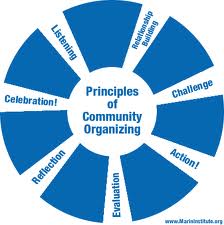
The workshop is designed to familiarize participants with an understanding of community organizing theory, online campaigns, and how these principles inform volunteer management and engagement. Integrating volunteers into online campaigns requires a great community organizer. Community organizing theory organizing lays the groundwork for strong online campaigns and effective movements.
You may not be familiar with community organizing, but it is the basis for every great online campaign. One great example is
, which is a worldwide event to move beyond fossil fuels, planned for September 24, 2011. These campaigns have all been built on the principles of being active where the volunteers and advocates are active (in these cases, within online spaces), community accountability and transparency, and leadership development.
During our workshop, we will present traditional community organizing principles, campaign mapping methods and case studies. If you are new to the concept of community organizing, don’t worry! The workshop begins with a definition of community organizing and review principles of community organizing. We will also spend some time discussing examples of both organization-based and grassroots-powered organizing in several of these areas: education, environment, economy, and emergency response. Specifically, we’ll look at what it takes to connect the dots between community organizing and creating a movement of volunteers.
In the second half of the session, you’ll put into action what you’ve learned to create an online campaign. We’ll divide into breakout sessions to design an online campaign, based on campaign suggestions from the audience.
Join us
June 7, 2011 at 8:30 a.m
. for the session
Bringing Community Organizing Into Online Campaigns
is an Engagement Strategist: who helps organizations and brands engage with their stakeholders in a deep and real manner. By engaging stakeholders in relevant conversation, listening, and offering real value, organizations can move them to action. As an engagement strategist, Debra translates basic organizing principles into online social media strategies. She listens and asks questions to determine what the appropriate strategy should be for each organization. Read her great blog at
and is dedicated to supporting and educating organizations and changemakers in the use of evolving technologies that cultivate and engage communities. She is inspired by opportunities to catalyze community building and social action, online and offline, whether it’s through blogging, facilitating, training, or speaking. Read
, as well as work with our clients and colleagues, I have been exploring the opportunity for volunteer engagement professionals to lead change.
Volunteer coordinators and directors are uniquely positioned to leverage the skills, talents, and passions of volunteers on behalf of the organization.
With volunteerism on the rise and service shining brightly in the national spotlight, you as a volunteer engagement professional are sitting on a veritable gold mine of human capital.
You are uniquely positioned to become a leader of organizational innovation.
You can do so by strategically harnessing volunteer skills, by becoming a talent manager, by being a change agent.
Change agents are those who lead, inspire, and catalyze change.
As you contemplate your potential as a change agent, consider these questions.
1. Do you see opportunities others don’t see
? For example, do you see how volunteers can play integral roles in organizational innovation – as leaders? Project managers? Pro bono consultants? How can you share those strategies with others in the organization?
2. Are you willing to look beyond the “tried and true” to find new solutions to emerging challenges
? Effective change agents not only are able to let go of “old ways” but also see multiple solutions and possibilities to address challenges. How can volunteers and the many talents they possess be the solutions to some of the challenges your organization is facing now and in the future?
3. Are you getting the best contributions from the most people?
As Bill Taylor wrote in Harvard Business Review:
These days, the most powerful contributions come from the most unexpected places – the ‘hidden genius’ inside your company, the ‘collective genius’ of [clients, partners, and volunteers]…. Tapping the genius requires a new leadership mindset – enough ambition to address tough problems, enough humility to know you don’t have all the answers.
You can model a new leadership mindset by tapping the genius of the volunteer corps and leveraging that talent to build your organization’s capacity and make innovation a sustainable part of its culture.
4. What do you need to be an effective change agent/leader within your organization
? Do you have the competencies to be effective in this role – including things like team-building abilities, networking skills, tolerance of ambiguity, political awareness, communication and interpersonal skills? And, if you don’t, what can you invest to gain or improve on some of these skills?
Once you have assessed your own potential and role as a change agent, your next steps include:
1. Pick the right place to intervene
– pick something important, something in the core business not just something “around the edges”.
Select a place to intervene and innovate in ways that will make a substantive difference. Consider the big picture and ensure that you are working to strengthen to organization as a whole.
For example, at one of our hospital clients, staff and volunteers are collaborating to develop a concierge program that will serve patients, their families, staff, and volunteers.
This program will fundamentally change the way constituents experience the hospital.
2. Mobilize and engage volunteers in the effort.
Engaging volunteers in the effort is crucial because it leverages your resources most efficiently, it models the power and potential of volunteer engagement, and it builds support and advocacy within the larger community.
Many of our clients develop innovation teams comprised of staff and volunteers working together to address core issues in the organization.
3. Focus on results. Defining the immediate impact and the long term outcome of the endeavor draws people to this new work
.
When I was a volunteer director, I put together an internal marketing team of volunteers who were professionals in public relations and marketing.
They developed an annual report on the results of volunteer engagement and created presentations for volunteer leaders, staff leaders, and the board of directors.
4. Be the model for change.
If we as volunteer engagement professionals don’t model the change that we are seeking by using high-impact, skilled volunteers, we will not inspire others to mobilize.
We observe our clients utilizing volunteers as interviewers, mentors to new volunteers, and evaluators of volunteer impact.
Think about the ways in which you can utilize volunteer talent within your volunteer organization in new ways and then jump in and get started in your new own new role as talent manager…. The moment is now to act!
Jill Friedman Fixler is a nationally known leader recognized for her innovative approaches to re-inventing, re-engineering, and re-vitalizing nonprofit and public sector organizations. Don’t miss her session at the NCVS Conference in June!
Change Notes: AmeriCorps Week Showcases Impact of Service
Friends,
This year’s National AmeriCorps Week, May 14 – 21, is a particularly important opportunity to elevate the value and importance of AmeriCorps and national service. In light of recent budget debates in Congress and the threatened elimination of funds for the Corporation for National and Community Service (CNCS) in 2012, AmeriCorps Week showcases the extraordinary impact of national service members every day across our nation.
AmeriCorps Week shines a light on the more than 80,000 members currently serving in communities across the country – individuals who are effectively serving and meeting critical needs in our country’s communities. We see this impact front and center in our HandsOn Network where, over the last 12 months, HandsOn Networks’ AmeriCorps members have recruited and mobilized more than 53,900 volunteers in more than 1,200 service projects impacting more than 70,000 citizens.
In addition to 80,000 current members, more than 600,000 have joined AmeriCorps Alums, a division of Points of Light Institute, and have given more than 860 million hours in service since 1994. We believe in the leadership potential of these individuals and have supported them both as an organization and a strategy to continue to create change. We have 26 chapters of AmeriCorps Alums throughout the country actively engaging thousands during AmeriCorps Week in service projects, networking events and thought leadership with elected officials.
The value of AmeriCorps service has been felt in communities both large and small – at Points of Light Institute affiliates, managing volunteers in disaster relief efforts and at the countless organizations that we partner with. Philadelphia Mayor Michael Nutter has said he believes the future of his city depends on citizens rolling up their sleeves and working together to tackle complicated challenges – and AmeriCorps Alums have played a major role.
“AmeriCorps Alums working in city government and nonprofit organizations throughout Philadelphia bring a level of experience and commitment to service that directly impacts our collective capacity to engage every day citizens in solving problems and strengthening their communities,” said Mayor Nutter.
The National League of Cities highlighted the impact of AmeriCorps volunteers in an editorial by AmeriCorps Alums Executive Director Ben Duda this week. The article reaches 30,000 mayors, city council members, city managers, police and fire chiefs, public works directors and others who make decisions about local operations. It is important that these individuals understand the valuable impact of service and how they can engage both current AmeriCorps members and AmeriCorps Alums to address local challenges and create change.
To share best practices, AmeriCorps Alums has convened a national training and professional development webinar called “How to Translate Your AmeriCorps Experience into Future Leadership Opportunities” on May 18 at 12 p.m. EST. This session will showcase the transformational force of service and how it can make an impact in solving our country’s challenging issues.
To register for the webinar or get engaged with your local AmeriCorps Alums, please visit www.AmeriCorpsAlums.org. National service has a critical role to play in our country as we face tough challenges and restricted funds. At Points of Light Institute, we look forward to celebrating AmeriCorps Week with our service partners and colleagues and lifting up currently serving members and the hundreds of thousands of Alums – they are at the forefront of possibility for community change.
Yours in Service,
CEO, Points of Light Institute
Co-Founder, HandsOn Network
Colleges across the country are preparing to honor their graduates but six schools have yet another reason to celebrate – they’ve just received Presidential Awards in the
This is the highest federal distinction a school can receive honoring their commitment to service. The six schools, chosen from the 511 named to the 2010 Honor Roll, were honored in three categories:
General Community Service
– considers the scope and quality of an institution’s service-learning, civic engagement, and community service programs.
Promise Neighborhoods Model
– centers on youth-focused services on education and social needs of children.
Summer Learning
– focuses on programs that provide a safe, healthy environment for academic enrichment during summer breaks to help students retain what they learned during the academic year.
, Minneapolis, Minnesota — Students completed more than 191,700 hours of volunteer service last year in projects focused on economic opportunity and promoting healthy futures. Some of the projects addressed low-income housing, community health outreach, and financial literacy; the students also helped establish a free clothing exchange and ran an employment education computer lab.
, Winter Park, Florida — Students contributed more than 55,700 volunteer hours last year in education, health, and disaster response projects. These included mentoring elementary-school students, teaching at an elementary school, rebuilding homes, creating hand-washing stations for farm workers, and providing health screenings in Nepal.
, San Francisco, California — San Francisco State serves one of the most ethnically and racially diverse student populations in the country. The university has increased the number of local minority students admitted by offering after-school, college-level classes to disadvantaged students of color in more than 15 high schools. Through community partnerships, SFSU students volunteer in community projects that provide health education, English language classes for immigrants, violence prevention programs, and educational programs for at-risk youth.
program produced a 100 percent college acceptance rate for 80 female at-risk participants; 68 percent of them received scholarships upon graduating from high school.
program provided 4,608 hours of mentoring to middle school students transitioning to high school. Loyola’s Math Tutoring program engaged 253 fourth- to eighth-grade students and improved their confidence and academic performance.
work through strategic partnerships to improve infrastructure and streetscapes, create urban pocket-parks, build affordable housing, and support a more sustainable business community. The students helped provide resources for the community that address home ownership, credit counseling, and neighborhood landscaping projects.
, Seaside, California — Students contribute more than 84,000 hours of service annually to programs aimed at reducing the academic achievement gap. The Increase the Peace Summer Youth Leadership program provides literacy, math, and art classes in the summer for local at-risk middle school students, resulting in increased academic achievement and positive behavioral change.
These institutions will be recognized during the closing plenary of the
While these schools were the select few chosen to receive the President’s Award, many other schools across the nation received honors. View the complete list
, where 511 were named to the Honor Roll, and 114 with distinction.
This commitment to community service has tremendous impact on the nation as a whole. In 2009, 3.2 million college students dedicated more than 307 million hours of service to communities across the country – a service valued at more than $6.4 billion.
Honorees are chosen based on a criterion involving scope and innovation of service projects, the extent to which service-learning is embedded in the curriculum, the school’s commitment to long-term campus-community partnerships, and measurable community outcomes as a result of the service.
Congratulations to all the winners!
Americorps Week May 14th-21st
This past Saturday, May 14th was the start of Americorps Week. AmeriCorps Week highlights AmeriCorps‘ impact in communities across the country in order to motivate more Americans to join AmeriCorps or volunteer in their communities.Today’s Americorps story is written by Willie M. Bolden, an Americorps Alum and now the Program Coordinator for the Intern and Volunteer Office at Points of Light Institute.
“My AmeriCorps story begins in the fall of 2008 when I decided it was time to seriously begin my search for employment. Prior to this, I had never heard of AmeriCorps, HandsOn Network or Points of Light. By chance, I learned of AmeriCorps through some postings on idealist.org. I began applying to them as I saw positions that interested me. I was also considering the Peace Corps at the time.
In late November, I was contacted via email by the Affiliate Advancement Team to schedule an interview. After a series of phone interviews, emails and faxes I was offered a VISTA position to start in February, 2009. I went through my Pre-Service Orientation and met Jesse Salinas and Zack Brown for the first time. It was really nice to finally meet them after months of talking via email and phone.
I began my work with seven different tasks for the year. One of the tasks included developing and managing an internal volunteer program. I began to dig in to this role very deeply with support from my team, organizational management and also with support from members of HandsOn Atlanta. It was very intense and brief education but the program was finally launched after its initial pilot in April of 2009.
The program quickly grew and by December of that year we hosted our first volunteer recognition event with over 70 volunteers and a dozen who had earned Presidential Volunteer Service Awards. We brought in people from all over the Metropolitan Atlanta area with a diverse set of skills, interests and backgrounds. It has been a truly exhilarating learning experience and continues to get better and more interesting every day.
I’m truly grateful to the organization for the confidence it has placed in me, for the support I have received in doing my work and for the truly great people that I work with everyday including staff, volunteers and interns.
I have grown tremendously from this experience and can truly say that my AmeriCorps experience has propelled me into a position of service beyond my wildest expectations. I continue to serve and work with Points of Light and am excited to see where we grow next!”
Interactive Strategy Will Blow Your Mind!
On Tuesday, June 7th, at 2:00 p.m., anyone attending the
will make a tough decision because there are several really amazing conference forums taking place that afternoon.
…. and if you choose the
Interactive Strategy Forum
, your head just might explode.
The Interactive Strategy Forum will feature more than 20 discussion tables, all staffed by leaders in nonprofit technology, all leading relevant, timely discussions and Q&A on topics you care about.
Participants can rotate to different tables/topics during the session, learn best practices & innovative approaches, hear about new tools and get answers to burning questions.
Additionally, experienced table hosts will provide session take away materials.
Check out the amazing line up of speakers and topics:
In this session, you’ll learn how to use completely free tools to create an effective, professional-looking online presence that champions your brand and engages volunteers. We’ll cover the basics of content strategy, content management systems, email marketing, social media, search engine optimization, and volunteer opportunity search engines.
LikeMinded is an online tool for offline action that helps people build on one another’s community projects no matter where they are. This hands-on workshop will explore how LikeMinded can help us inspire and inform one another by sharing stories of our local projects.
An increasingly effective, low-impact, inexpensive and popular means of connecting geographically distributed
volunteers and supporters mixed reality events blend live and virtual communication platforms. Session participants will learn how to produce an event and will have the opportunity participate in a live mixed reality event at the session itself. We will feature 5 tools that showcase the collaborative online experience.
This session will help participants assess their organizations’ technology needs and develop a plan for maintenance and improvement. The session will show how better technology use can deepen an organization’s impact and how employees and volunteers at all levels in a nonprofit can be champions for more strategic technology decisions.
Join the Points of Light Institute and HandsOn Network technology team to learn more about cloud computing and the next generation volunteer management platform HandsOn Connect. HandsOn Connect is a full lifecycle volunteer management platform that expands your capability to manage track and report on people programs trainings and volunteer opportunities in real time. HandsOn Connect uses
the leader in web-based CRM (Customer Relationship Management) to support the broadest model of volunteer management in the marketplace. It’s available to any organization that wants a comprehensive data management system for volunteer engagement and project management without the need to buy and update software or hardware.
With 60-hour workweeks deadlines and other responsibilities it’s difficult for
busy employees to take an entire day off to volunteer. Micro-volunteering allows employees to use their skills to complete brief volunteer projects for nonprofits online whenever they have spare time. It’s an easy turnkey solution for online volunteering and companies like Google, Kraft Foods, and SAP and more are integrating it into their CSR programs. Come discover how your company can use micro-volunteering to develop skills strengthen teams have an impact on nonprofits around the world and broadcast your good deeds through social media marketing channels.
Creating Cause Marketing Partnerships with Brands in Social Media
Explore ways to approach your brand partners with creative cause marketing partnerships using emerging media that raise awareness, dollars, and goodwill for your cause.
Recruiting and Mobilizing a Pro Bono Base using Social Media
More and more nonprofits are building capacity by tapping into the pro bono service market
. Skilled professionals in the for-profit sector can offer expertise in everything from web development to social media strategy, and have invaluable potential for budget-conscious nonprofits. Surveys have shown that most young professionals want their careers to address social good somehow. Catchafire has helped galvanize a growing corps of thousands of professionals interested in volunteering their skills by connecting with them thru social media. This roundtable talk will explore lessons Catchafire’s learned during its two years since launch in how to generate excitement, recruit and mobilize volunteers via social media.
Wondering how to best demonstrate the efficacy of your social media efforts? Michael Nealis will help you think about what to track and measure, and how to analyze the results.
Breaking Thru The Clutter:
How to Market Your Cause and Attract New Champions
With the proliferation of social and mobile media, it’s getting very noisy out there. How do you stand out and make it easy for people to join your cause? In this high-energy workshop, you will learn five key takeaways for breaking thru the clutter that will energize your volunteers without overwhelming your staff.
Size Doesn’t Always Matter: Building an Online Audience
We can all agree it’s nice to be loved – and social media provides plenty of ways to either share the love and inflate an ego or on the contrary make one feel small and unimportant – all based simply on the number of friends, followers, blog readers, etc. But, it doesn’t have to be that way. Explore some of the biggest myths behind the numbers – and better understand how to grow an engaged audience as we share real experiences from building the Social Citizens brand.
Micro-Giving: Big impacts for your business and the community
It’s no secret: companies with engaged employees clearly and consistently financially outperform companies with disengaged employees. Increasing employee engagement is a complex, multi-faceted challenge without easy answers – but one proven strategy is to actively involve employees in corporate goals through workplace giving as well as volunteering. Join this session to discover how using micro-giving in the workplace will result in increased employee engagement and surprisingly significant community impacts.
#myImpact: What’s Yours?: Leveraging Social Media to Record, Share and Track Volunteer Impact
myImpact.org is an emerging online platform for volunteers to record, share and track their impact online, through social media. For the past year, we’ve been in beta with a Twitter-based application that uses the #myImpact hashtag to capture a metric, quantity and action and populates a volunteer’s service journal while connecting with the organization’s group page. Come learn about the simple, scalable and social approach we’re taking to volunteer engagement, what we’ve learned from beta, our plan for relaunch in 2012, and how you and your organization can become involved!
Twitter 101 for NonProfits: Engage Advocates, Connect with Media & Raise
Learn what the heck social media is and why it’s an important tool to engage advocates and connect with people/influencers and other volunteers interested in your cause. This session will help get your fingertips wet on Twitter and Facebook; provide guidelines (cheerleading anyone?) and the very important do’s and don’ts in the social media world.
Do S’MO Good: Social Media Optimization
Noland Hoshino
, Social Good Curator, Do-Good Enforcer, Volunteer Evangelist and Givologist
Social Media Optimization (SMO) is a powerful strategy for building brand recognition and increasing visibility on social networks. By creating compelling content and developing genuine relationships, SMO can help build your online and offline brand, make you a subject matter expert, expose your content to new visitors, and increase quality inbound links to your website. Learn how to spread goodness with on- and offline tools and best practices.
Creating an Action-Ready Online Tribe by Getting Personal
It takes work to create a committed online community, but the return on investment includes committed online fans that will act when asked. Public tweets, blog posts and Facebook status updates are the content engines that create connections to your stakeholders. The key to moving stakeholders to online action is the personal connection. If you’ve always wondered how to combine the personal with your organizational presence online, and why this is so important to ROI, then join this discussion. During the overview, we’ll review why and how to be personal with social media, when to move conversations from the front yard (public-facing) to the back yard (private), and how this simple formula will create a tribe of powerful advocates, volunteers, and stakeholders ready to act on your behalf.
When it comes to communicating with an ever-evolving audience, today’s organization has more than enough tools to get the job done. Yet, the combination of rapid technological innovation and continuous social shifts
have left many organizations struggling to stay focused and execute their ideas. This session provides attendees with a framework for understanding this dynamic world and overcoming its many challenges. We will focus on how organizations can effectively develop successful media-centric strategies and explore real ways to implement them in your everyday endeavors. You’ll quickly learn how to view everything you do as an organization through three broad lenses: everything is fragmented and blurred, small things can gain great attention, and we are all connected. Along the way, you’ll also discover how to distinguish yourself from the competition by finding new ways to operate, creating new models to better serve your audience, and harnessing the full potential that technology provides. Takeaways: 1. Trends and best practices to help you lead your organization and respond to today’s challenges with a strategy that ensures success and properly position your organization to tap into new markets; 2. Direction on how to leverage the new tools needed to navigate your organization during periods of transition; and 3. Insights from business, organizational, and entrepreneurial leaders.
How can your organization better track, report and promote the impact of your volunteer events? This session presents information about how Virgin Mobile, Katy Perry and Causecast are using volunteer tracking and rewards to do just that. This session presents information about the tools utilized by the campaign (which are free to nonprofits) and provides specific next steps for how your organization can use them too.
What if there was an online community for volunteer managers and leaders? What would motivate you to participate and/or to encourage your volunteer leaders to engage? Join this discussion about the future of volunteer management collaboration.
Creating Impact through Pro Bono Technology Projects
In survey after survey, U.S. nonprofits identify technology as one of their most mission critical needs. However, millions of nonprofits continue to say they lack sufficient technology to serve their constituents. Used well, technology can help nonprofits work smarter, reach higher and provide more of their great services. The Community Corps represents a unique and powerful community of nonprofits, corporations and skilled IT & business professionals who share a passion for using technology to make a difference in people’s lives. Come discover how The Community Corps achieves this by matching pro bono resources with nonprofits in need of support and providing corporate partners with CSR reporting and employee engagement opportunities.
In this session we will lay out a rubric we call the Seven C’s” of social media: Cause, Communication, Community, Collaboration, Costs, Capital, and Competition. The audience will be challenged to ask questions around the Seven C’s in order to begin to organize their thinking about social media so that all the effort they put into it creates real value for their organizations. We will draw from insights gleaned in a recently published Bridgespan article “Getting Social Media Right: A Short Guide for Nonprofit Organizations” by Dickie Steele, Sivan McLetchie and Chris Lindquist.”
Update: Unfortunately, Chris Lindquist has had to cancel and won’t be joining us for this session. Maybe next year! 🙂
Are you registered?
(What are you waiting for?)
Interactive Strategy Forum
Tuesday June 7th
2:00 p.m. – 3:30 p.m.
New Orleans Convention Center Room 243-245
Session ID: 5033
Before Hurricane Katrina struck New Orleans in August 2005, the New Orleans Recreation Department (NORD) managed more than 130 parks across the city. Those parks range in size from small “pocket parks” of an acre or less to 187-acre Joe Brown Park, and provided much appreciated green spaces with playgrounds, walking paths, pools and athletic facilities of all kinds. Thousands of residents participated in organized football, soccer, baseball, softball, basketball, golf and tennis at NORD facilities. Many others used park-based community centers to take classes, and to access needed community services. In total, an estimated 300,000 people participated in NORD programs or used NORD facilities every year. Today, only 24 of those parks are equipped for community enjoyment.
At the 2011 National Conference on Volunteering and Service, we are committed to supporting the restoration of public spaces that are so much a part of the identity of the city and are a central convening place for community residents. With the time, talent and resources of up to 700 NCVS participants, local volunteers, and the continued support of University of Phoenix, we will revitalize 25 parks and recreation centers across the city of New Orleans signifying the conclusion of the Road to the Gulf Initiative. Included in the service activities are five complete park rehabilitations, five park clean ups, and 15 additional park enhancement and equipment projects:
Along with four signature University of Phoenix and Road to the Gulf service projects, we are conducting a recreational equipment drive for kids across New Orleans. And you can help!
Saturday, June 6 – Wednesday, June 9 Recreational Equipment Drive box will be located by Registration Area. We will be accepting the following items to donate to children in the communities where the six parks will be developed:
Basketballs
Soccer balls
Footballs, baseballs
Jump ropes
Any other sports and athletic gear for children
New or partially used gift cards to sporting goods establishments
If you are unable to attend the National Conference on Volunteering and Service but would like to make a donation, please contact [email protected]. If you are interested in attending conference, register today!
For more on how Road to the Gulf projects help to build stronger communities and the create positive impact, read today’s post on HandsOn blog. For a bigger picture view of Road to the Gulf events, read today’s post on the Points of Light blog.
iRecognize Volunteers – Free Mobile Application!!
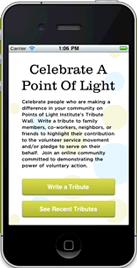
Throughout the past two months we have been highlighting volunteer work showcased at the Tribute event and during National Volunteer Week. These special days are important to recognize volunteer service, although it is also important to recognize volunteers all year round. Thus we have created and launched a free mobile application that allows anyone to recognize volunteerism whenever they feel inspired from the palm of their hand.
The new iRecognize Volunteers app for iPhone/iPad/iTouch products provides a unique way to celebrate those who are using their time, talent, voice and money to create change. The free app allows users to share inspiring stories, photos and YouTube videos that showcase how individuals have made a difference.
On the application you can easily write a tribute or pledge service on behalf of family members, co-workers, neighbors or friends to highlight their contribution to the volunteer service movement. Your tribute will be posted to our existing Tribute Wall on our website where you will become a part of the virtual community of change-makers who are committed to demonstrating the power of voluntary action.
Next week, May 14th-21st is Americorps Week, a week that brings people together to reflect on civic values, recognizes individual Americorps service, and promotes the impact that Americorps have on communities they serve. By downloading the app you can join us to tribute past and present Americorps members, or pledge service as a future member on our mobile application.
Click here to download iRecognize Volunteers today.
What it means to be a “good neighbor” post-disaster: resident engagement in New Orleans
This post is by Laura Mellem, she is the Neighborhood Coordinator at Beacon of Hope Resource Center in New Orleans. She works to engage and empower neighborhood leaders on issues like blighted property, crime, infrastructure problems, and neighborhood capacity-building.
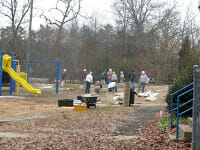
Kimberly Matthews was recently spotlighted in Beacon of Hope Resource Center’s monthly newsletter as a great neighbor in her New Orleans community. She organized a community clean-up of blighted lots in her neighborhood that were being used as illegal dumping sites. There are still many vacant lots and homes in New Orleans, many that have not been touched since the levees broke during Hurricane Katrina almost six years ago. Bringing together resident volunteers
and visiting volunteers working with Beacon of Hope, Ms. Kimberly was able to clear overgrown lots and get rid of years worth of debris. Her motivation was to beautify the neighborhood and boost morale in her still recovering community.A great neighbor, right?
Six years ago, Ms. Kimberly didn’t even know that the Paris Oaks/Bayou Vista Neighborhood Association existed. She would get up in the morning, go to work, and come straight home, with little notice of issues happening in the neighborhood. So what changed? Well, Hurricane Katrina and the ensuing levee breaches displaced every resident in her neighborhood, an area of the city that experienced up to seven feet of flooding.
Post-Katrina, New Orleans residents embarked on a cross-country diasporas, relocating to Houston, Dallas, Atlanta, Seattle, Minneapolis–all over. We’ve all heard the saying “there’s no place like home,” but imagine an entire city’s population experiencing this sentiment simultaneously across the country (and the globe). It is this experience that has provided a catalyst for some displaced New Orleanians to become engaged in their communities like never before. It was precisely this longing for home–not to mention lessons learned in neighborhood litter prevention in her evacuation-stay in Arkansas –that got Ms. Kimberly interested in being a leader in recovery in her New Orleans neighborhood.
There’s nothing like a collective trauma–be it a natural disaster, violence, or oil spill–to bring a community together in efforts to recover. Beacon of Hope Resource Center was founded on this very premise by a New Orleanian, named Denise Thornton, dedicated to see her own neighborhood recover after the storm. Beacon’s mission is to provide a model for recovery in neighborhoods devastated by Hurricane Katrina. And that starts with engaged residents.
Certainly Ms. Kimberly will not be leading neighborhood lot clean-ups forever–those lots will be developed into residential housing, community gardens, or will be land banked–but she will surely be involved in other neighborhood initiatives like neighborhood block parties, crime watch groups, and block captain communications. And that’s what it’s all about. A disaster might get people involved for the first time, but Beacon of Hope’s model helps to ensure that they stay involved so that neighborhoods become even better and more resilient for the future.








 Friends,
 In addition to 80,000 current members, more than 600,000 have joined


 This past Saturday, May 14th was the start of



 Throughout the past two months we have been highlighting volunteer work showcased at the