The Power of Youth: Making Their Mark on the World Through Volunteer Service
International Youth Day on Aug. 12 is the perfect opportunity to celebrate the importance of youth service and the ability of kids and teens to create meaningful change through volunteerism. As today’s youth continue to grow in our modern technological world, it is important to remember the power of uniting together in service. generationOn, our youth division, creates spaces and resources to empower youth to come together with fellow changemakers, share ideas and inspire their communities.
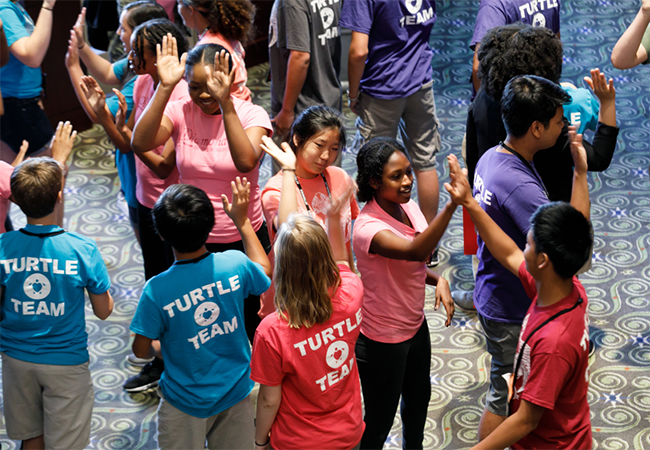
Earlier this summer, more than 50 youth came together in Atlanta for the second annual Points of Light Youth Summit at the Service Unites 2018 conference, demonstrating the power and dedication of kids and teens to make the world a better place. Participants, aged 11 to 18 years old, spent a full day in workshops that included important skills such as community mapping, how to budget, and how to pitch your ideas to funders. Finally, the groups pitched their community improvement projects to a panel of judges, including actress and activist Eden Duncan-Smith, artist and youth activist De’Andre Kind, and Hsuan Shen, district manager for Starbucks.
The kids and teens who participated in this year’s Youth Summit are inspiring examples of the power of youth to create meaningful change in their community. Here are a few highlights and key takeaways from the participants:
The Floating Island Project
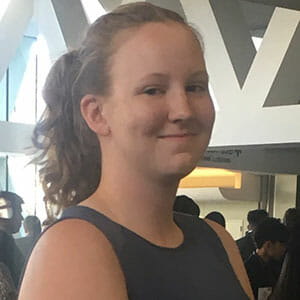
Brooke Sullivan, 17, and her team, based in Greenville/Pitt County, North Carolina, pitched The Floating Island Project. She shares:
“This project will fill a void and provide a natural filtration system to the existing lake water sites at our city’s flagship park and nature center.
The Points of Light Youth Summit provided us with the opportunity to learn the important aspects of a speech, and how to enhance or change your pitch according to different factors such as audience members. This knowledge will allow us to enhance future grant funding pitches. The money enables us to purchase non-recyclables needed in the project’s construction, zip ties, spray foam, and additional native wetland plants, plus marketing and promotional materials, and water quality and habitat survey supplies.
My original initiative with this project was to raise awareness about the lack of recycling in our local school cafeterias and ensure plastic bottles are repurposed, kept out of our landfills, or recycled. Through this project, we are utilizing recycled materials to reduce landfill waste, preserving native species, increasing plant and animal habitats, creating awareness of our environment and water sources, and helping others understand the importance of youth service.”
“Fresh and So Green Green”
Jayden Philpot, 16, from Decatur, Georgia, presented, “Fresh and So Green Green,” his team’s plan for addressing food deserts through urban gardening. He shares:
“Through my experience of preparing for the Youth Summit, attending, presenting and meeting adults and other youth, I learned a great deal about food and nutrition, about other participants and about myself.
Communities that have limited access fresh produce have a higher rate of preventable diseases. I realized that I can make a difference by learning how to grow produce in those communities, teaching others how to start and maintain gardens, and by having community farmers markets.
I am encouraged to know that making change does not have to be some big elaborate plan involving lots of people and groups. I can start making a difference by myself with one person, one group, one neighborhood.
We plan to start a garden near our center and invite speakers to come and talk about gardening, nutrition and healthy food preparation. We will charge a small fee for the classes, sponsor farmers markets where vendors will pay a fee for booths, and we will also sell produce that comes from the gardens that we help start. Eventually we would like to have a mobile farmers market!”
The FLY Life
Ishaa Hope, 15, from College Park, Georgia, and her group pitched an app called the FLY Life. She shares:
“The FLY Life app allows girls to post and answer questions anonymously, and also allows them to direct message mentors. This app was created to give middle and high school girls someone to talk to in their times of need.
Through my experience at the Points of Light Youth Summit, I learned many helpful tips on public speaking, how to make a good pitch, and being confident. I will use what I learned to become a better speaker and to continue the development of the FLY Life app. The grant money we received will help support our work by helping us finish the coding for the app.
It is important for me to make a difference in my community because that is the only way to make a change. If we start making a change now, the world can be a better place in the future.”
Blessing Bags and The Drama Free Campaign
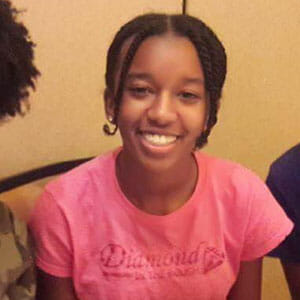
Jadyn Steele, 16, is a long-term member of Diamond In The Rough, a youth development program that creates a variety of activities designed to build self-esteem, character and leadership skills among girls of all ages. Their youth action team attended and pitched two ideas. She shares:
“Our youth action team, which included me and seven of my peers, attended the 2018 Points of Light Youth Summit. The event was very inspirational, and we saw many other youth leaders like us who wanted to see change in their community. My organization presented both the Blessing Bag project and the Drama Free Campaign.
I am very passionate about making a difference in my community. The issues facing our nation and world will have an affect me in one way or another, so helping to offer solutions and help change these issues is very important to me and many of my friends.
I personally learned a lot during the conference, including new presentation tactics, more team-building skills and the importance of participation. These major points that my peers and I learned will help us both in our organization and in our everyday life. Most importantly, these tools will help us in implementing our projects!
The Top 3 Volunteer Screening Trends for 2018
Verified Volunteers recently surveyed clients and non-clients alike — all of whom run volunteer programs – to better understand their background screening needs and processes. The 967 survey responders represented a wide range of organizations including social and human services, education, healthcare, religious and youth development groups. Responders were mostly volunteer managers and program managers and directors whose organizations relied heavily on unpaid volunteers.
Katie Zwetzig, executive director of Verified Volunteers and Toby Chalberg, chief digital officer at Points of Light, weighed in with insights from the third annual research study on the state of volunteerism and volunteer screening in America during the most recent Verified Volunteers webinar, “Volunteer Screening 2018: Research Results & Insights.”
Why are Organizations Screening?
Organizations are screening candidates for many reasons, but the majority of volunteer managers (91 percent) screen to protect constituents and vulnerable populations. The other top reasons to screen were:
89% to provide a safe and secure environment
77% to protect the organization’s reputation
48% to improve compliance/required by law
41% to improve volunteer quality
20% to increase volunteer retention
How are Organizations Screening?
Our survey found that 53.61 percent of organizations use an external third-party service to conduct background checks while 26.31 percent go directly to a government source and 15.98 percent perform the checks in-house. Almost half of the organizations screen all volunteers regardless of their position or how often they volunteer, but volunteers who work with vulnerable populations are most likely to be screened. Approximately 88 percent of organizations are not screening short-term, one-time and infrequent volunteers.
The overwhelming majority of the survey respondents (92 percent) said they conduct criminal record checks. The next most common background check used by volunteer organizations is the sex offender search at 73 percent. Toby found the large gap between the top two screens concerning and surmised that people might not know that the sex offender check is already part of their background screening package. Moving down the list in terms of commonality, 41 percent use identity verifications, 16 percent conduct drug and health checks and 12 percent conduct social media checks.
Top Three Trends Report Takeaways
There are many interesting volunteer screening trends and findings that we uncovered with the survey. We wanted to highlight just a few, but keep an eye out for future blog posts which will delve deeper into the survey findings. The top three takeaways are:
1. Social Media Checks
More and more nonprofit organizations have been asking about social media checks. Social media screening can be very valuable to volunteer managers during the onboarding process, as it humanizes the candidate. On the other hand, social media profiles can reveal both positive and negative information in what is a very public domain. It is critical that organizations understand the legal ramifications of this type of background screening. The volunteer must be told that a social media or other online source is being used to research information that could affect their application. Consent for doing these types of checks must be received. Social media searches should be carried out as late in the recruitment process as reasonably practical to avoid any biases.
It is highly recommended that organizations use a third-party screening company for social media searches. A third party social screening solution will only focus on information that relates to the volunteer role. This is important as “protected characteristics” such as age, disability, gender identity, marital status, race, religious beliefs, sex or sexual orientation, which can be easily seen on social media profiles, cannot be considered by organizations. Organizations need to have a clear policy in place for social media searches.
2. Rescreening Volunteers
Continual screening of volunteers can seem daunting, especially if you have a large team of volunteers. However, rescreening is very important especially since organizations might only see a volunteer once a year. The survey showed that rescreening volunteers has increased over last year and doubled among short-term volunteer positions.
21% rescreen all volunteers
25% rescreen those working with vulnerable populations
19% rescreen those in long-term volunteer positions
20% rescreen those in short-term volunteer positions
17% rescreen those in administrative or back office positions
How often should you rescreen? Every year, if possible. However, this will depend on your organization’s budget and the volunteer position of the person you are rescreening. Volunteers in leadership roles and volunteers working with vulnerable populations should be rescreened annually. What checks organizations use when they rescreen volunteers will vary. Some will run the full background check search again, while others will only run criminal record or sex offender checks. It is important to tell the volunteer if they are being rescreened.
3. Compliance is Key
The survey found that half of organizations disqualify only a small minority of volunteers whose checks return criminal results. Organizations disqualify volunteers based on sexual assault records (94 percent), felony convictions for violent crimes (94 percent), misdemeanor convictions for violent crimes (72 percent), felony convictions for nonviolent crimes (55 percent), driving convictions (30 percent), and misdemeanor convictions for nonviolent crimes (17 percent).
Compliance is a critical factor when conducting background screening. When an organization uses a volunteer candidate’s background information to deny them the position, they must comply with federal and state laws that protect the applicant from discrimination. When using consumer reports to make employment decisions, including hiring, retention, promotion or reassignment, companies must comply with the Fair Credit Reporting Act. The FCRA guidelines also apply to nonprofit organizations who have a volunteer staff. Volunteer managers must get consent to conduct screening, be transparent with the volunteer candidates and follow an adverse action process.
Based on the survey results, only 15 percent of organizations send both pre-adverse and adverse action notices to disqualified candidates, which means they may not be compliant with the FCRA. An adverse action process must include:
Steps for sending and receiving both pre-adverse and adverse action notifications
Sending a copy of the candidate’s background report
Adequate time for the candidate to respond and dispute findings
This post was originally published by Verified Volunteers and appears here with permission.
Here I Am: Reflecting on Service Unites 2018 with Repair the World
By Emma Saltzberg, Education Justice Fellow, Repair the World NYC
The first time I visited Atlanta was on a civil rights driving tour of the American South when I was in high school. We visited Dr. Martin Luther King Jr.’s birthplace and final resting place, as well as the historic Ebenezer Baptist Church. How fitting it was, then, to return to Atlanta again almost 10 years later, in a continuing fight for human rights and social and racial justice with Repair the World.
Last month, I traveled to Points of Light’s Service Unites conference in Atlanta as a member of Repair the World’s delegation. This three-day marathon of learning around volunteering and service brought together the nation’s leaders in service to share best practices and learn from one another. Repair the World’s delegation brought the unique approach of volunteering rooted in Jewish values to the group of more than 2,000 conference attendees.
As an education justice fellow at Repair the World NYC, I have spent the last year living, volunteering, and learning in the Crown Heights neighborhood of Brooklyn. Service Unites offered a powerful space to see what the merits of volunteer work and service programs in action look like on a larger scale. The location also felt particularly appropriate, as Repair the World is about to launch a new Community in Atlanta; the conference was a fabulous opportunity to share our work with stakeholders such as local nonprofit leaders, motivated volunteers, and board members.
Civil and Human Rights in Atlanta
After the conference, I visited the new Center for Civil and Human Rights. During this version of my civil rights tour of Atlanta, I entered with a much deeper understanding of the issues of racial justice that remain in our society today, thanks especially to my educational year as a Repair the World fellow. The most moving part of the museum was a simulated lunch counter sit-in, just like students in Greensboro, North Carolina would have experienced in 1960. I felt shivers down my spine as the harassers “whispered” in my ear (via a headphone recording) and the experience was nearly unbearable. The patience and self-discipline the nonviolent activists of the civil rights movement displayed is remarkable.
In 2018, we cannot afford to sit still and let the bullies of this country dominate society and the political sphere. While all of Repair the World’s Communities focus hyper-locally, one can imagine that the issues faced by people I’ve met in underserved neighborhoods in Brooklyn could be similar to communities in Atlanta and other cities around the country. This fellowship year has been spent in deep learning around racial justice, the needs of our local community, and why giving back through service is an inherently Jewish value. Visiting Atlanta for Service Unites and the Center for Civil and Human Rights only affirmed this understanding further.
Here I Am: Interfaith Conversations on Service
At Service Unites, Repair the World co-hosted the annual Service Supper, a dialogue around the influences of faith traditions on volunteering. Guests heard from local clergy who led interfaith blessings over the food and our presence there together. As a table facilitator, my role was to guide the discussion at my table of eight guests; the theme of the evening was “Hineni: Here I Am.” The goal of the evening was for participants to come away with an understanding that meaningful service should not divide us; in fact, it is one of the only actions that may bring people together to effect change.
One of the guests at my table felt comfortable sharing her personal story with the group. She spoke about a rough period she had gone through about two years prior, when this person found herself functionally homeless. She had a job, and she woke up and went to work every single day. She just didn’t have her own apartment to go home to.
This is the kind of homelessness we never speak about. The most common visualization of someone experiencing homelessness is of a person who abuses drugs, suffers from mental illness, or can’t keep a job. This paradigm ignores the thousands of hard-working American citizens who put in so much effort yet are consistently ignored and abused by the very system that proclaims to provide them with the American Dream.
What does Hineni mean to me? Saying “Here I Am,” or being truly present means showing up humbly with an open ear, ready to listen. It means never relying on preconceived notions or stereotypes, but rather approaching each individual where they are and truly listening to their story. It means breaking bread across vast differences, and showing up together.
Bringing my Service Unites Experience into the Future
As I transition out of my role as a Repair the World fellow in a couple of weeks, having the opportunity to attend Service Unites was a meaningful way to tie all the pieces together. From engaging in rich storytelling and listening at Service Supper, to sessions I attended around millennial engagement in service, to the wisdom gained from our constituents and colleagues at the Repair the World Delegation Summit, I was able both to share with others what I have learned this year applying Jewish values to service, as well as learn from others doing this work around the country, whether faith-based or secular. Seeing so many talented nonprofit leaders in action at Service Unites reinvigorated my belief that it is through honest conversation and humble service of others — in addition to through political action and systemic change — that we could actually have a shot at achieving racial justice as Dr. King imagined. Hinenu: we are here.
Emma Saltzberg recently completed a service year as an education justice fellow at Repair the World NYC. Emma took a gap year before college and lived in Israel volunteering at a kindergarten in Bat Yam. In this suburb of Tel Aviv, Emma realized how rewarding it was for her to help improve quality of life through hands-on education reform. Upon returning from Israel, she attended Tulane University and majored in ecology and evolutionary biology. Her favorite part of living in New Orleans was the multitude of food and music festivals to explore!
When President George H.W. Bush was in office in 1990, and after Nelson Mandela was released from prison, as a young civil rights lawyer living in Chicago reflecting on the need for more light, I wrote a poem. It was a privilege to share this poem last night at the opening plenary session of Service Unites 2018, as more than 2,200 volunteers, nonprofit, business and civic leaders gathered together for an exciting, star-studded event – part education, part activism, all inspiration – that celebrated and pushed the boundaries of civic culture and volunteerism.
Many of you have requested a copy of this poem, “How I Read a Poem Like This,” and we are pleased to share it with you, our community of changemakers – points of light in communities around the world, who are helping to ignite a civic culture. Thank you.
How I read a poem like this.
How it provoked thought.
How I’d like to do the same.
Provoke thought…
about racism
about sexism
about classism
about choice.
About basic human rights
human needs
human dignity.
About action.
About empathy.
About apathy.
How I think about life in America.
How I think about its economy.
about its drug problem
about health care,
“mental” health care.
How I think about its people.
about the rich.
about the poor.
about the average Joe and Jane on the street.
About our leaders.
about our illiterate and our homeless.
About what I can do
to make a difference.
Oh…..how I think about the crime in my neighborhood.
Exhausting.
How I think about the victimsand the victimizers.
the thieves and con-artists.
the moms with bills and babies.
and our gun-toting teens…who carry and represent for freedom?
How I think about the success
in my neighborhood.
Invigorating.
About our doctors.
our lawyers,
and our engineers,
and our teachers,
and our tech heads.
About our beautiful artists whose words,
and songs,
and pictures inspire us to skip from one scene to the next.
about those who tap into our natural hopes and joy.
About every day leaders
whose life it is to care for others.
How I think about our complex judicial system.
About the laws and their impact and their intent.
About equality.
How five opinions can change the lives of millions?
Think about it.
How I think about my education.
About the education of my children,
of your children,
of our children,
of all children.
PEOPLE!
What is we gon’ do?
We gon’ wake up.
Read up.
Get up.
Speak up.
We gon’ count.
Do the math.
And add it up.
We gon’ rise up.
Lift up.
Ourselves andOthers.
Today.
Today.
Today.
How I think about my lot in life.
How I ask you to think about yours.
How I read a poem like this.
How it provoked thought and action.
How I’d like to do the same.
‘ICU Grandpa’ Shares Comfort, Hugs with Babies Who Need A Little Extra Love
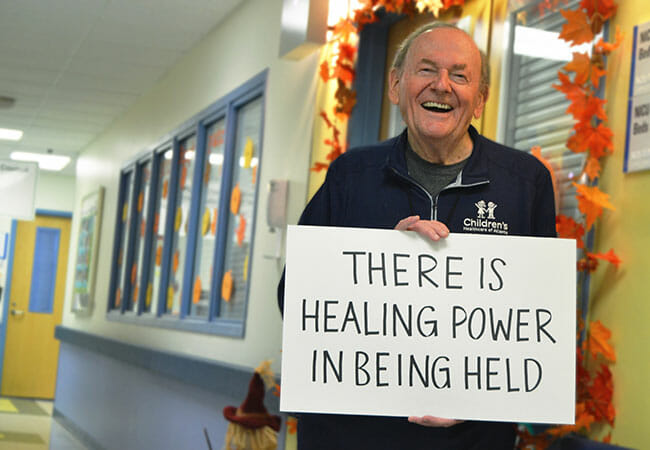
Meet Daily Point of Light Award honoree David Deutchman. Read his story and nominate an outstanding volunteer or family as a Daily Point of Light.
After retiring in 2000, David Deutchman was giving guest lectures at colleges and universities around Atlanta — but found it didn’t occupy enough of his time.
He started volunteering at Children’s Healthcare of Atlanta at Scottish Rite, and was teaching in a classroom when he noticed a couple of moms who looked like they needed someone to talk to. “I sat down for 30 minutes and they poured their hearts out to me,” David said. “I realized I could fill a gap.”
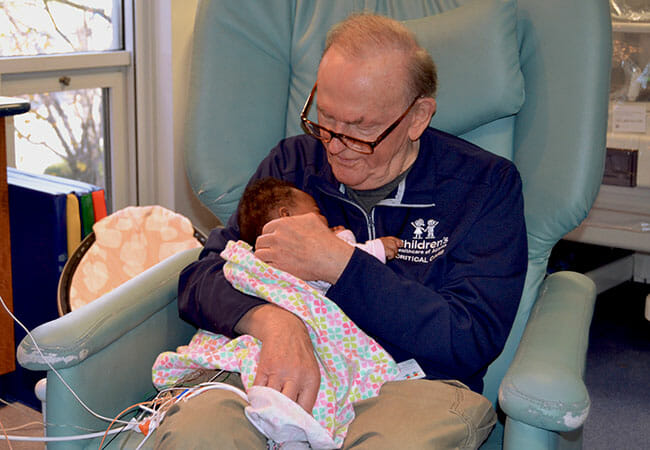
Before long, David carved out his niche volunteer role in the pediatric and neonatal intensive care units, offering comfort, support and hugs to parents and children. And he noticed that some patients, including those with Division of Family and Children Services, didn’t receive many visitors. “There were some babies no one was visiting or hugging, so I did,” he said.
The former marketing executive now goes by the title “ICU Grandpa,” and he spends two days a week at the hospital. On Tuesdays, he visits the pediatric ICU and on Thursdays, the neonatal ICU. “It is a wonderful atmosphere; I enjoy it so much,” said David, who has been volunteering at the hospital for more than 12 years now.
He says as a volunteer he has learned there are many children who are in need of kindness, and not just because they are sick or injured. Sadly, there are also kids who need a little more love. “That is a theme of mine — wanting to give as much to the kids who need it the most,” David said.
David’s role as ICU Grandpa became a viral sensation last September when Children’s Healthcare of Atlanta posted a photo of him holding a premature baby. He has since joined Facebook, which has led him to reconnect with many of the families he once knew in the ICU. While he says it is great to revive relationships and hear how he made an impact in their lives, not all the stories have had happy endings.
“Meeting many of the families again brought a new focus on some of the kids who haven’t done as well.” David makes a point of visiting with these kids and their parents when they’re back in hospital for treatment or because they’re sick. From his story, he wants other people to learn the importance of getting up to do something.
“I have made this a priority in my life,” says David, adding that he gets so much back from cuddling the babies. “I recommend everyone find a way to give back.”
Want to make a difference like David? Visit allforgood.org to find volunteer opportunities near you.
Written by Karen Cohen.
Women of Worth: Recognizing Those Who Make a Beautiful Difference in Their Communities
Each year L’Oréal Paris and Points of Light recognize and celebrate Women of Worth who make a beautiful difference in their communities. Ten honorees each receive a $10,000 grant to support their most cherished cause, and an online vote determines one honoree who will receive an additional $25,000 grant. Nominations for 2018 are now open! If you know a woman who works to create lasting and significant change in her community, nominate her to be one of the 2018 Women of Worth.
By Karen T. Fondu, L’Oréal Paris President Emeritus and Chairwoman of Women of Worth
This year, we celebrate the 13th anniversary of the L’Oreal Paris Women of Worth program, which was inspired by our legendary tagline, “because you’re worth it,” and reflects our belief in every woman’s worth. Each year, we honor 10 extraordinary women who are making a difference in the communities they serve. These women selflessly give their time, energy and passion to causes close to their hearts. And now through May 31, you can nominate a woman who is making a meaningful difference in your own community.
What would be the best way to honor Jaha Dukureh, for example, who founded Safe Hands for Girls and uses her voice as a survivor of female genital mutilation to educate communities and young girls about the dangers of FGM? Or Maria Rose Belding, whose volunteer work at a local food kitchen led to the creation of MEANS, a database that keeps food out of landfills and in the hands of those who need it most? And how could we honor Maria D’Angelo’s inspiring and transformative work with homeless and at-risk children and families through The Children’s Lifesaving Foundation?
It is difficult to calculate the value of something that feels so priceless.
Yet, the answer, we realized, was simple. These women already had passion, drive and determination. They were already out there making an impact. We realized that we had the opportunity to help them execute their vision on an even larger scale, to touch even more lives by championing their causes. L’Oréal Paris could give them the platform and resources to amplify their work.
Year after year, we are awed by the impact our Women of Worth continue to make in the world, and we are grateful to be part of their journeys.
As a Women of Worth honoree, Maria D’Angelo has taken The Children’s Lifesaving Foundation to new heights, serving more than 75,000 homeless and at-risk youth with her Camp4All Summer Camp program. She used her Women of Worth platform and grants to sponsor students through her Shining Stars Scholarship Program, helping teens become the first students in their families to enter college. Maria has been recognized by People magazine as one of their “Heroes Among Us,” and she was included among Good Housekeeping’s “50 Inspiring Women Over 50.”
Maria Rose Belding is also making powerful strides with MEANS. Before joining the Women of Worth family, Maria Rose was working with food pantries in 24 states. In less than two years, that number has doubled. Today, MEANS operates in nonprofits and community groups in 48 states, diverting food from the trash to local emergency feeding services with the ease and speed of the internet. Maria Rose has been a featured speaker at the White House, appeared on The Daily Show, and been recognized in the Starbucks Upstanders series for her leadership.
Prior to being a Women of Worth honoree, Jaha Dukureh’s Safe Hands for Girls had reached approximately 200 women and girls in the United States and 500 people in Gambia. Today, she has put a spotlight on the issue around the world, reaching more than 10,000 people in the United States, Gambia and other parts of West Africa, through education, outreach and grassroots activities. Jaha was included in the Time 100 list of influential people, and has even been nominated for a Nobel Peace Prize. She is currently working on a campaign to End FGM by 2030 – and we know that nothing is going to stand in her way.
Women like Maria Rose, Jaha and Maria prove that helping others is one of the highest callings there is. We at L’Oreal Paris are honored and privileged to support these extraordinary women and their worthy causes. Seeing the change they are making throughout the world has been one of the greatest honors of my career.
Do volunteers at your organization represent the racial and ethnic diversity of the community you serve?
The answer, for most governments and nonprofit organizations, is “no.”
But this can change.
The Minnesota Association for Volunteer Administration has spent the last year researching the challenges, barriers and best practices for volunteers from immigrant and diverse communities. While this project focused particularly on government organizations, the findings can largely be applied across both government and nonprofit entities. To reach these findings, MAVA built on several previous initiatives and conducted new research to more deeply explore questions such as:
How is the concept of volunteerism understood and perceived in racially and ethnically diverse communities?
What barriers currently exist to engaging diverse and immigrant populations as volunteers with government organizations, and how can these barriers be overcome?
What outreach or recruitment strategies are most effective in immigrant and diverse communities?
Are there particular volunteer roles that are more appealing to people of diverse backgrounds and, if so, how can governments or organizations develop these roles?
What efforts have organizations found successful in engaging diverse and immigrant volunteers, and how can other entities replicate these efforts?
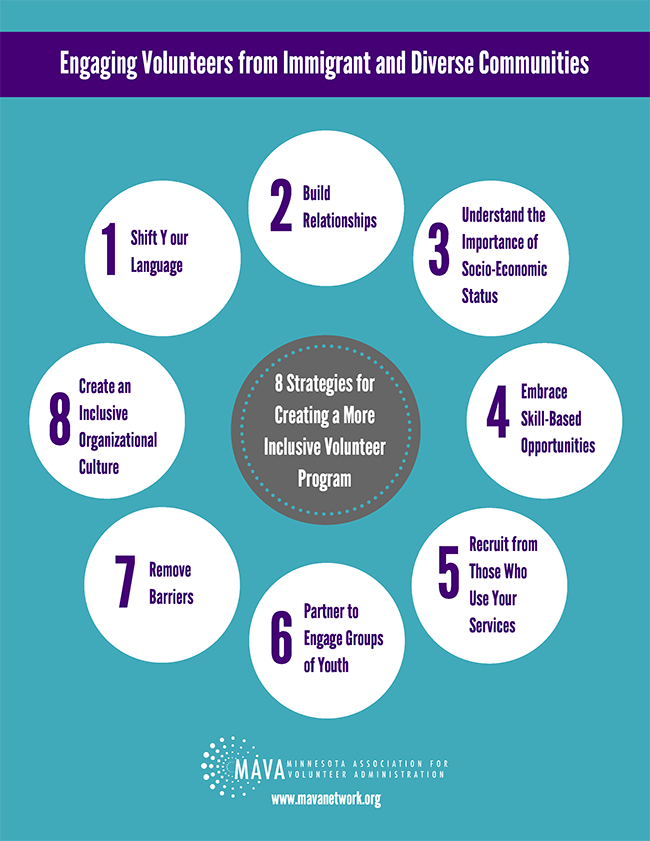
The result of this research is a set of eight strategies for engaging diverse and immigrant volunteers, which governments and organizations can develop into an action plan for change.
Some of the strategies are relatively simple. For example, we heard from a number of people new to this country that the word “volunteer” is not well understood in their community. Framing volunteerism in terms of how they can help their neighbors is a more effective way to discuss how they might be involved. And focusing on how someone might help their community, as opposed to how they will help your organization, will be a more compelling recruitment message.
Other strategies are much more difficult, like building relationships with communities of color and creating an inclusive organizational culture. While employing these strategies will not happen overnight, starting today by taking small steps forward will slowly build inclusion into your volunteer program in the months and years to come.
All eight strategies are represented in the infographic below, and the executive summary of MAVA’s report (featuring a brief overview of all eight strategies) is available at www.mavanetwork.org/inclusive.
If you would like to receive the full report or discuss MAVA’s work, contact Lisa Joyslin.
Clif Bar & Company: Sustaining the Environment Through Service
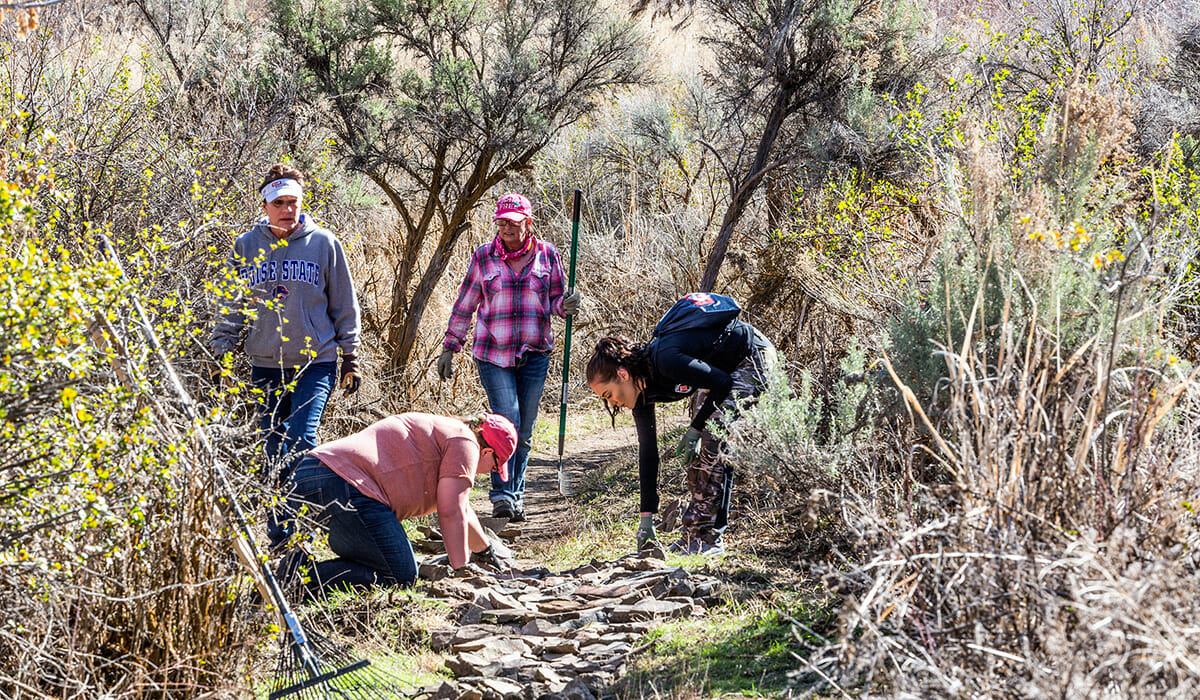
Clif Bar employees in Twin Falls, Idaho, rebuilding trails and picking up trash during the Companywide Service Day at Centennial Park.
By Cassie Cyphers, Community Programs Manager, Clif Bar & Company
, and our volunteer efforts largely focus on giving back in ways that help the planet. That’s probably not surprising, since we’re a company that relies on a clean and healthy environment to grow the ingredients we use in our food, and on the outdoors as a treasured place for us and our adventure-loving consumers to play.
Whatever your company’s volunteer focus, the benefits of community service are numerous. “Through the simple act of extending a hand, not just once in a while but as a regular part of life, we are changed as individuals and as a company,” said Kit Crawford, Clif Bar’s co-owner and co-chief visionary officer.
Kit and her husband, Gary Erickson, Clif Bar founder, co-owner and co-chief visionary officer, have built community service into everything we do. Clif Bar’s business model is comprised of five bottom lines, or Aspirations, as we call them – sustaining our business, brands, people, community and the planet.
CLIF® CORPS, our employee giving and engagement program, enables our employees to support communities in three ways, via service, funding and food. We encourage employees to volunteer in the community on company time — and do they ever, with a participation rate of more than 98 percent and nearly 117,000 hours volunteered since the program began in 2001. In 2017 alone, our 1,200 employees volunteered nearly nearly 20,000 hours.
Given our commitment to food and the outdoors, nearly 40 percent of employee community service is devoted to environmental causes. Pick a day at our California headquarters, or one of our two bakeries in Idaho and Indiana, and you’re likely to find a few employees or an entire department volunteering in the community, often on behalf of the planet. They might be restoring community gardens, clearing trails in a public park, planting trees, cleaning up beaches or building birdhouses.
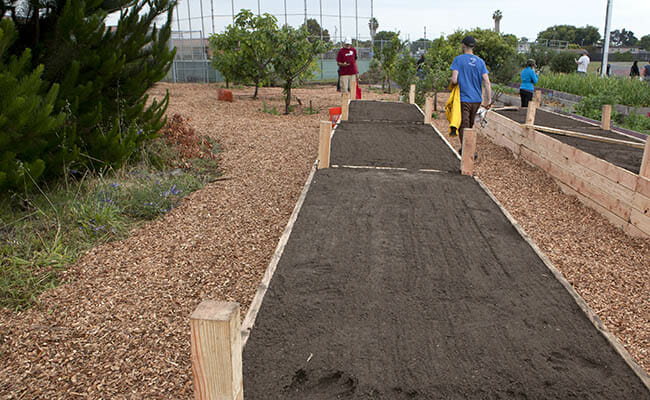
Once a year, we shut our doors and send everyone off on a day of service. A few years ago, our headquarters employees — then more than 300 strong — spent the day volunteering at two local urban gardens to benefit Urban Tilth, a nonprofit that cultivates agriculture in West Contra Costa County. “Clifsters” weeded, planted and built raised garden beds, picnic tables and a pollinator habitat.
We’re happy to share our recipe for community service because we think it can work for a lot of companies, no matter what your cause or focus. Build it authentically into your company’s DNA, encourage employees to take part, make it easy for them to participate, and let them choose the causes that interest them.
While we’ve won awards for our community service, that’s not what drives us. It’s doing the right thing for us, for others and for the planet, which is under siege and deserves a special nod here in April (and beyond), home of Earth Day, Earth Week and Earth Month. And the best part is hearing from the people we touch with our service — people like Brandy, a grandmother in Twin Falls, Idaho, who recently sent us this note via Facebook:
“Huge Rave – With the weather so nice today I decided to take my 2 grandsons walking (the trail at Centennial Park). There was a huge mass of Clif Bar employees working down there clearing the trails, picking up trash, trimming bushes and fixing the bridges. Not to mention the shopping carts and other trash they loaded onto a boat and hauled off. Everyone we passed was so polite and kind. I just wanted to say THANK YOU, not only for what you did for our community but for being awesome examples to my grandchildren.”
Now that is reward enough!
An advocate for community service and environmental conservation, Clif Bar & Company is just one example of the corporate citizens that make up the Points of Light Corporate Service Council. Does your company exemplify corporate citizenship, have an incredible team of employee volunteers or make a strong impact in the community?
Recognizing the Impact of Volunteer Service During National Volunteer Week
Photo Credit: Good Deeds Day
“Volunteering and community service is a lot like planting peonies. You may not see the results right away, indeed you may never see them, but you never know when you will plant a seed that one day will sprout and bloom forever.”
– Barbara Bush
]. This week, we join millions in celebrating the life of this iconic woman, who was a leader of and friend to the volunteering and service sector. And it is somehow fitting that her passing coincides with National Volunteer Week in the United States, as the country focuses on celebrating the millions of people who “plant peonies” every day.
Each year, we shine a light on the people and causes that inspire us to serve, recognizing and thanking volunteers who lend their time, talent and voice to make a difference in their communities.
was established in the United States in 1974 and has grown exponentially each year, with thousands of volunteer projects and special events scheduled throughout the week.
The
shows that nearly 63 million Americans volunteer annually, giving almost 8 billion hours of time at an estimated $184 billion value. Utah ranks No. 1 in volunteering among states, while Minneapolis-St. Paul ranks No. 1 among large cities, and San Jose, California, ranks No. 1 for millennial volunteering. Not that it’s a competition, but you can see where
— $24.69 per hour — helping to recognize the impact of those millions of volunteers.
You can see some of the 63 million stories of volunteers that have come to life this week by following
to one particular volunteer, “Thank you to our Animal Services volunteer Monica Pugh. Monica contributed over 4,000 hours in the last 4 years.” And the Detroit Airport, @DTWeetin, is using National Volunteer Week to
with President’s Volunteer Service Awards.
At Points of Light, we recognize volunteers five days a week with the Daily Point of Light Award. This week’s honorees exemplify the broad diversity of good deeds, consistent support, ongoing commitments of time and innovative solutions to persistent problems that play out in every corner of the country every day.
In Acton, Massachusetts, Barbara and Ira Smith, both age 86, have worked tirelessly for 28 years to ensure that veterans getting back on their feet, those emerging from homelessness or fleeing abuse, people living with illness or disability, people getting by on minimum wage and those who have experienced personal crisis such as a fire – have access to gently used furniture and household items, free of charge.
In San Francisco,
, an internationally acclaimed human rights organizer, first-degree black belt and social entrepreneur, founded (IM)WISE, a nonprofit organization and global grassroots movement supporting Muslim women empowerment through self-defense and skills-based training. Rana started (IM)WISE after being the victim of a hate crime at age 16; now, seven years later, she was honored as one of the 2017
.
In Arlington, Massachusetts, brothers Will and Matty Gladstone started The Blue Feet Foundation to sell blue socks to raise money for the blue footed bird after learning about this threatened species in the Galapagos. They have raised over $30,000 and sponsored a research project by a world expert in the blue-footed booby.
In Lexington, Kentucky, hip hop artist Devine Carama took his positive music and turned it into volunteer activism. His program Believing In Forever Inc. offers young people a safe outlet for artistic expression.
In Lincoln, Nebraska, after experiencing bullying firsthand,
and a group of friends wrote a curriculum for grade school and middle school programs that address bullying, gender issues, and focuses on building confidence. Last fall, she and 20 teenage volunteers from Lincoln School District hosted a “Like A Girl —Empowerment Boot Camp” for 50 at-risk elementary and middle school girls living in one of the toughest neighborhoods in the cornhusker state. Their project was recognized as an award winner of Make A Difference Day 2017.
The seeds being planted by these individual points of light have already begun to sprout and will no doubt bloom forever. Their stories – and all the stories shared during National Volunteer Week – demonstrate the power of volunteerism brings us together to tackle society’s tough challenges, spark change, and build stronger, more resilient communities.
National Volunteer Week is coming to an end, but there is still time to get involved:
Teen Creates After-School Program to Combat Gender-Based Bullying, Build Confidence in Young Girls
During National Volunteer Week, we celebrate the impact of volunteer service in our communities, and recognize extraordinary individuals who are at the center of social change – like Daily Point of Light Award honoree Ina Bhoopalam. Read her story and nominate an outstanding volunteer or family as a Daily Point of Light.
As a freshman in high school, Ina Bhoopalam found herself the target of bullying – simply because she was involved in, and excelling at, the same academic activities as her male classmates.
“People thought I shouldn’t be succeeding because I was a girl,” Ina said. The comments even spread to social media. “It didn’t make me feel good.”
Luckily for Ina, she had a support network of family and friends on which to lean on. When Ina’s dad told her that many girls don’t have that kind of support, she wanted to do something about it – and had the idea to start a program to address bullying, gender issues and building confidence in young girls in her own community.
“I had been through so much. I had people to help me through it. Some people don’t have that,” she said. “I wanted to do something to make a difference.”
In doing her research she came across an article about how, by the age of five, girls begin to think they’re less than boys. So, together with a group of friends, Ina created
– a curriculum developed to address the needs of elementary and middle school girls.
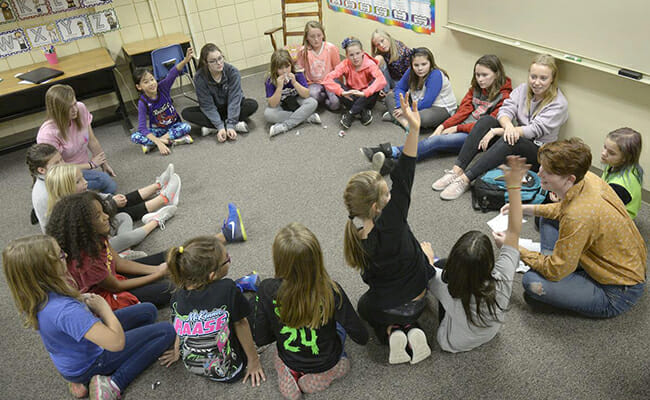
She created a pilot after-school program at Maxey Elementary School, in her community of Lincoln, Nebraska. On the first day it started with two girls and on the second day, the workshop had 10 girls and kept on growing.
“I want the girls to leave the program empowered, feeling like they can accomplish anything they want,” said Ina, now 17. “All girls are capable of doing anything they set their mind to. They should be empowered to dream and achieve what matters to them.”
Now, Ina has approval to expand the Like A Girl program, led entirely by youth volunteers, to 11 elementary schools, two middle schools and six high schools. In addition, the Like A Girl initiative is being offered through an after-school program at the Salvation Army.
Currently, Ina is working to register Like A Girl as a nonprofit and she would like to expand the program’s reach to all 40 Lincoln public schools, throughout Nebraska and into other states.
Ina hopes that Like A Girl will ensure no other girls have to face the same situation she went through. It wasn’t long ago that she experienced gender-based bullying herself, but starting Like A Girl has given her even more confidence.
“I have a purpose in what I am doing,” she said.
The Difference She Makes
Patrick Hunter-Pirtle has seen first-hand how Ina’s Like A Girl initiative has impacted young girls in Lincoln. He oversees the school district’s secondary education, and was approached by Ina with the idea to expand Like A Girl district-wide.
Like A Girl is incredible to watch, said Patrick, who has been impressed by the more than 100 youth volunteers Ina recruited to help lead the program – all are great students and community-minded people who make time and give energy to this program, he said.
And he has seen first-hand the joy of an elementary student sitting with one of the leaders, smiling. “They are teaching them they can be anything they want.”
recognizes 14 outstanding leaders of Make A Difference Day projects, awarding $140,000 in grants that are donated to the charities related to the winning projects. Learn more about Make A Difference Day at