, hunger — an often unseen issue — affects individuals of all ages, demographics, and backgrounds, and is often tied with other issues of poverty and economic insecurity.
Two members of the Points of Light
, Food Lion and General Mills, are going above and beyond to address hunger and food security in the communities where they do business. With ambitious goals to improve situations of hunger in the United States and around the world, both companies are working to strengthen food security through employee talents, industry leadership and corporate resources.
Food Lion
As a leading grocery store chain in the United States,
is certainly familiar with the ordering, processing and selling of food. However, in 2014 the company realized that in the area of hunger and food security, it could be doing more.
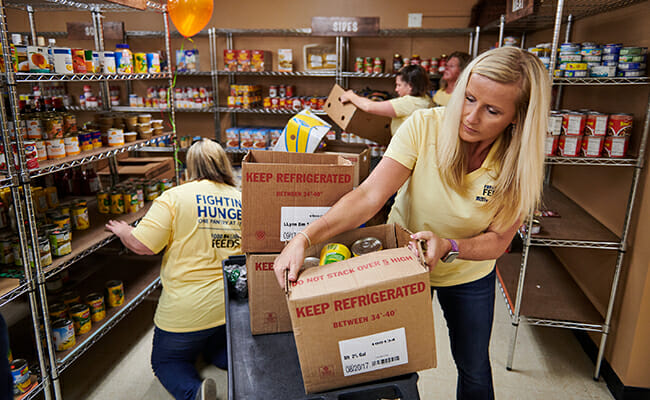
was born — a philanthropic platform powered by Food Lion and operated in partnership with 30 Feeding America food banks across 10 states. Through this initiative, Food Lion works to feed those who are hungry by leveraging its unique position to provide food, product donations, equipment and volunteers to food banks and nonprofits, supporting mobile food pantries to increase access to meal services, and increasing awareness about an issue that often lives closer to home than most are aware. To celebrate its 60th anniversary, Food Lion hosted
and rebuilt and restocked 60 individual food pantries. The volunteer-fueled initiative resulted in more than 2.5 million meals donated and 2,000 volunteer hours for Food Lion associates.
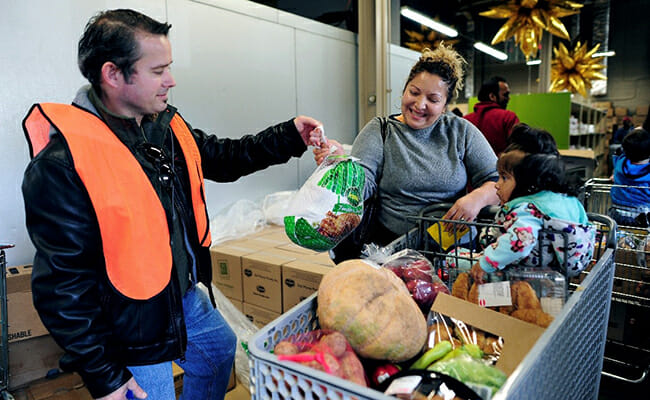
Food Lion is also using its presence in communities and online to raise awareness about hunger and food insecurity. Food Lion encourages its wide range of stakeholders – employees, customers, community members, and more – to take action by volunteering, giving spare change, or donating the extra canned goods in one’s pantry to collaboratively solve this widespread issue.
Thanks to the support of this network, and the company’s strong commitment to the cause, Food Lion has donated more than 370 million meals since 2014 and is its way to donating 500 million meals by 2020.
General Mills
If you’ve ever snacked on Chex Mix or treated yourself to Häagen-Dazs, you’re familiar with the
in the countries where they do business. As experts in food production and processing, the company has taken advantage of these unique strengths to spearhead initiatives around the world aimed at strengthening food security. Since 2010, General Mills has enabled the donation of more than 200 million meals to people in need.
Working with Feeding America, General Mills has also focused on another important food-related issue: waste. MealConnect™, an online platform enabled through this partnership, allows food providers to catalogue their excess food, which is then donated to food banks and local nonprofits, and in turn distributed to people in need. Thanks to the company’s support, MealConnect has
.
General Mills is also dedicated to ensuring all students are on the path to success. Because youth are often affected by issues of food insecurity to an even higher degree, the company works to increase access to nutritious meals for students around the world. Working with the
in India, General Mills is both increasing access to school lunch and making these meals more nutritious. And in partnership with the Food Research and Action Center, it has helped increase breakfast access for students who qualify for free and reduced lunch – a habit that has been shown to
Food Lion and General Mills are just two examples of corporations that share a commitment to ending hunger in our world and ensuring communities have the resources they need to be healthier and more resilient. Does your company exemplify corporate citizenship, have an incredible team of employee volunteers or make a strong impact in the community? Consider joining the Corporate Service Council today.
Top 5 Reasons for Businesses to Attend the Service Unites Conference
By Roger Hancock, Manager of Community Affairs, CSAA Insurance Group, a AAA Insurer
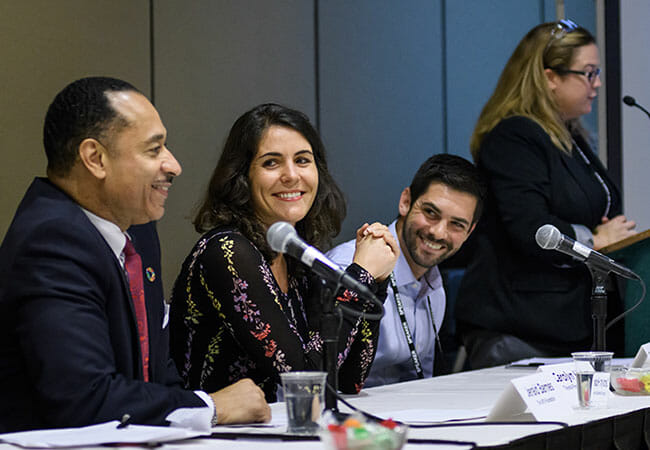
As communities around the world face continuous societal shifts, including, diverse political, economic and social challenges, companies are stepping up as leaders and advocates in social action, policy and community-building. Participants in the Business Path at Service Unites will leave inspired and equipped to amplify corporate values through employee engagement and position their businesses as a force for good.
My first “volunteer conference” was on the college campus of Southern Methodist University in Dallas in 1986. This year, my decades-long journey across America to attend Points of Light’s annual conference on volunteering and service – now called Service Unites – continues in Atlanta, June 18-20. I hope to see you there.
Yes, the original national volunteer conferences were held during the summertime on college campuses, when 500–600 community leaders from corporate America and nonprofit organizations would sleep in empty dorm rooms at Yale, Stanford, SMU and my alma mater, the University of Southern California. We would attend volunteer workshops in available classrooms and lecture halls during the day and we would network in the evening.
In the many years I’ve spent attending the Points of Light’s conference, I’ve seen a lot. I’ve met presidents and first ladies, the son and brother of a president (here’s looking at you, Neil Bush!), members of Congress, entertainers and athletes – and Jon Bon Jovi.
More importantly, I’ve met people like you who I have learned from, networked with, enjoyed a beer with, and who have helped me be a leader in the field of corporate volunteer management.
And, after more than two decades, I eagerly keep coming back to the Service Unites conference, just like Parrotheads annually migrate to Jimmy Buffett concerts. I registered for the June 2018 conference in Atlanta, paid my ridiculously cheap conference fees, booked my flight and reserved my hotel … all at the end of last year.
If you have attended the conference, you know why you need to go and why you want to go. But if you have not attended the conference before, here are five reasons why you should join me in Atlanta in June.
1. It’s a Bargain
The conference registration fee runs from $350 to $550. It’s a real bargain for a three-day conference filled with incredible, inspiring, and gifted speakers and presenters. Geez, there are some other corporate social responsibility conferences that cost $2,500 for two days of meetings. And rarely are there old guys like me at the podium. Service Unites speakers are diverse, vibrant and inclusive. Heck, I brought my daughter (who was in high school and then college at the time) to three conferences in Washington, D.C., Chicago, and San Francisco – she had a blast meeting and engaging with other service-minded students at these conferences. Today, this mighty millennial proudly works in our field.
2. One Nugget
Every year I walk away from the conference with at least one huge nugget of information that is a game-changer for how I do my job and lead my company in the community. Examples of recent “one nugget a year” learnings include: the launch of the Civic 50, as thought up by former New York City Mayor Michael Bloomberg; the release of the UN Sustainable Development Goals; United HealthCare’s study about the wellness benefits of volunteering; that “Volun-told-ism” is definitely acceptable (thanks Bea Boccalandro!); and that Bon Jovi’s acoustic rendition of “Livin’ on a Prayer” echoes in my ears louder when whispered solo on a simple acoustic guitar. (Jon Bon Jovi has meaningfully presented at two Points of Light conferences!)
3. Workshops, Plenaries and More
Service Unites. It sure does. Nothing like 3,500 people in a ballroom riveted to an inspiring and informative plenary speaker. And, sometimes that incredible featured special guest speaker is only 12 years old! And, the workshops – there is so much to choose from in your area or field of interest: business, nonprofit, government, faith, national service, higher education, youth and more. Pick your path and run down it. It’s your time to learn and share with like-minded colleagues.
4. The Hotel Lobby
Everything I wanted to learn about volunteer management … With 3,500 attendees, it can be a bit challenging to develop a relationship or build a network in a large plenary or at the workshops. Thus, the hotel lobby (and the bar) is the mecca to meet people from across the country and the entire globe to simply chat. I wear my conference name badge with company name and geographic location. The relationships and the network I have built from simply talking with a small group of folks in the hotel lobby from an array of cities, states and countries has allowed me to engage in conversations that provide insights on how I can do my job better. And, I have built a network that I can call on later when I am stumped or struggling with a community issue.
5. Baseball!
Father’s Day, Sunday, June 17, it’s Padres at the Braves! Hats off to Points of Light and the conference planning committee. These folks always book the conference in pretty cool baseball towns when the local team is on the field. Highlights have included the Chicago Cubs, Chicago White Sox, New York Yankees, New York Mets, Kansas City Royals, San Francisco Giants, Philadelphia Phillies, Seattle Mariners, Washington Nationals, Atlanta Braves and Detroit Tigers. I have been to all of these baseball stadiums (“cathedrals”) while attending Service Unites.
That’s it. Five reasons to attend Service Unites. I hope to see you in Atlanta in June! Come to the conference for three days of engagement and learning how you and your organization can best serve others. Yes, Service Unites!
“Take my hand and we’ll make it, I swear. Whoa, livin’ on a prayer.” – Jon Bon Jovi
“We realize the importance of our voices only when we are silenced.” ― Malala Yousafzai
During Women’s History Month, anchored by International Women’s Day, we celebrate the unique leadership and contributions made by women across generations. There is something remarkable and yet unsurprising about recognizing the inspirational message of a young woman like Malala Yousafzai, who, at age 11 became an activist for education for girls, and at age 17 became the youngest Nobel Peace Prize recipient.
During every age in history, women of every age have made history – some civically engaged as vocal leaders on issues they care about, and some as hidden figures whose contributions influence our lives today.
In celebration of the diversity of ways in which women lead a civic life, we brought together three nonprofit founders from around the world to share their experiences, talk about their work as part of the Points of Light Network, and offer advice to emerging women leaders who will continue to carry forward our collective mission.
Maya Angelou once said, “My mission in life is not merely to survive, but to thrive; and to do so with some passion, some compassion, some humor and some style.” Our three video-chat guests embrace and embody this mission.
Top 5 Reasons for Nonprofits to Attend the Service Unites Conference
By Amy Lytle, Executive Director, HandsOn Northwest North Carolina
Since beginning my work in the volunteering and service sector in 1998, I have attended all but two Points of Light conferences. And I go back year after year, even during the tightest of budget times – something I know many nonprofit professionals understand – because I continue to find unmet value in the opportunities the Service Unites conference has to offer. Here’s why:
1. Learn from Leaders Like You
The Service Unites conference is your one big chance to connect with people doing that exact same work as you – a chance that usually doesn’t exist in our home communities. Amy Poehler, in her memoir “Yes, Please,” says that two of the most powerful words in the English language are, “me, too!” From informal meet-ups and networking events, from workshops to the main stage, this conference is an opportunity to meet and learn from other leaders in our field who are facing the same challenges, creating innovative solutions for the same problems, and making the same commitments to their communities as you are every day.
2. Make Face-to-Face Connections
I don’t know about you, but webinars just don’t cut it as a way of creating peer learning networks. I have to see someone face to face, build a rapport, share a meal or a drink before I feel I know them well enough to pick up the phone and ask them how they do X, Y or Z. Attending the Service Unites conference has given me the opportunity to build strong, personal relationships with other leaders in our field. There are some colleagues who I see only at the conference, but I know that I can pick up the phone any time, and get advice and support from them. I’ve picked their brains, “borrowed” their ideas and learned from their experience. None of this knowledge would have been available to me had I decided to sit in my office alone. As an Points of Light Network affiliate leader, I’ve learned that creating and strengthening my peer network has been crucial to my success, both personally and organizationally.
3. Get VIP Treatment
It will make you feel like the VIP you really are. Nonprofit work is not glamorous. And in some communities, we’re considered “the best kept secret.” (Ugh!) But, at the Service Unites conference, that changes. This event is all about service and nonprofits, and celebrating the impact of the work we do every day. And the organizers demonstrate that with who they bring to be there with us. I’ve shared some of the best macaroni and cheese I’ve ever eaten while being serenaded by John Legend at a Sunday Supper event. I’ve met Kevin Bacon and Jon Bon Jovi. I’ve shaken the hand of a U.S. president. I’ve also met amazing volunteers and people who are doing incredible, inspiring work in their local communities. Going to this conference never fails to reinvigorate m, and make me feel like the work we do is important – and deserves such a high-profile event to celebrate it.
4. See The Whole Picture
Because you need to step back to see the whole picture. Look, I get it. Summer is busy. The conference is in Atlanta (and, unless you are already in Georgia, that may seem far away.) Too often we are buried deep in the weeds, unable to see the beautiful, grassy plains in front of us. For years now, I have set a personal goal to not let the urgent get in the way of the strategic. I may not meet the challenge of that goal every day, but making the time – claiming the time! – to attend the conference is one way I do rise to that challenge. Service Unites provides that chance to see the whole picture, to discover where the work you’re doing fits into the greater service movement. Service Unites is strategic. Yes, the urgent will be even more urgent when you get back – but wouldn’t it be, anyway, even if you stayed home? Don’t lie – you know it would!
5. Ideas You Can Implement
There is always something new to learn. My goal for each conference is always the same: at least one new idea I can instantly implement when I get back. I really should create a stronger “stretch” goal, because this has been so easy to fulfill. We all have the experience of leaving a conference with dozens of good ideas, which are instantly forgotten in the rush of urgency that awaits you when you get home (see my point above). But by focusing on my ONE INSTANT IDEA, I’ve been able to focus in on those things that are easily implemented and truly impactful. At past conferences, I’ve gotten key advice about implementing technology solutions, learned how to build a managed projects program, and gained confidence in working with corporate partners. Our organization has been able to improve service delivery, build new programs, and create new revenue streams – all with those single ideas that I’ve brought back with me. While Service Unites is, without a doubt, a significant financial investment, we’ve found that that our conference ROI is really quite high when we’ve measured the impact from those ideas take home and implement.
Good Deeds Day is a global celebration that unites people from more than 100 countries to do good deeds for the benefit of others and the planet. Each year, hundreds of thousands put into practice the simple idea that every single person can do something good, be it large or small, to improve the lives of others and positively change the world. In the United States, Good Deeds Day kicks off National Volunteer Week.
No matter where you are planning to participate on April 15, here are some project ideas to inspire your good deeds!
Host a Book and Toy Drive
Put up a stand or a box in a public area where you’ll be collecting donations. Promote your event – post online, put signs up and let everyone know that you’ll be collecting books and toys for donation to children. If you’re doing this in your office or school, we suggest emailing everyone to let them know where and when you’ll be taking donations, or placing a box in different public places for multiple donation points. Donate everything you receive to a school, community center or children’s hospital of your choice for an amazing impact!
Source: Good Deeds Day
Document Life Stories
Help document the life stories of elderly people in your neighborhood. Find an elderly person with an interesting life story – if you don’t know any neighbors that could use this service, you can contact a local nursing home or elderly center to match you up with an interesting resident. Meet up with them and let them tell you their life’s story, what they’ve been through, their childhood, etc. Document the occasion – take photos or even a video, write down the story or record the session. After writing and editing it, create a printed version or a CD/DVD with the result to give to them and their families as a heartwarming present.
Create a Pop-up Library
Build a pop-up library and invite your community to donate and take books. A great way to meet fellow readers! Find a neighborhood that does not have a library, yet has a facility or free space that can be turned into one. This doesn’t have to be a huge space – if you can fit a few shelves or a small cupboard, it works perfectly. If the place needs an overhaul – painting, fixing, cleaning and/or equipment – ask for donated materials and recruit volunteers to help in renovations. Encourage community members to donate used books they don’t read anymore and just have around the house – print posters or spread word of your library online to let everyone know where they can donate their books. Celebrate the library launch with the community, host an event or a fun story time for kids.
Source: Good Deeds Day/Credit: Fernando Tribino
Organize an Outdoor Cleanup Project
Many parks and natural spots could use some cleaning. Locate a park or nature reserve that could benefit from cleaning and care. Bring bags to collect waste, gloves and water for your volunteers and, if you expect a large amount of trash, a truck for waste disposal. Recruit volunteers for the project – advertise the need for volunteers through cross-community platforms and community centers.The results will definitely benefit all passersby and inhabitants!
Promote a Development Goal
Browse through the list of the UN’s Sustainable Development Goals and choose an SDG (or multiple!) that is closest to your heart and most relevant for your community. Choose an activity raising awareness for the goal you chose and promoting different ways the community can make it better – for example:
for goal #3 – good health and well being – do a blood donation stand in cooperation with your local hospital
for goal #4 – quality education – host a book drive and donate the books to a local school or organization
for goal #15 – life on land – plant trees with your friends to fight deforestation
The options are endless! Consult the Get Ideas page on the Good Deeds Day website for more inspiration. Ready to make a difference? Registration for Good Deeds Day is now open! Let us know what you’ll be doing to make the world a better place on April 15, 2018.
Black History Month offers us a time to reflect on the many contributions African-Americans have made to this country and the world. Growing up as the children of hard-working parents in a melting pot community, the school my brother and I went to paused on a variety of special commemorative days to celebrate the rich diversity of all of our cultures and ethnicities. On black history day, we did book reports, made posters and created other projects to celebrate prominent African Americans like Dr. Charles Drew who discovered blood plasma; Alice Ball, a chemist who created the first effective treatment for leprosy; and, of course, the works and teachings of Dr. Martin Luther King.
As children, our parents taught us that to whom much is given, much is required, and that words and deeds matter. They lived these values out every day. The stories about their involvement in the civil rights movement are vivid, and I specifically recall, as a child, being bored as my brother and I played together sitting at polls while our parents volunteered as poll watchers for various elections. These early experiences and lessons from school have left an indelible imprint on my life, and what I recognize today is that these non-negotiable family values are distinctly connected to the work and service of many historical figures in black history whom we celebrate.
The achievements of these leaders are as diverse as their individual backgrounds but a common theme throughout their lives is service to others. A visit to the National Museum of African American History and Culture in Washington, D.C., will bring this to life. For example, Sojourner Truth became a prominent abolitionist and women’s right’s advocate but some of her earliest acts of civic engagement were as a volunteer when she collected supplies for black regiments during the Civil War. George Washington Carver, who extracted oil from peanuts, did so as part of his drive to find solutions to the debt and poverty that burdened black farmers – a civic or social entrepreneur of his time. And Muhammed Ali, who became a humanitarian and agent of goodwill after his boxing career because, as he famously said, “service to others is the rent you pay for your room here on earth.”
Great leaders in black history created change that has made all of our lives better. Today, there is an expectation of service to others – often talked about in terms of purpose but with the same goal in mind. But the world we seek to serve is continuously changing, led by constant innovations in technology and data, the evolution and rapid rise of social networks, a digitally native generation now entering the workforce, and a growing leadership crisis. If you are in the volunteering and service sector, you know that we must evolve to continue to make an impact.
We see that evolution in African-American leaders emerging today. These young leaders use technology and data in innovative and disruptive ways to benefit those they seek to serve. Their approach to serving others is nontraditional and representative of the next wave of service. They are social entrepreneurs who are engaged in local and digital communities. And they are rebuilding trust with these communities and recognizing the strength of the next generation. Leaders like Laura Weidman Powers and Jeff Boodie, graduates of the Points of Light Civic Accelerator — Laura started the nonprofit Code2040 to close the racial wealth gap by placing black and Latino engineering students in top tech firms; and Jeff Boodie developed a hiring platform that connects businesses with tech-savvy generation Z candidates in underserved communities.
At Points of Light, we too see the continuous societal shifts as an opportunity to ensure that society’s greatest needs are met because people have made volunteering and service, in any form, an expected part of everyday life. When individuals recognize themselves as citizens in the fullest sense they become partners in civilization and in our collective humanity. Igniting this civic culture is the pathway to carrying on the legacy and learnings of the leaders we learned about growing up and who we celebrate this month.
Experiencing the Living Legacy of Dr. Martin Luther King
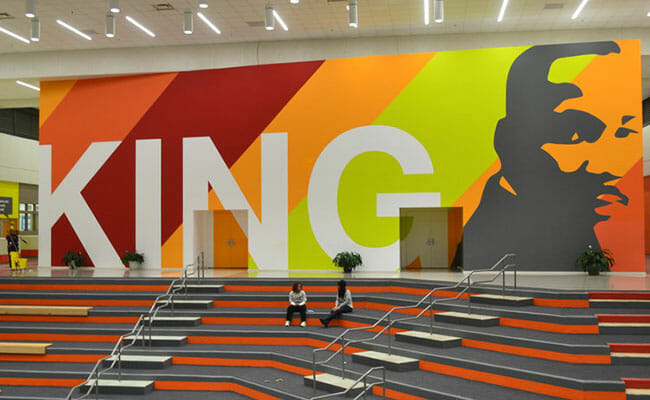
At Atlanta’s Martin Luther King Jr Middle School, volunteers with Hands On Atlanta sit in front of a mural of Dr. King on MLK Day of Service.
As someone whose early career was as a civil rights attorney and who now leads a global organization focused on volunteering and service, spending the Martin Luther King Jr. holiday in Atlanta is a full circle experience. In the span of five days, we joined this community to honor civil rights leaders; break bread together while discussing economic justice; roll up our sleeves to offer love and care to a west Atlanta neighborhood; and host just more than 50 Fortune 500 companies focused on integrating social purpose with business strategy. Dr. King said, “Life’s most persistent and urgent question is ‘what are you doing for others?’” The answers we heard inspire hope.
On a national stage, at the Salute to Greatness hosted by
, Dr. Bernice King honored amazing leaders who work to make their community and our world a better place. From U.S. Sen. Corey Booker, whose policies promote the values of social and economic justice, to Puerto Rico’s San Juan Mayor Carmen Yulín Cruz who has been a light in the darkness, leading her community out of despair after a devastating hurricane, to Hamdi Ulukaya, the founder and CEO of Chobani, who shared that his company’s values include producing affordable nutritious food and its employees’ rights. These honorees demonstrate what’s possible when you value and commit to doing what’s right.
Dr. King’s teachings show us that agreeing on “what’s right” isn’t easy but can come from meaningful dialogue about difficult subjects. Rooted in that philosophy, Points of Light provides tools for hosting
to offer a facilitated forum for people to come together, have tough conversations, learn from each other and discover actionable solutions. This year, our affiliate
, which gave the entire community a chance to be part of a rich discussion about economic justice and opportunity. The growth of this event, the attendance and engagement demonstrate the need and desire of community to share, reflect and problem-solve, together.
Photo courtesy of Hands On Atlanta
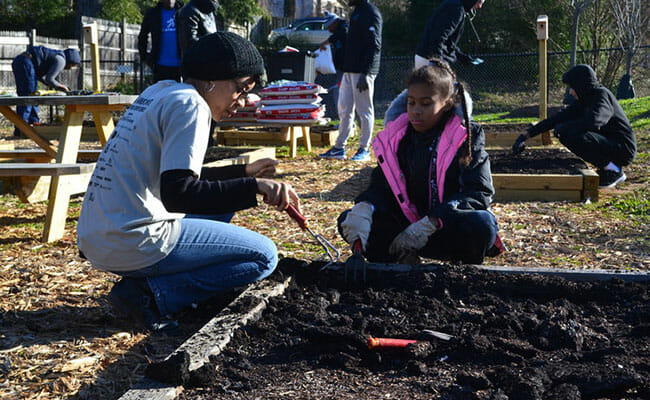
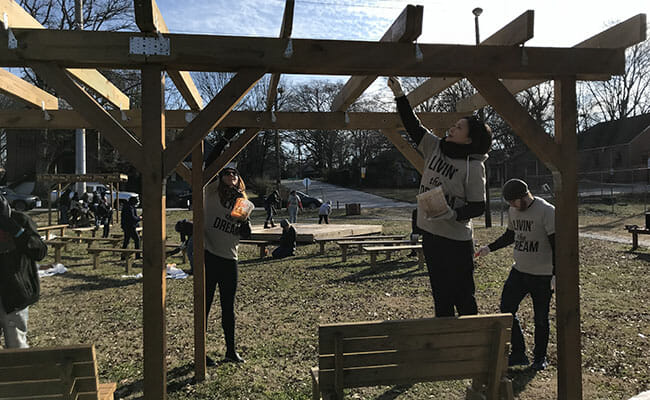
Volunteers do some gardening work as part of a beautification project in Atlanta’s English Avenue neighborhood on MLK Day of Service.
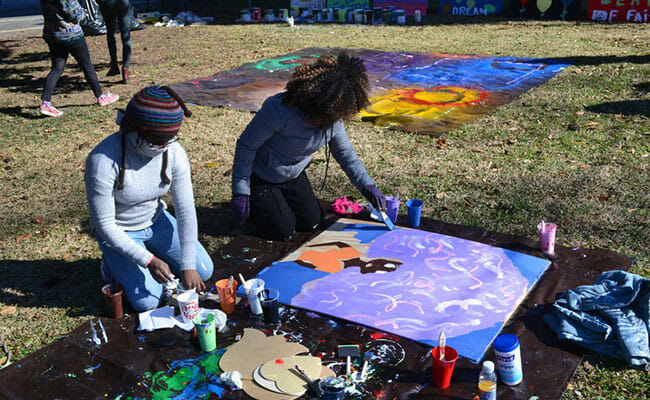
Despite frigid temperatures in Atlanta, the MLK Day of Service was reinvigorating as nearly 150 people rolled up the sleeves of their big, bulky coats and got to work in the city’s English Avenue neighborhood. The volunteers, including residents, along with Southwest Airlines and KPMG employees, and members of the Points of Light Corporate Service Council, cleaned up a park, restriped a parking lot, and painted vibrant art boards with inspirational messages. These projects were part of Points of Light’s Resilient Communities work with Southwest Airlines, an 18-month initiative in partnership with three of our local affiliates. Hands On Atlanta’s focus effort in English Avenue has been in collaboration with residents, like Annie Moore, to revitalize the area. Annie freely and wholeheartedly chooses to make every day a day about serving and being a light for others, and we were honored to recognize her with Daily Point of Light Award No. 6,175.
The English Avenue service projects were a subset of
across the city organized by Hands On Atlanta that engaged nearly 1,900 people as volunteers. These efforts are representative of the energy and activity across the country in which Points of Light, our affiliates and grantees engaged nearly 150,000 people in service projects and Sunday Suppers.
Our greatest opportunity for meaningful impact is through this coordinated effort that includes residents, community leaders and business leaders. More than 50 corporate partners that are focused on integrating social purpose into their business strategy joined us in Atlanta to connect and collaborate as part of our
. UPS Chairman and CEO David Abney, along with chief diversity and inclusion officer and UPS Foundation President Eduardo Martinez, welcomed us to the company’s headquarters where a diverse group of speakers representing small and large companies discussed everything from data philanthropy to storytelling. This determined group wasn’t deterred by the snow and ice that closed down the city on day two, as our Points of Light team quickly organized what would have been workshops into webinars. More than 50 participants who had traveled to Atlanta stayed warm in their hotels and joined the online discussions and we didn’t miss a beat.
This series of events marking Dr. Martin Luther King’s birthday throughout the week is significant. It shows us that even as we approach 50 years since Dr. King’s voice was silenced, his vision was not and his legacy lives on through the ways in which we answer that question, “what are you doing for others?”
Connecting Atlanta Volunteers with Opportunities to ‘Do Something Good,’ on MLK Day and Beyond
“Everybody can be great, because everybody can serve. … You only need a heart full of grace, a soul generated by love.” – Dr. Martin Luther King Jr.
Each year on the third Monday in January, friends, family, coworkers and neighbors come together in communities across the nation to honor the legacy of Dr. Martin Luther King Jr. through acts of service. The largest national day of service, MLK Day is an opportunity for all of us to reflect on gains won during the Civil Rights Movement and to address contemporary issues facing our nation through meaningful civic dialogue and community volunteerism.
At
, a Points of Light affiliate, it is also an opportunity to celebrate Dr. King in the city where he was born and raised. Founded nearly 30 years ago, in 1989, Hands On Atlanta’s mission is to “tackle greater Atlanta’s most pressing needs by igniting a passion for service and creating life-long community volunteers.” Engaging volunteers year-round in programs focused on youth and families, education, hunger and homelessness, their work breathes new life into Dr. King’s vision of neighbors working together for the betterment of their communities, and our world.
“We’re the volunteer hub for the city of Atlanta,” said Tim Adkins, director of marketing and communications at Hands On Atlanta. “Like most other affiliates in the Points of Light Network, our job is to connect changemakers – you know, volunteers – to nonprofits and schools in need. We engage about 20,000 volunteers every year, over the course of 150,000 service hours with projects that we have
anniversary of Dr. King’s assassination, which occurred April 4, 1968, in Memphis, Tennessee. At the time, he was focused on a project he called the Poor People’s Campaign, which sought to address income inequality. To mark the anniversary, this year Hands On Atlanta partnered with
and committed to “50 Acts of Service” – 30 projects to be done on the MLK Day holiday, and 20 more to be completed between January and April.
“Dr. King’s commitment to service and helping others is at the core of our work. Like Dr. King, we also believe that, ‘everyone can be great, because anyone can serve.’ As the needs for Atlanta continue to grow, the demand for volunteers is greater than ever, and it’s our job to connect our network of volunteers to our nonprofit partners and schools who need their help,” said Tim. “Going big for MLK Day is a way for us to honor Dr. King’s legacy while showcasing the work with do 365 days a year.”
At parks and schools, nature preserves and underserved neighborhoods, hundreds of volunteers built benches, planted gardens, maintained trails, painted and beautified communal spaces. Still others volunteered at food pantries and community outreach organizations, organizing donations, assembling lunches for school children, boxing and delivering meals to seniors – and so much more. In total, Hands On Atlanta engaged more than 1,800 volunteers, who gave nearly 5,000 hours of their time on MLK Day.
Longtime volunteer Donnis Davis sorted and distributed food to pre-screened families in need.
“The coolest thing about it is the church where the food distribution program is held was once led by Ralph David Abernathy (a close colleague of Martin Luther King),” said Donnis. Dr. King had visited West Hunter Street Baptist Church, he said, and the congregation is proud to be affiliated with Ralph Abernathy.
Donnis, a finance manager for a local car dealership, has volunteered with Hands On Atlanta for 20 years, doing everything from painting houses and schools to packaging and distributing food, to planting gardens and doing landscaping.
This year, as part of Hands On Atlanta’s Civic Leadership Program, Donnis is committed to a yearlong partnership with Southwest Ecumenical Emergency Assistance Center, a group of churches that addresses hunger, unemployment and health. It offers a monthly food distribution program, a weekly food pantry and regular classes in job interviewing skills. A clothing closet provides business attire for people who can’t afford to buy a new outfit for an interview.
For Donnis, whose large family has always been active in church in community, volunteering gives him the “chance to do something positive with so negative stuff going on in the world.”
“It’s basically like therapy,” said Davis, who adds that volunteering has helped him improve his organizational and communication skills. “It’s made me more open-minded and empathetic.”
Sunday Suppers
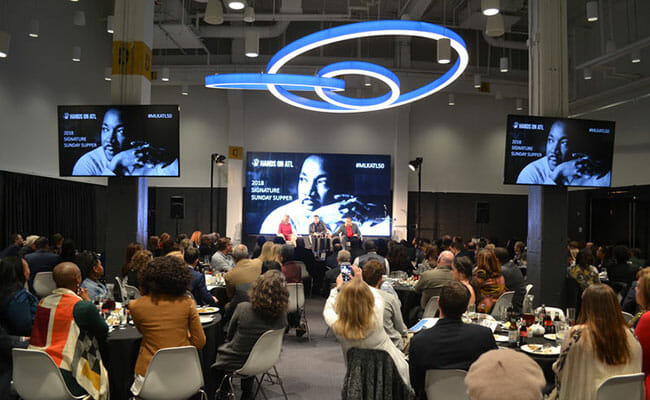
A newer initiative of Hands On Atlanta is the Signature Sunday Supper event. Since 2015, corporate and community leaders have gathered for dinner on the Sunday before the King Holiday. Speakers lead discussion about topics pertinent to Dr. King’s mission – acknowledging that many of these problems continue to exist today.
“We want to have an open and honest conversation about possible solutions,” said Tim. “Hands On Atlanta wants to be able to lead those conversations.”
, a Points of Light program, is inspired by Dr. King’s vision that people of diverse backgrounds would come together to discuss injustices of the day and create a plan for action. The events, which can be hosted by organizations and individuals alike, call people to share a meal and engage in dialogue about issues affecting their communities.
This year, about 250 people attended the Hands On Atlanta Signature Sunday Supper at The Gathering Spot. Speakers included Nathaniel Smith, founder and CEO of the Partnership for Southern Equity; Dedrick Asante-Muhammad, senior fellow, racial wealth divide, with Prosperity Now; Natalye Paquin, CEO of Points of Light; and Lori George Billingsley, vice president of community relations at Coca-Cola North America. Cheryl Preheim, evening anchor with 11Alive news, was the emcee. The livestream of the event, which was shared on Facebook, received more than 50,000 views nationwide – from Atlanta, to Tacoma, Washington, to Chicago and New Jersey.
In addition, individuals throughout Atlanta were invited to host their own Sunday Suppers, in conjunction with Civic Dinners, an organization that provides a template for discussion topics. Hosts were urged to invite guests with different points of view.
Rachel Sprecher was excited to host a Sunday Supper, along with her husband and three other couples in their late 20s or early 30s.
“I think it’s great, and something we probably don’t do enough of – get together with like-minded, action-oriented peers to talk about issues,” said Rachel. “I really like the idea of having 50 of them, celebrating the legacy of Dr. King. I like that at the same time, on the same night, this will be happening all over Atlanta.”
Rachel also works with Hands On Atlanta through her job with Atlanta Public Schools, where she is executive director in the district’s office of partnerships and development. “Hands On Atlanta recruits volunteers to do projects at our schools,” she explained. “They do beautification projects; they do Saturday programming for our students, help with tutoring and mentoring – pretty much anything we need, they step up and volunteer.”
With MLK Day behind them, the team at Hands On Atlanta looks forward to doing more good in 2018. Their year-round programming focuses on the impact areas of youth development, family support and self-sufficiency, and education – 75% of all volunteer opportunities available through Hands On Atlanta focus on education and youth hunger.
, a popular “Saturday School” program, provides tutoring and homework help, STEM enrichment, health and wellness activities, and more. Building on the success of the initiative, the organization has developed programming to give parents the tools and resources for their kids to be successful, including the
program that provides weekend backpacks filled with food. And this year, says Tim, Hands On Atlanta will launch a new “at work” program for employers to engage their employees in the parenting skills needed to ensure their children are developing literacy skills.
Make a New Year’s Resolution Your Company Can Keep in 2018
For most, the beginning of the year means one thing: New Year’s resolutions. Every new year brings a chance for improvement, a chance to better oneself not just in January, but throughout the entire year.
While many of us abandon our ambitious gym goals after just a few days, improving upon your corporate citizenship initiatives is an objective well within reach. The Civic 50, an initiative of Points of Light, annually recognizes and honors the 50 most community-minded companies in the nation. How? Through a quantitative annual survey that looks at four dimensions of corporate community engagement programs: investment, integration, institutionalization, and impact. In other terms:
Investment: How extensively and strategically does the company apply its resources to community engagement in the United States, including employee time and skills, cash, in-kind giving and leadership?
Integration: How does the company integrate its U.S. community engagement programs into key business functions, including employee engagement, marketing/PR, diversity and inclusion, recruiting, stakeholder relations and skill development?
Institutionalization: How does the company support community engagement in the United States through organizational policies, systems and incentives?
Impact: How does the company measure the social and business impact of its U.S. community engagement program?
While we can’t promise that every company that takes the Civic 50 survey will be recognized as an honoree, there is one thing we can guarantee: applying to the Civic 50 will help you and your team evaluate your community engagement program as related to these four dimensions, while also providing you with a personalized scorecard that ranks your company against the other applicants. Every company that takes the Civic 50 survey receives a benchmark to gauge organizational progress against a core group of leading organizations – true peers.
Time and time again, we hear from Civic 50 companies that the survey is an annual exercise for its corporate citizenship team to scrutinize their community engagement program’s impact, investment tactics, and overall integration and institutionalization into business strategy. The Civic 50 not only is a means to celebrate the great work companies are doing to strengthen the communities where they do business – it’s also a way to strengthen their programs through extensive analysis and inspiration from fellow applicants and honorees.
The evaluation doesn’t stop once the survey is submitted: companies receive scorecards from survey partner True Impact in the spring of 2018. These scorecards summarize how your company scored on the survey, ranked in each dimension, and more. The three options for the scorecard include:
Individual Scorecard | Free of charge: This one-page scorecard includes your company’s score, ranking as compared to all Civic 50 participants, and tier for each of the four dimensions.
Sector Scorecard | $1,500: In addition to all the content included with the individual scorecard, this enhanced scorecard includes sector-specific rankings and tier categorizations to quantify your performance as compared to your peers, and the additional percentage needed to be in top performance tiers for each dimension.
Comprehensive Scorecard | $3,500: The comprehensive scorecard builds upon the content of the individual and sector scorecards, adding question-specific rankings and benchmarks, information on score distribution across all companies and where your company falls, and more.
These scorecards help you take a deep dive into your corporate responsibility initiatives and provide a springboard for improvement in 2018 and beyond. Learn more about the different scorecards.
The Civic 50 sets the standard for excellence in corporate citizenship. Make 2018 your year to set yourself up for continuous improvement and distinction in community engagement. Get started.
The Civic 50 survey, powered by True Impact, is open to all private and public companies with annual revenue of $1 billion or more and operations in the United States. Learn more at www.civic50.org.
How Volunteer Organizations Across the Globe are Fighting Hunger, Providing Warmth During Cold Winter Months
Collecting warm coats for those in need sounds like a blast from the past – an age-old concept straight from a Charles Dickens novel. But wintry winds still squall and recent economic times have dramatically increased the number of homeless people and others in need of warm clothing.
At the same time, people are busier than ever and often struggling to get by themselves. Many are wary of giving money or their time to charities.
That’s why savvy charitable organizations are blasting out new ways to button down the practice of helping others. For example, coat drives are being staged in busy commuter stations, at work and at school, where people have to be anyway. The idea caught on so well in London that it’s spreading to several other cities in the United Kingdom.
Nonprofits are also cooking up better ways to feed the hungry and making it easier to distribute toys for Christmas.
In New York and Rome, fresh, healthy vegetables are joining cans and boxes of nonperishables at food pantries. New York teenagers compete in “Un-Hunger Games” to collect food donations. And in New Jersey, residents are flocking online to buy the exact toy a needy child wants with the click of a mouse, arranging for delivery by Amazon.
Nonprofit organizations that coordinate volunteer projects have embraced the Internet to allow people to browse online and click on opportunities that fit their busy schedules and interests. Social media is being used to spread the word about legitimate ways to help others and to showcase the results. Heartwarming photos are posted, further encouraging the generosity.
During this year’s holiday season, we are proud to shine a spotlight on four Points of Light Network affiliate organizations – each engaged in innovative charitable work that couldn’t be done without dedicated volunteers: Jersey Cares and Volunteer New York! in the United States, and Hands On London and RomAltruista in Europe.
Improved Coat Drives
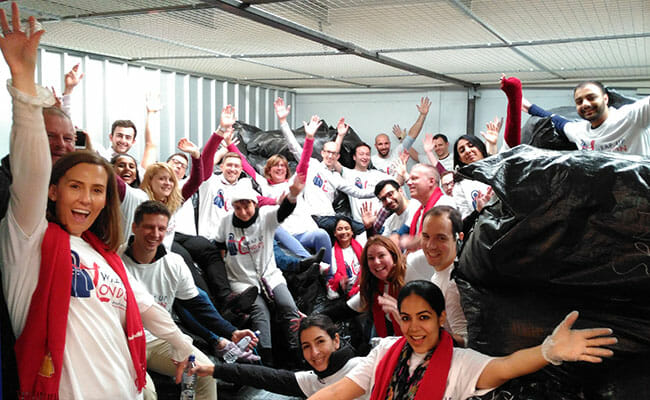
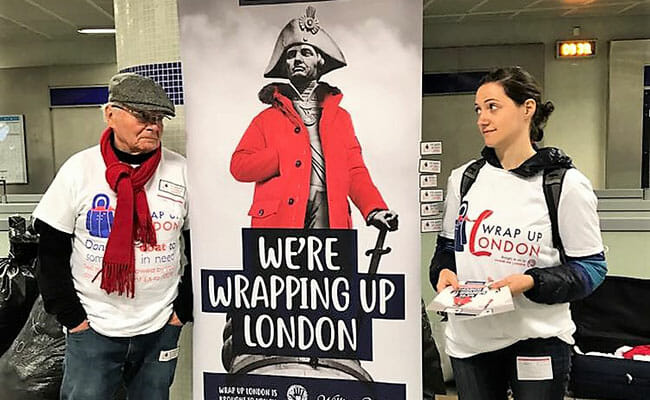
Wrap Up London, a 7-year-old project of Hands On London, sets up coat donation areas each November in Tube (underground transit) stations, where commuters donated 20,846 coats this year.
Amy Grant, a volunteer with Wrap Up London, says the method resonates with busy working people.
“I was first drawn to the cause because the premise is so brilliant in its simplicity,” Amy said. “Wrap Up London doesn’t ask for money – I love shouting that out when I’m volunteering at a Tube station – and almost everyone has an old coat they can part with.”
The idea proved contagious. Wrap Up Manchester is now in its second year, collecting 1,575 coats this season. Two more cities in the United Kingdom started drives this year: Wrap Up Birmingham (687 coats) and Wrap Up Glasgow (1,000 coats). Now, the city of Nottingham wants its own coat drive, too.
Jon Meech, CEO of Hands On London and project team leader, said the gift of a coat can open the door to other social services for struggling people.
“We know that at this time of year, many people turn up to support services with little other than what they are standing up in,” said Jon. “This is particularly the case for young people finding themselves homeless and women escaping domestic violence, although the lack of warm clothing is an issue for all vulnerable groups. For those living on the streets during the winter, outerwear does not last long.”
Though many nonprofits receive donations of food and clothing throughout the year, they typically do not receive many winter coats, according to Jon. “One women’s refuge commented this year that prior to knowing about Wrap Up London, they were forced to fundraise for the purchase of secondhand coats from thrift shops,” he said. Since Wrap Up London started in 2011, Hands On London has collected and distributed 102,027 warm coats.
Social media and mass transit proved to be key elements in expanding Wrap Up London to other cities in the UK.
The initiative caught the attention of Samra Said, UK programmes manager for Human Appeal – an international relief agency focused on providing humanitarian aid and eradicating poverty – who reached out to Hands On London via Twitter. The Wrap Up London program, said Samra, “embeds our core message of helping the most vulnerable people survive the winter.”
Hands On London provided a license for Human Appeal to use the trademarked “Wrap Up” program name, and extended thorough training and advice to help them launch the initiative, first in Manchester and then in Glasgow and Birmingham. They also negotiated local storage for Human Appeal through some of Hands On London’s corporate partners. Branding, campaign messages and dates are consistent across all four cities.
“At Human Appeal, we believe together we are stronger and we enhance that by working in partnership rather than overlapping,” said Samra.
Wrap Up Manchester also found success in appealing to commuters. It partnered with Network Rail to bring the campaign to Manchester Piccadilly station – collecting 600 coats in three days from Nov. 13-15. Non-commuters could also donate coats to selected self-storage centers across Manchester, Glasgow and Birmingham.
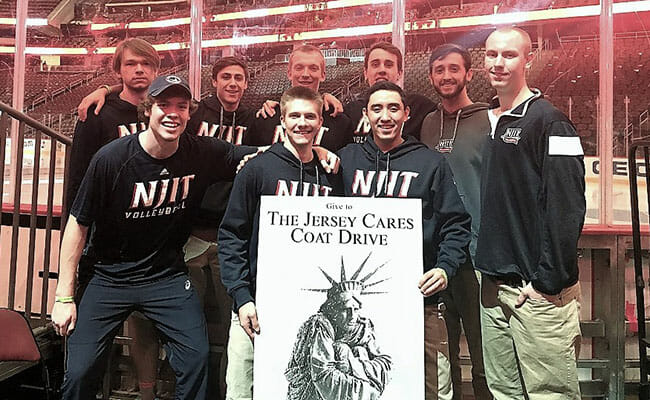
Meanwhile, on the other side of the Atlantic Ocean, Jersey Cares, an organization that links volunteers with worthy causes throughout the state of New Jersey, has held its fall coat drive for 22 years – but staff say they’ve never seen a response like this year, both in the volume of coats donated, and the number of businesses, Scouts and other groups holding collections.
“Just today, we had somebody sign up,” said Vanessa Martinez, Jersey Cares service events manager, on the final day of the event. “Some people who didn’t sign up still want to participate.”
Jersey Cares has been sharing eye-catching photos on social media to remind the public how “cool” winter giving can be. One ad shows the Statue of Liberty shivering without a coat as snowflakes swirl; another shows a cat poking its head from a parka.
“Our social media reach has grown over the past year,” notes Michelle Dee, vice president of external affairs for Jersey Cares. “We try to post pictures of kids getting coats. We talk about how a coat is not a luxury – it’s a senior being able to walk to the store to get medicine on a cold day – people are really able to make that connection.”
Michelle adds that corporate interest has also grown. “We’ve also seen a lot more businesses getting the word out, as well as large corporations doing a coat drive. For example, Robert Wood Johnson Barnabas Health is doing a drive at all 13 of their locations statewide.”
Jersey Cares uses shipping containers to consolidate coats collected at nearly 300 sites. The containers can be driven to shelters, churches and social organizations throughout the state.
This year, a dozen 8-foot tall shipping containers were packed. “Usually, the containers are about half full, and I would say this year, the majority are at least 80 percent full,” said Michelle. “We’re so happy and grateful, especially since I get to tell agencies their requested number will be filled this year, which isn’t always the case.”
And that’s where valuable volunteers come in.
Teams of 10 to 20 people at each location sort, count and examine each coat, making sure it’s clean and usable. Volunteers also separate lighter attire, such as hoodies, hats and gloves, to be distributed elsewhere.
“Our volunteers come together and take all the collected coats, sort and distribute them in one day,” said Vanessa. “We wouldn’t be as successful as we are if not for our volunteers.”
Fleeing War, Finding Hope
RomAltruista, our affiliate in Rome, works tirelessly to help disadvantaged populations find food, shelter, education and jobs. Founded in 2011, it’s had success with “flexible volunteering,” whereby volunteers can browse the organization’s website for projects by theme: animals, environment, elderly, disabled, etc., and sign up for dates by clicking on the online calendar. Schedules are confirmed by email.
In Italy, some of the most vulnerable groups served by RomAltruista are immigrants and refugees. According to a story on BBC posted in July, “more than 500,000 migrants have passed through Italian ports since 2014, and numbers are on the rise again. … Italy is the main destination for migrants attempting to reach Europe by sea, due to its proximity to Libya. According to the United Nations, 83,650 people have reached Italy by sea since the beginning of the year – a 20 percent increase on the same period in 2016.”
Mauro Cipparone, president and co-founder of RomAltruista, coordinates volunteers for several agencies that help the homeless, whether immigrants or native Italians. “Our partner organizations serve food on the streets,” said Mauro. “There are three main train stations in Rome. Every night of the year, at least one organization is serving food there.”
Helping immigrants appeals to Maria Baroni, a retired business professional with experience in organizing events and working with public authorities. She’s become a permanent volunteer with Casa Africa, a RomAltruista partner organization that helps immigrants obtain food, housing, jobs, child care and more.
One of the group’s biggest goals is helping newcomers learn to speak and read Italian, so they can get jobs. Since 2009, Casa Africa has offered an Italian language school at no cost for immigrants and asylum seekers from many areas of the world, including Latin America, China, the Middle East and the Philippines, in addition to Africa. Open four hours a day, five days a week, all months of the year, Casa Africa currently has 250 students. To Maria’s surprise, students even flock to the school in summer, despite the tempting surroundings. “The school is located close to Piazza del Popolo, Piazza di Spagna, Fontana di Trevi, the most attractive places in Rome,” she explained.
“I found my happiness,” Maria said of her volunteer work with Casa Africa. “There are people from different countries; my colleagues are very open-minded. It was perfect for me!”
“We also teach them the fundamental principles of the Italian democratic Constitution,” Maria added with pride. “They have the opportunity to express their opinions about dignity, equality, law, freedom, respect, citizenship, immigrant rights, etc.” Students also visit Italy’s “White House,” the Quirinale Palace presidential residence.
During 2017, about 75 volunteers from RomAltruista helped at the school.
To reach out further to immigrants, RomAltruista launched a new project: Welcome Dinners. “We aim to break the barriers between new arrivals and people who live in Rome,” said Mauro. “At each dinner, there are four locals, four newcomers and one facilitator, and every participant brings food – like a potluck. It helps foreigners and locals get to know each other and counteract bad press – immigrants only seem to appear in the news when there is a crime or something like that. We want people to get to get the direct experience of the immigrants so they can realize they are just normal people.”
Once again, social media generates positive visibility. Participants at Welcome Dinners are asked afterward to post a few words describing their experience on Facebook. Words posted so far include: “warm,” “sharing,” “brotherhood,” “pleasant,” “friendship” and “harmony.”
Better Food for Pantries
In New York, donations to food pantries now include fresh, locally grown vegetables, thanks to the efforts of Volunteer New York! The organization, which coordinates a wide variety of volunteer opportunities, has partnered with an energetic gardener, Amy Benerose, who created Our New Way Garden as a way to grow organic produce to serve urban areas that otherwise rely on canned and boxed foods.
“People who have the means can go to farmer’s markets or stores that carry organic produce,” Amy said. “If we really want to help with the problem [of nutrition], we have to make sure everybody gets access to organic food.”
As Amy has expanded from one to five gardens, volunteers are key to getting the produce planted, harvested and delivered.
“Last year, we grew about 20,000 pounds of vegetables and distributed most of them to local food pantries. The quality is really good because it’s grown locally,” said Amy.
The harvest includes corn, eggplant, squash, peppers, melons, pumpkins, lettuce and more, along with herbs and garlic. In addition, Our New Way Garden is raising fruit trees and hopes to build a greenhouse for future year-round crops.
Volunteer New York! uses other creative ideas as part of its Hunger Relief Corps program. Launched in 2015, the program works with soup kitchens, mobile meals for cancer patients and corporate food drives. To make it easier for busy people to donate, “Fill Me Up and Donate Me,” bags are handed out at food pantries, printed with a list of most-wanted items.
During Hunger and Homelessness Week, the “Un-Hunger Games” challenged three high schools to bring in the most food. The initiative was a phenomenal success, with the smallest school bringing in the most donations, said Wendy Armstrong, manager of the Hunger Relief Corps.
In Italy, urban gardens also have sprung up, not only to grow food, but to provide satisfying endeavors for volunteers, including people with disabilities and refugees.
“Its goal is social integration and empowerment for participants,” said Damiano Fiamin, who helps lead the Coltiva Torre garden, located in Rome’s Aniene Valley nature reserve. “We work with the park management, which provides us with water and gives us the boundaries in which we can move without ruining the ecosystem in which we (and another private urban garden) operate.”
Since turning to RomAltruista for help, the garden has found it easier to recruit volunteers, he adds.
Fulfilling Wishes in Just Minutes
Making things easier for donors was the inspiration for Frosty’s Friends, a Jersey Cares project that helps match children with the perfect donated toys. Children selected by social workers, teachers, foster care, etc., are encouraged to write letters to “Frosty,” naming items they want.
“How we differ from a toy drive is that rather than just buying a toy and putting it in a bin, you receive a letter from a child and you get to fulfill that specific wish,” said Jersey Cares’ Vanessa Martinez. “Last year, we filled 2,500 wishes, and this year, we’re well over 4,000 wishes. It’s pretty magical.”
Companies like the ease of distributing Frosty letters among employees. But individuals – even homebound ones – can also join in, easily finding children’s letters on the Jersey Cares social media sites. They can choose from an Amazon wish list that allows them to order and arrange delivery online.
“It’s really a matter of three clicks,” said Jenny Lewellen, senior manager of service events. “It’s really an awesome way for people who don’t have time or the ability to go to a store.” The Amazon donation lists often “sell out” within hours of being posted, she said.




 As communities around the world face continuous societal shifts, including, diverse political, economic and social challenges, companies are stepping up as leaders and advocates in social action, policy and community-building. Participants in the Business Path at Service Unites will leave inspired and equipped to amplify corporate values through employee engagement and position their businesses as a force for good.