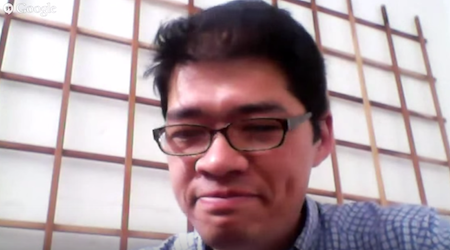
Virtual volunteering is a trend that promises to grow, as more and more of our lives move online. In this Q&A, Yvonne Siu Turner of Points of Light sat down with Jared Chung, founder of CareerVillage.org, an organization that crowdsources career advice for at-risk youth, to explore the growing micro and virtual volunteering movement.
In this video, learn about virtual volunteering from Jared Chung, founder of CareerVillage.org.
Q: What is virtual volunteering?
A: Virtual volunteering – sometimes called “e-volunteering” – is any kind of volunteering that supports a cause with a primarily online interaction. In some cases, I’ve seen virtual volunteer activities kick off or end with an in-person activity, but the core of the volunteering program takes place online.
Virtual volunteering is actually not that new – it started to emerge in the 1990s and is now maturing with some really interesting models.
Q: How do people volunteer virtually?
A: There are a couple of flavors of virtual volunteering: the remote/telecommuting model and what I would call the “Virtual Volunteering 2.0” model. With the remote/telecommuting model, you can do a pro bono marketing project, for example, for a nonprofit organization in another city, state or country.
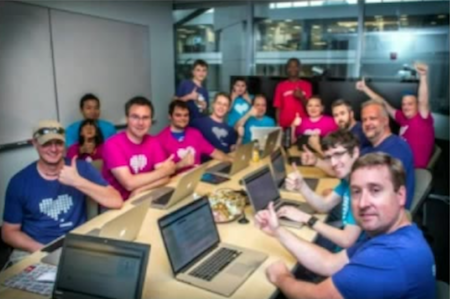
Zynga employees volunteer virtually together during the company’s Spring Service Days.
In that case, the volunteer’s communications with the NGO (nongovernmental organization) and the core project would be done virtually. You could find those opportunities on marketplaces including UN Volunteers, Points of Light’s AllforGood.org, or VolunteerMatch.
The other flavor of virtual volunteering is the Virtual Volunteering 2.0 model. These are volunteer projects that are enabled only through the Internet, and are in many ways similar to the Web 2.0 revolution in usability and interaction. Wikipedia, which allows volunteers to contribute to an online encyclopedia, is a good example. Crisis Text Line, which allows volunteers at home to text message with young people who are facing a personal crisis, is another.
CareerVillage.org, the organization I lead, uses online volunteers to share career advice with low-income youth over the Internet. Since we started three years ago, we have scaled to reach over 500,000 learners who are using the platform to get advice from our online volunteers.
Q. What’s unique about virtual volunteering?
One of the nice things about virtual volunteering is that we tend to engage a lot of first-time volunteers. In fact, 80 percent of volunteers who sign up through CareerVillage are first-time volunteers. There are a lot of reasons for this. First, it’s accessible and inclusive – anyone with access to the Internet can participate in CareerVillage.org or a virtual program.
Second, virtual volunteering is very flexible, so it’s a great option for employees or people that don’t have a lot of spare time. For example, at CareerVillage volunteers can share advice in 15-minute increments on their break during the day or on nights and weekends, as projects aren’t as time sensitive.
Third, it’s easy to get started – on CareerVillage we have our volunteers create an account with their LinkedIn account so they can be up and running within a minute or two giving advice to students.
Q. What has surprised you most about virtual volunteering?
Probably the most gratifying discovery has been that we haven’t lost the humanity of volunteering by going online. Actually, it turns out volunteering online has just as much personality and humanity as volunteering in-person. Young, Internet-connected volunteers don’t actually have to see the face of the beneficiary every time they do a service activity online.
If they can connect a couple times with the beneficiary – at the beginning and end of a project – they still feel like there’s a face behind the screen and that they are having a big impact. So, we’re seeing that the Internet has not dehumanized volunteering. It has actually become a catalyst to unlock even more volunteers in service to their communities. And that’s exciting.
Q. How can people get involved?
If you’re looking for a personal volunteer opportunity, please consider signing up as a volunteer at any of the platforms I mentioned (Wikipedia, Crisis Text Line or CareerVillage.org).
If you’re looking to explore virtual volunteering broadly, I’d encourage you to reach out to Points of Light (at [email protected]) for other great examples of virtual volunteer programs, or search for opportunities on AllforGood.org or other online volunteer marketplaces.
If you’re a corporate social responsibility professional looking for a virtual volunteering program to engage your employees, we can also help with that (for example, by email we’re available at [email protected]).
When Startups Take on Gender Inequality, Women and Girls Win
This post is by Ayesha Khanna, founder and president of the Points of Light Civic Accelerator, which works with impact entrepreneurs to scale their social innovations; Joy Anderson, founder and president of the Criterion Institute, which approaches social change by intentionally changing markets; and Teresa Younger, CEO of the Ms. Foundation for Women, which is devoted to securing rights, equality and justice for women.
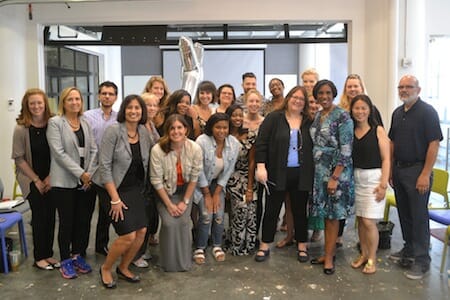
The Points of Light Civic Accelerator convened social ventures helping women and girls succeed.
It has been a great summer for women and families in the U.S. The Women’s National Team won the 2015 Women’s World Cup. There is a serious female contender for president. And our Supreme Court ruled to legalize same-sex marriage in all 50 states and uphold the Affordable Care Act, opening up access to health insurance for many.
Despite recent gains, gender inequality is still alive and well. Women are only earning 75 percent what men earn, with a more significant gap for working women of color. Women also represent a small percentage of executive officers (14.6 percent) and Fortune 500 CEOs (4.6 percent).
With that backdrop, the Points of Light Civic Accelerator last spring convened 13 cutting-edge social ventures from across the country, all focused on helping women and girls fully participate and succeed in our global economy.
The accelerator is a 12-week boot camp for nonprofit and for-profit startups; through a series of in-person sessions and a rigorous online curriculum, participants learn from leaders – in business and community, design thinking and startup engineering – and from each other.
Points of Light Civic Accelerator participants and advisers gather at the Centre for Social Innovation in New York during the spring session.
The Civic Accelerator’s most recent participants – the sixth group to run through the program – show how this innovative program is targeting key issues, to achieve deeper and more systemic insights and solutions.
These civic ventures are getting results in STEM (science, technology, engineering and math) education and workforce development, online harassment, and women and girls’ leadership in the U.S. and abroad. The solutions developed by these social entrepreneurs are inclusive and attempt to disrupt traditional systems that prevent women from reaching economic parity.
We had terrific guest faculty join us for the spring session, including Criterion Institute founder and president Joy Anderson and Ms. Foundation for Women president and CEO Teresa C. Younger.
We touched on many topics ranging from the intersections of gender, power and race to how the work of these startups fits within the context of gender equality writ large. Below are some of our shared reflections and insights from this dialogue.
Gender Lens – Beyond Women and Girls
When it comes to women and girls, our efforts to address gender inequity tend to focus on the individual – solutions to improve skills, opportunities and access. However, all genders need to be engaged to address the power dynamic and systems change required to build a truly inclusive society that takes advantage of everyone’s talents and contributions.
The Civic Accelerator’s recent participants were focused on building inclusive and innovative models that attempt to influence and change biased systems and markets to allow women and girls to more readily and successfully participate and succeed.
As we discussed how to define success at various levels – venture, organization and system-wide – we noticed the tendency to do a relatively simple count of women and girls (the number of girls in STEM programs or women leaders, for example) as primary indicators of progress.
While important, this approach limits our ability to interpret the complexity of the systems at play and does not reflect the fact that gender is a dynamic concept that defines norms, behaviors and identities that may be valued in a culture (or not).
The Role of Power
Leaders, including these venture founders, can use their power, networks and knowledge to create more access and equity. Influential leaders who are personally committed to speaking up and making decisions – who put themselves and their credibility on the line to create more equitable policies and practices – are what it takes to change an organization and the broader culture.
Proactively inviting diverse and opposing individuals and organizations to participate in a process, rather than attempting to join a process where they are excluded – the power of invitation – was a strategy we shared with the entrepreneurs.
Understanding perceptions of status and influence matters when you are fighting for access to capital and customers yourself. Systems change leaders have a double burden, as they need to think about what their ventures need, but also place those needs in the context of broader systems of power they are seeking to change.
This process requires constant navigation, as these leaders think about building non-traditional relationships and aligning with power brokers, in ways that move the system change forward. It is this larger change that is necessary for these ventures to ultimately scale.
This situation applies to women today who are juggling work, family demands and life, as they think about their roles in the broader movement. Women are disproportionately responsible for caregiving, even when employed outside of the home.
That means that when we work on workplace issues, we have to consider the realities of women’s lives – especially low-wage and immigrant women and women of color. For instance, access to affordable, quality childcare is essential for women’s economic empowerment. Likewise, workplace safety must also include measures to protect women from domestic violence, as nearly a third of women killed in U.S. workplaces between 2003-2008 were killed by a current or former intimate partner.
Enterprise vs. System Change
There is a difference between investing in individual ventures that are addressing issues impacting women and girls, and changing the underlying systems as a whole. Founders who are launching ventures that are creating new markets, like the ones supported by the Civic Accelerator, have unique challenges as they attempt to build their ventures.
The notion that a startup can, on its own, get to the root cause of a social problem and solve it in isolation is wrong. Twitter and Airbnb took advantage of emerging market trends, but they did not create the markets themselves.
Broad system reform requires consumer and citizen education and behavior changes, institutional shifts, and new policies that can be decades in the making. Startup founders disrupting social norms are tapping into change agents and emerging customer demand.
These disruptive ventures are betting on the change to come and it will require cross-sector intermediaries, larger institutions and governments working together to create strategies that shift the bigger system.
While this innovative class of change makers is creating a brighter future for women and girls, we know we need to do a lot more to build ecosystems that are not only supporting their success, but also focus on changing the systems that keep equality out of reach for women around the world.
Her Love for a Bear Led to a Cherished Volunteer Journey
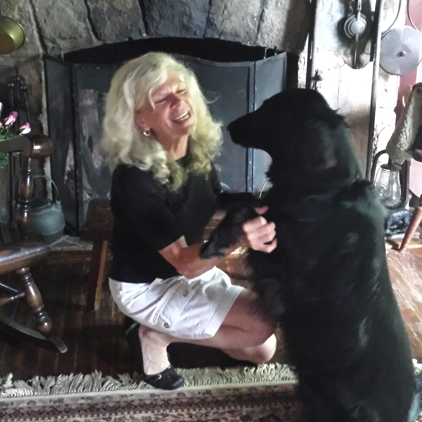
Patty Bailey loved a Bear. Well, a dog named Bear. An adopted flat-coated retriever/Newfoundland mix, which she traveled from New Jersey to Georgia to find, had what some might describe as a higher calling.
Patty Bailey
“From the moment we picked Bear up he was so full of love and compassion, we just had to share him with others,” says Bailey, of Sparta, New Jersey. “What we decided to do was very simple – bring Bear to hospitals and nursing homes to interact with children and seniors.”
Through Pass It Along, part of Points of Light’s HandsOn Network, Bailey would bring Bear to visit with folks of all ages in need of a little extra joy in their lives. Her favorite part was seeing faces light up and helping seniors remember their own pets from the past. Bear was so loved that he was voted Volunteer of the Month.
Bailey grew up in northern New Jersey and eventually became a schoolteacher. She taught elementary school for 30 years before retiring in 2001. In retirement, she still had lots of energy and wanted to get involved and help her community.
Along with her work for Pass It Along, she also volunteers at a local church soup kitchen and is a bell ringer for the Salvation Army.
For her volunteer work, Bailey was just honored recently as a Cabot Community Celebrity. Points of Light partnered with Cabot Creamery Cooperative this summer to recognize outstanding volunteers as Cabot Community Celebrities.
The farm families who own the cooperative are sending Bailey and other volunteers on a seven-day Caribbean cruise in November, to celebrate the volunteers’ contributions to communities across the country.
Bear has passed away but his spirit lives on through Jolly, a rescued flat-coated retriever and certified pet therapy dog that Bailey brings to those in need.
“I wanted to give back, share the love that I have for dogs,” Bailey says. “For the people in the nursing home, it’s their home, and bringing a smile to their face can help them get through the rough times.”
Join Nancy Pelosi, Joel Osteen and Other Distinguished Guests at Our Conference in Houston
At Points of Light’s Conference on Volunteering and Service – the world’s largest gathering of volunteer, national service and civic leaders – thousands of people who really care about the future of volunteer service come together to learn from, share with and get inspired by one another.
One of the highlights each year is hearing from our distinguished speakers, leaders who are shaping the future of volunteer and service.
We’re excited to announce some of those powerful voices, below. (See a full list here.) Come hear what they have to say – join us in Houston, Oct. 19-21!
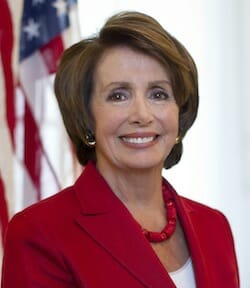
Nancy Pelosi
U.S. House of Representatives Democratic Leader
Nancy Pelosi Nancy Pelosi served as the first woman Speaker of the House, has led House Democrats for more than a decade and has represented San Francisco for 28 years. She led Congress in passing historic health insurance reform; key investments in college aid, clean energy and innovation; and initiatives to help small businesses and veterans. She is a powerful voice for civil and human rights around the world.
Joel Osteen
Pastor, Lakewood Church
Joel Osteen is a native Texan and Senior Pastor of Houston’s Lakewood Church, America’s largest Christian congregation. As one of the most influential ministries in the world, Pastor Osteen uses his global platform to serve others, a fact reflected in Lakewood’s commitment to humanitarian relief and development efforts around the world.
Anna Maria Chávez
CEO, Girl Scouts of the USA
Serving in multiple positions for President Bill Clinton and former Arizona Governor Janet Napolitano has informed Anna Maria Chávez’s dynamic leadership of Girl Scouts of the USA – a 2.8 million-member organization that offers girls a unique approach to developing their leadership skills.
Annise Parker
Mayor, City of Houston
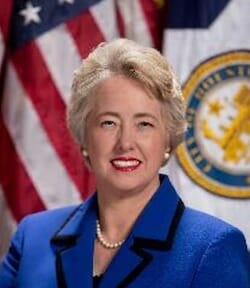
In Annise Parker’s State of the Union address she said, “I woke up one morning and discovered I lived in a thriving, exciting, hardworking global village, surrounded by immigrants and refugees and transplants and visitors and natives. And we all belong.”
Kristian Bush
Grammy Award-winning founder, Sugarland
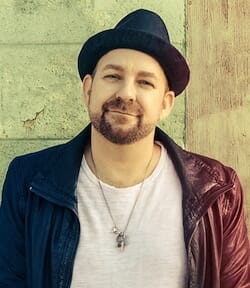
Kristian Bush, one half of platinum-selling country duo Sugarland, has been leaving his mark on music for more than two decades. A Points of Light Service Ambassador, Bush has also partnered with Goodwill Industries International to raise awareness of its message: Donate Stuff. Create Jobs. Using his hit song “Trailer Hitch,” he reminds fans all over the country to #GiveItAway.
For a list of all featured conference speakers, please click here.
Could You Use a $500 or $1,000 Grant for a Family Volunteer Day Project?
Family Volunteer Day celebrates the power of families who volunteer together, supporting their neighborhoods, communities and the world.
Points of Light created the day of service 25 years ago to showcase the benefits of volunteering as a family, including sharing quality time and imparting values.
Points of Light’s youth service division, generationOn, is offering $500 and $1,000 grants to support efforts to unite families in service for Family Volunteer Day, Nov. 21.
If you’re affiliated with a school or nonprofit, you can apply for a grant. The deadline is Aug. 14.
Join us in bringing families and communities closer together through service. For more information, or to apply, visit the generationOn website.
How an Earthquake Deepened My Commitment to Volunteer Service
This post is by Annette Sayre, a student at the University of Notre Dame. For seven years, she lived with her family in Japan, where she developed a love of volunteer service as a teen.
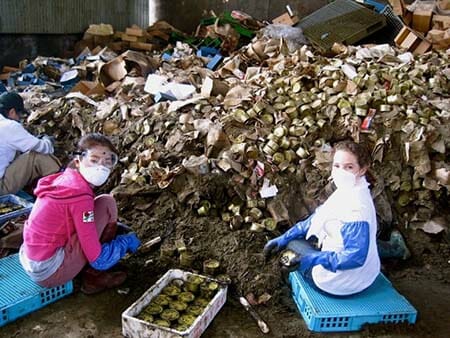
Annette Sayre, right, and another volunteer clean a fish canning warehouse after a tsunami in Japan.
Some volunteer experiences stay with you forever. Mine was in northern Japan, after a 9.0-magnitude earthquake.
March 11th, as the 2011 catastrophe is commonly known in Japan, profoundly affected the nation. Having suffered the massive earthquake, a consequent tsunami, seemingly perpetual aftershocks and a subsequent nuclear explosion in Fukushima, the Japanese people were undoubtedly united in suffering, but also in hope.
Immediately after the disaster struck, volunteers from HandsOn Tokyo – part of Points of Light’s HandsOn Network – were traveling north in buses to the devastated Tohoku region to offer their services. In June of that year I decided to go on one of the weekend Tohoku relief trips.
On the first day, our group arrived in the rice fields of Iwanuma to assist in debris cleaning. We cleared flooded homes of their furniture and valuables, discarding ruined technical equipment and soaked mattresses, and walked through flooded rice fields collecting debris that had settled on the grain.
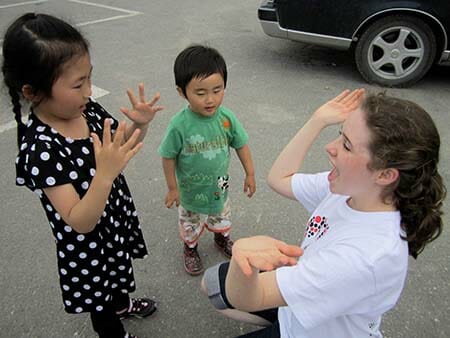
Annette Sayre, right, plays a traditional Japanese hand game called “Arupusu” with local children during a earthquake relief trip with HandsOn Tokyo.
We spent the night in Sendai, the nearest major city, and the following day we drove out to support the local residents of the severely ravaged area, Ishinomaki.
Roofs floating in the middle of the ocean, houses with broken windows jammed into gas stations and fishing boats lying sideways on main roads were a few of the images that struck me as our bus wound down a mountain to the coastal fishing city.
On the same ground that had once washed away thousands of lives, we set up our folding table and coffee maker next to a menu listing the baked goods we would be handing out at our little “cafe.”
People from the village formed two long lines to receive their share of fresh fruits and vegetables, which they had come to rely on from the HandsOn Tokyo volunteers’ weekly visits.
We then entered a crowded classroom in the refugee building on the highest hill in the area and played hand games and made crafts with children in desperate need of comfort during a traumatic and confusing period of their lives.
On the last day, we cleaned the remains of a fish canning warehouse, separating cans that were punctured and leaking from those that were still saleable.
I often think about my time in Tohoku, as it renewed my commitment to volunteer service. Wherever I call home, service will be a significant part of my life.
There are 250 HandsOn Network volunteer centers around the world. Click here to find one near you, or to search for local volunteer opportunities, visit AllforGood.org.
Teaching Children Around the World About Helping Others and the Power of Friendship
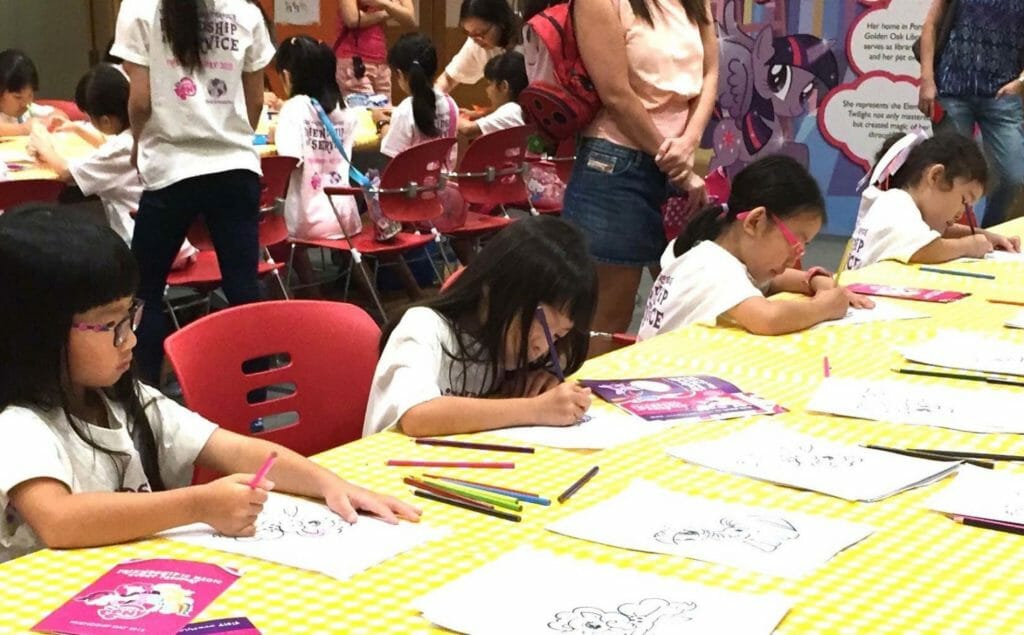
Showing that volunteering with friends and family can be lots of fun, parents and kids came together in Singapore last Saturday to do some good, while celebrating International Friendship Day.
Girls take part in a drawing activity during an International Friendship Day event in Singapore.
– the youth division of Points of Light – have launched a global campaign to encourage kids to volunteer in their schools, neighborhoods and communities.
Find out how you can your kids can celebrate by visiting
characters to teach children about helping others and the power of friendship. Four international events are set to engage hundreds of children in volunteer activities inspired by each of the six main My Little Pony characters. The first event was Saturday’s Singapore gathering, which will be followed in the coming days by events in New York City, São Paulo and London.
In Singapore, about 150 children and parents came to the Lifelong Learning Institute. In the spirit of My Little Pony, the room was filled with the magic and power of friendship.
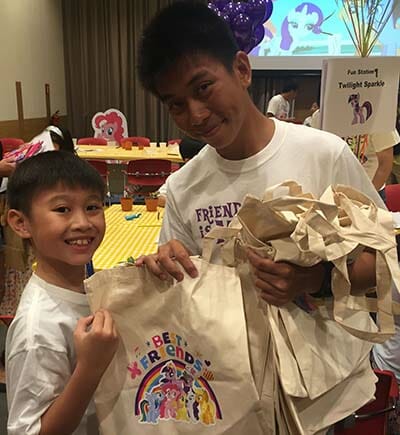
Singapore International Friendship Day volunteers left with smiles and goody bags.
Several volunteer stations were set up in a large room, each representing a My Little Pony character. At a Rainbow Dash station, kids put together “health and happiness kits” for the elderly; each kit included coffee, cookies, a toothbrush, toothpaste and more.
At a Pinkie Pie station, children decorated recycling bags that they could take home and pack with toys to donate to kids in need.
The event concluded with reflection and, in true Singapore style, a
makan
session (food with friends). Children and parents walked away with smiles on their faces and goody bags that included Play-Doh sculpture reminders to love and care for animals and plants to enhance the environment.
It was a wonderful way to celebrate International Friendship Day!
Honor Service on 9/11 by Hosting a Volunteer Service Project
Sept. 11 marks a day to commemorate tragedy and triumph, recognize heroism and sacrifice, and inspire volunteer service that makes a difference in communities.
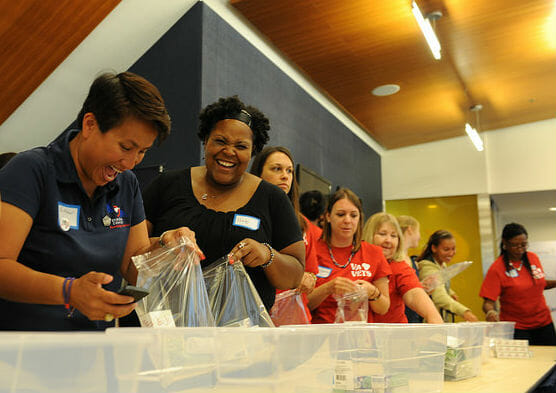
Volunteers share a lighthearted moment while assembling hygiene kits during last year’s 9/11 Day of Service.
This year, Points of Light’s Military Initiatives is inviting organizations to join a national service movement in cities across the country by hosting “Honoring Service” projects on the 9/11 Day of Service and Remembrance. To support this effort, Points of Light will provide mini-grants of $1,500 – $4,000 to 20 organizations.
Applications must be submitted by Aug. 6 at 8 p.m. Eastern to [email protected]. For more information, review the project overview, FAQ and host site application here.
For Kids, Volunteering Can Be a Fun Play Date, on Friendship Day or Any Day
“Volunteering can be fun. And you can make a difference just by going to the park and cleaning up,” says 10 year-old actress Emmy Perry, best known for her role as Kitty in “Wiener Dog Internationals” and currently filming the feature film “Scales.” “You can help your community; it’s really easy. You can make it a play date.”
Emmy Perry
Volunteer service has always been an integral part of Emmy’s life. She makes use of all the resources at her disposal – including her celebrity platform and passion for animal welfare – to give back.
She started Emmy’s Hope, a Laguna Beach, California-based charity devoted to helping homeless animals, and often includes friends in her efforts. For her past few birthdays, for example, Emmy has enlisted friends in providing supplies to animal shelters.
“I get my friends involved,” says Emmy, who gave up her last movie paycheck to help save a homeless dog. “I ask them to buy things off the shelter’s wish list for the animal shelters I volunteer at, on my birthdays.”
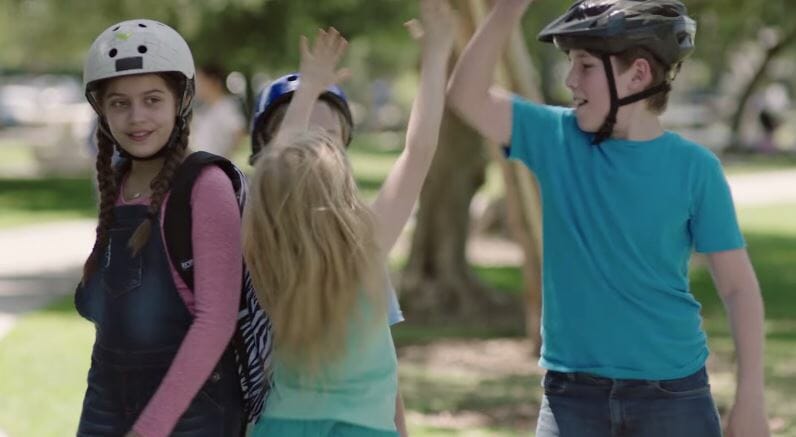
Now Emmy is asking kids around the world to get involved for International Friendship Day, July 30. She recently shot a public service spot to show how something as simple as cleaning a park with friends can be fun and make a difference in the community.
“She told me about how good she felt doing it because the trash affects the animals,” says Emmy’s mom, Elaine. Emmy told Elaine that she “would rather pick up the trash than have it end up in a bird’s mouth.”
Watch Emmy Perry, pictured left, in this 30-second spot, as she shows how fun cleaning up a park with friends can be.
The public service announcement was filmed as part of the generationOn and Hasbro, Inc. My Little Pony brand Friendship Day campaign – a global initiative that encourages kids to volunteer with friends in their schools, neighborhoods or broader communities.
The campaign is tied to International Friendship Day – a day when children and their families from all over the world are invited to celebrate friendship by completing acts of kindness and volunteering.
Emmy’s passion drives her action and makes giving back fun, particularly when her friends are involved. Her proud mom offers advice to other parents who want to get their kids interested in volunteering.
“Have a heart-to-heart with your kids to find out what they are passionate about. Then use that passion to get them involved,” Elaine says. “Kids are capable of so much more than we give them credit for.”
, an initiative that brings volunteers together to support literacy in communities. With thousands of volunteers, educators and partners in every time zone, together we’ll read to children all over the globe through one of the world’s largest reading events.
Here are four ways you can participate:
Pledge to volunteer.
Being able to read is a critical step toward success for every child. Together we can demonstrate the importance of literacy.
Exposure to language – talking, singing, or reading – through age 3 is a strong predictor of a child’s ability to read fluently by third grade. Children who are not reading proficiently by then are four times more likely to drop out of high school.
Spread the word.
Tell friends, family, colleagues and others in your networks about the importance of literacy and making it possible for all children to experience the magic of books and reading.
Host a reading event.
Put together a Read Across the Globe event in your community to elevate literacy and spread awareness. Click