Here’s How We Prepared Communities for Disaster and How You Can Get Prepared, Too
America’s PrepareAthon! – a grassroots campaign to get more people prepared for disaster – urges all of us to take action to keep ourselves, our neighbors and our families safe. To support the campaign, throughout April Points of Light informed and equipped local communities to be able to more quickly respond to and recover from disaster.
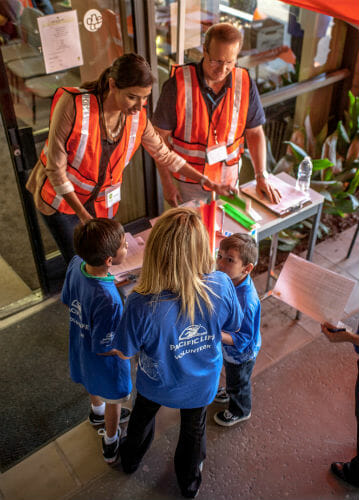
Community members in Orange County, California, take part in a disaster simulation as part of OneOC’s America’s PrepareAthon! activities.
Members of Points of Light’s Community Emergency Preparedness Corps organized service projects and informational fairs to distribute preparedness information.
With the help of corps members, thousands of disaster preparedness kits were assembled and distributed in diverse locations, such as food pantries and senior centers, and preparedness scavenger hunts were conducted to engage youth in how to become better prepared.
Affiliates of Points of Light’s HandsOn Network participated in various ways. Here are some highlights:
The AmeriCorps member at OneOC distributed preparedness material during a beach cleanup in Orange County, California, and organized a mock disaster in the community.
AmeriCorps members at Metro Volunteers in Denver canvassed four apartment complexes over six days, distributing more than 560 information packets to senior, low-income and immigrant residents.
The Allstate Foundation, which is currently supporting a 14-city disaster preparedness tour with Points of Light, printed more than 100,000 preparedness brochures and information sheets to support the AmeriCorps members’ efforts.
To learn how to better prepare yourself and your family and to take the preparedness pledge, visit www.goodandready.org.
See How These Volunteers Won $10,000 Grants Making a Difference and How You Can, Too
Odessa Willis was at home Aug. 11 when record rain fell on Metro Detroit.
“It came in like a roaring river,” Willis recalls. “There was 3 1/2 feet of water in my basement.”
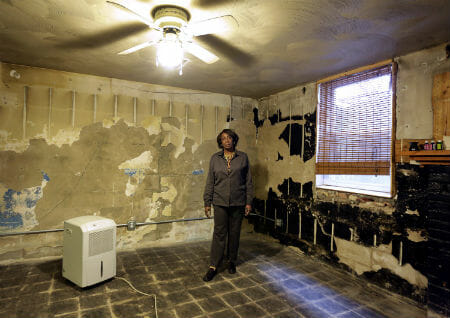
Odessa Willis stands in her Detroit home’s basement, which All Hands Volunteers cleaned after significant flooding.
Willis found help in the nonprofit group All Hands Volunteers, which responds to natural disasters. Volunteers pulled out carpeting, paneling, furnishings and other flood-damaged items at Willis’ home.
On Make A Difference Day, the group worked on four Detroit homes and to date has gutted 401 houses damaged by the floods. On Wednesday in Washington, D.C., volunteers from All Hands Volunteers and other community groups – selected from thousands of entrants – will be honored for their 2014 Make A Difference Day projects.
On the fourth Saturday of October, millions of volunteers across the nation unite to improve the lives of others. In its 24th year, Make A Difference Day is a USA TODAY initiative, backed by the Gannett Company, in collaboration with Points of Light.
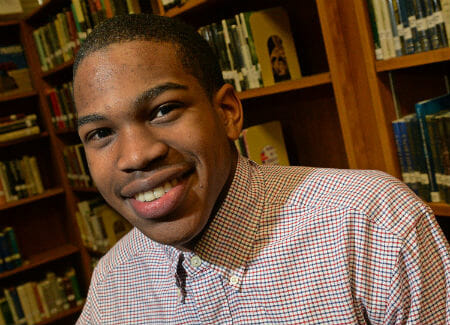
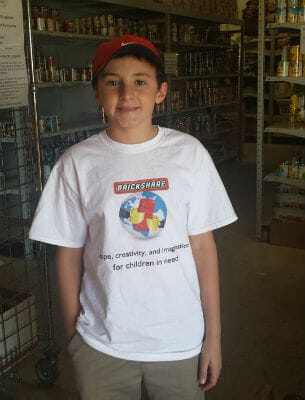
Isaac McFarland, of Shreveport, Louisiana, filled backpacks with nonperishable food and hygiene items for people in need.
Newman’s Own awards $10,000 grants to the organizers of 13 of the winning projects – 10 created by community members and three by local governments. And the Gannett Foundation gives a $10,000 all-star grant to a past winner that has demonstrated excellence in volunteerism during the most recent Make A Difference Day.
Learn about the 14 winners of 2014 below and see how you can get involved during Make A Difference Day 2015 at www.makeadifferenceday.com.
Isaac McFarland – Shreveport, Louisiana: The high school senior started a project to assemble backpacks filled with nonperishable food and hygiene items for people in need. On Make A Difference Day, he distributed more than 3,000 of the backpacks to the Caddo School District’s department for homeless students and to homeless shelters and rescue missions aiding families and veterans. Full story >
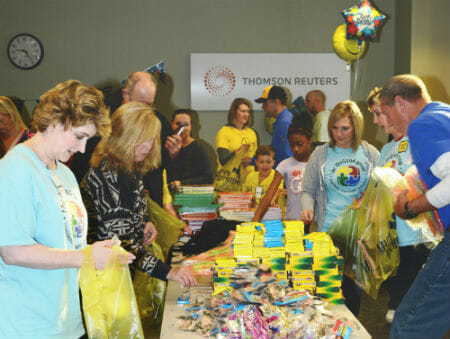
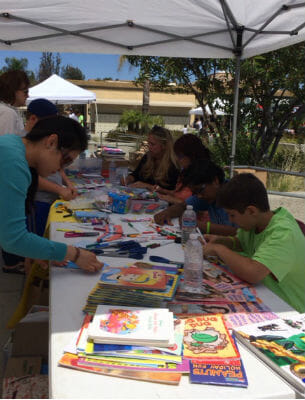
Cheerful Givers volunteers in Eagan, Minnesota, assemble bags of toys, books and other items for low-income parents to give to their children on their birthdays.
Cheerful Givers – Eagan, Minnesota: The organization assembles bags of toys, books and other items for low-income parents to give to their children on their birthdays. On Make A Difference Day, about 160 volunteers assembled 3,000 birthday bags. The organization raised $3,100 to purchase bags and items, and had books, bookmarks, crayons and pens donated from a variety of sources. Full story >
Makenna and Melissa Schwab – Wenatchee, Washington: Makenna Schwab, 12, was born with a rare connective tissue disorder that causes bone dislocations and affects her airway, spine and joints. For Make A Difference Day, Makenna challenged her community to donate Red Flyer wagons to Seattle Children’s Hospital. (“They’re less scary than wheelchairs” for young patients, Makenna explains.) She collected 33 wagons, more than 1,300 toys and toiletries, 36 portable DVD players, five baby swings, $280 in gift cards and $674 in cash donations. Full story >
Free Bikes 4 Kidz – Minneapolis: In south Minneapolis, Free Bikes 4 Kidz collects donated bikes, cleans and repairs them, and gives them to families who can’t afford them. On Make A Difference Day, the group worked with Burroughs Elementary School to put kids in charge of a bike donation event. More than 30 children collected and cleaned 150 bikes. Full story >
Joshua’s Heart Foundation volunteers in Miami distributed groceries to more than 500 families in need.
Joshua Williams – Miami: High school freshman Joshua Williams’ nonprofit organization, Joshua’s Heart Foundation, secured sponsors, a truck and about 60 volunteers to distribute groceries to more than 500 families in need. Full story >
Meals from the Heartland – Des Moines, Iowa: Volunteers produced 100,008 meals – more than 7 tons of food – to feed those in need. The dried meals included a rice mixture, dried vegetables, minerals and a soy protein supplement. Most were sent overseas through the Missouri-based nonprofit Convoy of Hope. Full story >
The Salvation Army – Rochester, New York: Buses took 323 Rochester-area children to department stores. There, 275 volunteers helped each child pick out a winter coat, with costs covered by donations and foundation spending. Full story >
Real Estate Council of Austin – Austin, Texas: Volunteers raised about $150,000 and organized one of the largest volunteer teams ever at SafePlace, which provides shelter and counseling to about 5,000 victims of domestic and sexual abuse annually. In the project, 115 members built a walking trail behind SafePlace’s family shelter, a new playground, a sitting area and granite benches. Full story >
University City, Missouri, volunteers worked on 25 home projects for senior citizens.
Daniel Soupiset – San Angelo, Texas: The efforts of one Texas teen have saved 57 animals from being euthanized. Daniel Soupiset organized an effort to get more pets adopted from San Angelo’s animal shelter. On Make A Difference Day, Daniel set up in front of the shelter with about 15 volunteers to hand out coupons that covered the cost of adopting a pet. For more than a month before that day, Daniel and about 25 volunteers raised more than $4,500 for the project. Full story >
City of University City, Missouri – University City, Missouri: The city worked with Our Lady of Lourdes parish to sign up 150 volunteers for 25 home projects for senior citizens. The city also spent about $3,000 on supplies such as paint, yard waste bags, concrete and new fencing. Full story >
Town of Fountain Hills, Arizona – Fountain Hills, Arizona: About 300 volunteers provided assistance to 67 elderly and infirm residents – doing household repairs and cleaning, painting, landscaping and building fences. Full story >
Delaware County, Ohio – Delaware, Ohio: About 700 volunteers tackled projects ranging from gardening and trimming to decorating for the county’s Halloween events. Senior citizens, who applied for assistance, also received help with home maintenance, furniture moving and other household chores. Full story >
Shaquawana Wester – Cookeville, Tennessee: Quawana’s Coats, organized by single mom of three Shaquawana Wester, involves public schools, nonprofit agencies, churches and the health department. Sixty volunteers organized donated coats, scarves, hats and gloves on Make A Difference Day, helping more than 350 families.
What’s Your Path for Change? Here’s One to Try
This post is by Kori Reed, vice president of cause and foundation for ConAgra Foods.
Mahatma Gandhi’s teachings tell us: “Be the change you want see.”
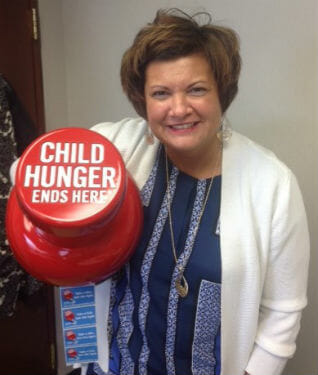
Kori Reed holds an oversized push pin promoting ConAgra Foods’ Child Hunger Ends Here campaign.
OK, but that’s not always easy to do. Where do we start? Where is the path?
Those are questions many of us ask ourselves – and struggle with. Including me. I have found some answers in
a book about evidence-based ways to create opportunity among our world’s most vulnerable, those in poverty.
In the book, award-winning journalists Nicholas Kristof and Sheryl WuDunn sound a call to action for individuals, communities and corporations alike, to be courageous and show kindness by helping others. (The book also showcases the personal benefits of volunteer work. Helping others really helps us, too!)
Kristof and WuDunn based the book title on a Chinese proverb about a path that becomes more visible the more it is walked upon. On the path to happiness for each person there are a number of milestones – starting with
concept (the idea that your lot in life hinges to a large degree on your birth) – and detours. Therefore, it also can be a roadmap to take action to help progress.
When I read the book, and as a visual learner, I wondered whether it was possible to capture all these lessons, research and evidence in one page. I reached out to WuDunn to develop the map of a path, a kind of a Chutes and Ladders for life.
A segment of the what Kori Reed calls “a kind of a Chutes and Ladders for life”
Why? I hope it shows how possible it is for us all to be kind and help a person at any point on the path, and ultimately, do our part to break the cycle of poverty – a large, complex issue that so encumbers our society and societies around the world.
The authors include the role of business in creating these pathways, and that hit the sweet spot for me. At ConAgra Foods, where I work, we know so well how hunger at a young age can harm a child’s chances for future growth, both physically and mentally.
The greatest gift we can give is opportunity. So, here’s hoping this visual path gives people the courage to jump in and sparks an idea for how to be kind to others in a way that creates opportunity for all.
More importantly, walking the path again and again will help others see it more clearly and spark catalytic change.
Have courage. Be kind.
Good Conversation and `a Little Light’ From a Volunteer Lead to Better Money Habits
In February, I met Linda R., a divorced mother who works full time as a preschool teacher and part time in a low-wage service job. She is passionate about teaching and has been in the field for 25 years.
Jamal Jimerson
Linda lives with her adult daughter, who was recently laid off from her job. When her daughter became unemployed, Linda enrolled in the Financial Opportunity Corps program to get help with managing her household finances.
Through the program, I became Linda’s financial coach.
As the director of Family Economic Success programs at the Connecticut Association for Human Services, it brings me great joy to take time off from my day-to-day responsibilities to volunteer as a financial coach. In this role, I work one on one with people facing economic hardship to provide them with meaningful support toward fulfilling their financial goals.
During our first meeting, Linda explained that she did not have enough income to pay her bills and she needed to “build a savings.” She told me more than once: “I save money, but I have to reach into my savings to pay my bills!”
I learned that Linda had some harmful financial behaviors and she did not have a budget. But she was creative and resourceful.
She already knew what her problems were – so my role was not to tell her what to do or how to do it, but to help her develop the confidence to do what she already knew.
At the end of our first session, Linda established a goal – save $600 in six months by saving $100 a month using direct deposit. To start the process, Linda agreed to participate in a free budgeting workshop.
During our second meeting, Linda indicated that she completed the budgeting workshop and put together a draft budget on her own. Our goal in the second session was to review her income and expenses. Linda discovered that there were ways to increase her income and decrease her expenses.
For example, Linda spends $14 a week on coffee at Dunkin’ Donuts. The $2 a day she spends is usually on her way home from work as a “gift” to herself after a long day. However, we also discovered that she purchases a cup a day on the weekends as well. Linda determined that one effective way to decrease the expense is to avoid buying coffee on the weekends.
Linda also spends $100 a month to purchase supplies and games for her preschool students and another $100 a month on a storage facility to store extra supplies.
Recognizing that this is Linda’s passion, we explored some options in this area, including comparison shopping to determine whether she was receiving the best deal on a storage facility, reusing materials and supplies from the storage facility as opposed to buying new items for the class, and researching grant opportunities for teachers.
Linda told me that she enjoyed sharing ideas and that there were many things she “never thought of doing” to improve her financial situation. For me, it has been a pleasure.
The Financial Opportunity Corps training equipped me well for this experience. I did not feel compelled to be the expert in Linda’s life. All she needed was some good conversation, a little light and the confidence to get started on the pathway to her goals.
Know a Woman Serving Her Community in Big Ways? Nominate Her for Women of Worth and a Chance for a $10,000 Grant
Stephanie Decker lost her legs to save her kids and found her calling, helping children missing limbs play sports. Mary K. Hoodhood heard about a child digging through the trash for food and set out to feed hungry kids. And, remembering her struggles as a single mom, Rachel Jackson-Bramwell rallied her community to prepare low-income women for success.
recognize, celebrate and support women who make a beautiful difference in their communities. Each of the 10 honorees receives a $10,000 grant to donate to her most cherished cause. Through online voting, the public gets to pick a national honoree, who receives an additional $25,000 grant.
“L’Oréal Paris Women of Worth is an example of the incredible energy created when we take time to recognize the amazing efforts of volunteers,” said Tracy Hoover, Points of Light’s CEO. “These exceptional women are truly points of light – leveraging their time, skills and resources to bring about change by tackling some of the world’s most pressing challenges and motivating others to serve.”
Women of Worth has recognized 90 extraordinary women, giving them a national platform from which to share their stories.
You have until May 15 to nominate for the 2015 Women of Worth. All 10 honorees will be recognized in December at an awards ceremony hosted by L’Oréal Paris in New York.
For more information about Women of Worth, to nominate a woman making a difference and to learn about past honorees, visit
Growing up, it didn’t take long for me to learn that I felt most fulfilled when giving my time to others.
I first learned the true meaning of empathy and saw my life in a greater context in high school. I took an elective course in hospice (The Harley Hospice Corps) that taught me how to take care of people at the peak of their vulnerability right before death.
I remember one patient in particular whom I bonded with. In only a few short weeks, I watched her physically and emotionally deteriorate beyond recognition. It was such a surreal experience for me.
It was also a brutal lesson: Life’s miseries don’t discriminate. None of us are safe from them, and all we can do is deeply cherish and respect one another while we can.
This newfound sense of civic responsibility was heightened when I studied sociology in college. I focused on exploring the areas of poverty and social inequality. During school, I volunteered with several organizations, including The House of Mercy, a homeless shelter in my hometown of Rochester, New York.
I became so enthralled with that community and felt so much joy building relationships with its residents and staff. But, volunteering there also made me sad.
The most painful to see were those newly seeking refuge in the shelter as they had run out of options, yet were inconsolable that this was what their lives had resorted to. It was hard not to feel the powerlessness and desolation that they experienced.
By the time I graduated college, I was frustrated. I didn’t feel like my direct-service work did more than put a Band-Aid over a festering wound. I was eager to start applying my skills to help create effective change, but I wasn’t ready to jump into a career.
I needed to find an opportunity that would let me build upon what I knew while simultaneously giving me the confidence to safely test my personal boundaries to see what I was capable of.
Children’s Home Society of Florida is the state’s largest, private nonprofit serving children and families. With 15 divisions and over 90 offices, it has programs in all 67 Florida counties and works tirelessly to provide healing and protection to abused children, while working to equip parents and guardians with the necessary tools to strengthen and rebuild their families.
The majority of my time is spent at Joshua House, a residential facility for abused, abandoned and neglected children, where I handle volunteer recruitment, coordinating activities and securing in-kind donations.
Initially, I had no direct experience with any of those roles. Now, everything comes so naturally. I love giving tours and making community presentations, and I cherish all the community partnerships I’m building for my organization.
Most important, I love that the work I am doing is sustainable, not temporary. In May, I will begin my second year with Children’s Home Society of Florida, and I look forward to the new adventures that lie ahead.
If I were to give any advice to new VISTAs it would be this: Trust in yourself, be patient, don’t be afraid to experiment and don’t be afraid to make mistakes. But most importantly, revel in every little victory!
Here’s What a Boy Did When He Found Out Kids Were Going Hungry in His Affluent Community
Living in one of the country’s most affluent areas – Orange County, California – Alex Triestman was shocked when he learned in elementary school about the plight of one of his friends. That child was struggling in school, in part because he did not have enough food to eat.
Alex Triestman
“It’s ridiculous that we have kids who are hungry,” said Alex, now 13. “The U.S. has enough resources to feed citizens, but we are not.”
Last Saturday, Alex led a student-run nonprofit fair at Don Juan Avila Middle School in Aliso Viejo, California, where he is a student. BASH, which stands for Broncos Annually Stop Hunger/Homelessness (the bronco is the school mascot), hosted an interactive day of projects to teach students how they can help combat hunger and homelessness.
The fair was part of
that challenges kids and teens to address child hunger through meaningful, hands-on service in their communities. For each youth engaged in service, the
, up to 20,000 meals.
As part of the BASH fair, students made birthday cards, toys, party favors and bookmarks for programs that serve homeless children and donated food to a food bank. The event included music and food trucks, which committed to donating 20 percent of sales to the participating charities.
Alex launched BASH with support from fellow members of the Peer Assistance Leadership club, which includes about 40 fellow students from his school, in the seventh and eighth grades.
Volunteers came out to the BASH fair to make birthday cards, toys, party favors and bookmarks for homeless children.
He and his club members organized the fair, in part, to raise awareness of the roughly 30,000 people living with homelessness and hunger in Orange County.
Alex, who has been volunteering and heading up projects since elementary school, has lead book drives for military families, food pantry collections and fundraisers for pediatric cancer patients.
He was first moved to start fighting hunger when he visited a food bank near his home at age 6.
“I saw that kids were not going to get my favorite food of mac-n-cheese,” he said. “This made me realize the problem was close to home.”
His mom, Joanie Triestman, describes Alex as “an old soul” since preschool. “He’s always thinking of others and thinking about the problems in society.”
Alex believes the key to fixing the hunger problem in a place of plenty requires raising awareness.
“You would think this problem wouldn’t exist here, but it does,” Alex said. “My project will make a difference not only for kids but for adults to wake up to the reality of what goes on even in our own school district where there are 3,000 homeless students.”
Alex’s message to adults and kids alike: “Think of others besides yourself. Everyone can make a difference.”
Join Us in Honoring Military Children Through Volunteer Service
In April, millions of Americans are celebrating the Month of the Military Child. To support the volunteer work of our youth and military, Points of Light is teaming up with the Travis Manion Foundation to serve communities with school volunteer projects you can join in New York, Washington, D.C., and Los Angeles.
Service projects will include planting flowers to beautify schools.
Each service project will begin with a presentation about Character Does Matter, a Travis Manion Foundation program that empowers veterans to connect with youth in their communities and inspire them with stories of our nation’s fallen heroes. AmeriCorps members serving with Corps 18 and the Veteran Leader Corps – programs managed by Points of Light – will lead the service activities.
The service projects, aimed at beautifying the schools, will include organizing school resource rooms, planting flowers, painting and more.
If you’re in New York, D.C. or Los Angeles, sign up and join us:
Erik Murudumbay didn’t need a lecture. He needed help.
The 19-year-old college freshman hoped to change his money habits, and he wanted advice while still maintaining control.
“The idea of having someone in my life who wouldn’t force me to take specific action or tell me what to do, but would coach and hold me accountable sounded appealing to me,” Murudumbay said.
That’s what he found with the Financial Opportunity Corps. Through the program, he was paired with a volunteer financial coach, Manni Lajeunesse, who prompted him to think deeply about how he was spending his money and whether that spending was making him happy.
Murudumbay told Lajeunesse that most of the money he spent each month went toward video games – typically $30 on game app purchases and $60 on a new video game.
“I realized that my overspending stemmed from the fact that I had a lot of free time, and was spending two to four hours a day playing video games, which ultimately was sucking up all my money and was not making me happy,” said Murudumbay, who receives his coaching through New York’s Asian Americans for Equality, one of the nonprofits that hosts the Financial Opportunity Corps program.
The Financial Opportunity Corps, a partnership between Bank of America, the Corporation for National and Community Service and Points of Light, recruits and trains volunteers as financial coaches who then help people from low- and moderate-income households achieve financial stability.
Together, Murudumbay and Lajeunesse brainstormed creative ways he could use his time. Murudumbay is now taking salsa classes, which cost $30 a month, and purchased hand weights, which cost $7 to $10 each. The weights were an especially smart purchase, because they have long-term use, as opposed to one-time-use game app purchases.
Murudumbay has also been putting in extra time at the library to do homework and help his younger sister with her school work. “She has been enjoying completing projects more, and loves that I’m spending time with her,” he said.
He cut his game-playing time to less than an hour. He spent $40 last month, down from an average of $90 a month. Because of this change, he is spending more time living his life and improving in school and work.Now that he is in control of his spending and other aspects of his life, he can start thinking more about the future and eventually investing his money.
Putting care and thought into spending has allowed him to focus on putting money into his savings account. Although Murudumbay had a savings account before he started working with a financial coach, he would withdraw from it frequently. Now he is depositing $100 to $200 each month and isn’t touching the balance.
“Before financial coaching, I would take a few steps forward and then go back to my old habits quickly, but now my mentality has changed,” Murudumbay said. “When I set a goal, I can keep going until I reach it. I feel like a different person.”
For more about the Financial Opportunity Corps, visit www.pointsoflight.org/financial-coaching.
Looking for Femininity, Volunteers Unearth Stories of Strength
When 100 volunteers took to the streets of São Paulo, Brazil, to interview ordinary women, they found stories of courage, resilience and perseverance.
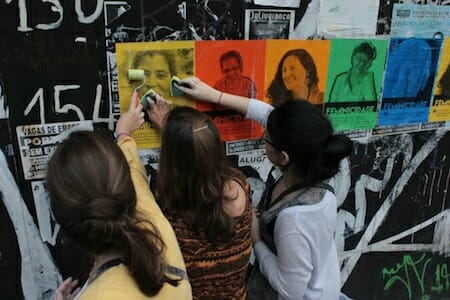
Volunteers hang fliers showcasing the FEMINICIDADE campaign.
Dona Francisca, a 57-year-old rural worker who used to “work like a man” in the crops told one volunteer: “My dream was to be a truck driver. My father would not let me. For him, it’s a man’s job. I think I will die without fulfilling my dream. When I talk to God I tell him that if one day I get my driver’s license I will be the happiest person in the world.”
The interviews for the recently completed volunteer project took place last month in celebration of International Women’s Day, March 8.
The objective: to recapture the original meaning of the day, which throughout the years has become more commercial.
With cameras and notebooks in hand, the volunteers fanned out across the city in search of stories that would inspire other women to continue the fight against oppression and for equal opportunity.
Many of the women shared their experiences of living in a male-dominated society, like 78-year-old Arlete Viera, who said:
“It is harder to be a woman when you don’t get to make choices about your life. Look at my brother. He was going to be a pastor, was prepared for that. He was the only one able to finish school. We all had to work, instead, and I ended up not being the great woman I wanted to be. I hope today girls will allow themselves to be different, so they can help us to rewrite this story.”
The volunteers, who interviewed about 50 women, reconvened at Roosevelt Square in the center of São Paulo to share the stories they heard, tell about their experiences and engage in meaningful conversations about such topics as religion and the role of the women in modern society.
“I hope we don’t stop here,” said volunteer Laleska Walver. “I hope this campaign will remind people that these conversations are not only necessary, they are urgent.”