plant sale, the 9-year-old from Raleigh, N.C., announced he wanted to become an entrepreneur. After volunteering with his family at the local food bank, he announced he wanted to become the U.S. president.
“He talks now about how he wants to help people,” said his mother, Serina Bangilan.
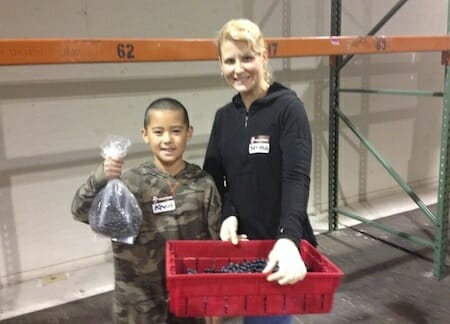
Kevin Bangilan and his mother, Serina, participate in a blueberry-picking volunteer project for a local food bank.
and inspire Points of Light sponsor, Disney, to make investments that inspire families to give back to communities where they live, work and play.
Since 1991, Points of Light has promoted the Saturday before Thanksgiving to kick off the holiday season with family giving and service. The day showcases the benefits of volunteering together as a family and provides opportunities for families to serve their communities in ways that spark their passions. The day also signals the start of
, families discovered many ways to take part in the day. The site has family-friendly project ideas and resources, and families can also search for family-friendly projects available in their zip codes.
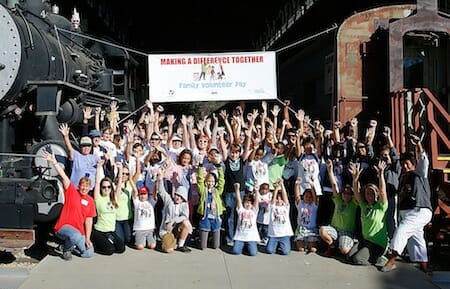
Volunteers celebrate Family Volunteer Day at The Travel Town Museum in Los Angeles.
Families that came back to the Family Volunteer Day site to share their stories of service have a chance to receive a generationOn prize package, which includes a family night out on the town with dinner and a movie.
Ten families will be selected to be featured in a fall edition of
magazine.
“We recognize that the holidays are family time but, ironically, they are the busiest time of the year – with work and social obligations for mom and dad, and the end of first semester crushes for kids,” said Dan Horgan, executive director of generationOn. “Family time often gets lost in the shuffle. Holiday volunteering is a great way for families to spend time together and to really connect.”
In support of Family Volunteer Day, Disney Friends for Change provided funding for family-friendly projects across the country, including a special event at Downtown Disney in Anaheim, Calif., where Disney VoluntEARS packed 5,000 snack packs for kids at local food banks. Other projects included painting a mural at a community nonprofit, packing and delivering meals to the chronically ill and visiting patients in hospice care.
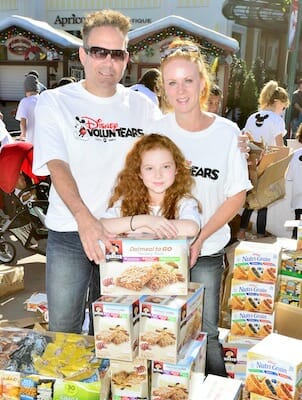
Francesca Capaldi, a generationOn celebrity youth ambassador, and her family help pack food on Family Volunteer Day at Downtown Disney in California.
There’s reason to believe the feel-good effect of meaningful family volunteer projects may help strengthen family bonds.
Building on a rich history of creating memorable experiences that bring families together,
hosted dozens of nonprofits from across America at the Disneyland Resort for “Discover Together,” a two-day symposium in January 2014, focused on how adults can make a difference in children’s lives by spending meaningful time with them.
The initiative, which employs
– a training for nonprofits to help them better engage family volunteers – is based on research exploring the significance of meaningful family time. A recent study by the
demonstrates the powerful influence positive parent-child interactions have on a child’s ability to learn, grow and thrive. The study shows that family volunteering helps to create these important bonds and teaches children valuable real-life lessons about empathy and caring.
Points of Light and Disney recognized 10 extraordinary families with
during the week leading up to Family Volunteer Day. The Daily Point of Light Award recognizes the power of individuals and families to spark change and improve the world through volunteer service.
For the Bangilans – who won a Daily Point of Light Award last year for their service – the rewards are apparent in the work of serving their community. Whether it’s packing blueberries for the
or selling plants for 4-H, the family of four – including father, Rod, and younger son, Crisanto, 3 – tries to do it together.
“I just really believe in the little things we do for one another in this world,” said mother Serina Bangilan. “We really believe that it will come back to us.”
Who Made the List? Announcing the 50 Most Community-Minded Companies in the Nation
This post is by Tracy Hoover, Points of Light’s president.
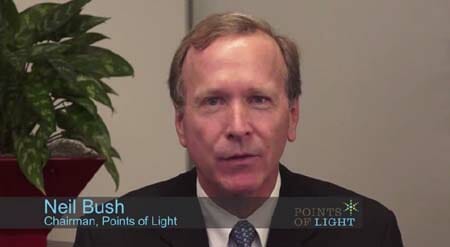
Click here to watch a short video announcement of the 2014 Civic 50 from Points of Light Chair Neil Bush.
The Civic 50 sets the standard for corporate community engagement nationwide and creates a roadmap for companies seeking to best use their time, talent and resources to improve the quality of life in the communities where they do business.
Please take a moment to celebrate these companies for their great and continued efforts. And as the holidays approach, I hope you’ll put your money where your values are and use your purchasing power to support all the companies that are doing great work in their communities.
To learn more, click here or register for our free webinar, “The Civic 50: 2014 Highlights and Best Practices,” Dec. 17 at 2 p.m. ET.
The 2014 Civic 50, in alphabetical order, are:
AbbVie
Adobe Systems Incorporated
Aetna Inc.
Alcoa
Altria Group, Inc.
Apollo Education Group
AT&T
Bank of America
Baxter International Inc.
Caesars Entertainment *Consumer Discretionary Sector Leader
Capital One
CenterPoint Energy *Utilities Sector Leader
Citi
Comcast Corporation *Communications Sector Leader
ConAgra Foods *Consumer Staples Sector Leader
CSAA Insurance Group – a AAA insurer DIRECTV
Dr Pepper Snapple Group
Eli Lilly and Company
FedEx Corporation
Freeport-McMoRan Copper & Gold
Gap Inc.
GE
General Mills
Hasbro, Inc.
Health Care Service Corporation
Hewlett-Packard *Technology Sector Leader
Intel Corporation
Intuit
KeyBank *Financials Sector Leader
Motorola Solutions, Inc.
Pacific Gas and Electric Company
Prudential Financial, Inc.
PwC
Raytheon Company
SAP
Sigma-Aldrich *Materials Sector Leader
Southwest Airlines
Sprint Corporation
State Street Corporation
Symantec Corporation
The Hershey Company
Toyota Financial Services
TSYS
UnitedHealth Group *Health Care Sector Leader
UPS *Industrials Sector Leader
Valero Energy Corporation *Energy Sector Leader
Verizon
Viacom
Western Union
Be a Joy Maker This Holiday Season
This post is by Daniel Horgan, executive director of generationOn, Points of Light’s youth service division.
I remember the residents’ smiles and the laughter that filled the living room at Woodcliffe Manor Nursing Home as though it was yesterday. For several years while in high school, I organized a group of volunteers to sing holiday carols, share homemade goodies, and pass out personalized gifts to the seniors based on their wish lists.
Young people get ready to distribute presents during a 2013 Joy Maker event.
It was a special joy-making operation every year that reminded my friends and I that the time and compassion we share with others can teach us so much more than we give.
Since Nov. 10, over 60,000 kids and teens across the country and around the globe have been bringing joy to others through service as part of the fifth annual Joy Maker Challenge generously sponsored by Hasbro and powered by generationOn, the youth service division of Points of Light.
The campaign is designed to connect students in grades K-12 to meaningful, hands-on service projects during the holiday season. The Joy Maker Challenge also addresses poverty through Hasbro’s commitment to donate a toy or game up to $1 million dollars’ worth to Toys for Tots for every action that a kid or teen takes to help others.
The stories of young joy makers featured on the generationOn site are a great source of inspiration. Students are learning about needs in their community, discovering ways that they can be a part of solutions, and calling on others to spread joy as well.
The Joy Maker Challenge has united students across two schools in Richmond, Va. – Bon Air and Crestwood Elementary Schools – to make holiday crafts (tootsie-pop turkeys) for those in hospice care. The kids at the Boys and Girls Club of North San Luis Obispo County in California partnered with Loaves and Fishes, an organization that feeds the hungry and homeless, to decorate boxes with holiday cheer that were then distributed to local businesses participating in a community-wide food drive.
Proving its ability to bring people together, the Joy Maker Challenge inspired the student body at Tanglewood Elementary School in Fort Worth, Texas, to support two classmates who lost their home and possessions to a fire. Funds, gift cards, clothing and even a Christmas tree were donated by students, faculty and staff thus strengthening Tanglewood’s culture of compassion.
With so many needs all around us, there are many ways that students, schools, youth groups and youth-serving organizations can take action. generationOn offers project ideas, planning toolkits, and service learning lesson plans to help equip kids and teens with the tools they need to be a joy maker. And joy making does not have to end after the holidays either as illustrated by kids in Middlesboro, Ky., who serve up joy 52 weeks a year.
Through an initiative called “52 Weeks of Giving,” kids living in rural Appalachia have been performing weekly acts of kindness every Friday for the past four years.
From delivering handmade thank you cards to local firefighters to raking leaves for elderly residents to fundraising for kids fighting cancer, the “givers” bring joy to people around the world through service all year long despite many of them living in poverty themselves.
Despite the traditional hustle and bustle that we find ourselves in during the holiday season, let’s pause for a moment and reflect on the last time someone shared joy with us. Whether someone shared a kind smile, held a door, or offered a helping hand, it sure does feel good to recognize all of the joy around us.
So let’s all commit to putting more joy into the world by being a joy maker, getting the kids in our lives engaged in service, and living out the motto of the kids engaged in “52 Weeks of Giving” – Don’t let anyone be nicer than you!
For more information on the Joy Maker Challenge, please visit www.generationOn.org/joymaker.
Small Efforts Add Up to Huge Results
This post is by Joyce Yamaato, a vice president with Wells Fargo’s Strategic Philanthropy and Partnerships Group. Her experience with AmeriCorps sparked a career in philanthropy spanning 20 years.
Joyce Yamaato
I will never forget my first day teaching English as a Second Language to adult immigrants and refugees in New Orleans as a new AmeriCorps volunteer in the fall of 1995.
It was a very humid, hot and muggy day, and I was in a small classroom with many students of different ages from different countries. Many were working two to three part-time jobs mostly in the service industry – some had worked the late-night shift and still made it to class.
I was nervous standing in front of them as a 23-year-old, thinking, I better do a really good job because I didn’t want to let them down. They were counting on me.
It was early on when I learned that in order to be an effective teacher, I had to move beyond teaching English grammar, sentence structure and spelling. I needed to serve as a coach about day-to-day life in America.
This included things like going to the grocery store to help them figure out the layout of the store, how to navigate public transportation, how to read letters or bills that would come in the mail, how to talk to their children’s teachers during parent-teacher conferences and how to build a budget.
I realized that every time I added value based on their terms, not my terms, that no matter how small a gesture it was, it all added up to make a difference. Small efforts add up to huge results.
That year with AmeriCorps changed my life. Ultimately I chose a career in strategic philanthropy with Wells Fargo.
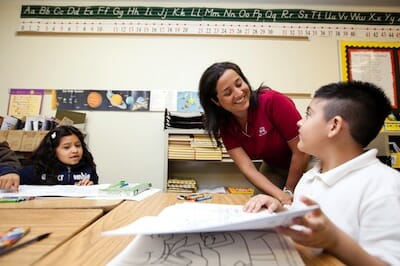
A Wells Fargo volunteer connects with students.
I am so lucky to work for a company like Wells Fargo. If you’re an AmeriCorps member pursuing a career after your service year, you also can find socially responsible and community-focused organizations like Wells Fargo.
My journey started with AmeriCorps and then led me to graduate school at Carnegie Mellon University’s H. John Heinz III School of Public Policy and Management. My career has been a combination of diverse experiences in banking, foundation, government, nonprofit and private sectors.
The combination of serving as an AmeriCorps volunteer along with my background in various sectors has helped me connect the dots in my day-to-day work.
As a strategist, I get to see the impact of our philanthropy come alive every day. In our communities, Wells Fargo is valued not just as a funder, but as a community leader. We too have a culture of service. More than 55,600 of our team members logged 1.69 million volunteer hours last year.
Wells Fargo is very supportive of pro-bono and skills-based volunteer opportunities as they increase the skills set of our team member volunteers as well as build the capacity of the nonprofit organizations where our team members serve.
A few examples include our Wells Fargo Global Fellows program, Hands On Banking® program and the pro bono community services provided by a number of our team members.
Wells Fargo’s Global Fellows program is a paid volunteer leave program. Those selected for the program work on-site in Colombia or India, or consult virtually, with microfinance or social enterprise organizations.
We have bankers provide financial education courses through our Hands On Banking program throughout the year, with special focus on the American Bankers Association’s Teach Children to Save and Get Smart About Credit annual campaigns.
Many of our departments also apply their talents to skills-based volunteering. Our legal department team members provide pro-bono services individually in their local communities.
The Digital Channels Group recently concluded a team meeting by inviting a small number of nonprofit organizations to provide design and scoping consultation for their web presence. We have communications consultants serving in board positions who help organizations with their public relations and communications plans.
Regardless of where you choose to get engaged, your pro bono service and volunteerism, however small, has the potential to make a huge impact.
Similarly, the record of the past 20 years of AmeriCorps service tells us that you can make a difference by volunteering. AmeriCorps also has a long tradition in this country of helping others to get things done for America.
This post also ran on the AmeriCorps Alums blog. AmeriCorps Alums is the only national network connecting the nearly 1 million AmeriCorps alumni to the people, ideas and resources that support their commitment to a lifetime of service.
Don’t Let Winter Volunteering Wane – Disaster Recovery Is Year-Round
After a disaster, all of us watch the news as people are airlifted from floodwaters and volunteers surge to provide shelter and food. But what happens when the media are gone and the communities are left with damaged homes and displaced citizens?
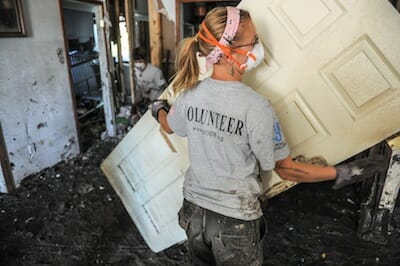
(Photo courtesy of FEMA)
Many of us do not consider that long-term recovery can be a process that lasts for years – or even decades – after the disaster strikes. Areas located in colder climates may experience surges of volunteers during the spring and summer and then struggle to meet the community’s needs for other seasons.
In 2013, Colorado experienced flooding that caused catastrophic damage across 200 miles affecting 17 counties. Fortunately, Denver’s Metro Volunteers, part of Points of Light’s HandsOn Network, was and continues to be there.
A year after the devastating floods, many residents are finally getting utilities restored and beginning to rebuild their homes.
Kristy Judd, executive director of Metro Volunteers, explains that long-term recovery requires strong partnerships – organizations working toward a common goal, as evidenced by the partnership between Metro Volunteers and the Long-Term Recovery Group of Northern Colorado – composed of more than 50 nonprofits, government agencies and faith-based groups.
“Collaboration and cooperation matter a great deal,” Judd said. “We have small communities with limited capacity to manage large scale disasters. Together, we’re stronger.”
As winter closes in, volunteering rates drop, although requests for assistance still come in daily.
Help those who need it most this winter season by volunteering. To find opportunities to support ongoing disaster recovery efforts, visit www.allforgood.org/disasters or contact your local volunteer center.
In Ferguson, Volunteering Strengthens the Community
For many Ferguson, Mo., residents living around the Canfield Green apartments, financial hardships and stress already were part of daily life. When the neighborhood experienced looting and civil unrest (after the Aug. 9 shooting of 18-year-old Michael Brown by a police officer), the struggling community was thrust into turmoil.
Carmie, a single mom who lives only a few blocks from the Ferguson police department, witnessed firsthand the fear and uncertainty that developed in her community.
“When everything happened we were stuck in our home. I saw people running down the street after looting and it felt like I was watching something on TV. It knocked the wind out of me because I was in a situation I couldn’t imagine,” Carmie said.
Besides forcing many people to take shelter in their homes in early August, the disruptions in the community took a toll on residents’ work and daily life.
Since Carmie’s daughters, only 6 and 7, could not attend school, Carmie was forced to miss work to care for them. A counselor who regularly made in-home visits to help her daughters cope with the death of their father also was unable to provide services during that time.
“I really tried to shield my girls from what was going on outside of our house. Everything felt so negative, and it was hard to protect them when we could hear people protesting at the police department and helicopters flying overheard,” Carmie said. “They were traumatized.”
Dealing with a community in upheaval only added to Carmie’s worries. Her income only barely covered the basics for her family. Behind on the gas and electric bills, she was unable to buy her girls school supplies and clothes.
“Sometimes you have to make hard decisions about where the money will go that month,” Carmie said.
During the events in Ferguson, United Way of Greater St. Louis
to provide a Community Resource Drop-in Center for Ferguson residents whose needs were exacerbated by what was happening in their neighborhood. After hearing about the drop-in center from a friend, Carmie visited and received help with her gas and electricity payments.
“I haven’t been able to pay off my entire gas bill for a year, so bringing my gas bill all the way to zero was a blessing. I was able to buy the necessary school supplies for my girls and now everything feels much more manageable,” Carmie said.
For five days, the drop-in center helped nearly 1,200 residents like Carmie from the affected area by providing hot meals, food staples, counseling, utility and rental assistance and respite activities for children. These resources were greatly needed by a community tragically thrust into the spotlight.
“There are a lot of people (in the area) going through things that people aren’t aware of,” Carmie said. “We don’t have access to a lot of resources. The drop-in center was truly a blessing for my family and a lot of my neighbors.”
After receiving help, Carmie got an email about volunteering at United Way 2-1-1 and St. Louis County’s Multi-Agency Resource Center (MARC) in mid-October. Developed to offer additional assistance to eligible Ferguson residents, the MARC represented the first portion of the work through the St. Louis County contract with United Way.
Since she no longer needed help, Carmie saw volunteering at the MARC as an opportunity to give back to an organization that helped her when she needed it most.
At the MARC, Carmie was tasked with handing out food tickets and gave up a Saturday to serve others in need in the area.
“Volunteering was well worth it,” Carmie said. “I didn’t require any help the second time, so it was awesome to be a part of serving people in my community.”
.
Take part by pledging to volunteer on All for Good in celebration of #GivingTuesday. It’s a chance to be generous without spending a cent, and it’s easy.
This post is by Tracy Hoover, Points of Light’s president.
I’m a hopeless cook – so much so that my husband jokes that when the fire alarm goes off “dinner’s ready!” I like college football (Go Vols!) but not 24 hours of it. And, despite all of that, I love Thanksgiving.
I love the acts and ideals of Thanksgiving – shared harvest, family and community, out-loud thankfulness. For many of us, this is a time of coming together, renewing bonds, celebrating the relationships and people who make our lives meaningful. It’s also a time of volunteer service and, for many families, serving together has become an important holiday tradition. And I love that, too!
For my family, the one enduring tradition is list-making. Not shopping lists… or chores lists… and certainly not grocery lists. Ours is a ritual of calling out and writing down what we are most thankful for. It’s a fun and affirming exercise and a celebration of what really matters. This year,TIME magazine asked several influential people what they were most thankful for. Not surprisingly, I loved President George H. W. Bush’s response, excerpted here.
So, during this season of Thanksgiving, I want to thank you – points of light everywhere – for all that you have done this year.
You helped a child learn to read.
You delivered food to a sick friend. You helped neighbors recover and rebuild after disaster struck.
You cleaned up a stream and built a playground and stocked shelves at a food bank.
You helped a neighborhood nonprofit do more, help more, reach more, change more.
You gave your time, talent, voice and money.
You are points of light.
Thank you and have a great Thanksgiving.
Top Five Resources for Volunteers Who Want to Create Projects
Whether you’re a budding or longtime volunteer, these resources can get you on your way to developing your own projects with your family, friends and neighbors. For a searchable list of volunteer resources, please visit the HandsOn Network Resource Library. And if you aren’t quite ready to start your own project, you can search for local opportunities on All For Good.
Volunteer With Your Family
What better way to teach your children the joy of helping others than through community service? If you’re a parent looking for family-friendly volunteer opportunities, generationOn’s Family Project Guide can help.
This step-by-step guide teaches you how to shape your family volunteer project as it evolves. By offering questions you discuss as a family, you can find service opportunities that mesh with everyone’s interests, ages and energy levels.
Organize a Food Drive
Imagine never knowing if, when or how you were going to get your next meal. For 45.3 million Americans, that is what life is like every day. There are ways you can help, including organizing a food drive in your community. See this guide.
Organizing a food drive is a manageable project for volunteer veterans and beginners alike. These comprehensive instructions map out the steps, including such essential questions as: Who will lead this project with you? And, how do you promote the food drive?
Organize a Disaster Kit
Preparing a disaster kit – ready to grab on the go – can lessen the fear, anxiety and losses that stem from a disaster. Organizing a disaster kit project in your community can help educate and prepare others in case disaster strikes.
You don’t have to be a disaster expert to organize a community-wide disaster kit project. With these guidelines, planning this project is straightforward and easy. Also check out Good & Ready for more tips and advice.
Become a Volunteer Leader
Sure, you care about the quality of your community, but what can you do to improve it? With the HandsOn! Volunteer Leader Guidebook, you can help lead volunteers in making positive change.
The guidebook walks you through how to successfully organize and lead a community service project. Equipped with tools and tips, including worksheets, the guidebook outlines how to develop, implement and wrap up a project in seven simple steps.
Tell Your Story
Gathering a strong and supportive team can be one of the most challenging aspects of a community service project. If you’re looking to educate, inspire and garner support, check out HandsOn Network’s Passion into Action: Telling Your Story.
The guide lists a wide range of ways to publicize your message, from posters to media campaigns to online social networks, and more. This resource also offers recommendations about marketing and provides tips on how to publicize your cause.
Bringing Financial Coaching to Those Who Need it Most
For Beverly Sanders, living on a budget used to sound like going on a diet: It’s the right thing to do, but it’s hard to know where to start.
“It sounded like depriving yourself, like starving yourself,” said Sanders, a nonprofit program manager. “While I’m a very well-educated woman, for some reason I seem to blank when it comes to sitting down and making a spending plan.”
That began to change in early 2014, when friends persuaded Sanders to try a new financial coaching program called the Financial Opportunity Corps.
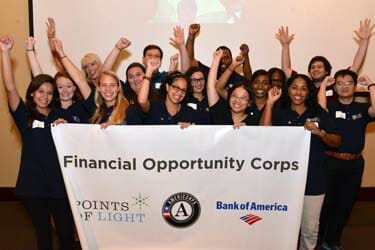
Financial Opportunity Corps AmeriCorps VISTA members cheer during their swearing-in ceremony.
It’s an innovative partnership between Points of Light, the
members to go into communities and recruit and train volunteer coaches to work with people in need of financial guidance.
Central to the program’s success – and what makes it different from other coaching models – is the engagement of these community volunteers as coaches.
Launched in 2013, the Financial Opportunity Corps currently operates in nine U.S. cities.
In addition to community volunteers, Bank of America employees have embraced the program and serve as volunteer coaches and financial workshop facilitators. The workshops and coaching sessions are designed to help people from low- to moderate-income households find strategies that will help them achieve better money habits and long-term financial health.
In the past year, more than 1,000 people have participated in the Financial Opportunity Corps’ workshops, and more than 200 volunteers have been recruited and trained as financial coaches to work one-on-one with participants.
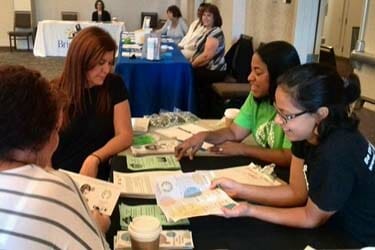
AmeriCorps VISTA members based at HandsOn Broward, right, distribute information about the Financial Opportunity Corps at a financial fair in Florida.
It’s an example of the “robust relationship” between Bank of America and Points of Light, said Kerry Sullivan, president of the
.
“We understood the need for individuals to be better educated on financial issues,” Sullivan said. “It hit a sweet spot for us.”
The Financial Opportunity Corps is a key program of Bank of America’s involvement with Points of Light, but the relationship goes much deeper. For a number of years, Bank of America has invested in and served as a thought leader for Points of Light’s global expansion and offerings, particularly in the Asia-Pacific region.
This involvement and investment, coupled with other philanthropic partners, has served as a catalyst for extending Points of Light’s footprint to 68 cities in 29 countries, in only a few short years. The groundswell of interest in volunteerism outside the U.S. continues to grow: Last year alone, more than 100,000 volunteers engaged in Points of Light partner-led projects and activities.
Additionally, Bank of America invests in the broader service sector through Points of Light, through the company’s involvement in the
. The council is a group of more than 70 industry-leading companies that form the premier global platform for increasing the quantity and transforming the quality of employee volunteering.
Through its corporate social responsibility program, Bank of America employees around the world logged 2 million hours of volunteer work last year. Employees are encouraged not only to take part in company-organized projects but to share opportunities to address needs in their communities.
This year, the company launched a Global Volunteer Awards program that recognized 20 employees for their outstanding service and commitment to their communities.
The Financial Opportunity Corps has allowed Bank of America employees to help people resolve many types of financial problems. Financial Opportunity Corps participants, or “clients,” are taught strategies for reducing debt, improving credit, building assets, saving for emergencies and planning for the future.
As a VISTA member assigned to
last year, Melinda Matthews matched 27 clients with coaches.
“The clients are so appreciative. They all have their ‘a-ha’ moments. You can see it on their faces and in the way their attitude changes. That’s priceless,” said Matthews, who now works as a development manager for HandsOn Broward, part of Points of Light’s
.
Program volunteer Mike Tsoi-A-Sue became a coach in January 2014. He has worked with four clients – including Sanders – meeting monthly for three to six months, depending on how quickly the client’s goals are met.
“They all start with basically balancing expenses against income,” said Tsoi-A-Sue. Coaches are essentially “an accountability partner who keeps them on track.”
The clients’ situations are sometimes complicated, he said. But Tsoi-A-Sue tries to help them focus on goal-setting, whether it’s reducing debt, saving for retirement or something else deemed important.
Tsoi-A-Sue “couldn’t be more different” from me, said Sanders. Formerly an accounting and finance worker in the petro-chemical industry, Tsoi-A-Sue is methodical and soft-spoken. But Sanders believes his calm, practical approach has helped her reach some breakthroughs in her attitude toward money.
“I come from a culture where when you have it in your pocket you spend it all,” she said. “I believe it’s kind of a poverty mentality. I know how to save money for things, but I just didn’t believe I was a person who could do it.”
Tsoi-A-Sue has helped her get control of her debt, gain focus and still have money in her pocket for the things she enjoys.
“What I realized is he wasn’t there to teach me about money. He was there to support me, to ground my free-spirit thinking and provide me some structure,” she said. “It really was about, `What are your values?’ and, `Where do you want to see your money go?’”