Thirteen for Thirteen: Reflections on Hands On Manila’s 13th Birthday
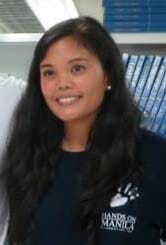
This post is by Ami Valdemoro, executive director of Hands On Manila. To find a HandsOn Network affiliate near you, visit www.handsonnetwork.org.
Ami Valdemoro
I joined the Hands On Manila family in April, fresh from a two-year sabbatical in graduate school and full of ideas for how make a meaningful impact in the Philippines, where my family is originally from. I quickly learned just how powerful a small handful of individuals can be when they set their minds and hearts to do good.
People have thought of the Philippines often over the past year, with the devastation wrought by Typhoon Haiyan last November. While the efforts of people from around the world to help the affected communities recover are well-documented, there are many more stories of service and daily acts of kindness, that occur below the radar.
Stories of everyday heroes who work tirelessly to help those in need. Stories of people who – even with limited free time – choose to be a point of light. It is these stories that make Hands On Manila who we are and that give us the energy and spirit to continue to be of service.
In honor of our 13th birthday this month, and the thousands of individuals who have shaped us and helped us grow, here is my list of 13 ways that Hands On Manila works to make our community a better place:
Cultivating curious young minds by mentoring high-achieving middle school students in public schools through our Hands On Schools – Galing Mo Kid! Program
Engaging young professionals in volunteer service to rebuild and prepare classrooms for the school year
Spending quality time and giving care to the elderly at a beautiful shelter in the hills of Tanay, Rizal
Teaching young people who have suffered tremendous hardship or abuse skills to help them get on their feet and make a livelihood for themselves and their families
Beautifying public spaces like the Freedom Islands through urban gardening and coastal cleanups
Developing volunteer leaders through our Sherpa program, named after the guides who patiently and diligently guide trekkers up Mount Everest in the Himalayas
Encouraging individuals with one or two hours of time to volunteer with any of our more than 30 nonprofit partners through our Volunteer Passport program
Reading to street children in a weekly Read-Along hosted with our friends at the Philippine Daily Inquirer, a widely circulated daily newspaper
Bringing the arts to children through mural painting in school classrooms and art classes in children’s shelters
Inspiring people to give back even when they are on vacation through our Hands On Volunteer Vacations in Boracay, Mindoro, and other popular holiday destinations
Creating personalized service opportunities for corporate partners who are new to social responsibility or volunteering throughout the year
Bringing together thousands of volunteers in an annual day of service that we like to call Servathon (Our next one is coming up on September 27 – stay tuned. #homservathon2014.)
Sharing our successes, and our challenges, with our friends at other HandsOn Network affiliates in the U.S. and around the world to inspire us to do good better
For more information on Hands On Manila, visit www.handsonmanila.org. To find a HandsOn Network affiliate near you, visit www.handsonnetwork.org.
Volunteers Go for the Win at Turner Field
Against the backdrop of America’s national pastime, hundreds of volunteers came together to recognize a national treasure: teachers.
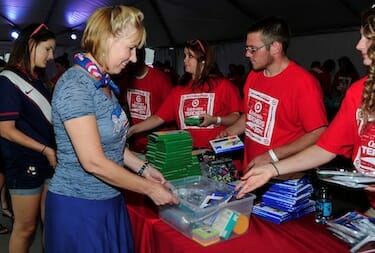
Volunteers help game-goers at Turner Field assemble containers of school supplies for Atlanta teachers.
Before an Atlanta Braves-Philadelphia Phillies baseball game at Turner Field, more than 300 volunteers and game-goers packed 5,000 kits full of school supplies for local teachers. Target team member volunteers stacked tables high with supplies and volunteers visiting Atlanta for Points of Light’s Conference on Volunteering and Service filled plastic bins with water bottles, sticky notes, disinfectant wipes, pens, pencils and more – items teachers too often have to buy with their own money.
The June 16 event was part of Target’s All-Star Teachers program, in partnership with Major League Baseball, designed to engage Target guests and MLB fans in celebrating the nation’s teachers, and Target’s involvement in Points of Light’s Conference on Volunteering and Service as its Official Excellence in Education sponsor. (See below for the July 31 presentation ceremony.)
Target supplied the products, funding, infrastructure and dozens of team member volunteers. Hands On Atlanta – part of Points of Light’s HandsOn Network of 250 volunteer centers – coordinated the service project to distribute the kits to dozens of Atlanta public schools.
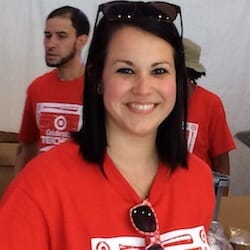
Target team member Jessica Johnson
Across the United States, public school teachers during the 2012-2013 school year spent $1.6 billion of their own money on school supplies and instructional materials, according to the National School Supply and Equipment Association. That’s an average of $500 per teacher.
In addition to assembling kits for the classroom, volunteers at the Turner Field event could vote for their favorite All-Star Teacher at an on-site kiosk and, by way of a photo booth, share photos of themselves via social media. Future MLB Hall-of-Famer and former Atlanta Braves pitcher John Smoltz came by for a few photos and to encourage the volunteers.
Jessica Johnson, who has worked at the Target store in Douglasville, Ga., for the past two years, says she appreciates the service opportunities Target provides its team members.
“It makes you feel good to work for a company that cares about things beyond just money, that cares about the community and the people who live there,” she said, as she reached for more supplies to stock the line. “That comes across in opportunities to go out and do things like this.”
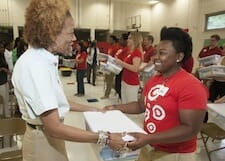
Target volunteers hand out school supplies assembled at the Turner Field service project to Atlanta teachers.
“The Turner Field event, part of the Conference on Volunteering and Service’s opening day, reflects our core values at Target,” said Reba Dominski, senior director of community relations. “Through raising awareness for teachers and celebrating the impact they have on our children, we are also able to demonstrate our longstanding commitment to service.”
“At Target, we believe every child deserves a quality education, regardless of race or socioeconomic status,” said Dominski. “Through our partnership with Points of Light, we’re able to invest in communities by offering programs that help provide the tools and resources educators need to help students succeed.”
Target team members volunteered alongside attendees of the Conference on Volunteering and Service, like Allan Collins. He embraced the chance to participate in a hands-on volunteer experience as part of the Conference, which brought together thousands of leaders from the nonprofit, corporate and civic sectors to celebrate and shape the future of volunteerism.
“Learning about the programmatic side of volunteer engagement is vital,” said Collins, director of HandsOn Inland Empire, a volunteer mobilization organization in Rancho Cucamonga, Calif. But Collins said that engaging in a tangible expression of volunteerism is “a powerful way to bring it all together.”
On July 31, representatives from Hands On Atlanta and Target presented the kits to Atlanta Public Schools teachers and Superintendent Meria Carstarphen at West Manor Elementary School. Target volunteers then helped teachers prepare their classrooms for open house the following evening and the first day of school, Aug. 4.
“Thanks to the generosity of Target, and literally, the hands of Hands On Atlanta, the 3,000 teachers of Atlanta Public Schools were given additional tools to actively engage and instill hope in our students this year,” Carstarphen said. “Target represents the important role of corporate partners in supporting student achievement by connecting the needs of our students and schools with the financial resources and goodwill of the community.”
One Candle Destroyed Everything – Teaching a Lesson About Preparing for Disaster
Read about how folks in Maryland are preparing for disaster. To help your family take action, visit Good & Ready, where you’ll learn how to create a disaster plan, build a preparedness kit and more.
Robbie Horwitz reflects on the lessons she learned after fire destroyed her Linthicum, Md., house. (Click photo.)
The door to Robbie Horwitz’s childhood home was boarded up. That was the first thing she noticed when she returned from a hiking trip to the split-level house that she shared with her mom in Linthicum, Md., near Baltimore.
The windows were broken, too, and there was the deep, pungent smell of smoke.
Then Horwitz remembered: She had left a candle burning on a table in the living room.
Horwitz tears up as she recalls that day. The home “was the only place I had ever lived,” she says. But after the fire, “every object was covered with a greasy, dirty film. … I had this baby quilt that I had since I was little. That disappeared and it was irreplaceable. I felt like [the fire] ended a section of my life.”
Horwitz says her family wasn’t prepared. The smoke alarm did not have working batteries. Papers were scattered, the important ones mixed with those they didn’t need.
An event participant makes her way down the disaster kit assembly line, as volunteers help her complete her kit.
To prevent more stories like Horwitz’s, the Allstate Foundation and Points of Light have teamed up for a 14-city tour to encourage emergency preparedness. “Eighty-five percent of families aren’t prepared for a disaster,” says Shelva Clemons, an Allstate spokesperson. “We want to be in the community to raise awareness.”
On Aug. 15, volunteers from Allstate and Business Volunteers Maryland, an affiliate of Points of Light’s HandsOn Network, helped people assemble 500 disaster preparedness kits – filled with first aid kits, hand sanitizer, empty water bags, flashlights and more – at the Waterfront Partnership of Baltimore’s summer social in the city’s Inner Harbor.
While the band New Romance performed a catalogue of 80s hits and children blew bubbles nearby, volunteers explained to guests why each item is needed as they filled their bags.
Althea West
Locals, as well as visitors from Pittsburgh, Houston and other cities, said that they were most surprised to learn that water that isn’t commercially bottled has an expiration date. It should be replaced every six months. Some were also happy to see that each kit contained a checklist showing items for a complete disaster kit.
For Dawn Reed, the event hit close to home. Reed’s aunt lost everything in Hurricane Sandy after her house flooded. She had to evacuate her home on Staten Island, N.Y., heading to Brooklyn to live with her daughter for a year while her house was rebuilt. (Click here to hear what Reed learned from her aunt’s experience.)
Sandy hit Marylanders hard too, especially in coastal regions. Many areas are prone to flash floods throughout the year because of the frequent thunderstorms that are common in the state. These flash floods, which are considered dangerous because people aren’t expecting them, occur within six hours of a rain event.
To prepare for these times when it’s a challenge to get to stores, Maryland resident Althea West keeps a stash of water and canned goods. “It’s a small one,” she says, adding that the little things that you set aside make a difference. West has learned from experience: She’s been stranded inside during blizzards in the past.
About the emergency preparedness event, West says, “Everybody needs this.”
3 Shortcuts to Help You Survive in a New Startup
This post is by Amy H. Fonseca, chief storytelling officer and lead blogger of Women@TheFrontier – a community of female visionaries. See what she learns from Points of Light Civic Accelerator founder Ayesha Khanna.
Amy H. Fonseca
I read an article recently where Alexis Ohanian, co-founder of Reddit, explains how the phrase “I have a startup is the new I’m in a band.” If that’s true, then this 30-something-year-old woman, wife and mom is in a band of sorts – and chances are you are too. In fact, over 500,000 U.S. business owners launched companies in 2012. That’s a lot of new bands, people.
The statistics also show that 25 percent of all startups in the U.S. fail in the first year and of those remaining, 36 percent fail the second year. At W@F, we started thinking about these numbers and wondered what hacks could help you thrive in a notoriously challenging startup world. We researched what experts and entrepreneurs at the forefront of their industries had to say and here’s what we found.
Startup Hack 1:Focus on Systems – Not Goals.
In an article entitled, “Forget setting goals. Focus on this instead,” writer, entrepreneur and behavior science expert James Clear asks, “If you completely ignored your goals and focused only on your system, would you still get results?” His answer? Yes. Clear explains that goals provide direction, but committing to a system, the practice you do every day, is what actually makes the difference.
When you focus on systems, you also get a new perspective on startup failure. “Systems-based thinking is never about hitting a particular number,” Clear says, “it’s about sticking to the process.” With systems, there is no failure. There’s just the process and the process always wins. Hayley Barna, founder and CEO at Birchbox, echoes a similar thought process when she advises, “Even if you fail miserably, you’re going to learn so much.”
So, what’s the CliffsNotes version for Hack 1? Focus less on goals and commit to a daily practice. You’ll find that this hack can transform both your perspective and your startup.
Startup Hack 2: Incorporate Nontraditional Working Hours
Keren Elazari, Gigaom analyst and an Israeli hacking scene insider, says, “For the past two years I’ve not had a single 9-to-5 workday. That’s not to say I don’t work hard, or that I don’t spend many hours working. There are 24 hours in a day; seven days a week and I use them all as potential working hours.”
Elazari’s trick for utilizing adaptable hours is to create office hours for email, social media or work-related meetings. Then, she allocates two-thirds of her time for creative hours. These are the hours where she shuts the door and cultivates the game-changing ideas that will make a difference. Elazari also follows author Zadie Smith’s advice that sometimes you need to “step away from the vehicle.” This means that at some point you walk away from the idea you are immersed in, give yourself the time to react to your work and allow your soul the opportunity to recharge.
If you’re used to more traditional hours, give adaptable hours a try. Not only is it one of the perks of a startup, but it’s also an awesome hack for getting work done in a productive and creative way.
Startup Hack 3: Keep Moving Forward Even When You’re Stuck
Ayesha Khanna, founder of the Points of Light Civic Accelerator, advises that it is important to keep moving forward even when your startup is stuck.
One tip to keep moving forward is to quickly assemble a diverse group of people to weigh in on a problem or roadblock. She says, “This comes from eliminating the idea of ‘genius’ or ‘expert’ and to recognize that nothing can be powered by one person’s intent. It is the interaction between individuals/artists/entrepreneurs which produces higher-quality results than one person or team can do on their own.” Khanna explains further, “So finding your own diverse, eclectic group to bounce ideas off of and inviting challenging views from unexpected places, can sometimes help break you free.”
Khanna learned another clever tip from a Civic Accelerator partner, Smallify, a San Francisco-based design firm that leads innovation labs and helped to design part of Civic Accelerator’s curriculum. Khanna explains, “We list transformative leaders from all disciplines, companies and industries on slips of paper and when we get stuck, we pull them out of a jar and spend five minutes putting ourselves in their shoes.”
Khanna and her team ask how this person would tackle a problem. What would they focus on? For example, how would Gandhi or Steve Jobs approach a particular hurdle? She says, “It’s a great ‘hack’ that can help drive new, creative ways to get past a roadblock.”
And Khanna’s last piece of advice? “A glass of wine and lifting your head up and walking away helps, too.”
Fellow band members, we know what you’re thinking. Great advice! And we could use that glass of wine, too.
Stony Brook residents participate in a computer class graduation ceremony.
Two years ago, when I came to Stony Brook, a 204-unit, low-income apartment complex in Alexandria, Va., I noticed two things right away. First, adult community members were not engaged in programming and meetings, and second, there were a lot of youth. By a lot, I mean, a lot. Almost 50 percent of the residents were under 18 years old. They contained a boundless amount of energy and enthusiasm, but didn’t know how to channel that youthful excitement into action.
I dove into engaging residents immediately, but took the same worn path: I went door-to-door, speaking with adult residents, persuading them to join programs. We held town halls, hired contractors to run programs and held engagement events, but each had similar results: a handful of residents who found the programs and events only moderately useful. But when I held an event for youth, children were lined up outside the door. I decided to change my approach and focus on engaging a specific subset of residents: the young ones.
It started out small – passing out flyers, community trash clean-ups and teens tutoring younger kids. We had always run an introductory computer course, spending large amounts on a contractor who would routinely see classes of two or three residents. After a less-than-stellar computer course with only two graduates, I approached our teenage residents with an idea: teach a computer course to adult residents. I would provide snacks, help with lesson planning and would assist in recruiting residents.
Stony Brook residents work on a landscaping project.
The teens accepted hesitantly. None of them had ever taught anything, let alone a professional course with adults. But the results were spectacular.
Our first course had eight graduates learning basics in Word, Excel and PowerPoint. Pre- and post-tests showed enormous gains in knowledge, much more than any previous course. As many of our teens come from bilingual homes, they were able to teach and engage residents with little to no English speaking ability. Residents felt comfortable taking courses with other residents and people they knew.
A second course, this time with an advanced class for previous graduates, proved even more productive, with 13 graduates. The demand is now so high that the teen residents are planning on three separate courses, with a specialized course for residents with more advanced skills.
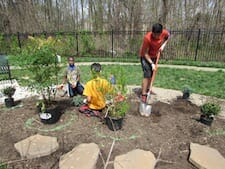
This activity branched off into a Zumba and yoga class led by teens, with two full classrooms of participants, as well as a community health initiative led entirely by teen residents. Our younger residents have even gotten into the action. Our youth who attend elementary school spent a school break turning a long abandoned plot of land into a community gathering garden, complete with an array of plants and a walking path, with future additions in the works.
The work of these youth has invigorated residents, and participation in adult programming is at an all-time high in our community. We plan on using this momentum to have adult residents begin running their own programming and meetings. But it was that youthful enthusiasm that started it all, enthusiasm that exists in every community, no matter the size or place.
5 Days Left to Apply for Fall 2014 Civic Accelerator
Here are 5 reasons to apply to the Points of Light Civic Accelerator, which invests in and supports seed stage social ventures that solve pressing social and environmental issues by engaging people.
5. New Challenge with a New Focus
How might we develop new pathways and increase access to economic opportunity for all?
Together with the PwC Charitable Foundation, the Starbucks Foundation, SAP and the Committee for Children New Mission Ventures Fund and Hilton Worldwide, the Points of Light Civic Accelerator is seeking innovative social ventures that are working to create greater, more accessible pathways to economic opportunity in communities across the U.S.
The potential solutions are many. From interventions in early childhood education and veteran re-entry, to financial literacy and 21st century skills development, we are interested in exploring a range of solutions and approaches together. We’re looking for innovative technologies, platforms, and other models that create positive economic outcomes for the communities in which they operate.
4. New Cities
The 12 week startup boot camp will convene for three, in-person, weeklong sessions, in addition to undergoing the virtual curriculum. Each session is focus on a specific in startup development and includes an opportunity to present your venture in front of a local audience concluding with Demo Night during session 3.
The Committee for Children (CFC), the nation’s leading non-profit provider of social-emotional curricula, has teamed up with the Civic Accelerator to find and support innovative ventures in social-emotional learning during the fall 2014 program. CFC is partnering under the auspices of its New Mission Ventures Department, which is dedicated to expanding CFC’s mission of fostering the social and emotional development, safety and well-being of children. The Seattle based nonprofit is most known for the award-winning Second Step program, teaching social-emotional skills to prevent bullying, violence, and abuse and improve academics. Their curricula are used in over 25,000 schools across the United States and around the world. To learn more, go to www.cfchildren.org.
2. Chance at $50,000 Investment
At the conclusion of the Civic Accelerator program, two teams (one for-profit and one nonprofit) will be selected to receive $50,000 investments each, with the decision being made by the entrepreneurs themselves. What would $50,000 mean for your civic venture?
1. Join a National Network of Civic Entrepreneurs
The Civic Accelerator curriculum in and of itself holds enough value to justify your application, however it’s the people – the entrepreneurs, mentors and partners that really make the Civic Accelerator such a unique and transformational experience. Connecting with likeminded individuals from across the country, building meaningful and lasting relationships to help grow your business is what it’s all about. Apply now and join the CivicX family.
Alex Kapur presents OpportunitySpace at a fall 2013 Civic Accelerator workshop.
Founded by two graduates of the Kennedy School at Harvard University, Cristina Garmendia and Alexander Kapur, and with a dynamic, lean team that includes Nico Tejera and Andrew Kieve, OpportunitySpace has a mission to create a public database for developers that makes it easy to access information about publicly owned buildings and land. So far, it has listings in Louisville, Ky., and in several cities in Rhode Island, including Providence.
“It just seems like the knowledge set for how to invest and develop is limited to such a select group of people that there’s an opportunity to use technology and data to open up access to this market,” Alex Kapur told the Times.
Together with our founding partners, PwC Charitable Foundation and Starbucks Foundation, and SAP, Committee for Children and Hilton Worldwide, the Points of Light Civic Accelerator is seeking innovative social ventures that are working to create greater, more accessible pathways to economic opportunity in communities across the U.S. Applications for the fall 2014 Civic Accelerator will be accepted until Aug. 15.Apply now!
17 Tornadoes and a House Fire Would Get You Thinking About Getting Prepared, Too
Read about how folks in Maine and Texas are preparing for disaster. To help your family take action, visit Good & Ready, where you’ll learn how to create a disaster plan, build a preparedness kit and more.
Audrey Castro
As a child, Audrey Castro survived tornadoes and a house fire, shaping how she and her family prepare for emergency.
“With my husband and kids, we’ve always had an escape plan,” said Castro, 53, who lives in Cape Elizabeth, Maine, a suburb of Portland, with her husband and children, ages 18 and 21. “When they were little, our kids knew what to do if they heard a smoke alarm go off. We bought ladders to hang from their bedroom windows to be able to get out, and they knew to head to a neighbor’s yard to a particular tree. We made them take a first-aid class.”
Nearly 60 people died on April 21, 1967, when 17 tornadoes hit northern Illinois in one day. With the sky darkening and alarms sounding, Castro – 6 at the time – and her family rushed to their basement safe room to cover themselves with mattresses. Five years later, while living in Portland, a middle-of-the-night fire caused by a cigarette ember in a trash can forced Castro’s family out of the house, fleeing heavy smoke. In both cases, they survived, unharmed.
Today, Castro’s family takes no chances: “Everyone in our house has a flashlight on their nightstand, and they’re in the bathrooms. We have gallon jugs of water in the garage, along with snacks. It’s the same thing with our cars. We have our valuable belongings videotaped. It’s just better safe than sorry … because you just never know what’s going to happen.”
Carlos Libby of West Gardiner, Maine, at the Portland disaster preparedness event, explains why he feels preparing for disaster is critical. (Click photo for video.)
That was the message relayed at recent disaster preparedness events in Houston and Portland, Maine. The
and Points of Light have teamed up for a 14-city tour to help people around the country become better prepared for emergencies.
People attending these events – with the help of volunteers from Allstate and affiliates of Points of Light’s
– assembled starter disaster preparedness kits. Participants received blue bags to fill with kit items and attentively listened as they made their way down a line, as each volunteer explained an item to add to their kits.
The donated kits included items such as a whistle, a flashlight that doesn’t require batteries, a mini first-aid kit, a poncho, a mask to wear if debris is in the air, a water receptacle, a trash bag, hand sanitizer – and brochures and handouts that provide a variety of emergency information.
“The event today is just to remind people that disasters occur,” said Adam Pisani, an Allstate agent in Sugar Land, Texas, who volunteered at the July 26 tour stop at the
. “They occur when we least expect them. And so being prepared is very important,” Pisani said.
A participant at the Houston disaster preparedness event gets help filling his disaster kit from a volunteer.
At the July 29 Portland event, held at a Sea Dogs minor league baseball game, Allstate spokesperson Julia Reusch noted that only about 15 percent of Americans would be considered prepared for a disaster, and these educational events aim to change that.
The goal is to teach people how to “build a kit that will help them be prepared and have enough to sustain them for 72 hours in the event of an emergency,” Reusch said.
Event participants said they appreciated the opportunity to learn about, think about and prepare for disaster.
Kristen Lue King, who put a kit together with her 9-year-old daughter at the Houston event, said the exercise was a great lesson for her child: “This helps show her that while there’s a reason for concern, there are some practical things you can do.”
Look How These Volunteers Show Compassion for Young People in Their Community
Today we recognize three volunteers we learned about through the United Way of King County in Seattle, part of Points of Light’s HandsOn Network – 250 volunteer centers across the globe. To find a center near you, visit the HandsOn Network map.
Fighting Childhood Hunger
McKenna Knight
McKenna Knight is a driving force behind the Healthy HIP Packs Program, a project of Hunger Intervention Program, at John Rogers Elementary in Seattle. The Healthy HIP Packs Program gets nutritious and kid-friendly food into the hands and mouths that need it most. Each Friday at several schools in north Seattle, backpacks are discretely filled with six meals and two snacks for 40 children per school who are at risk of hunger. So over the weekend, when school meals are not provided, the children are still able to eat well.
The collection, sorting, distribution and packing for this program takes a lot of volunteer support, and at John Rogers Elementary, this couldn’t be done without Knight’s coordination. Plus she supports the program by networking, helping to raise funds and garnering community support. She is the kind of volunteer who generates great ideas and is willing to do the work herself.
Getting School Supplies for Kids in Need
Jerry Johnson
How much do you think a family spends per child on school supplies? On average it’s between $60 and $100 each fall – and many families have more than one child in school. Not to mention the fact that teachers spend an average of $400 of their own money to cover classroom supplies.
Communities in Schools of Seattle organizes an annual Stuff the Bus campaign during the summer to help low-income families manage these costs and ensure that students are able to start the year with sufficient supplies.
For the past five years, Jerry Johnson has played an integral part in Stuff the Bus, which collects more than 50,000 school supplies for Seattle Public Schools students in need. As a volunteer, he drives the bus across Seattle to pick up supplies from collection sites collection events. His energy and enthusiasm pump up the entire team.
Showing You Can Give Back at Any Age
Eden Heu-Weller
Eden Heu-Weller volunteered at Friends of Youth’s administrative offices for the first time at age 5, on a Wednesday in January 2013. She arrived with her nanny. Eden spent her first day counting name tags for Friends of Youth’s annual Celebration of Youth luncheon, and she and her nanny have returned to volunteer every other Wednesday since.
Friends of Youth’s youngest volunteer, Eden has labeled and sorted volunteer packets, made thank-you cards, stocked food, organized toiletry bags and greeted attendees at a ribbon cutting. She is now 6, and she recently finished helping Friends of Youth prepare for another Celebration of Youth luncheon, counting and sorting name tags and helping stuff packets.
Kickoff of ServiceWorks Engages the Heart, While Putting Muscle Behind Service as a Solution
Three national partners – one corporate, one nonprofit, and one from the federal government – spoke to the power of service yesterday in New York at a moving ceremony kicking off ServiceWorks, a 10-city initiative designed to use service as a strategy to help 25,000 young adults develop the skills they need to prepare for college and careers.
Points of Light Board Chair Neil Bush speaks about how ServiceWorks can help young people who feel they don’t have anyone to set them on a path to success.
Citi Foundation Board Chair Ed Skyler said, “We want to focus on and make a big commitment to what we see as the biggest problem facing our country today: youth unemployment.”
Points of Light Board Chair Neil Bush spoke of the thousands of young people who feel they are without anyone to set them on a path to success. “That’s so painful to hear. That’s something thousands of volunteers can change. I know that’s why we’re here today.”
And Corporation for National and Community Service CEO Wendy Spencer said, “This is a beautiful thing. It’s what Congress has charged us with: investing federal dollars in programs that work.”
The event – which featured poems from Grammy Award-winning artist J. Ivy, along with music, dance and inspiration – kicked off a national program unique in many ways.
ServiceWorks will be a massive demonstration of the power of service as an intervention in young lives. The program will give tens of thousands of young adults training in critical 21st century leadership and workplace skills, the chance to build their networks and connections to community, and the opportunity to use their new skills by participating in, and leading, volunteer service projects.
New AmeriCorps VISTA members get sworn in at the ServiceWorks kickoff ceremony.
ServiceWorks will be a large-scale volunteer response to the crisis of low career and college attainment, mobilizing thousands of volunteers – including Citi employees – as coaches, mentors and trainers.
ServiceWorks will be the nation’s largest corporate-sponsored AmeriCorps VISTA program, including 225 AmeriCorps VISTA members over three years.
ServiceWorks will unite the Citi Foundation, AmeriCorps and Points of Light in a powerful public-private partnership – the kind President Obama and other national leaders have been calling for – to solve our nation’s most critical problems.
ServiceWorks will unite a large group of nonprofit host agencies, using their collective experience in supporting the goals and dreams of our nation’s young people. The host sites are:
Boston – The Boston Private Industry Council
Chicago – Casa Central
Dallas – The Volunteer Center of North Texas and CitySquare
Los Angeles – Public Allies
Miami – Greater Miami Service Corps
Newark, N.J. – Jersey Cares
New York – The Door
San Francisco – Public Allies
St. Louis – United Way of Greater St. Louis
Washington, D.C. – Covenant House Washington DC
ServiceWorks will change so many lives, beginning with those of the 45 new AmeriCorps VISTA members who were sworn in yesterday. One of them, Abe Sierra, explained that he grew up in Boston, with few resources and fewer role models.
“I got kicked out of school,” he said, “but others who served in my community became an inspiration to me.” Thanks to them, Sierra said, “I got my GED, I’m currently enrolled in college, and I joined CityYear last year, which turned out to be a life-changing experience.” This year, Sierra will continue that “ripple effect of service” as a ServiceWorks AmeriCorps member in Boston.
“We’re the small motor that will spark the bigger motor of change,” he said.