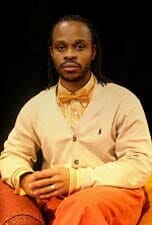
This post is by Jamiel L. Alexander, a member of AmeriCorps Alums and president of YouthBuild USA’s National Alumni Council and Aspen Institute’s Opportunity Youth Incentive Fund Leadership Council. See below how you can get involved in a summer service challenge.
Jamiel L. Alexander
I was sitting in a business management class during this summer semester while my professor was giving a lecture. As I tried to concentrate on the classwork, a song, “Money Can’t Buy” by Neo, played in my mind accompanying my thought process. I was thinking that the benefits of service cannot be bought similar to how affection cannot be bought in this song.
In an effort to serve my community better, I’m taking courses in business law, money and banking, and business management that have given me a new outlook on service. It is through service that I have become a Millennial leader. Yet, those who know me well (and even those who don’t) understand that service is who I am and what I do.
Since service is part of who I am, I knew I had to go to the recent Aspen Institute’s Franklin Project Summit on National Service in Gettysburg, Pa. I was one of many AmeriCorps alumni there who believed there should be a “bridge year of service” for graduating high school and college students. In my opinion, this opportunity should be open to anyone.
The need for the whole community, and not just parts of it, supporting service, was made clear to me by my conversations and participation in this summit of world and community leaders. Is it possible that 20 years ago, our pioneers of the national service community envisioned and imagined that we would be here, today, advocating and pushing this cause, humanity’s call, forward: Service to others!
When I went back to my summer school session after the conference, I started to see how the conversation on increasing investment in a business to help it grow applies to service too. A major concept taught in my business class is that of “compounding.” Compounding is earning interest on interest that was earned in prior years.
In class, I was thinking of how I could use this concept in my everyday life. My professor began to give us the story of his life. Of course a few of my fellow classmates gave the “here-we-go-again look,” but I began to go with him through a snippet of his journey: him growing up on a farm, his challenges in becoming a well-respected businessman in corporate America, and now a semiretired professor. (Neo’s song slowly fading in.)
As he paused, I sat there, and it hit me as he stated, “You will accomplish more than you think.” I thought, the accomplishments and the seeds of good deeds through service may not be seen or recognized now, but your service will be our legacy – a force for unity, not just for families but for our community for generations to come.
So, here is my challenge to you. We’re doing a summer service challenge on twenty.americorpsalums.org to encourage people to serve 20 hours this summer. Go to the link for your service pledge, give back and pay it forward.
Creativity Pays Off for Innovative Nonprofit Programs
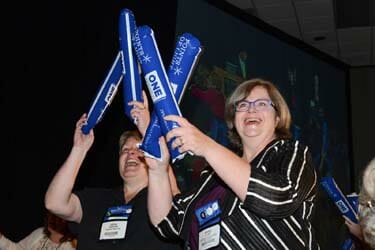
With spectators clapping blue thunder sticks together, jumping out of their seats, cheering for their favorite teams, the gathering looked more like a pep rally than a bid for nonprofit grants.
Zelda Magnuson, left, and Karen Delaney cheer at the forum with thunder sticks.
The pitches fueled the excitement – four innovative programs attracting volunteers and serving communities in creative ways.
At the
JPMorgan Chase and Points of Light have a history of collaborating to find new ways to support and facilitate volunteer service. At last year’s Conference, they kicked off a nationwide
tour focused on uniting unlikely allies to help students succeed, alleviate hunger and improve the environment.
The innovation and social impact forum at this year’s Conference – a celebration of the One America campaign – gave HandsOn Network affiliates a chance to showcase how they are uniting people through service for good.
The innovation forum judges confer to decide which organization will receive the $50,000 grant.
“One America really represents what we’re here at this Conference to talk about: Service unites,” said Points of Light Chairman Neil Bush.
Lois Backon, head of corporate partner marketing for JPMorgan Chase, welcomed forum attendees on behalf of the 250,000 JPMorgan Chase employees who have themselves logged more than 1.5 million hours of volunteer service over the past four years, including 56,000 skills-based hours in 2013 alone.
Backon said the forum was a great opportunity for JPMorgan Chase to combine two core values: service and innovation. “JPMorgan Chase is committed to investing in service innovation,” she said. “We know that when we harness what our best and brightest have to offer, we can make a tangible difference in every local community we touch.”
Then it was pitch time.
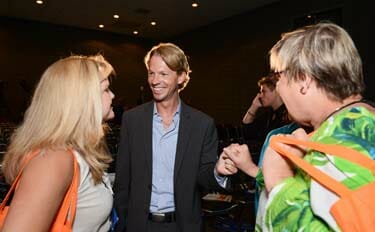
Brian Williams, center, of Hands On Nashville receives words of congratulations after the forum.
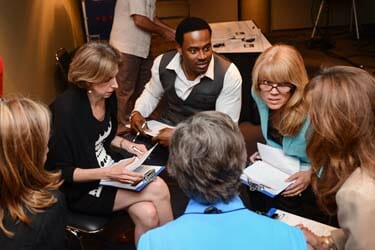
The four competing nonprofits – part of Points of Light’s HandsOn Network of 250 volunteer centers – showed video presentations of their work and answered questions from a panel of judges. The panel picked which organization would take the top grant of $50,000, included Lamman Rucker from “Tyler Perry’s Meet the Browns”;
came out on top for its work mobilizing volunteers to make homes in low-income neighborhoods more energy efficient, saving homeowners as much as $500 a year on their utility bills.
Hands On Nashville launched the program in the wake of the city’s historic flooding in 2010. Since then, nearly 1,000 volunteers have repaired 311 homes, including 156 damaged by the flooding. Volunteers install attic insulation, replace traditional light bulbs with compact fluorescent bulbs and more.
Brian Williams, president and CEO of Hands On Nashville, said the $50,000 grant will allow his organization to add program components that will further reduce energy consumption and engage donors in ways Hands On Nashville hasn’t done before. Hands On Nashville can also use the funds to start working with the city of Nashville to “expand service in a very thoughtful way and within a much quicker timeline than we imagined.”
Each of the three runners-up took home $15,000 to invest in their own innovative programs:
Volunteer Center of Santa Cruz (California) Senior Tech Day – a program that invites teen volunteers to help seniors navigate the digital age by teaching them how to use e-mail, how to view and share photos electronically and more.
HandsOn Twin Cities (Minnesota) Skills-Based Summit – an event that brings together skills-based volunteers who facilitate workshops exploring topics from marketing and social media to leadership development and finance.
HandsOn Genesee (Michigan) Community Service for Success – a three-week program that connects clients receiving cash assistance from the state of Michigan with volunteer opportunities that help sharpen life and job skills.
Emily Gilliland, HandsOn Network’s executive director, said the programs featured at the forum reflect the creativity, commitment and passion of HandsOn Network affiliates across the country.
“They have perspective and vision about what is needed and how to get it done,” Gilliland said. “And they each are doing it in unique, creative, incredible ways that are inspiring their communities.”
The grant program, which Backon called an extension of JPMorgan Chase’s “commitment to innovation and to helping communities and cities thrive,” is the kind of support that Williams said helps service organizations have a greater impact.
“JPMorgan Chase encourages organizations to be very thoughtful about their programming and then they reward those organizations for doing so,” Williams said. “It’s a very productive path for donors to take.”
A Fear of Commitment, But Not When it Comes to This
This post is by Veronica Scheildler, an AmeriCorps VISTA member at generationOn, Points of Light’s youth service arm. Scheildler is serving through Corps18, a Points of Light program that supports VISTA members addressing chronic absenteeism across the country. Corps 18 VISTAs serving at generationOn help make volunteer service part of the culture at select New York City public schools by involving students, parents and teachers.
Veronica Scheildler
I’m a bit of a commitment-phobe, but I want to be doing something that rings of purpose. VISTA has been a perfect fit. Twice.
My Corps18 experience marks the second time I have taken the oath to build America’s communities and do my best to make its people smarter, safer and healthier. Both times I have been inspired by the objectives laid forth in my VISTA assignment description. Both times I’ve navigated the emotional ups and downs of community work. Both times I’ve very seriously contemplated quitting before the buzzer rang on 365 days. Both times I’ve had those shining moments that make me immensely glad I stuck with the work despite the days I struggled to feel like my efforts had any utility.
This year, the feeling of satisfaction hit hardest when I saw the rather difficult eighth grade class of a public middle school in New York – MS 57 – graduate. From the moment they marched into the auditorium clad in their shiny blue caps and gowns, unbidden tears sprang to my eyes. I was shocked at the intensity of my emotion, but also cognizant of how meaningful my interaction with those young people on the precipice of adulthood was to me.
For my own future, I want to climb mountains, travel, write, draw, eat, laugh, argue, cry, sing, dance and swim in rivers, oceans and lakes. However, I want all of that to be interspersed with developing meaningful relationships. I want to grow and see other people grow with me. I have been attracted now more than ever before to work with after-school programs, and have tossed my hat into the ring for some positions in that field.
At a training I attended last winter, the presenter spoke about the differences between school and after school. Her explanation was that school focuses on education – really instilling those basic skills of reading, writing and arithmetic – but that after-school programs are uniquely poised to focus on learning – really connecting the skills learned in the classroom to the wider world allowing for exploration and experiential learning. It could be cool to be a part of that.
I have been so grateful for the opportunity to be engaged in building communities. I truly believe that you often meet the very best people when you do this sort of work.
Startups Get $50,000 Each for Ideas Serving the Greater Good
A San Francisco company that teaches people how to raise money and a Chicago nonprofit that brings science, technology, engineering and math education (STEM) to students in low-income neighborhoods, were chosen by their peers to receive $50,000 each at the close of the spring 2014
Points of Light Civic Accelerator
.
From left, Megan Christenson of the Civic Accelerator; Nzinga West of Project SYNCERE; Kenahn Jung of Piggybackr; Ayesha Khanna of the Civic Incubator; and Rashad Thornton of Project SYNCERE
The Civic Accelerator is a 12-week boot camp dedicated to boosting startups with missions that engage people as part of the solution to community challenges. This spring’s 14 participating startups – a mix of nonprofit and for-profit enterprises – met in Seattle, New York and Atlanta for networking, mentoring and peer support.
During the last session on June 20 in Atlanta, the participants themselves picked the winners, which both focus on helping future generations succeed:
, a Chicago nonprofit that has developed a STEM enrichment program for underrepresented students in grades four through 12.
Piggybackr plans to use the investment to reach more young people and communities across the nation so that funding is not a barrier. Andrea Lo, CEO and co-founder, credits the Civic Accelerator with helping her focus at a critical point in her venture’s growth. Project SYNCERE Executive Director and co-founder Jason Coleman expressed his enthusiasm and shared how meaningful this investment was coming from his peers in the program.
Since launching two years ago, the Civic Accelerator – a program of the Points of Light
– has now graduated 48 startups, invested $500,000 in civic ventures, built a pipeline of more than 150 mentors, advisers and partners, and engaged more than 150,000 people in solving society’s critical challenges in the environment, economic development and using technology for good. Each venture class is unique, having its own identity and feel.
was launched in 2012, in partnership with Village Capital, and receives generous support from PwC Charitable Foundation and Starbucks Foundation, both founding partners, and from the Blackstone Charitable Foundation, SAP and the accelerator’s official hotel sponsor, Hilton Worldwide.
Are You Part of the Unprepared 85 Percent?
Read about how folks in Tampa, Fla., Indianapolis and Baton Rouge, La., are preparing for disaster. To help your family take action, visit Good & Ready, where you’ll learn how to create a disaster plan, build a preparedness kit and more.
Kevin Sloan, center, and one of his sons receive a disaster preparedness kit in Tampa, Fla.
Charley, Frances, Ivan, Jeanne. Anyone who lived in the Tampa Bay area in 2004 remembers them well – the four hurricanes that battered Florida in less than six weeks.
Luckily the area was mostly spared, suffering power outages and some flooding. Those who moved to the area in the last decade have no memory of the constant hurricane watches and warnings that left people on edge for weeks. And even many who lived in the area during the storms have let their guards down.
“We want to engage people to get them to think about a hurricane,” says Gus Rodriguez, an Allstate insurance agency owner in Belleair Bluffs, Fla. “Everybody’s complacent. We live in hurricane alley.”
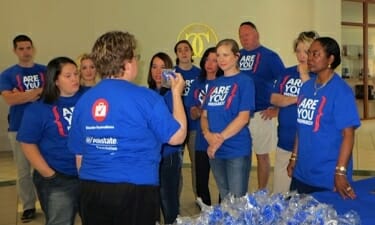
Rodriguez was one of the Allstate agents taking part in a disaster preparedness event last Saturday before a Tampa Bay Storm arena football game. The event was part of a public awareness campaign and 14-city tour brought to town by the Allstate Foundation and Points of Light. On the same day, the tour also stopped in Indianapolis at PBS KIDS in the Park and Baton Rouge, La., at the Mall of Louisiana.
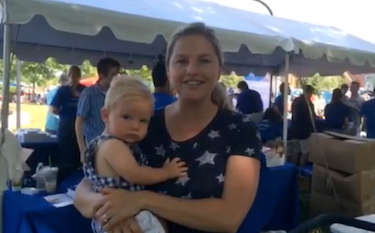
Sheila Ungerer of Indianapolis, holding her son Will, shares what she learned during a disaster preparedness event.
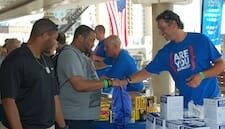
During the events, with the help of volunteers from Allstate and local affiliates of Points of Light’s HandsOn Network, participants assembled their own disaster preparedness kits using items provided.
In blue sacks, the kits included water bottles, hand-powered flashlights that don’t require batteries and other essentials. Participants and volunteers put together more than 2,000 kits at the three events combined.
“Eighty-five percent of us are not prepared for disaster,” said Ranj Puthran, an Allstate agent from Carmel, Ind., who volunteered at the Indianapolis event. “We’re so comfortable, and our first responders are so good, that I think we’re almost lulled into comfortableness instead of preparedness. We need to take more initiative.” (See a short video of Puthran here.)
The Indianapolis tour stop had special meaning for Emily Gilliland, executive director of HandsOn Network. An Indiana native, she has lived through two tornadoes.
“In 1979 I remember being at my grandmother’s house in Westport, Ind., and saw a tornado coming down the street,” Gilliland said. “My aunt’s house, halfway down the block, was hit. The roof was taken off.” (See a short video of Gilliland here.)
Baton Rouge, La., volunteers are briefed on how to assemble disaster preparedness kits.
As Gilliland spoke, people were lining up behind a row of tables at the Allstate booth, waiting to assemble their free preparedness kits. As they picked up the items volunteers explained the significance of each in an emergency situation.
The kits also included cards about tornado safety and other information, such as the need to have enough supplies on hand for at least three days in case of an emergency or disaster. Basic supplies include a gallon of water per person and non-perishable, easy-to-prepare food.
Sheila Ungerer, who moved to Indianapolis four years ago, learned at the event in her city about each of the items in her new disaster kit, which included a whistle.
“I’m from Virginia and my husband is from Syracuse, N.Y., and we know that tornadoes can happen here,” said Ungerer. “I came away with some good tips. I didn’t know about the whistle – that three short bursts means `help.’ That’s not only good for me, but good in case I ever hear it.”
Having a kit is only part of being prepared, the participating Allstate agents in all three cities said. Also having an emergency plan in place is critical. If your town imposed an evacuation order, would your family know what to do?
“Education is a part of planning,” said Baton Rouge volunteer and Allstate agent Agnes Andrews. “Education will take care of a lot of the problems that could occur in a disaster, because if you have things in order, you’re less likely to have problems.”
Along with emergency kits, “be sure to include some cash, not to be touched except in the event of a catastrophe like a hurricane,” Andrews added.
Beth Dudley of Natchez, La., was visiting the mall on the day of the Baton Rouge event. “I stopped by to get a kit,” she said, “because you can never be too prepared for an emergency. I’ve never experienced a natural disaster, so it’s great that this event provides all the basic things people might need.”
`Service Unites’ as Conference Sessions Encourage Cross-Sector Collaboration
Zelda Magnuson, left, and Karen Delaney cheer with thunder sticks at the HandsOn Network Innovation and Social Impact Forum.
Today attendees of the Conference – sponsored by UPS – witnessed the principle in action, as dozens of educational sessions and forums focused on creating cross-sector alignment and new alliances to help address pressing community issues.
Speakers and attendees explored the relationship between the business and nonprofit sectors, looking for opportunities to expand skills-based volunteering while helping volunteer-driven organizations grow vital programs.
During the Business Track Opening on Building a More Creative Workforce,
CEO Jean Oelwang gave a TED-style talk about how companies are redefining the way they think about their volunteer programs, which help employees build skills they can use in their jobs and even in their personal lives. “We need every single person to be empowered with purpose right now,” Oelwang said.
Later during the Business Track Luncheon, Points of Light honored The Advisory Board Company and UnitedHealth Group with the 2014 Corporate Engagement Award of Excellence.
Deon Jones of Be the Change Inc., opens the Creating a Bright Future for Our Kids Forum.
Nonprofits and social entrepreneurs will have the opportunity to bring key initiatives to scale, thanks to collaboration and support from corporate partners participating at this week’s Conference. At the HandsOn Network Innovation and Social Impact Forum, sponsored by JPMorgan Chase & Co., four HandsOn Network affiliates took home a combined $100,000 in grants.
HandsOn Nashville earned the top grant of $50,000 for a program that makes low-income homes more energy efficient and safe, while the Volunteer Center of Santa Cruz (Calif.), HandsOn Twin Cities (Minn.) and HandsOn Genesee (Mich.) shared another $50,000 in grants.
The Civic Accelerator Demo Night showcased the work of startups aiming to solve pressing social and environmental issues. Ventures had three minutes to pitch inside the theater at the World of Coca-Cola to compete for some startup essentials from prize sponsors CSRwire, NEX Atlanta and more.
The Global Forum on Disaster Preparedness and Recovery, sponsored by UPS, offered an opportunity to discuss how various government agencies, nonprofits and individual volunteers can better cooperate to help communities prepare for disaster. Four U.S. mayors – Karl Dean of Nashville, Laurie Gill of Pierre, S.D., Edna Branch Jackson of Savannah, Ga., and Dayne Walling of Flint, Mich. – joined Corporation for National and Community Service CEO Wendy Spencer for a discussion about the critical role volunteers play when disaster hits, and the need for a plan to coordinate volunteers well before disaster happens.
Spencer later led a National Service Town Hall meeting that included a panel of AmeriCorps Alums who have each deepened their commitment to service in both the public and private sectors. She highlighted public-private partnerships, such as
, which use national service to help solve our nation’s most pressing challenges.
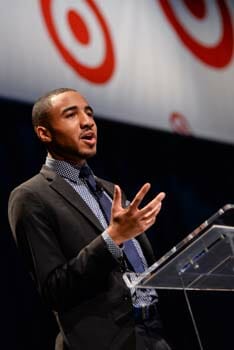
Conference speakers and attendees also discussed how to disrupt silos and engage more volunteers and strategic partners to support students. The Creating a Bright Future for Our Kids Forum, sponsored by Target, focused on the power of caring adults to affect the lives of young people and took a deeper dive into the complexities of mentoring. “Caring is important and necessary but not sufficient,” said John Gomperts, president and CEO of America’s Promise Alliance.
Mentoring was also a hot topic of conversation during a panel on Black Male Achievement that included actor and activist Lamman Rucker; Dillard University President Dr. Walter Kimbrough; civil rights and criminal attorney Mawuli Davis; MiWae co-founder and life coach Awo Thurmon; and mentor, community activist and entrepreneur Dakori Thurmon. The panel stressed the importance of mentoring and community support help create level playing fields academically and on the job.
“Regardless of what you do for a living, regardless of how much money you make… you have an opportunity to serve,” said Rucker, who later in the day received the Daily Point of Light Award for his commitment to community service. “All you’re doing is contributing to the dysfunction around you by thinking you can’t have an impact.”
A New Facebook App for Finding Volunteer Opportunities
It’s all about The Ask. Before you ran a nonprofit, you were a volunteer.
Think about that last time you volunteered. What inspired you? Chances are there was a social spark. A friend was volunteering. Your church held a service day. A coworker or classmate mentioned their weekend volunteering plans and invited you to come along. Basically, someone asked, and you answered.
Now your nonprofit can make The Ask on Facebook with All for Good Volunteer – the first app for finding volunteer opportunities right on Facebook.
How does it work? Nonprofits posting their projects via AllforGood.org or a Partner Portal can install the app (announced today in Atlanta at the Conference on Volunteering and Service) to get a feed of their projects built into their organization pages. Visitors to the page can then search for projects that fit what they’re looking for – and, once they sign up, they’ll be able to share the news with their Friends List and encourage other folks to come along.
It’s another way to build connections and make sure we keep up with volunteering as it evolves. By putting projects right on Facebook, we’re meeting people where they already are, putting important causes on the front page to help volunteers connect to change.
Points of Light Digital offers a portfolio of volunteer management tools, including All for Good and HandsOn Connect, to help power the nonprofit sector. To learn more about the All for Good Volunteer Facebook app, or check out any one of our tools, head to www.allforgood.org/services.
Birthday Wishes for President George H. W. Bush and Your Chance to Give a Meaningful Gift
It’s our founder’s 90th birthday today, and lots of folks have something to say about that.
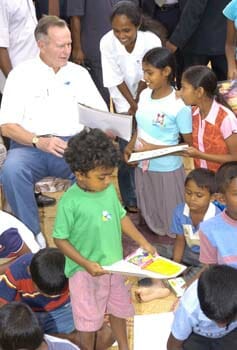
President George H. W. Bush reads to children during a visit to Sri Lanka. (Photo by Joe Reilly)
What does President Bush really want for his birthday? His son Neil Bush, chair of Points of Light’s board, answers the question on CNN.com.
What should today’s young people know about President Bush’s life of service? Gregg Petersmeyer, founding director of the White House Office of National Service, answers on Politico.com.
What was so revolutionary about President Bush’s focus on service? Read Points of Light President Tracy Hoover’s views on The Huffington Post.
What did President Bush have to do with five promises to young Americans? Check out this piece from John Gomperts, president and CEO of America’s Promise Alliance.
You can wish President Bush a happy birthday by giving him the one present he’s sure to love: your pledge to serve. Go to BeOne.PointsofLight.org and make a pledge to volunteer in honor of President Bush’s lifetime of service. Let us know that you’ll tutor a child, plant a community garden, serve at your local food bank – whatever you feel passionately about. When you pledge, a point of light will appear on a national map.
Better Living Through Technology
This post is by Jackie Norris, executive director, and
Yvonne Siu Turner, senior manager, corporate resources and programs,
means creating a better future for everyone through its actions and innovations. After Haiti’s earthquake in 2010, with critical medical infrastructure in ruins, the country’s Ministry of Health asked Partners in Health (PIH), a U.S.-based health care organization, to scale up plans to build
, a community hospital just 60 kilometers north of Port-au-Prince.
“The urgency of the situation escalated plans and we confirmed our commitment to become one of the primary technology partners for the hospital,” said Paul Ellingstad, director of human progress initiatives at HP.
“PIH was a natural strategic partner for HP,” he said. “We believe in the role of technology in democratizing people’s lives and helping them live and work better. PIH’s vision is health equity for all and a belief that modern technology should be made available to support health care delivery to the poorest of the poor. We were a natural fit.”
How did HP help?
Yvonne Siu
It provided what the company knows best – technology and IT infrastructure to support all the applications needed to run a modern hospital. The hospital was fitted with a high-capacity server rack, wireless access points and VoIP phones. HP workstations were situated throughout the hospital equipped with 27-inch monitors to enable teaching opportunities in the operating rooms and optimum radiology image viewing.
Further, the electronic medical record system housed on HP servers allows hospital staff to quickly refer to and update patient records, providing clinicians with the tools they need to diagnose and treat patients.
Long-Term Commitment
In addition to providing technology and funding, HP employees contributed their time and expertise to the design, build-out and installation of the IT systems at the hospital.
Alan Nemeth, HP fellow emeritus, and Les Fox, HP distinguished technologist, both volunteered to oversee the project – and continued to volunteer after their retirements in 2012. Throughout the project they brought in experts from other areas of HP including HP Technology Services, HP Networking, HP Enterprise Services and Manufacturing.
Good For The Community, Good For The Company
HP’s commitment to global community engagement and skills-based volunteering projects like this has not only improved the health of thousands, it has also helped develop professional skills and boost morale at the company.
In fact, employees who use their professional skills when they volunteer are 38 percent more likely to have the highest level of employee morale than employees who don’t volunteer, according to
. The scorecard showcases the impact that HP’s employee volunteer programs have on everything from the nonprofits they serve to employee satisfaction.
While there has been much progress, much of the dialogue surrounding CSR and corporate citizenship today still centers on making the business case for programs that allow employees to get involved in their communities and tackle social issues, especially through volunteering. HP is at the forefront of this discussion, as it supports its business case with data. It is this discipline and commitment to measurement and evaluation that won the company accolades in the
Having data to support integration between business strategy and CSR is no small achievement – many companies are in the beginning stages of collecting data that can show a direct connection between volunteerism and bottom-line business goals like talent development and employee engagement. While many volunteer programs start out with good intentions and stem from a culture of wanting to give back, the ability to sustain and scale a program often relies on data proving that it is good for business.
“Ever since its inception in 2011, our employee community engagement program has put tools in place to track the results of key initiatives,” says Rebecca Wang, manager for HP corporate affairs.
Wang continues: “Why is measurement so important? Because we are accountable for our results just like any other area of the business. If we can’t prove our value to our business leaders, we will lose their support. And without senior management support, no corporate program can hope to last for long.
And without measuring results, you can’t determine whether a program is successful or not. It makes no sense to continue implementing programs that take valuable resources and funding if they can’t prove their worth.”
Other findings from HP’s scorecard show that volunteering is associated with higher rates of employee inspiration, motivation and loyalty. When asked what they would do if they were offered a comparable position at another company, volunteers were 12 percent more likely to say they wouldn’t leave than non-volunteers while 13 percent were more likely to recommend HP as a great place to work.
For companies like HP, this indicates a win all around: engaged employees, an engaged community and a direct way to scale its social impact.
“As we look to the future, we embrace the opportunity to apply the talents of our people and the broadest technology portfolio to deliver solutions for our customers’ and the world’s most complex challenges,” says Wang. “By working to achieve a balance of human, economic, and environmental progress, we will create a better future for everyone. One in which we are all living progress.”
40 Million Puppy Adoption Fees, Clean Water for 160 Million People and More – the Possible Result of This Small Business Practice
This post is by Matthew Manos, founder and managing partner of verynice, a global design firm that gives more than half of its work for free to nonprofit organizations. Hear from Manos June 16 during the Points of Light Conference on Volunteering and Service in Atlanta.
Matt Manos
When I was 16 years old, I took on my first pro-bono project. I found myself in a skate park in the Silicon Valley. You could find me there on most weekends, but this particular weekend, something spectacular happened.
I saw a man in a wheelchair ripping around the park far better than everyone else, myself included. Intrigued, I rolled a bit closer to the man only to find that he was not alone, but he was actually with a group of kids, also in wheelchairs.
I came to find out that this man was the founder of a nonprofit organization that taught handicapped children how to participate in extreme sports. Incredibly moved, I volunteered to design some stickers to help promote the organization. Just starting to learn how to use Photoshop, the stickers really were not my best work, but they did have a profound impact on me that would define the next 10 years of my career as a designer.
I’m the founder of a company in Los Angeles called verynice. We are a global design and innovation consultancy that gives more than half of its work away for free. So far we have been able to save nonprofit organizations almost $1.5 million, which has been directly reinvested into each organization to generate more impact. It is our sole mission to invent new models of business that allow for the alleviation of expenses for nonprofit organizations.
In more recent years, we have started to pioneer a new kind of movement amongst service providers. As a result, there are now dozens of other businesses and individuals that are giving half of their work away for free, on top of thousands of practitioners that have begun offering pro-bono services, inspired by our mission.
Why do we do this? Let’s start imagining something pretty remarkable.
If nonprofit organizations can save billions a year, and if service providers in my industry alone waived fees for nonprofit clientele, we could accomplish some pretty amazing things on an annual basis. This is the equivalent of 40 million puppy adoption fees, clean water for 160 million people, and the labor and materials required to build homes for 160,000 families.
I’m constantly asked why we give half of our work away for free instead of 10 percent, 20 percent, 30 percent… The reason is far less logistical than everyone might imagine. It really is a philosophical decision. I truly believe that if we want to create social impact, we need to make giving back an integral component of our day-to-day lives, not an extracurricular activity that we do on the weekends.
We might not think that we can each individually change the world through our work. In reality, we can’t. But what we can do is resist the societal norm of charging for our work in the social sector so that they may move onward and upward with an abundance of resources.