Michelle Obama and Jill Biden Listened – Will You?
To an audience that included First Lady Michelle Obama and the vice president’s wife Jill Biden, Points of Light’s President of Programs Delores Morton illustrated how volunteers have changed veterans’ lives.
Delores Morton
The event in Washington, D.C., last week brought philanthropic and nonprofit leaders together with the
.
More than 30 philanthropic organizations and corporations have taken the pledge, committing more than $170 million over the next five years to support veterans and military families.
Points of Light is a member of the steering committee of the annual White Oak Conference hosted by
, which brings together the public and private sector to address the ever-changing challenges of military family life. The committee helped secure the pledges.
Following is an excerpt of Morton’s remarks, including what Points of Light is doing to help veterans and their families:
We’re all familiar with Lily Tomlin’s quote: “I always wondered why somebody didn’t do something about that. Then I realized I was somebody.”
Three years ago at White Oak, many of the folks in this room recognized that there was a gap in communities of all sizes in how organizations worked together to meet needs of service members, veterans and their families.
These organizations, determined that they were the “somebody” that was needed to help create a solution to this challenge and set out on an ambitious goal of bridging the gap between the more than 40,000 nonprofits dedicated to helping the military community.
The result of this collaboration between organizations like
is the Community Blueprint, which has found a home at Points of Light. We are engaging volunteers and convening communities to create lasting change.
Since its inception, the Community Blueprint has engaged more than 298 organizations across more than 600 communities.
Through the Community Blueprint, we are collecting, creating and disseminating resources that encourage more effective collaboration and help communities to leverage
all
of their available resources – especially volunteer power – to meet needs of America’s warriors and their families. The Community Blueprint’s on-the-ground work takes advantage of the individual skills that veterans can bring to bear in communities to address complex problems.
Points of Light and our partners are working together every day to create programs that benefit both veterans and military families, including two AmeriCorps programs – the Veteran Leader Corps and VetSuccess on Campus.
These AmeriCorps programs demonstrate the collective impact that occurs as a result of cross-sector collaboration – bringing together the Veterans Administration, companies like UPS and Exelis, and the Corporation for National and Community Service.
An example of what this looks like in practice is the Bridging the Gap initiative started in partnership with the San Antonio Veteran Coalition and Veterans Leader Corps members. This coalition represents 120 organizations that have connected 400 veterans in rural communities with services that include employment, counseling and education.
Not only are we seeing organizations come together to create more opportunity, we also see the benefits of these partnerships for veterans. Veterans like Marsha J., an Iraq war veteran and single mother who struggled to find stable employment to support her children.
Because of the work of Robert W., a Veteran Leader Corps member stationed at Volunteers of America Chesapeake, Md., Marsha was connected to one of our hiring partners. Within two weeks of their first meeting, she secured a meaningful job as an executive assistant at a defense contracting organization. Marsha conveyed to Robert that that because of our work, she’d gotten back her sense of hope.
While I could quote the statistics that state we have reached more than 10,000 veterans in the first two years of the Veteran Leader Corps program, or supported almost 800 student veterans in just the last five months during which we have operated Vet Success on Campus, it is more meaningful to bring this work to life for you.
Our VetSuccess On Campus program – a pilot initiative in partnership with the Department of Veterans Affairs – has helped many veterans understand and access the education benefits available to them.
People like Kaleb W., a disabled veteran looking for ways to increase his chances of securing a better job with his brain injury. Because of the work of Amanda Linville, a VetSuccess member and military spouse at Boise State University, Kaleb is enrolled in school pursing a college degree using his Veteran Education Benefits.
Stories like these and many others are only possible because of the strong public and private partnerships that we have made.
I invite everyone to learn more about what we are doing to change communities and how your organization can get involved.
Read more about the Community Blueprint and other Points of Light programs serving veterans and their families at
Do Your Kids Have This Crucial Ingredient for Learning to Read?
This post is by Madeline S. Collazo, AmeriCorps VISTA program associate at the Jewish Coalition for Literacyin San Francisco. Collazo is serving through Corps18, a Points of Light program that supports VISTA members addressing chronic absenteeism across the country.
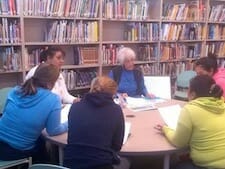
Joan Green, center, a Jewish Coalition for Literacy reading specialist, meets with parents at North Shoreview Elementary School in San Mateo, Calif.
When I was a little girl, my favorite time of day was story time. After I got ready for bed, I would pick out one of my favorite books. My mother would then read aloud as I listened and drifted off to sleep, cocooned in stories of dragons and princesses and children who would not eat their vegetables.
I remember my excitement the day I looked down at the page and discovered I could read the words along with my mother, the stories I loved leaping off of the page.
For many children, there is no story time. The only exposure they get to reading is in the classroom, and for many, this simply isn’t enough. Boosting reading skills at a young age is crucial for future success and, in order for students to get the most out of school, they should also have reading support at home.
My current position as an AmeriCorps VISTA at the Jewish Coalition for Literacy is focused on parent and community engagement; my top priority is organizing and facilitating workshops for parents who want to practice basic English vocabulary, pronunciation and structure so that they can read books at home along with their children. Since September 2013 alone, JCL conducted more than 100 parent workshops in public schools across the San Francisco Bay Area, helping communities that are often marginalized and underserved.
Phyllis Harrison, principal of North Shoreview Montessori School in San Mateo, Calif., and longtime JCL partner, believes that JCL’s parent workshops have a multigenerational effect on families, benefiting the parents who come to the workshops, their children who now benefit from a reading-friendly home, and consequently, future generations in the family.
“By coming to their child’s school every week, parents need and want to know that North Shoreview is their child’s home away for home,” Harrison told me.
Parents love the workshops as well, which provide them with the skills they need to help their children excel. Mothers, fathers and guardians are their children’s first teachers, and the most trusted people in their sons’ and daughters’ lives.
Sara L. Gomez, who faithfully goes to JCL’s Reading Together in English workshop every Tuesday morning at an elementary school in San Francisco, said: “I love to learn English so that I can help my daughter.” Dina Estevez, another regular at the Tuesday session, added that “it is very fun and we practice a lot of English.”
It is thanks to this enthusiasm and growing interest that JCL’s workshops are developing a new cadre of parents committed to their children’s reading success, and to creating supportive home reading experiences. Together, we are making story time the new favorite time of day.
Are you in the San Francisco Bay Area and interested in inspiring a young reader? Check out www.jclread.org. To find similar opportunities across the country, visit All for Good.
She Grabbed What She Could and Got Out
This post is by Eric Nankervis, program manager of disaster services at Points of Light.
Izola Nichols tells her story during last Saturday’s disaster preparedness event in Birmingham, Ala.
As Izola Nichols stood in her house, floodwater rising up her calves, she remembered the words she heard during a preparedness training session two weeks prior: “Grab your medicines and prescriptions. Get your purse and passwords. Grab your evacuation kit and a change of clothes. And get out!”
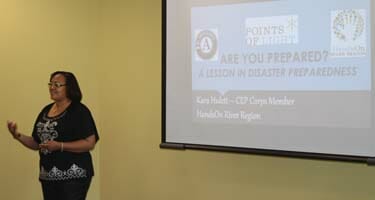
The training was one of a series led by Kara Hulett, a Points of Light Community Emergency Preparedness Corps member, in the Pratt City neighborhood of Birmingham, Ala. No stranger to disasters, Pratt City was devastated by tornadoes on April 27, 2011. Hulett’s presentation focused on tornado awareness and safety, but as Nichols witnessed, one needs to be prepared for anything, at any time.
“I knew the hazards of a tornado,” Nichols recalled, “but was I prepared for a flood?”
She had stayed up all night with her husband, a local pastor, watching the weather and monitoring for signs of a tornado. Only after the storm blew over did they get to sleep. At 4 in the morning the pastor was awakened by a strange noise. As he got out of bed to investigate, his feet hit water.
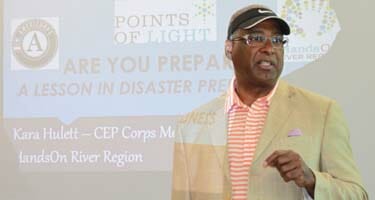
Birmingham, Ala., Mayor William Bell talks about the importance of preparing for disaster.
The April 7 storm flooded the nearby creek and water was gurgling through the home’s floorboards. He went outside and witnessed the water continuing to rise – off of the front steps the water was up to his waist.
The pastor waded through the rising water to get the family’s small boat as Nichols gathered their supplies. “You prepare for one hazard, and forget there are others,” she said. “But I knew what to get. There are only a few things you can grab and you only have a few precious minutes.”
Nichols credits Hullett’s presentation for helping her family prepare for the flood. The training Hullett offered is part of her service as an AmeriCorps member. Serving at HandsOn River Region in Montgomery, Ala., Hulett had partnered with Birmingham City Council member Marcus Lundy and Hands On Birmingham to better prepare the citizens of Pratt City in the event of another disaster. (HandsOn River Region and HandsOn Birmingham are part of the Points of Light’s HandsOn Network.)
“Storms in life do come,” said Lundy. “How you prepare is what is important.”
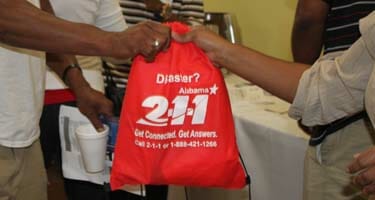
Birmingham, Ala., residents receive disaster preparedness kits at last Saturday’s event.
Since the 2011 tornadoes, Pratt City has been rebuilt with new homes with storm cellars and new infrastructure, including a new library and fire station. Yet more than a third of the residents did not return.
“The majority of the people have hung in here. They have endured,” Lundy said. “And these trainings cannot be more important. “
The Nichols family’s story proves it. Nichols and her husband were able to take their son, their dog, a few precious belongings, a disaster kit and what they learned at the preparedness training to evacuate their house safely. Lundy invited Nichols to share her story last Saturday at another disaster preparedness training session, as a part of a tornado memorial day in Pratt City.
With basic disaster kits provided by Lundy, HandsOn River Region and HandsOn Birmingham – all assembled by local schoolchildren – the training session was kicked off with welcoming remarks by Birmingham Mayor William Bell, who praised the timing of the training and warned residents of the potential of tornadoes that followed earlier this week.
Fortunately, Pratt City was spared this time but its citizens are ready. “Being prepared on the top end is vital,” Nichols told those at the training event, again led by Hulett. “You will learn what you need to get, and when you need to get out.” And sometimes, that is just in time.
The Community Emergency Preparedness Corps is an AmeriCorps program implemented by Points of Light, with funding from The UPS Foundation and the Corporation for National and Community Service. With 22 members serving in 13 sites across the United States, the program helps Americans better prepare for and recover from disasters.
Here’s How You Can Help Tornado Victims
Beginning on April 27, a dangerous storm system sparked a series of tornadoes causing extensive damage and power outages across the central and southeastern United States. The severe storm threat continues as the storm systems move east.
Points of Light’s HandsOn Network is the expert in volunteer engagement and our affiliates often lead their local communities in managing spontaneous, unaffiliated volunteers throughout response and recovery efforts. Points of Light is coordinating with HandsOn Network affiliates in the affected areas and connecting with Voluntary Organizations Active in Disaster (VOAD) chapters across the U.S. to assess the situation and offer support.
If you would like to support the recovery effort, here’s what you can do to help:
PLEASE DON’T:
Don’t self-deploy at this time. The situation is still critical and travel is extremely difficult or impossible throughout much of the affected area.
Don’t bring supplies or donations to fire stations, police departments, etc. First responders need to focus on immediate needs and emergency situations.
PLEASE DO:
Do donate to help Points of Light and HandsOn Network affiliates support the mobilization of volunteers in ongoing response and recovery efforts.
Do register your interest to volunteer on All for Good and check this page often for the latest updates on how you can help. (For Alabama, Mississippi and Arkansas, include the words “spring 2014 tornados” in the Volunteer Opportunity Name. For Alabama coastal and Florida coastal responses you should include the words “spring 2014 flood” in the Volunteer Opportunity Name.)
Do be prepared! As the devastation caused by these tornadoes reminds us, disasters can happen anytime, anywhere. Please take steps now to help your family and community recover more quickly from disasters. Visit www.goodandready.org/resources to download an emergency preparedness checklist and create a disaster readiness plan for your family.
Would You Do This to Help Your Neighbors?
As snowstorms give way to spring showers, we give thanks to those who stepped up during the rough winter season – like the volunteers of Serve Rhode Island.
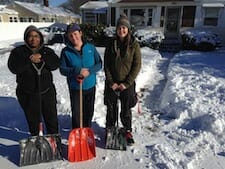
East Bay Community Action AmeriCorps members, shown here, were among the volunteers who responded to Serve Rhode Island’s call for volunteers to shovel snow.
In response to several snowstorms in the area, the Providence-based volunteer center, dispatched hundreds of volunteers to shovel sidewalks and driveways at residences of the elderly and the disabled. During the past two winters, volunteers have helped at 500 residences.
“Shoveling a driveway seems so simple, but to seniors, elderly and disabled folks it impacts their ability to get medical care, go to doctors’ appointments and get food delivered,” says Marisa Petreccia, director of operations at Serve Rhode Island. “So from our vantage point we are making sure that their basic needs are still being met in times of disaster.”
The snow-shoveling program began in February 2013 when Serve Rhode Island recognized there was no statewide or community effort to help residents clear the snow from around their homes.
Serve Rhode Island, part of Points of Light’s HandsOn Network, contacts residents to assess what kind of help they need. Homes are then posted as assignments volunteers can sign up for online. The volunteers – community members, neighbors and AmeriCorps members – are enthusiastic about the work.
William Volpe, a teacher and counselor from Central Falls, R.I., helped shovel out 10 residents during the winter.
“When I helped out during Winter Storm Hercules, not only did I get to help elderly and disabled residents in my neighborhood, but I also enjoyed my time and was able to get some great exercise,” says Volpe. “Giving back is certainly a way to show my gratitude to the many elderly and disabled residents who have given much to the community.”
Petreccia says the volunteers generally share that sentiment: “There’s a growing aging population in our state and so I think many of the volunteers are paying it forward by helping their neighbors and with the idea that, ‘I hope this program continues so that if I am ever in this situation I will also have the resources.’”
Debra Garrett’s house went green, but she didn’t have to spend any green. Thanks to Hands On Nashville, Garrett’s home has new lights, water filters, thermostats, smoke detectors, and a new showerhead and fire extinguisher.
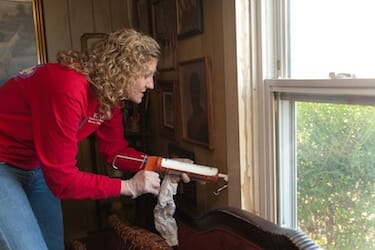
A Hands On Nashville volunteer fixes a window pane in an old home.
Garrett is one of 160 homeowners to benefit from Hands On Nashville’s Home Energy Savings Program since 2011. The program engages volunteers to make energy and safety improvements at no cost for qualifying low-income Nashville residents.
“I really appreciate everything they have done to my home,” Garrett says. “I did not realize how important these improvements could be for me, and the volunteers were absolutely wonderful to work with.”
The Home Energy Savings Program is funded by the profits of Go Green Home Services, which provides high-quality home energy improvements for an affordable fee. The socially responsible business is a joint venture of Hands On Nashville and Nashville residential real estate firm Village Real Estate Services.
The Home Energy Savings Program has three key goals: decrease low-income homeowners’ utility bills, decrease energy consumption in the area with sustainable improvements and engage community volunteers in service.
The program has saved each homeowner an average of 16 percent – or $600 – a year on their utility bills. For low-income households, that money can help a great deal, says Brian Williams, Hands On Nashville’s president and CEO.
And while the homeowners learn how to keep their utility bills down, so do the volunteers.
“Throughout the process both the volunteers and the homeowners learn innovative ways to decrease energy consumption and make sustainable home improvements,” Williams says.
Volunteers can choose from a list of Home Energy Savings projects online. Occasionally corporate teams will volunteer together.
Williams says Hands On Nashville would like to increase the number of volunteers and homeowners helped, perhaps reaching hundreds of homes each year.
“We are really proud of how our programs have become a wrap-around service in a way to help all segments of the population through both paid and unpaid services,” says Williams.
This Island Knows How to Throw a Volunteer Service Party
This post is by Janis Vinck, Curaçao Caresprogram manager and project coordinator.
The first national volunteer initiative on Curaçao, CURA DOET, sent a huge wave of positive impact throughout this tiny Dutch Caribbean nation of 150,000 people. On March 21 and 22 more than 2,500 volunteers from all walks of life tackled 132 service projects in almost every neighborhood on the island – coordinated from the headquarters of Curaçao Cares, a new international member of Points of Light’s HandsOn Network.
Author Janis Vinck, left, celebrates CURA DOET with fellow participants.
To prepare for CURA DOET (translation: Hands-on Curaçao), we first reached out to social organizations and then launched a massive media campaign to make as many people as possible aware of this service weekend and recruit volunteers.
We invited nursing homes, primary schools, cultural organizations, foundations, neighborhood centers, sport associations and afterschool programs to propose volunteer projects. Our team spent many days on the road visiting social organizations in order to plan activities. It was a great opportunity for us at Curaçao Cares to build relationships with organizations, schools and even companies we hadn’t worked with before.
Many organizations saw CURA DOET as the perfect opportunity to get things done that they did not yet have the time, manpower or resources to do. This included hands-on jobs such as painting neighborhood centers, fixing playgrounds in a school, sprucing up the garden at a home for the elderly and giving special attention to clients and patients by organizing a special breakfast, celebration or a nice outing. Our goal was to reach at least 100 projects, so we were pleasantly surprised when we surpassed that mark!
On the eve of the big weekend, the governor of Curaçao kicked off CURA DOET in the company of several community partners and other invited guests. It was a festive start to an unforgettable two days during which we saw families, colleagues, teammates and classmates all roll up their sleeves and join forces.
It was fulfilling to see young and old having fun while lending a hand and many volunteers were gratified to see the result of their work.
“Dun’un man, gan’un Kurason” – “Lend a hand, win a heart” – is the motto we chose for CURA DOET and we are proud that it inspired so many to take action for Curaçao. We are already looking forward to CURA DOET 2015!
Leaning Toward Leadership? Consider a Nonprofit Board
Once involved, volunteers often see they can make a difference – and want to do more. Feeling that pang, longtime volunteer Anne Fisher considered serving on a nonprofit board of directors to make more of an impact on her community.
Anne Fisher
“I thought joining a board might be a great way to do that, but I wasn’t quite sure where to start,” Fisher said.
Having no prior board experience, Fisher decided to take part in The Bridge, a Seattle Works program that prepares people for board service.
About 10 years ago Tara Smith, the executive director of Seattle Works, saw the organization’s method of placing people on boards for a yearlong trial period wasn’t ideal. “We wanted to connect people more quickly to boards,” Smith said.
So The Bridge was born. During the one-day program, participants learn from experts in different fields about fundraising, finance, leadership development and different board structures. The program also includes an interactive board simulation. The goal is to help participants figure out whether board service is right for them. (If you’re not in the Seattle area but would like to find out more about serving on a nonprofit board, check out these resources from The Bridgespan Group.)
“The Bridge was a helpful introduction to board service,” Fisher said. “It helped me understand what questions to ask when considering an organization and how to articulate both what I had to offer and what I wanted out of the experience.”
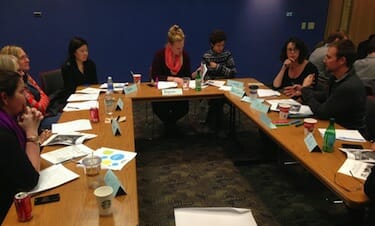
Prospective nonprofit board members participate in a Bridge session at Seattle Works.
Aside from training participants how to be board members, Seattle Works – part of Points of Light’s HandsOn Network – helps program graduates meet and get paired with different boards.
These Board Speed Dating nights, as Seattle Works calls them, bring together Bridge graduates and prospective nonprofits looking for board members.
Ben McCarthy, who heads The Bridge, says Seattle Works partners with more than 40 nonprofit partners focused on such issues as community engagement, the environment, health and wellness, the economy, the arts, education and more.
Following Fisher’s graduation from The Bridge she became a board member for Youth in Focus in 2011 and is currently the board’s president. Youth in Focus, now celebrating its 20th anniversary, uses photography to help at-risk youth see the world in new ways so they can make positive choices in their lives.
“I’ve found my board service to be an incredible learning experience,” Fisher said. “It’s been a chance to take on new challenges, build my leadership skills and feel like I’m making a meaningful impact. It can be a lot of work at times, but it’s very rewarding.”
Trina Gadsden, executive director for Youth in Focus, acknowledges how The Bridge has helped Fisher and in turn Youth in Focus: “The Bridge program prepared Anne for the role of board president because it gave her the necessary tools and experience to navigate and lead positive change.”
Seattle Works runs The Bridge four times a year for the public in addition to holding private sessions for corporations, such as Microsoft and Boeing. Since its first year The Bridge has prepared approximately 1,500 people.
Because of The Bridge’s success and in response to feedback from people who wanted more training and support, Seattle Works created Bridge 201 – a six-hour advanced training session designed for current board members to become more effective leaders.
For those thinking of board service Fisher has some advice: “I believe that having a passion for the organization’s mission is essential. … Spend time understanding an organization’s missions and goals, what they need from their board, their greatest challenges and opportunities, as well as the time and financial commitment required from their board members. Clear expectations and the right fit help to create a fulfilling and valuable experience.”
An Unexpected Career in Volunteer Service
Tracy Hoover, an America’s Promise Alliance trustee, has been a dedicated leader in the service movement for the majority of her career. America’s Promise Alliance asked Hoover to talk a little about herself. (See the original post here.)
Tracy Hoover
Q: You’ve devoted most of your career to service. Was there a specific moment that this issue “clicked” with you and became your personal and professional passion? Why service?
A. Points of Light’s founder George H. W. Bush says every definition of a successful life includes service to others. Like many people, I started volunteering out of a desire to give back. Organizations like Hands On Atlanta made it easy for people like me to find fun, flexible volunteer projects at night and on weekends.
But volunteering in Atlanta’s public schools and homeless shelters taught me a lot – about our city and its citizens, about complex issues like illiteracy and hunger, and about how engaged citizens can change the odds. It also taught me a lot about myself – and launched me on an unexpected career in service that has spanned two decades (so far), and that has defined meaning and purpose for me.
Why service? Because it’s transformational – it changes communities, it changes the odds, and it changes lives – on both sides of the service equation.
Q: As the decades pass, what has changed the most about the service/volunteerism field, what has changed the least, and where do you see the field heading in the next 10 or so years?
A: Twenty years ago, it was disruptive, in a good way, to allow people to sign up for a “hands-on,” volunteer-managed service project. It gave the ultimate power and choice to individuals and required nonprofits to package volunteer opportunities in new and different ways.
Today, millennials and technology are creating change that’s just as disruptive, still in a good way, for volunteers and for nonprofits that depend on them. I’m excited to see volunteers becoming more informed consumers, trying to make the best and highest use of their time, talents, dollars, networks and more. That’s a big challenge for the nonprofit sector.
It’s also exciting to see how technology is driving innovation in service: crowdsourcing, social media, mobile apps, social enterprise. Individuals have more power, more opportunities and tools for leveraging all of their assets – their time, talent, voice, philanthropic dollars and consumer power – to make a difference.
I do want to point out that amidst all this change, some critical things have stayed the same. People still volunteer because someone asks them to. Service still brings people together. And volunteers are still the only constantly renewable resource capable of creating dramatic improvements and bringing them to scale.
Q: What do you think about mandated volunteering through a high school class requirement? Could it turn off teenagers, who never like being required to do anything?
We spend a lot of time working to increase the number of volunteers in the world and the impact of what they do. So we examine why people volunteer, and in survey after survey the answer is the same – it’s because they were asked. Sounds pretty simple, doesn’t it? But, if you really think about the traditional ways people are invited to serve – and who is typically invited to serve – you realize that a lot of people are left out and a lot of potential is untapped.
When done well, I think compulsory service can create an entry point for people to find their passion and tap into their power to make a difference. I’ve seen this happen many times – when a minor infraction inspired “community service” that became a family tradition, when a high school student from an under-resourced school started tutoring in a volunteer Saturday program – initially, to satisfy a graduation service requirement, but then because it mattered. It’s also worth noting that both the high schooler who volunteered and the younger student he tutored did better in school.
Compulsory service can be a starting point for a lifetime of service. That said, we’re all for encouraging people to serve because every single person can make a difference, regardless of background, means, education, connections. We all have a role to play to create a better world.
Q: Anything else you’d like people to know?
A: Yes. Just a few days ago, Points of Light, AmeriCorps and the Citi Foundation announced a major public-private partnership we’re calling ServiceWorks. The $10 million, 10-city initiative will engage 25,000 youth, age 16-24, in service and build a large-scale volunteer response to the crisis of low college and career attainment.
We plan to give young people training in critical 21st-century leadership and workplace skills, the chance to build professional networks and connections to their communities, and the opportunity to use their new skills by participating in and leading volunteer service projects. And we’ll give thousands of volunteers – including Citi employees – the chance to participate as success coaches and mentors.
Research shows that young people involved in service exhibit a significant change in “life skills such as showing increased concern for others, improved ability to problem solve, and improvements in self-perceptions of potency – the ability to make a difference in a community.” And a 2013 study by the Corporation for National and Community Service shows that volunteering is associated with an increased likelihood of finding employment for all volunteers regardless of a person’s gender, age, ethnicity, geographical area or job market conditions.
ServiceWorks will demonstrate that the coupling of national service and volunteer service can help level the playing field for low-income young people, not only by decreasing the opportunity gaps they face but by increasing the likelihood that they will stay in school and find good jobs. Read more about the program at www.pointsoflight.org/serviceworks.
In the last quarter of 2013, a series of natural disasters hit several parts of the Philippines, leaving thousands of people homeless and infrastructures worth millions of pesos destroyed. Although Hands On Manila didn’t specialize in volunteer management during disaster, we became one of the coordinating hubs after Typhoon Haiyan for people who wished to help either through donations or as relief volunteers.
Given the need and demand from the volunteers, it was natural for Hands On Manila – part of Points of Light’s HandsOn Network – to recalibrate to respond to disaster-related scenarios.
Through the help of Points of Light, Hands On Manila was able to start incorporating volunteer management in the context of disaster through a weeklong immersion facilitated by Colleen Clay, Point of Light’s senior director of disaster services. We started with a workshop attended by Hands On Manila’s volunteer leaders (called Sherpas) and other partner organizations. We learned not only about the ABCs of disaster but also how to effectively manage volunteers before, during and after a disaster.
Colleen and I then flew to Bohol, one of the affected areas in the country, to meet potential local partners and visit some of the vulnerable sites.
Bohol experienced three major natural disasters last year: a 7.2 magnitude earthquake in October, Typhoon Haiyan in November and Typhoon Zoraida a few days after. Hands On Manila already had a relationship with some communities in Bohol through its Volunteer Vacations program, which aims to provide tourists with flexible volunteering and traveling opportunities in the Philippines. So we decided to pilot our disaster program in Bohol.
In line with our existing Hands On Schools program, which partners with public schools to help improve infrastructure, the disaster program will focus on rebuilding and reconstruction of select affected schools in Bohol.
After visiting Bohol, Colleen and the rest of the Hands On Manila team met with our partner corporations to give a preview of the disaster program. The response was very encouraging, as most of them see the value in allocating money and volunteers to the program.
Although we’re still developing the program, our entire team is inspired by the passion and dedication of our volunteers to help.