This post is by André Cervi, one of the founders of Atados, which connects volunteers and nonprofits in Brazil. He is responsible for corporate volunteering projects.
André Cervi
The strike against political corruption in Brazil last June illuminated a desire among Brazilians for change, including ways to improve the lives of ordinary citizens. Volunteering is a novel approach to create better public services through citizen involvement, and Atados – one of the newest HandsOn Network international members – is an answer to the growing demand for volunteer opportunities in Brazil.
In April 2012, four friends and I had the idea of creating a marketplace to connect people who are willing to help with nongovernmental organizations (NGOs) in need. In São Paulo, we created a platform called Atados (bond), and launched it within seven months. We fielded more than 100 volunteering opportunities from more than 70 NGOs in that short time. From providing English classes to serving as entrepreneurial coaches to developing cultural activities, many citizens contributed to social change with the skills and the time they devoted as volunteers.
The launch was an epic success. The media feasted on our newly bonded project, and as a result many interested citizens started volunteering with NGOs. However, the greatest challenge was yet to come. Right after the website was launched, we discovered that the NGOs wanted to work with volunteers but were really ill-prepared to receive and manage them. To better serve our purpose, we started to train our NGO partners in increasing their efficiency through volunteer management. But the system was still lacking.
Fortunately, when we were approached by Jonathas Barreto of the HandsOn Network/Points of Light Global Team in early 2013, we understood better that we could also learn more by getting to know HandsOn Network affiliates and accessing a pool of resources globally. A few months later, we decided to become a HandsOn Network international member and with that, Atados made more bonds than ever before.
One of the perks of being in the HandsOn Network family is learning best practices from other members. I was able to do that when I visited New York Cares and The Volunteer Center of United Way in November. I found out how these U.S. affiliates deal with fund-raising, implementing corporate projects and managing NGO relationships, which are clearly the same challenges we experience in Brazil.
The meeting, more than face-to-face networking, was a learning experience indeed. The stories they told me gave me better foresight in solving current volunteering issues and planning programs for the future.
This year, our main thrust at Atados is partnering with major Brazilian companies to add to our volunteer opportunity offerings. We believe we have made a good head start in this regard and many other organizations are getting interested in cooperating. It feels good to see that NGOs and the private sector are now appreciating our work.
We are still at the beginning of our quest to make volunteering commonplace in Brazil, but we know that we are making progress toward social equality.
Building a Startup for the Greater Good? Here’s a Hot Place for Entrepreneurs
When we think of entrepreneurial hubs, naturally we think of San Francisco and Silicon Valley. In our ever-flattening world, however, it is no surprise that the entrepreneurial landscape is rapidly changing and other lesser-known hubs are popping up all over the United States.
After having worked in Mumbai and traveling through East Africa, I landed in the Denver area ready to follow my passion for social innovation. Unbeknownst to me I had landed in a hotbed for high-tech startups and entrepreneurship.
I joined the
team in February of 2013 in a position that naturally fit with my networking efforts – helping to recruit promising civic ventures from the Denver area for the spring and fall Civic Accelerator programs.
The Civic Accelerator is a three-month, boot camp-style program; participating startups receive tools and mentoring – and potentially $50,000 investments – to expand their innovative work aimed at helping communities. In this work, I have had the pleasure of getting to know the startup communities of Denver, Boulder and Fort Collins – all buzzing with entrepreneurial activity.
So why do these cities make such great launch pads for social ventures? I asked Stephanie Brady, founder of
, one of the 15 ventures in the fall 2013 Civic Accelerator. LaunchUR equips teens with skills that will be crucial when they enter the workforce.
“This region is extremely open to innovation, new approaches and challenging the status quo,” Brady said. “There is an authentic culture here that is energized, inquisitive, curious, inventive, socially conscious and willing to help others.”
She added, “So many leaders in this region embrace our mission to accelerate the 21st century skills of our next-gen leaders and are willing to share advice and refer us to others in their valued networks to sharpen our business model and startup strategies.”
This comes as no surprise considering that Denver, Boulder and Fort Collins were among the “25 Top Startup Cities,” as named by
lists Boulder and Fort Collins as the No. 1 and 2 metro areas for high-tech startup density.
When it comes time to find a home for your next social venture, be sure to visit our mile high communities. You might end up staying!
Applications for the spring 2014 Civic Accelerator are due March 2. For more information, and to apply, please visit www.pointsoflight.org/civic-accelerator.
Since Age 7, This Teen Has Been Clearing Pathways for Kids With Disabilities
Stephanie Jennis mentors a boy at a soccer program.
I started Pathways for Exceptional Children when I was 7 as a series of after-school programs where kids with disabilities worked with peer mentors and established friendships. I had no idea that it would get to be so much bigger.
Pathways now has a home base at our own space in Boonton, N.J., called the Creative Studio, where kids with disabilities as young as 8 explore career tracks through classes that spark their interest, like photography, retail, disc jockeying, customer service and our newest tracks: computer programming and filmmaking!
Through an initiative called Project Win-Win, we are now securing jobs for students with disabilities in places like Staples and sending our disc jockeys out with peer job coaches to do gigs for parties in schools and other venues. I have seen what many deem impossible become a reality and I have seen the potential of people of all abilities reach heights never thought imaginable.
After receiving a Hasbro Community Action Hero Award last year, I was even more inspired to move further in my cause of tackling the 70 percent unemployment rate that faces people with disabilities. I knew that Pathways for Exceptional Children had come far, and I was sure that with the support of generationOn, Hasbro and other like-minded organizations we could do even more.
And we did! The Pathways’ Rock Band was invited by Kevin Jonas to play on the PNC stage with them during the Jonas Brothers’ sound check party. Later in the year, the Youth Advisory Board of State Farm awarded the youth leaders from Pathways almost $70,000 from Best Buy Children’s Foundation to transform our Project Win-Win program into a true social entrepreneurship venture.
Being one of the 2013 Hasbro Community Action Heroes, I’ve realized that there are so many great kids who are just as interested in service as I am. The award gave me the opportunity to see the potential in children and how much they can offer as far as service to their community, country and even the world.
Do you know a young person who is doing great work? Nominate him or her to be a 2014 Hasbro Community Action Hero. The deadline is 5 p.m., Eastern, Feb. 25, 2014. Don’t wait – submit a nomination today!
A Storyteller Uses Her Skills to Help the Hungry and More
Jasmine Youssefzadeh had a passion for storytelling, and she knew she wanted to incorporate that passion into a business that was dedicated to creating social good.
Looking for inspiration, she went to the HUB LA, a business accelerator and support group for the Los Angeles startup scene, and met Matthew Manos, the founder of verynice, a design consultancy that gives half of its work away pro bono to nonprofits. When Youssefzadeh heard about the social impact Manos was having with his unique approach to business and social causes, she knew she had found her inspiration and the business model for her social venture.
A year after that initial meeting, Youssefzadeh founded filmanthropos, a creative agency that specializes in digital media storytelling for causes, nonprofits and corporate social responsibility programs. Through stories, the company humanizes social issues and develops cause marketing that builds awareness. Even as a new startup, filmanthropos’ clients include the Boys & Girls Club of Santa Monica, the Children’s Bureau of Southern California and the Zimmer Children’s Museum.
To meet the goal of giving half of her organization’s work away for free, Youssefzadeh doubles filmanthropos’ workload and taps into a network of local volunteers to staff pro bono projects. In the company’s first year, Youssefzadeh was able to recruit 16 pro bono volunteers and take on 15 pro bono projects to meet local needs.
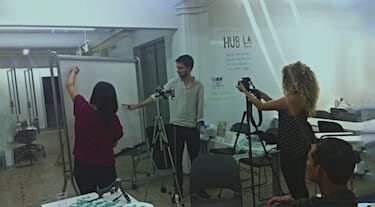
More than that — Youssefzadeh and her team place heavy emphasis on creative initiatives. For Pro Bono Week 2013, they completed their first pro bono “ProduceAthon.” A work-around-the-clock creative blitz, the “ProduceAthon” helped a nonprofit tell its story, highlighting the organization’s impact, in a short film produced entirely over 24 hours. The outcome of the event was a 60-second motion-graphic video created for Swipes for the Homeless, a nonprofit focused on alleviating hunger.
“Our volunteers pitched in and helped with scripting, storyboarding, shooting, animation, audio production, editing and more,” says Youssefzadeh.
And Dasha Orlova, filmanthropos’ creative director, recalls: “My favorite memory of the project was when we were doing a stop-motion scene outside, moving fruit a half-inch at a time. Everybody who walked by wanted to know what we were doing.”
For filmanthropos’ staff, the pro bono project was not only an opportunity to lend their professional skills to a good cause; it was also a fun team-building experience. “The most gratifying part was the bonding experience,” says Orlova. “You get to know other volunteers very well when you’re all together for 24 hours straight and your one goal is to produce a video.”
The pro bono marathon also generated media coverage for filmanthropos and helped the company develop its client base.
For Rachel Sumekh, executive director of Swipes for the Homeless, a program that enables college students to donate their excess meal points to buy food for those in need, the ProduceAthon was a huge boon.
“The video helps us communicate the impact of our work, makes our organization look edgier and has already helped drive more traffic to our website” says Sumekh, Swipes for the Homeless’ sole staff person. “We often don’t qualify for services from larger foundations or companies, but with filmanthropos’ focus on smaller nonprofits, we could.”
Watch the video that filmanthropos created for Swipes on YouTube. Interested in applying for filmanthropos’ next “ProduceAthon” in March? Email [email protected].
A Young Olympian and Volunteer at Heart
In Sochi, he’s an Olympian. Back home in Highland Park, Ill., he’s a volunteer.
Jason Brown
Jason Brown – who at age 19 is the youngest American men’s skater to qualify for the Olympics in nearly 40 years – participates in service projects through Chicago Cares, a HandsOn Network affiliate.
“The Jason Brown you’ve seen as part of Team USA is authentic, humble and full of positive attitude – the very same Jason Brown who shows up to volunteer,” says Katie Stearns, who worked with Brown at Chicago Cares.
“His family, friends and community –including those who know him through his volunteer service – are rooting for him to do his personal best at the Olympics because he always does his best for those around him,” says Stearns, now Points of Light’s vice president, corporate partnerships, action networks.
NBC recently featured Brown’s commitment to volunteering as part of the network’s Olympic coverage; read it here. On Feb. 9, Brown helped the men’s team win the bronze medal. (The men’s figure staking competition continues Feb. 13.)
Brown’s volunteer work has included organizing a community service project for his Bar Mitzvah in lieu of a traditional party. He invited hundreds of family members and friends to join him in service at an elementary school outside of Chicago.
These volunteers of all ages completed several projects, including organizing the school library, installing an outdoor classroom, painting a U.S. map and line games on the playground, creating inspirational murals and mosaics and planting a garden in front of the building. They also made teddy bears and fleece blankets by hand for a local children’s organization.
“Jason is the best kind of volunteer,” Stearns says. “He’s filled with energy and a real desire to make a difference and ready to share that passion with those around him so they, too, get excited about volunteering.”
A Great Opportunity for Entrepreneurs Who Want to Do the World Good
So you are a social entrepreneur with a civic-minded startup who wants to make a difference in the world. You have an innovative solution that gets to the root of a social issue, but are overwhelmed by the crowded field of startups and are unsure of how best to engage people, secure funding and grow your startup into a success.
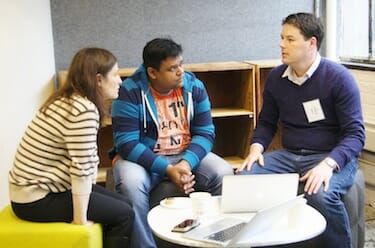
From left, Carly Shuler, Manish Anand and Tico Ballagas of
Kindoma chat during a recent Civic Accelerator gathering in New York. (Photo by D&A Images)
We believe people can be part of the solution to pressing social and environmental issues, which is why we focus on civic ventures, both nonprofit and for-profit, that are designed to tap into people’s talents, compassion and goodwill.
The Civic Accelerator program will take you and your team through a the three-month, bootcamp-style program with 10 to 15 other startups. You’ll convene in person during three weeklong sessions in Seattle, New York and Atlanta, and online in between sessions.
Aside from working with other startups the Civic Accelerator will partner you with mentors, impact investors and community leaders who are committed to your success. Industry experts will also train you in necessary skills such as fundraising, startup engineering, marketing, measurement and evaluation, and how to expand your startup.
Need more incentive? At the close of the program each startup will pitch their idea at a showcase event for civic leaders and investors. The two most promising ventures, one for-profit and one nonprofit, will be selected to each receive a $50,000 seed investment with a twist – you and your fellow entrepreneurs ultimately decide who will receive the investment.
In the most recent cycle the two startups that received funding were Kindoma and IDignity. Kindoma, a for-profit company in Palo Alto, Calif. created a mobile videochat platform that makes activities such as book reading longer, richer and more engaging for children and parents. IDignity, a nonprofit in Orlando, Fla., helps the disadvantaged overcome barriers to participating in society by helping them obtain identification documents such as birth certificates, Social Security cards and photo IDs.
“Receiving this investment from my Civic Accelerator peers is an exceptional honor and will help us scale and grow our impact based on a new business and revenue model we were inspired to develop during the program,” said Michael Dippy, founder and executive director.
Applications for the spring 2014 Civic Accelerator are due March 2. We are looking for ventures in these areas:
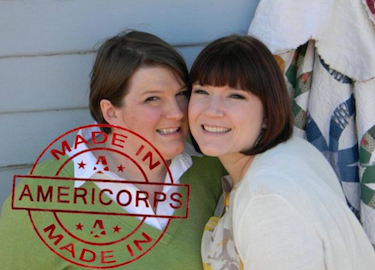
Today’s post is by Margaret Garvey, an AmeriCorps Alums member and founder of Arizona Serve. Check out how she found love through AmeriCorps, and if you have your own service love story, enter Points of Light’s Love & Service Valentine’s Day Contest for a chance to win Valentine’s Day dinner on us.
Margaret and Shona Garvey wed in October.
I am not really a morning person. So, in July of 2006 when I boarded the airport shuttle in Prescott, Ariz., at 5:30 a.m. to start the two-hour ride to the airport on the way to an AmeriCorps orientation, I was not really in the mood to chat.
Being a city girl, newly transplanted to rural Arizona, public transportation felt like a familiar comfort. My plan was to pop in my headphones, curl up with my bag and go back to sleep. This was the first of many plans I would make during my year of service that would not work out, and all the better for it.
Sitting in the very first seat, in the front of the bus, was a big-haired, smiling Tennessee gal who was so eager to meet me, she practically leaped at me. She was like a blast of caffeinated air fired at you from a leaf blower. “How could anyone be this friendly at 5:30 a.m.?” I pondered in my Bostonian brain.
Our travel experience together was… interesting. She had never been to a Starbucks, because she didn’t drink coffee (excuse me, say that again?); refused to wait in line at the gate because, in her southern accent, “I don’t sttayund in lionnes” (then how do you eat, bank and use the restroom?); and was eager to strike up a conversation with anyone and everyone around.
I made all sorts of plans for my term of service: I would only be in Arizona for one year; I would save money; reduce my stress levels; learn to decipher and then accomplish everything on my AmeriCorps Volunteer Assignment Description. I did none of these things.
I did some other things, though. I made lifelong friends; struggled with and eventually accomplished some important work in service; laughed a bunch, figured out how to make a budget and then actually stick to it; developed my leadership skills; learned about culture (mainly about my own culture); and I fell in love with that very happy southern woman.
Seven years later, we are both still living in Prescott. I am directing a statewide AmeriCorps VISTA program though Prescott College (www.arizonaserve.org) and Shona is doing foster care and adoption home studies with Arizona’s Children Association. In October, we got married back in Massachusetts. Our story is just one of many stories of folks who fell in love while in service.
I think, what it really comes down to, is that romantic love is just one form of the bigger love that we all share for service. I have had the pleasure of watching AmeriCorps members fall in love with service and in service and it just never gets old. We do great work, we have great fun and we do it all (as cheesy as it sounds) in love.
Are Vets Selfish? Let’s Debunk that Myth
This post is by Molly Blake, managing editor of Blue Star Families, a Points of Light partner.
If you haven’t read Time magazine’s “Are U.S. Veterans Selfish?” you might want to. It’s a powerful article, albeit with an unfortunate title. I’m a Marine Corps spouse – my husband served 20 years – and I can say without a shadow of doubt that vets are not selfish.
Lawmakers, congressional staffers and policy wonks may or may not plow through the more than 800 comments from readers at the end of the article to get a handle on how the military community feels about the budget cuts or commissary closings.
Often, they want research. They want smart answers to smart questions. They are interested in knowing how the lives of military families are affected by deployments, relocations, financial constraints and, yes, budget cuts.
If you are part of a military family, here’s something you can do: Voice your concerns when the 2014 Blue Star Families Military Family Lifestyle Survey. (Click here to access the survey.) Put your thoughts together – think about the realities of our lives, our challenges, our interactions with our kids and their schooling and mental well-being.
The 2013 Survey was designed by Blue Star Families, a Points of Light partner, with extensive input from military family members and advocates, subject matter experts and policymakers who work with military families. The survey is intended to facilitate a more complete understanding of the experiences of military families so that communities and policymakers can better serve their unique needs, thereby making voluntary military service sustainable.
Here are just a few of the ways previous surveys have made an impact: We’ve seen increasingly higher numbers of private sector businesses and employers equipped to address the unique needs of military families, including veterans and spouses – such as portable, flexible work.
The results have also provided a better understanding how family finances and concerns about finances are impacting military families and have increased programming around military family finances. And, there’s been an increase in the number of states and schools around the country that recognize the unique needs of children in military families and educators who know how to support them.
These are real results and just a few examples of tangible ways survey-takers’ thoughts have been translated into action. So, as military wife and mother of three Terri Barnes suggested last year, “grab a cup of coffee and a sandwich and take the survey!” You can find it here.
Join Actor Tyler Perry and 5,000 Others to Change Lives
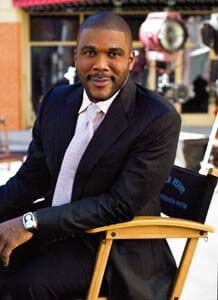
Here’s your chance to come together with filmmaker, actor and philanthropist Tyler Perry and 5,000 others with a single mission – to strengthen communities and change lives through volunteer service.
Tyler Perry
Registration is now open for the Points of Light Conference on Volunteering and Service, June 16-18, 2014, in Atlanta! The Conference is the largest convening of service leaders from all walks of life, sectors, races and religions, and political persuasions, united to lead the dynamic, ever-expanding, international volunteer service movement.
The first 500 people to register will be entered in a drawing to win one of FIVE Platinum Conference Packages, including complimentary registration, hotel accommodations and round-trip airfare to Atlanta.
This year’s Conference will showcase those on the forefront of the service revolution who have new ideas and proven solutions to tough community problems. Participants will hear from dynamic voices who meld digital prowess with down-home inspiration, provocative thinking with old-fashioned activism – to drive, empower and engage volunteers toward positive solutions.
See Atlanta Mayor Kasim Reed’s welcome message to 2014 Conference on Volunteering and Service attendees here.
Join us as we share best practices; learn about new tools, technologies and strategies for engaging volunteers; and prove that, no matter the challenge or opportunity, service unites.
Visit www.volunteeringandservice.org to register and find all the latest news on the 2014 Conference. We hope to see you in Atlanta!
What Is it About Disaster That Brings Out the Best in People?
This post is by Tracy Hoover, president of Points of Light.
Like many in Atlanta, I’m snowbound today. This week’s rare snowfall – a disabling two inches – hit our city and triggered a massive traffic jam, the kind that only happens when more than 1 million people rush home at the exact same time, on the exact same slick highways.
Tracy Hoover
After more than six hours in my car – to make an eight-mile commute home – I can tell you that when the sun sets on Atlanta’s icy overpasses, behemoth trucks stall and 10 lanes of traffic screech to a halt. For days! Abandoned cars and stranded motorists created an impossible crisis, the scale of which even hundreds of tons of sand, fast and coordinated government action, and the National Guard couldn’t match.
But people could. Many of those who abandoned their cars to walk miles in the cold stopped to check on those who couldn’t. They shared jackets and helped the elderly, children and those in frail health move into cars with gas and heat. Some good Samaritans got home, then walked back to the highway with blankets, flashlights, hot chocolate – and hope.
Michelle Sollicito, a tech contractor in Marietta, Ga., quickly created a Facebook page, “SnowedOutAtlanta,” that became a fast sensation. The site connected stranded motorists with nearby strangers offering a place to stay, a gas can, a cell phone with power or help moving a car out of the way.
As volumes of stories like these unfold, I’m reminded of how effectively and immediately Americans respond in times of disaster.
I should have been in Washington, D.C., today attending a meeting of America’s Promise Alliance. Instead, I’m listening by phone to the Alliance’s trustees talk about their heroic efforts to reduce the dropout crisis – efforts that are working and that could be accelerated by increases in public and private investment and a large-scale citizen response.
The connection between Atlanta’s storm and America’s schools is clear me. We have to do a better job of tapping the urgency and limitless reservoir of good will and citizen service that we see during weather disasters to meet the everyday disasters of failing schools, struggling families and the catastrophic effects of poverty.
What would it take for good people everywhere to see children with everyday needs in the same way they see children in the back seat of a snowy car that’s spun off the road?
Here in Atlanta, it’s been painfully clear that government can’t do it all, and just as clear that people can do a lot. That’s a lesson worth remembering long after the last icicle melts.