Let’s Leverage Our National Investment in AmeriCorps to Build Civic Leadership
This post is by Ben Duda, executive director of AmeriCorps Alums, and Mary Bruce, chair of the AmeriCorps Alums National Advisory Council.
Since AmeriCorps was launched 20 years ago, nearly 1 million Americans have served, working to address our nation’s most pressing challenges. They’ve tutored in our toughest schools, provided emergency relief services after tornadoes and hurricanes and helped veterans get connected to employment opportunities.
Many of these AmeriCorps members directly link their success today with their service experience. Kellie managed volunteers during a disaster and now works on a global crisis management team for a major retailer. Traymone was a wildlands firefighter while in AmeriCorps and uses those same teamwork and leadership skills in managing military veterans in service. And Katie tutored young people and is now working in corporate philanthropy, guiding a Silicon Valley technology firms’ employee volunteering program.
These individuals were “made in AmeriCorps” and, each day, they continue to make America stronger.
Sadly, their experience is not universal. Many AmeriCorps alums are having a tough time finding a job. One alum served a successful term with a small town mayor, increasing resource allocations to communities in need. He’s now working shifts at a pizza joint. Another, who managed teams of volunteers retrofitting homes to higher energy efficiency standards, has been searching for a job for more than six months.
These individuals were “made in AmeriCorps,” too, but they’re not making it. They have skills that employers say they want but can’t find – in problem solving, teamwork and project management – and yet they can’t find a job.
A McKinsey survey of 2,000 U.S. companies found that two-thirds report difficulty in filling job vacancies because applicants have unsuitable work habits or insufficient experience. AmeriCorps alums – who have demonstrated dedication, commitment and skills – could help fill this gap. Yet there is no system connecting national service alumni with employers most in need of new talent.
We at AmeriCorps Alums are working toward a solution by launching bold new partnerships and programs to strengthen the pipeline of leadership. We’re making increased investments in professional development initiatives for alums, including adding a career coach to the national team.
We recently launched an “Employers of Service” campaign to celebrate public, private and nonprofit employers that actively support the recruitment, hiring and professional development of AmeriCorps Alums.
We announced a partnership this week with BoardSource to target and train women and people of color as prospective board members for local nonprofits.
We’re also calling on the federal government to extend hiring preferences to all full-time national service members. And, to help Alums continue to develop their skills, we’re calling on institutions of higher education to join the more than 100 colleges that already match the Segal AmeriCorps Education Award that all alums receive.
AmeriCorps Alums isn’t in this alone. The Peace Corps recently launched Career Link, a job board that carries on the proud, 50-year tradition of connecting returned Peace Corps volunteers with post-service career and education opportunities. New Politics (founded by an AmeriCorps alum) is working to elevate national service alums to political office, and the Veteran’s Campaign (founded by a veteran) is a similar initiative focused on veterans.
The nearly 1 million AmeriCorps alums nationwide are uniquely positioned to be the nation’s 21st century civic leaders. They’ve demonstrated their commitment. They’ve cultivated their talents. They’re hungry to lead. Now we must leverage our investment to pave the way for continued service to community and country.
Change Notes: Points of Light Conference Highlights – My Top 10 List
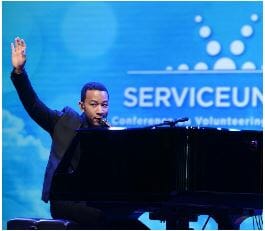
Education activist and Grammy Award-winner John Legend inspired Conference attendees
Dear friends,
One week ago today, Points of Light’s 2013 Conference on Volunteering and Service convened in Washington, D.C.. Reflecting on an amazing week packed with speakers, workshops and events, I’m having trouble picking just a few high points to share. After a bit of squeezing, here are my top 10:
The heartfelt talks from Special Advisor to the President Valerie Jarrett, New Jersey Governor Chris Christie and nine-time Grammy Award-winner John Legend.
The nearly 5,000 participants who traveled from almost every state and 47 countries to attend and to lead the volunteer movement.
Our sponsors – title sponsor Chase, along with Target, Capital One, Disney, Gannett and UPS – who made the largest convening of volunteer, national service and civic leaders in the world possible.
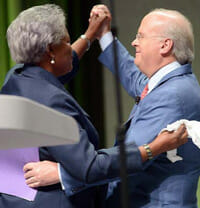
Political strategists Karl Rove and Donna Brazile, dancing together to illustrate our theme, Service Unites, and showcased for readers of the Washington Post, BuzzFeed, Politico, TIME magazine and many other outlets.
The launch of One America, a nationwide, yearlong campaign Points of Light is leading, with founding support from Chase, to bring together rivals in politics, entertainment and sports with the goal of inspiring millions to unite in service to their communities.
Democrats and Republicans from both sides of the aisle – Sen. Dan Coats, Sen. Johnny Isakson, Sen. Tim Kaine, Sen. Carl Levin, Rep. Joaquin Castro, Rep. John Lewis, and Rep. Jim McGovern – coming together to support America’s volunteers.
The announcement that more than 500 companies committed to provide more than $2 billion in pro-bono service through Billion + Change.
Wharton professor and New York Times bestselling author Adam Grant challenging nonprofit and business leaders to empower the “givers” among us and thereby unleash the potential of our teams.
Chairman of the Joint Chiefs of Staff General Martin E. Dempsey’s powerful call to engage and support more veterans and military families through volunteer service.
The volunteers who came out in force to clean up the National Mall, assemble100,000 mac-and-cheese kits for those in need, and package school readiness kits for D.C. children.
You’ll find more highlights, stories and photos in the Conference wrap-up
. Please visit and tell us who you’d like to see unite in service. Rival college basketball teams? Competing news anchors? Superheroes and villians? We’ll collect the best pairings and let you vote on which ones we’ll ask to come together to serve.
It was a whirlwind few days packed full of inspiration. Thanks so much for all you to every single day of the year to lend a hand and strengthen communities worldwide.
Hope to see you in Atlanta next year!
In service,
Michelle Nunn
CEO, Points of Light
Change Notes: Even in Divisive Times, Service and Volunteering Bring Us Together as One America
Friends,
Donna Brazile and Karl Rove at the
Conference’s opening session
At Points of Light’s Conference on Volunteering and Service in Washington, D.C., yesterday, the crowd of 5,000 saw something you don’t see every day. And it wasn’t just right-leaning strategist Karl Rove dancing on stage with left-leaning strategist Donna Brazile.
In the heart of our nation’s capital, Democrats and Republicans, conservatives and liberals, corporate executives and grassroots organizers got together to agree on one thing: Despite our differences, we can make a difference together.
It’s all part of the launch of One America, a nationwide, yearlong campaign Points of Light is leading, with founding support from JPMorgan Chase, to bring together rivals in politics, entertainment and sports with the goal of inspiring millions to unite in service to their communities.
Unlikely allies on stage included conservative talk show host Bill O’Reilly and liberal political strategist Donna Brazile, plus former adviser to President George W. Bush Karl Rove and former adviser to President Obama David Plouffe.
Senior Adviser to the President Valerie Jarrett was on hand to announce that President and Mrs. Obama will host a special White House ceremony in July to honor the 5,000th Daily Point of Light Award — a volunteer recognition program begun by President George H. W. Bush in 1993.
At the close of the session, rival marching bands from D.C.’s Eastern and Duke Ellington high schools led thousands of delegates to a cavernous room where they assembled 100,000 mac-and-cheese kits for those in need in the nation’s capital.
Take a look at the
One America video
At the historic Sewall-Belmont House & Museum on Capitol Hill, 200 volunteer leaders assembled 600 school supply kits for area children. During the service project, sponsored by Altria, volunteers were joined by several members of Congress, including Rep. John Lewis (D-GA), Sen. Johnny Isakson (R-GA) and Sen. Carl Levin (D-MI).
Summing up the spirit of One America, Peter Scher, executive vice president and head of corporate social responsibility at Chase, recalled the words of Abraham Lincoln: “A house divided against itself cannot stand.” In today’s world, Scher said, “We know that what really matters to our nation’s future is not what divides us, but what brings us together. And what brings us together here today is what brings us together in neighborhoods across the country – service.”
So which unlikely allies would you like to see unite in service? Tom and Jerry?
Larry Bird and Magic Johnson? Kanye West and Taylor Swift? Visit www.one-america.org and let us know. We’ll collect the best pairings and let you vote on which ones we’ll ask to come together to serve.
We may live in divisive times, but service unites.
All best,
Michelle Nunn
CEO, Points of Light
Get Good & Ready: Hurricane Season is Here
Just six days into the 2013 Hurricane Season, Tropical Storm Andrea drenched the Gulf Coast and East Coast of the United States, bringing heavy rain, flooding, tornadoes and high winds. It’s time to think about what you can do to prepare your family and your community for disaster.
The Good & Ready initiative aims to help 1.5 million Americans become more prepared for disasters by 2015. The initiative is made possible with generous support from Target and The Allstate Foundation.
It doesn’t matter where you live, disasters can strike anywhere, at any time. Don’t wait. Get involved! Go to Good & Ready today.
Let’s Help AmeriCorps Alums Use Their Experience to Keep Giving Back
Today’s post is by Ben Duda, executive director of AmeriCorps Alums, a Points of Lightenterprise. (It originally ran on the website of social media expert Beth Kanter).
Last summer, I met a young man in Arizona named Kyle. He had spent his AmeriCorps term as a liaison between a mayor’s office and the homeless community, building relationships and creating resources. But even with all that valuable experience, Kyle was stuck working double shifts at a local pizza joint.
Countless organizations could benefit from Kyle’s skills, yet there is no system connecting national service alumni with nonprofits and public sector agencies most in need of young talent.
We at AmeriCorps Alums are working toward a solution by launching Employers of Service, a program exploring how we can link national service experience and a career pipeline. We’re kick-starting this initiative and conversation on June 20 in Washington, D.C., at Points of Light’s Conference on Volunteerism and Service, which runs from June 19 – 22.
During the conference, I’m hosting a session – AmeriCorps Alumni as Leaders: How to Grow as a Leader After Your Term of Service – showcasing Echoing Green’s Work on Purpose platform, which applies lessons from social entrepreneurs to professional development strategies for young people looking to make a difference. The session will also feature a roundtable conversation and Q & A with three nonprofit leaders (all AmeriCorps alumni): Linda Kay Klein, director of Work on Purpose; Michael Omenazu, recruitment manager at Commongood Careers; and Nakeisha Neal, executive director of Public Allies Washington, D.C.
The discussion is just part of a larger conversation about innovation and uniting communities woven throughout this year’s conference, the largest gathering of its kind, assembling roughly 5,000 nonprofit, corporate and government leaders. It will feature such big names as Grammy award-winning singer John Legend, New Jersey Gov. Chris Christie and social media expert Beth Kanter. Will you join us? Click here to register. (AmeriCorps Alums will also be featured at the 21st Century National Service Summit convened by the Franklin Project at the Aspen Institute later this summer.)
We often hear of an impending leadership shortage in the nonprofit sector. Meanwhile, more than 800,000 AmeriCorps alums are uniquely positioned to be the sector’s 21st century leadership pipeline. Together let’s figure out how to leverage this tremendous resource to benefit smart, young people with fresh ideas, while better serving our communities.
We’d love to hear about your experiences and ideas. Share them with me at [email protected].
Corporate Pro Bono Support Matches Charitable Giving
Today’s post is written by Jackie Norris. Jackie is the Executive Director of the Points of Light Corporate Institute and leads the corporate strategy and employee engagement programs.
Imagine the 2020 CECP Giving in Numbers report with a headline like that! Imagine a time when every CEO and corporate leader asks, “How can I use the time and talent of my employees for good in the community and create the shared value for company and society alike?”
Just a few years ago, A Billion + Change set out on a mission to mobilize billions of dollars of pro bono service from the business community to build non-profit capacity at home and around the world. And companies big and small joined the movement to create and expand their pro bono programs.
The 2011 Giving in Numbers report showcases an increase in pro bono activity by CECP companies. We welcome this growing trend and encourage all CECP companies to join the movement as we drive the transformation of business culture in America to increase the quantity and quality of pro bono service. To take the pledge or learn more, http://abillionpluschange.org/
Submitted by Jackie Norris, Executive Director, Points of Light Corporate Institute
How to Build and Grow a Successful Cross-Sector Partnership
Today’s Post is written by Jeff Hoffman, an accomplished corporate executive who has served on the global stage in the areas of corporate philanthropy, human resources, operations, special projects and events. Through board and commission leadership roles, he has a distinguished history working with non-profit, civic and government agencies on strategic direction and innovative programs. Jeff is president of Jeff Hoffman & Associates, a global philanthropy and civic engagement firm that enables businesses, organizations and individuals re-imagine a world full of hope, promise and opportunity.
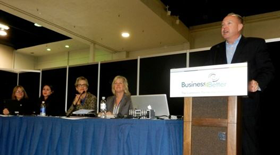
Business professionals and not-for-profit directors often have very different perspectives. There are inequities in power and differences in resources. Building a good working relationship is critical to success. Differences can be worked through by developing strategies, including setting clear expectations and goals, based on achieving mutually beneficial results. This is the description of, Partnerships That Work, the panel I moderated at the Business4Better conference last week. To illustrate the best attributes of partnerships, I choose two that demonstrate the positive impact to both parties when there are shared goals and defined outcomes; Disneyland Resort and CHOC Children’s, The Boeing Company and Inside The Outdoors.
Inside The Outdoors is a unique entity as it is part of the Orange County Department of Education and is not taxpayer supported as they raise their own funds. They are an environmental education organization where they “make the world your classroom.” This partnership with Boeing has been in existence for more than five years and is an excellent example of skills-based volunteering. Volunteers from Boeing worked with students to create a new shade structure at the Outdoor Science School. These volunteers were engineers and paired with groups of students who competed against each other for the winning design. Each team designed a structure, determined what materials and skills were needed, developed a budget and then pitched their idea. The winning team’s design was then actually built at a later date by Boeing volunteers. This effort demonstrated to the student’s real world applications, to the disciplines they learn, such as science and engineering. It now provides the school with a new shade facility replacing one that had burned.
The Disneyland Resort partnership with CHOC Children’s (Children’s Hospital of Orange County) spans 50 years. Walt Disney was part of the committee of Orange County leaders who worked for the creation of the hospital. This partnership is based on alignment, the complimentary audience of children and families. It truly is a two way partnership with both organizations receiving value. Components include cash contributions, in-kind support, product donations, board participation, Disney VoluntEARS and character visits. The new CHOC building’s lobby was designed with the help of Disney Imagineers and has an under the sea theme including elements from “Finding Nemo.” The big annual CHOC Walk in the Park actually takes walkers through Disneyland Resort.
These two examples showcased are from large global companies, yet they are local Orange County based divisions paired with local organizations. While every company doesn’t have Mickey Mouse, most of the examples can be translated into smaller enterprises. It’s about using the core competencies of the company, the skills of its employees and matching with organizations where a partnership is organic and mutually beneficial. This was the purpose of the Business4Better conference, helping a community partnership movement that fosters strategies, practical guidance and inspiration for businesses that want “to do better.” What particularly intrigued me about this conference is their focus on midsized companies. This is a category that has long been doing good, but without the resources afforded to their larger counterparts. This is the first B4B conference to take place in the U.S. with the first three being in Brazil, India and the United Kingdom. The sponsor, “UBM, is a global live media and B2B communications, marketing service and data provider.” They are a producer of conferences and conventions. This is an example of utilizing one of their core competencies, that of convening, to bring together businesses and NGOs to tackle serious problems more effectively. There plan is to produce B4B annually and they already have scheduled conferences in London, Sao Paulo and Mumbai through 2013.
Points of Light, along with its local HandsOn affiliate OneOC, were part of the advisory board for the conference. Neil Bush, Chairman of Points of Light, gave an inspiring closing keynote address. Many of the principals of Reimagining Service were evident in the presentations such as making volunteering a core strategic function, not an add-on.
There is much momentum around companies providing pro-bono services using their core competencies such as web design, human resources, marketing, finance and program design to help nonprofits be more effective in achieving their mission. Many of these companies, including ours, are taking the Billion + Change pledge as part of the largest commitment of pro bono service in history. Business4Better is exactly what it says and hopefully more businesses of all sizes will learn that creating societal value is also a good business strategy. http://www.business4better.org/ http://www.reimaginingservice.org/
This is a reprint of an article that originally appeared on Reimagining Service’s website
Fourth Grader Writes: What Will You Bring to the Table?
What is childhood hunger and what does it look like? Childhood hunger is a big problem in all of our communities. More than 16 million kids in America live in households that struggle to put food on the table. That’s one in five kids who are at risk of being hungry. A hungry child might look like you or me, but he might not focus as well in school, he might get sick more often, and have trouble paying attention in class.
When I was 8 years old, the summer after first grade, I saw a man on a street corner holding a sign that said: NEED A MEAL. It made me sad inside to know that there are so many hungry people in this country and I decided to get involved in the fight against hunger in my community. Over the last couple of years I have met a lot of great people who donate their time to help those who are hungry, but the ones I admire the most are the kids who see a need and decide to become part of the solution.
When I first decided to get involved, I was worried that the food bank wouldn’t be interested in my help because of my age. Instead of telling me I was too young and to come back later when I was older, they actually listened to my big ideas and embraced them. My friends at the food bank became some of my biggest fans and supporters, teaching me about the hungry in my area and helping me find ways that I could help.
Their support inspired me to find more volunteers to help address hunger, and my group, FROGS, has now recruited hundreds of kids to help fight hunger at our events. One of my favorite things to tell people is: “No matter how tall or small you are, you can make a BIG difference!” Sometimes when I share this with people, they think I mean physical size, but really what I mean is that anyone of any age, background or skill level, can step up and get involved in making a difference. All you need is the willingness to give of yourself and your time to make a mark on something that matters to you.
So, what am I doing to help end child hunger? I partnered with generationOn to participate in the What Will You Bring to the Table? initiative. It’s a call to action for youth from across the country to address childhood hunger by gathering around tables to complete service projects that will raise awareness and help to end child hunger in the United States. My group, FROGs, has a motto: Having Fun while Helping Others. And that’s exactly what we brought to the table…FUN!
FROGs hosted an event to raise money and awareness for the hungry in our community. Because we were bringing fun to the table, we decided to host an event centered around games. We called it “Game Over! for Childhood Hunger.” We recruited businesses to donate their services and supplies, and invited elementary school age kids from all across our city to participate. We had video games, laser tag, memory games using child hunger facts and a letter-writing station where kids could write letters to government officials and let them know about the millions of kids who are hungry. I hope these letters will make our politicians care more about effects of hunger on kids and how much it impacts a child’s development.
I’m proud that my project, along with the projects of other kids and teens, helped generationOn raise over 1.5 million meals that will help fight back against child hunger. Together, we did an awesome job!
My work on hunger isn’t done and together, I think that we can do even more. So, what can YOU bring to the table to help end child hunger in your community? You can:
volunteer,
donate, and
spread awareness.
Chances are you’ll have fun while helping others! Host your own game event, a kickball tournament, or a dodge ball throw-down or something else that you love. For more project ideas and resources, go to http://www.whatwillyoubringtothetable.org/ and remember: you are never too young to make your mark on hunger.
__________________
About Will Lourcey:
Will Lourcey, founder of the nonprofit Friends Reaching Our Goals Together (FROGs), is a fourth grader at Tanglewood Elementary in Fort Worth, Texas. He enjoys writing, traveling and fighting hunger. Will was recognized as a 2012 Hasbro Community Action Hero, an award given to outstanding young service leaders, presented by Hasbro in partnership with generationOn, the global youth service enterprise of Points of Light. Will was also honored by President Obama following his designation as a Hasbro Community Action Hero, for his unquestionable dedication to making a positive impact on his community and the world through community service. Additionally, Will’s inspiring work led him to be named a CNN Young Wonder in December 2012, as part of the annual CNN Heroes awards.
Why Millennials Are Not Interested In Your Corporate Service Program
When a Millennial employee swipes their card to gain access to the company’s building, their interests, networks, and personal passions don’t remain at the door. After all, the concept of work-life balance is not a term with which Millennials are familiar. They live an environment where work-life blending is the norm. Like it or not, the lines are blurring.
When it comes to community engagement, the lines are also blurred. Millennials see their involvement with causes not as a thing that happens outside of work, but as an interest to be explored throughout the day. The data continues to suggest that Millennials place higher value on companies that offer service and pro-bono, skills-based volunteering opportunities.
If this is the case, then why are Millennial employees not getting involved in your organization’s CSR programming?
The answer lies in how corporations approach volunteer programming, and whether or not they can be an asset in a Millennial’s search for community interaction, experimentation and action.
It is Not About Your Company
Millennials are interested in making things happen in their communities, and look to any institution – their work, home, and/or faith – to channel their passion. When doing ‘good’ through the company is focused on corporate attention in the process, it will loose its importance with Millennial employees. Millennials care about the issues, not the company wanting to gain awareness for efforts addressing the issues. The goal of the company should be to help Millennials channel their passion to causes and experiment with service to find the issues they care about.
It Is About Being Challenged
Millennials are inspired by the opportunity to tackle a challenge, build a prototype that will solve a problem, and create a concrete solution. Volunteer programming based on long standing relationships with community organizations is appreciated, but may not be personal and challenging to the Millennial. Identifying and providing opportunities that will challenge their thinking and test their skills will draw them closer to community organizations and ultimately more service.
The Big Question – Why?
Millennials need to know why their participation in service or workplace giving matters. Not why it matters to the company, but why their work will matter to the people they help. If companies are going to ask Millennials to participate in service, just like nonprofits, they need to report back on the people helped and how the community issue is different because of their efforts. Even if the experience is a one-time volunteer project, it is imperative that Millennials are provided feedback to quickly inspire future engagement. Remember: this generation gets instantaneous feedback from social networking all the time.
The ultimate goal of any corporation is to be the conduit for Millennial cause action. Companies acting as honest and fair brokers of Millennial service, skill, and interest with causes will move into a different role than where they are currently. This new role, as manager and advisor to Millennials on their cause interests, will place a new value on the company. A value driven by their Millennial employees that represents one of trust, appreciation, and openness to a very personal thing – the issues in the community that drive their passion. The bottom line? Millennials invested in the ethos of the company.
Join us on July 18, 2013 at MCON to explore how Millennials are redefining their workplace engagement, connection with causes, and how they activate for good.
, a ranking of America’s most community-minded companies, thanks in part to the work of the Citi Foundation, the bank’s philanthropic arm.
The Civic 50
, a
partnership between National Conference on Citizenship and Points of Light, ranks corporations on seven dimensions of local involvement. The
measurement and strategy
dimension requires a firm to show that it has defined its programs’ goals, performance metrics and interim indicators – or in plain English, that it can trace its community funding to actual changes in individuals’ lives.
How Did The Citi Foundation Do It?
First, they realized they had room to grow. While the Foundation has always been able to count how many people its community-oriented grants and projects reach, getting beyond that was a challenge.
“We were really tracking activities, not the impact we were trying to achieve,” recalled Pamela Flaherty, president & CEO of the Citi Foundation and Director of Corporate Citizenship at Citi.
Second, they implemented a results-oriented measurement system, reevaluating their strategy and designing new ways to identify and track the impact of their grantmaking on people’s lives.
People like Ernst Nicolas.
A New York resident, Nicholas came to The Financial Clinic for help in sorting out his debts, repairing his credit rating and getting his spending under control. The clinic is one of 31 organizations seeking to strengthen their financial capability coaching programs through the work of the Citi Foundation’s partner NeighborWorks America.
With coaching, Nicolas made critical changes.
“Right now I have my priorities set,” Nicolas said. Top on his new budget: rent, child care and transportation, while one-on-one counseling is helping him restore his credit and rebuild his savings.
“I do have a plan, and because of the coaching I’m getting, I’m more disciplined now when it comes to finances.”
A Measurement System Built Around Results
The results-oriented measurement system allows the Citi Foundation to focus on creating positive gains for individuals and their communities. And they can begin to understand how their efforts are helping nonprofit partners to transform and how all this is informing broader systemic change.
Maggie Grieve, NeighborWorks director of success measures, said she worked with the Citi Foundation to develop yardsticks for people’s financial status, habits of behavior and resilience, “things that hadn’t been easily measured before.”
The Foundation provided a $5 million grant to NeighborWorks to put the criteria into practice: selecting the 31 organizations whose financial coaches would be trained, establishing project objectives, planning training activities and setting benchmarks.
“The Citi Foundation really partnered with us to achieve mutual goals,” Grieve said. “We were able to demonstrate that significant numbers of low- and moderate-income people who participated were really able in less than a year to make progress toward their financial objectives.”
The 400 coaches trained under the program have served some 65,000 people in just two years.
Using Measurement & Results to Scale Impact
Third, the Foundation uses the results of its new measurement system to lay a solid foundation for scaling up impact.
The Citi Foundation hopes the new tracking system will show that its grant to NeighborWorks helped create a financial coaching model that can be used nationally to assist low- to moderate-income individuals in adopting positive financial behaviors that build and preserve their assets over time.
This investment is part of Citi and the Citi Foundation’s commitment to “financial inclusion” – ensuring widespread access to affordable, high-quality financial products, services and asset-building opportunities for individuals, families and communities.
The more people who become financially savvy, carry less debt and rack up more savings, like Ernst Nichols, the better for any community and for the national economy.
And finally, the Foundation goes beyond grants and numbers to leverage the expertise and resources of its people to enhance philanthropic efforts. Its Volunteer Management System identifies ways employees can help, then tracks what they do.
In 2012, Citi employees contributed more than 1.3 million volunteer hours in efforts they know made a difference.
To learn more about optimizing your company’s community engagement programs, check out this upcoming