A Global Youth Movement: Taking Action to Change the World
This is the second blog of a two-part series featuring Daily Point of Light honorees Shreyaa and Esha Venkat of Ashburn, Virginia, US and UK Point of Light Award honorees Amy and Ella Meek, of England, in a discussion around youth activism.
These incredible young women all speak at our 2020 Youth Summit, which inspires youth ages 13-18 to continue improving their communities and giving back. Register now to join us on Aug. 19.
As young people, you’ve all used school as a basis for your programs and also a place for support. Tell us more about that.
Amy and Ella:
Getting your school involved is also a great way to build support for your cause or campaign. At school, in normal times at least, you have easy access to a large number of young people your age to get on board. Plus, you’ll often find that your teachers are more than happy to help you with your mission, so doing talks to your tutor group (or homeroom) is a good way to develop your skills and get more confident speaking to an audience.
More often than not, you may find that the issue you’re passionate about tackling relates directly to your school as well. For example, our school used a lot of plastic in the canteen (such as plastic bottled water, and plastic cutlery). Schools aren’t small, and 1000+ students using, for example, a plastic fork every day for lunch can quickly add up, and so swapping these out for reusable cutlery can have a large positive impact. So, working with your school on the issue you’re campaigning against (be it plastic pollution, food waste, or period poverty) can help you make a big positive difference in a relatively short period of time.
Shreyaa and Esha:
Inclusive, good-quality education is the foundation for dynamic and equitable societies. After witnessing the transformative effects of continued education in our own community, we set our sights on providing quality education and leadership & mentoring services for vulnerable students worldwide through NEST Tutors, our free virtual tutoring program, and NEST Inspires, our leadership program! We’ve impacted kids in 32+ schools and have over 250 high school and college mentors. Also, we’ve donated 10,000+ books to underprivileged kids worldwide! By forging global partnerships with organizations in Zambia, India, and Vietnam, we help underprivileged students achieve academic success while contributing to the Sustainable Development Goals.
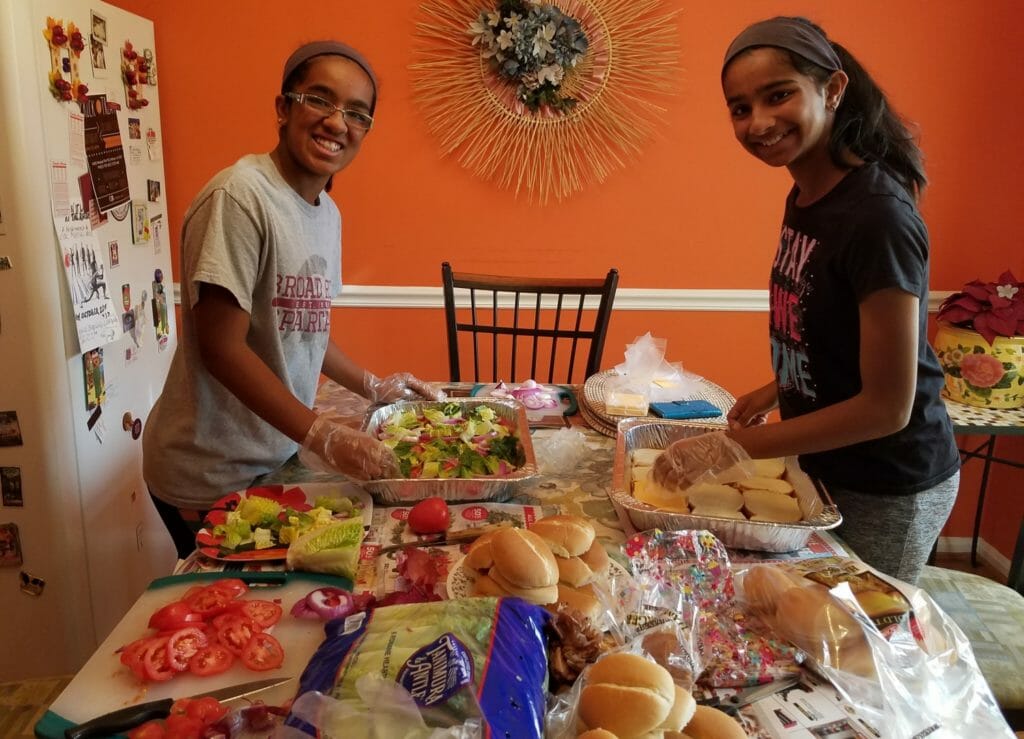
Shreyaa and Esha Venkat preparing meals for delivery in 2019.
How do maintain financial support for your organizations to continue running?
Amy and Ella:
If you’re looking to grow your campaign onto an even larger scale, financial support can be really useful. There are lots of grants available for youth-led organisations, but they’re certainly competitive. If you are keen to apply for some, make sure you have a clear focus of what you’d like to achieve with the funding you get – the more specific, the better. Also make sure you have targets in place for the future, as the last thing organisations or people offering funding is to see the impact fizzle out once the funding has stopped – they like longevity and for campaigns to become self-sustaining.
We’d definitely recommend getting your parents or carers to help you with this where possible – any extra experience with money and budgeting can be helpful, and some grants are only open to those 18+.
Shreyaa and Esha:
In the beginning, the biggest barrier NEST4US has faced has been getting adequate financial resources. Since we’re a teen-led organization, we were self-funding and relying on in-kind donations, community support, and mini-grants from local business partners to run our programs efficiently. As we developed NEST4US, we began receiving tremendous financial support, partnerships, and networking opportunities from corporate businesses and other organizations. We believe strongly in the power of collaboration and are continually forging partnerships with other nonprofits to find new and innovative ways to help those in need.
What are some final thoughts you have for youth who want to get involved?
Amy and Ella:
Don’t give up. Your cause is worth fighting for.
Shreyaa and Esha:
Finding a cause you’re passionate about helping and then spreading awareness about it is the first step towards getting more involved in your community. According to us, EVERYONE has the power to make a difference!
Preventing a Double Recession for Nonprofits: 5 Things You Can Do to Meet Urgent Needs
Driven by a desire to lend a helping hand, the “hands-on” world of volunteer service connects people to help each other meet community challenges. These on-the-ground organizations are powered by people, comprised of community leaders who know the specific needs and strengths of their community.
But in this new “hands-off” world of social distancing, volunteering in person has come to an abrupt halt.
With COVID-19, nonprofits are facing unprecedented headwinds. Not only are funds constricting quickly and dramatically, but now the volunteers that organizations rely on cannot perform many critical functions, while the needs of their populations they serve grow each day of this crisis.
, during the Great Recession (2008-2012), a survey by NCOC found that “72 percent of Americans said they were devoting less time to volunteering and other civic activities, like providing food and shelter to those in need and participating in public discussions like town-hall-style meetings.”
Given that in this unprecedented time communities are going to be more vulnerable than ever if the economy slides into a recession after COVID-19 runs its course, which there are indicators it will, we simply cannot afford for volunteers to take a step back or for the organizations who mobilize them to be out of commission.
What does this look like on a macro scale? 63 million Americans volunteer about 8 billion hours of their time, talent, and effort to improve contributing approximately $203.4 billion of value in the U.S.,
, for every volunteer mobilized an average of six lives are positively impacted.
If we apply that ratio to the national numbers of 63 million,
just a 10% reduction in volunteers would directly impact nearly 38 million of our most vulnerable neighbors
.
So what can be done, right now and in the future? How can we help people-powered organizations weather this storm?
In addition to volunteering, civic engagement can come in many forms, each of which can help nonprofits when we cannot volunteer in person.
Donate to your local “volunteer connector” organizations. Many areas have a local community foundation that is well equipped to support the specific financial needs of local nonprofits; they can connect volunteers to where they are needed most. The Points of Light Global Network is made up of nearly 200 such organizations. These organizations are also radically efficient, taking every dollar donated and doubling the impact of that donation in the community.
If you were going to give time, give that value in other ways. With people practicing social distancing, resources are more needed than ever. If you are one of the millions that volunteer, consider donating the economic value of that time to an organization you volunteer for. Independent Sector values the average volunteer hour at $25.43. Help that pet shelter, senior home, or advocacy organization that had to cancel their spring event keep their doors open. If your company gives you PTO for volunteer time, see if they will convert that to cash to match your funds.
Donate technology hardware and software, and get your company involved too. Did your office support your work from home by providing a laptop and video conferencing licenses? Most nonprofits don’t have laptops to issue to employees or volunteers. As your company is replacing its laptops, consider donating those in good condition to nonprofits, or adding a few extra laptops to your company’s purchase order to make an in-kind donation to local nonprofits. This gift could make a big difference to many organizations, potentially supporting staff work remotely, and may also mitigate disruption to their office. Beyond laptops, a local senior center or homeless shelter could do a lot of video visiting with smart TV smart home devices, and video-conferencing software to stay connected during the height of isolation.
Use your voice. Nonprofits are always trying to build awareness of their mission and the needs in the communities. Use your social network to advocate for them and their cause. It will likely provide them with more followers long-term and help break-up the relentless news cycle. Follow, repost and comment with your favorite causes and amplify the impact of their message.
Educate yourself on the issues. In this time of social distancing, empathy will be tested. Awareness of issues, and the impact of these environmental forces on our communities, is a needed step for us all to get ready to take-action; particularly when we transition from emergency response to recovery. Additionally, there are a lot of issues that will be on the ballot this November in the U.S. Make sure you know how to use every aspect of your civic power.
People always find a way to do good – to be points of light—and will continue to do so, even when they are socially distancing. We know this virus cannot stop the human spirit, but even with new and innovative approaches, the nonprofit sector is not equipped to deliver its services when crippled by drastic reductions in both their financial and human capital. These organizations have been there for us, caring for our parents, running amazing programs for our kids, providing meals and connections, and raising awareness on critical issues. Let’s be there for them when they need us most.
Click
to sign up for our newsletter to receive our latest news and updates.
Natalye Paquin was the president and chief executive officer of Points of Light from 2017–2022.
She is a visionary and results-oriented leader, with more than 20 years of experience providing strategic, operations and fiscal leadership in the nonprofit and public sectors.
Delivering on Our Commitment to the Clinton Global Initiative
A STEM major in college and now the mother of two girls passionate about science, you could say that Sandy Marshall knows a little bit about the challenges of getting more girls and women interested in STEM careers. That’s precisely why, in 2011, she started
, a nonprofit that educates, coaches, and advocates for girls and women with an aptitude, talent, and passion for STEM.
Seeing early success, Sandy was looking for ways in which she could catapult the nonprofit’s success and increase its impact. She was accepted into the fifth cohort of the Points of Light Civic Accelerator, or CivicX, in the fall of 2014. Through this 10-week boot camp-style program, she gained the right knowledge and skills to seek investments and scale her social innovation. Since graduating from the accelerator, she has increased the organization’s funding, grown the program from serving 95 girls to serving over 500, and is now focused on building a nationwide model to increase the number of women in STEM fields.
Sandy’s success with Project Scientist tells just a fraction of the changemaking story that is being written by the CivicX with every cohort that graduates from this Points of Light initiative. Soon after we launched, we knew we had tapped into a pool of talent with the determination to make a difference. That’s why, just two years after launching the Civic Accelerator, we made a bold and exciting bet at the Clinton Global Initiative America (CGI) in the summer of 2014: to double the number of graduated civic entrepreneurs within two short years!
Two years later, and in our home city of Atlanta, we are thrilled to once again be at CGI America. With a new emerging program on the national scene, a disruptive model that abounds with diversity and a unique desire for both innovation and scale, we have great progress to share on this commitment and much more.
The headline: we are 75 percent to goal in doubling the number of civic entrepreneurs with two cohorts to go this year! The real news, below the headline, is in the impact and the alignment with CGI-America and its goals. Taking a glance at this year’s working groups for the CGI conference, CivicX has graduated social ventures that match up with all nine of this year’s working groups. A few examples:
In “Financial Opportunity,” MoneyThink has been a national force in financial literacy for low-income communities, having trained over 10,000 high school students and engaged over 1,200 college-age volunteers.
In “STEM Education,” Atlanta’s own STEAMTruck, a mobile innovation lab, provides STEM education by bringing innovative tools, equipment and experts directly to students, no matter where they are.
In “Workforce Development,” CareerVillage, through an innovative technology now available to millions, empowers young people from low-income communities to attain gainful employment by closing the career, information, and advice gaps.
Speaking of innovation, in the last year, as part of the CGI commitment to leverage learnings to-date, CivicX developed a new Rapid Innovation Summit. This two-day onsite workshop provides design thinking, rapid prototyping and startup methodologies to social entrepreneurs and civic leaders. Rolled out initially in the three cities – Atlanta, New Orleans and Houston – the Summits represent a very effective way to provide entrepreneurial capacity to a broader range of nonprofit leaders in regions that lack sufficient resources for aspiring social entrepreneurs. In addition, the eighth cohort of CivicX, scheduled to take place in Detroit in the fourth quarter of 2016, will focus on Opportunity Youth – scaling innovative social ventures that reach displaced youth in order to provide educational and workforce opportunities.
On the heels of CGI America in Atlanta, we’ll turn our focus to graduating the seventh CivicX cohort this Thursday. If you are in the Washington, DC area, join us for
to see first-hand how these civic entrepreneurs are leading innovations in accelerating technology adoption and financial inclusion so that everyone may succeed in our digital economy.
Thanks to a track record of real impact, CivicX has successfully attracted the attention and amazing support of key national partners, including PwC Foundation, Starbucks Foundation, Hilton Worldwide, Capital One and Vodafone, among others. As expansion continues to new regions and markets, exciting new opportunities will be created for partners to join CivicX and the effort to scale social impact through incredible civic entrepreneurs.
Putting Purpose on the Red Carpet
This post is by Ayesha Khanna, founder of the
Points of Light Civic Accelerator
.
This Sunday is the 88
th
Academy Awards – #Oscars in Twitter speak – the world’s biggest night in entertainment. Most years, I enjoy watching the Oscars from the comfort of a friend’s couch. But this year, I’ve been invited to join our good friends at PwC to attend “Putting Purpose on the Red Carpet,” their viewing party and red carpet event in Los Angeles to raise awareness on how purpose can drive powerful storytelling.
Ayesha Khanna
Instead of asking red carpet participants “Who are you wearing?” PwC will ask them about their purpose, and how they bring that purpose to life every day.
Now, where does purpose fit among the glitz and glamour of the world’s most famous red carpet event? PwC is making the point that purpose is often the force behind the scene – the driving factor that motivates an actor, director or writer to persevere in the face of challenges to bring complex issues and powerful stories to the screen, and to make them accessible to audiences around the world.
In a nice twist, PwC will be interviewing not only big names, but also social entrepreneurs and educators – everyday people who have connected with their purpose to make a difference. I am excited to be a part of this creative effort by PwC to shed more light on how ordinary citizens are connecting to their purpose to bring about powerful change.
PwC is a founding supporter of the Points of Light’s Civic Accelerator, the only startup boot camp and investment fund that focuses on “civic ventures,” for-profits and nonprofits that include people as part of the solution to help solve critical social problems.
When I first received PwC’s invitation, my first thought was – you guessed it
–
“does this mean I have to find an Oscar-worthy dress?” Cue the panic. But my next thought was that this would be a fun, unique red carpet moment and an honor to share my purpose, the driving force that imbues my work and passion for social change.
I thought back to the years after I graduated from college, when I worked in villages in India with an incredible group of elders and women from the community, local nonprofits, experts and nuns from Mother Teresa’s order to build healthcare and education centers. This experience showed me how a small group of people, with many different talents and expertise, could make a big difference with limited resources. It was my first exposure to the idea that the innate desire to help others, along with innovative thinking and persistence, goes a long way to making big, bold and unimaginably good things happen.
As a President of the Civic Accelerator, I continue to live my purpose every day. Points of Light’s mission is to inspire, equip and mobilize people to take action that changes the world. Through the Civic Accelerator, we are supporting social entrepreneurs in their journey to make big things happen. We provide training and an in-depth curriculum, working with expert faculty and mentors across our national networks. Our corporate partners contribute their assets to support the entrepreneurs and we invest $50,000 in the two top teams in each class, as determined by the entrepreneurs themselves.
One of the most gratifying parts of my work is seeing our impact multiply through the power of our entrepreneurs. In just four years since launching the Civic Accelerator, we have graduated 74 teams, and they, in turn, have generated more than $30 million in revenue and engaged almost 4 million people to help solve these issues.
PwC streamed live from the red carpet on the Huffington Post. Listen to Ayesha from Oscar night as she talks about her purpose and commitment to inclusive entrepreneurship.
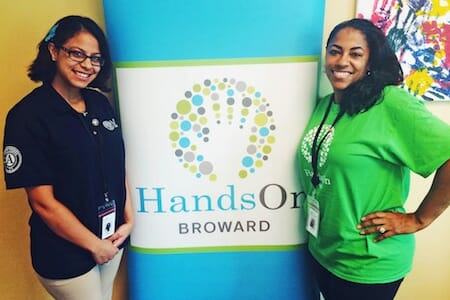
Carolina Linares, left, with fellow Financial Opportunity Corps AmeriCorps VISTA member Tamika Mallard
Someone asked me once (or twice) why I was doing a year of service with AmeriCorps VISTA, a national service organization that focuses on Lyndon Johnson’s 1964 resolution to eradicate poverty in our community.
It seemed ludicrous for them to think that someone would want to dedicate a year of their life doing something that wasn’t directly advancing their career. That doesn’t make them callous, it just makes them practical.
For me, it was so much more than just a rest stop from my career in journalism and photography; it was about doing something that would make me proud, and above all, something that would allow me to contribute to my community. I wanted to make a difference – as simple as that.
For many years, I had planned to become an AmeriCorps member, but it always came a close second after school, work, etc. The reason behind it was that it never seemed like the right time – until it was.
I started to browse through positions on the AmeriCorps portal looking for my best fit. Two months later, I found a couple of service opportunities that caught my attention and I went ahead and applied for them.
My introduction to AmeriCorps VISTA was through the Summer Associate Program at the Miami Coalition for the Homeless as an outreach coordinator. Immediately thereafter, I started my yearlong service with the Financial Opportunity Corps. HandsOn Broward, part of Points of Light’s HandsOn Network, was one of nine sites that pioneered this program.
In my VISTA role I help coordinate a financial literacy program that takes as a premise the coaching framework to help individuals become financially self-reliant. We do this through financial education workshops and one-on-one coaching. Among other duties, I help recruit and train the volunteers who would take on these roles.
This was not a service that was readily available to the community members in the low-to-moderate income bracket. Another aspect that makes this program unique is its focus on individuals, their financial goals and their strengths rather than their shortcomings. Someone could be somewhat money wise and still struggle to save.
Sometimes, they just need an accountability partner, and that is what we offer them.
I’ve also worked on developing strategic alliances with community organizations that have supported the success of the program.
As an AmeriCorps VISTA member, I understood the need to alleviate poverty and enhance the community in which I lived; that is why most of us commit to do this work full time for at least a year. But it is not until I started developing my program and started working alongside community partners, organizations and volunteers that I saw how this work was having such a positive effect in the lives of the people we were serving.
I used to think that it was too hard for one person to have an impact in our society, but being a VISTA member, I have found out that each person’s effort and talent contributes tremendously to change. I never imagined how vast the reach of one person’s effort was.
I decided to extend my service for an additional year because I told myself, “I am not done expanding this program.” (This was the second year this program had been in place.) I felt that my mission wasn’t complete because there were still some plans I wanted to implement in the new program year.
The VISTAs before me paved the way for us by creating the foundation to get the program started, and it was our job to build upon their effort and ensure the sustainability of the program for years to come.
Through this position I have been able to grow and improve myself both in the personal and the professional aspect. I learned a lot about myself, and through interacting with many people from different cultural and socio-economic backgrounds, I also learned how to adapt to different environments and adjust my approaches accordingly.
I knew HandsOn Broward was the perfect site for me in which to be stationed because of its collaborative, small-team environment. Working hand in hand with these people proved to be very valuable in my professional and personal life because each of them possesses a unique set of talents that they brought to the table.
They were always willing to share their expertise in a particular subject, and taught me skills that I will continue to carry and improve upon for the rest of my life. Sometimes it was as easy as simplifying an approach for me, since I tend to overcomplicate everything.
During my tenure as an AmeriCorps VISTA, I learned about leadership and presentation skills by training and managing a group of amazing volunteers who also taught me a lot about other topics. I saw from their involvement and dedication the qualities that I wanted to ensure I nurtured in myself. The skills I have learned through my service are too numerous to list.
In sum, I serve because through our work as volunteers, we are able to bring programs to a community that alternatively may not have access to them, because we are able to see our community grow from the efforts of like-minded people and because each step we take is helping someone who wouldn’t have been able to receive this service otherwise.
The expression “Esprit de Corps” – a feeling of pride, fellowship and common loyalty shared by the members of a particular group – encapsulates everything I have gained and expected to gain from serving as an AmeriCorps VISTA member.
I am proud to be a part of this group of like-minded and service-oriented individuals who work together to effect change in their community.
Here are some accomplishments from the Financial Opportunity Corps’ second year:
462 low-income individuals received one-on-one financial coaching from trained volunteers (financial coaches) at nine sites across the country.
More than 1,700 community members have attended financial education workshops supported by AmeriCorps VISTA members and trained community volunteers.
341 trained financial coaches are participating in the program, including 47 Bank of America employees.
At HandsOn Broward, 37 trained volunteers are working one on one with and providing financial coaching for 40 low-income community members. AmeriCorps VISTA also helped support financial education workshops reaching 279 community members during the past year.
For more information on AmeriCorps VISTA opportunities throughout the country, go to www.nationalservice.gov/VISTA. For more about the Financial Opportunity Corps, visit www.pointsoflight.org/financial-coaching.
Startups Addressing Digital and Financial Inclusion: Here’s Your Chance to Innovate and Grow
Are you running a startup working to answer this question: How might we accelerate technology adoption and financial inclusion for all to succeed in the digital economy?
Ayesha Khanna, founder of the Points of Light Civic Accelerator, addresses a group of accelerator participants in San Francisco.
The Points of Light Civic Accelerator can help. The program – now seeking applications from for-profit and nonprofit early-stage ventures – will convene 10-15 teams in Atlanta from April 11-14, in San Francisco May 9-13 and in Washington, D.C., June 13-17.
During the course of 10 weeks, participating entrepreneurs will take part in an intensive entrepreneurial curriculum founded in lean startup development, rapid innovation, design thinking and business model design, as well as connect directly with sector leaders, mentors and investors through curated events and workshops.
Since 2008, the economic recovery in the U.S. has gained momentum for many, yet financial security remains out of reach for low-income families, young adults and ethnic and racial minorities.
In today’s economy, digital skills and financial literacy are essential to reaching financial stability, obtaining living-wage employment and achieving economic mobility. And traditional models are failing to close the gap.
The spring 2016 Civic Accelerator will accelerate innovative, scalable ventures that increase opportunities for the underserved and underemployed through:
Financial services offering equitable access to investment capital
Savings incentives and access to cash
User-generated and peer-to-peer technologies that eliminate inefficiency and reduce costs for all
Digital skills development that increases employability and opens access to higher-wage opportunities
Financial literacy models that support and influence healthy financial behavior and greater access to social services, professional mentoring, career advice and healthy living
The deadline to apply for the spring session of the Civic Accelerator is Feb. 26. The accelerator does not charge for participation, and all selected ventures will receive travel and lodging stipends.
Social Innovators in Atlanta and New Orleans – Check Out This Opportunity
The Points of Light Civic Accelerator is calling all social innovators – entrepreneurs and business, community and nonprofit leaders – in Atlanta and New Orleans to participate in a two-day, hands-on boot camp. Learn about and use innovation best practices to make better decisions, test solutions and solve problems more effectively.
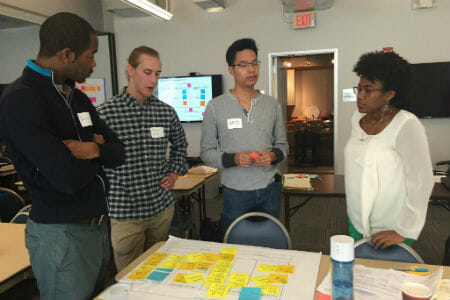
From left, Innovate Houston participants Jaison Oliver, Stephen Love, Krid Fung and Mercedes Harris
The two boot camps round out a three-city series of Rapid Innovation Summits, which launched this month in Houston, coinciding with Points of Light’s Conference on Volunteering and Service. More than 40 participants brought diverse challenges to the Houston summit, exploring solutions with their peer innovators.
Highlights included a networking reception and a thought-provoking conversation between Jeff Reichman, founder of January Advisors, and Ayesha Khanna, founder of the Points of Light Civic Accelerator. See more about Innovate Houston here.
“I’ve never been more excited for a Monday morning,” said participant Mark Cueva, who works for the City of Houston. “I’m looking forward to putting these tools and ideas to work.”
For the summits, attendees are encouraged to bring real-life, organizationwide issues. For example, if you’re thinking of launching a new program, if you want to motivate your team or perhaps you’re trying to re-energize funding efforts, the Civic Accelerator encourages you to bring your problems to solve.
As an added bonus, Innovate Atlanta attendees will be able to join change makers at an exclusive Innovate Atlanta VIP Reception at Google Atlanta. This is a not-to-miss opportunity to network with one another, exchange ideas and build a community of social innovators.
For more information and to register for the Atlanta summit, visit bit.ly/InnovateATL. Hurry, “early adopter” pricing ends Oct. 30. Early registration has also opened for Innovate New Orleans.
We look forward to seeing you!
A Life-Changing Chance to Get Out of Debt
This post is by a woman named Karen, who shares how the Financial Opportunity Corpsand a volunteer financial coach helped her dig out of crushing debt. (We are withholding her last name to protect her privacy.)
On Black Friday last year, I gave myself a gift. I walked into the office of the Philadelphia-based nonprofit Clarifi and I paid off my debt early. And then I cried.
I cried because just a few years earlier I faced a mountain of credit card bills I didn’t think I would ever pay off. I was scared, ashamed and secretive about my financial situation.
And now, just a few years later, I can attest that Clarifi changes lives. They put me on the path that helped turn mine around. I can’t say it was easy, even when I was set up on a debt management plan. I was scared.
I wasn’t sure I could pay off this chunk of money every month for five years. Nearly the same amount as my rent. Money was tight; I could no longer rely on credit cards as free money. I had to face reality, but I never missed a payment.
It couldn’t have come at a better time, because I had recently launched my own consulting business, so I needed to keep my budget in check more than ever.
My coach, my mentor, Jerry Block, is a big deal at U.S. Trust Bank of America Private Wealth Management. But he never spoke down to me – actually, completely the opposite. He genuinely believed that I could be successful.
Plus, I learned lots of practical tips from him. For instance, I learned that I could save $50 a month from switching to my mother’s family phone plan. So today, thanks to Clarifi, Jerry, the support of loved ones, and yes, my own hard work, life is very different.
I have great credit, I just bought a car and I have a business that continues to grow. And without the fear and crushing weight that comes with crushing debt, the future feels open and full of possibility.
For more about the Financial Opportunity Corps, visit www.pointsoflight.org/financial-coaching.
When Startups Take on Gender Inequality, Women and Girls Win
This post is by Ayesha Khanna, founder and president of the Points of Light Civic Accelerator, which works with impact entrepreneurs to scale their social innovations; Joy Anderson, founder and president of the Criterion Institute, which approaches social change by intentionally changing markets; and Teresa Younger, CEO of the Ms. Foundation for Women, which is devoted to securing rights, equality and justice for women.
The Points of Light Civic Accelerator convened social ventures helping women and girls succeed.
It has been a great summer for women and families in the U.S. The Women’s National Team won the 2015 Women’s World Cup. There is a serious female contender for president. And our Supreme Court ruled to legalize same-sex marriage in all 50 states and uphold the Affordable Care Act, opening up access to health insurance for many.
Despite recent gains, gender inequality is still alive and well. Women are only earning 75 percent what men earn, with a more significant gap for working women of color. Women also represent a small percentage of executive officers (14.6 percent) and Fortune 500 CEOs (4.6 percent).
With that backdrop, the Points of Light Civic Accelerator last spring convened 13 cutting-edge social ventures from across the country, all focused on helping women and girls fully participate and succeed in our global economy.
The accelerator is a 12-week boot camp for nonprofit and for-profit startups; through a series of in-person sessions and a rigorous online curriculum, participants learn from leaders – in business and community, design thinking and startup engineering – and from each other.
Points of Light Civic Accelerator participants and advisers gather at the Centre for Social Innovation in New York during the spring session.
The Civic Accelerator’s most recent participants – the sixth group to run through the program – show how this innovative program is targeting key issues, to achieve deeper and more systemic insights and solutions.
These civic ventures are getting results in STEM (science, technology, engineering and math) education and workforce development, online harassment, and women and girls’ leadership in the U.S. and abroad. The solutions developed by these social entrepreneurs are inclusive and attempt to disrupt traditional systems that prevent women from reaching economic parity.
We had terrific guest faculty join us for the spring session, including Criterion Institute founder and president Joy Anderson and Ms. Foundation for Women president and CEO Teresa C. Younger.
We touched on many topics ranging from the intersections of gender, power and race to how the work of these startups fits within the context of gender equality writ large. Below are some of our shared reflections and insights from this dialogue.
Gender Lens – Beyond Women and Girls
When it comes to women and girls, our efforts to address gender inequity tend to focus on the individual – solutions to improve skills, opportunities and access. However, all genders need to be engaged to address the power dynamic and systems change required to build a truly inclusive society that takes advantage of everyone’s talents and contributions.
The Civic Accelerator’s recent participants were focused on building inclusive and innovative models that attempt to influence and change biased systems and markets to allow women and girls to more readily and successfully participate and succeed.
As we discussed how to define success at various levels – venture, organization and system-wide – we noticed the tendency to do a relatively simple count of women and girls (the number of girls in STEM programs or women leaders, for example) as primary indicators of progress.
While important, this approach limits our ability to interpret the complexity of the systems at play and does not reflect the fact that gender is a dynamic concept that defines norms, behaviors and identities that may be valued in a culture (or not).
The Role of Power
Leaders, including these venture founders, can use their power, networks and knowledge to create more access and equity. Influential leaders who are personally committed to speaking up and making decisions – who put themselves and their credibility on the line to create more equitable policies and practices – are what it takes to change an organization and the broader culture.
Proactively inviting diverse and opposing individuals and organizations to participate in a process, rather than attempting to join a process where they are excluded – the power of invitation – was a strategy we shared with the entrepreneurs.
Understanding perceptions of status and influence matters when you are fighting for access to capital and customers yourself. Systems change leaders have a double burden, as they need to think about what their ventures need, but also place those needs in the context of broader systems of power they are seeking to change.
This process requires constant navigation, as these leaders think about building non-traditional relationships and aligning with power brokers, in ways that move the system change forward. It is this larger change that is necessary for these ventures to ultimately scale.
This situation applies to women today who are juggling work, family demands and life, as they think about their roles in the broader movement. Women are disproportionately responsible for caregiving, even when employed outside of the home.
That means that when we work on workplace issues, we have to consider the realities of women’s lives – especially low-wage and immigrant women and women of color. For instance, access to affordable, quality childcare is essential for women’s economic empowerment. Likewise, workplace safety must also include measures to protect women from domestic violence, as nearly a third of women killed in U.S. workplaces between 2003-2008 were killed by a current or former intimate partner.
Enterprise vs. System Change
There is a difference between investing in individual ventures that are addressing issues impacting women and girls, and changing the underlying systems as a whole. Founders who are launching ventures that are creating new markets, like the ones supported by the Civic Accelerator, have unique challenges as they attempt to build their ventures.
The notion that a startup can, on its own, get to the root cause of a social problem and solve it in isolation is wrong. Twitter and Airbnb took advantage of emerging market trends, but they did not create the markets themselves.
Broad system reform requires consumer and citizen education and behavior changes, institutional shifts, and new policies that can be decades in the making. Startup founders disrupting social norms are tapping into change agents and emerging customer demand.
These disruptive ventures are betting on the change to come and it will require cross-sector intermediaries, larger institutions and governments working together to create strategies that shift the bigger system.
While this innovative class of change makers is creating a brighter future for women and girls, we know we need to do a lot more to build ecosystems that are not only supporting their success, but also focus on changing the systems that keep equality out of reach for women around the world.
Innovation Through Disruption – How New Thinking From Startups Is Tackling Our Greatest Challenges
This post is by Ayesha Khanna, founder of the
Points of Light Civic Accelerator
, now in its third year.
For all the strides women have made in the workplace, consider this:
And while there is a lever that can boost a girl’s earning potential by 20 percent later in life, it remains out of reach for many – one additional year of education.
We still have a long way to go for gender equality.
Megan Christenson, Points of Light Civic Accelerator; Jill Carey, Mission Propelle; Ben Fischer, Move This World; Annie Warshaw, Mission Propelle; Ayesha Khanna, Points of Light Civic Accelerator
With that landscape in mind, the Points of Light Civic Accelerator – a 10-week, boot-camp-style program for startups that address critical social problems – adopted a gender lens for our spring 2015 program. All 13 participants work to create greater opportunities for women and girls to succeed in today’s economy.
As we celebrated the close of the spring program at the Microsoft Technology Center in New York – the lights of Times Square sparkling through the windows – the Civic Accelerator teams pitched their ideas to about 200 sponsors, mentors, investors and other supporters. It was an inspiring night.
At the end of each Civic Accelerator session, the participants choose two ventures from the group, one nonprofit and one for-profit, to each receive a $50,000 investment. Shortly after the Times Square gathering, those investments went to Chicago-based
, a New York-based nonprofit that harnesses the power of creative expression to foster safe and supported learning environments.
The commitment of these startups to social issues gets to the heart of why Points of Light created the Civic Accelerator. The program launched in the fall of 2012 with the intention of building new civic solutions: finding new ways people are leveraging technology and using their time, talent, money/purchasing power and voice to drive change.
Whereas technology and changing norms are important, it is the power of people acting collectively that is going to move the needle. It is this intersection of business and purpose where true innovations are happening. Points of Light is excited to be contributing new solutions as we collectively build a purpose-focused economy with our corporate and community partners around the country.
, have helped 74 civic ventures graduate from our startup boot-camp and investment fund.
The Civic Accelerator provides these and other corporate partners a unique way to engage their employees – and often their leadership – to offer strategic guidance, business planning and more as mentors and advisers. While themselves building skills from the experience, these professionals also offer the ventures corporate assets to support growth and impact.
“Most accelerators we spoke with focused solely on tech,” said Annie Warshaw, founder of Mission Propelle (formerly Smarty Pants Yoga), one of the spring 2015 Civic Accelerator participants that received a $50,000 investment. (She’s presenting in the photo at top.) “The Civic Accelerator recognizes the power of citizen action and scaling models that include – but are not reliant on – technology alone. We found that really compelling.”
We believe this is what makes the Civic Accelerator fundamentally different from other innovation and accelerator programs. We have been intentional in our design to attract diverse founders and incorporate peer learning and evaluation, with a nod to one of our founding partners,
, which began testing the peer investment approach five years ago.
Most importantly, our biggest differentiator and impact is that we are lifting up and accelerating new civic solutions and 150 civic innovators – from those 74 ventures – who are tackling social issues in new ways that are sustainable and scalable.
We are also targeting issues in depth – such as our recent focus on economic opportunities and access for women and girls – to achieve deeper and more systemic insights and solutions.
We believe driving more citizen action is where the magic lies for long-term change. We look forward to propelling many more ventures focused on critical and pressing social issues that require disruptive and new thinking and working models to get real results.