How Tackling Personal Finances Helped One Entrepreneur Take Charge
When Makeda Perryman was getting ready to launch her life coaching business, she never thought that when it came to finances, she might need some coaching herself.
Makeda Perryman (Photo by Naim Hasan Photography)
While she had some student loan and credit card debt, Perryman said she was not worried about money because she had multiple streams of income through her work as a tax preparation specialist, artist, dancer and now her burgeoning life coaching firm.
“I was totally avoidant and resistant because it’s something that I don’t think too much about,” she said.
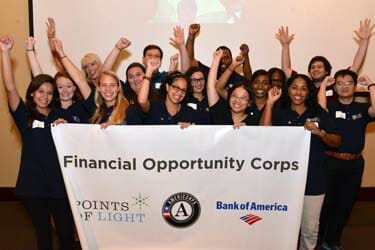
The Financial Opportunity Corps is an innovative coaching program powered by Points of Light, Bank of America and the Corporation for National and Community Service. Together, the organizations are mobilizing AmeriCorps VISTA members and community volunteers to deliver free financial coaching and asset-building services in economically disadvantaged communities around the United States.
Volunteer coaches receive specialized training and strategies to help clients refine objectives and build healthy financial habits to reach their goals.
Erin Marcoccia
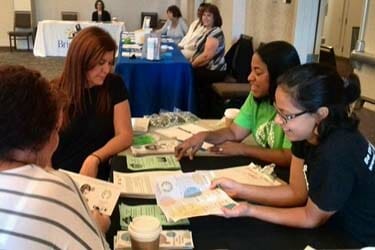
Perryman was partnered with Erin Marcoccia, and they began meeting two Saturdays a month at their local library. During the first meetings, they calculated Perryman’s debt, explored her income and discussed her short- and long-term personal and business goals.
“When we started actually crunching numbers it was very clear to me that this was an opportunity that was just invaluable,” Perryman said. “I was like, ‘Oh, I have how many digits of debt?’”
She added: “There is this really big feeling of relief that comes from actually telling someone, ‘I owe this much money with student loans and credit card debt’ – to actually say that out loud and not feel judged at all and not have to justify it.”
While discussing money can be uncomfortable, Perryman said those feelings quickly dissipated because she knew Marcoccia was there to help.
“I can really empathize with the people I work with because I’ve been there and I understand what they are going through,” said Marcoccia. “My husband and I have been in a situation where I had been laid off and I didn’t qualify for unemployment. We were just living off of his paycheck and it just felt like the apocalypse was happening. So, when you crawl your way out of that, it feels rewarding.”
Marcoccia served as a sounding board as Perryman vocalized her challenges and together they mapped out a plan.
“Everyone’s situation is really different, so it’s nice that someone can sit down and take your situation for what it is and then help you to figure out what is next,” Perryman said.
Immediately, Perryman opened a savings account and now has a percentage of her pay directly deposited into it each week. She is also taking advantage of student loan deferment programs and paying down her credit cards each month. She makes it a habit to check in on her finances regularly.
The new habits and accountability have been key.
“She doesn’t pressure me, but knowing we will be meeting helps,” Perryman said of Marcoccia. “I don’t want to waste her time, so I know I have to have my budget figured out and keep getting things done.”
Coaches and clients make a commitment to work together for at least six months, so they can assess trends, see progress and deal with real-life situations as they crop up.
After just a few months, Perryman said she feels a huge shift – in her finances, her business and her confidence.
“This has changed my life,” she said. “It is very exciting.”
Good Conversation and `a Little Light’ From a Volunteer Lead to Better Money Habits
In February, I met Linda R., a divorced mother who works full time as a preschool teacher and part time in a low-wage service job. She is passionate about teaching and has been in the field for 25 years.
Jamal Jimerson
Linda lives with her adult daughter, who was recently laid off from her job. When her daughter became unemployed, Linda enrolled in the Financial Opportunity Corps program to get help with managing her household finances.
Through the program, I became Linda’s financial coach.
As the director of Family Economic Success programs at the Connecticut Association for Human Services, it brings me great joy to take time off from my day-to-day responsibilities to volunteer as a financial coach. In this role, I work one on one with people facing economic hardship to provide them with meaningful support toward fulfilling their financial goals.
During our first meeting, Linda explained that she did not have enough income to pay her bills and she needed to “build a savings.” She told me more than once: “I save money, but I have to reach into my savings to pay my bills!”
I learned that Linda had some harmful financial behaviors and she did not have a budget. But she was creative and resourceful.
She already knew what her problems were – so my role was not to tell her what to do or how to do it, but to help her develop the confidence to do what she already knew.
At the end of our first session, Linda established a goal – save $600 in six months by saving $100 a month using direct deposit. To start the process, Linda agreed to participate in a free budgeting workshop.
During our second meeting, Linda indicated that she completed the budgeting workshop and put together a draft budget on her own. Our goal in the second session was to review her income and expenses. Linda discovered that there were ways to increase her income and decrease her expenses.
For example, Linda spends $14 a week on coffee at Dunkin’ Donuts. The $2 a day she spends is usually on her way home from work as a “gift” to herself after a long day. However, we also discovered that she purchases a cup a day on the weekends as well. Linda determined that one effective way to decrease the expense is to avoid buying coffee on the weekends.
Linda also spends $100 a month to purchase supplies and games for her preschool students and another $100 a month on a storage facility to store extra supplies.
Recognizing that this is Linda’s passion, we explored some options in this area, including comparison shopping to determine whether she was receiving the best deal on a storage facility, reusing materials and supplies from the storage facility as opposed to buying new items for the class, and researching grant opportunities for teachers.
Linda told me that she enjoyed sharing ideas and that there were many things she “never thought of doing” to improve her financial situation. For me, it has been a pleasure.
The Financial Opportunity Corps training equipped me well for this experience. I did not feel compelled to be the expert in Linda’s life. All she needed was some good conversation, a little light and the confidence to get started on the pathway to her goals.
Erik Murudumbay didn’t need a lecture. He needed help.
The 19-year-old college freshman hoped to change his money habits, and he wanted advice while still maintaining control.
“The idea of having someone in my life who wouldn’t force me to take specific action or tell me what to do, but would coach and hold me accountable sounded appealing to me,” Murudumbay said.
That’s what he found with the Financial Opportunity Corps. Through the program, he was paired with a volunteer financial coach, Manni Lajeunesse, who prompted him to think deeply about how he was spending his money and whether that spending was making him happy.
Murudumbay told Lajeunesse that most of the money he spent each month went toward video games – typically $30 on game app purchases and $60 on a new video game.
“I realized that my overspending stemmed from the fact that I had a lot of free time, and was spending two to four hours a day playing video games, which ultimately was sucking up all my money and was not making me happy,” said Murudumbay, who receives his coaching through New York’s Asian Americans for Equality, one of the nonprofits that hosts the Financial Opportunity Corps program.
The Financial Opportunity Corps, a partnership between Bank of America, the Corporation for National and Community Service and Points of Light, recruits and trains volunteers as financial coaches who then help people from low- and moderate-income households achieve financial stability.
Together, Murudumbay and Lajeunesse brainstormed creative ways he could use his time. Murudumbay is now taking salsa classes, which cost $30 a month, and purchased hand weights, which cost $7 to $10 each. The weights were an especially smart purchase, because they have long-term use, as opposed to one-time-use game app purchases.
Murudumbay has also been putting in extra time at the library to do homework and help his younger sister with her school work. “She has been enjoying completing projects more, and loves that I’m spending time with her,” he said.
He cut his game-playing time to less than an hour. He spent $40 last month, down from an average of $90 a month. Because of this change, he is spending more time living his life and improving in school and work.Now that he is in control of his spending and other aspects of his life, he can start thinking more about the future and eventually investing his money.
Putting care and thought into spending has allowed him to focus on putting money into his savings account. Although Murudumbay had a savings account before he started working with a financial coach, he would withdraw from it frequently. Now he is depositing $100 to $200 each month and isn’t touching the balance.
“Before financial coaching, I would take a few steps forward and then go back to my old habits quickly, but now my mentality has changed,” Murudumbay said. “When I set a goal, I can keep going until I reach it. I feel like a different person.”
For more about the Financial Opportunity Corps, visit www.pointsoflight.org/financial-coaching.
Giving Women Entrepreneurs a Place to Refine and Expand Their Civic-Minded Ideas
While serving as executive director of the NASCAR Foundation, Sandy Marshall noticed a worrying trend for girls. They are consistently left out of opportunities in science, technology, engineering and math, though emphasis within schools in these areas is growing.
Sandy Marshall
Recent research backs her observations. According to the
. Through summer camps, one-day programs and mentoring and volunteer opportunities for women and girls, Marshall is bringing like-minded girls together for education, mentoring and encouragement.
Just like she got from the Points of Light Civic Accelerator.
Since 2012, the Civic Accelerator has supported and invested in innovative, civic-minded social entrepreneurs, providing a rich curriculum in lean start-up methods, networking opportunities, as well as mentoring and coaching. The boot-camp-style program gives these leaders a place to test ideas in the early stages of their nonprofit or for-profit ventures, get sage advice from a range of experts, and recruit potential partners, investors and clients.
From the beginning, the
has been there – a founding sponsor of the accelerator and its largest, having invested $1.8 million in the program with PwC executives also participating on the Advisory Panel and selection committee for the cohorts, reviewing cohort applications, acting as mentors and coaches to some of the entrepreneurs and as faculty to the program.
Laura Weidman-Powers, center, CEO and co-founder of Code2040, participates in a session of the Civic Accelerator.
– which honors women entrepreneurs globally, the Foundation deepened its commitment to the Civic Accelerator and to female entrepreneurship. That day at the United Nations, Shannon Schuyler, Principal and Corporate Responsibility leader at PwC and President of the PwC Charitable Foundation, and Ayesha Khanna, President of the Civic Accelerator, announced that the spring 2015 cohort of the Civic Accelerator would focus on women and girls.
The question posed to potential participants: How might we create greater opportunities for women and girls to succeed in today’s economy?
“We want to support entrepreneurs – most of whom will likely be women – who are leading breakthrough solutions to better enable women and girls to fully and successfully participate in our global economy,” Khanna said.
By design, the Civic Accelerator was created to attract and support diverse entrepreneurs, including women and minorities, as well as founders from various places, backgrounds and sectors. Out of 61 participating ventures since 2012, nearly half were founded by women. Half of the $500,000 awarded to date to accelerator graduates went to ventures founded or co-founded by women.
Laura Weidman-Powers
While more women are starting businesses at younger ages, more than 87 percent of top management posts in American companies are held by men, Schuyler said. By helping to support a community for these women leaders, Schuyler hopes to encourage even more women to step onto the entrepreneurial path.
“It is immensely important that women are not only given opportunities to lead social ventures, but that they understand that they have a very important seat at the table in solving the problems plaguing our world,” said Schuyler. “The business community has an extremely important role to play in helping pave pathways for women to embrace their innovative spirits.”
shares that sentiment. The San Francisco-based nonprofit works to increase the representation of African-Americans and Latinos in the technology sector through its fellowships for college- and graduate-level students and other programs.
The organization’s CEO and co-founder, Laura Weidman-Powers, said the Civic Accelerator connected her “with an inspiring group of fellow social entrepreneurs in a scenario where we weren’t just socializing or supporting one another but actively working to improve each other’s ventures.”
Weidman-Powers added, “It was an amazing opportunity to get honest feedback from smart folks who know that just because you don’t have something figured out now doesn’t mean you won’t down the line and who are willing to help you grow.”
Since launching Code2040, Weidman-Powers has appeared in
and on NPR. More than 1,000 students have applied to become CODE2040 fellows, and more than 200 companies have expressed interest in hosting fellows for summer internships.
For Marshall, the Project Scientist founder, participating in the accelerator brought new ideas, validation and some much needed “building dollars” during the early stages of the nonprofit, based in Charlotte, N.C.
“It was a lot of work,” Marshall said. Participation included three weeklong stints in various cities over three months, with intensive work sessions. Marshall brought a team member to each session to benefit from the experience.
“It certainly gave us some confidence, but then some days, we lost all that confidence depending on the exercise,” she said. “Those days, we were able to poke some holes in our model. We left (as) a stronger organization.”
The work paid off. Project Scientist won one of the accelerator’s $50,000 investments.
Marshall said she’s glad the accelerator is working to advance more women’s ventures like her own.
“I think it’s a great focus and a hot topic right now,” she said. “Any organization that’s working toward improving the lives of girls and women I want to see succeed.”
Startup – Like a Girl
“Lean In,” “#GirlBoss,” “Thrive,” “Playing Big.” The list of books that aim to empower women goes on, and for good reason. In this spirit,
– a viewer favorite – challenges us to rethink what it means to do, run, throw and fight “like a girl.”
Co-founders from Union Capital Boston, SparkMarket and Akimbo chat during the fall 2014 Civic Accelerator program in San Francisco.
That theme drives the spring 2015 session of the Points of Light Civic Accelerator, which will focus on startups that create greater opportunities for women and girls to succeed in today’s economy. (
for the12-week boot camp for startups.)
We reached out to some Civic Accelerator alumni – who are in the thick of testing products with customers, networking and pitching investors – to get their take on leading a social enterprise as a woman. In other words, what is it like to startup like a girl?
Here’s what they told us.
, a crowdfunding platform designed for users of all ages: “When I show up, people notice because I’m not like everyone else in the room. And though I’m sometimes underestimated, I like to see it as having many more opportunities to prove people wrong and exceed their expectations.”
, a nonprofit that creates opportunities for blacks and Latinos in technology: “In terms of creating a gender lens within the organization, we do try to proactively consider any unique barriers, external or internal, that women in our network may experience as applicants or participants in our programming.”
Mackenzie Hughes and Danielle Gaglioti, co-founders of Akimbo
, which itself is creating a more inclusive workforce by connecting workforce organizations to companies: “As female entrepreneurs, we seek to not only exemplify strong women ourselves, but to change the perspectives of people all over the world so that one day they can see that with equality and inclusivity comes great change and success.”
Are you a woman running a civic-minded social enterprise, or are you from a startup focusing on solving issues affecting women and girls? Our Civic Accelerator is interested in exploring a range of solutions, including STEM (science, technology, engineering, math) education; workforce, leadership and 21st century skills development; and innovative childcare, public safety and community development solutions.
For more information and to apply visit
, the Chicago-based company’s new fundraising product.
Matthew Rattigan, Edgeflip co-founder, participates in a Points of Light Civic Accelerator spring 2014 session in New York.
On the surface, Donor Boost is simple: It’s a Facebook-enabled share button that can be embedded into any webpage or email. Behind the scenes, however, Donor Boost – which is in a public testing phase – is intricate. It collects data that can both inform your organization about its online supporter base and optimize performance.
By embedding the button on a thank-you page or in a thank-you email donors see after contributing, your organization can make it easier for donors to encourage their friends to give.
Donor Boost users aren’t just “sharing” on behalf of your organization, they’re advocating. When they click, their friends receive personalized notifications, coming from a trusted source.
By enabling your donors to advocate on your behalf, you enlist the mighty force of peer influence, which can lead to demonstrably higher response rates. The goal: more high-quality impressions, more supporters and more donors.
Learn more about Donor Boost and other leading Chicago-based civic ventures, and meet 13 of the most innovative civic startups from across the country as the Points of Light Civic Accelerator celebrates its fall 2014 Demo Night in Chicago on Dec. 17 from 5:30 to 9 p.m. at
Bringing Financial Coaching to Those Who Need it Most
For Beverly Sanders, living on a budget used to sound like going on a diet: It’s the right thing to do, but it’s hard to know where to start.
“It sounded like depriving yourself, like starving yourself,” said Sanders, a nonprofit program manager. “While I’m a very well-educated woman, for some reason I seem to blank when it comes to sitting down and making a spending plan.”
That began to change in early 2014, when friends persuaded Sanders to try a new financial coaching program called the Financial Opportunity Corps.
Financial Opportunity Corps AmeriCorps VISTA members cheer during their swearing-in ceremony.
It’s an innovative partnership between Points of Light, the
members to go into communities and recruit and train volunteer coaches to work with people in need of financial guidance.
Central to the program’s success – and what makes it different from other coaching models – is the engagement of these community volunteers as coaches.
Launched in 2013, the Financial Opportunity Corps currently operates in nine U.S. cities.
In addition to community volunteers, Bank of America employees have embraced the program and serve as volunteer coaches and financial workshop facilitators. The workshops and coaching sessions are designed to help people from low- to moderate-income households find strategies that will help them achieve better money habits and long-term financial health.
In the past year, more than 1,000 people have participated in the Financial Opportunity Corps’ workshops, and more than 200 volunteers have been recruited and trained as financial coaches to work one-on-one with participants.
AmeriCorps VISTA members based at HandsOn Broward, right, distribute information about the Financial Opportunity Corps at a financial fair in Florida.
It’s an example of the “robust relationship” between Bank of America and Points of Light, said Kerry Sullivan, president of the
.
“We understood the need for individuals to be better educated on financial issues,” Sullivan said. “It hit a sweet spot for us.”
The Financial Opportunity Corps is a key program of Bank of America’s involvement with Points of Light, but the relationship goes much deeper. For a number of years, Bank of America has invested in and served as a thought leader for Points of Light’s global expansion and offerings, particularly in the Asia-Pacific region.
This involvement and investment, coupled with other philanthropic partners, has served as a catalyst for extending Points of Light’s footprint to 68 cities in 29 countries, in only a few short years. The groundswell of interest in volunteerism outside the U.S. continues to grow: Last year alone, more than 100,000 volunteers engaged in Points of Light partner-led projects and activities.
Additionally, Bank of America invests in the broader service sector through Points of Light, through the company’s involvement in the
. The council is a group of more than 70 industry-leading companies that form the premier global platform for increasing the quantity and transforming the quality of employee volunteering.
Through its corporate social responsibility program, Bank of America employees around the world logged 2 million hours of volunteer work last year. Employees are encouraged not only to take part in company-organized projects but to share opportunities to address needs in their communities.
This year, the company launched a Global Volunteer Awards program that recognized 20 employees for their outstanding service and commitment to their communities.
The Financial Opportunity Corps has allowed Bank of America employees to help people resolve many types of financial problems. Financial Opportunity Corps participants, or “clients,” are taught strategies for reducing debt, improving credit, building assets, saving for emergencies and planning for the future.
As a VISTA member assigned to
last year, Melinda Matthews matched 27 clients with coaches.
“The clients are so appreciative. They all have their ‘a-ha’ moments. You can see it on their faces and in the way their attitude changes. That’s priceless,” said Matthews, who now works as a development manager for HandsOn Broward, part of Points of Light’s
.
Program volunteer Mike Tsoi-A-Sue became a coach in January 2014. He has worked with four clients – including Sanders – meeting monthly for three to six months, depending on how quickly the client’s goals are met.
“They all start with basically balancing expenses against income,” said Tsoi-A-Sue. Coaches are essentially “an accountability partner who keeps them on track.”
The clients’ situations are sometimes complicated, he said. But Tsoi-A-Sue tries to help them focus on goal-setting, whether it’s reducing debt, saving for retirement or something else deemed important.
Tsoi-A-Sue “couldn’t be more different” from me, said Sanders. Formerly an accounting and finance worker in the petro-chemical industry, Tsoi-A-Sue is methodical and soft-spoken. But Sanders believes his calm, practical approach has helped her reach some breakthroughs in her attitude toward money.
“I come from a culture where when you have it in your pocket you spend it all,” she said. “I believe it’s kind of a poverty mentality. I know how to save money for things, but I just didn’t believe I was a person who could do it.”
Tsoi-A-Sue has helped her get control of her debt, gain focus and still have money in her pocket for the things she enjoys.
“What I realized is he wasn’t there to teach me about money. He was there to support me, to ground my free-spirit thinking and provide me some structure,” she said. “It really was about, `What are your values?’ and, `Where do you want to see your money go?’”
Fast Company Highlights PwC, Points of Light Initiative to Support Women Entrepreneurs
Fast Company magazine ran an exclusive today – the first Women’s Entrepreneurship Day – about a new initiative to boost women entrepreneurs.
Andrea Lo, cofounder and CEO of Piggybackr, represented Points of Light’s Civic Accelerator at Women’s Entrepreneurship Day at the United Nations.
With support from the PwC Charitable Foundation, Inc., Points of Light will select the next group of entrepreneurs to benefit from its Civic Accelerator with a gender lens, selecting only startups that help women and girls gain equal access to opportunities. The majority of these ventures will be led by women founders.
The Points of Light Civic Accelerator is the first accelerator program and investment fund in the country focused on “civic ventures” – for-profit and nonprofit startups that include people as part of the solution to critical social problems.
The three-month, boot camp-style program convenes 10-15 teams in person and online with the goal of equipping each startup to seek investments and scale their social innovations.
The Civic Accelerator was launched in 2012, in partnership with Village Capital, and receives generous support from PwC Charitable Foundation and Starbucks Foundation, both founding partners, and from the Blackstone Charitable Foundation, SAP, The Committee For Children, and the official hotel sponsor, Hilton Worldwide. For more information, go to www.civic-x.org and follow @PointsofLight #CivicX.
3 Shortcuts to Help You Survive in a New Startup
This post is by Amy H. Fonseca, chief storytelling officer and lead blogger of Women@TheFrontier – a community of female visionaries. See what she learns from Points of Light Civic Accelerator founder Ayesha Khanna.
Amy H. Fonseca
I read an article recently where Alexis Ohanian, co-founder of Reddit, explains how the phrase “I have a startup is the new I’m in a band.” If that’s true, then this 30-something-year-old woman, wife and mom is in a band of sorts – and chances are you are too. In fact, over 500,000 U.S. business owners launched companies in 2012. That’s a lot of new bands, people.
The statistics also show that 25 percent of all startups in the U.S. fail in the first year and of those remaining, 36 percent fail the second year. At W@F, we started thinking about these numbers and wondered what hacks could help you thrive in a notoriously challenging startup world. We researched what experts and entrepreneurs at the forefront of their industries had to say and here’s what we found.
Startup Hack 1:Focus on Systems – Not Goals.
In an article entitled, “Forget setting goals. Focus on this instead,” writer, entrepreneur and behavior science expert James Clear asks, “If you completely ignored your goals and focused only on your system, would you still get results?” His answer? Yes. Clear explains that goals provide direction, but committing to a system, the practice you do every day, is what actually makes the difference.
When you focus on systems, you also get a new perspective on startup failure. “Systems-based thinking is never about hitting a particular number,” Clear says, “it’s about sticking to the process.” With systems, there is no failure. There’s just the process and the process always wins. Hayley Barna, founder and CEO at Birchbox, echoes a similar thought process when she advises, “Even if you fail miserably, you’re going to learn so much.”
So, what’s the CliffsNotes version for Hack 1? Focus less on goals and commit to a daily practice. You’ll find that this hack can transform both your perspective and your startup.
Startup Hack 2: Incorporate Nontraditional Working Hours
Keren Elazari, Gigaom analyst and an Israeli hacking scene insider, says, “For the past two years I’ve not had a single 9-to-5 workday. That’s not to say I don’t work hard, or that I don’t spend many hours working. There are 24 hours in a day; seven days a week and I use them all as potential working hours.”
Elazari’s trick for utilizing adaptable hours is to create office hours for email, social media or work-related meetings. Then, she allocates two-thirds of her time for creative hours. These are the hours where she shuts the door and cultivates the game-changing ideas that will make a difference. Elazari also follows author Zadie Smith’s advice that sometimes you need to “step away from the vehicle.” This means that at some point you walk away from the idea you are immersed in, give yourself the time to react to your work and allow your soul the opportunity to recharge.
If you’re used to more traditional hours, give adaptable hours a try. Not only is it one of the perks of a startup, but it’s also an awesome hack for getting work done in a productive and creative way.
Startup Hack 3: Keep Moving Forward Even When You’re Stuck
Ayesha Khanna, founder of the Points of Light Civic Accelerator, advises that it is important to keep moving forward even when your startup is stuck.
One tip to keep moving forward is to quickly assemble a diverse group of people to weigh in on a problem or roadblock. She says, “This comes from eliminating the idea of ‘genius’ or ‘expert’ and to recognize that nothing can be powered by one person’s intent. It is the interaction between individuals/artists/entrepreneurs which produces higher-quality results than one person or team can do on their own.” Khanna explains further, “So finding your own diverse, eclectic group to bounce ideas off of and inviting challenging views from unexpected places, can sometimes help break you free.”
Khanna learned another clever tip from a Civic Accelerator partner, Smallify, a San Francisco-based design firm that leads innovation labs and helped to design part of Civic Accelerator’s curriculum. Khanna explains, “We list transformative leaders from all disciplines, companies and industries on slips of paper and when we get stuck, we pull them out of a jar and spend five minutes putting ourselves in their shoes.”
Khanna and her team ask how this person would tackle a problem. What would they focus on? For example, how would Gandhi or Steve Jobs approach a particular hurdle? She says, “It’s a great ‘hack’ that can help drive new, creative ways to get past a roadblock.”
And Khanna’s last piece of advice? “A glass of wine and lifting your head up and walking away helps, too.”
Fellow band members, we know what you’re thinking. Great advice! And we could use that glass of wine, too.
5 Days Left to Apply for Fall 2014 Civic Accelerator
Here are 5 reasons to apply to the Points of Light Civic Accelerator, which invests in and supports seed stage social ventures that solve pressing social and environmental issues by engaging people.
5. New Challenge with a New Focus
How might we develop new pathways and increase access to economic opportunity for all?
Together with the PwC Charitable Foundation, the Starbucks Foundation, SAP and the Committee for Children New Mission Ventures Fund and Hilton Worldwide, the Points of Light Civic Accelerator is seeking innovative social ventures that are working to create greater, more accessible pathways to economic opportunity in communities across the U.S.
The potential solutions are many. From interventions in early childhood education and veteran re-entry, to financial literacy and 21st century skills development, we are interested in exploring a range of solutions and approaches together. We’re looking for innovative technologies, platforms, and other models that create positive economic outcomes for the communities in which they operate.
4. New Cities
The 12 week startup boot camp will convene for three, in-person, weeklong sessions, in addition to undergoing the virtual curriculum. Each session is focus on a specific in startup development and includes an opportunity to present your venture in front of a local audience concluding with Demo Night during session 3.
The Committee for Children (CFC), the nation’s leading non-profit provider of social-emotional curricula, has teamed up with the Civic Accelerator to find and support innovative ventures in social-emotional learning during the fall 2014 program. CFC is partnering under the auspices of its New Mission Ventures Department, which is dedicated to expanding CFC’s mission of fostering the social and emotional development, safety and well-being of children. The Seattle based nonprofit is most known for the award-winning Second Step program, teaching social-emotional skills to prevent bullying, violence, and abuse and improve academics. Their curricula are used in over 25,000 schools across the United States and around the world. To learn more, go to www.cfchildren.org.
2. Chance at $50,000 Investment
At the conclusion of the Civic Accelerator program, two teams (one for-profit and one nonprofit) will be selected to receive $50,000 investments each, with the decision being made by the entrepreneurs themselves. What would $50,000 mean for your civic venture?
1. Join a National Network of Civic Entrepreneurs
The Civic Accelerator curriculum in and of itself holds enough value to justify your application, however it’s the people – the entrepreneurs, mentors and partners that really make the Civic Accelerator such a unique and transformational experience. Connecting with likeminded individuals from across the country, building meaningful and lasting relationships to help grow your business is what it’s all about. Apply now and join the CivicX family.