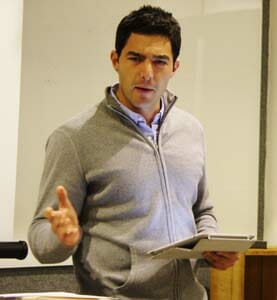
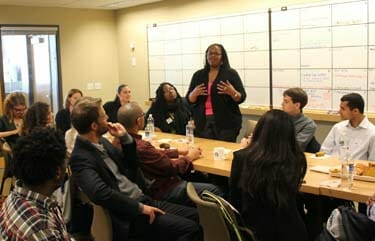
Alex Kapur presents OpportunitySpace at a fall 2013 Civic Accelerator workshop.
Founded by two graduates of the Kennedy School at Harvard University, Cristina Garmendia and Alexander Kapur, and with a dynamic, lean team that includes Nico Tejera and Andrew Kieve, OpportunitySpace has a mission to create a public database for developers that makes it easy to access information about publicly owned buildings and land. So far, it has listings in Louisville, Ky., and in several cities in Rhode Island, including Providence.
“It just seems like the knowledge set for how to invest and develop is limited to such a select group of people that there’s an opportunity to use technology and data to open up access to this market,” Alex Kapur told the Times.
Together with our founding partners, PwC Charitable Foundation and Starbucks Foundation, and SAP, Committee for Children and Hilton Worldwide, the Points of Light Civic Accelerator is seeking innovative social ventures that are working to create greater, more accessible pathways to economic opportunity in communities across the U.S. Applications for the fall 2014 Civic Accelerator will be accepted until Aug. 15.Apply now!
Are You Part of a Startup Aiming to Do Good in the World? Could You Use Some Help?
Now entering its third year, the Points of Light Civic Accelerator brings together innovative ventures across the country focused around one common challenge:
How might we create new pathways and increase access to economic opportunity for all?
Civic Accelerator participants take part in an exercise.
How It Works
The three-month, boot camp-style program convenes 10-15 teams in person (Atlanta, Silicon Valley and Chicago) and online with the goal of equipping each startup to seek investments and scale their innovative ideas. At the end of the program, ventures give presentations at a demo night attended by impact investors, foundations, corporate executives and social sector leaders. And there’s a twist. The participating entrepreneurs themselves decide which two most promising ventures, one for-profit and one nonprofit, will receive a $50,000 seed investment.
Who Should Apply
As recruiting for the fall 2014 Civic Accelerator program heats up, both for-profit and nonprofit startups that engage people to create greater access and pathways to economic opportunity are encouraged to apply. We’re looking for innovative technologies, platforms and other models that create positive economic outcomes for the communities in which they operate. Potential solutions include (but are not limited to) innovations in:
Job/career readiness
Financial literacy
21st century skills development
Youth development
Inclusive financial/social services
Social-emotional learning
Workforce development
STEM (science, technology, engineering and math) education
One Person Changed His Life, Now He Wants to Be That One for Others
Meet Sherman Williams, a volunteer at HandsOn Broward – part of Points of Light’s HandsOn Network of 250 volunteer centers. Williams is using his expertise in business to help people from low- and moderate-income households achieve financial stability.
Sherman Williams
As a teenager, Sherman Williams experienced the powerful difference one person could make in someone’s life. A native Trinidadian, he had moved to the United Sates when he was 5.
“Early on, the motivation to adapt to the American culture was a priority,” Williams says.
But adapting was difficult. Teased for his accent, he became a quiet boy who noticed everything but said little. That changed in the eighth grade, when Williams wrote an essay about homelessness and the environment.
“Back home [in Trinidad], homeless people were everywhere,” Williams says. “Then I saw them in the United States and I made the connection that homelessness was a serious issue.”
Williams’ heartfelt writing won him first place in the contest and earned him a spot in the oratory contest that followed. Having never given a speech, and self-conscious of his accent, Williams was dismayed. But a dedicated teacher stepped in to help. She coached him daily, working with him on projecting his voice and slowing down his speech.
“I took her teaching to heart,” Williams says.
Under the teacher’s guidance, Williams practiced diligently and won third place in the districtwide competition. “That was a life-changing experience for me,” he says. “The event gave me the confidence to be whoever I wanted to become. It was an empowering moment in my life.”
Williams wanted to help others feel that same empowerment. Inspired in part by Dr. Martin Luther King, Jr. and the power of one, he began to volunteer here and there. President Obama’s call to service, however, was the final impetus Williams needed to become a committed volunteer. In 2011, he signed up with HandsOn Broward and has been actively engaged ever since.
When Williams learned about the Financial Opportunity Corps – a partnership between Points of Light, Bank of America and the Corporation for National and Community Service – he quickly signed up for the first volunteer orientation and training. The program recruits and trains volunteers as financial coaches who help people from low- and moderate-income households get their finances on track.
Williams, who holds a bachelor’s degree in business management and an MBA, felt he could use his business background and speaking skills to benefit the program, run locally by HandsOn Broward.
“I chose (the Financial Opportunity Corps) because the information it offers is basic but is widely overlooked,” Williams says. “It can make positive impact in communities. … On my path, it took only one person to bring change, the proverbial power of one. Now I can empower others to make positive financial decisions.”
Startups Get $50,000 Each for Ideas Serving the Greater Good
A San Francisco company that teaches people how to raise money and a Chicago nonprofit that brings science, technology, engineering and math education (STEM) to students in low-income neighborhoods, were chosen by their peers to receive $50,000 each at the close of the spring 2014
Points of Light Civic Accelerator
.
From left, Megan Christenson of the Civic Accelerator; Nzinga West of Project SYNCERE; Kenahn Jung of Piggybackr; Ayesha Khanna of the Civic Incubator; and Rashad Thornton of Project SYNCERE
The Civic Accelerator is a 12-week boot camp dedicated to boosting startups with missions that engage people as part of the solution to community challenges. This spring’s 14 participating startups – a mix of nonprofit and for-profit enterprises – met in Seattle, New York and Atlanta for networking, mentoring and peer support.
During the last session on June 20 in Atlanta, the participants themselves picked the winners, which both focus on helping future generations succeed:
, a Chicago nonprofit that has developed a STEM enrichment program for underrepresented students in grades four through 12.
Piggybackr plans to use the investment to reach more young people and communities across the nation so that funding is not a barrier. Andrea Lo, CEO and co-founder, credits the Civic Accelerator with helping her focus at a critical point in her venture’s growth. Project SYNCERE Executive Director and co-founder Jason Coleman expressed his enthusiasm and shared how meaningful this investment was coming from his peers in the program.
Since launching two years ago, the Civic Accelerator – a program of the Points of Light
– has now graduated 48 startups, invested $500,000 in civic ventures, built a pipeline of more than 150 mentors, advisers and partners, and engaged more than 150,000 people in solving society’s critical challenges in the environment, economic development and using technology for good. Each venture class is unique, having its own identity and feel.
was launched in 2012, in partnership with Village Capital, and receives generous support from PwC Charitable Foundation and Starbucks Foundation, both founding partners, and from the Blackstone Charitable Foundation, SAP and the accelerator’s official hotel sponsor, Hilton Worldwide.
What Can You Learn About Entrepreneurship in Three Days? Plenty.
When you bring entrepreneurs together, ideas fly, networks grow and partnerships emerge. We got to see all three happen recently in New York during a three-day gathering of the spring 2014 class
of the Points of Light Civic Accelerator.
De Nichols of Catalysts By Design brainstorms solutions to gaps in her nonprofit’s operations model with peer entrepreneurs in the Civic Accelerator.
Through the accelerator – a 12-week boot camp for entrepreneurs of startup ventures that aim to serve the greater good – 14 fledgling enterprises are learning from experienced leaders in various fields, and each other. Here’s a taste of what happened in New York May 19 – 21.
Day 1: The Value of Collaboration
Have you ever seen Jeep drivers flash a peace sign to each other or motorcycle riders acknowledging each other with a head nod? If you don’t live in their world, you probably wouldn’t understand the rituals. The same is true of people who lead startups.
Obvious challenges, such as the development of company culture or the brand, are sometimes overshadowed by questions like, “Who’s taking out the garbage this week?” or, “Can you expense that Uber ride?”
On this day we saw ventures working together, not only in offering their feedback and constructive criticism (which isn’t always easy) but actually partnering on projects. Take
. Accountability Lab was looking for a way to generate a small amount of funding, while increasing digital awareness. Coincidentally that is what tinyGive does, so the two decided to launch a collaborative campaign.
Day 2: The Growth of a Network
The next day, the teams prepared for that evening’s Investor Cafe at The Blackstone Charitable Foundation – one of the Civic Accelerator’s significant partners. There, the ventures worked on their pitches and receive feedback from investors and industry connectors.
During a session with Alex Neckles of
, participants learned about managing funder relationships. It’s one thing to be able to comfortably talk about your passion with your supporters, but entirely different when it comes to investors and potential partners on the 40th floor of a Park Ave. high-rise.
It started off a bit awkward, almost like speed dating, but by the time it was over, the entrepreneurs all walked away with new, valuable connections and great, candid advice. Some were able set up a few meetings.
Day 3: Telling the Right Stories
Most of the workshops and breakout sessions revolved around the art of storytelling. On this day, the Civic Accelerator hosted an intimate talk with Michael Haberman, managing director, northeast region, global philanthropy, at
. The idea of doing the right thing, and finding the sweet spot between good business and good community investment, brought everything full circle.
Most of the ventures participating in the Civic Accelerator were started because committed entrepreneurs wanted to make a difference. Large or small, these startups began with an idea to make their communities and the world better, and that’s a story worth telling.
What’s Next
The Civic Accelerator now shifts its attention toward the conclusion of the 12-week program, during the
in Atlanta June 16 – 18. On June 17, the startups will show what they learned – and you can learn about what makes them special.
We invite you to join the country’s most innovative civic startups and network with celebrity judges, local and national entrepreneurs, investors, and business and community leaders. For more information and to purchase tickets to this exclusive event,
Civic Accelerator was launched in 2012, in partnership with Village Capital, and receives generous support from PwC Charitable Foundation and Starbucks Foundation, both founding partners, and from the Blackstone Charitable Foundation, SAP and the accelerator’s official hotel sponsor, Hilton Worldwide.
Finding New Ways to Solve Old Problems
With new approaches, the 14 startups participating in the spring 2014 Points of Light Civic Accelerator are addressing some of society’s greatest challenges, including homelessness, hunger and access to education.
Nzinga West, standing, of Project SYNCERE shares the venture’s challenges and opportunities with the Starbucks Digital and Foundation Teams in Seattle.
Points of Light recently gathered the budding enterprises, both nonprofit and for-profit, to kick off the fourth Civic Accelerator – an intensive, 12-week startup boot camp that includes mentoring, entrepreneur education, peer support and networking. Points of Light will offer two of the most promising ventures – as selected by the entrepreneurs themselves – a $50,000 investment after the program wraps up in Atlanta in June.
In late April, we held the first session of the spring program at
Accountability Lab (Washington, D.C., nonprofit) The Accountability Lab empowers citizens to fight corruption and promote accountability though media and innovation in the developing world.
Catalysts by Design (St. Louis, nonprofit) Catalysts by Design is a network of social design organizations that partner with communities and organizations to resolve critical social challenges.
City Pioneers (Atlanta, hybrid) City Pioneers strengthens cities by connecting local public organizations with hometown talent to solve city challenges and to create an ecosystem of public entrepreneurs.
Code2040 (San Francisco, nonprofit) CODE2040 creates pathways to success for blacks and Latino/as in the innovation economy, with a focus on the critical transition from learning to earning.
eatiply (Minneapolis, hybrid) Eatiply is a cause marketing platform that sustainably fights hunger while providing businesses and nonprofits a valuable marketing solution.
Edgeflip (Chicago, for-profit) Edgeflip uses technology and analytics to accelerate the influence of nonprofits, advocacy groups and other social good organizations.
Food Recovery Network (College Park, Md., nonprofit) Food Recovery Network empowers students to recover food from colleges that would otherwise be wasted and donate it to hungry Americans.
Piggybackr (San Francisco, for-profit) Piggybackr teaches teams of all ages and experience levels how to crowdfund.
Project SYNCERE (Chicago, nonprofit) Project SYNCERE is a STEM enrichment program for underrepresented students in grades four through 12.
SEMADevelopment (Atlanta, hybrid) SEMADevelopment sells community-created mobile app games to raise money for nonprofit organizations.
tinyGive (Washington, D.C., for-profit) tinyGive is a micro-philanthropy platform that enables individuals to support causes and social good organizations through simple, social and meaningful actions.
UrbnEarth (San Francisco, for-profit) UrbnEarth makes guided gardening kits that empower everyone to experience the health benefits of homegrown food.
WorkReadyGrad (Atlanta, for-profit) WorkReadyGrad enables students to proactively acquire the right skills, experiences and mentors to reach their career potential.
Zealous Good (Chicago, for-profit) Zealous Good connects people and companies with excess items to local charities with matching needs.
The Points of Light
Civic Accelerator was launched in 2012, in partnership with Village Capital, and receives generous support from PwC Charitable Foundation and Starbucks Foundation, both founding partners, and from the Blackstone Charitable Foundation, SAP and the accelerator’s official hotel sponsor, Hilton Worldwide.
Digging Out of Debt With Help From Volunteer Financial Coaches
Even with a full-time job, Cat struggled with her finances. She had amassed significant student loan and credit card debt and was having trouble managing her money.
Financial Opportunity Corps members Caroline Ezzo (back
row, left) and Thomas Revelle (back row, third from left) join
with volunteer financial coaches and their clients at Clarifi.
But thanks to a financial coach who came to her through the Financial Opportunity Corps, Cat recently created a budget and identified places where she can cut spending and move toward a debt-free future.
“I think one of the benefits of this program is having a person who is not judgmental and not as emotionally connected to my money and spending as I am,” says Cat, a social worker.
The Financial Opportunity Corps recruits and trains volunteers as financial coaches who then help people from low- and moderate-income households achieve financial stability. The program is a partnership between Points of Light, Bank of America and the Corporation for National and Community Service.
The corps is made up of 20 AmeriCorps VISTA members working from nonprofits in 10 cities across the country. In Philadelphia, where Cat lives, Financial Opportunity Corps members Caroline Ezzo and Thomas Revelle have spent the past six months helping the staff of a local nonprofit establish a financial coaching program fueled by volunteers. The 47-year-old nonprofit, Clarifi, offers financial counseling and education to 15,000 clients each year.
So far Ezzo and Revelle have recruited, trained and activated 21 coaching pairs. In such pairings, a coach is matched with a client based on logistics, personality and complexity of the financial goal. Ezzo and Revelle plan to add up to 10 more coaching pairs every month.
The effort is paying off for dozens of clients – including Cat, who has been able to reduce her monthly student loan payment from $500 to $200. She says her financial coach has been instrumental in helping her become more financially secure.
“It’s hard for me to set concrete steps to achieve my financial goals, because it’s hard to see the big financial picture,” Cat says. “My coach helps me to look at my finances with a new perspective and helps me to set small, achievable goals to help me build confidence in my ability to manage my money.”
Entrepreneurs: Here’s How to Nail Your Startup Accelerator Application
Entrepreneurs in the Fall 2013 Civic Accelerator participate
in a peer coaching session in New York.
For many startup accelerator programs, the written application is your only chance to prove why your venture deserves a shot. How can you ensure your venture will stand out?
This April will mark the start of the fourth round of the Points of Light Civic Accelerator program since our launch in 2012. Our team has met with several hundred social entrepreneurs and reviewed nearly 500 business plans. We’ve figured out how to spot the great ones.
As the application deadline for our spring 2014 program nears (Friday, March 7 – don’t forget!), we thought we’d compile the most common application blunders and offer a few pointers to make your application shine.
Mistake 1 – Confusing market size with traction
Stating a large market size or the gravity of the social issue doesn’t mean that your venture is poised to gain a slice of the market share pie. More importantly, market size is not synonymous with demand.
The Question: What proof do you have that your customers are willing to buy your product or service?
The wrong answer: “Waste management is a $200 million dollar industry, and 1 million people are without proper sanitation services. This is an untapped market ripe with demand.”
The fix: “In our pilot phase, we secured 300 users of our waste management system. Of these users 20 percent renewed their subscriptions, and since opening our product to the public we’ve experienced an increasing rate of user adoption. If we can continue to grow at this rate over the next year, we will net $2 million in recurring revenue.
No one can argue with real numbers. If your product or service isn’t live yet, positive testimonials from customer interviews, preregistered users or results from product focus groups can also hint at potential demand.
Mistake 2 – Believing you don’t have competitors
Even if you are the first to market with your innovation, the status quo is your biggest and most threatening competitor.
The Question: Who are your main competitors, and what makes you different and unique from them?
The wrong answer: “Our community-based waste management system is the first of its kind. We do not have any known competitors.”
The fix: “Our research shows that convenience and acquisition cost are the biggest barriers to adopting any kind of advanced waste management system. The existing solution, while it generates long-term health implications, does not cost the user additional money or time. Our waste management system is the first of its kind to actually generate supplemental household income, and is designed with cultural tendencies and existing user behavior in mind.”
You must demonstrate awareness of the other solutions to the problem (or why they haven’t been adopted). Even better, show that you understand how your target customer currently manages or deals with this problem and why your solution is better.
Mistake 3 – Confusing a lack of seed funding as a challenge versus a symptom
Funding is not your biggest challenge. All of the reasons why you haven’t received funding are your biggest challenges.
The Question: What is your venture’s biggest challenge?
The wrong answer: “We’ve had a hard time connecting with the right investors. With a little bit of seed capital we would be able to successfully scale our venture.”
One possible fix: “One of our biggest challenges right now is identifying the right channel(s) for expansion. Our first pilot was a huge success, due in part to strong local networks rooted in years of personal relationships. We know that this will not be the case in other markets. As we prepare to scale, it is crucial that we identify the right kind of strategic partners and that we are able to quickly and clearly articulate our value to these partners.”
Other great responses we’ve seen to this question include sharing feedback from funders and identifying the struggle to incorporate that feedback.
Other advice to consider:
Demonstrate flexibility. For example, when did you pivot in response to customer or user feedback?
Show you can play nice with others. What do you have to learn from others, and what lessons can you share?
Be succinct. Brevity allows reviewers to find your strongest elements quickly.
For accelerator managers, what other advice do you have for entrepreneurs? For entrepreneurs, what else would be helpful to know about the accelerator application process? Drop us a line at [email protected], and let us know!
Building a Startup for the Greater Good? Here’s a Hot Place for Entrepreneurs
When we think of entrepreneurial hubs, naturally we think of San Francisco and Silicon Valley. In our ever-flattening world, however, it is no surprise that the entrepreneurial landscape is rapidly changing and other lesser-known hubs are popping up all over the United States.
After having worked in Mumbai and traveling through East Africa, I landed in the Denver area ready to follow my passion for social innovation. Unbeknownst to me I had landed in a hotbed for high-tech startups and entrepreneurship.
I joined the
team in February of 2013 in a position that naturally fit with my networking efforts – helping to recruit promising civic ventures from the Denver area for the spring and fall Civic Accelerator programs.
The Civic Accelerator is a three-month, boot camp-style program; participating startups receive tools and mentoring – and potentially $50,000 investments – to expand their innovative work aimed at helping communities. In this work, I have had the pleasure of getting to know the startup communities of Denver, Boulder and Fort Collins – all buzzing with entrepreneurial activity.
So why do these cities make such great launch pads for social ventures? I asked Stephanie Brady, founder of
, one of the 15 ventures in the fall 2013 Civic Accelerator. LaunchUR equips teens with skills that will be crucial when they enter the workforce.
“This region is extremely open to innovation, new approaches and challenging the status quo,” Brady said. “There is an authentic culture here that is energized, inquisitive, curious, inventive, socially conscious and willing to help others.”
She added, “So many leaders in this region embrace our mission to accelerate the 21st century skills of our next-gen leaders and are willing to share advice and refer us to others in their valued networks to sharpen our business model and startup strategies.”
This comes as no surprise considering that Denver, Boulder and Fort Collins were among the “25 Top Startup Cities,” as named by
lists Boulder and Fort Collins as the No. 1 and 2 metro areas for high-tech startup density.
When it comes time to find a home for your next social venture, be sure to visit our mile high communities. You might end up staying!
Applications for the spring 2014 Civic Accelerator are due March 2. For more information, and to apply, please visit www.pointsoflight.org/civic-accelerator.
A Great Opportunity for Entrepreneurs Who Want to Do the World Good
So you are a social entrepreneur with a civic-minded startup who wants to make a difference in the world. You have an innovative solution that gets to the root of a social issue, but are overwhelmed by the crowded field of startups and are unsure of how best to engage people, secure funding and grow your startup into a success.
From left, Carly Shuler, Manish Anand and Tico Ballagas of
Kindoma chat during a recent Civic Accelerator gathering in New York. (Photo by D&A Images)
We believe people can be part of the solution to pressing social and environmental issues, which is why we focus on civic ventures, both nonprofit and for-profit, that are designed to tap into people’s talents, compassion and goodwill.
The Civic Accelerator program will take you and your team through a the three-month, bootcamp-style program with 10 to 15 other startups. You’ll convene in person during three weeklong sessions in Seattle, New York and Atlanta, and online in between sessions.
Aside from working with other startups the Civic Accelerator will partner you with mentors, impact investors and community leaders who are committed to your success. Industry experts will also train you in necessary skills such as fundraising, startup engineering, marketing, measurement and evaluation, and how to expand your startup.
Need more incentive? At the close of the program each startup will pitch their idea at a showcase event for civic leaders and investors. The two most promising ventures, one for-profit and one nonprofit, will be selected to each receive a $50,000 seed investment with a twist – you and your fellow entrepreneurs ultimately decide who will receive the investment.
In the most recent cycle the two startups that received funding were Kindoma and IDignity. Kindoma, a for-profit company in Palo Alto, Calif. created a mobile videochat platform that makes activities such as book reading longer, richer and more engaging for children and parents. IDignity, a nonprofit in Orlando, Fla., helps the disadvantaged overcome barriers to participating in society by helping them obtain identification documents such as birth certificates, Social Security cards and photo IDs.
“Receiving this investment from my Civic Accelerator peers is an exceptional honor and will help us scale and grow our impact based on a new business and revenue model we were inspired to develop during the program,” said Michael Dippy, founder and executive director.
Applications for the spring 2014 Civic Accelerator are due March 2. We are looking for ventures in these areas: