Serving the Greater Good Without Going Out of Business
This post is by Cristina Garmendia, co-founder of OpportunitySpace, a Points of Light Civic Acceleratorparticipant that aims to bring governments, developers and community organizations together to create vibrant communities.
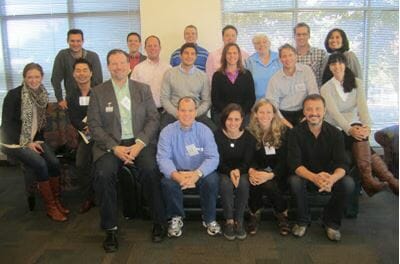
Civic Accelerator teams gather in Atlanta.
What does it mean to be a civic startup?
One of the most common questions we receive here at OpportunitySpace after we explain what we do is, “Wait, are you a for-profit or a nonprofit?” – promptly followed by, “For profit? But how do you make money?” The confusion is understandable. We take public information and make it easier for the public to access it at no charge. (I’m going to leave you hanging on the edge of your seat for a few paragraphs.)
Government often doesn’t know what it owns. It has a worse inventory than your average shoe store. OpportunitySpace has an explicit social mission to provide better data to the public in order to drive community revitalization. Unless you’re great at trolling though tax assessor data, you’re not going to know that a vacant lot is owned by your city. Without stalking your city’s (probably atrociously designed) website, you’re not going to know that the property in question – something your community could put to good use – is up for sale.
We believe that more accessible property data will lead to tangible, quantifiable value for our customers. And there are also less quantifiable social impacts to increasing the transparency of government and increasing citizen engagement.
As we sell governments on the idea, we are honored to be part of the latest group of startups participating in the Points of Light Civic Accelerator, an intensive, 12-week startup boot camp that includes mentoring, entrepreneur education, peer support and networking. We’re joined by 14 other organizations, both nonprofit and for profit, a diverse bunch who share the belief that people are at the center of change. In October, we spent a week getting to know each other in Atlanta. In November, we broke bread in Palo Alto, Calif. In the new year, we’ll come together one last time in New York.
Why be part of an accelerator devoted to civic startups? We have been taking a hard look at our weaknesses so we can make our company more sustainable and a smarter investment. Part of this process has been to more strongly articulate our revenue model. That means defining our value and differentiating between our customers and our users.
What’s the difference between customers and users? Facebook’s users pay nothing and have signed up by the millions. Facebook’s customers are not you and me, rather those willing to pay for access to our eyeballs: advertisers.
So, who are our users? And who are our customers – as in who is willing to pay for access to our users? Our users – including urban agriculturists, artists, next-door neighbors and local developers – pay nothing. Our customers are not our users, rather those who are invested in providing public services: governments.
Like Facebook, one of our jobs at OpportunitySpace is to deliver active users to government. These users represent both greater community engagement in public space and more potential buyers and lessors of government surplus property. We hypothesize that these users will drive cost savings in the form of decreased maintenance costs of vacant properties and revenues in the form of more properties on the property tax rolls.
Let’s wrap up by returning to our initial question: What does it mean to be a civic startup?
For the team at OpportunitySpace, being a civic startup means our success as a company is deeply tied to both improving citizen engagement and quality of governance. Our resolution for 2014? To prove it!
Why Where You Don’t Work Is as Important as Where You Do
Startups that “dream” together grow together.
That’s our hypothesis at the Points of Light Civic Accelerator, a 12-week boot camp-style program that supports and invests in seed-stage “civic ventures,” or startups that engage people to solve pressing social issues in our communities.
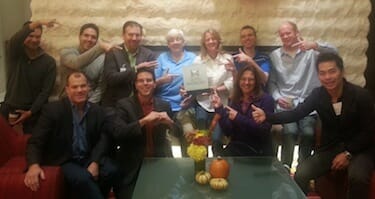
Civic Accelerator teams gather at Hilton Garden Inn Atlanta
Midtown to unwind.
In our newest partnership with Hilton Worldwide, the 15 ventures in the fall 2013 Civic Accelerator will not only spend intensive daytime hours working together on their startups, but they’ll also kick back, relax and “dream” alongside their peers during weeklong meetings in Atlanta, Silicon Valley and New York City over the next three months.
In the first year of the Civic Accelerator, we made a number of small (and sometimes big) bets to determine the right quantity and mix of startup ingredients – capital, entrepreneurial education, mentoring, peer collaboration, introductions to investors and others – that would allow for our ventures to successfully attract investment and scale their social innovation.
One, perhaps critical, ingredient was not so obvious at first – space. We don’t mean space in the literal square-footage, work-area sense. But rather, we’re referring to “no-working” space:
No-working space
nō -ˈwərkiNG spas noun
A regenerative space to unwind and connect meaningfully with a peer or colleague over a warm drink on a comfy couch, instead of over a business-model canvas, surrounded by a rainbow of post-its.
Early feedback from our first two accelerator classes indicated a strong desire for more unstructured time together in such “no-working” spaces where they could interact and interplay with like-minded peers on all sorts of topics, not just their ventures. Externally, we’ve seen this trend reinforced through initiatives such as the Social Impact House at the University of Pennsylvania, and Krash, which provides turnkey living communities exclusively for entrepreneurs and innovators in Chicago, Boston and New York.
We recently completed our first intensive meeting in Atlanta, during which the majority of our entrepreneurs stayed under one roof at the Hilton Garden Inn Atlanta Midtown. Many of the entrepreneurs in our program immediately took advantage of the no-working space to share a toast of their first pitch, invite a new friend on a walk around Atlanta or squeeze in additional time providing feedback to another venture. (OK, so it’s not 100 percent no-working…)
We’ll continue to test this hypothesis on the importance of shared, no-working space over the next few months, and hope to report back with stories of startup serendipity, midnight epiphanies and maybe even a pillow fight (or two).
How do you create no-working space in your accelerator or startup organization? We’d love to learn from you. Leave a comment, or say “hello” at [email protected].
Having Trouble Expanding Your Startup? Try Using Volunteers
Are you an entrepreneur working to solve community problems? Volunteers can help. Check out this post by Jay Cranman, vice president with thePoints of Light Civic Incubator.
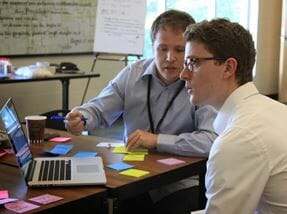
Civic Accelerator participants brainstorm.
What do you think of when I say the word “volunteer”? If you are like any of the hundreds of people within the startup community that I’ve spoken with over the last 18 months, this probably doesn’t bring up an image of high-growth, scalable startups. Volunteering isn’t sexy in the modern world of big data, the cloud, the sharing economy and other more notable themes impacting our startup community today. But maybe it should be.
Consider this. Could you be more effective if you had access to the same marketing, technology, financial and legal talent as more established organizations do, and it was free? Not everyone can quit their day jobs to change the world, but they might volunteer their talents to help you create extraordinary change. Volunteers can also help with the most basic tasks – serving meals, sorting donations and answering phones.
Volunteers can be convincing advocates for your startup. Their personal commitment to your mission makes them tremendously effective at sales and fundraising. They can help you stay connected to the community – they know its assets, important players and underlying challenges.
People have always been at the center of change – and people want to help more than ever. It is intrinsic to human beings. We see this every day at Points of Light in the 250 communities where we have HandsOn Network Volunteer Action Centers – from neighbors helping neighbors to corporate employees lending their talents to nonprofits.
People are using their purchasing power and voice, in addition to their talent and time, and thinking more holistically about how to engage with their communities. All together, Points of Light mobilizes 4 million people annually in 30 million hours of service, across 270,000 projects in 25 countries. Not bad, right?
But there’s a flip side. In 2012 alone, people across the U.S. spent more time watching a single episode of “American Idol” than they spent volunteering at one of our action centers.
I don’t say this to discount in any way the hard work and accomplishments of our organization, but rather to make a point. There is a tremendous underutilized asset pool in communities across the globe – people’s good intentions. Therefore, anyone who can turn those good intentions into real action will have an abundance of inexpensive, scalable and renewable resources at their disposal.
As any great entrepreneur can tell you, where there are vastly underutilized assets, there is an opportunity for value and wealth creation.
Two years ago, we launched a program at Points of Light called the Civic Accelerator (@PointsofLight #CivicX for anyone who wants to follow us on Twitter). Our goal was to drive innovation in the civic sector. What can we do to get more people using their time, talent, voice or money in new and different ways? How can we update – and possibly upend – what it means to volunteer, and in the process solve some of the pressing social and environmental problems facing our communities? Or more simply, how can we get people to “do something” more than text to vote for the next Kelly Clarkson?
After 18 months on this journey, I’m excited to say that I’m optimistic about the 19 investments we have made in civic ventures. There exist today a number of innovative and disruptive ways for people to get engaged.
Do you want to be a “citizen scientist”? No worries, Public Lab is here for you. Do you want to help raise money for a community park? Great, Neighbor.ly is here for you. Want to make a film for good? Check out Jubilee Project. Want to spend a week volunteering in Ghana? Then sign up with UBELONG. All of these organizations didn’t exist a mere five years ago, and they are all poised to scale rapidly over the next five years as they solve social problems by turning people’s good intentions into real action.
Startups that don’t put people at the center of their product or service could be missing a tremendous opportunity. As we know, people are the only renewable resource in the world. We also know that managing (lots of) people can be hard. How might you and your team effectively engage more people in achieving your company’s mission?
We’d love to hear your stories and offer our own insights and advice around getting more people to “do something.” Please send your thoughts to [email protected] or comment below.
got some national attention for its success in the recent Points of Light Civic Accelerator and its innovative idea that could soon have you sparking civic projects in your community.
From left, Sean Connolly, Sarah Shipley, Briston
Davidge and Jase Wilson of Neighbor.ly
, “Oddly, very little of the conversation focused on the $50,000 investment they had just won for being selected by their peers as the accelerator’s top for-profit startup. … Rather, there were a number of takeaways that had them excited about their crowdfunding startup’s future and evolution.”
Namely, Wilson said, the accelerator helped the team “realize it’s not just about individuals, but bringing together an entire community.”
The 12-week Points of Light Civic Accelerator provides mentoring, peer support, entrepreneurial education, networking and investment for startups that solve education, environmental and economic issues by engaging people as part of the solution. At the end of the 12 weeks, the participating entrepreneurs select two ventures – one nonprofit and one for profit – to each receive $50,000 investments. Last month, the program’s third group of participants chose Neighbor.ly and the
of Kansas City, Mo., a for-profit business, uses the idea of crowdfunding – calling upon large numbers of people, local businesses and community organizations – to raise money and awareness for projects that benefit communities, such as wireless Internet access for low-income housing, restoration of historic city fountains and a playground built to accommodate children with disabilities. (Click
to start a project for your own community.)
And as Wilson told Bauters: “We’re hellbent on helping greenlight tens of thousands of projects by raising millions of dollars. Points of Light really helped accelerate that process.”
Read the full Silicon Prairie News article
The Digital Native Fallacy: Teaching New Skills While Learning From Their Strengths
Today’s blog is another in the series from Huffington Post’s blog posts featuring thoughts and ideas from Civic Accelerator participants, a program that helps civic startups successfully launch and scale solutions to our nation’s social challenges by providing mentorship, education and investment.
We’ve often heard parents and educators quip that today’s young people are digital natives — a generation of youth who can rent movies on iTunes and buy school supplies on Amazon before they’re out of preschool. These tech-savvy kids seem to live and breathe digitally.
But for many American youth living in low-income communities, the digital native moniker doesn’t quite fit. For some, fluency in a few areas often hides substantial inadequacies in others. I was forced to confront misconceptions about students’ digital fluency through my work building EdTech software with
, a new venture that uses technology to help youth in low-income communities prepare for college and careers. We’ve launched technology-based programs with 500 students in low-income communities over the past year and have found some startling things.
Thanks in part to the support from the Civic Accelerator, we have hired interns to scale up our program offerings. Recently, I assigned an intern to edit a shared Google document. I was surprised to find him playing with his phone a few minutes later with his borrowed laptop idling in front of him. I had assumed he was using his phone for communications or games, but he was editing our Google doc on his phone. Unfortunately, because our intern was using his phone, his assignment took longer to complete and he had difficulty keeping up with the rest of the team. Without a laptop at home, he uses the Internet exclusively through his iPhone on borrowed Wi-Fi. His preference is for touchscreen over keyboard, for four inches over 13 inches. He’s adept on mobile, but he is far from the technology mastery we expect from a digital native.
Young people like our intern will find lots of creative ways to get around obstacles, but academic and professional success today still hinges on comfort with desktop and laptop interfaces. This can have profound effects for students as they move to college and then into the workforce. It is critical for these students that we recognize a gap in digital literacy exists and we start making investments to close this gap.
We have learned much from our work with students and wanted to share a few tricks and tips on working with school-aged digital natives:
Hire Them: If you work with students, hiring them as interns is a great way to learn more about their behaviors and motivations while helping them get valuable experience. Credit for this excellent strategy goes to our mentors at the Civic Accelerator who have emphasized the need to deeply understand your users.
Don’t Assume: Just because they are young doesn’t mean they are fluent online and with a computer. Sit down with them to talk through what they’re comfortable with and what skills they will need to learn. You may need to give them time to get comfortable, or a bit of extra training.
Ask For Tips: When you see them trying something online that you haven’t explored yet, ask them for tips and ways that it could help with your work. This could be a learning experience that they could share with the broader team, increasing everyone’s skill set.
Check For Comfort: Make sure students are comfortable using technology. If they’re squinting, show them how to increase the font size. If they’re hunched over, help them find a better posture to avoid fatigue or encourage them to take breaks. Remember that students are used to sitting still for no more than one class period at a time!
Interested in participating in the next round of the Civic Accelerator? Applications will be accepted from February 11-March 15. To learn more and apply, please visit
5 Lessons Between Tech and Social Entrepreneurship
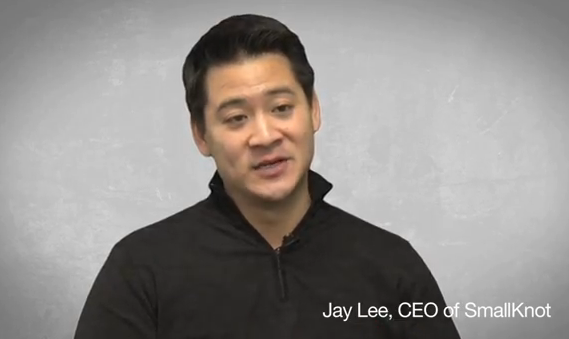
Today’s blog is another in the series from Huffington Post’s blog posts featuring thoughts and ideas from Civic Accelerator participants, a program that helps civic startups successfully launch and scale solutions to our nation’s social challenges by providing mentorship, education and investment. This is written by Jay Lee co-founder and CEO of Smallknot, republished from the Huffington Post Social Entrepreneurship section Feb. 28, 2013.
My company, Smallknot, is propelled by a dash of rage and a spoonful of optimism. We are angry about how the financial system works for real people. And we believe we can make it better. This is what drives us.
But between the tech and social enterprise spaces, it’s not always easy to know where we fit. As a business, our product is a community crowdfunding platform for local businesses. We help neighbors fund small businesses in exchange for premium goods, services and experiences. Our mission is to empower communities to cultivate local economies through social finance. But even though our goal is to replace bankers with a nurturing neighborhood, let’s be honest: tilting your head and squinting
just so
could make our pre-sale model resemble a saintly nonprofit lender like Kiva or the not-so-saintly Groupon.
Fortunately, we’ve been behind the curtain in both the tech and social enterprise worlds. After immersing ourselves in tech as part of TechStars NYC, we had a rare chance to peek into the impact and social enterprise world by joining the Civic Accelerator. Here we are surrounded by a group of ambitious people setting out to improve the world. It was like cracking open a can of crazy — the good kind. For you social entrepreneurs out there, here’s what the team at Smallknot thinks we’ve figured out so far:
1.
Talk dirty
. If you’re building a business, then build a business. Use all of the dirty words: sales, marketing, monetization, exit strategy, and, god forbid, profits. You will live or die by these concepts so don’t run away — lean into them. (Unless you have an endless supply of money that people will happily plow into your bank account. That also works.)
2.
Impact ≠ Soft.
You likely will spend hours wondering why money seems to be split between investors seeking a return and philanthropists who just
last year. Especially when, obviously, your world-changing idea will do both and you only need a measly half million. But the reality is crystal clear: Impact investors still need to see a strong business case. Do not expect breathing room on a soft business case because you might produce positive social outcomes. Focus on your business case. Be ruthless. Pitch investors with your vision for change, but I promise you — the second meeting will not be about that vision.
3.
Don’t overthink it
. Social entrepreneurship is red hot — #socent is the new black. You will find any number of conferences and write-ups about social innovation, social entrepreneurship, venture philanthropy and impact investing. You might feel bewildered by it – I certainly am. Next to traditional nonprofits self-styled as social entrepreneurs, you’ll find massive company bureaucrats in charge of social innovation, giving lessons to nonprofit microfinanciers. Someday I hope the wind companies that monetize tax credits will no longer be lumped into the same category as voter engagement software – but for now, don’t overthink the categories. Just do what you do
4.
Keep your mission out of your product.
Be passionate about your product, but don’t inject your mission into the product itself. Mission-driven startups have a hard time bridging the gap between fixing a social problem in the world and building a successful product that people want. Just because your mission is to empower at-risk youth through educational games doesn’t mean any kid is ever going to play them. There is tension between validating customer feedback on your product and the social outcome you
want to see.
For most of us, our customers shouldn’t have to care about our social mission for us to succeed. Let your passion drive you and let it drive your company. But not your product.
5.
Above all … Persist.
I love what I do and you should too, but entrepreneurship is not sexy — it’s hard. That’s okay. Don’t get discouraged. This is a chance to be something new in the world. Whether consumer preferences change to the extent that high-impact products will feed a growing demand (and, thus, profitability), or the tax code changes to make it easier for foundations to fund for-profit startups, something is happening. A transformation is coming – a new generation demands more from their business sector. Get started. Keep going.
Interested in participating in the next round of the Civic Accelerator? Applications will be accepted from February 11-March 15. To learn more and apply, please visit
We the People: Civic Accelerator Brings Together Social Entrepreneurs to Solve Challenges
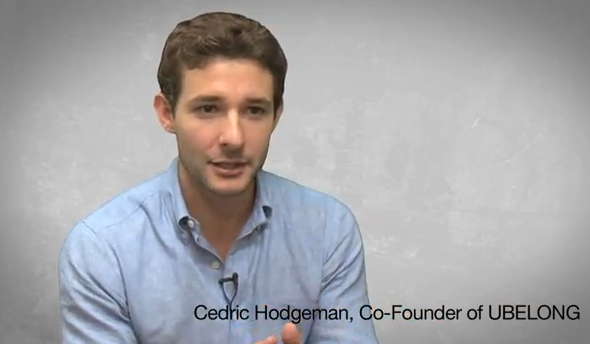
Today’s post is a series featured in the Huffington Post featuring thoughts and ideas from Civic Accelerator participants, a program that helps civic startups successfully launch and scale solutions to our nation’s social challenges by providing mentorship, education and investment. The Civic Accelerator is a joint venture between Points of Light and Village Capital and includes founding support from The PwC Charitable Foundation, Inc., and StarbucksFoundation. Today’s post is written by Cedric Hodgeman co-founder of UBELONG and republished from the Social Entrepreneurship section on Feb. 28, 2013.
This is the story of ten organizations brought together to gain invaluable insights from each other and a team of mentors as we strive to help solve social challenges. We are participants in the Civic Accelerator and we’re a diverse bunch. Our focuses extend from volunteer engagement and crowdfunding to green building. Our scopes range from the state of Maryland to the most remote corners of the developing world. And in a twist that illustrates the Accelerator’s forward thinking, half of us lead nonprofits while the other half lead for-profits.
Despite our dissimilarities, each of us operates from the fundamental belief that ordinary people are at the heart of social change. Reflecting the Accelerator’s values, we believe change happens from the ground-up. That’s why we focus laser-like on everyday folks.
It used to be that the only way for ordinary people to contribute socially was donating to a charity. Certainly, we funded worthy causes and felt good about it. But it was impersonal. To make the world a better place, most of us just wrote checks at our kitchen table.
Times have changed. Social media has empowered all of us to do more as it gives us all the unprecedented power to access and promote information. Seemingly distant challenges and crises have become much more real to us as we now discover the faces, names and stories that lie behind them simply from the writing, reading or sharing of a blog.
Social entrepreneurs reflect this civic awakening; instead of selling cars, cards or carbs, social entrepreneurs sell people the opportunity to do good. I’m proud to be part of this movement. The aim of my organization, UBELONG, is to mainstream international volunteering. Before our formation, unless you had years to spare in the Peace Corps or the cash to pay a niche tourism outfit for a “voluntourism” experience, volunteering abroad safely, comfortably and meaningfully proved difficult. Tapping the power of social media and buoyed by our belief in the power of ordinary people uniting, we have set out to tear down barriers and drive social change through international volunteering.
The UBELONG story is similar to that of our peers in the Civic Accelerator. Mymaryland is breaking down barriers between constituents and local officials in Maryland. Generation Citizen, Career Village and Moneythink are tapping university volunteers to serve as mentors and teachers to disadvantaged youth. Bould, which operates in the world of homebuilding, helps mainstream green building.
The Civic Accelerator exemplifies how civic ventures – -indeed, adventures — serve at the heart of engaging ordinary citizens to act together for the common good. All of us are united in our drive to mobilize people beyond donations and words. We seek to inspire people to collaborate and take action. The new communication tools of our age enable us to maximize our reach. And, while our organizations come in all shapes and sizes, we all believe the power to do good lies more than ever with we the people.
Interested in participating in the next round of the Civic Accelerator? Applications will be accepted from February 11-March 15. To learn more and apply, please visit www.pointsoflight.org/civic-accelerator
5 Lessons As We Launch Civic Startups
Today’s post is written by Ayesha Khanna, president of the Civic Incubator, which incubates and nurtures emerging civic ventures.
Points of Light has partnered with Village Capital to launch the first national startup accelerator program focused on “civic ventures” – enterprises that inspire, equip and mobilize people to create positive change. In November 2012, our inaugural class of 10 nonprofit and for-profit civic ventures started their term in the Civic Accelerator, and they are preparing to graduate at the end of January.
It’s been a time of great learning – for the 10 teams and for the Civic Accelerator – and I would like to share the five big things we have learned so far.
1) Accelerators and investment terms are new concepts to nonprofit organizations and their Boards
The market is moving away from purely philanthropic grants to more outcome-based and program-related investments; however nonprofits are only slowly adjusting
The investor and customer mindsets are not natural ones for nonprofits; although it is seen as very beneficial following training, modeling and use
Many of the nonprofits had to be educated about the role of accelerators; the selected for-profits took 1-2 days to accept, whereas the nonprofits took much more time to absorb the time commitment and investment opportunity
For most, this investment was the first they had ever taken; the concept of earning revenue and paying back a recovering loan after two years and hitting total revenue targets was intimidating
2) Art matters as much as science when selecting teams
Criteria such as the entrepreneur’s growth orientation and coach-ability proved to be critical to the success of teams in the program
The question of stage of development and how catalytic the Accelerator can be to the venture’s trajectory ended up being as important as financial and program measures when selecting the teams
The intersection of the leadership and the venture both being a good fit was a challenge to find, but both are important criteria
3) Peers are exceptional evaluators and can get into the investor mindset
How well the leaders interacted with one another during the selection process proved to be indicative of how well they contributed to the success of their peers, a key driver of progress over the 3-month program
Peers can be tough on one another without creating a “blood-bath” competitive environment
Transparency in feedback and ranking is a must to develop trust
4) For-profit and nonprofit ventures can learn from one another and, in fact, bring important and differing strengths
The for-profit ventures focus on their business model, investment levels required to deliver a profit, and clarity on customer needs was helpful when applied to nonprofit models
The nonprofits focus on how to best leverage resources and partnerships, engage the community, and build their brand by engaging people in their mission and social media provided useful models for the for-profit ventures
Early stage for-profits have a tougher time raising early stage funds, but can scale much easier with a proven business model. Nonprofits with charismatic, effective leaders can more easily raise early stage funds, but risk prematurely scaling without building a sustainable business model for the long-term that includes repeatable revenue and earned income.
5) Rigor is missing in many accelerators, which do not measure metrics beyond the valuation of exits
The identification of metrics, across legal structures, to measure venture progress and the program’s impact would differentiate the Civic Accelerator
The metrics around “what does success look like” for graduation and the long-term for civic ventures is an area where we can provide important models and learning
Applications for the Civic Accelerator’s second round of investments in 10 start-ups will be open from Feb. 11 to March 15. To learn more and apply, go to www.pointsoflight.org/civic-accelerator.
BOULD Millennial Impact Challenge
BOULD, a member of the Civic Accelerator, a joint venture between Points of Light and Village Capital, has been named a winner of the Millennial Impact Challenge. The competition was a nationwide search for the best social-impact projects launched and developed by innovators under the age of 30.
Based in Denver, BOULD is pioneering a tuition-based service-learning program that equips the next generation of building professionals with the experiences and tools to launch green careers while simultaneously building affordable green homes for low-income families. BOULD is partnering with 1,500 Habitat for Humanity affiliates across the United States to transform their affordable-housing projects into green “learning laboratories.”
“By 2015, BOULD will have trained more than 1,600 LEED-certified professionals, prepared to tackle the environmental challenges of today and tomorrow,” said CEO Shane Gring. “We will also have assisted in the construction of 250 green-affordable homes that will save low-income families over $50,000 in reduced utility costs over a typical mortgage.”
BOULD was among the five winners chosen by the reader of The Huffington Post and received $10,000, ongoing coaching, pro bono support and training, as well as an invitation to a three-day bootcamp in New York City led by a team of experts who will impart practical tools for long-term success and scale.
Dreams, Grit, and Trust: Foundations of a Civic Startup Accelerator
Ayesha Khanna is president of the Civic Incubator at Points of Light, the world’s largest organization dedicated to volunteer service. She and her colleagues are about to launch the nation’s first accelerator to invest solely in civic ventures that inspire, equip or mobilize people to create positive change. Here she reflects on why.
Whenever I’m looking for inspiration or a reminder of the impact a few committed people can make, I go back to the time I spent in India after college. I was part of a small group made up of women from the villages of Dayalpur (outside New Delhi), health professionals from the United Kingdom, village elders, an innovative nonprofit and Mother Teresa’s order of nuns. Together, we worked to improve access to education and build a health center.
It was grueling work. And we challenged a lot of traditional thinking. We acted on the belief that all children deserve access to education, including disabled kids; that everyone should pay and contribute to something no matter how impoverished; that a group of women could not only build a health center, but also a new institution.
Our nonprofit partner understood local politics and was able to secure seed money. The health professionals from the UK had proven methodologies for designing and delivering services. The women from the village were creative and resourceful, enticing businesses to provide cheap, quality materials and bringing their children to be tested and enrolled. The nuns, tough and hardworking, slept at the construction site when we couldn’t afford security and walked miles to secure customers and partners.
We succeeded because we trusted and relied on each other’s strengths. We succeeded through the grit and power of people.
A lot has changed in the past 20 years, but it’s still true that social entrepreneurs often work in isolation without the networks and feedback they need or the tools and access to capital that would best help them. I wondered if we at Points of Light could change that. Could we bring entrepreneurs together to share what they know and tap into a broader network of resources and inspiration, building trust and connectivity?
We started with a focus on the dreamers and doers and a quest to find amazing people and build a support system that helps them access investments and resources to grow. And because our challenges know no boundaries, we decided our solutions shouldn’t either. We determined to support both for-profit and nonprofit enterprises.
We found a true partner to launch this joint venture in Village Capital, a global social enterprise accelerator that takes its name from village financing, where individuals pool their resources and decide themselves who is most deserving of the money. Not as a gift, but as an investment that will be paid back over and over. Surely, we thought, new, emerging civic ventures in the U.S. need similar kinds of pooled resources.
Accelerators have successfully launched for-profit technology technology and mobile companies for over a decade. We chose to use that model and had the chance to experience it first hand as participants in the Flashpoint accelerator at Georgia Tech. We also found critical supporters with innovation in their DNA in the PwC Charitable Foundation, Inc. and Starbucks Foundation.
The Civic Accelerator we will launch in a few weeks brings me back full circle to India. I am once again working with modest means, against big odds, but with smart, hard-working people who want to change our part of the world. What a gift to be able to help social entrepreneurs launch their dreams to do good – and what fun to build a larger ecosystem to help make it so.
Stay tuned for more information on the 10 ventures we’ll be supporting. And if you’re a dreamer and a doer, apply for a slot in our next program. Find more information online or email us at [email protected].