Making the Business Case for Employee Volunteering
For companies, building a culture that connects volunteering to a broader organizational mission can require an intentional and sustained effort to engage stakeholders, creating a strong business case and adopting policies and programs supportive of service. Increasingly, leaders in corporate citizenship are building the skill set and experience to translate the importance of engaging employees in service to the vernacular of an executive boardroom. To provide some best practices for companies trying to build volunteer programs, Jenny Lawson, president of networks at Points of Light, and Hannah Christie, environmental, social and governance project manager EMEA at Bank of America Merrill Lynch, lay out some of the foundational facts that employee volunteer leaders can use to strengthen their case.
Engagement
Jenny:
Whether it’s cleaning up community parks or mentoring a student online; giving pro bono time to a nonprofit in need or hands-on hours to a food bank; volunteering for an hour in your hometown or for a multi-week assignment cross-border, volunteering is a great way to engage individuals of all ages, interests and backgrounds to unite around a common goal. At the same time, we’ve also seen that companies with volunteer programs realize more than $2,400 of value per volunteer resulting from decreased turnover and improved performance, and that different motivations drive employees to volunteer. How is that happening at Bank of America Merrill Lynch?
Hannah:
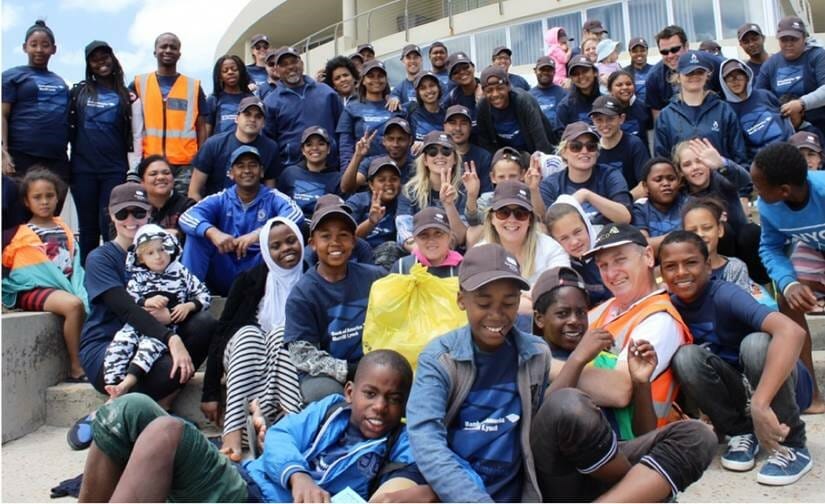
At Bank of America Merrill Lynch, we generate value for the community by matching capital investment from the Bank of America Charitable Foundation with the investment of our time and expertise. We’ve learned that creating value for the community, in turn, helps create value for the business. For example, our International Coastal Cleanup, Habitat for Humanity Global Build Week and World Food Day initiatives give employees the opportunity to build their networks, have fun with colleagues and make a positive impact on their local community. Our professional skill share programs bring a different aspect of engagement as they give our employees the opportunity to view their professional skills through a new social lens, making a long-term and often wide-ranging positive impact. Throughout all parts of our volunteer program, we seek to generate engagement by helping employees expand their networks, build skills and feel good about giving back to the community.
Leadership Skills
Jenny:
A culture that supports volunteering can also help a company develop leaders from within, as research has shown. From organizing peers, working across internal silos, building external relationships, managing projects and more – participating in corporate volunteering can build important skills and relationships. How do you build that value in your programs?
Hannah:
This is a great example of how an employee volunteering program brings benefits to everyone involved. In a highly competitive hiring environment, connecting to purpose and volunteering can increase employee retention and productivity which reduces costs associated with turnover. We work closely with HR to develop and integrate our charity skill share program with the bank’s learning and development offerings to employees. From our summer interns through to senior management, sharing time and skills plays a key role in career progression. For example, in December 2016 we launched Inspiring Governance in the U.K. with our partner charity, Education and Employers, giving employees the opportunity to build their leadership experience, influencing and negotiation skills.
Connecting and Recognizing Colleagues
Jenny:
Every workplace is looking at the latest science on health and employee well-being. In fact, research on
. This emotional win-win further connects people to community and co-workers. As a global enterprise, how do you build that camaraderie and sense of shared experience?
Hannah:
Working at a global company, the employee volunteer program is a great way to connect our approximately 200,000 employees who work with clients and stakeholders in 90 countries around the world. In April each year, we hold Global Service Month as a way to connect employees around the world and celebrate the impact of volunteering in the community. This year, you will see a lot of them sharing their stories on social media through
. Additionally, we run our internal Global Volunteer Awards to celebrate teammates who go above and beyond in their support of the community. We also run a Volunteer Grants program in support of our colleague’s volunteer efforts. By recognizing our people’s achievements with community partners, we are able to double the ‘feel good’ effect of volunteering and the engagement it brings.
For more information on the business case for employee volunteering, register for the Conference on Employee Volunteer Engagement in Paris, France, on April 25, 2017, and explore the Points of Light Corporate Institute’s online resources. You can also join Points of Light, Bank of America, and other nonprofit, corporate, and government changemakers at the Conference on Volunteering and Service in Seattle from June 19-21. For more information on Bank of America Merrill Lynch’s environmental, social and governance efforts – visit their ESG webpage.
What’s Working for Employee Volunteering in Asia?
This post was written by Yvonne Siu Turner, senior manager for corporate resources and programs at the Points of Light Corporate Institute and editor of “What’s Working: Effective Employee Volunteering in Asia, a Framework for Corporate Volunteer Leaders.”
With growing dialogue around purpose in the workplace and the increasing number of community-minded brands in the market, consumer and employee engagement trends in the United States are fueling the rise of corporate citizenship. Similar trends are also emerging in Asia.
To address these global trends, Points of Light has published a new report that harnesses the insights of our corporate partners and global network of innovative volunteer organizations. The report, titled “What’s Working: Effective Employee Volunteering in Asia, A Framework for Corporate Volunteer Leaders,” features a framework to equip corporate volunteer leaders to build effective employee volunteer programs in Asia, highlighting examples of what’s working for more than 25 global and regional brands.
Unique in the market, it showcases a wealth of practitioner insights on critical elements needed to start and scale employee volunteering in Asia. These elements include getting employees in local offices excited about service, celebrating success, equipping and empowering volunteer leaders, offering a wide variety of volunteer opportunities to meet employees where they are, and more. Here are a few best practices featured in the report, which reveal what’s working for effective employee volunteer programs in Asia:
Offer a wide variety of volunteer opportunities that meet employees where they are, especially considering regional differences in employee interests, societal expectations and NGO capacity. While industry research shows that in Asia, 71 percent of companies offer pro bono programs, other research suggests that hands-on volunteering is more popular in China due to nonprofit capacity constraints and employee interests. In Singapore, the receptivity of the nonprofit sector to training opportunities has allowed State Street, in partnership with CLSA, Credit Suisse, Macquarie and Nomura, to create a Not-for-Profit Director Program to equip staff for board service.
Empower volunteer leaders at all levels within the company. Ichiro Takeuchi, an account manager in PIMCO’s Tokyo office, was so passionate about service that he recruited a planning committee that became Japan Volunteers, which was able to respond when the 2011 Tohoku earthquake and tsunami hit Japan. Today, Ichiro is an executive vice president at PIMCO and champions corporate volunteering at every turn.
Celebrate small wins to help gain the respect of employees and volunteers in the Asia Pacific region. “While Groupon’s Asian offices have often been the last to roll out different HR or pilot programs, I’ve found that including their volunteer successes in global EVP messaging and announcements has generated a great amount of excitement and pride from our Asian colleagues,” said Alicia Koch, who manages Groupon’s employee volunteer program. Employee participation in Groupon’s APAC volunteer program increased from 6 percent in 2015 to 74 percent in 2016, with offices in Bangalore and Tokyo achieving 100 percent employee participation.
Provide resources, training and supportive policies to mobilize and equip employees to serve. Mitsubishi Corporation provides volunteer training courses at work and five days of volunteer leave each year to enable employees to serve the community – especially through its Dream as One initiative, which supports the company’s deep societal commitment to people with disabilities. Mitsubishi employees have volunteered to help with everything from building a field for the Japan Para Wheelchair Rugby Championships and coaching a soccer class for children with cerebral palsy, to serving as members of the governing board of the Japanese Paralympic committee.
The more than 25 featured case studies represent a wide variety of industries and organizations dedicated to global corporate citizenship in various stages of building out their employee volunteer programs around the world.
We encourage corporate volunteer leaders to use the framework, examples and stories as inspiration to develop practices that work for their organizations, along with Points of Light webinars, training and consulting services for a greater understanding of best practices for employee volunteerism.
As you start and scale volunteering in Asia and around the world, please share your thoughts and reflections on these resources. Tell us what’s working for you, so we can continue to answer this question: What’s working for employee volunteering in Asia?
Through Strategic Volunteer Engagement, KPMG and Freeport-McMoRan Promote Youth Education
There are a variety of ways companies support education initiatives across the country, from philanthropic investments and fundraising to employee engagement activities and skills-based volunteering. For 2016 Civic 50 sector leaders KPMG and Freeport-McMoRan, investment in education translates to a firm-wide commitment and strategic business opportunity. Not satisfied with one-and-done service opportunities, these companies are using strategic corporate citizenship initiatives to ensure maximum impact for students in the communities where they do business.
For KPMG, Civic 50 industrials sector leader, an emphasis on youth and education has always been a focus of their philanthropic and foundational work. In an effort to improve reading levels across the country, KPMG established its signature community involvement program, Family for Literacy, which provides families and children from low-income areas with books. Since 2007, the program has engaged employees across all levels of KPMG – interns, its partners and professionals alike – to donate books to local schools and education centers. KPMG also finds ways to engage key stakeholders – including clients, alumni, and family members – in their community involvement initiatives. At KPMG, supporting learning and literacy is more than just providing books. For example, after realizing a lack of diverse representation in children’s books, KPMG worked with an outside publisher to create a children’s book about a disabled man in Ghana. Through its work in education, KPMG is striving to ensure all children grow up with a love of reading.
Freeport-McMoRan saw a different opportunity to strategically align philanthropy efforts with the needs of educators and students. After identifying a recruitment gap, the Civic 50 materials sector leader decided to work with universities around the country through their University Teams program. The company sent representatives from key business areas to eight universities with strong mining engineering, metallurgy and geology programs to create high-impact partnerships. This mutually beneficial program helps the company identify and cultivate a new talent pool and also gives the University Teams a chance to work hand-in-hand with schools to identify opportunities for grants, educational programs, scholarship needs, and more. The program also ingrains a strong culture of service at Freeport-McMoRan by offering employees an opportunity to be key players in the recruitment process and see first-hand how investments are helping students across the country.
By investing time, money and other resources in education programs, and connecting community engagement initiatives to key business functions, KPMG and Freeport-McMoRan demonstrate a strategic commitment to students across the United States. As sector leaders of The Civic 50, they scored highest in their industries in the annual Civic 50 survey, a benchmarking effort to recognize and honor the 50 most community-minded companies in the nation.
Do you work with a company that excels in community involvement and exemplifies the ideals of The Civic 50? The Civic 50 is currently looking for the next cohort of community-minded champions to take the 2017 Civic 50 survey, the deadline for which has been extended to 11:59 PM EST on March 13. The entirely quantitative survey looks at four dimensions of community engagement: impact, investment, institutionalization and integration. Any company with operations in the United States and an annual revenue of $1 billion or more is eligible to apply. For more information – including a best practices report, resources for survey-takers, and a full list of the 2016 Civic 50 honorees – visit www.civic50.org. For further updates and insights, follow The Civic 50 on LinkedIn or Twitter.
Waste Management Crisis Meets the Full Power of Employee Volunteerism
The 2016 GE Global Month of Service connects employees worldwide around a commitment to serve, with thousands of GE employees volunteering their time and talent to build stronger communities where they live and work. This month of service, in partnership with Points of Light, demonstrates the power that individuals have to impact their communities.
Nigeria is one of the fastest growing countries in the world. According to recent UN predictions, its population will reach 397 million in 2050, making it the fourth most populous nation in the world. Even now its cities are feeling the pressure – Lagos, the most populous city in the country, is home to 20 million people and is expected to double in population over the next 35 years.
As with all rapidly growing and industrializing areas, Nigerian cities are now challenged to bolster their infrastructure to support the needs of their expanding populace. In addition to concerns about education and health care, Nigerian communities are facing serious waste management concerns.
A city as big as Lagos can produce 10,000 metric tons of waste in a day, only 40 percent of which is collected by the strained municipal government. In addition, only 13 percent of recyclable material avoids the landfill, making the trash problem even worse. Over the coming years, Nigeria’s growing pains will only get worse as it looks for ways to support its rapidly growing populace.
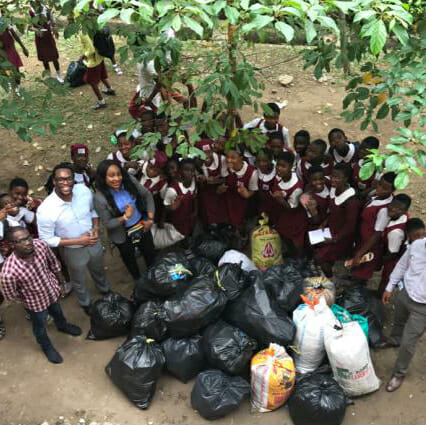
GE is demonstrating how service can be a powerful solution to this problem. On Dec. 2, GE volunteers in two Nigerian cities, Lagos and Rivers, teamed up with more than 5,400 students in 10 secondary schools on a community recycling project. The volunteers worked with students, explaining the importance of recycling and helping them develop plans for a Recycle and Win game.
The children collected recyclable items that could be donated to Recycle Points, a Nigeria-based nonprofit that awards points to people who collect and turn in recyclable material. The children earned points determined by the number and type of recyclables they collected; the points can be redeemed for prizes ranging from basic school supplies to laptop computers. As an added incentive, GE awarded 20 laptops to the school that collected the most recyclables.
In putting together a service project to address urban sanitation, GE volunteers are leveraging the full potential employee volunteerism and using it to address the most pressing needs where they live – teaching children the value of sustainable practices. As a result of this program, these students will return to their neighborhoods and encourage their friends and family to recycle, creating a trend that will hopefully have a marked impact on Nigeria’s waste management crisis.
Spreading Holiday Joy to Veterans and Active-Duty Military Through Service
The 2016GEGlobal Month of Service connects employees worldwide around a commitment to serve, with thousands of GE employees volunteering their time and talent to build stronger communities where they live and work. This month of service, in partnership with Points of Light, demonstrates the power that individuals have to impact their communities.
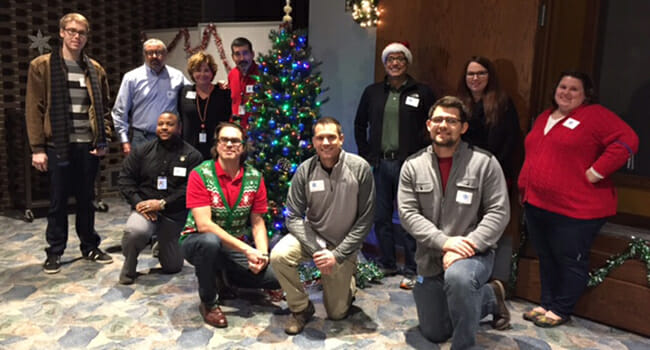
With the holidays fast approaching, individuals and organizations alike are looking for ways to give back and support those in need. This year, to bring holiday cheer to hospitalized veterans, GE volunteers in Milwaukee came together for the second year in a row to decorate the Clement J. Zablocki Veterans Medical Center.
Veterans receiving treatment at the Zablocki Medical Center, a regional VA hospital, come from as far away as Hawaii. For many families with loved ones in long-term care, it’s difficult to stay in Milwaukee due to the costs associated with travel and housing. As a result, many of these veterans will be alone during the holiday season.
On Dec. 2, more than 100 GE volunteers decorated the entire hospital for the holidays, visited with patients and distributed more than 500 stockings stuffed with healthy snacks. While the decorations brought holiday cheer to the hospital, the volunteers’ primary purpose was to offer hope and let the veterans know they are not alone.
“Veterans hold a very special place [at] GE. Over 10,000 veterans work across [GE] and over 2,000 within our GE Healthcare business. This event is one of many that GE volunteers lead to celebrate our veterans during the holidays and recognize their devotion and commitment to our country,” said Rob Reilly, vice president and general manager of U.S. and Canada services for GE, who co-sponsored the event with Laura O’Donnell, vice president and general counsel for GE Healthcare.
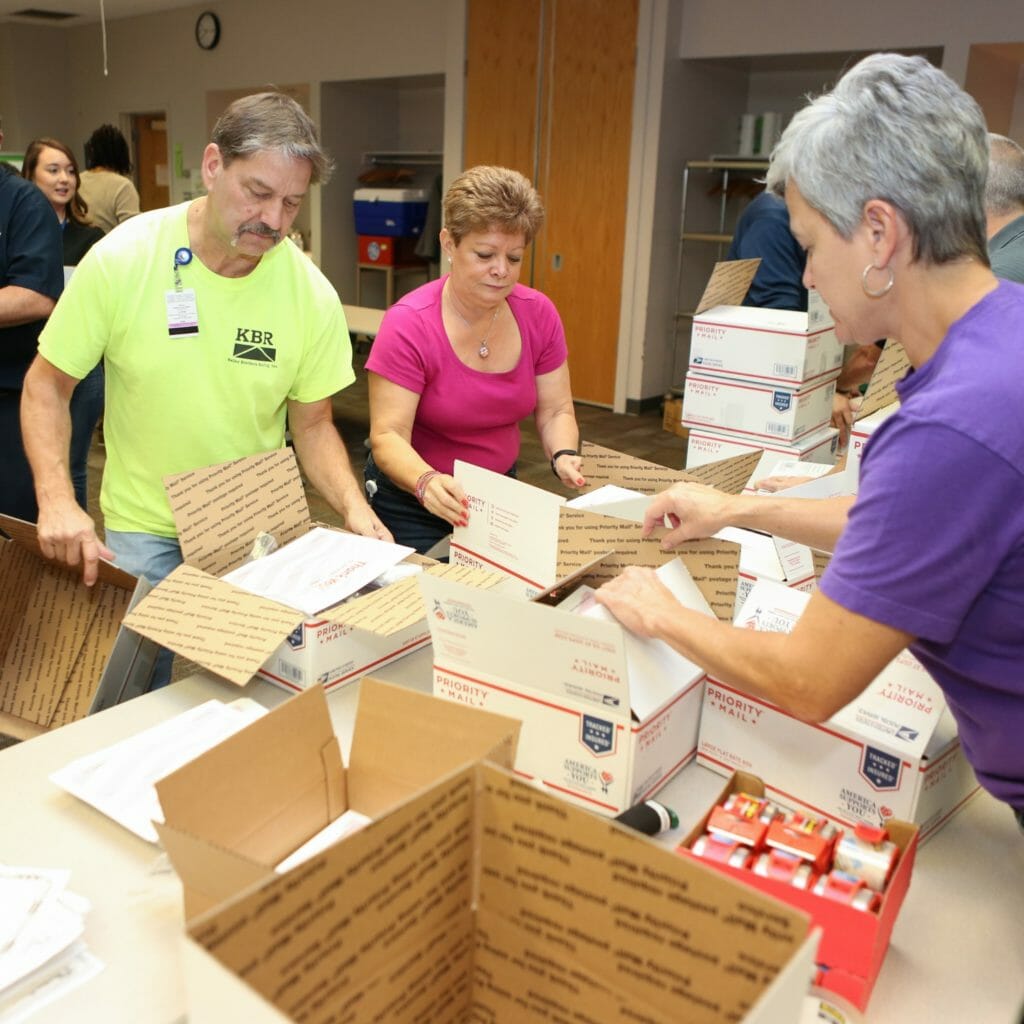
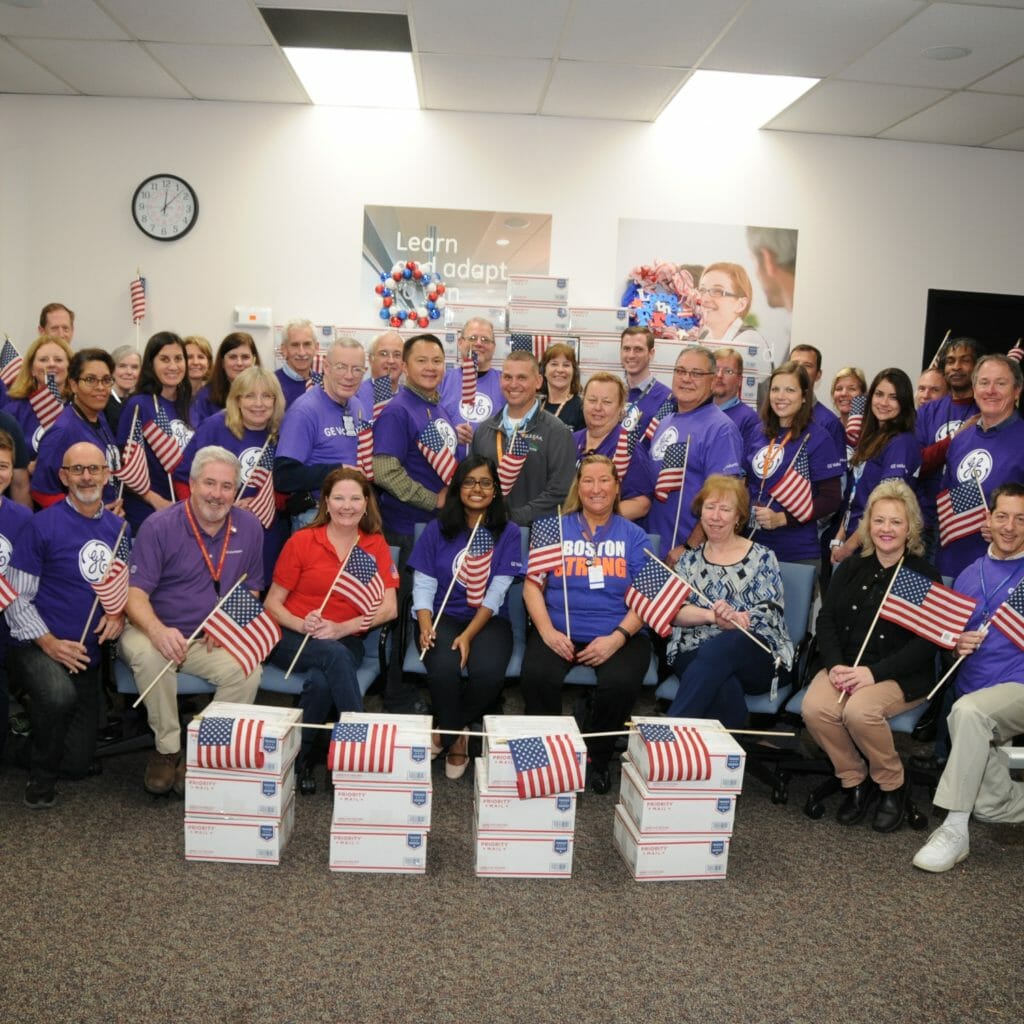
In addition to the Zablocki Medical Center project, GE hosted several military care packaging projects throughout its Global Month of Service to benefit deployed service members. Five projects in Lynn, Massachusetts; Peebles, Ohio; Evandale, Ohio; Dayton, Ohio; and Milwaukee engaged 142 volunteers in 496 hours of service, packing more than 720 care packages.
“These care packages mean so much to the military [members] that receive them! For some it means a chance to brush their teeth or take a shower — some of the little things that we may take for granted each day,” said Penny Louf, the project lead with GE Aviation in Lynn.
Each care package contained nearly 30 items, including socks, toiletries, cookies and padded shoe inserts. Some of the items were included by special request from GE volunteer leads who had served — items that the leads themselves had missed while deployed.
GE sends the care packages directly to the troops using a running list of APO addresses – the GE veterans’ network sites maintain lists of deployed GE employees, friends and family of employees, and others through word of mouth. This enables some GE locations, like Lynn, to host care package events throughout the year, with employees donating most of the goods.
These projects are just some of the ways that GE volunteers are giving back to communities around the world during the company’s Global Month of Service. Through this work, GE employees are demonstrating the true impact that individuals can make when they volunteer their time and talent to improve their communities.
Power of Pro Bono Collaboration Helps NGOs in Hungary Unlock Full Potential
Global Month of Service connects employees worldwide around a commitment to serve, with thousands of GE employees volunteering their time and talent to build stronger communities where they live and work. This month of service, in partnership with Points of Light, demonstrates the power that individuals have to impact their communities.
For several years, NGOs in Hungary have been working to make a greater impact in the communities they serve. András F. Tóth, executive director of
, has been a champion of this cause.
Volunteering Hungary helps local volunteers find opportunities and supports the partner organizations that engage them with information, advice and training, to make the best use of volunteers’ effort. Four years ago, F. Tóth started to think on a broader scale and discovered a way for partner corporations to better leverage their volunteers – through pro bono service.
F. Tóth said there were various factors that influenced this discovery, one being a workshop at the
. It was through them that he discovered the power that corporate volunteers possess, which can result in deep impact when working with NGOs.
The largest American employer in Hungary, with more than 10,000 associates, GE Hungary has been able to carry on the company’s legacy of service. Joerg Bauer, president of GE Hungary, attended the European Pro Bono Summit and was inspired to get more GE employees involved in pro bono volunteerism.
“Pro bono for us means that we contribute with those professional skills that we have been trained for, said Bauer. “Think about a finance or IT person who can give advice in this field, or someone who is doing marketing, communication or customs. We strongly believe in knowledge transfer creating the most impact for the common good, allowing the NGO or charity to concentrate on their core activities.”
This year, GE Hungary and Volunteering Hungary held their second annual Pro Bono Marathon at the company’s Váci Green campus in Budapest, where GE volunteers provided strategic guidance and skills-based support to help four NGOs generate solutions for problems they are facing. The NGOs left the event with fully formed implementation strategies to achieve their goals.
, which provides services for mentally and physically disabled community members, presented a need for marketing advice – how to better spread awareness on the integration of disabled citizens. Volunteering Hungary participated, too, seeking GE’s advice on how to build guidelines to help NGOs and corporations prepare for pro bono collaborations.
“GE is in a special position because they have so many people with so many skillsets,” said F. Tóth. “They have the potential to go into detail and offer an overview of projects that the NGOs might not have been able to do on their own.”
, whose mission is to protect and restore the current condition of Nógrád caste and the tourist area surrounding it, worked with volunteers to develop a plan to implement more technology and tech knowledge to their town. This pilot example will serve as a case study for how other villages in Hungary that are behind in technological and business advances can get up to speed with the rest of the country.
F. Tóth reflected that the “the added value is the systematic and business mindset that allows GE to help NGOs grow.”
GE follows-up with participating organizations to see how they’ve used the knowledge gained during the workshop. And, participants from the first Pro Bono Marathon have reported tangible results: GE volunteers defined an exact action plan for the implementation of an
project for Autisták Országos Szövetsége, which was recently successfully realized. In the future, GE plans to extend the scope of this collaboration and establish a long-term mentorship with NGO partners.
When major corporations like GE encourage employee volunteers to use their skills for social good, NGOs are able to maximize their potential and truly focus on their areas of impact. But even beyond the impact they will make is the lasting message of the power in cross-sector collaborations to improve communities around the world.
Using Employees’ Skills, Toyota Financial Services and UnitedHealth Group Build Stronger Communities
Giving back: it’s an action that can be carried out in countless ways. For some, giving back means volunteering in their community. For others, it means donating money or goods to those who need it most. For Civic 50 sector leaders Toyota Financial Services and UnitedHealth Group, employees give back by exercising their corporate know-how and investing their time and talent in communities to provide the biggest impact. In matching community needs with employees’ corporate expertise, these companies have identified a way to both give back and continually engage employees. These employee volunteering initiatives helped propel TFS and UnitedHealth Group to the top of their sectors in The Civic 50, the annual initiative from Points of Light to recognize and honor the 50 most community-minded companies in the nation.
TFS led the financial sector in the 2016 Civic 50 thanks to their robust community involvement programs. One such program, Financial Empowerment Initiative, helps under-represented youth and local community members make informed financial decisions through training and tools. TFS extends the reach of its programs through partnerships with nationally recognized organizations, such as Boys & Girls Clubs of America and Girl Scouts, providing financial education support and guidance, along with leadership and life skills and college scholarships and internships to youth across the nation
To improve the effectiveness and reach of their programs, TFS turns to its greatest asset: its employees. Through the TFS Community Ambassador program, team members are empowered to build strategic partnerships with local nonprofits in their community and engage TFS team members to participate in community activities. This leadership development program enables team members to increase their aptitude in the workplace through skill development, while informally guiding and shaping a culture of service in the organization.
UnitedHealth Group, the Civic 50 health care sector leader, leverages its expertise in health promotion and research in order to help make the health care system work better for everyone. To share nationwide health insights, United Health Foundation – the company’s philanthropic arm – publishes America’s Health Rankings every year, assessing nation’s health on a state-by-state basis. This year the foundation published its 27th report, tracking key trends and identifying ways to improve the health of different populations across the country on both the national and state level. Through these reports, which have covered the health of seniors, the health women and children, and the health of those who have served, UnitedHealth Group provides a blueprint for how other community-minded companies can use their expertise to influence positive change.
These two companies are using their corporate strengths to positively affect their communities. They scored highest in their sectors in the annual Civic 50 survey, which provides a framework and a roadmap for how companies can turn good intentions into sound business practices. Toyota Financial Services and UnitedHealth Group are just two examples of the many companies that are using their time, talent, and resources to improve the quality of life in the communities where they do business.
Do you work with a community-minded corporation that is a champion of corporate engagement and exemplifies the ideals of the Civic 50? Take the Civic 50 survey today at www.Civic50.org. Survey closes March 1, 2017. For more updates, follow the Civic 50 on LinkedIn and Twitter.
Building a Culture of Service: Altria and Valero Put Local Communities First
Crafting a mission statement is a chance for a company to put into words what truly drives the organization: what are the values it holds above all others? For many, success and profit come to mind. For Civic 50 sector leaders
, community is consistently held as the organizations’ driving force. These companies are doing their part to support local communities by institutionalizing policies, systems and incentives to build a culture of volunteerism and community engagement and to drive their social impact.
Civic 50 consumer staples sector leader Altria pioneered its
, which supports a culture of giving back to the community. Altria employees not only participate in charitable giving programs, they play an active role in managing and operating them. Founded in 2000 by Altria employees, the unique charitable giving program highlights the power of initiatives that bridge the gap between businesses and communities.
As the only publicly reported employee-giving program of its kind in the United States, employees choose the focus areas, lead fundraising, develop marketing and communications plans and allocate funds. Each year, 60 percent or more of Altria employees participate in the program. Since 2001, it has awarded 1,886 grants for a total of $49.8 million.
All administrative costs are covered by the company, which means that every dollar raised by employees goes directly to the community. This fund illustrates the company’s commitment to supporting a culture of community engagement, and employees routinely rate employee involvement as one of the top reasons to work at Altria.
Valero Energy, the Civic 50’s 2016 energy sector leader, has created a culture of community engagement by incorporating community involvement into its highest level of corporate governance. Valero’s commitment to communities is incorporated into its
, as the company pledges to share “success with the communities where we live and work through volunteerism, charitable giving and the economic support of being a good employer.”
During National Volunteer Week, all Valero plants sponsored food drives to address food insecurity issues. The company headquarters in San Antonio collected nearly 1.4 million pounds of food for the
. Valero leverages its strong community engagement culture to consistently and strategically encourage employees to give ample time and commitment to local communities, with 50 percent of employees participating in its community engagement initiatives and logging more than 130,000 volunteer hours annually.
As sector leaders of The Civic 50, Altria and Valero scored the highest in their sectors in the annual Civic 50 survey, a benchmarking effort to recognize and honor the 50 most community-minded companies in the nation. They are just two examples of the many companies that are adopting critical policies, systems and incentives to institutionalize community engagement and create a culture of giving back in the workplace.
Do you work with a community-minded corporation that is a champion of corporate engagement and exemplifies the ideals of the Civic 50? Visit www.Civic50.org to learn more and to take the Civic 50 survey today – survey closes March 1, 2017. Want to learn more? Follow the Civic 50 on LinkedIn or Twitter for updates, and email [email protected] with any questions.
Argentina’s Youth Create Tech Solutions to Community Needs
The 2016 GE Global Month of Service connects employees worldwide around a commitment to serve, with thousands of GE employees volunteering their time and talent to build stronger communities where they live and work. This month of service, in partnership with Points of Light, demonstrates the power of individuals to create change in their communities.
After several years of political and economic unrest, including a recession beginning in mid-2015 that pushed the unemployment rate to 9.3 percent, Argentina’s new president, Mauricio Macri recently declared the country “open for business” as part of a campaign to restore economic viability.
Entrepreneurship and innovation are key to being successful in the new Argentinian workplace. Low wages and a convenient time zone make Argentina an attractive international partner for businesses in the United States – in fact, Globant, an Argentinian software development firm, recently became the first Latin American company to go public on the NYSE.
As Argentina seeks to re-enter the global marketplace, GE volunteers are making sure that the next generation has the skills they need to contribute to this new growing economy.
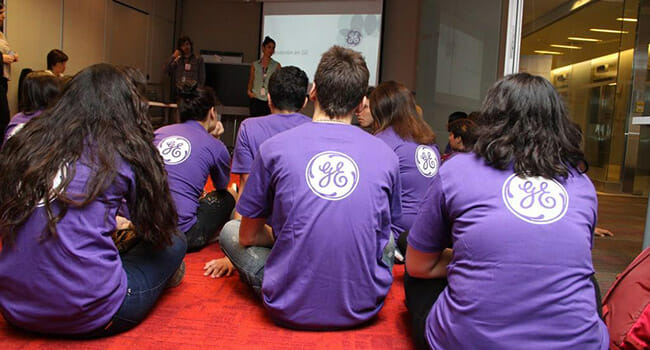
In collaboration with Junior Achievement, GE hosted a Youth Innovation Camp at their Argentina headquarters in Buenos Aires that challenged 40 students from four local schools to find innovative solutions to problems faced by the modern city.
GE volunteers first gave the students, ages 16 to 18, examples of real-life solutions GE has developed in response to community issues in the areas of healthcare, energy and technology. The students were then broken into teams and, using GE innovation as a model, challenged to brainstorm ideas for smartphone applications that address challenges facing the city. Finally, the students presented their app solutions to a panel of GE employees.
The goal of this program is to help students “understand that they can promote an idea to solve problems in the city,” said Florencia Montoreros, manager of GE global parts and repair solutions for the Caribbean and Latin America, who helped organize the event. The students also gained valuable presentation experience as they explained their ideas to the panel, Florencia added.
Some ideas that the students came up with included an application called Basurin, which would alert citizens when their trash truck was arriving so that they could bring their trash directly to the truck and help cut down on the amount of litter in the city streets.
Another app, called Quisque, would help resolve parking problems in Buenos Aires by sending users real-time updates about parking availability on city streets and even allow users to pay through the app.
The winning proposal, an application called Techno Save, would send users a notification if they left a light on in their house and allow them to turn it off from the app’s interface.
By encouraging students to develop innovative solutions to everyday problems, GE is helping Argentinian youth build valuable research and critical problem-solving skills they can apply to future careers in business and technology. This will not only have a positive effect on the students’ lives but also on the ability of Brazilian communities to meet the needs of their citizens and compete in the global economy.
Civic 50 Honorees AT&T and Hasbro Made a Difference by Mentoring Youth
Maya Angelou. Quincy Jones. Sting. Tom Brokaw. President Bill Clinton. What do all of these
sector leaders AT&T and Hasbro Inc. recognize the importance of mentorship – especially in the lives of underserved youth who may lack the resources or individuals in their lives to guide them through tough decisions such as college, career, and more. While leaders in their respective sectors, these companies have also taken the lead on aligning purpose with profit and giving back to the community, and in these examples, through youth mentoring.
With the introduction of their innovative community and talent development program, Transforming Talent,
– the consumer discretionary sector leader for the 2016 Civic 50 – stands by their purpose to make the world a better place for children and their families. In partnership with
, a leading workforce development and higher education nonprofit, Hasbro provides college classes, corporate internships, educational stipends, and mentoring to youth that simply need a chance. This strategic partnership with Year Up allows integration between Hasbro’s community engagement program and its business interests.
Transforming Talent provides a platform for Hasbro to work toward their employee engagement, and diversity and inclusion goals, but more importantly, generates a pipeline of full-time, diverse talent from young adults who would otherwise not have access to the corporate workforce. The success of Hasbro’s Transforming Talent program is evident through the statistics alone: 75 percent of the Transforming Talent graduates
, the company’s signature philanthropic initiative focused on helping students succeed in high school and beyond, launched an expanded mentoring program. Through Aspire, AT&T collaborates with leading education nonprofits to match employees with students who will benefit the most from mentoring. The program is a flexible resource for both employees and students as mentoring events take place in the classroom, at AT&T locations, within the local community and even online.
This school year, AT&T is contributing more than $1.3 million to innovative organizations such as
to help even more students explore their potential through online and in-person mentoring. They are also providing funding to bring careers to classrooms through an innovative program called
that matches professionals with classrooms virtually to help connect what students are learning at school to their future careers. As of January 2016, more than 160,000 students had been mentored in 336 cities for a total of 1 million employee volunteer hours. AT&T has demonstrated a profound impact on the communities they serve by helping underserved youth connect with their passions and potential.
AT&T and Hasbro demonstrate what can be accomplished when companies use their internal strengths and resources to improve the communities where they live and work. As sector leaders of the Civic 50, they scored the highest in the annual Civic 50 survey, a benchmarking effort to recognize and honor the 50 most community-minded companies in the nation. Hasbro and AT&T are just two examples of the many companies that are translating good intentions into sound business practices and best using their time, talent, and resources to improve the quality of life in the communities where they do business.
Do you work with a community-minded corporation that is a champion of corporate engagement and exemplifies the ideals of the Civic 50? Follow the Civic 50 on LinkedIn or Twitter or email [email protected] to receive updates on the 2017 survey, which will launch Tuesday, November 15 and close on March 1, 2017. For more information and a full list of the 2016 Civic 50 winners, visit www.civic50.org or sign up for our technical assistance webinar “2017 Civic 50: What You Need to Know” which will take place on Friday, November 18 from 1 – 2 PM ET.