A Lifelong Volunteer Expands His Reach with the Help of UPS
Tony Heath grew up watching his parents serve their community. It was a way of life. His mother involved the family in volunteer work through their church, and his father tried to help people in need whenever he could.
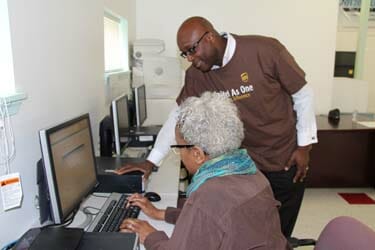
UPS employee Tony Heath, standing, volunteers at the Better Living Center in Chester, Pa., which offers free Internet access to the community.
“They were poor,” Heath said, “but they still helped others.”
Volunteering became a way of life for him, too. He helped found the Better Living Center in Chester, a struggling city in Pennsylvania. The center – which assists low-income residents – provides food in an area with no grocery stores, helps with job searches, provides clothing, offers health education and screenings, and strives to provide individual solutions to individual challenges.
“If you come in and need help, we’ll find help,” Heath said. The longtime volunteer is also actively involved with a similar program through the Chosen 300 Ministries in Philadelphia, which runs a soup kitchen and helps homeless people search for jobs. He’s also provided meals and propane and arranged for other basic comforts to homeless people living in a tent city in Camden, N.J.
These and other works earned Heath, a UPS community relations supervisor, this year’s Jim Casey Community Service Award. Named after the company’s founder, it’s the highest UPS employee honor. Heath credits UPS for making the breath of his volunteer work possible. The company, using its connections and its own expertise as a global leader in logistics, has helped provide trash disposal services for the tent city and donated computers for the youth and job centers. UPS has even hired some of the job seekers.
See how volunteering has become a way of life for Jim Casey Community Service Award winner Tony Heath. (Click image to watch video.)
“The leverage and the reach of UPS gives us access to people and things we might not ordinarily have,” Heath said.
Volunteering is also a way of life for UPS. The company – the title sponsor of Points of Light’s 2014 Conference on Volunteering and Service – encourages its employees worldwide to volunteer in their communities, logging 1.8 million volunteer hours each year. The UPS Foundation, the company’s charitable arm, has four focus areas: diversity, environmental sustainability, community safety and volunteerism, explained Jerald Barnes, director of global employee engagement for The UPS Foundation. “Volunteerism is the foundation of the other three,” he said.
“Humanitarian relief and road safety are the two areas we focus on in our Community Safety focus area,” Barnes said. “Road safety because we have more than 100,000 trucks on the road a day driving safely. We take that skill and teach teens at Boys and Girls Clubs the same methods our drivers use. Humanitarian relief is also important for us because we have the logistical expertise to support nonprofits in a disaster through engineers, planes, trucks, warehousing and equipment.”
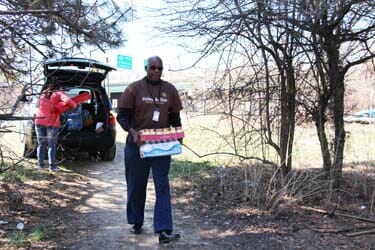
UPS employee Tony Heath brings food to people in need.
Taking on the role of Conference title sponsor this year “demonstrates our commitment to the mission of Points of Light and its effort to engage the world through volunteerism,” Barnes added.
At the Conference, David Abney, UPS chief operating officer and CEO-elect, announced a company pledge of 20 million hours of global volunteerism and community service by the end of 2020.
“Volunteerism has always been an integral part of our company culture,” Abney said during the announcement. “UPS’ founder Jim Casey continually advocated for employees to give back to the communities in which they live and work. Our pledge of logging 20 million hours of volunteer service by the end of 2020 reinforces our corporate giving strategy and our commitment to our volunteering and philanthropic efforts that advance and enrich communities around the world.”
Heath’s own commitment to helping neighbors won him this year’s Casey Award.
“Tony Heath can speak to a homeless person on the corner, train a new driver at Christmastime or go deliver packages in Texas after an ice storm,” said Jill Schubert, UPS’ Chesapeake district manager. “He’s really a total package, and with that comes that sense of community, regardless of where he is, whether it is Houston or Philadelphia or in his backyard.”
Heath is working on another plan now, an expansion of work to help youth through the Better Living Center in Chester. The center’s goal is to fill the role that a YMCA would have in another community, giving youth a place where they can study and congregate safely.
As his parents did with him, Heath has involved his children with his volunteer work. His youngest daughter, at 13, particularly enjoys working in the soup kitchen and talking with the people there.
“She’s been volunteering a good portion of her life,” Heath said. It is a routine his two adult children would recognize. “They all know; they all get it. It’s about respecting people that are struggling.”
Creativity Pays Off for Innovative Nonprofit Programs
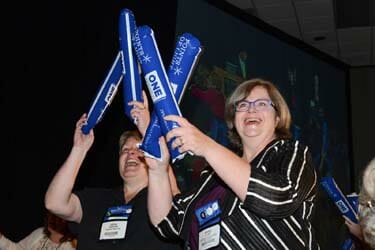
With spectators clapping blue thunder sticks together, jumping out of their seats, cheering for their favorite teams, the gathering looked more like a pep rally than a bid for nonprofit grants.
Zelda Magnuson, left, and Karen Delaney cheer at the forum with thunder sticks.
The pitches fueled the excitement – four innovative programs attracting volunteers and serving communities in creative ways.
At the
JPMorgan Chase and Points of Light have a history of collaborating to find new ways to support and facilitate volunteer service. At last year’s Conference, they kicked off a nationwide
tour focused on uniting unlikely allies to help students succeed, alleviate hunger and improve the environment.
The innovation and social impact forum at this year’s Conference – a celebration of the One America campaign – gave HandsOn Network affiliates a chance to showcase how they are uniting people through service for good.
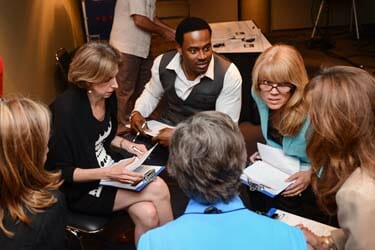
The innovation forum judges confer to decide which organization will receive the $50,000 grant.
“One America really represents what we’re here at this Conference to talk about: Service unites,” said Points of Light Chairman Neil Bush.
Lois Backon, head of corporate partner marketing for JPMorgan Chase, welcomed forum attendees on behalf of the 250,000 JPMorgan Chase employees who have themselves logged more than 1.5 million hours of volunteer service over the past four years, including 56,000 skills-based hours in 2013 alone.
Backon said the forum was a great opportunity for JPMorgan Chase to combine two core values: service and innovation. “JPMorgan Chase is committed to investing in service innovation,” she said. “We know that when we harness what our best and brightest have to offer, we can make a tangible difference in every local community we touch.”
Then it was pitch time.
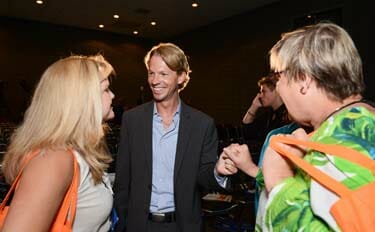
Brian Williams, center, of Hands On Nashville receives words of congratulations after the forum.
The four competing nonprofits – part of Points of Light’s HandsOn Network of 250 volunteer centers – showed video presentations of their work and answered questions from a panel of judges. The panel picked which organization would take the top grant of $50,000, included Lamman Rucker from “Tyler Perry’s Meet the Browns”;
came out on top for its work mobilizing volunteers to make homes in low-income neighborhoods more energy efficient, saving homeowners as much as $500 a year on their utility bills.
Hands On Nashville launched the program in the wake of the city’s historic flooding in 2010. Since then, nearly 1,000 volunteers have repaired 311 homes, including 156 damaged by the flooding. Volunteers install attic insulation, replace traditional light bulbs with compact fluorescent bulbs and more.
Brian Williams, president and CEO of Hands On Nashville, said the $50,000 grant will allow his organization to add program components that will further reduce energy consumption and engage donors in ways Hands On Nashville hasn’t done before. Hands On Nashville can also use the funds to start working with the city of Nashville to “expand service in a very thoughtful way and within a much quicker timeline than we imagined.”
Each of the three runners-up took home $15,000 to invest in their own innovative programs:
Volunteer Center of Santa Cruz (California) Senior Tech Day – a program that invites teen volunteers to help seniors navigate the digital age by teaching them how to use e-mail, how to view and share photos electronically and more.
HandsOn Twin Cities (Minnesota) Skills-Based Summit – an event that brings together skills-based volunteers who facilitate workshops exploring topics from marketing and social media to leadership development and finance.
HandsOn Genesee (Michigan) Community Service for Success – a three-week program that connects clients receiving cash assistance from the state of Michigan with volunteer opportunities that help sharpen life and job skills.
Emily Gilliland, HandsOn Network’s executive director, said the programs featured at the forum reflect the creativity, commitment and passion of HandsOn Network affiliates across the country.
“They have perspective and vision about what is needed and how to get it done,” Gilliland said. “And they each are doing it in unique, creative, incredible ways that are inspiring their communities.”
The grant program, which Backon called an extension of JPMorgan Chase’s “commitment to innovation and to helping communities and cities thrive,” is the kind of support that Williams said helps service organizations have a greater impact.
“JPMorgan Chase encourages organizations to be very thoughtful about their programming and then they reward those organizations for doing so,” Williams said. “It’s a very productive path for donors to take.”
Better Living Through Technology
This post is by Jackie Norris, executive director, and
Yvonne Siu Turner, senior manager, corporate resources and programs,
means creating a better future for everyone through its actions and innovations. After Haiti’s earthquake in 2010, with critical medical infrastructure in ruins, the country’s Ministry of Health asked Partners in Health (PIH), a U.S.-based health care organization, to scale up plans to build
, a community hospital just 60 kilometers north of Port-au-Prince.
“The urgency of the situation escalated plans and we confirmed our commitment to become one of the primary technology partners for the hospital,” said Paul Ellingstad, director of human progress initiatives at HP.
“PIH was a natural strategic partner for HP,” he said. “We believe in the role of technology in democratizing people’s lives and helping them live and work better. PIH’s vision is health equity for all and a belief that modern technology should be made available to support health care delivery to the poorest of the poor. We were a natural fit.”
How did HP help?
Yvonne Siu
It provided what the company knows best – technology and IT infrastructure to support all the applications needed to run a modern hospital. The hospital was fitted with a high-capacity server rack, wireless access points and VoIP phones. HP workstations were situated throughout the hospital equipped with 27-inch monitors to enable teaching opportunities in the operating rooms and optimum radiology image viewing.
Further, the electronic medical record system housed on HP servers allows hospital staff to quickly refer to and update patient records, providing clinicians with the tools they need to diagnose and treat patients.
Long-Term Commitment
In addition to providing technology and funding, HP employees contributed their time and expertise to the design, build-out and installation of the IT systems at the hospital.
Alan Nemeth, HP fellow emeritus, and Les Fox, HP distinguished technologist, both volunteered to oversee the project – and continued to volunteer after their retirements in 2012. Throughout the project they brought in experts from other areas of HP including HP Technology Services, HP Networking, HP Enterprise Services and Manufacturing.
Good For The Community, Good For The Company
HP’s commitment to global community engagement and skills-based volunteering projects like this has not only improved the health of thousands, it has also helped develop professional skills and boost morale at the company.
In fact, employees who use their professional skills when they volunteer are 38 percent more likely to have the highest level of employee morale than employees who don’t volunteer, according to
. The scorecard showcases the impact that HP’s employee volunteer programs have on everything from the nonprofits they serve to employee satisfaction.
While there has been much progress, much of the dialogue surrounding CSR and corporate citizenship today still centers on making the business case for programs that allow employees to get involved in their communities and tackle social issues, especially through volunteering. HP is at the forefront of this discussion, as it supports its business case with data. It is this discipline and commitment to measurement and evaluation that won the company accolades in the
Having data to support integration between business strategy and CSR is no small achievement – many companies are in the beginning stages of collecting data that can show a direct connection between volunteerism and bottom-line business goals like talent development and employee engagement. While many volunteer programs start out with good intentions and stem from a culture of wanting to give back, the ability to sustain and scale a program often relies on data proving that it is good for business.
“Ever since its inception in 2011, our employee community engagement program has put tools in place to track the results of key initiatives,” says Rebecca Wang, manager for HP corporate affairs.
Wang continues: “Why is measurement so important? Because we are accountable for our results just like any other area of the business. If we can’t prove our value to our business leaders, we will lose their support. And without senior management support, no corporate program can hope to last for long.
And without measuring results, you can’t determine whether a program is successful or not. It makes no sense to continue implementing programs that take valuable resources and funding if they can’t prove their worth.”
Other findings from HP’s scorecard show that volunteering is associated with higher rates of employee inspiration, motivation and loyalty. When asked what they would do if they were offered a comparable position at another company, volunteers were 12 percent more likely to say they wouldn’t leave than non-volunteers while 13 percent were more likely to recommend HP as a great place to work.
For companies like HP, this indicates a win all around: engaged employees, an engaged community and a direct way to scale its social impact.
“As we look to the future, we embrace the opportunity to apply the talents of our people and the broadest technology portfolio to deliver solutions for our customers’ and the world’s most complex challenges,” says Wang. “By working to achieve a balance of human, economic, and environmental progress, we will create a better future for everyone. One in which we are all living progress.”
40 Million Puppy Adoption Fees, Clean Water for 160 Million People and More – the Possible Result of This Small Business Practice
This post is by Matthew Manos, founder and managing partner of verynice, a global design firm that gives more than half of its work for free to nonprofit organizations. Hear from Manos June 16 during the Points of Light Conference on Volunteering and Service in Atlanta.
Matt Manos
When I was 16 years old, I took on my first pro-bono project. I found myself in a skate park in the Silicon Valley. You could find me there on most weekends, but this particular weekend, something spectacular happened.
I saw a man in a wheelchair ripping around the park far better than everyone else, myself included. Intrigued, I rolled a bit closer to the man only to find that he was not alone, but he was actually with a group of kids, also in wheelchairs.
I came to find out that this man was the founder of a nonprofit organization that taught handicapped children how to participate in extreme sports. Incredibly moved, I volunteered to design some stickers to help promote the organization. Just starting to learn how to use Photoshop, the stickers really were not my best work, but they did have a profound impact on me that would define the next 10 years of my career as a designer.
I’m the founder of a company in Los Angeles called verynice. We are a global design and innovation consultancy that gives more than half of its work away for free. So far we have been able to save nonprofit organizations almost $1.5 million, which has been directly reinvested into each organization to generate more impact. It is our sole mission to invent new models of business that allow for the alleviation of expenses for nonprofit organizations.
In more recent years, we have started to pioneer a new kind of movement amongst service providers. As a result, there are now dozens of other businesses and individuals that are giving half of their work away for free, on top of thousands of practitioners that have begun offering pro-bono services, inspired by our mission.
Why do we do this? Let’s start imagining something pretty remarkable.
If nonprofit organizations can save billions a year, and if service providers in my industry alone waived fees for nonprofit clientele, we could accomplish some pretty amazing things on an annual basis. This is the equivalent of 40 million puppy adoption fees, clean water for 160 million people, and the labor and materials required to build homes for 160,000 families.
I’m constantly asked why we give half of our work away for free instead of 10 percent, 20 percent, 30 percent… The reason is far less logistical than everyone might imagine. It really is a philosophical decision. I truly believe that if we want to create social impact, we need to make giving back an integral component of our day-to-day lives, not an extracurricular activity that we do on the weekends.
We might not think that we can each individually change the world through our work. In reality, we can’t. But what we can do is resist the societal norm of charging for our work in the social sector so that they may move onward and upward with an abundance of resources.
Collaboration. It’s one of the most frequently used words in the philanthropic space, but is it being done successfully? Clearly, there are some great examples of collaboration, but what you typically find is that many collaborations start off with the best of intentions, but don’t accomplish what they set out to do.
Collaborations are a lot like families. There can be a number of competing opinions and priorities and often times each family member thinks he or she knows how best to get something done. But at the end of the day, you’re passionate about what you’re doing so you try to make it work. Does this sound familiar?
Several years ago I was having breakfast with a colleague. We were talking about the need for regional businesses to work together to solve the challenges that are bigger than what we can tackle individually. My colleague told me she had this same conversation with another one of our peers and encouraged me to reach out to connect.
Shortly after that call, I became part of a group representing 10 major St. Louis-based companies focused on STEM (Science, Technology, Engineering and Math) education and a leading higher learning institution. We came together to talk about how to address the shortfall of STEM-based education in the region, which was affecting the talent pipeline.
As a group, we spent two years gaining an understanding of the ecosystem. We talked to teachers, school administrators, state officials, the region’s higher education leaders, our own talent acquisition teams and conducted countless studies on best STEM education practices around the world.
While two years without any tangible outcome might seem like a waste, it was one of the smartest things we could have done. We had an intimate knowledge of the subject. We spoke a common language and agreed to a common vision.
Instead of funding enrichment activities outside of the classroom, we saw an opportunity to partner with school districts and invest in their greatest assets – their teachers – who are the constant in the education equation. Without having this foundational agreement in place there is no way we could be where we are today.
For several years our group went without a name. We now have one, STEMpact, a play on the word “impact” and our belief that STEM-capable learners are a big part of solving the challenges we face. We didn’t realize the importance of our work or the interest from the St. Louis region until we received reports back from people who had heard that this “clandestine group” had gotten together to talk about STEM.
We’re not a formal organization. We all have to dig deep and pitch in. We’re doing the dirty work, with the help of several brilliant individuals who are leveraging their experience to make sure we stay on the right track. This July, we’ll host our third two-week, intensive STEM Teacher Quality Professional Development Institute. Initial results are positive. We’ve seen test score improvements in math and science in our evaluation results from year one and are eagerly awaiting the follow-up results from our 2013-2014 school year investment.
We’ve been successful because we’ve been deliberate about communicating our expectations, we’ve been forthright in our disagreements and we’ve worked collaboratively to find solutions to the problems we face. Through collaboration, we are charting a new course for the fast-changing world in which we live.
The True Value of Employee Volunteerism
This post is by Jackie Norris, executive director of the Points of Light Corporate Institute, the go-to resource for community-minded companies looking to build and expand effective employee volunteer programs, and Raquel Karls, chief human resources officer at Outerwall, the company behind brands including Redbox, Coinstar and ecoATM.
Jackie Norris
In recent years we’ve seen a steady rise in the quantity and scale of corporate volunteer programs in the U.S. After gaining considerable momentum during the global recession as a fiscally responsible way for companies to supplement and expand upon their existing community giving initiatives, employee volunteerism has become a mainstream business practice. According to the Committee Encouraging Corporate Philanthropy, in 2012
enabled employees to volunteer with nonprofit organizations during paid working hours. This represents a 17 percent jump since 2007, prior to the recession.
As the economy recovers, we might expect companies to revert back to conventional giving strategies that are easier to coordinate and execute. But in fact the opposite is happening: employee volunteerism is becoming more prevalent. Why? Because it’s a mutually beneficial and sustainable option for companies, nonprofit organizations, individual employees and most importantly, those in need.
Raquel Karls
Employee volunteerism is an effective way for companies to get involved in local communities, build relationships, support recruitment and retention, and strengthen their internal culture. Deloitte’s volunteerism survey found that most HR executives believe volunteerism has a positive impact on an organization’s reputation, and that it’s both valued by and benefits employees. According to a study from Net Impact and Rutgers University, employees who say they have an opportunity to make a direct social and environmental impact at work report higher satisfaction levels than those who don’t, by a
.
Skills-based volunteerism can provide additional value by functioning as a professional development mechanism, giving employees learning and leadership opportunities that may not be immediately available in the workplace. Working for nonprofits with new teams – under new constraints and with limited resources – gives employees a fresh perspective and stimulates their creativity.
According to True Impact, skills-based volunteers are
in comparison with for-profit companies, the value of skilled support in general operations, technology and professional services roles can be 500 percent greater than the value of traditional volunteering.
Companies that are considering launching skills-based volunteerism programs should consider a few
: support multiple causes that align with the company’s business objectives and employee interests to broaden the scope of impact; keep projects going year-round with the same nonprofit partners to build strong alliances; and
to support communication with internal and external stakeholders.
At Outerwall, volunteerism has become an important component of the company’s community-building and employee engagement efforts. In 2010, Outerwall began to put the infrastructure in place to formally launch an employee volunteerism initiative that included skills-based opportunities. During this period, employee participation
and employee perception of Outerwall as a good corporate citizen also rose from 58 percent to 87 percent.
In relation to community giving, Outerwall has recently refined its grantee selection criteria to support the availability of meaningful employee volunteerism opportunities. This level of integration can significantly increase the value of corporate contributions.
Outerwall is working to build an organization that not only attracts talented employees, but motivates them to stay and grow with the company. Employee engagement is central to this effort, and there’s also
that corporate volunteerism programs can benefit employees on a personal level. According to a United Health Group study, three-quarters of people who reported volunteering in the past 12 months said that doing so made them feel physically healthier. And there’s an even stronger connection between volunteering and mental/emotional health. Volunteers score higher than non-volunteers on nine established measures of emotional wellbeing including personal independence, capacity for rich interpersonal relationships and overall satisfaction with their lives.
For companies such as Outerwall that have large, dispersed field operations, it can be especially challenging to engage employees in volunteer service. To overcome this hurdle, the company provides paid time off for volunteer activities and has cultivated a strong network of executive champions – some of whom have built volunteerism into their team commitments.
Combined with routine internal communications that celebrate progress and positive impacts, these efforts have resulted in a marked cultural shift at Outerwall – a shift that benefits employees and the communities where they live and work while supporting the company’s long-term goals. This model can be adapted for companies of all sizes, in various industries.
Could your company be next?
Get the Skinny on Employee Volunteerism From the People Who Know
From left, Deb Elam, Jean Oelwang, Jeffrey Raider, Kerry Sullivan and Mark Kramer
Are you an employee volunteer manager, corporate social responsibility professional, corporate foundation leader or a nonprofit leader who wants to help your corporate sponsors take your volunteer service programs to the next level? Come hear from a range of voices in the field – including Jean Oelwang, CEO of Virgin Unite; Super Bowl MVP Drew Brees; and Kweku Mandela, the grandson of Nelson Mandela – at the Points of Light Conference on Volunteering and Service in Atlanta June 16 – 18.
Oelwang, who leads the entrepreneurial foundation of the Virgin Group, will address in a keynote speech the role of service in corporate innovation and social impact. She’ll then join a panel discussion about corporate volunteer programs that build employee creativity and problem-solving skills and how such programs redefine the way companies think about business.
Mark Kramer, founder and managing director of FSG, will examine how companies and their employees from different sectors can come together to solve a specific social problem using a common agenda – aligning their efforts and using common measures of success – at the Business Track Luncheon.
National Football League Super Bowl MVP Drew Brees of the New Orleans Saints will join
A Billion + Change at a reception following the opening plenary. Brees will honor companies involved with A Billion + Change, a campaign that encourages companies to do more skills-based and pro bono service. He will also encourage participating companies to inspire others by sharing their stories through the Super Service Challenge, a nationwide program that galvanizes co-workers to volunteer together.
“We are thrilled to have so many dynamic speakers this year,” said Jackie Norris, executive director of Points of Light Corporate Institute. “We want attendees to walk away from each session with the tools and knowledge to improve or begin a service program at their companies.”
The Points of Light Conference on Volunteering and Service is the largest convening of service leaders from all walks of life, sectors, races, religions and political persuasions, united to lead the dynamic, ever-expanding, international volunteer service movement. Conference workshops are organized by both impact areas and tracks, allowing you to select sessions based on both the issue (impact area) and the type of audience or organization that is most relevant (track).
Attendees find value in the variety and diversity of sessions, speakers and opportunities to meet others in their fields. “I found the Business Track sessions at last year’s conference to be very worthwhile and relevant to the work I do on a daily basis,” said conference attendee Rebecca Wang, manager of corporate affairs at HP. “I love the incredible opportunities to network with colleagues and gain new perspectives about our field from them.”
The Business Track at this year’s conference has 19 sessions, which include speakers such as Philip Weinberg, president and CEO, STRIVE International; Melissa Long, morning anchor and reporter, WXIA-TV; Chris Waits, regional vice president, The Home Depot; and many more!
Sessions include (click session names to learn more):
One- and two-day rates are now available. To register or learn more about the Points of Light Conference on Volunteering and Service, visit www.volunteeringandservice.org.
In the Air, on the Ground and Getting Things Done for Communities in Need
This post is by Jackie Norris, executive director, and
Yvonne Siu Turner, senior manager, corporate resources and programs,
. The Civic 50 identifies the top 50 community-minded S&P 500 corporations that best use their time, talent and resources to improve the quality of life in the communities where they do business.
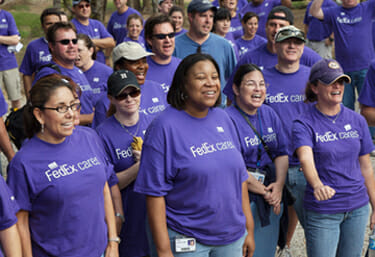
FedEx employees get revved up for FedEx Cares Week.
When Hurricane Sandy pulverized parts of the East Coast in 2012, Bill Bonneau found himself in a unique position. As manager of station operations for
, he could help deliver relief supplies throughout New York.
“FedEx’s logistical expertise and extensive network made us a key player,” said Bonneau. “Despite the logistical challenges associated with route access after a natural disaster, we found a way to answer the call.”
Together with thousands of FedEx volunteers, Bonneau directed an effort to deliver almost four million pounds of relief aid for agencies such as the
. They delivered everything from meals and clothing to water and medical supplies. They provided logistical expertise to deliver more than 85 generators to LaGuardia Airport, police stations and even polling stations to help residents vote during the 2012 presidential elections.
Thanks to volunteers like Bonneau, agencies like Direct Relief quickly met community needs. “The residents of the area were really hit hard after Hurricane Sandy,” said Kerri Murray, vice president of communications for Direct Relief. “Thousands lost power, heat, hot water, so we distributed personal care packs, nutritional supplements and food supplies, all delivered by FedEx.”
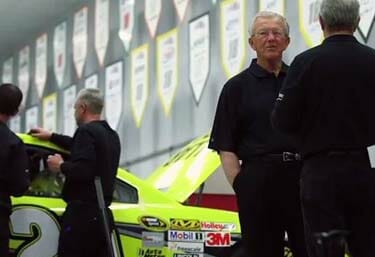
FedEx enlisted NASCAR team owner and former NFL coach Joe Gibbs, second from right, to promote disaster readiness as part of an American Red Cross campaign.
In total, FedEx provided $1.5 million in monetary aid, moved nearly four million pounds of disaster aid supplies and shipped 23,000 meals and 17 polling stations in the aftermath of Hurricane Sandy.
For Bonneau and his colleagues, volunteerism is part of the FedEx culture. The company has managed to connect the dots between corporate citizenship and employee satisfaction, skill development and strengthening the FedEx brand by integrating community engagement into its business – earning it the No. 1 spot in the “Business Integration” category of the Civic 50.
Here are a few examples of how this integration works at FedEx.
Volunteering During FedEx Cares Week Boosts Employee Loyalty and Satisfaction
From building solar-powered playhouses in the San Francisco Bay Area to helping prepare meals in Atlanta, almost 10,000 FedEx volunteers around the globe stepped up to contribute more than 46,000 hours during the company’s annual week of service in 2013.
What did they like about FedEx Cares Week? Reasons ranged from pride from working for a company that gives back to meeting other FedEx employees with the same passion to support the community.
“During FedEx Cares Week, I had the opportunity to help make a difference in the lives of others. I felt proud to see the team spirit from all the team members who attended,” said Giulia Fontana, a FedEx volunteer.
Training Future Leaders Through International Corporate Volunteerism
FedEx also launched a Global Leadership Program that began in 2012, which has included a total of 24 participants to strengthen the leadership skills of high performers. Groups of volunteers are sent in teams to emerging markets like Brazil and India to work with governments and nongovernmental organizations on skills-based volunteer projects.
Returning volunteers report acquiring critical leadership skills such as recognizing cultural differences; encouraging teamwork; demonstrating resilience, flexibility, resourcefulness and creativity; mentoring; communication and even conducting research.
“Outstanding program – learning to manage in a different culture displays your effectiveness in communication and lets you know your strengths and weaknesses,” said Paul Davis, Global Leadership FedEx participant.
From the U.S. Chamber to NASCAR: Building a Good Corporate Citizen
Building on its disaster relief support, FedEx sponsored a monthlong campaign in 2012 to help the American Red Cross promote its Ready Rating program, which helps small businesses prepare for disasters.
While the company could have written a check and walked away, FedEx chose to engage by using its wide array of relationships and corporate assets to support Ready Rating. The result?
NASCAR team owner Joe Gibbs and driver Denny Hamlin spoke on a satellite media tour to promote disaster readiness; America’s Small Business Summit featured a panel discussion addressing the need for small business preparedness with the U.S. Chamber of Commerce, the Red Cross and FedEx; and a Red Cross Ready Rating ad ran in Inc
.
magazine featuring FedEx as a Ready Rating sponsor.
The campaign gave FedEx an incredible boost to its corporate brand: 32 small businesses signed up for Ready Rating and the ad reached more than 700,000 print subscribers and nearly one million unique visitors online. As part of the satellite media tour, Hamlin also gave three national broadcast TV interviews and three local television interviews about the program, which generated more than 50 news stories reaching potentially more than 20 million people.
“FedEx built a commitment to (corporate social responsibility) into the business from the very beginning – dedicating itself not just to moving packages, but also to connecting people and businesses to the global marketplace, improving living standards and building social capital across the world,” said Raj Subramaniam, FedEx executive vice president, marketing and communications. “It’s credibility you can’t generate by simply making a donation, rather it needs to radiate from the heart of your company and your employees to believe in it.”
This post is by Jackie Norris, executive director, and Sarah Boison, marketing manager, of the Points of Light Corporate Institute. It is part four in a seven-part blogCSRWireseries exploring the community engagement practices of winning companies in The Civic 50, an initiative launched in 2012 by Points of Light, the National Conference on Citizenship and Bloomberg. The Civic 50 identifies the top 50 community-minded S&P 500 corporations that best use their time, talent and resources to improve the quality of life in the communities where they do business.
Aetna employees volunteered for four days to bring health screenings to more than 1,500 athletes competing in the Arizona Special Olympics summer games last year.
At more than 1.4 million free health screening clinics in 120 countries, the Special Olympics Healthy Athletes program offers health services and information to athletes in need – making the Special Olympics the largest global public health organization dedicated to serving people with intellectual disabilities.
Volunteers make this work possible. In Arizona, a group of Aetna employees made it their mission to help the Special Olympics screen athletes in their own community – demonstrating a longtime company commitment to help all people live healthy lives.
Competing for Impact
Aetna’s culture encourages employees to give back to the community. To make it easier for employees to volunteer, Aetna created an intranet site called Aetna’s Employees Reaching Out (AERO). The site allows 54 Aetna Volunteer Councils in 46 cities around the world – run by employees – to post local volunteer opportunities. Aetna employees can also find opportunities and log in their volunteer hours through AERO. Employees frequently work with their managers and co-workers to help find time to volunteer at organizations of their choice.
If an Aetna employee volunteers 20 or more hours, he or she is eligible to apply for a grant to benefit a nonprofit organization through Aetna’s Dollars for Doers Program. The program donates $300 cash grants to qualified nonprofit organizations based on level of employee involvement, usually as volunteers or board members. Last year Aetna employees logged in 401,000 volunteer hours, the highest number of hours in one year since AERO launched in 2003.
AERO also serves as the hub for Aetna’s team volunteering competitions. Every year, five to 15 volunteer teams are selected by the Community Relations and Urban Marketing area as top projects, and employees get to vote for their favorite. The most recent winner was from a volunteer project where more than 225 employees from Aetna and Mercy Care Plan (for which Aetna provides administrative services) served for four days to bring health screenings to more than 1,500 athletes competing in the Arizona Special Olympics summer games. At the Arizona Special Olympics Healthy Athlete Village on site, the employees helped register participants, escorted athletes around the festival area and then served as clinical assistants in the village – a fun and upbeat environment for athletes, sponsors and families.
“Athletes participating at the event were taken to various stations including hearing, vision and dental and received a T-shirt upon completing all six stations,” said Karen Krell, an Aetna employee who volunteered during the event. “The athletes were eager to race through the event and Aetna employees were excited to serve.”
Aetna and Mercy Care Plan employees also submitted their story on the AERO site and won the competition with 993 votes from employees. Each vote was worth $5, which gave the team a total of $4,965 in Aetna grant money that was donated to the Arizona Special Olympics.
The Arizona Special Olympics is often the only place where athletes with intellectual disabilities in the state have an opportunity to participate together in their communities. For the athletes, Special Olympics sports events provide a gateway to empowerment, acceptance and joy. The health screenings and checkups become an important added benefit.
“Aetna is committed to improving the quality of health care for everyone by helping to build healthy communities,” said Floyd W. Green III, Aetna’s vice president of Community Relations and Urban Marketing. “Every day, our approximately 47,500 employees help empower people to live healthier lives. However, they also go above and beyond their daily efforts with extensive charitable donations and volunteering in the communities where they live and work. Their commitment to their communities is a major aspect of the outstanding culture that Aetna employees have established for our company.”
Changing Lives, Enriching the Workplace
The event at the Arizona Special Olympics is just one of the thousands of volunteer events in which Aetna employees participate around the country and around the world. From organizing companywide volunteer competitions to holding annual service events that include top executives, the company fosters a culture of service and promotes workplace teamwork. Last year, thousands of Aetna employees participated in volunteering and giving programs.
In addition, in 2013 Aetna and the Aetna Foundation awarded more than $20 million to nonprofit organizations around the U.S. The grant-making focused on improving nutrition and increasing physical activity; promoting equity in health and health care for chronic conditions; building a more diverse generation of health care professionals; and exploring innovative solutions to promote wellness and achieve health equity for low-income and minority communities.
With a commitment to help people around the world live healthy and sustainable lifestyles, Aetna has integrated its employees and philanthropic efforts with its business model centered on healthy living. Through this dedication to help others, Aetna demonstrates why it is a leader in cultivating a civic-minded workplace.
Will You Help Nonprofits Get $5 Billion Worth of This?
This post is by Georgia Gillette, lead catalyst at A Billion + Change, a national campaign – housed at Points of Light – that is inspiring the largest commitment of pro bono service in history.
Georgia Gillette
This year marked the 40th anniversary of National Volunteer Week, which celebrates the importance of recognizing our country’s volunteers for their contributions to the community. Across the nation, individuals, nonprofits and companies alike offered their time and resources to help others in need.
At A Billion + Change, we’re grateful to our community of more than 500 companies that have already pledged skills-based and pro bono service, helping us deliver more than $2 billion worth of skilled service to help nonprofits address critical community needs. To make pro bono the “new norm” for businesses though, we’re eager to continue our effort.
Beginning with a new goal of inspiring 5,000 companies to do skills-based and pro bono service – translated into mobilizing $5 billion worth of pro bono service – by 2015.
When companies take the pledge, commitments are usually made in one of three ways: hours of service pledged, dollar value or service pledged, and pledging to begin a pro bono or skills-based program. But, our companies aren’t simply pledging; they are rolling up their sleeves, sharpening their pencils and turning those commitments into reality.
According to the 2013 Taproot National Data and Financial Dynamics report, 92 percent of U.S. nonprofits report that they do not have enough pro bono support. Many companies are now starting to understand the impact of pro bono service. Now, A Billion + Change plans to collect some of these stories to inspire others to get involved and do the same.
In April 2014, for example, filmanthropos, a Billion + Change pledge company, held their second ProduceAthon. A ProduceAthon is a work-around-the-clock creative blitz to help a Los Angeles-based nonprofit organization tell their story and the impact they are making through a short film produced over a 24-hour period. Last year, filmanthropos created a 60-second motion graphic video for Swipes for the Homeless, a nonprofit that enables college students to donate their excess meal points to buy food for those in need.
“We created an entire video, from pre-production to post, in 24 hours,” said Jasmine Youssefzadeh, founder of filmanthropos. “Our volunteers pitched in and helped with scripting, storyboarding, shooting, animation, audio production, editing and more.” For Rachel Sumekh, Executive Director of Swipes for the Homeless, the “ProduceAthon” was a huge asset.
“The video helps us communicate the impact of our work, makes our organization look edgier, and has already helped drive more traffic to our website” she said, adding, “We often don’t qualify for services from larger foundations or companies, but with filmanthropos’ focus on smaller nonprofits, we could qualify.”
Morgan Stanley, one of A Billion + Change’s first pledge companies, addresses nonprofits’ need for pro bono support through their Strategy Challenge, the firm’s signature skills-based volunteer program that has provided 61 nonprofits since 2009, with pro bono strategic consulting. The Strategy Challenge pairs each nonprofit with a team of four Morgan Stanley employees for eight weeks to address a mission-critical issue facing each organization.
But Morgan Stanley and filmanthropos are just two of the hundreds of companies – from the largest in the Fortune 100 to the smallest sole proprietorship – using their skills and talents to help nonprofits be more effective in achieving their social missions.
Sharing their pro bono service stories, along with the stories of other companies across the country, will allow us to show what is possible through pro bono.
Introducing Pro Bono Champions: Mobilizing and Equipping Companies to Do More Pro Bono
Pro bono education is such an important part of our movement building that we have decided to lead Pro Bono Champions trainings across the nation, recruiting corporate citizenship leaders to tell their pro bono stories and share their learnings with peers and communities. To do this, we’re empowering and equipping Pro Bono Champions with a Skills-Based Volunteering 101 curriculum and training toolkit.
Congratulations to our first batch of Pro Bono Champions trained during National Volunteer Week! (See them here.) It’s inspiring to see the diversity of this list.
In fact, in our discussions with corporate social responsibility, corporate citizenship and volunteer leaders, we’ve identified corporate volunteering is increasingly shifting away from episodic volunteering to year-round engagement – making skills-based volunteering and pro bono a great way to create sustained, long-term nonprofit partnerships that enable employees to give back all year round.