Last week, Points of Light staff had the honor of participating in the Madrid Innovation Service Summit, the first global service leadership event of its kind, hosted by the Meridian International Center, the U.S. Embassy in Spain and the Rafael del Pino Foundation.
I was lucky to be joined by two other members of our team at the summit: Delores Morton, president of Programs, and Gared Jones, vice president Global Service. We traveled to Madrid to share the projects, tools and ideas that Points of Light uses now and our vision for the future of volunteerism with more than 200 corporate, nonprofit and government leaders from Spain and the United States.
Highlights Include:
A campaign to promote Spanish volunteerism was launched – Cuenta Conmigo, which translates to “Count on Me” – providing resources and online community for people to share their ideas; as part of the launch, communities are encouraged to submit their ideas for service projects to win a 10,000 Euro grant
New York Mayor Michael Bloomberg congratulated Madrid on becoming the second international city to join the Cities of Service; this is a great accomplishment for Madrid, which joins more than 100 U.S. cities and London
U.S. Ambassador Alan Solomont directly connected the high unemployment rates in both Spain and the U.S. to the power of service and volunteerism by saying, “lives are fundamentally transformed by the experience of serving others”
Ambassador Stuart Holliday of the Meridian International Center said, “this summit will lead to greater cooperation between service leaders and volunteer leaders here in Spain and the U.S… we hope the ideas they generate here will make a tangible difference in their communities”
The list of attendees also included the Crown Prince of Spain, the U.S. Assistant Secretary of State, the Spanish Minister of Health, Social Services and Equality, the Mayor of Madrid and many other notables; having all of these leaders in attendance added to the conversation and value of the summit, specifically around the power of cross-sector collaboration
The Madrid Service Innovation Summit was a great success and benefited from the luminaries in attendance. We congratulate Meridian International and U.S. Ambassador Alan Solomont and Susan Solomont for its success. It connected major service leaders from the U.S. and Spain so that they could work together to deliver results. New ideas were generated, projects were started, collaborations have begun and volunteerism is on its way to the next level.
Sincerely,
Jackie Norris
Executive Director, Points of Light Corporate Institute
News Flash: Just Released: Trends in Excellence – Innovations in Employee Volunteering
Innovations in Employee Volunteering is available as a free download today. This latest volume focuses on key innovative practices displayed by excellent EVPs, such as making service a celebration, offering microvolunteering and positioning volunteering as an HR tool. The research findings indicate innovative practices that EVPs seeking greater participation, effectiveness, and societal and business impact should consider. Findings suggest EVPs should:
Customize EVP policies that encourage targeted volunteering and draw on company skills and competencies to achieve higher impact
Maximize the quality of volunteer contributions through volunteer preparation, training and other support
Fold volunteering into the workplace experience to strengthen the HR benefits that accrue from volunteering and improve volunteer recruitment
Select nontraditional causes that resonate with the workplace culture and corporate character
Extend EVP messaging to wider audiences, including those that may not be interested in employee volunteering by communicating volunteer opportunities through other business functions and linking to business functions, such as performance reviews and onboarding
The report is based on information from the 2011 Points of Light Corporate Engagement Awards of Excellence finalist companies. Download the report today and learn more about innovations in employee volunteering.
The Points of Light Corporate Institute enables companies to engage their employees and customers in service in the communities in which they do business. It is the go-to organization providing resources, consulting services and on-the-ground activation to companies around the world seeking innovative, multi-channel engagement in employee volunteer programs, skills-based volunteering and hands-on service.
For additional information or for assistance with developing or enhancing your EVP, contact
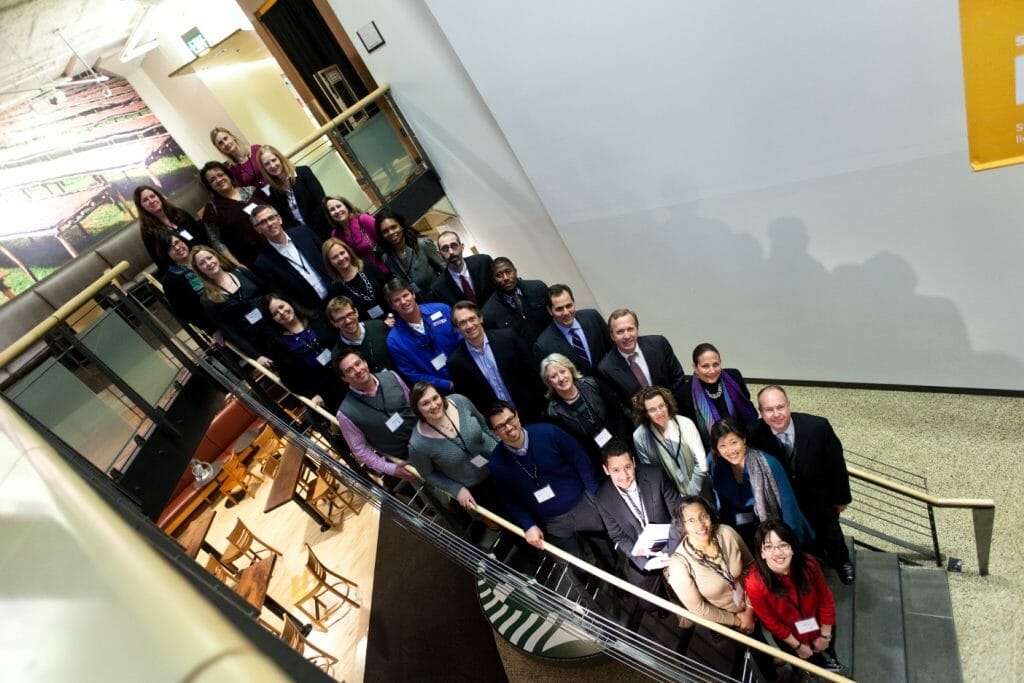
Corporate Service Council- Photo Courtesy of Points of Light
Today’s post is written by Daniel Horgan and republished from his blog “Discover U: Carpe Diem” on March 11, 2012.
This past week, I had the opportunity to travel to Seattle and attend the Corporate Service Council, a convening of the Points of Light that is structured to share innovations in corporate volunteerism, corporate social responsibility and corporate philanthropy as well as advance networking and problem solving discussions. My experience with the Council caused me to recall an important quote from Andrew Stanton, the filmmaker for “Toy Story” and “WALL-E” as well as a recent TEDspeaker on the topic of storytelling: “Make me care.”
The message behind Andrew’s three words is that to advance our passion and influence people, we must play the role of a storyteller and bring people on a journey that illustrates for them why they should care about that which lights a fire in our belly. The Corporate Service Council engages representatives from close to 75 companies around the globe including Starbucks, Kraft, Disney, Accenture and Chase. These companies employ hundreds of thousands of people and reach even more through their customers, community relations and marketing. There exists not only an opportunity but an obligation for these companies to “nudge and inspire the human spirit” as Cliff Burrows, President of US & Americas Starbucks Coffee Company, shared with us.
It was with this principle in mind that Starbucks launched their job development and small business loan campaign by investing $5 million from their foundation and inviting customers around the country to contribute to awakening the American economy. It was a bold move to step out front, to lead, and to shine a spotlight on an issue that is tearing communities and families apart. As a masterful storyteller that relies on bringing people from diverse walks of life around a community table over a cup of coffee, Starbucks has made me and hundreds of others care to the tune of an additional $3 million invested in small US businesses over the past several months.
Another speaker at the Council, Eric Liu, Founder of Guiding Lights Network, reminded us that “society becomes how we behave” and that “we’re all better off when we’re all better off.” There is this “fierce urgency of now” that companies of all sizes and industries must join forces with nonprofit organizations, schools, foundations, civic groups, and individuals to combat the complex issues plaguing our society. These issues are only growing more complex and can not be resolved at the hands and resources of one player; a collaborative approach is required if we are to spark a movement in which more and more people care, engage and remain committed.
While it is important for all players in this game of social change to maintain their own identity, to differentiate their investments of time, talent and treasure, it is equally critical that “community” remains at the forefront of our actions. We must not lose sight of the fact that communities dictate our success. When schools flourish with strong leadership, well-supported and trained teachers and academically successful students, a strong and robust workforce emerges. When nonprofit organizations have the resources and the capacity to advance wrap around support services to residents in need and ultimately reduce the dependency on a social safety net, communities thrive with residents reaching their full potential. When businesses “do well by doing good” they have more satisfied employees and loyal customers that will propel their growth and development.
When we all care, the story of our lives is richer. And we will all believe, in the words of Marianne Williamson, that “playing small does not serve the world.” So I continue to challenge myself and you to “make me care.”
IBM: Making Volunteer Service a Celebration
This post is written by Diane Melley, Director, IBM, Corporate Citizenship & Corporate Affairs, who will be hosting a free live webcast, in partnership with Points of Light, on March 13, 2012, 1:00-2:00pm EST. Learn about the many strategies IBM follows to sustain a strong, effective, and worldwide volunteer program that builds healthy communities and helps the world work better. Register today!
Last year during IBM’s Centennial, I had the opportunity to join more than 100 IBMers and 100 local NGO leaders in Boston during our Celebration of Service milestone day in June. I participated in a marketing strategy session workshop, where IBMers shared their expertise in marketing strategy and social media with our community partners. In small working groups, we brainstormed best practices which leveraged ideas from the “Basics of Marketing” Activity Kit, a set of materials designed to introduce not-for-profits to marketing fundamentals such as planning, segmenting, targeting and brand strategy with the end goal of helping these organizations effectively reach and serve a full range of stakeholders. It was amazing to see the energy and give-and-take from the IBMers and community leaders. I was in awe being able to witness first-hand the passion of the IBM volunteers and their sincere desire to share their skills to make a difference. Their dedication didn’t end on that particular day – several volunteers even made commitments to conduct follow up projects with their NGO partners.
I am extremely proud to work for a company that has a long tradition of service. Even though IBM has been committed to service since its founding, the ways in which our company has been able to contribute to our communities and the world has evolved over time. When I joined our Corporate Citizenship group, we primarily donated hardware, since that was the focus of our business. Over time, as our business mix has changed, we have seen a transition over to donating software, services and consulting. Recognizing that our employees have a wide-range of intellectual capital, including legal, marketing, and countless other skill areas, we have also become comfortable sharing expertise outside our areas of core strength in technology.
Our IBM Centennial Celebration of Service was the culmination of this type of skills-based volunteering, and a case-in-point for the integration of all of our programs at a massive, worldwide scale. What makes IBM unique was our ability to bring all of these elements together. Not only did more than 330,000 IBMers around the world contribute more than 3.2 million hours of their time on the service milestone day, but we also enabled our service leaders with tools, successful models, and more than $12 million in grants at various award levels.
Another key part of the Celebration of Service was the creation of a portfolio of activity kits, robust and polished sets of volunteer materials ready for any volunteer – in or out of IBM – to take into schools and nonprofits. I mentioned the Basics of Marketing Activity Kit above, but there are now more than 30, with each kit including all the materials an individual or team needs to conduct an impactful volunteer activity: presentations, speaker notes, volunteer guides and handouts. The activity kits were built from the most successful and innovative skills-based volunteer activities performed by IBMers around the world, and represent the contributions of IBM’s most valuable asset – the skills and expertise of its employees.
IBM considers these kits just one contribution among many to making the planet a better and smarter place in which we all work and live. It is our hope that you will leverage these free activity kits as a way to grow your volunteer programs.
News Flash: A Billion + Change Mobilizes $1.6 Billion in Skills-Based Volunteering
More than 100 leaders in business, policy and civic engagement celebrated the continuing success of A Billion + Change on Monday with the announcement of 78 pledge companies and more than $1.6 billion of skills-based services contributed since the summer of 2011. Virginia Sen. Mark Warner, the campaign’s honorary chairman, announced this as part of a program hosted by Morgan Stanley at the company’s headquarters in New York City on International Corporate Philanthropy Day. The event recognized the innovative pro bono programs companies are developing to deliver high-impact services to address community needs.
A Billion + Change, housed and managed by Points of Light, is a national campaign to mobilize billions of dollars of pro bono and skills-based service from corporate America by 2013. The campaign is seeking 500 companies willing to pledge their best business skills and talents to serve the needs of nonprofits and communities at home and around the world. The campaign’s vision is to inspire the largest commitment of corporate pro bono service in history.
At a time when public resources for social services are stretched, Sen. Warner emphasized the salience and the critical nature of A Billion + Change. “As a percentage of our GDP, we are spending less on safety net programs in 2012 than we did in the 1960s. Future spending trends on these programs are also under great pressure. To be competitive, we need to spend more on things like education and workforce development, and nonprofit action in this sector will be critical,” he said. “A Billion + Change is an opportunity for businesses to get involved, not to just write checks, but to give their most valuable expertise.” Senator Warner also outlined the creative ways businesses are stepping up to invest in communities in a front-page article published by the Huffington Post on Monday.
The skills-based volunteer programs of campaign pledge companies are redefining what it means to help. Morgan Stanley’s annual Strategy Challenge, for example, has delivered more than 14,500 hours of pro bono services to 36 nonprofits across the nation, worth approximately $2.2 billion. One Strategy Challenge team was able to save New York-based New York Cares $30,000 annually by recommending improvements to its volunteer on-boarding process in 2009.
A Billion + Change is encouraging companies of all sizes across all sectors to achieve this kind of change. Pledge companies range in size from small businesses, like gothamCulture and AltruHelp, to large companies such as Nielsen, General Mills, State Farm, Hewlett-Packard, UnitedHealth Group and Morgan Stanley. To date, these companies have committed to give more than 11 million hours of time and talent to nonprofits by 2013.
Read more about A Billion + Change, see companies that have taken the pledge and follow media coverage of the campaign online. Photos of the event can be viewed on Flickr.
A Billion + Change was launched by the Corporation for National and Community Service in 2008 and continues as an initiative of the federal agency. Reinvigorated in 2011 with expanded leadership under the honorary chairmanship of Sen. Warner, it is now housed and managed by Points of Light. The initiative is powered by the support of Deloitte, HP, the Case Foundation and IBM with additional founding support from State Farm, McKenna Long & Aldridge LLP, and Morgan Stanley.
From A Thousand Points of Light Toward New Innovations in National Service and Social Impact
Today’s guest post is written by Jackie Norris, the Executive Director at the Points of Light Corporate Institute, an Iowan by way of NY, Mom to 3 Boys, Previous Chief of Staff to Michelle Obama. You can find her on twitter: @MsJackieNorris
When President George H. W. Bush invoked a thousand points of light in 1989, he set off a movement of individuals, nonprofits and corporations working together to create positive change in our communities through volunteer service. He was also the catalyst for launching Points of Light, which is today the nation’s leading volunteer organization dedicated to inspiring, equipping and mobilizing people to take action to change the world.
More than 20 years later, the need for volunteer service is greater than ever before. Every sector of our society is facing serious challenges, from our uncertain path toward economic recovery and social unrest at home and abroad, to the cultural and demographic forces shaping our society and workplaces. But as the decades have brought more complex challenges, they have also brought innovations in service and deep commitments from the private sector to take a greater role in creating a more sustainable world.
A Billion + Change is a great example of the kind of innovation and of the growing scale of commitments taking place in the nonprofit, business and service sector. A Billion + Change is a national campaign to mobilize billions of dollars of pro bono and skills-based services by 2013. It is challenging and inspiring companies to lend their most valuable assets—their talent and their human capital—to help nonprofits achieve more with scarce resources, so they can be effective agents of change.
The scale of corporate commitments to this campaign so far has been significant. In November 2011, 50 companies had pledged more than $1 billion worth of skills-based volunteer services to build nonprofit capacity. Today, on International Corporate Philanthropy Day, the campaign will announce progress toward its overall goal of having 500 companies pledge to create or expand a pro bono program. Together, these companies are stepping up to inspire the largest commitment of corporate pro bono service in history.
There is also a lot to be said about encouraging companies and employees to lend their professional skills to build nonprofit capacity. For nonprofits, the value of skilled support in areas such as general operations, technology and professional services can be 400% greater than the value of traditional volunteering. So in a real sense, A Billion + Change is redefining what it means to help.
Morgan Stanley, whose annual Strategy Challenge is an excellent example of the value skills-based volunteering can have on nonprofits. Since it began in 2009, this initiative has used the financial analysis and business strategy expertise of its talented professionals to deliver more than 14,500 hours of skills-based volunteer services to nonprofits. These services are worth approximately $2.2 million, and have been contributed to 36 nonprofits across the nation. A team of Morgan Stanley employees participating in the Strategy Challenge was able to save New York-based New York Cares $30,000 annually by recommending improvements to its volunteer on-boarding process in 2009.
Pledge companies are delivering high-impact volunteer services like this daily to address every aspect of community needs, from education and healthcare to economic and community development programs and programs helping victims of domestic abuse.
I ask you to ask yourselves: have you, as an employee, an employer or as a civic leader, thought about how you or your company can contribute your skills, knowledge and talent to join the growing pro bono movement? To learn more, visit A Billion + Change online, and take part.
Corporate Volunteering Across Borders
Today’s guest post is written by Cristina Andoni, ATLAS Corps Fellow from Republic of Moldova, serving at Points of Light as Corporate Institute Coordinator. If you are interested in contacting her for more information, you can reach her at: [email protected]
Volunteering is on the rise. According to the Corporation for National and Community Service, volunteerism is at a 30-year high. Corporations continue to increase their giving and further diversify and develop their employee volunteer programs (source). National campaigns such as A Billion + Change create business value through strategic alignment of philanthropy and business goals by mobilizing billions of dollars of skills-based volunteer services to build the capacity of nonprofits to meet community needs.
Although trends vary from country to country, corporate civic engagement is growing everywhere. Corporate engagement continues to boom in countries with strong traditions of civic innovation, such as United Kingdom, and even in countries such as Poland, where only 2 percent of companies ran an employee volunteering program in 2008.
Additionally, companies from emerging European markets, where civic consciousness is only awakening, are beginning to realize that corporate civic engagement and corporate social responsibility go beyond being expensive, sporadic PR campaigns and philanthropy. Companies incorporate responsible business principles into core business activities. Corporate volunteering, for example, is becoming an integral part of companies’ strategy and culture and has proved to tackle important organizational and community-related issues.
Kyivstar, a Ukranian telecommunications company and the winner of the National Corporate Volunteering Contest in the Innovation category, is a great example. It is one of the first companies in the country to integrate corporate social responsibility into its business strategy and implement innovative practices and approaches in employee motivation, such as paid release time, impact communication, employee recognition or scalable employee volunteer projects.
Why is this happening? I would speculate that it is globalization that is pushing a new normal in corporate citizenship, as well as empirical evidence of the benefits it generates for the company, its employees and communities.
Companies in America hold a great opportunity in their hands, the power to be leaders in corporate volunteerism for the world around us. In the years ahead, it’s not just the nice thing to do, but the necessary thing to do for businesses to stay relevant and competitive.
The New Year is always a great time for clean slates, aggressive goals and personal resolutions to be good and do good in the world. Our Points of Light goals for 2012 are ambitious. This year, Points of Light and its enterprises – HandsOn Network, generationOn, AmeriCorps Alums and the Corporate Institute – plan to:
Provide people with access to 500,000 projects and other opportunities to learn new skills and engage in work to improve their communities
Mobilize 3.5 million people to use their time, talent, voice and money to create community change
Play a significant role in improving the civic health of the communities we serve with projects like the Community Blueprint Network for military, veterans and their families; generationOn service clubs providing kids and teens a way to begin a lifetime of service; and opportunities for AmeriCorps Alums to create transformational change and serve as advocates for the power of service
Contribute to a measurable change in education and student performance, environmental sustainability, economic prosperity, and emergency preparedness and recovery in communities we serve by connecting people to their power to make a meaningful difference by providing access to tools, resources and opportunities
I hope you will share your resolutions with us on the Points of Light Facebook page. As a community, we can support one another as we strive to meet our individual goals. We’ll keep you posted on our progress and hope you’ll do the same.
Here’s to a transformational 2012.
Yours in service,
Michelle Nunn
CEO, Points of Light
Why Measurement Matters: 5 Steps to Improving Corporate Volunteer Programs
Today’s guest post was written by Sadie Miller with True Impact LLC. Prior to her work at True Impact, Sadie was the national AmeriCorps*VISTA Leader at Campus Compact, outreach and planning intern at the Corporation for National Community Service, and graduate research assistant at the Brandeis Center for Youth and Communities.
As a young VISTA (Volunteer in Service to America), I was committed to measuring the impact of my volunteer programs with participant surveys. When I got back the results of my first survey, the only thing I learned was how much college students like to complain about the food and timing of volunteer events. Of course, making programs comfortable, filling, and convenient is important for keeping volunteers coming back. I didn’t get any deep insights by asking about satisfaction and hours in the community. Many of us fall into the process measurement trap, losing focus on the end impact. In Mapping Success in Employee Volunteering, the Boston College Center for Corporate Citizenship found that many Fortune 500 respondents track satisfaction, participation levels and volunteer hours. Getting an employee volunteer program requires fulfilling business and community goals beyond how many volunteers leave happy. Here’s a checklist for improving the bottom-line impact of corporate volunteer programs.
STEP 1: Make a list of stakeholders
Cast a wide net when identifying stakeholders; you’ll never know who will be your biggest advocate– or squeakiest wheel. Map all of the internal and external people and organizations that influence and are affected by your volunteer program. Here’s a start:
Advocacy groups
Beneficiaries
Community partners
Customers
Government agencies
Public Relations and the Communications Department
CEOs and CFOs
Prospective employees
STEP 2: Define social and community goals
It doesn’t matter if you have a 5-year strategic plan or are in the first year of your employee volunteer program. Every program has a set of explicit or implicit expectations for social and community change. Brainstorm a list of outcomes your stakeholders want to see to guide your evaluation. Process indicators, like the monetary investment and the number of volunteers engaged, can be left off the list– focus on the bottom-line outcomes. Examples of social goals include:
Get low-income middle school students to matriculate into 9th grade on time and prepared for high school
Inspire young people in our communities to go to college and major in science, mathematics, engineering, or computer science
Prevent children under five from death and illness caused by water-borne disease.
STEP 3: Define business goals
Sustainable CSR programs forward the social and business bottom-line. Who wants to support a community program that bores employee volunteers? Inspiring programs resonate with a company’s business goals, be it training a future generation of engineers and entrepreneurs or reducing employee turnover. Business goals for employee volunteer programs include:
Enhancing brand and reputation in the community
Fostering productive and committed employees
Networking with advocacy groups, leaders, and customers that provide the company with a social “license to operate” in the community
Identifying sales opportunities with other volunteers, organizations, or companies, because your next business partner may be as committed to Habitat builds as your employees are!
, we firmly believe that measuring the right things is simple and attainable, as long as you focus on measuring the outcomes that capture your program goals.
Your employee volunteers are best equipped to evaluate the personal, professional, and business effects of their volunteerism. Examples of business outcomes include:
Skill development
Job satisfaction related to volunteerism
Employee recruitment through volunteer activities
Relationship development with business stakeholders
The monetary value of employee volunteers.
Community partners are the key to evaluating social outcomes, and are the most invested in proving the value of their outreach. Long-term social outcomes include:
The number of middle school students tutored by employee volunteers that matriculate into 9th grade and graduate high school
The number of high school students mentored in a STEM program that major in science, mathematics, engineering, or computer science
The number of children protected from water-borne diseases because of volunteer investments in training and clean water infrastructure.
STEP 5: Prepare for change
Once you and your stakeholders define a program’s goals and evaluate the end outcome, it is much harder to justify programs that don’t make a difference. It is also harder for internal stakeholders to ignore programs that enhance employee satisfaction, develop sales opportunities, and make lasting social change. So take the next steps to make programmatic changes that will leverage employee skills. And when your evaluation points toward significant social impact because of your volunteers, toot your own horn to build institutional support and get more employees engaged. Because measuring impact is only as good as the work it does for you.
For more information or to participate in the ongoing Volunteerism ROI Tracker, visit us at
Now more than ever CSR and EVP managers need to prove value, invest more strategically and continuously improve the impact of their programs. Points of Light can help! Learn about our exciting new tools and services for measuring and benchmarking. Such as the ROI Tracker, provided in partnership with True Impact LLC and the Employee Volunteer Program Benchmarking Tool, developed with the support from the AT&T Foundation. For additional information contact Jennifer Highsmith, Director of Business Training and Consulting at The Points of Light Corporate Institute.
I’m Volunteering My Story
Today’s post is written by Jackie Norris,the Executive Director of the Points of Light Corporate Institute and former White House Chief of Staff to Michelle Obama. This piece was originally published on December 13, 2011 on Momsrising.org.
As I pecked away at my laptop on a 6:30am flight to Atlanta, I took a moment to reflect on the three tasks I just completed long before I landed to start my day job. First, I reviewed the budget projections for Lafayette Elementary School’s 2nd grade class to assess if we were on track with revenue and expenses. Then, I mapped out key goals and milestones which undergird the 2012 strategy for the Impact Center Leadership Council, which I chair on a volunteer basis in support of women’s leadership development. Last, I reviewed and edited a press release for my local food bank in advance of a big event they are having this month.
My guess is that my morning is probably pretty similar to that of many moms across the country. As moms and professionals, we volunteer for things all the time, and think nothing of it! What I do is “just what you do” to support and give back to the world in which we live. It’s pro bono—for the good of our children’s lives, our community’s health and our cultural future.
But pro bono means something more. While as moms, we consider volunteering for school or community projects as part and parcel of what it means to be a mom, as professionals, only a minority of us think of volunteering our skills and expertise to make the world a better place.
What does pro bono, or skills-based volunteering, look like? The clearest example I can offer is an accountant. If an accountant wants to volunteer, they have two choices – to go out and do some “hands dirty” volunteering like stuffing envelopes, which is valued at approximately $12 – $15 an hour, or take the same amount of time to audit the books for a local nonprofit, which is valued at $150-$250 an hour. Think of what a nonprofit could do with the money they just saved! They could support one more bed at the homeless shelter, an additional meal at the church, an extra round of home visits for shut ins, an afterschool program for latch key kids who’d rather not go home and be alone.
Interestingly enough, best practice businesses are embracing pro bono service as the “new normal” in volunteering, recognizing that value to nonprofits can be leveraged when professionals move beyond painting walls, hammering nails or stuffing envelopes. With skills-based volunteering, businesses can harness the talent of their workforce to attract, develop and engage their employees, while creating shared value for themselves and their communities.
Take Alison Hager, she’s a great example of what skills- based volunteering is all about. Alison works as a Manager in the Corporate Controller’s Financial Controls Team at Pfizer. As part of Pfizer’s Global Health Fellows Program, she was stationed in Rwanda for 6 months, where she worked with the Access Project at Columbia University’s Earth Institute and the Rwandan Ministry of Health to help improve management systems for health care in the country. Pfizer has found its program to be a powerful leadership development and training tool, as well as a way to enhance its reputation around the world.
How can we then scale volunteer programs like Pfizer’s to achieve widespread social change? We can do so through initiatives like A Billion + Change, a national campaign to mobilize billions of dollars in skills-based and pro bono volunteer services from the corporate sector by 2013. The campaign aims to inspire and unleash talent and expertise to help build the capacity of nonprofits to achieve lasting change across the country and around the world. Guided by Points of Light and powered by visionary organizations like Deloitte, HP, IBM, the Case Foundation and the Corporation for National and Community Service, the main purpose of A Billion + Change is to get all of us – as moms, employees and professionals to ask the key question – how can we do the most good? To date, more than $1 billion worth of service has been pledged.
Pro bono really is for the good — of business and community.
To find out more about A Billion + Change, its upcoming activities and to see which businesses have pledged to lead the movement, visit www.abillionpluschange.org.







 This post is written by Diane Melley, Director, IBM, Corporate Citizenship & Corporate Affairs, who will be hosting a free live webcast, in partnership with Points of Light, on March 13, 2012, 1:00-2:00pm EST. Learn about the many strategies IBM follows to sustain a strong, effective, and worldwide volunteer program that builds healthy communities and helps the world work better.
  At a time when public resources for social services are stretched, Sen. Warner emphasized the salience and the critical nature of A Billion + Change. “As a percentage of our GDP, we are spending less on safety net programs in 2012 than we did in the 1960s. Future spending trends on these programs are also under great pressure. To be competitive, we need to spend more on things like education and workforce development, and nonprofit action in this sector will be critical,” he said. “A Billion + Change is an opportunity for businesses to get involved, not to just write checks, but to give their most valuable expertise.” Senator Warner also outlined the
  Today’s guest post is written by Jackie Norris, the Executive Director at the Points of Light Corporate Institute, an Iowan by way of NY, Mom to 3 Boys, Previous Chief of Staff to Michelle Obama. You can find her on twitter:
  Today’s guest post is written by Cristina Andoni,
 Today’s guest post was written by Sadie Miller with
  STEP 1: Make a list of stakeholders
Cast a wide net when identifying stakeholders; you’ll never know who will be your biggest advocate– or squeakiest wheel. Map all of the internal and external people and organizations that influence and are affected by your volunteer program. Here’s a start:
STEP 1: Make a list of stakeholders
Cast a wide net when identifying stakeholders; you’ll never know who will be your biggest advocate– or squeakiest wheel. Map all of the internal and external people and organizations that influence and are affected by your volunteer program. Here’s a start: