Can You Weather a Winter Storm? We’ll Tell You How to Prepare
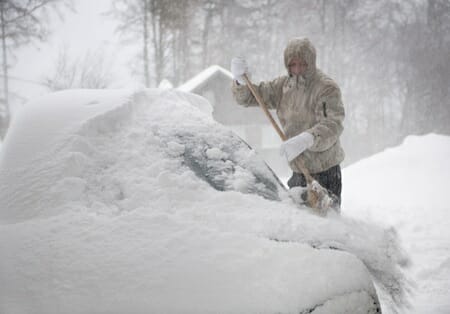
The winter storms that have punished the Northeast during the past couple of weeks have gotten many of us talking about how best to prepare for bad weather.
Do you know how?
Join us this Friday, Feb. 6, from noon to 1 p.m. Eastern, for #GoodandReady for Winter – an interactive chat on Twitter.
During this online discussion, you’ll get safety tips and more from Good & Ready, a Points of Light program that convenes select business, nonprofit and government partners to increase the ability of individuals and communities to prepare for, respond to and recover from disasters and emergencies.
Find out how to build an emergency supply kit. Ask us about winter volunteer opportunities. Share your winter preparedness plans. What’s on your mind?
To participate, follow @goodandreadyorg on Twitter and use the hash tag #GoodandReady.
Don’t Let Winter Volunteering Wane – Disaster Recovery Is Year-Round
After a disaster, all of us watch the news as people are airlifted from floodwaters and volunteers surge to provide shelter and food. But what happens when the media are gone and the communities are left with damaged homes and displaced citizens?
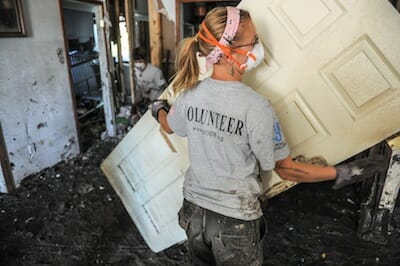
(Photo courtesy of FEMA)
Many of us do not consider that long-term recovery can be a process that lasts for years – or even decades – after the disaster strikes. Areas located in colder climates may experience surges of volunteers during the spring and summer and then struggle to meet the community’s needs for other seasons.
In 2013, Colorado experienced flooding that caused catastrophic damage across 200 miles affecting 17 counties. Fortunately, Denver’s Metro Volunteers, part of Points of Light’s HandsOn Network, was and continues to be there.
A year after the devastating floods, many residents are finally getting utilities restored and beginning to rebuild their homes.
Kristy Judd, executive director of Metro Volunteers, explains that long-term recovery requires strong partnerships – organizations working toward a common goal, as evidenced by the partnership between Metro Volunteers and the Long-Term Recovery Group of Northern Colorado – composed of more than 50 nonprofits, government agencies and faith-based groups.
“Collaboration and cooperation matter a great deal,” Judd said. “We have small communities with limited capacity to manage large scale disasters. Together, we’re stronger.”
As winter closes in, volunteering rates drop, although requests for assistance still come in daily.
Help those who need it most this winter season by volunteering. To find opportunities to support ongoing disaster recovery efforts, visit www.allforgood.org/disasters or contact your local volunteer center.
Top Five Resources for Volunteers Who Want to Create Projects
Whether you’re a budding or longtime volunteer, these resources can get you on your way to developing your own projects with your family, friends and neighbors. For a searchable list of volunteer resources, please visit the HandsOn Network Resource Library. And if you aren’t quite ready to start your own project, you can search for local opportunities on All For Good.
Volunteer With Your Family
What better way to teach your children the joy of helping others than through community service? If you’re a parent looking for family-friendly volunteer opportunities, generationOn’s Family Project Guide can help.
This step-by-step guide teaches you how to shape your family volunteer project as it evolves. By offering questions you discuss as a family, you can find service opportunities that mesh with everyone’s interests, ages and energy levels.
Organize a Food Drive
Imagine never knowing if, when or how you were going to get your next meal. For 45.3 million Americans, that is what life is like every day. There are ways you can help, including organizing a food drive in your community. See this guide.
Organizing a food drive is a manageable project for volunteer veterans and beginners alike. These comprehensive instructions map out the steps, including such essential questions as: Who will lead this project with you? And, how do you promote the food drive?
Organize a Disaster Kit
Preparing a disaster kit – ready to grab on the go – can lessen the fear, anxiety and losses that stem from a disaster. Organizing a disaster kit project in your community can help educate and prepare others in case disaster strikes.
You don’t have to be a disaster expert to organize a community-wide disaster kit project. With these guidelines, planning this project is straightforward and easy. Also check out Good & Ready for more tips and advice.
Become a Volunteer Leader
Sure, you care about the quality of your community, but what can you do to improve it? With the HandsOn! Volunteer Leader Guidebook, you can help lead volunteers in making positive change.
The guidebook walks you through how to successfully organize and lead a community service project. Equipped with tools and tips, including worksheets, the guidebook outlines how to develop, implement and wrap up a project in seven simple steps.
Tell Your Story
Gathering a strong and supportive team can be one of the most challenging aspects of a community service project. If you’re looking to educate, inspire and garner support, check out HandsOn Network’s Passion into Action: Telling Your Story.
The guide lists a wide range of ways to publicize your message, from posters to media campaigns to online social networks, and more. This resource also offers recommendations about marketing and provides tips on how to publicize your cause.
When it Sounds Like a Baseball Team Is Pitching Balls Against Your House, Will You Be Ready?
Read about how folks in Milwaukee are preparing for disaster. To help your family take action, visit Good & Ready, where you’ll learn how to create various disaster plans, build a preparedness kit and more.
Julie Brown of Eagle, Wis., could barely see as she drove home one June evening four years ago – hail and rain pounded on her car relentlessly. She tried to phone her husband, Jason, who was home with their two children, Jillian and Joseph, ages 8 and 4 at the time.
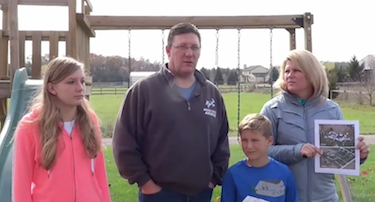
The Brown family of Milwaukee share their story about surviving a tornado. (Click photo to play video.)
But Jason Brown and the kids were huddled underneath a basement staircase, bracing for a tornado.
Above them, the house shook. Jason recalls feeling air pressure so strong, “It felt as if the top of my head was going to explode.” In addition to a deafening roar, the father and children heard what sounded “like an entire baseball team pitching balls against the house.”
Minutes later, the noise stopped. When Jason ventured upstairs, he found the inside walls of the home plastered with garden mulch and mud, blown inside through windows that now bowed outward. The garage door was gone, as was the kids’ heavy, wooden backyard climbing gym and slide.
Meanwhile, Julie had to abandon her car, as all roads leading to her subdivision were blocked with fallen trees and power lines. Julie had no flashlight, no rain gear and no sturdy shoes or boots for wading through deep water or climbing over limbs.
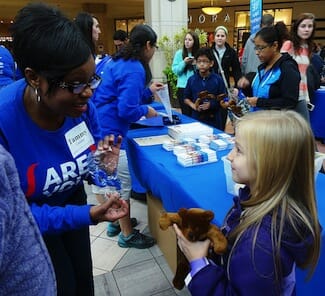
Volunteer Tammy Lockhart helps Delilah Haggerty fill her family’s emergency kit at Mayfair Mall.
Hundreds of shoppers who lined up Oct. 18 at Mayfair Mall in suburban Milwaukee to assemble starter emergency kits admitted they also would be unprepared for a sudden disaster, even though Wisconsin gets hit by deadly tornadoes each summer and howling blizzards each winter.
“Thank you, because I just never even think about it,” said Merline Levers of Milwaukee, who uses an electric scooter for mobility, after receiving her emergency kit.
The Allstate Foundation teamed up with Points of Light in Milwaukee to raise awareness about preparing for disasters as the final stop on a 14-city nationwide tour that began in May. Similar events were held in Los Angeles, Houston, Salt Lake City, Colorado Springs, New York, Indianapolis and other cities.
As the tour wrapped up, more than 10,000 emergency kits had been distributed nationwide. In Milwaukee, event participants and volunteers put together 500 kits in a little over two hours.
Volunteers from local Allstate agencies, The Allstate Foundation and Allstate’s national catastrophe team teamed up with local volunteers from the American Red Cross and the Nonprofit Center of Milwaukee – part of Points of Light’s HandsOn Network – to explain the purpose of each item in the kit, from hand-cranked flashlights to rain ponchos to dust masks to loud whistles for attracting the attention of rescue workers.
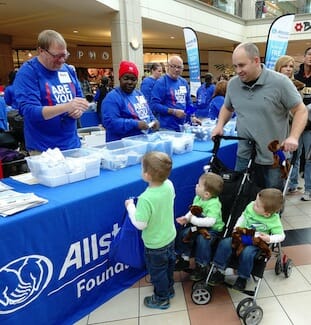
Ryan Bagley and his sons Jack, 4, and twins Luke and Max, 2, put together an emergency kit.
For the Wisconsin event, waterproof mylar “blankets,” designed to retain 90 percent of a person’s body heat, and lists of winter safety tips were added to the kits.
Bilingual agent Alex Ferreira of Milwaukee explained the kits and conducted surveys in Spanish when needed. Yong Yang, an agent in Brookfield, Wis., who helped distribute emergency kits, said many people appreciated the opportunity to learn how to prepare.
Andre Walls of Milwaukee, one of the attendees, said he once shivered for nearly an hour awaiting help after one of his tires went flat on a bitter winter night. Walls said that from now on he plans to stock his vehicle with a blanket, flashlight and battery jumper cables.
Event participants with young children seemed especially interested in getting prepared.
“Usually, you figure, `I’ll be OK,’ but now that I have other people to care for, I’m making sure they’re OK and they’re all set,” said Jessica Olbrot, who attended the event with her husband, Kris, and toddler, Olivia.
Ryan Bagley – who turned heads as he expertly managed a double stroller shuttling identical twin sons Luke and Max, 2, while his 4-year-old son, Jack, held his hand – vowed to create a home emergency kit that would contain safety essentials as well as toys to keep the boys occupied and calm in the event of a disaster.
Children at the event were given small teddy bears – just as they are during real disasters by the Allstate “Cat” team, which often finds families bereft of all possessions, including their children’s stuffed toys.
“They’re devastated and they don’t have anything,” said Mark Smith of Traverse City, Mich., who works with Allstate’s flood disaster team based in Mobile, Ala.
Tanya Joeng of Allstate Foundation’s Northbrook, Ill., office, said it’s been gratifying to help prepare the public for emergencies. “People really listen,” she said. “They really take in the information, which I think it is really great.”
What Would You Do in a Disaster? Allstate Shows How Easy it Is to Prepare
Read about how folks in Los Angeles are preparing for disaster. To help your family take action, visit Good & Ready, where you’ll learn how to create various disaster plans, build a preparedness kit and more.
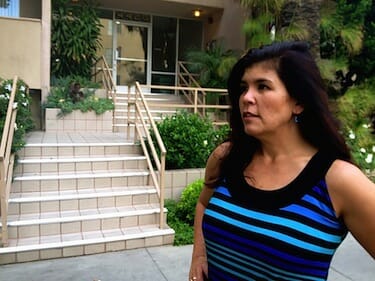
Paula Solano recalls the morning when the walls of her apartment fell apart around her during an earthquake.
Paula Solano was asleep when her walls started violently shaking and loudly crumbling around her. The patio sliding glass doors in her Los Angeles apartment blew out, spraying glass everywhere. She made a run for it, cutting her bare feet on glass shards and breaking a toe as she fled.
“I really thought that, maybe, I was going to die,” Solano recalled of that day 20 years ago, when an earthquake jolted the Northridge neighborhood of Los Angeles. “I wish I would have known where to go when the earthquake started. … I was literally caught unaware – out of a dream.”
The 1994 Northridge earthquake rated a 6.7 magnitude and left nearly 60 people dead. Thousands of others were left without shelter – including a young Solano, who had just arrived in town to teach, write and act.
Today, Solano makes sure her family is prepared, right down to having slippers next to her children’s beds, in case they have to run out in the middle of the night like she did. “You need to have a plan,” she said. “I call it a ‘clear path to safety.’”
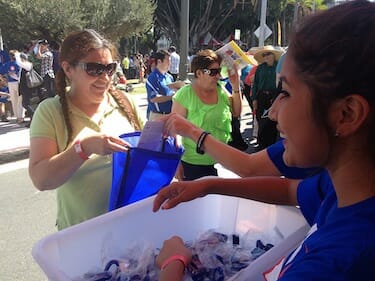
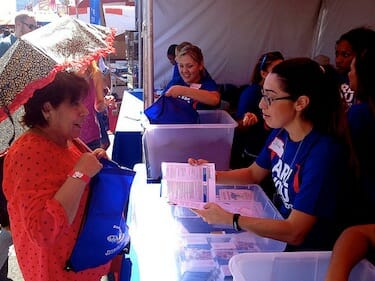
A participant at the Los Angeles tour stop receives a pamphlet for her disaster kit.
That’s the mission of the national disaster preparedness tour created by The Allstate Foundation and Points of Light. Among others, stops have included Portland, New York City, Baltimore and Savannah in the East, Baton Rouge, Houston and Indianapolis in the south and Midwest, and Los Angeles.
At the Los Angeles event September 13, dozens of volunteers from Allstate insurance agencies and Volunteer Los Angeles – part of Points of Light’s HandsOn Network – lent their time to help people get ready for all types of disasters.
“This is one stop in a 14-city countrywide campaign,” said Jan Epstein, senior manager at The Allstate Foundation. “We want to educate people on the perils they face in their particular region of the country; and we want to help them become more prepared for those times of disaster During the tour, Allstate is providing supplies to hands-on build 10,000 kits, but just as importantly, we are educating people as they build their kits and by directing them to online resources”
Folks who attended the annual Dieciseis de Septiembre (Mexican Independence Day) celebration in downtown Los Angeles worked with volunteers to build free disaster starter kits. Inside blue Allstate drawstring satchels, people placed items such as first aid kits, water bottles, emergency checklists, escape plans, battery-free flashlights, whistles and dust masks.
A bilingual volunteer speaks with an event participant in Spanish to explain the importance of being prepared.
Allstate agency owner Beatriz Zaragoza spent the day talking with people at the festival in English and Spanish. “Some of the people don’t have anything in place, because they just don’t think it could happen,” she said. “But you just never know.”
The good news is that there was a sprinkling of families who stopped by to add to what they already had at home. “I’m kinda, sort of prepared, but not like this,” said Julian Bueno from the Echo Park neighborhood of Los Angeles. “I have a flashlight, I’ve got bottled water, but not the rest.”
Patricia Garza, Allstate Foundation director of strategic philanthropy, said the foundation is focused on demonstrating how easy it can be to set aside critical items.
“Every person, and every family, deserves the chance to realize their hopes and dreams. Poor disaster preparation leads to a needless loss of lives and property,” Garza said. “Doing a few simple things, like building an emergency kit or creating an evacuation or communications plan will go a long way to keeping people safe. That’s why The Allstate Foundation and local agency owners want to get Americans thinking about preparedness, before a disaster strikes.”
Marisela Magaña of La Crescenta, California, attended the Los Angeles event to reinforce what she has been teaching her kids about disaster preparedness. The mother of five has two autistic children who need frequent reminders of what they should do in an emergency. Magaña brought her 12-year-old sons with her – Mark, who is autistic, and Jonathan, who has ADHD and severe asthma.
“Kids with special needs, you have to continuously tell them and remind them and reprogram them so they are prepared for what might happen,” Magaña said. “If they weren’t prepared, a disaster would get them into a total frenzied panic.”
Julian Bueno, from Echo Park, acknowledged the need to be much better prepared after the kit-building activity. He had no idea until the event that he’d need more than a basic starter kit. He only had one emergency bottle of water to share with his son, Christopher, in case of disaster.
“I thought I was prepared, but I guess I wasn’t,” said Bueno. “I feel more complete now.”
Three Things You Can Do to Help During the Ebola Outbreak
This post is by Colleen Clay, senior director of disaster services at Points of Light.
People respond to crisis with action, and as the world faces the first Ebola epidemic and the largest Ebola outbreak in history, that desire to help has mobilized volunteers from around the globe to serve affected communities.
A micrograph of the Ebola virus (Centers for Disease Control and Prevention)
Finding an effective way to help can be difficult when the epidemic and greatest need is in Africa, and you are not a medical professional nor in an affected area. However, you can make a difference in prevention, reduction in suffering and support for responders. Here are three steps you can take to help.
1. Get informed. Deadly epidemics are scary and misinformation can actually make things worse. The U.S. Centers for Disease Control and Prevention has the facts on risk, transmission, diagnosis and treatment, and they have multiple fact sheets for travelers and people and organizations that want to provide factual information to their networks.
Get all the facts here. Share them with friends and family and through your social networks. Click here for a great infographic you can share that communicates the most important basic facts.
2. Take action to prepare your family and household for disaster, including pandemic flu. The U.S. government’s pandemic preparedness is focused on health care system preparedness, hospitals and medical providers. But every family should have a family disaster plan and supplies, and should talk together about their family plan.
GoodandReady.org has resources available to help your family learn about and plan for all hazards. The CDC and the U.S. Department of Health and Human Services have produced guides and checklists to help your family and community prepare for flu epidemics. These guides are helpful in thinking through communicating with schools and workplaces, and ensuring you have needed supplies should an outbreak occur in your community. Click here and here for examples.
3. Help support the response to Ebola and other disasters by donating cash, goods and services, and by volunteering. The Center for International Disaster Information has useful information about how to help. Cash is the most useful assistance and CIDI has listings of nongovernmental organizations working specifically on Ebola.
There is great need for medical supplies, particularly personal protective equipment. But general donations are usually best donated to local charities. Alternatively, you could hold a rummage sale, and donate the proceeds to response organizations.
Points of Light partners with the American Red Cross and Save the Children. Both organizations are working to halt the epidemic and provide care to affected communities.
You can take action to stop the epidemic and provide needed resources to affected communities. Get informed, get prepared and share facts and resources to halt the epidemic.
What’s in Your Disaster Kit? Do You Have One?
Read about how folks in Salt Lake City, Utah, are preparing for disaster. To help your family take action, visit Good & Ready, where you’ll learn how to create a disaster plan, build a preparedness kit and more.
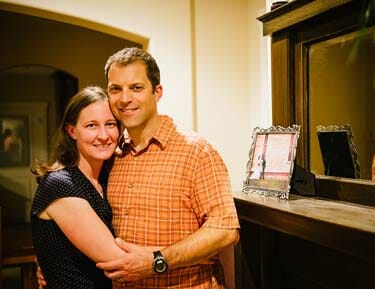
Emily and Jim Weigel stand beside the only part of their house that survived a 2010 fire, the living room mantle.
Just after lunch on July 26, 2010, Emily Weigel was startled by a banging on the front door. A neighbor warned that the house next to Weigel’s was on fire, so Weigel grabbed her baby – who was wearing just a diaper – and ran outside barefoot.
Within minutes, 10-foot-tall flames ripped into the second floor of Weigel’s Salt Lake City, Utah, home. She watched helplessly as fire burned everything in her house, grateful that at least her family was safe.
“Sure, I miss my wedding dress,” Weigel said, “but I’d rather have my husband and kids with me than a wedding dress.”
Weigel and her husband, Jim, learned that though they can’t predict when a disaster will strike, there are things they can do to prevent harm and minimize headache. Now, for example, they frequently check the smoke detectors in every room and have fire extinguishers at the ready.
To help Utahns and others around the country prepare for disasters, The Allstate Foundation and Points of Light have paired up to present a 14-city preparedness tour. After stops in Savannah, Ga., Baton Rouge, La., Colorado Springs, Colo., among other cities, the tour landed at the Hogle Zoo in Salt Lake City last Saturday.
Volunteers help Hogle Zoo visitors assemble disaster preparedness kits.
Dozens of volunteers from Allstate and Points of Light’s HandsOn Network helped hundreds of Utahns build free disaster kits, which contained first-aid kits, cleaning supplies, battery-free flashlights, emergency planning checklists and several other items. They assembled more than 500 kits in less than two hours.
“The thing that is unique to Utah is that we have seasonal disasters,” said Gavin Seal, a Salt Lake City Allstate agency owner. “We have the wildfire season (June through October) and those living in the foothills or the mountains face that risk. Then, we move into winter. Last year, we had a series of extreme cold temperatures, which can cause a lot of destruction – from plumbing freezing to power outages. And finally, there’s the underlying risk of a catastrophic earthquake at any time.”
According to FEMA, 85 percent of Americans are unprepared for disaster, which can lead to the unnecessary loss of property and lives, Seal said.
The educational component of the event was helpful for Casey and Jillian Koon, who were reminded that they need to have clothes packed for themselves and their two children.
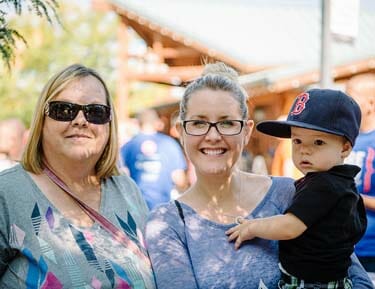
Autumn Shaw, center, came to learn about disaster preparedness with her mother, Paula, and son, Boston.
“They were helpful in telling us what extra supplies to pack, what things to think of and what to use in case of an emergency,” Casey Koon said. “Having kids heightens your awareness and definitely raises more concerns about making sure you have everything you need in case of emergency.”
Many locals receiving kits said they had previously either done nothing or too little to prepare. Autumn Shaw, who attended the event with her mother, Paula, and son, Boston, said she was not prepared for a disaster and was surprised about some of the items in her starter kit.
“I never thought about having a garbage bag and using that as a poncho or for sanitary reasons,” Shaw says. “I think that’s one of the last things you think about when you think about being prepared in an emergency – ‘Where am I going to go to the bathroom?’”
Supplies in preparedness kit were just a start. Volunteers encouraged Shaw and others to add food and water. The recommendation for a standard 72-hour kit is one gallon of water per person per day and food that is dehydrated and plentiful.
“It’s so simple,” Shaw said. “It’s just a matter of doing it.”
Memories of Hurricane Sandy and Recent Floods Bring Long Islanders Out to Prepare
Read about how folks on Long Island, N.Y., are preparing for disaster. To help your family take action, visit Good & Ready, where you’ll learn how to create a disaster plan, build a preparedness kit and more.
Hear what Colleen Popp learned about disaster preparedness after Hurricane Sandy severely damaged East Rockaway, N.Y., home. (Click photo.)
For her 50th birthday in 2012, Colleen Popp and her best friend headed to New Orleans to celebrate. She remembers being shocked by the lasting effects of the devastation caused by Hurricane Katrina in 2005.
“Everything was either new construction, still in disrepair or just desolate,” she said. “I just remember us looking at each other and thinking, could you imagine?”
Six weeks later – while sitting in the living room of her East Rockaway, N.Y., home watching Hurricane Sandy blow into town, water rushed in – sending her, her husband and two grown kids scurrying to the second story of their home.
It only took a few hours for the storm to destroy the first floor.
The Popps thought they were prepared – they had moved their cars to higher ground, had flashlights, candles, food and water on hand, and moved most of their electronics up to their second floor.
Lidia Fajardo of Franklin Square, N.Y., and Elizabeth Gosioco of Bayside, N.Y., show off their disaster kits.
“I thought we were just going to get it on the floor, I didn’t think to empty out the cabinets or counters,” she said.
According to Jan Epstein, senior manager of the Allstate Foundation, the Popps are not alone. “Only 15 percent of Americans are prepared for a disaster, which means that 85 percent are not,” Epstein said.
The Allstate Foundation and Points of Light hope to change that. This summer, they launched a 14-city disaster preparedness tour to help people take action. Last Saturday, the tour came to Long Island at Eisenhower Park, taking place before a free KC and the Sunshine Band concert.
“We want to give people the tools they need to take care of themselves and their families,” Epstein said.
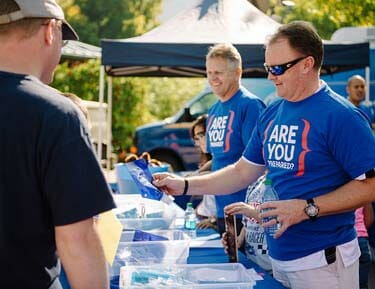
Hundreds of Long Islanders lined up to create more than 750 free disaster preparedness kits. The kits include flashlights that don’t need batteries, dust masks, ponchos, first-aid kits and whistles. Volunteers from Allstate and the Long Island Volunteer Center, part of Points of Light’s HandsOn Network, provided tips and advice as they gave out the items.
Allstate agent Christina Shaw, second from left, hands out supplies for disaster preparedness kits.
The event was just what friends Elizabeth Gosioco, Lidia Fajardo and Marilyn Jara – who are admittedly part of the unprepared 85 percent – needed.
With the recent storms hitting Long Island – Hurricane Sandy in 2012 and even the recent heavy rains that flooded many parts of the island just two weeks ago – they know that complacency is not an option.
“It happens so unexpectedly,” Gosioco said, shaking her head. She said she worries about what she would lose if her neighborhood flooded, her basement filled with 30 years of memories.
Now, the friends say they’ll take preparations more seriously. “This is a good start,” said Jara, pointing to their newly prepared disaster kits.
Diana O’Neill, executive director of the Long Island Volunteer Center, said she hopes that the event helps people realize that being prepared can offer some semblance of control at a time when many feel powerless.
“It’s up to us to be responsible for our preparedness, our response and the recovery,” she said.
Mary Halcott of Hicksville, N.Y., said that after Sandy, she faced extra challenges in caring for her elderly mother. “I came because I wanted to see if there was anything new to learn,” she said, adding she now knows how much water she should have on hand – one gallon per person for at least three days.
While the kits provide many items needed during a storm, Allstate agent Christina Shaw said it is only a start.
“Every family needs to really sit and think about their own personal needs – including medicine, how much water they may need – and really make it their own,” she said.
Shaw knows firsthand how devastating a disaster can be. She was six months pregnant with her daughter when five feet of water barreled into her home in Long Beach during Sandy. Her Allstate office was also without power, so she set up shop behind a Starbucks to help her customers file claims.
“Even if you weren’t directly affected or hit, almost everyone knew someone who was,” Shaw said. “We need to be prepared – especially because right now we are in the height of hurricane season.”
As for Colleen Popp and her family, it took them a year to renovate their home. Their neighborhood is still struggling to recover. Walking the quiet streets, many houses are still under construction, some have been leveled and others are still vacant.
“We were lucky. We didn’t lose our cars, we didn’t lose our jobs,” Popp said. “These are just things. And we are all fine.”
One Candle Destroyed Everything – Teaching a Lesson About Preparing for Disaster
Read about how folks in Maryland are preparing for disaster. To help your family take action, visit Good & Ready, where you’ll learn how to create a disaster plan, build a preparedness kit and more.
Robbie Horwitz reflects on the lessons she learned after fire destroyed her Linthicum, Md., house. (Click photo.)
The door to Robbie Horwitz’s childhood home was boarded up. That was the first thing she noticed when she returned from a hiking trip to the split-level house that she shared with her mom in Linthicum, Md., near Baltimore.
The windows were broken, too, and there was the deep, pungent smell of smoke.
Then Horwitz remembered: She had left a candle burning on a table in the living room.
Horwitz tears up as she recalls that day. The home “was the only place I had ever lived,” she says. But after the fire, “every object was covered with a greasy, dirty film. … I had this baby quilt that I had since I was little. That disappeared and it was irreplaceable. I felt like [the fire] ended a section of my life.”
Horwitz says her family wasn’t prepared. The smoke alarm did not have working batteries. Papers were scattered, the important ones mixed with those they didn’t need.
An event participant makes her way down the disaster kit assembly line, as volunteers help her complete her kit.
To prevent more stories like Horwitz’s, the Allstate Foundation and Points of Light have teamed up for a 14-city tour to encourage emergency preparedness. “Eighty-five percent of families aren’t prepared for a disaster,” says Shelva Clemons, an Allstate spokesperson. “We want to be in the community to raise awareness.”
On Aug. 15, volunteers from Allstate and Business Volunteers Maryland, an affiliate of Points of Light’s HandsOn Network, helped people assemble 500 disaster preparedness kits – filled with first aid kits, hand sanitizer, empty water bags, flashlights and more – at the Waterfront Partnership of Baltimore’s summer social in the city’s Inner Harbor.
While the band New Romance performed a catalogue of 80s hits and children blew bubbles nearby, volunteers explained to guests why each item is needed as they filled their bags.
Althea West
Locals, as well as visitors from Pittsburgh, Houston and other cities, said that they were most surprised to learn that water that isn’t commercially bottled has an expiration date. It should be replaced every six months. Some were also happy to see that each kit contained a checklist showing items for a complete disaster kit.
For Dawn Reed, the event hit close to home. Reed’s aunt lost everything in Hurricane Sandy after her house flooded. She had to evacuate her home on Staten Island, N.Y., heading to Brooklyn to live with her daughter for a year while her house was rebuilt. (Click here to hear what Reed learned from her aunt’s experience.)
Sandy hit Marylanders hard too, especially in coastal regions. Many areas are prone to flash floods throughout the year because of the frequent thunderstorms that are common in the state. These flash floods, which are considered dangerous because people aren’t expecting them, occur within six hours of a rain event.
To prepare for these times when it’s a challenge to get to stores, Maryland resident Althea West keeps a stash of water and canned goods. “It’s a small one,” she says, adding that the little things that you set aside make a difference. West has learned from experience: She’s been stranded inside during blizzards in the past.
About the emergency preparedness event, West says, “Everybody needs this.”
17 Tornadoes and a House Fire Would Get You Thinking About Getting Prepared, Too
Read about how folks in Maine and Texas are preparing for disaster. To help your family take action, visit Good & Ready, where you’ll learn how to create a disaster plan, build a preparedness kit and more.
Audrey Castro
As a child, Audrey Castro survived tornadoes and a house fire, shaping how she and her family prepare for emergency.
“With my husband and kids, we’ve always had an escape plan,” said Castro, 53, who lives in Cape Elizabeth, Maine, a suburb of Portland, with her husband and children, ages 18 and 21. “When they were little, our kids knew what to do if they heard a smoke alarm go off. We bought ladders to hang from their bedroom windows to be able to get out, and they knew to head to a neighbor’s yard to a particular tree. We made them take a first-aid class.”
Nearly 60 people died on April 21, 1967, when 17 tornadoes hit northern Illinois in one day. With the sky darkening and alarms sounding, Castro – 6 at the time – and her family rushed to their basement safe room to cover themselves with mattresses. Five years later, while living in Portland, a middle-of-the-night fire caused by a cigarette ember in a trash can forced Castro’s family out of the house, fleeing heavy smoke. In both cases, they survived, unharmed.
Today, Castro’s family takes no chances: “Everyone in our house has a flashlight on their nightstand, and they’re in the bathrooms. We have gallon jugs of water in the garage, along with snacks. It’s the same thing with our cars. We have our valuable belongings videotaped. It’s just better safe than sorry … because you just never know what’s going to happen.”
Carlos Libby of West Gardiner, Maine, at the Portland disaster preparedness event, explains why he feels preparing for disaster is critical. (Click photo for video.)
That was the message relayed at recent disaster preparedness events in Houston and Portland, Maine. The
and Points of Light have teamed up for a 14-city tour to help people around the country become better prepared for emergencies.
People attending these events – with the help of volunteers from Allstate and affiliates of Points of Light’s
– assembled starter disaster preparedness kits. Participants received blue bags to fill with kit items and attentively listened as they made their way down a line, as each volunteer explained an item to add to their kits.
The donated kits included items such as a whistle, a flashlight that doesn’t require batteries, a mini first-aid kit, a poncho, a mask to wear if debris is in the air, a water receptacle, a trash bag, hand sanitizer – and brochures and handouts that provide a variety of emergency information.
“The event today is just to remind people that disasters occur,” said Adam Pisani, an Allstate agent in Sugar Land, Texas, who volunteered at the July 26 tour stop at the
. “They occur when we least expect them. And so being prepared is very important,” Pisani said.
A participant at the Houston disaster preparedness event gets help filling his disaster kit from a volunteer.
At the July 29 Portland event, held at a Sea Dogs minor league baseball game, Allstate spokesperson Julia Reusch noted that only about 15 percent of Americans would be considered prepared for a disaster, and these educational events aim to change that.
The goal is to teach people how to “build a kit that will help them be prepared and have enough to sustain them for 72 hours in the event of an emergency,” Reusch said.
Event participants said they appreciated the opportunity to learn about, think about and prepare for disaster.
Kristen Lue King, who put a kit together with her 9-year-old daughter at the Houston event, said the exercise was a great lesson for her child: “This helps show her that while there’s a reason for concern, there are some practical things you can do.”