`In Case There’s an Act of G.O.D. – Get Out of Dodge – I’m Ready’
Read about how folks in Oregon and New Jersey are preparing for disaster. To help your family take action, visit Good & Ready, where you’ll learn how to create a disaster plan, build a preparedness kit and more.
Emily Johnson
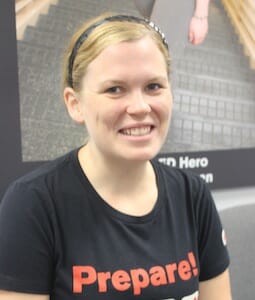
Emily Johnson was a child the first time her family outran a hurricane. Its name was Erin, and when it struck the Florida panhandle in the summer of 1995, it sent her family – Emily and three of her siblings, her parents and grandparents, plus the family dog – on a drive across Alabama to a friend’s farm.
But one month later, when Opal struck blowing at 115 miles an hour, the Johnsons only got as far as a high school gym. Emily vividly recalls waiting out the storm on a cot while disaster relief volunteers provided aid.
“Having that experience of being afraid and not knowing what to do, it really inspired me to be able to know – `What should I do if there’s an emergency? How can I be more prepared and more resilient afterwards?’” she said.
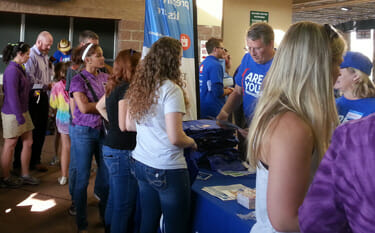
Johnson is now an AmeriCorps member serving on a disaster action team for the Red Cross in Portland, Ore. She came out last Saturday to help out at the Portland stop along a 14-city Allstate Foundation and Points of Light disaster preparedness tour, which also hosted an event that day in the Philadelphia area. At both tour stops, volunteers from Allstate and affiliates of Points of Light’s HandsOn Network helped participants assemble free disaster preparedness kits and learn about emergency readiness.
The kits included flashlights, ponchos and whistles, among other vital items. Research shows 85 percent of Americans are unprepared.
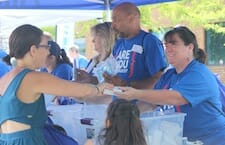
Volunteers talk to attendees of the disaster preparedness tour stop in Portland, Ore., about what to have on hand in case of an emergency.
Sam Workman, an Allstate agent from West Linn, Ore., who volunteered at the Portland event at the Oregon Museum of Science and Industry, said the effort was intended to spur resiliency: “This is to get people thinking about how to be more prepared. We’re trying to keep them hydrated and dry, with some basics in case of an emergency.”
At the Philadelphia-area event, at the Burlington County Farm Fair in New Jersey, Kevin Mass recalled a time when being prepared helped save time when it mattered. He was asleep when he heard the rap rap rap of police officers knocking on his door at 2 in the morning.
“We live on the Rancocas Creek and it floods a few times a year,” he said. “But this time, they were suggesting that we move our cars and voluntarily evacuate. We didn’t think twice. And, I was glad we did – a little while later, there was a gas leak.”
Fortunately, Mass has always been what he terms a “prepper” – “In case there’s an act of G.O.D. – get out of Dodge – I’m ready,” he said with a laugh. So he gathered everybody together, grabbed a few bags packed with provisions for his family and pets – including clothes, food, water and medicine – and left his home.
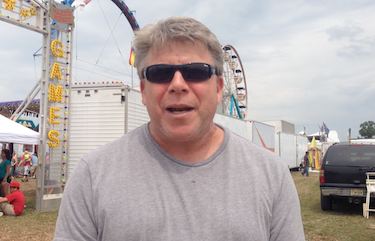
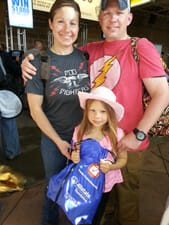
Kevin Mass shares how he has prepared for disaster and why he brought family and friends to a disaster preparedness event in New Jersey.
That Mass is the kind of guy who can never be too prepared was evident at the preparedness event. After he and his family took in the amusement rides, cotton candy and fluffy animals at the fair, they joined the disaster kit assembly line.
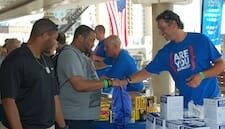
“I wanted to see if there was anything that I hadn’t thought of,” he said. Reaching into a blue nylon backpack with the words “Are You Ready?” emblazoned on it, he pulled out a small crank-operated flashlight that doesn’t require batteries. “I like this – it’s pretty genius!”
At the two events combined, volunteers and attendees assembled more than 1,000 kits.
The items were starting points, the volunteers emphasized. They also encouraged participants to create a household emergency plan including contact names and phone numbers, medical and insurance information and an agreed-upon family meeting place.
“We didn’t have anywhere to go, so we ignored the warnings,” said Tiffany Watkins, a survivor of a tornado that ripped through Tuscaloosa, Ala., a few years ago. Now that she lives in New Jersey, she said, she knows where she’s going should she ever be told to evacuate: back to Alabama, where she has family.
“Once you see someone’s house being smashed flat,” she said, “it’s too late to realize that something bad is really happening and you shouldn’t be there.”
Are You Part of the Unprepared 85 Percent?
Read about how folks in Tampa, Fla., Indianapolis and Baton Rouge, La., are preparing for disaster. To help your family take action, visit Good & Ready, where you’ll learn how to create a disaster plan, build a preparedness kit and more.
Kevin Sloan, center, and one of his sons receive a disaster preparedness kit in Tampa, Fla.
Charley, Frances, Ivan, Jeanne. Anyone who lived in the Tampa Bay area in 2004 remembers them well – the four hurricanes that battered Florida in less than six weeks.
Luckily the area was mostly spared, suffering power outages and some flooding. Those who moved to the area in the last decade have no memory of the constant hurricane watches and warnings that left people on edge for weeks. And even many who lived in the area during the storms have let their guards down.
“We want to engage people to get them to think about a hurricane,” says Gus Rodriguez, an Allstate insurance agency owner in Belleair Bluffs, Fla. “Everybody’s complacent. We live in hurricane alley.”
Rodriguez was one of the Allstate agents taking part in a disaster preparedness event last Saturday before a Tampa Bay Storm arena football game. The event was part of a public awareness campaign and 14-city tour brought to town by the Allstate Foundation and Points of Light. On the same day, the tour also stopped in Indianapolis at PBS KIDS in the Park and Baton Rouge, La., at the Mall of Louisiana.
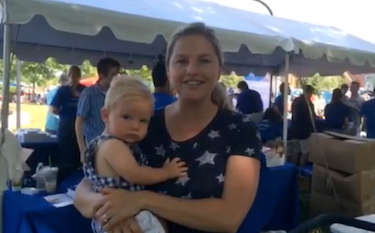
Sheila Ungerer of Indianapolis, holding her son Will, shares what she learned during a disaster preparedness event.
During the events, with the help of volunteers from Allstate and local affiliates of Points of Light’s HandsOn Network, participants assembled their own disaster preparedness kits using items provided.
In blue sacks, the kits included water bottles, hand-powered flashlights that don’t require batteries and other essentials. Participants and volunteers put together more than 2,000 kits at the three events combined.
“Eighty-five percent of us are not prepared for disaster,” said Ranj Puthran, an Allstate agent from Carmel, Ind., who volunteered at the Indianapolis event. “We’re so comfortable, and our first responders are so good, that I think we’re almost lulled into comfortableness instead of preparedness. We need to take more initiative.” (See a short video of Puthran here.)
The Indianapolis tour stop had special meaning for Emily Gilliland, executive director of HandsOn Network. An Indiana native, she has lived through two tornadoes.
“In 1979 I remember being at my grandmother’s house in Westport, Ind., and saw a tornado coming down the street,” Gilliland said. “My aunt’s house, halfway down the block, was hit. The roof was taken off.” (See a short video of Gilliland here.)
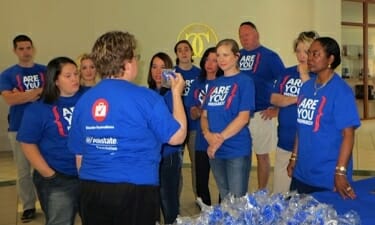
Baton Rouge, La., volunteers are briefed on how to assemble disaster preparedness kits.
As Gilliland spoke, people were lining up behind a row of tables at the Allstate booth, waiting to assemble their free preparedness kits. As they picked up the items volunteers explained the significance of each in an emergency situation.
The kits also included cards about tornado safety and other information, such as the need to have enough supplies on hand for at least three days in case of an emergency or disaster. Basic supplies include a gallon of water per person and non-perishable, easy-to-prepare food.
Sheila Ungerer, who moved to Indianapolis four years ago, learned at the event in her city about each of the items in her new disaster kit, which included a whistle.
“I’m from Virginia and my husband is from Syracuse, N.Y., and we know that tornadoes can happen here,” said Ungerer. “I came away with some good tips. I didn’t know about the whistle – that three short bursts means `help.’ That’s not only good for me, but good in case I ever hear it.”
Having a kit is only part of being prepared, the participating Allstate agents in all three cities said. Also having an emergency plan in place is critical. If your town imposed an evacuation order, would your family know what to do?
“Education is a part of planning,” said Baton Rouge volunteer and Allstate agent Agnes Andrews. “Education will take care of a lot of the problems that could occur in a disaster, because if you have things in order, you’re less likely to have problems.”
Along with emergency kits, “be sure to include some cash, not to be touched except in the event of a catastrophe like a hurricane,” Andrews added.
Beth Dudley of Natchez, La., was visiting the mall on the day of the Baton Rouge event. “I stopped by to get a kit,” she said, “because you can never be too prepared for an emergency. I’ve never experienced a natural disaster, so it’s great that this event provides all the basic things people might need.”
Turning Complacency Into Action When it Comes to Disasters
Read about how folks in Savannah, Ga., are preparing for disaster. To help your family take action, visit Good & Ready, where you’ll learn how to create a disaster plan, build a preparedness kit and more.
Barbara Moss-Hogan of Savannah, Ga., who moved from New Orleans after Hurricane Katrina, is prepared in case she experiences another hurricane.
Barbara Moss-Hogan hears a familiar complacency among friends and coworkers living in Savannah, Ga., a coastal city that’s been spared by major hurricanes for more than a century.
Their talk brings back memories of the bizarre items she and her friends took while evacuating New Orleans ahead of Hurricane Katrina.
A string of pearls and a bathing suit were all one friend brought. Others grabbed a sewing machine, a set of golf clubs, a ball gown.
“People don’t realize what you’re supposed to bring,” said Moss-Hogan, a social worker who moved to Savannah shortly after fleeing New Orleans in 2005. (Click here to hear her advice.)
Volunteers from Savannah-area Allstate insurance agencies and United Way Hands on Savannah last week paired up to help inform residents as part of a 14-city disaster preparedness tour, brought to town by the Allstate Foundation and Points of Light. Volunteers set up tables on May 31 outside a Savannah Sand Gnats minor league baseball game to help hundreds of Savannah residents build free disaster kits.
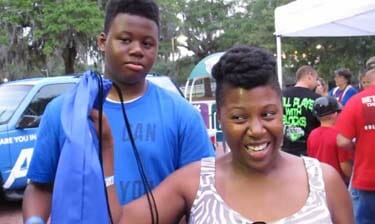
An event attendee, showing her new disaster preparedness kit, talks about getting ready for disaster before it happens. (Click image to watch video.)
They helped participants assemble close to 450 kits containing flashlights, first aid kits, cleaning supplies, checklists for emergency planning and other items proven to keep people safe and prepared.
Many locals receiving kits said they had done little to prepare.
“I’m not as prepared as I should be,” said James Ricks, whose home has flooded three times during tropical storms.
Girl Scout troop leaders Tara Trappio and Evelyn Ragland confessed they, too, weren’t ready for a weather emergency.
“Some of this stuff I have – the flashlight, the first aid kit and the water bottles – but that’s about it,” said Trappio. Ragland recalled evacuating the city because of an approaching storm in 1999. “I wasn’t prepared at all. Everything went too fast,” she said.
Coastal Georgia has enjoyed decades with rarely a tropical storm. Despite 100 miles of coastline, Georgia hasn’t taken a direct hit from a hurricane of Category 3 or greater strength (winds of 111 to 129 miles an hour) since the late 1890s.
The Rev. Kevin Veitinger of Savannah, Ga., moved his family to higher ground not long after helping to pushing cars out of waste-high waters near their rental home.
A hurricane evacuation study commissioned in 2012 by the Federal Emergency Management Agency and the U.S. Army Corps of Engineers found that many coastal Georgia residents underestimate the vulnerability of their homes to storm surge. Some said they plan to ignore evacuation orders.
Preparing for a hurricane starts with deciding whether to evacuate and where to go should evacuation be recommended. Basic supplies to have on hand include a three-day supply of water – one gallon per person – and non-perishable, easy-to-prepare food. Some families may also need to stock up on medications, baby supplies, pet supplies and copies of personal documents.
“I think the threat isn’t taken as seriously as it should be,” said Marianne Fischer, a Savannah native and Allstate insurance agent who volunteered at the ballpark event to build disaster preparedness kits.
Savannah residents who the recall the area’s only evacuations in recent history – for Hurricane David in 1979 and Hurricane Floyd in 1999 – usually talk of the hours of stalled traffic on the interstates. David hit the city but caused minor damage, while Floyd bypassed Georgia.
Though hurricanes are rare, more Savannah residents are familiar with flooding after heavy rains and high tides have overwhelmed parts of the city’s extensive canal system.
The Rev. Kevin Veitinger moved his family to higher ground not long after spending a rainy afternoon pushing cars out of waste-high waters near their rental home. A United Methodist minister from south Florida, Veitinger takes the hurricane threat in Savannah seriously. (To hear his advice, click here.)
He and his family experienced Hurricane Wilma in 2005, back when they lived near Fort Lauderdale, Fla. The storm took off the roof of his church and left his neighborhood without power for a month.
He doesn’t want to relive that experience in Savannah.
“The city is almost 300 years old,” he said. “If a Category 3 was predicted for Savannah, I’d be out of here.”
Would You Know What to Do if a Fire, Tornado or Other Disaster Was Headed for You?
Read about how folks in Colorado Springs, Colo., are preparing for disaster. To help your family take action, visit Good & Ready, where you’ll learn how to create a disaster plan, build a preparedness kit and more.
Deanne Ladefoged stands on the Colorado property where her house, destroyed by fire, used to be. Her family is rebuilding.
On a sunny day last June while having lunch with friends, Deanne Ladefoged got word through a cell phone text that she needed to return home – immediately. The fire that had erupted that day in Black Forest, a heavily wooded rural community northeast of Colorado Springs, Colo., was headed for her home.
“Luckily we had learned a lot from Waldo,” a 2012 canyon fire, she said. “We already had all of our important papers, titles, birth certificates in a fire-proof box. We also had the photos all in one place set aside.”
Ladefoged’s family had 30 minutes to evacuate. “By the time I got home,” Ladefoged said, “I was able to grab the videos of the kids, a handful of clothing, a little bit of jewelry, medications, the dogs and dog food. Then we left.” Her son grabbed the photos and box with the documents. The fire destroyed their home – along with about 500 others – but the family made it to safety.
The Lasley family – Marissa, Jeff and 6-year-old daughter Skyler – put a disaster kit together at the Colorado event.
The lesson: Be prepared.
To help people across the country do just that, The Allstate Foundation and Points of Light last week launched a 14-city disaster preparation tour. Participants put together their own disaster preparedness kits with materials provided – including flashlights that don’t require batteries, first aid kits and other essentials – and learn strategies they can use. The campaign’s first stop was in Colorado Springs on May 21, at a minor league baseball game. Other stops include Savannah, Ga., Baton Rouge, La., and Los Angeles.
“Nobody ever thinks it’s going to happen to them,” said Tamie Farris, an Allstate agent Colorado Springs. “Even with fires happening here two summers in a row, people have short memories.”
In fact, according to Jan Epstein, senior manager at The Allstate Foundation, a sponsor of the Good & Ready preparedness campaign, 85 percent of Americans are unprepared to deal with a disaster. And that number has not changed from 2012 or 2013.
Epstein said of the Colorado Springs gathering, “This is much more than a kit-building event, it’s an educational opportunity. We have to take action before disaster strikes. If we don’t, where will we be?”
Event participants line up to create their disaster preparedness kits with the help of Allstate agent volunteers at Security Service Field in Colorado Springs, Colo.
Several Colorado Springs-area Allstate agents volunteered at the event by explaining to the participants the significance of each item in the kits. Ashley Simpson, with the Cally O’Donnell Allstate Agency, handed out water bottles. She explained the importance of having an ample supply of water and being aware of expiration dates.
Many participating in the event at Security Service Field, home of the Sky Sox, admitted they would not be ready if disaster struck. Chris Vrana, a 19-year resident of Colorado Springs, said, “I do have a family and I do want to be aware. I think we think it won’t happen to us, but it does happen to people, so I think I need this. The fire in Black Forest was scary. … At the time it made me think I should start doing something, but of course I didn’t. I’m glad this (event) is getting me thinking about it again.”
Farris, the Allstate agent, said she’s made disaster preparedness kits for her family for 20 years. She calls them 72-hour kits, because they contain items that would provide aid in the first 72 hours following a disaster.
A few creating kits said they are comfortable with the plans their families have put together should fire strike again. But they said they still learned something new.
Jonneen Kistler, a 21-year resident of Colorado Springs, said her family has a disaster plan and has set aside water, batteries, extra food and more. Nonetheless, she was putting together a bag with her children because she said it was important to keep thinking about being prepared. She added, “We didn’t have a whistle or filtration masks. Now we do. I didn’t think about those before.”
As for Deanne Ladefoged and her family, they’re breaking ground on their new home in the same location. They have already planted 110 seedlings and spread grass seed around their once forested property. They spend as much time as possible clearing debris and dead timber from the land.
“The experience made me realize I could become a bitter or a better person. I want to be a better person,” Ladefoged said, adding that while you can never prepare for every contingency when it comes to disaster, “you can do some things that help make a difference.”
She Grabbed What She Could and Got Out
This post is by Eric Nankervis, program manager of disaster services at Points of Light.
Izola Nichols tells her story during last Saturday’s disaster preparedness event in Birmingham, Ala.
As Izola Nichols stood in her house, floodwater rising up her calves, she remembered the words she heard during a preparedness training session two weeks prior: “Grab your medicines and prescriptions. Get your purse and passwords. Grab your evacuation kit and a change of clothes. And get out!”
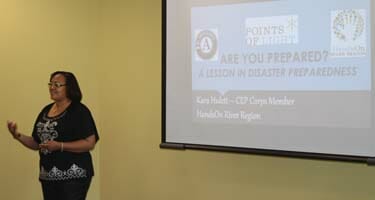
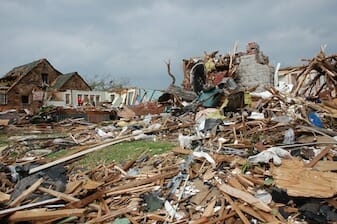
The training was one of a series led by Kara Hulett, a Points of Light Community Emergency Preparedness Corps member, in the Pratt City neighborhood of Birmingham, Ala. No stranger to disasters, Pratt City was devastated by tornadoes on April 27, 2011. Hulett’s presentation focused on tornado awareness and safety, but as Nichols witnessed, one needs to be prepared for anything, at any time.
“I knew the hazards of a tornado,” Nichols recalled, “but was I prepared for a flood?”
She had stayed up all night with her husband, a local pastor, watching the weather and monitoring for signs of a tornado. Only after the storm blew over did they get to sleep. At 4 in the morning the pastor was awakened by a strange noise. As he got out of bed to investigate, his feet hit water.
Birmingham, Ala., Mayor William Bell talks about the importance of preparing for disaster.
The April 7 storm flooded the nearby creek and water was gurgling through the home’s floorboards. He went outside and witnessed the water continuing to rise – off of the front steps the water was up to his waist.
The pastor waded through the rising water to get the family’s small boat as Nichols gathered their supplies. “You prepare for one hazard, and forget there are others,” she said. “But I knew what to get. There are only a few things you can grab and you only have a few precious minutes.”
Nichols credits Hullett’s presentation for helping her family prepare for the flood. The training Hullett offered is part of her service as an AmeriCorps member. Serving at HandsOn River Region in Montgomery, Ala., Hulett had partnered with Birmingham City Council member Marcus Lundy and Hands On Birmingham to better prepare the citizens of Pratt City in the event of another disaster. (HandsOn River Region and HandsOn Birmingham are part of the Points of Light’s HandsOn Network.)
“Storms in life do come,” said Lundy. “How you prepare is what is important.”
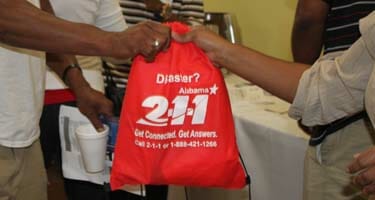
Birmingham, Ala., residents receive disaster preparedness kits at last Saturday’s event.
Since the 2011 tornadoes, Pratt City has been rebuilt with new homes with storm cellars and new infrastructure, including a new library and fire station. Yet more than a third of the residents did not return.
“The majority of the people have hung in here. They have endured,” Lundy said. “And these trainings cannot be more important. “
The Nichols family’s story proves it. Nichols and her husband were able to take their son, their dog, a few precious belongings, a disaster kit and what they learned at the preparedness training to evacuate their house safely. Lundy invited Nichols to share her story last Saturday at another disaster preparedness training session, as a part of a tornado memorial day in Pratt City.
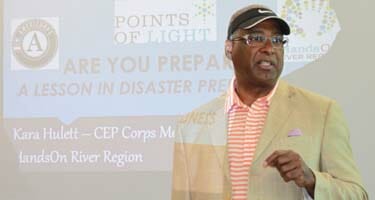
With basic disaster kits provided by Lundy, HandsOn River Region and HandsOn Birmingham – all assembled by local schoolchildren – the training session was kicked off with welcoming remarks by Birmingham Mayor William Bell, who praised the timing of the training and warned residents of the potential of tornadoes that followed earlier this week.
Fortunately, Pratt City was spared this time but its citizens are ready. “Being prepared on the top end is vital,” Nichols told those at the training event, again led by Hulett. “You will learn what you need to get, and when you need to get out.” And sometimes, that is just in time.
The Community Emergency Preparedness Corps is an AmeriCorps program implemented by Points of Light, with funding from The UPS Foundation and the Corporation for National and Community Service. With 22 members serving in 13 sites across the United States, the program helps Americans better prepare for and recover from disasters.
Here’s How You Can Help Tornado Victims
Beginning on April 27, a dangerous storm system sparked a series of tornadoes causing extensive damage and power outages across the central and southeastern United States. The severe storm threat continues as the storm systems move east.
Points of Light’s HandsOn Network is the expert in volunteer engagement and our affiliates often lead their local communities in managing spontaneous, unaffiliated volunteers throughout response and recovery efforts. Points of Light is coordinating with HandsOn Network affiliates in the affected areas and connecting with Voluntary Organizations Active in Disaster (VOAD) chapters across the U.S. to assess the situation and offer support.
If you would like to support the recovery effort, here’s what you can do to help:
PLEASE DON’T:
Don’t self-deploy at this time. The situation is still critical and travel is extremely difficult or impossible throughout much of the affected area.
Don’t bring supplies or donations to fire stations, police departments, etc. First responders need to focus on immediate needs and emergency situations.
PLEASE DO:
Do donate to help Points of Light and HandsOn Network affiliates support the mobilization of volunteers in ongoing response and recovery efforts.
Do register your interest to volunteer on All for Good and check this page often for the latest updates on how you can help. (For Alabama, Mississippi and Arkansas, include the words “spring 2014 tornados” in the Volunteer Opportunity Name. For Alabama coastal and Florida coastal responses you should include the words “spring 2014 flood” in the Volunteer Opportunity Name.)
Do be prepared! As the devastation caused by these tornadoes reminds us, disasters can happen anytime, anywhere. Please take steps now to help your family and community recover more quickly from disasters. Visit www.goodandready.org/resources to download an emergency preparedness checklist and create a disaster readiness plan for your family.
What Is it About Disaster That Brings Out the Best in People?
This post is by Tracy Hoover, president of Points of Light.
Like many in Atlanta, I’m snowbound today. This week’s rare snowfall – a disabling two inches – hit our city and triggered a massive traffic jam, the kind that only happens when more than 1 million people rush home at the exact same time, on the exact same slick highways.
Tracy Hoover
After more than six hours in my car – to make an eight-mile commute home – I can tell you that when the sun sets on Atlanta’s icy overpasses, behemoth trucks stall and 10 lanes of traffic screech to a halt. For days! Abandoned cars and stranded motorists created an impossible crisis, the scale of which even hundreds of tons of sand, fast and coordinated government action, and the National Guard couldn’t match.
But people could. Many of those who abandoned their cars to walk miles in the cold stopped to check on those who couldn’t. They shared jackets and helped the elderly, children and those in frail health move into cars with gas and heat. Some good Samaritans got home, then walked back to the highway with blankets, flashlights, hot chocolate – and hope.
Michelle Sollicito, a tech contractor in Marietta, Ga., quickly created a Facebook page, “SnowedOutAtlanta,” that became a fast sensation. The site connected stranded motorists with nearby strangers offering a place to stay, a gas can, a cell phone with power or help moving a car out of the way.
As volumes of stories like these unfold, I’m reminded of how effectively and immediately Americans respond in times of disaster.
I should have been in Washington, D.C., today attending a meeting of America’s Promise Alliance. Instead, I’m listening by phone to the Alliance’s trustees talk about their heroic efforts to reduce the dropout crisis – efforts that are working and that could be accelerated by increases in public and private investment and a large-scale citizen response.
The connection between Atlanta’s storm and America’s schools is clear me. We have to do a better job of tapping the urgency and limitless reservoir of good will and citizen service that we see during weather disasters to meet the everyday disasters of failing schools, struggling families and the catastrophic effects of poverty.
What would it take for good people everywhere to see children with everyday needs in the same way they see children in the back seat of a snowy car that’s spun off the road?
Here in Atlanta, it’s been painfully clear that government can’t do it all, and just as clear that people can do a lot. That’s a lesson worth remembering long after the last icicle melts.
Thank you for your service – today and every day.
Three Things You Can Do Right Now to Help Colorado Flood Victims
Today’s post is by Kristy Judd, executive director of Metro Volunteers, a HandsOn Network affiliate in Denver. See the end of the post for recommendations from Points of Light about how you can help.
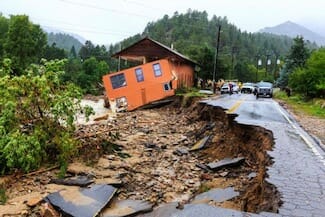
Floods have devastated parts of Colorado,
including this stretch of road in Jamestown.
Colorado is one of those states where collaboration and cooperation matter a great deal. We have small communities with limited capacity to manage large scale disasters. Together, we’re stronger.
The volunteer centers in Colorado have adopted that same philosophy when tasked with managing spontaneous, unaffiliated volunteers, especially when multiple incidents are happening concurrently. For that past five years, our Colorado Volunteer Center Network has worked together to develop the Volunteer Coordination System. Crafted by phenomenal VISTA members, this scalable program can be implemented remotely with Internet connections. It gives us the ability to have Aimee Liotino in Colorado Springs support Sue McCullough in Boulder. Or Emma Woods in Greeley support Jami McMannes in Fort Collins.
Even though we’re in a state where disasters aren’t frequent, when they hit, they are devastating. That our network took the time to develop this system, train our staff and establish clear communication tools has given us the ability to be the “go to” organization. While we’re the quiet, behind-the-scenes group, we have the opportunity to put citizens to work to help their neighbors in meaningful and impactful ways.
This work is important. Sign up to volunteer with your HandsOn Network affiliate and please, also write them a check. Without their organizational skills and knowledge, much of the work in communities to recover from a disaster wouldn’t happen.
Here are three things you can do to help Colorado’s flood recovery efforts:
Register your interest to volunteer here. (Please do not self-deploy to affected areas.)
Be prepared! Visit www.goodandready.org to download an emergency preparedness checklist and create a disaster readiness plan for your family.
The Most Important Shopping List You’ll Make This Weekend
A flashlight with extra batteries. A first-aid kit. A three-day supply of water. Add these items – and a few others – to your weekend shopping list, and you’ll be taking a big step toward helping your family be more prepared should a disaster.
September is National Preparedness Month, and in communities across the country, volunteers are helping families prepare for disasters by participating in “Good & Ready” emergency preparedness kit-building events. Disasters can happen anytime, anywhere, with little or no warning. Research from the Federal Emergency Management Agency (FEMA) found that 85 percent of Americans are not prepared for potential disasters.
Good & Ready is an online and on-the-ground emergency preparedness program led by Points of Light in partnership with Ready.gov, the American Red Cross and the Federal Alliance for Safe Homes, with support from Target and The Allstate Foundation. You can help your family and community be better prepared for, and recover more quickly from, disasters.
Visit www.GoodandReady.org to take an emergency preparedness quiz, download a checklist to build an emergency preparedness kit of your own, or find a kit-building event in your community.
And get Good & Ready this month!
Get Good & Ready: Hurricane Season is Here
Just six days into the 2013 Hurricane Season, Tropical Storm Andrea drenched the Gulf Coast and East Coast of the United States, bringing heavy rain, flooding, tornadoes and high winds. It’s time to think about what you can do to prepare your family and your community for disaster.
The Good & Ready initiative aims to help 1.5 million Americans become more prepared for disasters by 2015. The initiative is made possible with generous support from Target and The Allstate Foundation.
It doesn’t matter where you live, disasters can strike anywhere, at any time. Don’t wait. Get involved! Go to Good & Ready today.