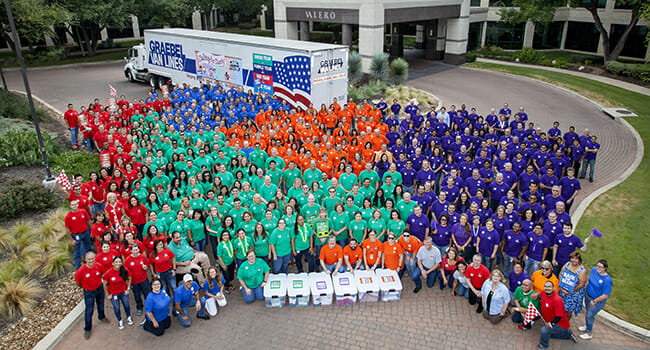
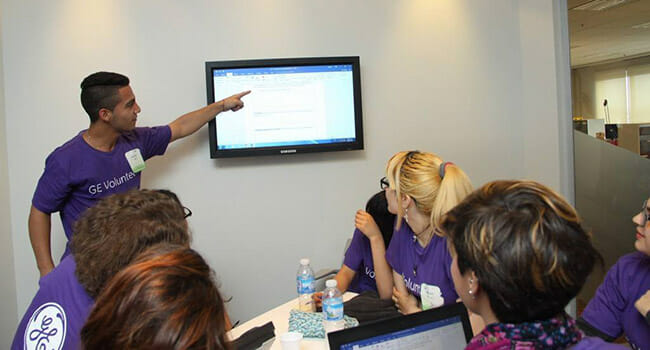
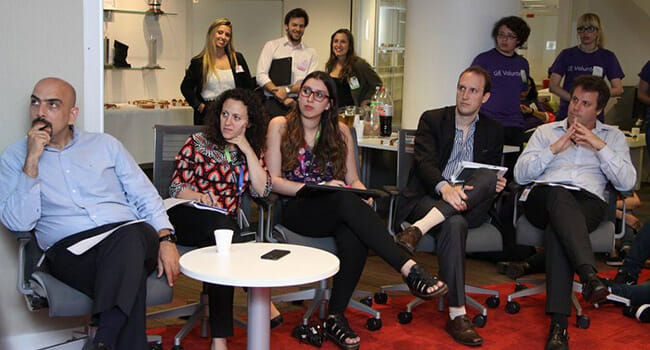
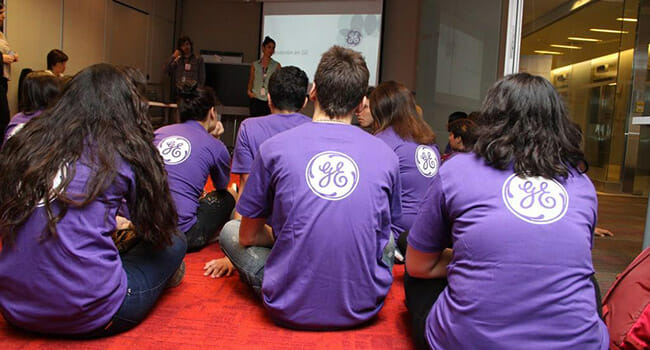
Global Month of Service connects employees worldwide around a commitment to serve, with thousands of GE employees volunteering their time and talent to build stronger communities where they live and work. This month of service, in partnership with Points of Light, demonstrates the power that individuals have to impact their communities.
For several years, NGOs in Hungary have been working to make a greater impact in the communities they serve. András F. Tóth, executive director of
, has been a champion of this cause.
Volunteering Hungary helps local volunteers find opportunities and supports the partner organizations that engage them with information, advice and training, to make the best use of volunteers’ effort. Four years ago, F. Tóth started to think on a broader scale and discovered a way for partner corporations to better leverage their volunteers – through pro bono service.
F. Tóth said there were various factors that influenced this discovery, one being a workshop at the
. It was through them that he discovered the power that corporate volunteers possess, which can result in deep impact when working with NGOs.
The largest American employer in Hungary, with more than 10,000 associates, GE Hungary has been able to carry on the company’s legacy of service. Joerg Bauer, president of GE Hungary, attended the European Pro Bono Summit and was inspired to get more GE employees involved in pro bono volunteerism.
“Pro bono for us means that we contribute with those professional skills that we have been trained for, said Bauer. “Think about a finance or IT person who can give advice in this field, or someone who is doing marketing, communication or customs. We strongly believe in knowledge transfer creating the most impact for the common good, allowing the NGO or charity to concentrate on their core activities.”
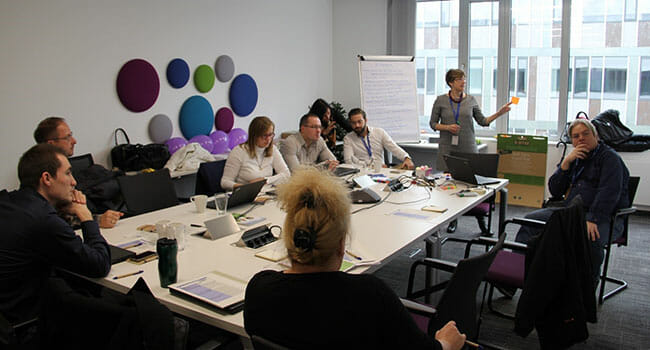
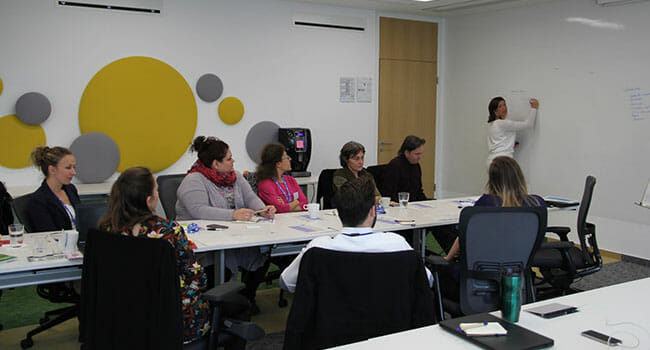
This year, GE Hungary and Volunteering Hungary held their second annual Pro Bono Marathon at the company’s Váci Green campus in Budapest, where GE volunteers provided strategic guidance and skills-based support to help four NGOs generate solutions for problems they are facing. The NGOs left the event with fully formed implementation strategies to achieve their goals.
, which provides services for mentally and physically disabled community members, presented a need for marketing advice – how to better spread awareness on the integration of disabled citizens. Volunteering Hungary participated, too, seeking GE’s advice on how to build guidelines to help NGOs and corporations prepare for pro bono collaborations.
“GE is in a special position because they have so many people with so many skillsets,” said F. Tóth. “They have the potential to go into detail and offer an overview of projects that the NGOs might not have been able to do on their own.”
, whose mission is to protect and restore the current condition of Nógrád caste and the tourist area surrounding it, worked with volunteers to develop a plan to implement more technology and tech knowledge to their town. This pilot example will serve as a case study for how other villages in Hungary that are behind in technological and business advances can get up to speed with the rest of the country.
F. Tóth reflected that the “the added value is the systematic and business mindset that allows GE to help NGOs grow.”
GE follows-up with participating organizations to see how they’ve used the knowledge gained during the workshop. And, participants from the first Pro Bono Marathon have reported tangible results: GE volunteers defined an exact action plan for the implementation of an
project for Autisták Országos Szövetsége, which was recently successfully realized. In the future, GE plans to extend the scope of this collaboration and establish a long-term mentorship with NGO partners.
When major corporations like GE encourage employee volunteers to use their skills for social good, NGOs are able to maximize their potential and truly focus on their areas of impact. But even beyond the impact they will make is the lasting message of the power in cross-sector collaborations to improve communities around the world.
Using Employees’ Skills, Toyota Financial Services and UnitedHealth Group Build Stronger Communities
Giving back: it’s an action that can be carried out in countless ways. For some, giving back means volunteering in their community. For others, it means donating money or goods to those who need it most. For Civic 50 sector leaders Toyota Financial Services and UnitedHealth Group, employees give back by exercising their corporate know-how and investing their time and talent in communities to provide the biggest impact. In matching community needs with employees’ corporate expertise, these companies have identified a way to both give back and continually engage employees. These employee volunteering initiatives helped propel TFS and UnitedHealth Group to the top of their sectors in The Civic 50, the annual initiative from Points of Light to recognize and honor the 50 most community-minded companies in the nation.
TFS led the financial sector in the 2016 Civic 50 thanks to their robust community involvement programs. One such program, Financial Empowerment Initiative, helps under-represented youth and local community members make informed financial decisions through training and tools. TFS extends the reach of its programs through partnerships with nationally recognized organizations, such as Boys & Girls Clubs of America and Girl Scouts, providing financial education support and guidance, along with leadership and life skills and college scholarships and internships to youth across the nation
To improve the effectiveness and reach of their programs, TFS turns to its greatest asset: its employees. Through the TFS Community Ambassador program, team members are empowered to build strategic partnerships with local nonprofits in their community and engage TFS team members to participate in community activities. This leadership development program enables team members to increase their aptitude in the workplace through skill development, while informally guiding and shaping a culture of service in the organization.
UnitedHealth Group, the Civic 50 health care sector leader, leverages its expertise in health promotion and research in order to help make the health care system work better for everyone. To share nationwide health insights, United Health Foundation – the company’s philanthropic arm – publishes America’s Health Rankings every year, assessing nation’s health on a state-by-state basis. This year the foundation published its 27th report, tracking key trends and identifying ways to improve the health of different populations across the country on both the national and state level. Through these reports, which have covered the health of seniors, the health women and children, and the health of those who have served, UnitedHealth Group provides a blueprint for how other community-minded companies can use their expertise to influence positive change.
These two companies are using their corporate strengths to positively affect their communities. They scored highest in their sectors in the annual Civic 50 survey, which provides a framework and a roadmap for how companies can turn good intentions into sound business practices. Toyota Financial Services and UnitedHealth Group are just two examples of the many companies that are using their time, talent, and resources to improve the quality of life in the communities where they do business.
Do you work with a community-minded corporation that is a champion of corporate engagement and exemplifies the ideals of the Civic 50? Take the Civic 50 survey today at www.Civic50.org. Survey closes March 1, 2017. For more updates, follow the Civic 50 on LinkedIn and Twitter.
Building a Culture of Service: Altria and Valero Put Local Communities First
Crafting a mission statement is a chance for a company to put into words what truly drives the organization: what are the values it holds above all others? For many, success and profit come to mind. For Civic 50 sector leaders
, community is consistently held as the organizations’ driving force. These companies are doing their part to support local communities by institutionalizing policies, systems and incentives to build a culture of volunteerism and community engagement and to drive their social impact.
Civic 50 consumer staples sector leader Altria pioneered its
, which supports a culture of giving back to the community. Altria employees not only participate in charitable giving programs, they play an active role in managing and operating them. Founded in 2000 by Altria employees, the unique charitable giving program highlights the power of initiatives that bridge the gap between businesses and communities.
As the only publicly reported employee-giving program of its kind in the United States, employees choose the focus areas, lead fundraising, develop marketing and communications plans and allocate funds. Each year, 60 percent or more of Altria employees participate in the program. Since 2001, it has awarded 1,886 grants for a total of $49.8 million.
All administrative costs are covered by the company, which means that every dollar raised by employees goes directly to the community. This fund illustrates the company’s commitment to supporting a culture of community engagement, and employees routinely rate employee involvement as one of the top reasons to work at Altria.
Valero Energy, the Civic 50’s 2016 energy sector leader, has created a culture of community engagement by incorporating community involvement into its highest level of corporate governance. Valero’s commitment to communities is incorporated into its
, as the company pledges to share “success with the communities where we live and work through volunteerism, charitable giving and the economic support of being a good employer.”
During National Volunteer Week, all Valero plants sponsored food drives to address food insecurity issues. The company headquarters in San Antonio collected nearly 1.4 million pounds of food for the
. Valero leverages its strong community engagement culture to consistently and strategically encourage employees to give ample time and commitment to local communities, with 50 percent of employees participating in its community engagement initiatives and logging more than 130,000 volunteer hours annually.
As sector leaders of The Civic 50, Altria and Valero scored the highest in their sectors in the annual Civic 50 survey, a benchmarking effort to recognize and honor the 50 most community-minded companies in the nation. They are just two examples of the many companies that are adopting critical policies, systems and incentives to institutionalize community engagement and create a culture of giving back in the workplace.
Do you work with a community-minded corporation that is a champion of corporate engagement and exemplifies the ideals of the Civic 50? Visit www.Civic50.org to learn more and to take the Civic 50 survey today – survey closes March 1, 2017. Want to learn more? Follow the Civic 50 on LinkedIn or Twitter for updates, and email [email protected] with any questions.
Argentina’s Youth Create Tech Solutions to Community Needs
The 2016 GE Global Month of Service connects employees worldwide around a commitment to serve, with thousands of GE employees volunteering their time and talent to build stronger communities where they live and work. This month of service, in partnership with Points of Light, demonstrates the power of individuals to create change in their communities.
After several years of political and economic unrest, including a recession beginning in mid-2015 that pushed the unemployment rate to 9.3 percent, Argentina’s new president, Mauricio Macri recently declared the country “open for business” as part of a campaign to restore economic viability.
Entrepreneurship and innovation are key to being successful in the new Argentinian workplace. Low wages and a convenient time zone make Argentina an attractive international partner for businesses in the United States – in fact, Globant, an Argentinian software development firm, recently became the first Latin American company to go public on the NYSE.
As Argentina seeks to re-enter the global marketplace, GE volunteers are making sure that the next generation has the skills they need to contribute to this new growing economy.
In collaboration with Junior Achievement, GE hosted a Youth Innovation Camp at their Argentina headquarters in Buenos Aires that challenged 40 students from four local schools to find innovative solutions to problems faced by the modern city.
GE volunteers first gave the students, ages 16 to 18, examples of real-life solutions GE has developed in response to community issues in the areas of healthcare, energy and technology. The students were then broken into teams and, using GE innovation as a model, challenged to brainstorm ideas for smartphone applications that address challenges facing the city. Finally, the students presented their app solutions to a panel of GE employees.
The goal of this program is to help students “understand that they can promote an idea to solve problems in the city,” said Florencia Montoreros, manager of GE global parts and repair solutions for the Caribbean and Latin America, who helped organize the event. The students also gained valuable presentation experience as they explained their ideas to the panel, Florencia added.
Some ideas that the students came up with included an application called Basurin, which would alert citizens when their trash truck was arriving so that they could bring their trash directly to the truck and help cut down on the amount of litter in the city streets.
Another app, called Quisque, would help resolve parking problems in Buenos Aires by sending users real-time updates about parking availability on city streets and even allow users to pay through the app.
The winning proposal, an application called Techno Save, would send users a notification if they left a light on in their house and allow them to turn it off from the app’s interface.
By encouraging students to develop innovative solutions to everyday problems, GE is helping Argentinian youth build valuable research and critical problem-solving skills they can apply to future careers in business and technology. This will not only have a positive effect on the students’ lives but also on the ability of Brazilian communities to meet the needs of their citizens and compete in the global economy.
Civic 50 Honorees AT&T and Hasbro Made a Difference by Mentoring Youth
Maya Angelou. Quincy Jones. Sting. Tom Brokaw. President Bill Clinton. What do all of these
sector leaders AT&T and Hasbro Inc. recognize the importance of mentorship – especially in the lives of underserved youth who may lack the resources or individuals in their lives to guide them through tough decisions such as college, career, and more. While leaders in their respective sectors, these companies have also taken the lead on aligning purpose with profit and giving back to the community, and in these examples, through youth mentoring.
With the introduction of their innovative community and talent development program, Transforming Talent,
– the consumer discretionary sector leader for the 2016 Civic 50 – stands by their purpose to make the world a better place for children and their families. In partnership with
, a leading workforce development and higher education nonprofit, Hasbro provides college classes, corporate internships, educational stipends, and mentoring to youth that simply need a chance. This strategic partnership with Year Up allows integration between Hasbro’s community engagement program and its business interests.
Transforming Talent provides a platform for Hasbro to work toward their employee engagement, and diversity and inclusion goals, but more importantly, generates a pipeline of full-time, diverse talent from young adults who would otherwise not have access to the corporate workforce. The success of Hasbro’s Transforming Talent program is evident through the statistics alone: 75 percent of the Transforming Talent graduates
, the company’s signature philanthropic initiative focused on helping students succeed in high school and beyond, launched an expanded mentoring program. Through Aspire, AT&T collaborates with leading education nonprofits to match employees with students who will benefit the most from mentoring. The program is a flexible resource for both employees and students as mentoring events take place in the classroom, at AT&T locations, within the local community and even online.
This school year, AT&T is contributing more than $1.3 million to innovative organizations such as
to help even more students explore their potential through online and in-person mentoring. They are also providing funding to bring careers to classrooms through an innovative program called
that matches professionals with classrooms virtually to help connect what students are learning at school to their future careers. As of January 2016, more than 160,000 students had been mentored in 336 cities for a total of 1 million employee volunteer hours. AT&T has demonstrated a profound impact on the communities they serve by helping underserved youth connect with their passions and potential.
AT&T and Hasbro demonstrate what can be accomplished when companies use their internal strengths and resources to improve the communities where they live and work. As sector leaders of the Civic 50, they scored the highest in the annual Civic 50 survey, a benchmarking effort to recognize and honor the 50 most community-minded companies in the nation. Hasbro and AT&T are just two examples of the many companies that are translating good intentions into sound business practices and best using their time, talent, and resources to improve the quality of life in the communities where they do business.
Do you work with a community-minded corporation that is a champion of corporate engagement and exemplifies the ideals of the Civic 50? Follow the Civic 50 on LinkedIn or Twitter or email [email protected] to receive updates on the 2017 survey, which will launch Tuesday, November 15 and close on March 1, 2017. For more information and a full list of the 2016 Civic 50 winners, visit www.civic50.org or sign up for our technical assistance webinar “2017 Civic 50: What You Need to Know” which will take place on Friday, November 18 from 1 – 2 PM ET.
AbbVie Demonstrates What’s Possible When Employee Volunteers Band Together to Give Back
Service and volunteerism have the power to impact and change lives. And when a corporation engages thousands of employees who are ready to give back to their local communities, innovation and advancement take place on a global scale.
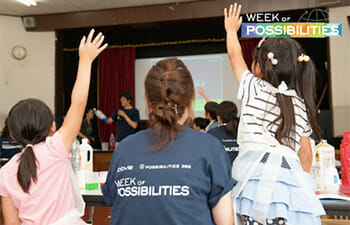
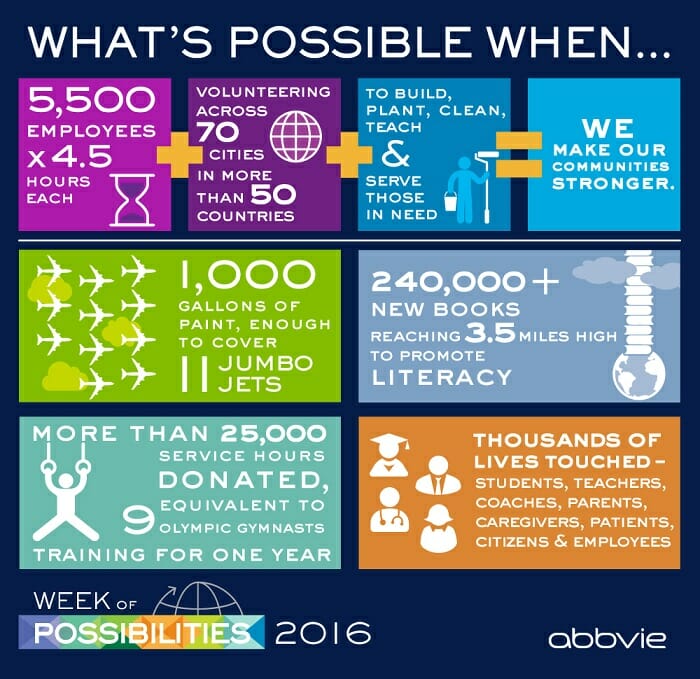
This summer, Points of Light partnered with AbbVie for its third annual Week of Possibilities, a program that engaged more than 5,500 employee volunteers in nearly 25,000 combined hours to help underserved populations. As the global activation partner, Points of Light affiliates in the United States, Europe, South America, Canada, Mexico and Asia provided employee volunteers with meaningful service opportunities that addressed challenges in the communities where they live and work. The Week of Possibilities builds on AbbVie’s extraordinary year-round commitment to corporate social responsibility, which earned them recognition as a 2016 Civic 50 company.
“We are proud to be partnering with the AbbVie Foundation on this global service campaign,” said Delores Morton, president of programs for Points of Light. “Volunteers have the power to change the world, and Week of Possibilities demonstrates how nonprofits and the private sector can work together to empower that change.”
This year’s program included hands-on service projects in more than 50 countries, with a particular focus on improving educational opportunities and facilities by transforming schools and other learning spaces. Volunteers refurbished libraries, renovated buildings, landscaped and gardened, collected books for schoolchildren, assembled furniture, painted walls, repaired homes and much more.
“Week of Possibilities unites AbbVie employees around the world in an effort to give back to our local communities, with a special focus on building strong education systems,” said Tracie Haas, vice president of corporate responsibility, brand and communications for AbbVie. “We’re delighted and privileged to partner with leading national and international organizations to help local nonprofit partners tackle our communities’ toughest challenges.”
Examples of Global Impact:
AbbVie employee volunteers teamed up with Points of Light affiliates, dedicating their time, energy and skills to make a difference in communities around the world.
In Lake County, Illinois, where AbbVie is based, youth and veterans were the main focus as volunteers transformed schools and renovated three properties to provide housing to families of military veterans, in conjunction with North Chicago Community Partners.
In North Chicago, teams partnered with Kohl Children’s Museum to bring the museum experience to kids who may not ordinarily have access, and provided a day-long Science Adventure program to more than 150 students.
In Menlo Park and San Jose, California, and Worcester, Massachusetts, AbbVie volunteers refurbished three under-resourced school libraries by improving the layout and providing new furniture, technology and library books.
In London, AbbVie volunteers worked at the Northside Community Center and painted more than 30 rooms from top to bottom, redid the computer lab with new carpet, 10 new computers and two new printers, and added new kitchen appliances. The impact was so great that the Center’s board chair reported that it is unlikely they could have stayed open much longer without the contribution made by AbbVie volunteers.
Nearly 50 volunteers in Tokyo spent more than 200 hours delivering the SEEK Program (Science Engineering Exploration Knowledge) to underprivileged children living in group homes. The SEEK curriculum is designed to spark interest in STEM topics.
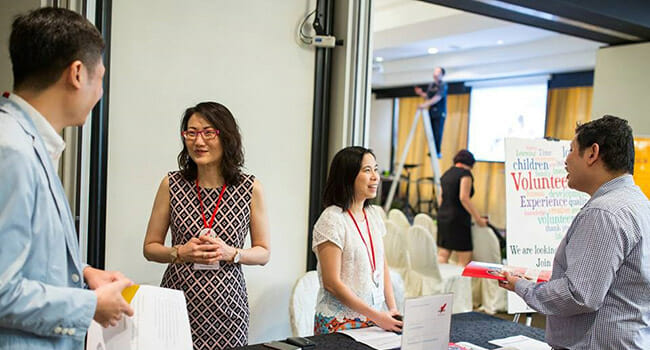
In Singapore, volunteers participated in educational activities at Care Corner Student Care Centre.
In Montreal, 20 AbbVie employees participated with the Boys and Girls Club/Dawson Community Center, completing projects that had no staff support. From the moment they arrived, employees gardened, cleaned, painted and prepared for summer day camps.
In Guatemala at Escuela Vicente Rivas, more than 50 AbbVie volunteers worked on classrooms, while another 20 implemented interactive methodology and participated in STEM curriculum.
For five days, AbbVie volunteers and HandsOn CDMX worked with at-risk girls in Mexico at the Casa Hogar de la Santísima Trinidad, participating in painting and gardening projects.
Teams in Paris sang in nursing homes for National French Music Day, and in Thiais, AbbVie volunteers planted gardens and fixed homes for women.
Empact Creates ‘Done in a Day’ to Benefit Corporations, Social Service Organizations and Local Communities
It’s easy to imagine a rigid divide between the social services sector and the world of for-profit corporations, but cross-sector collaborations have the potential to do a lot of good. While employees at nonprofits may lack some of the expertise needed to keep operations running smoothly, employees at corporations may feel they lack the time and opportunity to serve their community. In Singapore, one organization seeks to solve these problems and unlock the mutual benefits of working together.
Empact, a global affiliate of Points of Light, launched Done in a Day to help social good organizations tackle their specific challenges efficiently and effectively. In a single, structured day, skilled volunteers from corporations are matched with nonprofits in need of support in specific areas, such as HR or technology. Through Empact’s signature program, corporate volunteers are able to offer talent and expertise to fill these gaps, which benefits the community and ensures that nonprofits can operate at optimal capacity.
UBS AG, a financial services company, partnered with the Students Care Service to help with fundraising efforts and increasing individual donor contributions. UBS volunteers came up with several feasible fundraising plans and mapped out a timeline of action for the next few years. Through the match-up, Students Care Service received fundraising guidance from experts, while corporate volunteers gained an awareness of the challenges facing youth in their community. As one volunteer shared, “I got more out of this than expected, in less time than we planned for.”
Done in a Day’s cyclical design empowers companies to strengthen nonprofits, which in turn fortify and support local communities. Empact also facilitates an event, giving employee volunteers the opportunity to collaborate and showcase their experience.
The organization sees the success of Done in a Day as the first step for corporate giving and engagement, and a platform to encourage long-term corporate partnerships and involvement in the future. After participating in the program, participants reported they felt more knowledgeable about skills-based volunteerism and inspired to volunteer more in the future.
Employee Volunteers Demonstrate Fidelity’s Commitment to Education and Service
Corporations that embrace social responsibility make a lasting impact on the communities where they live and work, and also do better financially while maintaining higher employee satisfaction rates. Members of the Points of Light Corporate Service Council demonstrate a commitment to mobilizing, equipping and inspiring high-impact volunteering through successful employee engagement programs. Fidelity Investments is one shining example of this dedication to service.
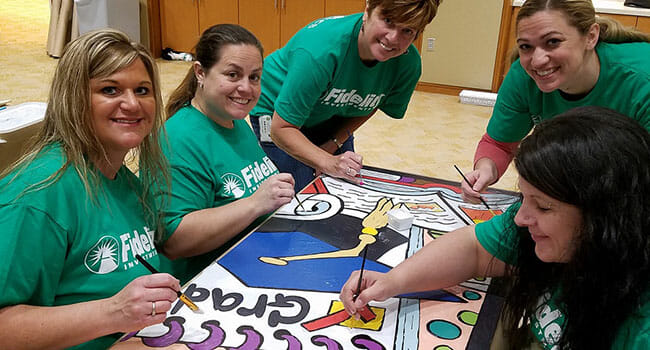
Demonstrating a long-term commitment to education, employee volunteers and their families invest in local schools through Fidelity’s School Transformation Days, which take place throughout the year. Volunteers clean classrooms, plant gardens, build or fix odds and ends around the schools, and paint murals to create a friendly and clean environment for students. Fidelity volunteers also engage in STEM projects with students, promoting skills for future career success.
Building on its efforts throughout the year, the company, through it’s Fidelity Cares program, recently celebrated its annual Fidelity Cares Day, with more than 6,000 employee volunteers sharing their time and talent with 27 schools and 81 projects across the United States, Canada and India. The day’s projects reached nearly 18,000 students and more than 2,600 teachers. Employees found volunteer opportunities that matched individual passions to connect with colleagues and develop leadership skills in their communities while benefiting local education and financial initiatives. In partnership with nonprofit organizations and regional school systems, Fidelity focused on creating opportunities for employees to leverage their insights and experience to help provide students in need with an educational foundation to feel more confident, make smart decisions, and achieve success in personal and financial goals.
In North Carolina, more than 120 Fidelity volunteers joined Stop Hunger Now to pack 20,000 meals for distribution to local families in need.
In Texas, volunteers energized students by creating hands-on chemistry demonstrations in line with Fidelity STEM (science, technology, engineering, and math) educational goals.
450 volunteers served the Boys and Girls Club of Greater Cincinnati, the Ronald McDonald House, Holmes Middle School, and Crayons to Computers where these volunteers assembled math kits for middle school students, which included a handwritten note of encouragement to boost confidence and show students that Fidelity cares about their success.
75 volunteers worked at the Boys and Girls Club Camp Foster in Manchester, New Hampshire, helping to refurbish buildings.
This is just a small glimpse into the meaningful changes made in local communities on Fidelity Cares Day. Check the hashtag #FidelityCaresDay on Twitter to see more Fidelity volunteers in action.
Recognizing Employee Volunteers – Another Way to Show You Care
Today’s guest post is written by Cristina Andoni, ATLAS Corps Fellowfrom Republic of Moldova, serving at Points of Light as Corporate Institute coordinator. If you’re interested in contacting her for more information, please e-mail [email protected]
Coming from a country where employee recognition is often given in the form of end-of-year bonuses, occasional tchotchkes and certificates at corporate parties, recognition programs in American corporations are strategic and complex.
Each year $46B is spent on employee recognition (Bersin&Associates, 2012) which includes employee volunteer recognition: grants (dollar for doers, matching gifts), traditional employee recognition (certificates, employee awards, success stories shared in media) and non-traditional recognition (ex: lunch with the upper management).
Recognizing employee volunteers goes beyond good judgment and cost-benefit analysis. Empirical evidence proves that recognizing employee volunteers is good for business. Recognized employees are more motivated, engaged and ultimately – more productive. After all, great recognition programs drive 31 percent lower employee turnover (Bersin&Associates, 2012) and engaged organizations have 3.9 times the earnings per share growth rate compared to organizations with lower engagement in their same industry (Gallup, 2011).
At Points of Light, based on Corporate Engagement Award of Excellence applicants, we have seen that while recognition programs vary in complexity depending on the corporate culture, strategic goals and mission, they all share the objective to motivate and maximize the impact of employee volunteers. To do so, some companies award their employee volunteers for hours they volunteer, while others provide philanthropic awards given to charities where employees volunteer.
Here are a few tips to consider when recognizing employee volunteers:
If you do not have a recognition program, consider starting one. Integrate formal and non-formal recognition practices into your program. Most effective recognition practices include volunteer grants, competitive awards (especially team awards) and story-telling.
While recognition is not a major motivator for most employees to volunteer, many employees want to be recognized (LBG Associates’ study on volunteerism, 2009).
Recognize volunteer employees for concrete actions and results. Align the employee recognition program goals to the corporate mission and business goals. Show your employee volunteers that their engagement contributes to the business in the long-run. Some Employee Volunteer Programs even integrate their volunteer recognition into company reward programs or performance review processes (Points of Light Trends of Excellence Series, 2012).
While recognition often works from the top down, i.e. management recognizing the volunteering efforts of its subordinates, employees want to be recognized as well as by their peers. For example, communicate about the great work your employees do in communities and involve their colleagues by asking them to vote for the most compelling project or volunteering activity.
Position recognition as a HR tool. Many companies are already actively using employee volunteer engagement to build employee skills, teams and even integrate employee volunteerism into the company annual performance review process.
While you want to clearly state the criteria for employee recognition (if there is such) and make recognition available for all employees, try to recognize your employees impromptu. A note of spontaneity will make your employees feel special.
Finally, analyze current employee volunteer behavior and preferences and draw conclusions. Place the employee at the center of all our actions, and build future program components based on what really works in your organization instead of on what might be “trendy” on the market at the moment.
Human capital employees are a company’s greatest asset. Recognizing volunteers is just another way to show your employees you value and support their community engagement and tell them that you care.
Want to have your company recognized for their great employee engagement? Click here to learn more about and apply for the Corporate Engagement Award of Excellence. Deadline for applications is March 13, 2013, 11:59 p.m. EST
Points of Light will announce the 2013 Corporate Engagement Award of Excellence honorees at the Conference on Volunteering and Service in Washington D.C. on June 19 – 22, 2013.
September Staff Volunteer Mulching at Zoo Atlanta
Today’s post is written by Shaketia Robinson, the Intern and Volunteer Services Coordinator for Points of Light. A graduate of American Intercontinental University, Shaketia holds a Bachelors of Arts in Business Administration with a concentration in Management.
Here at Points of Light we believe strongly in practicing what we preach! Every month we indulge in a service project with a local nonprofit. This month our Atlanta staff had the pleasure of volunteering with Zoo Atlanta.
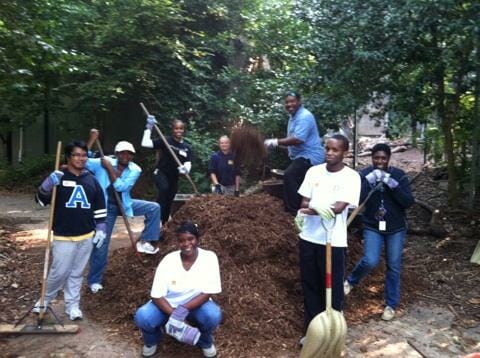
Our staff group was hosted by the horticulture department, a friendly, fun-loving bunch of people who really care about their work and the animals they attend to. They guided us in mulching the primate exhibit, which is a task that is performed at least twice a year. Mulching is extremely important to maintaining a healthy enclosure landscape. Mulching not only looks nice, but it adds nutrition to enrich the soil, helps to retain moisture, protects soil from erosion, and helps prevent weed growth.
We were a little overwhelmed as we walked up and saw a huge pile of mulch and several shovels, rakes, and wheel barrels. The task, at first glance, seemed as if it would take forever. The first pile was the hardest, as we all realized just how out of shape we were. And, just as we thought we were finished, they brought us a second pile! Luckily, Points of Light staff are champions and we knocked out both piles in less than two hours. Even though it was hard work, we really enjoyed ourselves.
After we completed our mulching duties, we had the pleasure of watching the primates enter the exhibit. It was fulfilling to know that we played a small part in their enjoying what we called the “monkey’s playground”. As an extra treat Zoo Atlanta gave all volunteers free time to explore their remarkable zoo. I think I speak for us all when I say it took us right back to childhood. We walked around in amazement looking at all their incredible animal exhibits and appreciating the endangered species they house. The zoo is not only a great place for the animals but for the Atlanta community as well, a place for students to visit the animals they learn about in real life.
These monthly volunteer projects are important to Points of Light’s overall service culture. The service days allow us to live out our organizations mission in a very personal way.