Tending to the Visible and Invisible Wounds of War
For our troops, returning home after long tours of duty abroad doesn’t always mean their fight is over. The Theater of War: Soldiers & Citizens Tour addresses one of the most difficult journeys our service members face – reintegration back into their communities after experiencing the trauma of war.
To engage communities in meaningful discussions about the visible and invisible wounds of war, the tour presents dramatic readings of Sophocles’ “Ajax,” an ancient Greek tragedy about the suicide of a great warrior.
A number of film and television actors have performed on the tour so far, including David Strathairn (“The Bourne Ultimatum,” “Good Night, and Good Luck” and “Lincoln”) and Erica Newhouse (“Law & Order,” “The Good Wife,” Blue Bloods”).
After each reading, a panel of military service members and civilians leads a town-hall-style discussion in which audience members are encouraged to participate.
The discussion is intended to mobilize citizens and resources to help ease the reintegration process, while fostering understanding and compassion toward service members, veterans and their families.
The events are free but spaces fill up quickly. Check out the tour’s Facebook page for upcoming performances and how to get tickets. Upcoming dates include:
For more about Points of Light’s programs that serve veterans, please visit www.pointsoflight.org/veterans.
Serving Those Who Served Their Country – Exelis Action Corps Members Make it Their Mission
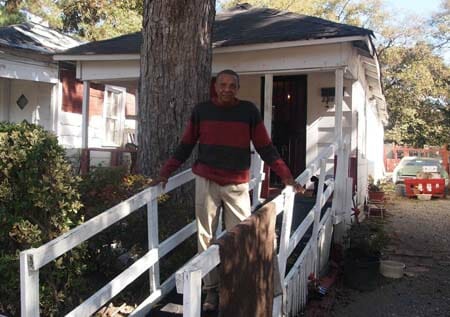
Lindsey Kirksey’s childhood home was in such bad shape, two of the rooms were separating. But the Korean War veteran in his early 80s couldn’t afford to do anything about it. He needed help.
Korean War vet Lindsey Kirksey stands in front of his house before its renovation.
Volunteers from the Exelis Action Corps came together to repair his four-room Montgomery, Alabama, house.
“The volunteers I spoke to – they are just like me,” said Kirksey, who taught math in low-income neighborhoods in the Montgomery area. “They want to help people just like I want to help people.”
For decades, veterans and military service members of all ages have faced unique challenges. And there is growing concern in particular for the one million veterans transitioning out of the military between 2013 and 2018.
The volunteers from Exelis Action Corps, the signature volunteer service program of aerospace and defense company Exelis, have been on the front lines.
They’re lending their time and expertise – whether it’s providing career coaching to a new veteran, sprucing up a veterans support center or working with military families overcoming the challenges of military life, such as frequent relocation or deployments.
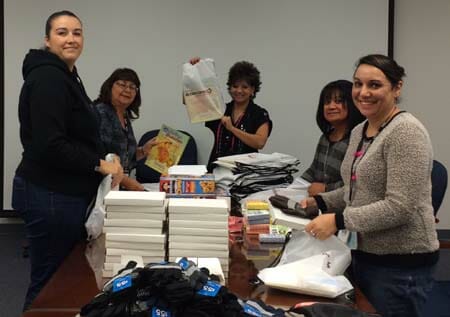
Exelis Action Corps volunteers put together care packages for veterans traveling through the Honor Flight Network.
Across the country, the young program – launched in October 2012 through a partnership with Points of Light – has already engaged 4,374 volunteers and completed 317 projects, serving thousands of veterans, service members and their families.
“We are proud of what the Exelis Action Corps has accomplished, but it’s not just about the numbers,” said David Albritton, vice president and chief communications officer at Exelis. “It’s about the difference we are making in the lives of those who served and the families who sacrificed for us.”
Just a few examples from 2014:
Across the country, Exelis employees created Family Fun Night packages for service members and their families. Volunteers shared with others what they like to do as a family, including playing games, watching movies and working on crafts. Each package was different depending on what the family decided to put into it. Service members received the packages so they could enjoy their own free “family fun night.”
In Salt Lake City, Exelis employees worked with Canines With a Cause, helping train 10 dogs to act as service companions for veterans. They also built 35 dog beds for veterans who already had service dogs.
In Clifton, New Jersey, Exelis employees collected turkeys for veterans at St. Peter’s Haven, a local shelter serving veterans. Their efforts yielded 47 turkeys and enough funds to purchase complete thanksgiving meals for 27 families.
Employees supported the Honor Flight Network, which flies veterans for free to Washington, D.C., to visit their respective war memorials. The volunteers assembled care packages for veterans on six flights. Each veteran received a flight bag containing items to make his or her visit more memorable and enjoyable.
In various locations, Exelis leadership provided resume assistance and interview coaching to hundreds of veterans seeking employment over the course of the year.
Ten Exelis offices held large projects, which engaged employee volunteers in the communities of Fort Wayne, Indiana; Roanoke, Virginia; Clifton, New Jersey: Rochester, New York; Washington D.C.; McLean, Virginia; Philadelphia; Salt Lake City; and Colorado Springs, Colorado. These projects ranged from a health fair to horse therapy sessions and revitalization of several veterans’ facilities.
For many Exelis Action Corps volunteers, it’s personal. As a veteran and volunteer, Erica Jeffries is clear on what matters: “To do good for others – it’s our purpose in life.”
Jeffries recalls one of her most gratifying volunteer moments with Exelis Action Corps came through Final Salute, an organization that provides housing to homeless female veterans in the Washington, D.C., area. The volunteers worked on landscaping, painting and otherwise making the house a comfortable living environment.
“The experience working with Final Salute was powerful because we knew we were preparing a home for veterans and their families,” Jeffries said.
As another Exelis Action Corps member pointed out: A wonderful feeling comes from “seeing the appreciation on the vet’s face. All that matters is making their day a little brighter.”
Help All Vets Live With Dignity and Hope
In honor of Veterans Day, this week we’re highlighting veterans serving their communities. This post is by Kevin C. Miller, a veteran who was recently awarded an AmeriCorps Alums National Leadership Award for his AmeriCorps service.
Kevin C. Miller
Transitioning from the Marine Corps in 2006 to the civilian world was far from easy. Even after earning a college degree, I struggled to find meaningful employment, endured a form of homelessness politely known as “couch-surfing,” self-medicated with alcohol and eventually got a DUI.
None of this helped my job prospects. Eight years later, I’ve turned it around. AmeriCorps VISTA and a nonprofit called Swords to Plowshares gave me an opportunity and a home. Today, because I was given the opportunity to serve post military, I’m actively involved in the mission to end veteran homelessness.
Swords to Plowshares brought me on as their AmeriCorps VISTA, put me in my first permanent residence in two years under the Supportive Services for Veteran Families program, and provided legal assistance in my disability claim with the Department of Veterans Affairs (VA).
Coincidentally, Swords to Plowshares was founded by five AmeriCorps VISTA members who were also veterans and one other veteran, who sought to provide resources and a community for their veteran peers.
They applied the capacity-building principles of VISTA and created a comprehensive, care-based model of “vets helping vets.” The organization now provides employment services, mental health counseling, legal assistance on upgrading discharge statuses and VA claims, mentorship, and direct assistance to veterans. Every year we provide another 2,100 veterans with an opportunity to rebuild their lives.
Poverty and homelessness disproportionally affect veterans. Across the country, veterans make up less than 7 percent of the general population but 12 percent of the nation’s homeless population. Swords to Plowshares houses nearly 500 veterans on any given night. These sobering statistics are what inspire me to advocate for policy and programmatic changes in how we serve our homeless veterans.
In 2009, President Barack Obama established the goal to end veteran homelessness by 2015, making our shared mission a national priority. While we have made great strides, much work still needs to be done: Organizations need to expand the definition of who they will serve and provide more opportunities for Americans to engage in civilian service.
According to the VA, a veteran is defined as a person who served in the active military, naval or air service, and who was discharged or released under conditions other than dishonorable. More than 46,000 organizations serve veterans, but unfortunately most organizations limit which veterans they will serve, especially with regard to discharge status.
By adhering to serving only veterans with honorable discharges, organizations leave approximately 20 percent of homeless veterans without access to any resources. Some, like Swords to Plowshares, step in to fill this gap and support all those who have served in the military regardless of gender, branch of service, length of time served or discharge status.
If we really want to end veteran homeless, then we have to end homelessness for all those who were in the military.
Part of the solution is to ensure that all those who want to help veterans can do so through organizations such as my own Swords to Plowshares. For example, more than 4,000 individuals are currently doing their part to end veteran homelessness powered by AmeriCorps, but plenty more individuals wish to serve as well.
Last year, more than 580,000 individuals applied for just 80,000 AmeriCorps slots, so the desire is there if the programs were funded at their full capacity.
I have personally benefited from the transformative experiences of both military and civilian service. Programs like AmeriCorps, and initiatives such as the Franklin Project at Aspen Institute, encourage Americans to exercise their citizenship through service and are essential to meeting the challenges our veterans face.
As we reflect and honor this week those who have served, in recognition of Veterans Day, let us support all of those who have served – not a select few. One key way to do this is by connecting more Americans and veterans to national civilian service opportunities that enhance or introduce them to the power of civic engagement.
Let us aspire to give all of our veterans the ability to turn their lives around, live with dignity and hope, and continue serving.
This post also ran in The Huffington Post and on the AmeriCorps Alums blog. AmeriCorps Alums is the only national network connecting the nearly 1 million AmeriCorps alumni to the people, ideas and resources that support their commitment to a lifetime of service.
Service Before Self – Reflections on Military and Civilian Service
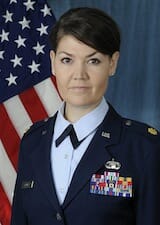
In honor of Veterans Day, this week we’re highlighting veterans serving their communities. This post is by Maj. Rebecca “BB” Lange, deputy legislative assistant at the office of the chairman of the Joint Chiefs of Staff. In September, Lange was awarded an AmeriCorps Alums National Leadership Award for her commitment to service.
Maj. Rebecca Lange
Sometimes, you need a push. Or a shove.
At 17, my parents told me I was on my own to pay for college. Partly because of the expense, partly because they believed I would appreciate a college education more if I earned it. With President Clinton’s 1995 State of the Union Address, I found a way.
When I heard the words, “…there are 20,000 Americans… helping people, solving problems and, in the process, earning some money for their education. This is citizenship at its best,” I was sold.
I took a leap of faith and signed up for the still-nascent AmeriCorps. I joined other young, idealistic, and eager 18-24 year olds in AmeriCorps National Civilian Conservation Corps. We tutored, built trails, painted houses and supported the 1996 Olympic Games. We made a difference to those around us.
And service made a difference for me. I used my AmeriCorps education award to pay my first tuition bill at the University of Colorado. AmeriCorps was also my launching pad to military service. As a student, I became an Air Force ROTC cadet.
With the unique privilege of having seen both the military and civilian side of service, here’s what I can tell you: eyes closed, acronyms masked, locations undisclosed … there are far more similarities than differences between military and civilian service.
Here’s why: We put service before self. Military and civilian service members take an oath to serve a larger cause. One group pledges to defend the Constitution, the other to strengthen our communities.
Our country needs us and equips us to answer its call. Active civilian and military service members are united by a belief that we all have a role to play in our country’s story and welfare. We have a shared sense of responsibility – and the skills to serve as civic leaders.
We’re also changed for life. Military service is sometimes more visible, but service of all types has a profound and lasting impact on those who serve. Most Americans understand that those who have worn our uniform are trained to both lead and follow, to problem solve, and are inherently resourceful.
But, in the words of Gen. Martin Dempsey, the current chairman of the Joint Chiefs of Staff and principal military adviser to the president, “Less understood are the ways we continue to serve in our communities when we take off our uniforms… whether at the end of the day, or at the end of our careers.”
He’s absolutely right – and championing the similarities between civilian and military service is the perfect place to start.
Initiatives like the Aspen Institute’s Franklin Project, led by Gen. Stanley McChrystal and former Marine Jason Mangone, are doing just that. Leaders at Aspen, and their partner organizations, know that while some people need a push, or a shove, many are ready to leap into service.
As the war in Afghanistan winds down, thousands of veterans who understand service are hungry to continue solving our nation’s toughest problems – but we don’t have enough service opportunities available to them.
Each year, more than 580,000 applicants apply for just 80,000 AmeriCorps slots. The Peace Corps gets 150,000 applications for 4,000 full-time positions each year. Volunteering in America is on the rise and millennials are drawn to companies with “clearly-defined company policies on giving and volunteering.”
We’re leaving hundreds of thousands of service-oriented Americans without an outlet to serve. This has to change. Not everyone can join the military. Not everyone is interested in joining the military.
But I firmly believe that every single American is programmed – we are wired! – to serve our nation in our own unique capacity. I’m proud to live in a country where the demand for service opportunities is so great, but we must support efforts to ensure that all have a chance to serve.
Let’s share this story and give more people – military and civilian alike – a chance to leap.
This post also ran in The Huffington Post and on the AmeriCorps Alums blog. AmeriCorps Alums is the only national network connecting the nearly 1 million AmeriCorps alumni to the people, ideas and resources that support their commitment to a lifetime of service.
She Uses Her Background as a Child With Parents in the Military to Serve Vets and Their Families
In honor of Veterans Day, this week we’re telling the stories of people making a difference for veterans in their communities. Meet Charity Bowen, a member of the Veteran Leader Corps – an AmeriCorps program run by Points of Light.
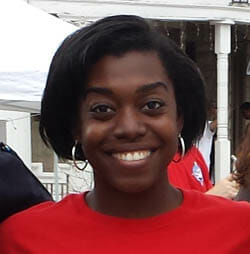
Charity Bowen
Having grown up with both parents serving in the military, Charity Bowen knows firsthand the challenges veterans and military families can face. Moving from base to base as a child gave her deep insight into the community she serves today as a member of the Veteran Leader Corps.
“The fact that it’s fundamental to the corps program to help veterans’ families convinced me to sign up,” says Bowen, 25, of San Antonio, Texas. “It was important to me that the program focused on this neglected part of the population.”
The Veteran Leader Corps (VLC), an AmeriCorps program run by Points of Light, serves as a critical component of the Community Blueprint, a coalition of organizations designed to share tools and resources to better serve the veteran community at the local level.
The VLC program – which recruits AmeriCorps members to support the needs of veterans and military families – focuses specifically on providing employment support services and community engagement opportunities for veterans.
As a VLC member serving with the Military and Veteran Community Council – a group of organizations and agencies serving veterans in San Antonio, Bowen has recruited many volunteer leaders from within the veteran community to serve and support veterans focusing on health and caregiving.
Bowen reaches out to veterans and military families frequently to share with them the opportunities available and events she and her team have organized for them, such as job fairs.
“The first veteran I met at the beginning of the program at my first job fair really impacted me,” Bowen says. “He shared his five-year experience in the Navy with me, showed me his resume and mentioned how difficult it was to find a decent-paying permanent job. He was educated and had good qualifications.”
Through her service, Bowen has learned the key components of job fairs that are most helpful to veterans.
“Now every time while organizing a fair, I ask myself, what’s the percentage of jobs versus educational resources?” Bowen says. “Are there any employers hiring? Are recruiters referring job seekers to other employers? Is there resume help? Are there mock interviews? Are recruiters explaining the application process?”
Bowen met veterans trying to get support through the Veterans Administration and find employment; they were frustrated because they either didn’t qualify for services or the process took too long.
She says whenever she or one of her colleagues offered alternative options available in the community, the veterans would often express surprise – and gratitude.
During her service, Bowen estimates that she has assisted more than 200 veterans in getting the help and resources they needed.
In serving veterans, Bowen herself has developed skills and knowledge in the areas of outreach, networking and community coordination, along with refreshing her volunteering spirit.
She says, “My faith in service deepens every time someone comes up and says, `I am glad someone is out there in the community engaging with us veterans, empathizing with what we are going through.’”
Using Our Skills to Serve Those Who Served Our Country
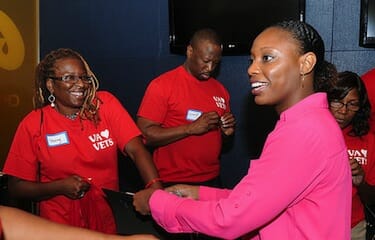
Janaia DeShields, right, works with volunteers at a 9/11 Day of Service event in Washington, D.C.
Veterans Day is not only a day to show your appreciation for those who have served; it’s a time to honor them through service.
I had the pleasure of attending the first annual Joining Community Forces Conference where Adjutant Generals – de facto commanders of a state’s military forces, their staff and community leaders – convened to discuss how to better serve veterans, service members and military families in their states.
During the discussions, I mentioned how A Billion + Change (a national campaign to mobilize billions of dollars of pro bono and skills-based volunteer service from corporate America) and companies are eager to provide skills-based and pro bono volunteer support to the military community.
The initial response was that of surprise, quickly followed by true appreciation and an eagerness to connect with companies that want to provide direct service to our veteran community.
In the midst of a military drawdown and the increased numbers of veterans transitioning from service, it’s more important than ever for companies to reach out to their communities through their philanthropic efforts to fill the gaps in services that nonprofits do not have the capacity or capabilities to fill.
Veterans are not only leaders during wartime but they have a prowess unmatched by many to lead in their communities. The strength of character and professional experiences may be unique to the military culture; but those same attributes can be used as the foundation for building stronger communities. As companies pledge volunteer hours, I encourage them to carve out time to focus on our nation’s heroes.
Pro bono services are not only a valuable asset to service members but also to companies. The experience helps employees master their own skills and abilities, using their expertise to make an impact. They get the chance to connect with individuals outside of the normal humdrum of weekly agendas.
Pro bono service presents an opportunity to give back – to make a difference in a capacity that is priceless.
The philanthropic efforts of a corporation both make a positive impact for those who require support and bring a sense of accomplishment to the employees who offer their services.
Veterans are our nation’s leaders, heroes, and patriots. Leading the charge to protect and serve them is the first step to our continued growth as a nation.
President Barack Obama said, “Our men and women in uniform have taught us about strength, duty, devotion, resolve – cornerstones of a commitment to protect and defend that has kept our country safe for over 200 years. In war and in peace, their service has been selfless and their accomplishments have been extraordinary.”
We can do the same for those heroes. We all can make a difference.
Learn how you can serve veterans through skills-based and pro bono service by visiting the resources section on the Billion + Change website, and stay tuned for a veterans’ webinar in mid-December. (A version of this post originally appeared on the Billion + Change website.)
Veteran Finds His Way to Stability Through the Veteran Leader Corps
In honor of Veterans Day, we will be telling the stories of veterans making a difference in their communities. Meet Spirit Padilla, a member of the Veteran Leader Corps – an AmeriCorps program run by Points of Light.
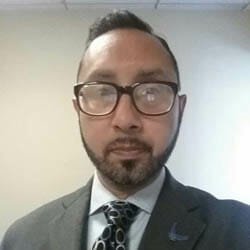
Spirit Padilla
Air Force veteran Spirit Padilla never imagined he’d experience joblessness, homelessness and underlying feelings of despair stemming from his military service. But that’s what the last several years had been like for him until recently.
Raised by a single mother in New Mexico, Padilla, 46, entered the military in 1986, just two weeks after high school. After serving four years – including deployments to Panama and the United Arab Emirates – he decided to leave the Air Force and started looking for a civilian job.
“I had no plan for life,” says Padilla, who has been living in a shelter for the past 14 months. “I was homeless for a few years; I started drinking and got into substance abuse. It took me many years to acknowledge that I had PTSD (post traumatic stress disorder).”
Realizing that his issues were far beyond his control, he quit drugs and sought professional help and a fresh start.
In addition to PTSD, Padilla dealt with the challenge of translating his professional military skills to the civilian job market. He had a hard time adapting to new circumstances and kept moving from one job to another, usually as a waiter, before his potential was realized by a colleague who introduced him to the
program run by Points of Light. Padilla signed up as a corps member.
Veterans who join the military soon after high school, like Padilla, can face obstacles after their service when competing for civilian jobs. The VLC focuses on providing employment support services and community engagement opportunities for veterans, by placing corps members at host organizations serving veterans and military families.
The VLC, which engages veterans as part of the solution, serves as a critical component of the Community Blueprint, a coalition of organizations designed to share tools and resources to better serve the veteran community at the local level.
Since its launch in 2012, the VLC has placed 158 corps members in 26 communities.
Padilla is about to finish his service at
in New Jersey, where he talks to veterans about local job fairs and helps with job and resume writing events arranged by Goodwill. During his service, he collaborated with a
student – a fellow veteran – to create a resource manual to help homeless veterans navigate available services in New York City.
One story that stands out to Padilla is one of an Air Force veteran balancing a family and evening classes. The veteran is unable to cover his full tuition costs with the GI Bill and has worked with Padilla to find support for tuition, housing and food. The veteran landed a job to fill temporary financial gaps and has worked with Padilla to file a successful claim for 30 percent disability support from the Veterans Administration.
Padilla estimates he has had a significant impact on more than 70 veterans and their families since joining the VLC in March 2014.
“Having Spirit on board has elevated the work we do to build veterans’ capacity,” says Martha Jackson, director of operations at
. “Having a veteran as a staff member gives us credibility in veteran communities, working knowledge of issues they face and insight into the best way to solve them.”
Padilla is looking forward to starting his new job at a high-end steakhouse in New York soon. He is ready to move out of the shelter and eager to go back to school. He’s preparing for an exam to become a certified sommelier. He continues to work through his own needs and feels confident he is on the right track.
“In helping others, I am helping myself,” Padilla says. “I am able to see my life in a new light. I foresee how things will change for the better at the end of this program.”
To find out more about or get involved with the Veteran Leader Corps or the Community Blueprint, please contact Janaia DeShields at [email protected].
A Child of War, Now a Woman of Peace, Serves Veterans by Writing With Them
Meet Maxine Hong Kingston, recently named a Purpose Prize fellow by the nonprofit Encore.org, which promotes serving the greater good in the second half of life. Read about all the Purpose Prize winners and fellows at Encore.org/prize.
Maxine Hong Kingston
I am Maxine Hong Kingston, 73 years of age. I began taking war personally as a child during World War II. My mother was a refugee from China, where she was a medic during the bombing of Canton. Years later, two of my brothers were in the Vietnam War, and one of them returned with severe post-traumatic stress disorder, or PTSD.
Over time, I became a professor at U.C. Berkeley and authored nine books, including “The Woman Warrior: Memoirs of a Girlhood Amongst Ghosts,” but the problem of war stayed with me. I wanted peace for my loved ones, and for the world.
In my birthday month, October of 1991, I lost my father, then my house and neighborhood, and my novel-in-progress, in the Berkeley/Oakland firestorm. My trauma was such that I lost my ability to read. I needed a shout-out, “Encore!” – or “Hana hou!” as we say in Hawai’i. A phoenix of an idea came to me: Gather around me veterans, who have been through fire, and let’s write together. Write our way home. Write Peace.
During two decades, veterans of many wars answered my call – mostly veterans of Vietnam, but also of World War II, Israel, the Persian Gulf, the Dominican Republic, Guatemala, and now Iraq and Afghanistan. There are “veterans” of Tiananmen Square and Philadelphia’s MOVE raid and bombing, and an uprising in Malaysia. Survivors of gang violence also came, identifying themselves as veterans, as did widows and children of soldiers, as well as peace activists. More than 800 people have participated.
For wont of a name, the veterans call our community The Veteran Writers Group. We have no formal organization; veterans prefer being underground. My hope is that with a calming practice and artistic expression, veterans can find peace and relief.
Unlike hour-long classes or therapy sessions, our group stays together all day, and sometimes through the night. A volunteer will teach a theme, lead meditations, establish silence for writing, hold space for everyone to read, chair discussions and host the breaking of bread.
The most important goal of this project is to build community, what Martin Luther King, Jr., called “the beloved community,” and Buddhists call “sangha.” The veterans come out of the isolation of PTSD – out of lonely apartments, out of the bush, off of the homeless streets.
I retired from U.C. Berkeley at the age of 65, but there is no retiring from the social good that it behooves each of us to do in this world. I am Buddhist, and take this vow seriously: “However innumerable the sentient beings, I vow to save them all.” So I have made a comeback – an encore. I am doing my life’s work.
Vice President Joe Biden Joins Points of Light on 9/11 Day of Service to Pay Tribute to First Responders
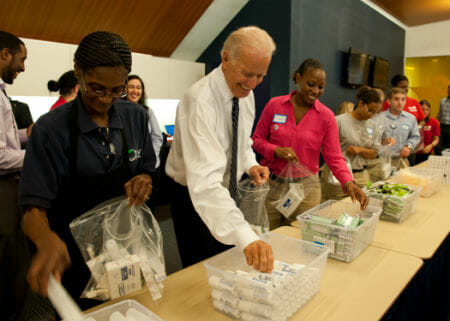
Vice President Joe Biden joins volunteers at George Washington University to assemble hygiene kits.
“What you’re doing matters to them,” he told the volunteers. “The recognition matters.”
The vice president then circled through an assembly line with volunteers from the university, AmeriCorps and various nonprofit organizations. They put together 500 hygiene kits – with toothpaste, nail clippers, shampoo, combs and more – for Operation Gratitude, which distributes care packages to veterans, first responders and the caregivers of wounded military members. There was also an opportunity to talk to first responders from local fire stations.
Points of Light – in partnership with Operation Gratitude and George Washington University, and with support from the Corporation for National and Community Service – organized the volunteer service project.
Wendy Spencer, CEO of the Corporation for National and Community Service, came to applaud the volunteers. She said to them that volunteering on 9/11 is a sincere way to “participate, honor and give back.”
How did you recognize the 9/11 Day of Service? Tell us at [email protected].
Having served myself and being married to a U.S. Navy veteran, I have experienced the tough transition process from the military life to a civilian career. And even though we seem to have made it, I can relate to others who are having a hard time adjusting to the change.
When you leave the military, it is not like just changing your career but changing your whole life. You come from a system that completely took care of you, starting with giving you strict guidelines about your work schedule and location, to setting expectations regarding your physical fitness, while providing you with health care. You are part of a unit, you go to places that others will never (want to) go to and you have buddies you would die for, and they for you. And then it all stops.
There are some fantastic programs in place that ease the transition, but the newly gained freedom that comes with being on your own can be overwhelming and lonely.
One fantastic organization that I was introduced to thanks to fellow AmeriCorps VISTA member, Alley Smith, is Team RWB. Team RWB’s mission is to enrich the lives of America’s veterans by connecting them to their communities through physical and social activity.
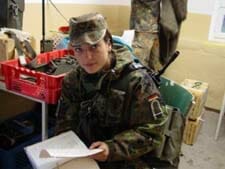
Birte Keays participates in a training exercise with the German Army, in which she served as an officer from 2002 to 2008.
Another great opportunity to get involved is First Lady Michelle Obama’s Mayors Challenge to End Veteran Homelessness. Launched in June, the initiative is a way for mayors across the country to solidify partnerships and secure commitments to end veteran homelessness at the local level. Learn more about supporting veterans and others who are facing homelessness by getting involved with a project near you.
To find other national volunteer opportunities, check out the U.S. Department of Veterans Affairs to find a medical center or hospital. You could also get involved with Habitat for Humanity’s special Veterans Build initiative to help provide housing.
One of the projects that I am working on aims to bridge the gap between veteran, military service members and military family service providers and the volunteers interested in supporting them. While there are a number of service providers in the area, all too often they are not aware of each other. (For those of you in the D.C. area, Serve DC’s volunteer opportunity database, NeighborGood offers one way to find volunteer opportunities.)
During my service, the military built on toughness and encouraged a team spirit, which often led us to look out for others first rather than ourselves. Admitting weakness and helplessness is hard for everyone, and from my own experience, I think it can be even harder for veterans – myself included.
By volunteering with each other you can learn from and support each other without forcing help on someone who does not need any or is not able to accept it at that time. However, they will know that you are there if and when they need someone.