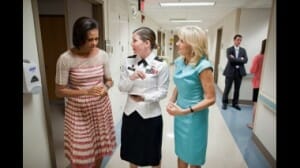
Michelle Obama and Jill Biden launch Joining Forces in 2011
Yesterday marked the start of First Lady Michelle Obama & Dr. Jill Biden’s Joining Forces Anniversary Tour.They kicked off a two-day tour celebrating the one-year anniversary of Joining Forces, their initiative to recognize, honor and serve military families. Since launching Joining Forces on April 12, 2011, significant progress has been made to rally Americans around military families. Communities all around the country have joined forces to take action to support veterans and military families as they serve our country and throughout their lives. The Joining Forces two-day tour will highlight examples of organizations and companies that have made significant commitments to support military families.
The initiative focuses on key priority areas – employment, education, and wellness – while raising awareness about the service, sacrifice, and needs of America’s veterans and military families.
In partnership with Joining Forces, Points of Light has committed to mobilizing service leaders across the country to leverage the Community Blueprint, a new tool and initiative, to help local service leaders improve their communities’ support for veterans, service members and their families in the areas of education, employment, mental health, reintegration, and financial and legal services.
Today’s turning point post is written by Vivian Greentree, Ph.D., who is the director of research and policy for Blue Star Families. In Vivian’s spare time, she volunteers as a member of the Board of Directors for the USO of Hampton Roads and Central Virginia. She also enjoys uncovering the nuances of LEGO building from her two sons. She is a Daily Point of Light recipient for March 20, 2012.
I grew up in a very community-oriented household. My earliest memories include going to vote with my uncle, who was a U.S. Congressman. By the third grade, I was the president of “Kids for Ben Jones,” the club we started in my neighborhood to raise money to donate to his campaign. He was a strong advocate for educational spending and promised to help us get more books for our school library. I know now our donations, pooled allowance money, probably didn’t end up buying us the books that ended up in our library shelves, but his letting us believe we had a place in the process was a lesson in and of itself. And, it got me hooked. There is no doubt that my family’s strong influence started me on the path of community involvement that has led me to where I am now.
In college I majored in public relations and political science. While my friends were hunting for Fortune 500 companies to work for, I was looking for a political candidate that I believed in to work with. I found that person in Gov. Roy Barnes. I worked in his press office and was there the day the Georgia Assembly voted to change our state flag to remove the “stars and bars.” The Governor had used some major political capital to push the initiative through and I saw firsthand how ordinary people, working together, can effect positive change. While I was working in the Governor’s office, another opportunity to serve presented itself to me and I was accepted into Officer Candidate School for the U.S. Navy.
I served in the Navy on both active duty and in the reserves. My husband is still active duty and has deployed four times in our marriage, most recently to Iraq. There are challenges that come with that, especially with regard to our children. However, I’m thankful they are growing up in a culture of service, that they see their dad and other service members giving of themselves for their country. I believe everyone should give back to our society – be it with the military or community service. We owe it to those who came before us and helped us to get where we are in life. We also owe it to the future generations who depend on us to keep adding to our country’s foundation. I contribute to several print and online military family outlets as a writer. I enjoy writing about the immense pride and honor I feel as part of a military family, as well as the challenges associated with supporting a military member.
Through my involvement with Blue Star Families, I have also met and worked with some phenomenal military spouses. Our leadership team, small but efficient, is full of women who I am honored to know and who have each taught me life lessons by their examples. Their ability to navigate and push an agenda for military families, while providing support to our team and their own families, has been awe-inspiring. I also work with spouses across the country, virtually, who I have never met in person, but who I trust implicitly and who have provided support to me when I needed it most. Together, we can see we are making a difference; all the while juggling deployed spouses, children, jobs, etc.
Assisting in developing Blue Star Families with a group of seven women into a national organization with more than 35,000 members is something I am very proud of. One specific idea I had, early on in the development of Blue Star Families, was to introduce our program Operation: Appreciation, a program where we collect cards of support for military family members – spouses, parents of service members and children (as well as veterans) from the civilian community and pass them out to our members. There are a lot of programs aimed at sending packages and letters to service members, but not so much their families. I came up with the idea while my own husband was deployed and one of my friends gave my oldest son a card, which just said something like “Good Job!” for being so good while his dad was gone. It’s a simple concept but we have been able to grow the program over time and now it is one of our most popular requests from community groups and private sector partners. And, I still love posting individual cards that we get on our Facebook page. To think it grew out of a few of us sorting cards in my living room with small donations for postage (or our paying for it ourselves) to what we have now, with governors, Hollywood celebrities and other high-profile companies participating, is just awesome.
We can all contribute to the national dialogue on what it means to serve by continuing to discuss our personal roles in encouraging the public service ethic and cultivating the valuation of national and community service and civic participation within our own personal spheres of influence. Civic engagement and volunteerism should go beyond voting and complaining about elected officials. Volunteerism is what sustains this country and allows us to see past our differences to our commonalities as human beings. Through volunteerism we continue to learn, grow and give back to the communities that have given us all so much.
My Turning Point Was During My Dad’s Deployment
Simone A. Bernstein is a sophomore at St. Bonaventure University in Olean, N.Y. Simone and her brother, Jake, created a website http://www.stlouisvolunteen.com, and will soon launch http://www.volunTEENnation.org, a resource for youth throughout the nation to find volunteer opportunities in their communities.
Over my winter breaks from college, I often stock up on old movies and watch them curled up on the couch. I recently rented the 1970s movie, Turning Point. Anne Bancroft and Shirley McLaine, the lead actresses, reflect and ponder on how difficult and complex decisions impacted and altered their lives. Fortunately, as a college sophomore, I have not yet had to face such difficult life choices as these actresses in the movie. Yet, each of us has our own turning points that mark and highlight the beginning of a new and positive change in our lives.
My turning point was during my dad’s deployment. As a military dependent, it was difficult and challenging for my mom to maintain a sense of normalcy with three young children. Yet the outpouring of support our family received from the community: from volunteers bringing meals, neighbors helping my mom with childcare and errands, and even strangers mowing our lawn, sparked my siblings’ and my desire to get involved and help others. I immediately called the local USO to see how we could all sign up to volunteer. Although they appreciated our interest, due to safety and security concerns, volunteers had to be 18 years old to volunteer onsite. It was tough for my brother and I to find nonprofit organizations allowing youth onsite. We were active with scouts and our religious youth groups, but we wanted to do more.
Though word of mouth, we discovered a few local volunteer opportunities available for youth. We volunteered at the local library, at an emergency shelter for children and, as we got older, the VA Hospital. We were hooked. We met with nonprofit agencies, religious institutions and schools to find ways for local nonprofit organizations to include youth. We created a simple website for youth and nonprofit organizations to connect within the community. The positive feedback in the community from the site led my brother and me to organize the first St. Louis Youth and Family Volunteer Fair. The Volunteer Fair is now an annual spring event. Thirty-five youth- and family-friendly volunteer nonprofit organizations recruit students and families with young children. More than 1,500 youth and families attended the fairs.
We wanted to create more opportunities that offered youth flexible options. My brother and I organized events to engage youth in volunteer service from offering free tennis and basketball clinics for youth with special needs to a youth and family park clean-up. Youth are interested in volunteering service when they are offered interesting, fun and rewarding volunteer opportunities. More than 5,000 youth have found volunteer opportunities though our website, organized volunteer projects, Twitter postings, Facebook notices and text messages. The care and concern we received from the community from our dad’s military service commitment was the turning point for my siblings and me to pay it forward and give back to our community.
To find more resources/tools for military families check out the Community Blueprint Network for best practice sharing and more effective delivery of services among organizations that serve military personnel and their families. To find youth volunteer resources check out generationon.org.
My Turning Point: Life As An Army Brat
The theme for this years National Conference on Volunteering and Service is “Turning Point.” At Points of Light we will be highlighting turning point stories – the stories of when someone recognized they could no longer stand by and watch the needs of their communities go unmet. The moment when they stepped in and took action. Today’s Turning Point comes from guest writer, Saxon Seay, Points of Light’s Manager of Marketing. Want to share your turning point story and have it published on our blog? Email stories to: Listen [at] pointsoflight.org
My family and the experiences I had growing up as an “Army brat” is one of the single largest drivers of who I am. Oftentimes when people learn that I am a “brat” they comment on how difficult a lifestyle it must have been, but I cannot think of a better way to have grown up. My diversity of experiences as a child taught me several important lessons but the most important lesson was about living life in service to others.
When I was younger I saw that my father did not have the luxury of working regular hours in safe conditions. Giving back to our community and country was an inherent part of his profession and both he and my mother taught us to live our lives with the same enduring spirit and dedication to others that they demonstrated every day.
For me, there isn’t one experience that stands out as my turning point – there is my parent’s legacy of turning our minds and hearts toward others day after day.
As a result, I started volunteering at a young age. Now I continue to give back to my undergraduate institution by engaging millennial-aged alumni with the school as a member of the Berry College Young Alumni Board and acting as a mentor for students interested in marketing or nonprofit management. I truly enjoy working with university-aged students and have spent hundreds of hours serving this demographic through Passion conferences/Passion City Church, a faith-based organization that engages students to meet the world’s greatest social needs through Do Something Now.
I’m also forever indebted to the army family who stood by our side during my dad’s 27-year-career as an Army aviator and look for ways to give back to that community. That’s why I’m so excited to see Points of Light increasingly support active-duty military, veterans and their families through our work on Community Blueprint, an initiative led by the Points of Light designed to provide a “blueprint” for community leaders to take action and serve with and for the military community.
This spring we hope you’ll join us at Points of Light in talking about your turning point – the moment or moments that inspired your service. For Saxon, it wasn’t just a moment. It was years witnessing her parents living a life of service to others and their country.We know you have a story too. To share it with us and/or on this blog, send your story to: Listen [at] pointsoflight.org
Change Notes: Resolve to Serve in 2012
Friends,
The New Year is always a great time for clean slates, aggressive goals and personal resolutions to be good and do good in the world. Our Points of Light goals for 2012 are ambitious. This year, Points of Light and its enterprises – HandsOn Network, generationOn, AmeriCorps Alums and the Corporate Institute – plan to:
Provide people with access to 500,000 projects and other opportunities to learn new skills and engage in work to improve their communities
Mobilize 3.5 million people to use their time, talent, voice and money to create community change
Play a significant role in improving the civic health of the communities we serve with projects like the Community Blueprint Network for military, veterans and their families; generationOn service clubs providing kids and teens a way to begin a lifetime of service; and opportunities for AmeriCorps Alums to create transformational change and serve as advocates for the power of service
Contribute to a measurable change in education and student performance, environmental sustainability, economic prosperity, and emergency preparedness and recovery in communities we serve by connecting people to their power to make a meaningful difference by providing access to tools, resources and opportunities
I hope you will share your resolutions with us on the Points of Light Facebook page. As a community, we can support one another as we strive to meet our individual goals. We’ll keep you posted on our progress and hope you’ll do the same.
Here’s to a transformational 2012.
Yours in service,
Michelle Nunn
CEO, Points of Light
Americorps Opens Eyes to the Military Community
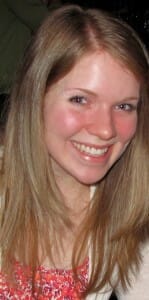
As an economics major, I sometimes felt out of my element as I found myself more concerned about people and their well-being than I did about money, profit, and finance. As my classmates competed for the typical financial analyst positions, I found myself applying for the Peace Corps. As those very same people took internships at high paying investment banks, I decided to pay my way to South Africa to learn how to mentor emerging young entrepreneurs. And as my classmates received their job offers as we approached graduation, I saw my dreams collapse before my eyes as medical clearance was revoked, just weeks before I was to receive my invitation to be a business advisor in sub-Saharan Africa though the Peace Corps.
I felt lost for a while as my dreams took on new shapes, and eventually I found myself looking for opportunities with non-profits. I wanted to move to DC, a major hub for non-profits. A friend finally recommended AmeriCorps, and my old dreams of helping people rise out of poverty were finally rekindled as the Peace Corps dream turned into the AmeriCorps reality. At pre-service Orientation I found myself surrounded by like-minded people, and finally feeling understood by my peers was a welcome change.
Four months into my service, I am proud of the decision I made. I am learning about a population previously very foreign to me (the military community), but at the same time I am developing strategies and practices that could easily be applied to other groups. I am having a cultural exchange as well, from west to east coast, though admittedly not quite as dramatic as the Peace Corps would have been! I am thankful for the experiences I have been given and for the great team of people I work with here in DC, and I am looking forward to the rest of my year of service.
Americorps Thoughts on the Community Blueprint Network
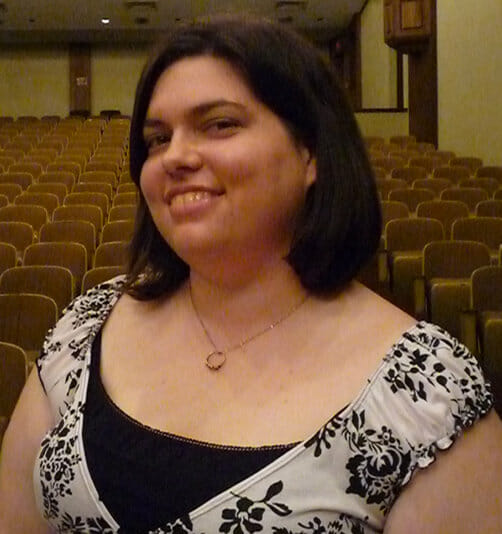
I chose to work on the Community Blueprint Network and with the American Legion Auxiliary due to the target population. Growing up, I spent countless hours at my local American Legion Post, where my mother was a Legionnaire, working on fundraisers, outreach to the community, etc. My mother separated from the US Army before my time, but nonetheless she taught me that there is nothing greater than one’s selfless service to our country by serving in the military. Thanks to her encouragement and dedication to the veteran and military community, I have followed her footsteps in an attempt to make a difference for those who so admirably serve our country.
This is my second service year with AmeriCorps VISTA and American Legion Auxiliary Call to Service Corps. It is truly a unique opportunity to assist the military community, while standing true to the Auxiliary’s motto, that I’ve grown up with, service not self. Both VISTA-ships have afforded me the opportunity to be part of a support system for communities to engage and retrain volunteers in service towards veterans, service members and their families.
The thing I admire most about the Blueprint is that it is designed to assist communities to be proactive from within. It guides them to suggested paths, but recognizes there is more there one way to reach a desired outcome in each of the eight impact areas. I feel fortunate to say that in my seven months on the Blueprint, I’ve seen it become defined and take shape into something a community will benefit from using.
It is truly an honor for me to be able to serve the military community and volunteer in such a way in conjunction with my American Legion Auxiliary membership to honor our nation’s bravest, those like my mother.
Where Are You From? Challenges Military Families Face
For Veterans Day we are highlighting all types of stories regarding Military service members, families, and communities. This guest post is written by Tyler Anger, a graduate of the University of California, Berkeley. As the son of an active duty member of the Army, Tyler grew up on military installations throughout the United States, and attended high school in Heidelberg, Germany. He joined AmeriCorps and the Community Blueprint Initiative with the hope of mitigating the challenges and inequities faced by veterans, service members, and military families in communities across the country. As a writer for the Blueprint, he is responsible for the Behavioral Health, Employment, and Family Strength impact areas.
It’s an easy question. In college, when I first moved away from the insular military communities in which I had grown up, I heard it all the time. It’s one of those basic canned niceties you’re supposed to ask and answer without much thought, an old-fashioned hand-me-down from the days such things were a more acceptable metric of evaluation. Say your name. Shake hands. So, where are you from?
It seems silly now, but after a while I came to hate the question. At first I simply said “All over,” which came off as awkward and evasive. There was a subsequent period when I said “Heidelberg, Germany,” which was where I had attended high school, and for a time I enjoyed the profit of distinction this seemed to give me in classrooms and at parties. Inevitably, though, someone would say “Oh, but your English is so good!” sending me backpedaling to square one. I’d thought about saying New Jersey, where I lived for a remarkable three years, or Oregon, where I was born, but both rang false in some profound and meaningful way. These days I’ll say Berkeley, California, where I attended college, and this is usually sufficient to facilitate the continuation of meaningless small talk without a lengthy digression into my experience as a military child.
The ubiquity of “Where are you from,” aside from providing for pithy self-deprecating anecdotes, points to an important truth about the military family experience. There are certain unpleasant realities that you internalize, one of which is that you will be relocating frequently. “Where are you from?” isn’t a question we asked in my Department of Defense-run high school. Other aspects of these internalized realities are even less pleasant, such as the slow shift into acceptance of those long months when one parent is away in some distant corner of the earth, missing your soccer games, skipping your school plays, dodging those boring parent-teacher conferences, and – you try not to think about this one – living in a war zone, in constant danger of becoming a statistic. That’s your reality, and it’s one that, for all its grasping, American society still fails to understand.
If there is an indelible fingerprint that the military experience leaves on families, it can be found there, I think, in the disconnect between the basic social implications of “Where are you from?” and the ability of a military child to answer.
I joined AmeriCorps and the Community Blueprint in order to resolve that disconnect. As a VISTA, I work to hone the support of and responsiveness to service members, veterans, and military families in communities across the nation. The challenges I faced growing up with a parent in the Army shaped me into who I am today, and I am proud of my family’s service to our country. At the same time, it is my sincere hope that, through my work with the Blueprint, I will reduce and eventually eliminate those challenges for future generations.
Tyler Anger is a graduate of the University of California, Berkeley. As the son of an active duty member of the Army, Tyler grew up on military installations throughout the United States, and attended high school in Heidelberg, Germany. He joined AmeriCorps and the Community Blueprint Initiative with the hope of mitigating the challenges and inequities faced by veterans, service members, and military families in communities across the country. As a writer for the Blueprint, he is responsible for the Behavioral Health, Employment, and Family Strength impact areas.
Support Military Families this Veterans Day With Community Blueprint
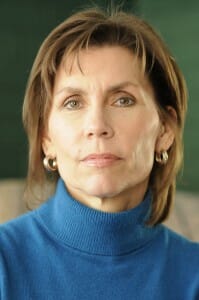
Today’s guest post is written by Barbara Van Dahlen, Founder & President of Give an Hour.
Approximately 2 years ago, I joined a handful of my colleagues to begin work on a national initiative now known as the Community Blueprint Network. Originally a jointly crafted project that was neither owned nor controlled by any one entity, the Community Blueprint Network now has a permanent home with Points of Light.
As the initial set of architects for the Blueprint, we set out to create an initiative that would add structure and consistency where little existed. We sought the advice and wisdom of representatives from over 75 public, private, and nonprofit organizations. We took the knowledge gained and shaped it into a tool that provides community leaders interested in supporting military families with specific guidance regarding precise areas of focus (employment, education, behavioral health, homelessness, financial/legal issues, family strength, reintegration, and volunteerism). Within each area of focus, several concrete suggestions for action are offered and examples of promising practices are provided. Our expectation has always been that each community will implement the Blueprint in its own unique way.
I am so proud that several organizations are now leading the implementation of the Blueprint in a handful of demonstration sites in Texas, Florida, Georgia, Alabama, North Carolina, and Virginia. Surveys conducted in two of these demonstration sites (Fayetteville, N.C., and Norfolk, Va.) have provided valuable information about the opportunities and challenges ahead as we move forward with this mission.
Specifically, these surveys indicate that Admiral Mullen was right: there is tremendous good will in communities and a powerful desire to support those who serve and their families. Community members in Fayetteville and Norfolk—and the leaders of organizations in both communities—believe they understand the issues their military families face. And yet these community members and leaders acknowledge that the needs of those in the military community are not being met. When asked about the obstacles that prevent effective coordination and collaboration, an overwhelming majority of leaders indicated that little or no communication currently exists among the organizations tasked with providing services and care. The leaders also cited lack of time, lack of resources, and turf issues as primary obstacles.
In addition to providing concrete suggestions and recommendations for community leaders regarding areas of focus and actions to be undertaken, partner organizations working to implement the Blueprint in demonstration sites are exploring strategies and techniques to overcome the obstacles that prevent communities from effectively caring for their service members. Partner organizations and the talented and dedicated citizens in the various communities are learning that the answer to the problem lies in our ability to connect the dots between and among organizations and in our ability develop consistency in our efforts. By crafting a ”blueprint” designed to guide leaders in these efforts, we are laying the foundation for the development of a comprehensive integrated system of care that emphasizes coordination and collaboration.
Change Notes: Points of Light Calls on Americans to Unite in Honoring Veterans
Friends,
Nowhere is the uniquely American ideal of service more evident than among our military men and women and their families. As we approach Veterans Day and contemplate the return of more than 30,000 soldiers serving in Iraq, I am reminded of the tremendous sacrifices these men and women have made. I’m also moved by their propensity to continue their service by getting involved in their communities.
A recent New York Times article profiled some of these amazing stories and, I think, challenges us to think more deeply about how we not only serve, but also better engage veterans and members of the military.
As part of Points of Light’s observance of Veterans Day, our partnership with the White House’s Joining Forces initiative and a year-round commitment to engaging and serving the military and veteran communities, Points of Light is inviting Americans to join us by volunteering, taking action in their own communities, learning more about the issues that affect service people and honoring others for their military or community service. Our goal is to generate five million acts of service by Veterans Day 2012.
We will also be honoring veterans, military members and their families throughout the year with the Daily Point of Light Award. People like Ramon Guitard, a Purple Heart recipient who lost both legs to a roadside bomb in Baghdad in 2004. Since his recovery, he has become a motivational speaker encouraging those with disabilities to lead independent lives. Like Taryn Davis, who became a widow at age 21 when her husband was killed in Iraq. She started the American Widow Project to provide resources and support to other young widows. And Brittany Bergquist who, at age 13, launched Cell Phones for Soldiers, Inc. to provide cell phones to deployed troops so they can stay in contact with loved ones.
Beginning on Nov. 11, we are elevating the importance of collaborative efforts to support service peoples’ unique needs year-round. Our HandsOn Action Centers are conducting projects throughout the year and throughout the country. In addition there are a variety of ways to get involved. Click on the links below to learn more.
Honor a group or individual for service to their community with a Daily Point of Light award. For Veterans Day, we are highlighting 11 truly inspirational people: wounded veterans, widows of service men, young people, Kids Care Clubs and more. Read the Points of Light blog to see their stories.
Engage with local military members, veterans and their families by taking advantage of free, online do-it-yourself project toolkits. Projects include creating welcome home cards or starting an oral history project that provides a structure for understanding and talking with veterans and active service members about their experiences.
Learn about the Community Blueprint Network, a national collaborative initiative, which provides resources, expertise and support for organizations that want to make a greater impact on the issues that most affect active and retired military individuals and families.
Get involved year-round by discussing issues that service people are facing in your community by holding a Sunday Supper on Martin Luther King, Jr. Day, or plan to attend a workshop in the Veterans and Military Families track during the 2012 National Conference on Volunteering and Service. We will be announcing other ways to get involved throughout the year, so stay tuned for more information.
As our veterans and active military personnel have sacrificed so much for the freedoms we all enjoy, I hope you will join me in thanking them for their service and honoring them by serving and taking action in your community.




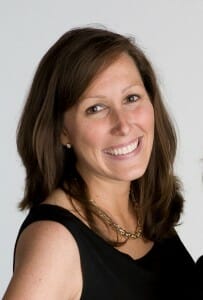 Today’s turning point post is written by Vivian Greentree, Ph.D., who is the director of research and policy for
 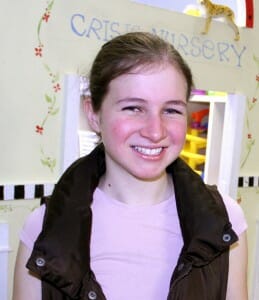 Simone A. Bernstein is a sophomore at St. Bonaventure University in Olean, N.Y. Simone and her brother, Jake, created a website http://www.stlouisvolunteen.com, and will soon launch http://www.volunTEENnation.org, a resource for youth throughout the nation to find volunteer opportunities in their communities.
 The theme for this years

 As an economics major, I sometimes felt out of my element as I found myself more concerned about people and their well-being than I did about money, profit, and finance. As my classmates competed for the typical financial analyst positions, I found myself applying for the Peace Corps. As those very same people took internships at high paying investment banks, I decided to pay my way to South Africa to learn how to mentor emerging young entrepreneurs. And as my classmates received their job offers as we approached graduation, I saw my dreams collapse before my eyes as medical clearance was revoked, just weeks before I was to receive my invitation to be a business advisor in sub-Saharan Africa though the Peace Corps.
 I chose to work on the Community Blueprint Network and with the
  For Veterans Day we are highlighting all types of stories regarding Military service members, families, and communities. This guest post is written by Tyler Anger, a graduate of the University of California, Berkeley. As the son of an active duty member of the Army, Tyler grew up on military installations throughout the United States, and attended high school in Heidelberg, Germany. He joined AmeriCorps and the
  Today’s guest post is written by Barbara Van Dahlen, Founder & President of