News Flash: Partnerships, Projects, Grants, Tools Available for MLK Day
The Martin Luther King, Jr. Day of Service on Jan. 16, 2012, marks the beginning of the year of service as millions of Americans honor the memory of Dr. King by contributing their time, talent, voice and money to improve their communities. Join Points of Light and activists around the country in meaningful dialogue, reflection and service projects to advance Dr. King’s work, legacy and vision of creating a beloved community.
At a time of increasing inequalities, Dr. King’s call to be a “drum major for justice” is particularly poignant and relevant. He challenged us all to see the world as it really is, then work to bring about change.
Points of Light aims to engage more than 50,000 Americans to participate in America’s Sunday Suppers across the nation, inviting people from diverse backgrounds to come together to share a meal, discuss issues such as poverty and homelessness that American families and veterans are facing today, and be inspired to take action through service and advocacy.
Through HandsOn Network, AmeriCorps Alums and generationOn, we will also engage 40,000 individuals in active service and philanthropy through thousands of service projects and dialogue in more than 50 communities across the nation.
Grant Availability
To support the development of MLK Day initiatives and opportunities for people to serve, Points of Light, in partnership with the Corporation for National and Community Service, is offering grants to increase the impact and effectiveness of service projects around the country. Available are two $30,000 leadership grants and four $15,000 signature grants.
To receive one of the six available grants, the following requirements must be met:
Honors the life and legacy of Dr. King through civic dialogue and service, preferably including a signature America’s Sunday Supper – which invites people from diverse backgrounds to come together to share a meal, discuss issues that affect their community and highlight the power each one of us has to make a difference
Includes projects that focus on improving the lives of active military, veterans and their families
Builds a MLK Day coalition or strengthens an existing one to engage the community in volunteer efforts
Includes training for volunteer leaders to be placed at nonprofits
Focuses on MLK Day as both a day of service and an activation opportunity for year-round service
Apply today and tell Points of Light how your project meets these requirements. The deadline is Nov. 7, 2011, at 5 p.m. If you have questions, please email us at [email protected].
Webinars
To help build nonprofits’ capacity to plan and execute national days of service, Points of Light is offering a series of free webinars to develop the skills of volunteer or project managers.
To get more information or register for these webinars, please visit HandsOn Network.
Veterans and Military Families Sessions at NCVS!
This year at NCVS, session content is organized across a series of issue areas so that attendees can tailor their schedules to meet their learning and networking needs.
Check out all the sessions associated with…
Veterans and Military Families
“So you want to start a Vet Corps…”
Monday, June 6, 2011 10:00 AM – 12:00 PM
Session ID: 5632
Twitter Hashtag: #NCVS5632
Have you ever wanted to be a fly on the wall of a collaboration meeting?
Here’s your chance! Join representatives of Louisiana’s national service, volunteer, military, veterans and military family organizations as they explore opportunities to collaborate in this special fishbowl session.
Leave with a strategy for approaching such organizations in your community or state.
Welcome to Our World! Feds, Veterans and Military Family Service Organizations, Meet Community Volunteers.
Monday, June 6, 2011 1:00 PM – 2:30 PM
Session ID: 5590
Twitter Hashtag: #NCVS5590
“Have you ever wondered, “Who works in this field? How do I meet them? How do I build a partnership?”
If so, join federal agencies, veteran and military family service organizations, volunteer service organizations and national service project representatives in this special, lively get acquainted session.
Who knows?
Maybe you’ll meet your program’s match!
Benefits of Partnership with Veterans Service Organizations
Tuesday, June 7, 2011 8:30 AM – 10:00 AM
Session ID: 5331
Speaker: Bob Reeg
Twitter Hashtag: #NCVS5331
Learn how organizations that use volunteers to accomplish their missions may engage veterans service organizations (VSO) in both veteran-specific and general population efforts.
General practical recommendations and case examples will be provided
Engaging Veterans with Disabilities and Wounded Warriors in National and Community Service
Tuesday, June 7, 2011 4:00 PM – 5:30 PM
Session ID: 5210
Speakers: Joanne Cohen, Paula Sotnik, Alfredia Johnson, Zernial Bogan
Twitter Hashtag: #NCVS5210
As part of the larger CNCS initiative to engage veterans in national service the National Service Inclusion Project (NSIP) collaborated with Denver Options’ Center for Technical Assistance and Training (CTAT) and Operation TBI Freedom to launch the Engaging Veterans with Disabilities Initiative guided extensively by information from veterans, especially current or former AmeriCorps or other national service volunteers.
Join us for an informative and interactive session that presents outcomes from 1:1 interviews and discussion groups and engages participants in an interactive discussion that highlights promising practices for engaging veterans with disabilities and Wounded Warriors in national service.
Networking Session for CNCS’s Veterans and Military Families Knowledge Network Participants (5619)
Wednesday, June 8, 2011 7:00 AM – 8:00 AM
Session ID: 5619
Twitter Hashtag: #NCVS5619
This interactive discussion will give you an opportunity to put Network voices to faces as you contribute to the growing body of knowledge and experience about support to veterans and military families. Curious about the network? Join us!
Recognizing Service and Sacrifice: Supporting Military Families in Your
Community
Wednesday, June 8, 2011 8:30 AM – 10:00 AM
Session ID: 5062
Speakers: Christina Jumper, Kelly Hruska
Twitter Hashtag: #NCVS5062
This session will provide participants with resources, strategies, and useful tools to identify and support military families.
Participants will also learn how a tool such as the Community Toolkit can help them do their work.
What We Know So Far: Best Practices in Serving Veterans and Military Families
Wednesday, June 8, 2011 10:30 AM – 12:00 PM
Session ID: 5589
Speakers: Karen Zapp, Bill Basl, Gloria Butler, Mark Fischer, Timm Lovett, Bob Belknap
Twitter Hashtag: #NCVS5589
Experienced volunteer and national service programs working with VA medical centers, homeless veterans, and military bases will share lessons learned and best practices for working with these groups and institutions in this lively session. Bring your experiences and questions. Leave with great ideas and inspiration!
We are stronger when we work together!
by Vivian Greentree, Director of Research and Policy,
I am very excited to be attending this year’s National Conference on Volunteerism and Service as a representative of Blue Star Families, a national military family support organization.
Along with attending all the amazing sessions (and exploring New Orleans!), we will also have booth space to share our program, Operation Honor Card, with the other participants of the conference.
A part of Joining Forces, Operation Honor Card is a joint project between Blue Star Families, the American Red Cross, and ServiceNation: Mission Serve with the support of The Corporation for National and Community Service, the Department of Defense, and the Department of Veterans Affairs.
The program allows citizens to pledge volunteer hours in honor of the service of military families, veterans, and service members in order to create an atmosphere of shared service and the high level of community engagement seen during WWII, when ‘all gave some.’
Those coming by our booth at the conference will be able to pledge service hours and write notes of support and encouragement to the military community, which we will then distribute among our membership and partnering organizations.
Both the community service hours pledged and the cards written and given out to our military families through Operation Honor Card are much treasured personal, tangible gestures that our civilian counterparts can perform to support and engage our military community.
Someone famous once said,
“Courtesies of a small and trivial character are the ones which strike deepest in the grateful and appreciative heart.”
As a military spouse who has both given and received just such letters, I can tell you that finding out someone who doesn’t even know me cared enough to take a moment and say “I’m thinking of you” was priceless at a moment during a long deployment when I needed a little encouragement.
I’m also excited to meet other organizations who will be attending the conference to find out ways we can work together to promote civic engagement and interaction between public and private organizations looking to get involved with the military community.
While there is little data on the particulars of volunteerism within the military community, sixty-eight percent of respondents to our 2010 Military Family Lifestyle Survey had volunteered in the past year and research shows that veterans who volunteer have more successful transitions home than those who do not.
There is a therapeutic quality to helping others that many of our military parents and spouses say help get them through deployments and make them feel satisfied that they have ‘paid it forward’ from the help they received when they were newbies.
Military families are also in a special position to encourage others to donate their time, energy, and spirit to make this country a better place to live for ourselves and our future generations.
While our military members are most noted for protecting our rights and freedoms, their service also demands from us the responsibility of making this country a land where freedom engenders a sense of duty to do what one can to strengthen our communities and truly encourage the democratic principles of commitment and service.
Civic engagement and volunteerism are what sustains civil society and allows us to see past our differences to our commonalities as human beings.
In the military community, we know that we are only as strong as our weakest link and that it is a group effort to maintain strength and resiliency on both the forefront and the homefront.
Our relationships are forged through our collective experiences of mutual sustainment and, I believe, we are stronger for it.
So, I’m excitedly awaiting the conference and looking forward to meeting wonderful people and sharing innovative ideas (along with great food!) to build a stronger nation through volunteerism and service.
I hope that if you are interested in learning more about the military community, you’ll stop by and see us at our booth or in one of the sessions.
We are stronger when we work together!
Vivian, a Navy veteran, is the Director of Research and Policy for Blue Star Families. She is currently completing her dissertation on public service motivation for her PhD.
How Does Your Community Support Military Families?
So, you want to support military families but you don’t know where to start, think it’s too expensive or complicated, or even time consuming?
Well, we have a simple, easy answer for you!
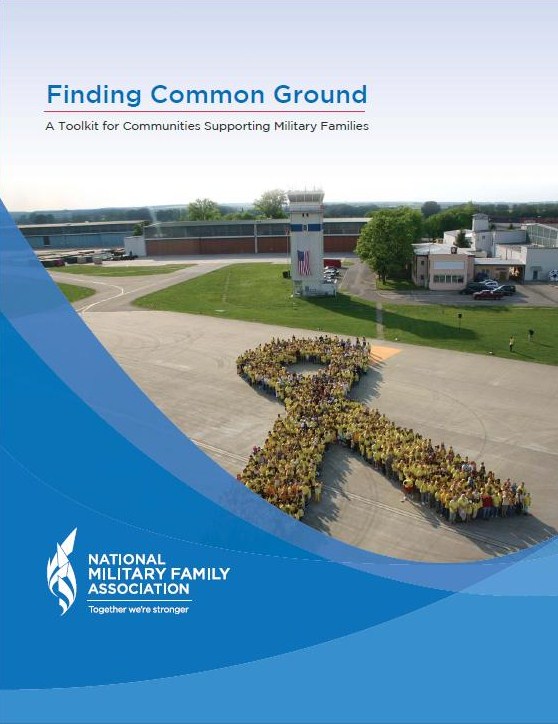
Finding Common Ground: A Toolkit for Communities Supporting Military Families is a new resource from the National Military Family Association.
This toolkit is the product of our Association’s summit, “When Parents Deploy: Understanding the Experiences of Military Children and Spouses,” at which we gathered the leading experts in the fields of military family support, childhood development, women’s issues, and behavioral health.
This toolkit suggests easily-achievable action items and useful resources to guide anyone who wants to support military families, but doesn’t know where to start.
This toolkit provides an answer to the question “What can I do to help?”
Using and sharing the information in this toolkit is easy.
, identify yourself in one of the communities, and read about ideas and resources that can start conversations and stimulate action.
Then, take some time to explore the other toolkit links. Print pages of the toolkit or use your online social networks to share the information with your friends.
Supporting military families doesn’t need to be complicated or expensive.
The toolkit provides examples of how easy it is to help military families – from having coffee with a service member’s parent to youth organizations looking for ways to include military families as part of the curriculum.
Share how you’re supporting military families in your community!
By Bailey Bernius, Public Relations Specialist, National Military Family Association
In communities all over the world, military families are living a unique lifestyle in order to serve our country alongside their service member.
It can be difficult for those not familiar with the military to understand this lifestyle and to figure out their role in helping military families in a time of need.
Everyone has a role to play in supporting military families – not just their friends and neighbors. Employers, educators, community leaders, government leaders, and health care professionals can all help support military families in unique ways.
Here are some simple ways civilian families can help the military families who are living right in their own communities.
Hang out: Where appropriate, invite the spouse of a deployed service member to go out to dinner, see a movie, or go to a concert. Getting out of the house is a great stress reliever during a lonely time.
Be yourself: Look for opportunities to help by matching your own talents and resources with the needs of another.
Volunteer: Organizations all over the country are helping military families. Whether it is with time, money, or talents, it is the volunteers that keep these much-needed services running. Check out your state volunteer website or use the search engine on Serve.gov.
Provide a helping hand: When a service member you know is deployed, offer a play date for their kids, run errands, assist with home repair, mow the lawn, cook dinner, or help with anything else that is so much easier to do when there are two parents in the home.
Show your appreciation: Business owners can offer military discounts for service members and their families.
Give a taste of home: Bake or cook for single military personnel who are living in the barracks or invite them over for a holiday when they’re stationed away from home.
Be a friend: Having a spouse deployed is extremely difficult and having a shoulder to lean on eases the hardship.
Be understanding: Civilians can offer employment opportunities to military spouses and understand that their lifestyle may cause time gaps in a military spouse’s resume. It can be hard to establish a career while having to move to a new duty station every few years. Co-workers can rally behind the family of a deployed service member, providing a close-to-home support group.
Help make a house a home: Organize your neighborhood association to make newly-arrived military families welcome in your community.
Support education: Make military children feel welcome when they arrive in your children’s schools. When possible, be lenient with tryout dates and admission cut-offs. Recognize their achievements at other schools and find the best fit for them to thrive.
Be a proud American: Through actions and words, at every opportunity, support the men and women of the military. Never take for granted the individual freedoms these service members work tirelessly to safeguard and defend, often at great personal risk and sacrifice. They do it not only for themselves, but for their family members who support them daily in their patriotic service and privilege.
Keep your flag flying high!
* This information was gathered from more than 4,000 military spouses surveyed by the National Military Family Association.
Engaging Veteran’s with Disabilities and Wounded Warriors in National and Community Service
(CNCS) values initiatives and programs that engage veterans and military families, grow a knowledge base of how national service can best meet the needs of veterans and military families, support efforts that engage veterans who want to continue service in new ways at home, and promote effective collaboration with our veterans, military family members, and veteran-serving organizations.
To support CNCS in this effort, the National Service Inclusion Project (NSIP), a CNCS training and technical assistance provider on disability inclusion, is collaborating with the Center for Technical Assistance and Training (CTAT) and Operation TBI Freedom (OTF) at Denver Options.
This initiative is identifying promising practices, products, and delivery strategies. Most importantly, veterans, including those who are current or former AmeriCorps or other national service volunteers, will inform this work extensively. Information from this work and related products will be made widely available to veterans’ groups, national service programs, and the disability community to guide the practice, policies, and procedures of service programs as they recruit and support veterans with disabilities.
The following narrative summarizes seven interviews that were conducted during 2010 with veterans who are current AmeriCorps members or alums. Of the seven, five have a disability. Of the five, one did not disclose the nature of his/her disability, one had a “traumatic disability” that he/she did not want to discuss, one has post traumatic stress syndrome (PTSD) and physical disabilities unrelated to the military, one has a head trauma as a result of being in the military, and one has PTSD that has not been officially diagnosed along with a disability that has been diagnosed through the Veterans Administration.
Themes:
Common themes emerged from the conversations:
All interviewees expressed a passion to help people, including Veterans.
Many described how AmeriCorps provides them the opportunity to get back into the workforce—additional skill sets are developed, it is a great addition to their resume, and they believe it is impressive to potential employers.
Interviewees articulated that service and volunteerism is a satisfying and structured opportunity to serve our country in another way, giving back to the community and committing to someone else’s well-being, life, happiness, and education, while making an impact on others’ lives and helping the “under served” to help themselves.
Through AmeriCorps, these veterans felt a sense of belonging, regaining their identity. AmeriCorps gets them out of their comfort zone, stretching and learning a great deal.
AmeriCorps promotes change while making our country and the world better equipped to meet actual needs of others.
The following is a quote from one of the interviewees, an anonymous veteranwho served in AmeriCorps:
“My experience as a volunteer in the AmeriCorps program has given me the will to get out of bed every day. It has given me the education and the knowledge to understand my disability and it gives me a purpose in life. If you don’t have a purpose in life, it’s hard to get out of bed every morning.”
Joanne has over thirty years combined experience in coaching, consulting, and facilitation. She was in a car accident in 1992, experiencing her own TBI and PTSD. It is with this experience that many Iraq and Afghanistan Veterans who return with TBI and PTSD relate to her. Joanne is proud to serve as a liaison to this project.
Engaging Veteran’s with Disabilities and Wounded Warriors in National and Community Service
As part of the larger CNCS initiative to engage veterans in national service the National Service Inclusion Project (NSIP) collaborated with Denver Options’ Center for Technical Assistance and Training (CTAT) and Operation TBI Freedom to launch the Engaging Veterans with Disabilities Initiative guided extensively by information from veterans, especially current or former AmeriCorps or other national service volunteers. Join us for an informative and interactive session that presents outcomes from 1:1 interviews and discussion groups and engages participants in an interactive discussion that highlights promising practices for engaging veterans with disabilities and Wounded Warriors in national service.




 The Martin Luther King, Jr. Day of Service on Jan. 16, 2012, marks the beginning of the year of service as millions of Americans honor the memory of Dr. King by contributing their time, talent, voice and money to improve their communities. Join Points of Light and activists around the country in meaningful dialogue, reflection and service projects to advance Dr. King’s work, legacy and vision of creating a beloved community.