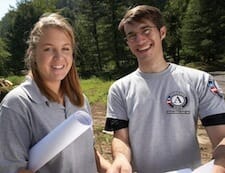
This post is by Tracy Hoover, president of Points of Light.
The journey of a thousand miles may begin with a single step – but for more than 900,000 AmeriCorps alumni, the journey of a lifetime of service began with 11 words from a powerful pledge.
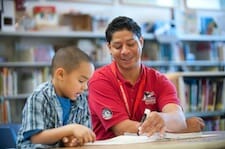
An AmeriCorps member in Minnesota tutors a child in reading.
“I am an AmeriCorps member, and I will get things done.”
This month marks 20 years since the first class of AmeriCorps members began their year of service. As part of the anniversary celebrations this week, Points of Light with AmeriCorps Alums will honor 20 exceptional AmeriCorps alumni, more than 50 leaders who helped AmeriCorpsget started and more than 20 companies for their tremendous work supporting and advancing national service.
Service unites Americans and transcends politics and partisanship. When President Bill Clinton signed AmeriCorps into law, he praised Americans’ “fundamental desire to do something to reach beyond themselves.”
This week, President Obama and three former presidents – including Points of Light founder President George H. W. Bush – will honor AmeriCorps and remind us that volunteer service is an essential part of our national character. It’s how we get things done.
AmeriCorps isn’t just a one-year commitment. Research shows that AmeriCorps is creating pathways and commitments to a lifetime of service. Long after their terms expire, AmeriCorps members are still getting things done here in America and across the globe.
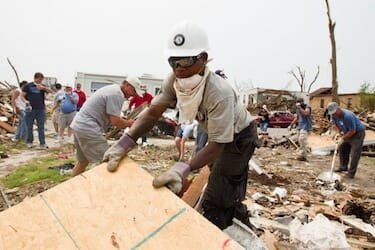
AmeriCorps members help clean up after a tornado in Missouri.
Kyle Kimball served in 1994 at AIDS Outreach in Birmingham, Alabama. Today he manages economic development for the City of New York.
Mona Mowafi served as a health educator at the Latin American Youth Center in Washington D.C. Today she is president of an organization that encourages social entrepreneurship and civic engagement in Egypt by Egyptians across the globe. Rebecca Langebuilt houses and trails with the National Civilian Conservation Corps. Today she is an active duty Air Force major and works in the Office of the Chairman of the Joint Chiefs of Staff, bringing the perspectives from both civilian and military service to her role.
Since AmeriCorps’ founding in 1994, AmeriCorps members have contributed more than 1.2 billion hours in service, helping 15,000 community organizations mobilize 4 million volunteers to help tackle some of the toughest issues, from poverty to education, health care to disaster recovery and environmental cleanup.
We have many to thank for 20 powerful years of AmeriCorps. That’s why we are honoring companies that have demonstrated outstanding commitment to national service as thought leaders, investors in national service programs, and mentors and employers of alums. We’ve named these companies National Service Corporate Champions, and you can see the full list here.
We’re also grateful to the many who played a role in founding AmeriCorps. The AmeriCorps Alums Founders Club has brought many of these individuals together again to support AmeriCorps and the alumni network.
AmeriCorps members, AmeriCorps alumni and millions of volunteers are transforming our communities and our country – all because those who served in AmeriCorps have proven that they continue to believe – and live – a simple, 11-word credo.
“I am an AmeriCorps member, and I will get things done.”
Vice President Joe Biden Joins Points of Light on 9/11 Day of Service to Pay Tribute to First Responders
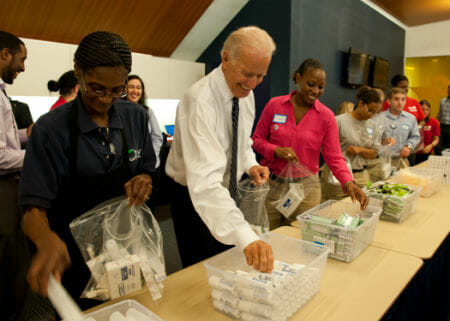
Vice President Joe Biden joins volunteers at George Washington University to assemble hygiene kits.
“What you’re doing matters to them,” he told the volunteers. “The recognition matters.”
The vice president then circled through an assembly line with volunteers from the university, AmeriCorps and various nonprofit organizations. They put together 500 hygiene kits – with toothpaste, nail clippers, shampoo, combs and more – for Operation Gratitude, which distributes care packages to veterans, first responders and the caregivers of wounded military members. There was also an opportunity to talk to first responders from local fire stations.
Points of Light – in partnership with Operation Gratitude and George Washington University, and with support from the Corporation for National and Community Service – organized the volunteer service project.
Wendy Spencer, CEO of the Corporation for National and Community Service, came to applaud the volunteers. She said to them that volunteering on 9/11 is a sincere way to “participate, honor and give back.”
How did you recognize the 9/11 Day of Service? Tell us at [email protected].
Reclaim the Legacy of 9/11 by Volunteering – Here’s Something Anyone Can Do
On Sept. 11, 2001, I walked into my classroom in Paramus, N.J., like it was just another day. At 8:35 a.m., our town, located just eight miles from New York City, was changed forever. On Sept. 12, I made a decision to allow my computer students to collect images from the Internet and place them into a PowerPoint project.
The next three days they worked quietly, expressing their grief and their fears on their screens. As the weekend approached, I instructed the children to ask their loved ones for a list of their favorite songs. On Monday, Sept. 17, they placed the music into their PowerPoint shows.
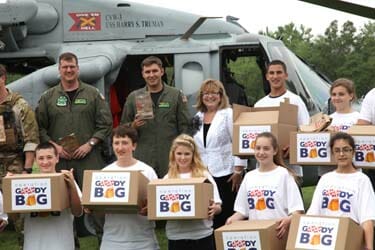
Sixth through eighth graders shared their work with classmates and teachers, families and first responders across the state. But, they felt they weren’t sharing with enough “heroes.” So, Operation Goody Bag was born.
Just a brown lunch bag, hand-colored and filled with a thank-you note, inspirational poem and candy treats. One delivery was made, and then the next, in total 1,783 in the first month. A job well done! But then the first thank-you note arrived and we were hooked. Goody Bags were shipped to the troops, to first responders in New Orleans after Hurricane Katrina and 5,000 to the children in Haiti after the earthquake.
To date, more than 325,000 Goody Bags have been packed and shipped to say thanks to those who keep us safe. Sept. 11 may be remembered for the tragic act of evil, but more importantly, it should be remembered for a time when real heroes, without concern for their own well-being, sacrificed their safety to protect others.
On the 10th anniversary of Sept. 11, the Corporation for National and Community Service held a 9/11 challenge, and Operation Goody Bag got top honors, with over 17,000 volunteers coloring Goody Bags and writing thank-you notes to troops and first responders. This year, we are reaching out to all Americans to help us achieve a new goal: 50,000 thank-you notes in 50 states on 9/11!
Kickoff of ServiceWorks Engages the Heart, While Putting Muscle Behind Service as a Solution
Three national partners – one corporate, one nonprofit, and one from the federal government – spoke to the power of service yesterday in New York at a moving ceremony kicking off ServiceWorks, a 10-city initiative designed to use service as a strategy to help 25,000 young adults develop the skills they need to prepare for college and careers.
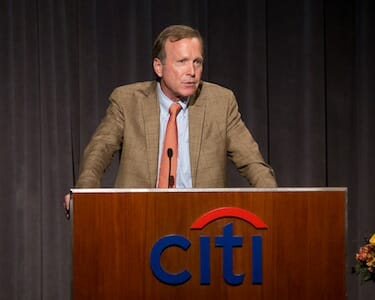
Points of Light Board Chair Neil Bush speaks about how ServiceWorks can help young people who feel they don’t have anyone to set them on a path to success.
Citi Foundation Board Chair Ed Skyler said, “We want to focus on and make a big commitment to what we see as the biggest problem facing our country today: youth unemployment.”
Points of Light Board Chair Neil Bush spoke of the thousands of young people who feel they are without anyone to set them on a path to success. “That’s so painful to hear. That’s something thousands of volunteers can change. I know that’s why we’re here today.”
And Corporation for National and Community Service CEO Wendy Spencer said, “This is a beautiful thing. It’s what Congress has charged us with: investing federal dollars in programs that work.”
The event – which featured poems from Grammy Award-winning artist J. Ivy, along with music, dance and inspiration – kicked off a national program unique in many ways.
ServiceWorks will be a massive demonstration of the power of service as an intervention in young lives. The program will give tens of thousands of young adults training in critical 21st century leadership and workplace skills, the chance to build their networks and connections to community, and the opportunity to use their new skills by participating in, and leading, volunteer service projects.
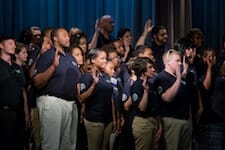
New AmeriCorps VISTA members get sworn in at the ServiceWorks kickoff ceremony.
ServiceWorks will be a large-scale volunteer response to the crisis of low career and college attainment, mobilizing thousands of volunteers – including Citi employees – as coaches, mentors and trainers.
ServiceWorks will be the nation’s largest corporate-sponsored AmeriCorps VISTA program, including 225 AmeriCorps VISTA members over three years.
ServiceWorks will unite the Citi Foundation, AmeriCorps and Points of Light in a powerful public-private partnership – the kind President Obama and other national leaders have been calling for – to solve our nation’s most critical problems.
ServiceWorks will unite a large group of nonprofit host agencies, using their collective experience in supporting the goals and dreams of our nation’s young people. The host sites are:
Boston – The Boston Private Industry Council
Chicago – Casa Central
Dallas – The Volunteer Center of North Texas and CitySquare
Los Angeles – Public Allies
Miami – Greater Miami Service Corps
Newark, N.J. – Jersey Cares
New York – The Door
San Francisco – Public Allies
St. Louis – United Way of Greater St. Louis
Washington, D.C. – Covenant House Washington DC
ServiceWorks will change so many lives, beginning with those of the 45 new AmeriCorps VISTA members who were sworn in yesterday. One of them, Abe Sierra, explained that he grew up in Boston, with few resources and fewer role models.
“I got kicked out of school,” he said, “but others who served in my community became an inspiration to me.” Thanks to them, Sierra said, “I got my GED, I’m currently enrolled in college, and I joined CityYear last year, which turned out to be a life-changing experience.” This year, Sierra will continue that “ripple effect of service” as a ServiceWorks AmeriCorps member in Boston.
“We’re the small motor that will spark the bigger motor of change,” he said.
How I Choose to Spend My 9-to-5
This post is by Madeline S. Collazo, AmeriCorps VISTA program associate at the Jewish Coalition for Literacyin San Francisco. Collazo is serving through Corps18, a Points of Light program that supports VISTA members addressing chronic absenteeism across the country.
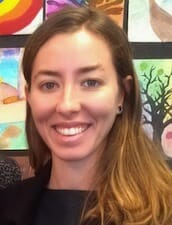
Madeline S. Collazo
I think that I was born to serve. Who or where I’m serving is irrelevant, what is most important to me is that I am helping those who need support.
Luckily, I have been across the United States doing just that, and loving it. Some of the opportunities that laid the foundation for my deep passion for community service include planting native trees in Massachusetts, teaching second graders in American Samoa and promoting universal health insurance in Puerto Rico.
Currently, I serve at the Jewish Coalition for Literacy in San Francisco increasing literacy rates in public schools across the Bay Area, and this year has given me key resources to think about why I love serving and how I can integrate it into my life, for the rest of my life. (Learn about Collazo’s work here.)
The idea that community service is just a phase for recent undergraduates who want to postpone “real work” is unfortunately common. Even my family and friends laugh when I tell them how I choose to spend my 9-to-5 and ask when I will decide to get a suitable job.
More specifically, AmeriCorps VISTA members are often misunderstood as office helpers, and I continually need to remind others of their role in an organization. When describing my job to people, I am usually met with confused or patronizing comments, which can diminish a sense of purpose and value.
But I’m not worried, because what I do makes me happy and I genuinely believe that working for a good cause trumps making lots of money. Although, I am not going to lie, I look forward to one day earning more than my current stipend, but I wouldn’t do it if it meant abandoning my principles and happiness.
Therefore, after my year at the Jewish Coalition for Literacy, which ends Aug. 8, I plan to re-enroll for a second year and continue developing the systems that will enhance community engagement and student success. During my second year as a VISTA, I will also apply to get a masters in social work or psychology (or both!), with hopes of continuing to serve in struggling communities.
Although I am unsure of the specifics of my future career, my job title and even my geographic location, I am certain that I will not stray too far from my current vocation: working toward a better world for all.
Money Can’t Buy What Service Pays Forward
This post is by Jamiel L. Alexander, a member of AmeriCorps Alums and president of YouthBuild USA’s National Alumni Council and Aspen Institute’s Opportunity Youth Incentive Fund Leadership Council. See below how you can get involved in a summer service challenge.
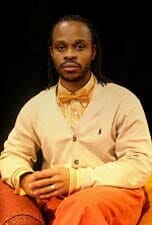
Jamiel L. Alexander
I was sitting in a business management class during this summer semester while my professor was giving a lecture. As I tried to concentrate on the classwork, a song, “Money Can’t Buy” by Neo, played in my mind accompanying my thought process. I was thinking that the benefits of service cannot be bought similar to how affection cannot be bought in this song.
In an effort to serve my community better, I’m taking courses in business law, money and banking, and business management that have given me a new outlook on service. It is through service that I have become a Millennial leader. Yet, those who know me well (and even those who don’t) understand that service is who I am and what I do.
Since service is part of who I am, I knew I had to go to the recent Aspen Institute’s Franklin Project Summit on National Service in Gettysburg, Pa. I was one of many AmeriCorps alumni there who believed there should be a “bridge year of service” for graduating high school and college students. In my opinion, this opportunity should be open to anyone.
The need for the whole community, and not just parts of it, supporting service, was made clear to me by my conversations and participation in this summit of world and community leaders. Is it possible that 20 years ago, our pioneers of the national service community envisioned and imagined that we would be here, today, advocating and pushing this cause, humanity’s call, forward: Service to others!
When I went back to my summer school session after the conference, I started to see how the conversation on increasing investment in a business to help it grow applies to service too. A major concept taught in my business class is that of “compounding.” Compounding is earning interest on interest that was earned in prior years.
In class, I was thinking of how I could use this concept in my everyday life. My professor began to give us the story of his life. Of course a few of my fellow classmates gave the “here-we-go-again look,” but I began to go with him through a snippet of his journey: him growing up on a farm, his challenges in becoming a well-respected businessman in corporate America, and now a semiretired professor. (Neo’s song slowly fading in.)
As he paused, I sat there, and it hit me as he stated, “You will accomplish more than you think.” I thought, the accomplishments and the seeds of good deeds through service may not be seen or recognized now, but your service will be our legacy – a force for unity, not just for families but for our community for generations to come.
So, here is my challenge to you. We’re doing a summer service challenge on twenty.americorpsalums.org to encourage people to serve 20 hours this summer. Go to the link for your service pledge, give back and pay it forward.
A Fear of Commitment, But Not When it Comes to This
This post is by Veronica Scheildler, an AmeriCorps VISTA member at generationOn, Points of Light’s youth service arm. Scheildler is serving through Corps18, a Points of Light program that supports VISTA members addressing chronic absenteeism across the country. Corps 18 VISTAs serving at generationOn help make volunteer service part of the culture at select New York City public schools by involving students, parents and teachers.
Veronica Scheildler
I’m a bit of a commitment-phobe, but I want to be doing something that rings of purpose. VISTA has been a perfect fit. Twice.
My Corps18 experience marks the second time I have taken the oath to build America’s communities and do my best to make its people smarter, safer and healthier. Both times I have been inspired by the objectives laid forth in my VISTA assignment description. Both times I’ve navigated the emotional ups and downs of community work. Both times I’ve very seriously contemplated quitting before the buzzer rang on 365 days. Both times I’ve had those shining moments that make me immensely glad I stuck with the work despite the days I struggled to feel like my efforts had any utility.
This year, the feeling of satisfaction hit hardest when I saw the rather difficult eighth grade class of a public middle school in New York – MS 57 – graduate. From the moment they marched into the auditorium clad in their shiny blue caps and gowns, unbidden tears sprang to my eyes. I was shocked at the intensity of my emotion, but also cognizant of how meaningful my interaction with those young people on the precipice of adulthood was to me.
For my own future, I want to climb mountains, travel, write, draw, eat, laugh, argue, cry, sing, dance and swim in rivers, oceans and lakes. However, I want all of that to be interspersed with developing meaningful relationships. I want to grow and see other people grow with me. I have been attracted now more than ever before to work with after-school programs, and have tossed my hat into the ring for some positions in that field.
At a training I attended last winter, the presenter spoke about the differences between school and after school. Her explanation was that school focuses on education – really instilling those basic skills of reading, writing and arithmetic – but that after-school programs are uniquely poised to focus on learning – really connecting the skills learned in the classroom to the wider world allowing for exploration and experiential learning. It could be cool to be a part of that.
I have been so grateful for the opportunity to be engaged in building communities. I truly believe that you often meet the very best people when you do this sort of work.
Why AmeriCorps Alums Should Matter to Colleges and Employers
This post is by Mary Bruce and Ben Duda, co-executive directors of AmeriCorps Alums, the only national network that connects the nearly 1 million alumni of all AmeriCorps programs to the people, ideas, and resources that support their commitment to a lifetime of service.
This past year, through AmeriCorps service, Maya was a mentor, teacher, coach, adviser and inspiration to Oakland middle schoolers. She’s an emerging leader in the neighborhood where she grew up and where she served. Through national service, she gained critical skills in teamwork, project management, facilitation and communication. As her one-year term of service ends, will a potential employer or a college admissions officer actively recruit her because of her service – or will they wonder, “What’s AmeriCorps?” and, “How come Maya only lasted a year in her last role?”
Maya is not alone. Since 1994, nearly 1 million Americans have raised their hands through service with AmeriCorps. This spring, more than 5,200 alumni of AmeriCorps, from all 50 states, raised their voices. In a “Life after AmeriCorps” survey administered by AmeriCorps Alums, alumni told us that their civilian national service solidified their commitment to strengthening America.
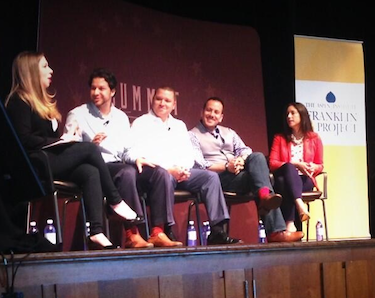
From left, Chelsea Clinton, vice chair, Clinton Foundation; Zach Maurin, executive director, ServiceNation; Fagan Harris, CEO, Baltimore Corps; Rodrigo Garcia, board chair, Student Veterans of America; and Mary Bruce, co-executive director, AmeriCorps Alums
Nearly all alums (88 percent) believed their AmeriCorps service was among the most significant professional experiences of their life. They were confident that through national service they developed skills to be better students, employees and citizens. They shared with us that as young alums, they wanted careers that mattered.
Alumni of national service, like a veteran coming home or a returned Peace Corps volunteer arriving stateside, had challenges continuing their educations and moving from their service experiences into their next professional jobs. Only a third of alums strongly agreed they knew how to navigate “life after AmeriCorps” (for example, find a new job or get into a school of their choice).
Engaged citizens and civic leaders like Maya aren’t just nice to have. They’re critical to our country’s future. We are a nation where one in five children lives in poverty, high school dropout rates persist, and the rungs of the ladder to economic mobility are shaky at best. America’s challenges are real. Now more than ever, we need all Americans – and especially those who have proven themselves to be citizen leaders – to be asked to be part of the solution, and to be given opportunities to do so.
Too frequently, and for too long, the potential of AmeriCorps alumni has gone unrecognized, unrewarded and underleveraged. With the future of our country at stake, why would we leave this talent on the sidelines? Three steps we can take to fix this:
College and universities should be fast-tracking AmeriCorps national service alumni into their programs by giving preference to and providing additional scholarships for their domestic service experience. Around 120 schools already match the scholarship that AmeriCorps members receive for their service – we should expand these efforts.
Employers, both private and nonprofit, should recognize that the skills built in AmeriCorps are incredibly valuable in today’s work force and they should update hiring applications and HR screening protocols to seek out AmeriCorps service experience. Many partners, ranging from Comcast to Deloitte, and the Urban Teacher Center, already actively recruit alums. Their efforts should be applauded and others should follow their lead.
The federal government should extend noncompetitive eligibility to all AmeriCorps alumni, and government leaders at state and local levels should adjust their hiring practices so alumni from Reading Partners to Conservation Corps have clear on-ramps to meet the civil service needs they’re facing. Returned Peace Corps Volunteers get noncompetitive eligibility, as do members of the Public Lands Corps. We should expand these benefits to all civilian service veterans.
Maya, along with the nearly 1 million alumni of AmeriCorps who have served since 1994 have proven to be civic leaders, team builders and problem solvers with a “get-things-done” attitude. For the good of America, let’s work to ensure that all Americans have the common opportunity of being able to serve like Maya – and then let’s tap the potential of alums to grow as civic leaders, for life.
Let’s thank these alums, support them and count on them to keep getting things done for America. To help spread this message, today we joined more than 300 leaders at the Aspen Institute’s Summit at Gettysburg.
There, in a discussion with Chelsea Clinton (see photo above), we proudly shared that national service and the impact of our alumni network is necessary, not just nice. Maya wants to change the world – and America needs her. We’re asking you to join us in supporting her and her nearly 1 million alumni peers.
This post is by Dani Nispel, an AmeriCorps VISTA member at Community Schools Collaboration, a nonprofit organization that provides after-school tutoring and more in Seattle-area schools. Nispel is serving through Corps18, a Points of Light program that supports VISTA members addressing chronic absenteeism across the country.
I work directly in two elementary schools, places I haven’t spent a significant amount of time in since I was actually in elementary school myself. I’ve been helping to coordinate the after-school programs. But mostly, I’ve found I’ve been doing a lot of listening.
I’m listening to the counselors and what they think their kids and parents need. I’m listening to the family liaisons and what struggles they face. I’m listening to the PTA moms who want to support their schools as best they can. I’m listening to the kids who know that their parents work too many hours as it is.
I’ve worked with after-school programs before back on the East Coast, but those were with middle school students. I think elementary age kids are different, at least for me. I think it’s hard because for kids this age, a lot of things are out of their control.
They don’t always get to choose if they’ll be walking home from the after-school program, even if it’s dark out by early November. They don’t always get to control if they’ll get to school on time or get picked up on time. There are also some pieces that fall under the “ignorance is bliss” category.
At this age, the kids don’t always recognize that they’re getting their dinner here at school because there won’t be food at home; it’s just fun to have pizza and yogurt after school. They don’t always understand that it’s a disadvantage to go home and have parents who can’t help with homework because they don’t speak English; it’s just a pain that they have to do their homework with us.
I get frustrated a lot, either because I feel like I don’t have enough to do during the days or because I feel like there are way too many avenues to start a project. But in the end, when the kids come in at 3:10 every day and tell me about their days, those frustrations don’t really matter anymore.
It’s worth it when a third grader comes in the next day excited because they remember how we did their long division homework together. Or when the parents reach out to me because they want to put together an MLK Day of Service at our schools.
The day-to-day work isn’t what’s hard. It’s hard because no one tells you what to do. You have to listen and understand and be a part of the community before you can make any kind of difference. But I’m glad I’m here. There are a lot of good ideas floating around. A lot of people who want to make positive changes at our schools. I’m glad I get to be a part of that.
Get a Jump on Your Career by Helping Others Get a Jump on Theirs
This post is by Melissa Grober-Morrow, senior director of economic opportunity programs at Points of Light.
Here’s your chance to find out what 830,000 AmeriCorps members have already learned: AmeriCorps is a great way to serve others, while learning a lot about yourself and the strengths that can propel you into a meaningful career.
Points of Light is searching for 50 people, who believe in the power of volunteer service to change lives, to serve with us as AmeriCorps VISTA members for one year in one of 10 cities – Boston, Chicago, Dallas, Los Angeles, Miami, New York, Newark, San Francisco, St. Louis and Washington, D.C.
You’ll be helping us launch ServiceWorks, a new AmeriCorps VISTA program that will engage low-income 16- to 24-year-olds in training and service to increase their employability and prepare them for college and careers. ServiceWorks – powered by the Citi Foundation, AmeriCorps and Points of Light – will deploy 225 national service members over three years. You’ll be getting in on the ground floor!
By serving as an AmeriCorps VISTA member, you’ll learn about the community you serve, make connections to nonprofits and city agencies and see firsthand the resilience and struggles of people trying to succeed. This opportunity isn’t right for everyone, but if you are the type of person who likes to make connections that benefit others, build programs and build capacity within communities to solve problems, I hope you’ll consider a year of VISTA service.
After college, I served as an AmeriCorps VISTA member in a Chicago public elementary school. It was a challenge, running a reading program and serving as a parent coordinator in a school with low parent engagement, but I was given opportunities and responsibilities that few people are given in an entry-level position.
I grew so much during my year as a VISTA and learned a lot about my strengths. And, after completing my service, I received a $5,000 education award that I used to pay off student loans.
AmeriCorps was a good move for my career, too. I was able to leverage my experience to get a job at New York Cares, New York’s leading volunteer agency. Through the years, I have drawn upon my VISTA experience many times and continue to do so in my current job, creating new economic opportunity programs at Points of Light.
This year marks the 20th anniversary of the AmeriCorps program. Since 1994, AmeriCorps members have provided more than 1 billion hours of service addressing critical challenges from poverty and hunger to disasters and the dropout crisis. Sure, AmeriCorps VISTA service is a big commitment to community, but I think it’s one that provides dividends for years to come!
To apply to become a ServiceWorks VISTA, go to https://my.americorps.gov and search for “ServiceWorks”