Do Your Kids Have This Crucial Ingredient for Learning to Read?
This post is by Madeline S. Collazo, AmeriCorps VISTA program associate at the Jewish Coalition for Literacyin San Francisco. Collazo is serving through Corps18, a Points of Light program that supports VISTA members addressing chronic absenteeism across the country.
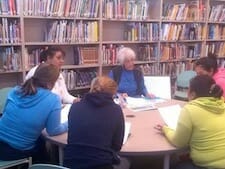
Joan Green, center, a Jewish Coalition for Literacy reading specialist, meets with parents at North Shoreview Elementary School in San Mateo, Calif.
When I was a little girl, my favorite time of day was story time. After I got ready for bed, I would pick out one of my favorite books. My mother would then read aloud as I listened and drifted off to sleep, cocooned in stories of dragons and princesses and children who would not eat their vegetables.
I remember my excitement the day I looked down at the page and discovered I could read the words along with my mother, the stories I loved leaping off of the page.
For many children, there is no story time. The only exposure they get to reading is in the classroom, and for many, this simply isn’t enough. Boosting reading skills at a young age is crucial for future success and, in order for students to get the most out of school, they should also have reading support at home.
My current position as an AmeriCorps VISTA at the Jewish Coalition for Literacy is focused on parent and community engagement; my top priority is organizing and facilitating workshops for parents who want to practice basic English vocabulary, pronunciation and structure so that they can read books at home along with their children. Since September 2013 alone, JCL conducted more than 100 parent workshops in public schools across the San Francisco Bay Area, helping communities that are often marginalized and underserved.
Phyllis Harrison, principal of North Shoreview Montessori School in San Mateo, Calif., and longtime JCL partner, believes that JCL’s parent workshops have a multigenerational effect on families, benefiting the parents who come to the workshops, their children who now benefit from a reading-friendly home, and consequently, future generations in the family.
“By coming to their child’s school every week, parents need and want to know that North Shoreview is their child’s home away for home,” Harrison told me.
Parents love the workshops as well, which provide them with the skills they need to help their children excel. Mothers, fathers and guardians are their children’s first teachers, and the most trusted people in their sons’ and daughters’ lives.
Sara L. Gomez, who faithfully goes to JCL’s Reading Together in English workshop every Tuesday morning at an elementary school in San Francisco, said: “I love to learn English so that I can help my daughter.” Dina Estevez, another regular at the Tuesday session, added that “it is very fun and we practice a lot of English.”
It is thanks to this enthusiasm and growing interest that JCL’s workshops are developing a new cadre of parents committed to their children’s reading success, and to creating supportive home reading experiences. Together, we are making story time the new favorite time of day.
Are you in the San Francisco Bay Area and interested in inspiring a young reader? Check out www.jclread.org. To find similar opportunities across the country, visit All for Good.
An Unexpected Career in Volunteer Service
Tracy Hoover, an America’s Promise Alliance trustee, has been a dedicated leader in the service movement for the majority of her career. America’s Promise Alliance asked Hoover to talk a little about herself. (See the original post here.)
Tracy Hoover
Q: You’ve devoted most of your career to service. Was there a specific moment that this issue “clicked” with you and became your personal and professional passion? Why service?
A. Points of Light’s founder George H. W. Bush says every definition of a successful life includes service to others. Like many people, I started volunteering out of a desire to give back. Organizations like Hands On Atlanta made it easy for people like me to find fun, flexible volunteer projects at night and on weekends.
But volunteering in Atlanta’s public schools and homeless shelters taught me a lot – about our city and its citizens, about complex issues like illiteracy and hunger, and about how engaged citizens can change the odds. It also taught me a lot about myself – and launched me on an unexpected career in service that has spanned two decades (so far), and that has defined meaning and purpose for me.
Why service? Because it’s transformational – it changes communities, it changes the odds, and it changes lives – on both sides of the service equation.
Q: As the decades pass, what has changed the most about the service/volunteerism field, what has changed the least, and where do you see the field heading in the next 10 or so years?
A: Twenty years ago, it was disruptive, in a good way, to allow people to sign up for a “hands-on,” volunteer-managed service project. It gave the ultimate power and choice to individuals and required nonprofits to package volunteer opportunities in new and different ways.
Today, millennials and technology are creating change that’s just as disruptive, still in a good way, for volunteers and for nonprofits that depend on them. I’m excited to see volunteers becoming more informed consumers, trying to make the best and highest use of their time, talents, dollars, networks and more. That’s a big challenge for the nonprofit sector.
It’s also exciting to see how technology is driving innovation in service: crowdsourcing, social media, mobile apps, social enterprise. Individuals have more power, more opportunities and tools for leveraging all of their assets – their time, talent, voice, philanthropic dollars and consumer power – to make a difference.
I do want to point out that amidst all this change, some critical things have stayed the same. People still volunteer because someone asks them to. Service still brings people together. And volunteers are still the only constantly renewable resource capable of creating dramatic improvements and bringing them to scale.
Q: What do you think about mandated volunteering through a high school class requirement? Could it turn off teenagers, who never like being required to do anything?
We spend a lot of time working to increase the number of volunteers in the world and the impact of what they do. So we examine why people volunteer, and in survey after survey the answer is the same – it’s because they were asked. Sounds pretty simple, doesn’t it? But, if you really think about the traditional ways people are invited to serve – and who is typically invited to serve – you realize that a lot of people are left out and a lot of potential is untapped.
When done well, I think compulsory service can create an entry point for people to find their passion and tap into their power to make a difference. I’ve seen this happen many times – when a minor infraction inspired “community service” that became a family tradition, when a high school student from an under-resourced school started tutoring in a volunteer Saturday program – initially, to satisfy a graduation service requirement, but then because it mattered. It’s also worth noting that both the high schooler who volunteered and the younger student he tutored did better in school.
Compulsory service can be a starting point for a lifetime of service. That said, we’re all for encouraging people to serve because every single person can make a difference, regardless of background, means, education, connections. We all have a role to play to create a better world.
Q: Anything else you’d like people to know?
A: Yes. Just a few days ago, Points of Light, AmeriCorps and the Citi Foundation announced a major public-private partnership we’re calling ServiceWorks. The $10 million, 10-city initiative will engage 25,000 youth, age 16-24, in service and build a large-scale volunteer response to the crisis of low college and career attainment.
We plan to give young people training in critical 21st-century leadership and workplace skills, the chance to build professional networks and connections to their communities, and the opportunity to use their new skills by participating in and leading volunteer service projects. And we’ll give thousands of volunteers – including Citi employees – the chance to participate as success coaches and mentors.
Research shows that young people involved in service exhibit a significant change in “life skills such as showing increased concern for others, improved ability to problem solve, and improvements in self-perceptions of potency – the ability to make a difference in a community.” And a 2013 study by the Corporation for National and Community Service shows that volunteering is associated with an increased likelihood of finding employment for all volunteers regardless of a person’s gender, age, ethnicity, geographical area or job market conditions.
ServiceWorks will demonstrate that the coupling of national service and volunteer service can help level the playing field for low-income young people, not only by decreasing the opportunity gaps they face but by increasing the likelihood that they will stay in school and find good jobs. Read more about the program at www.pointsoflight.org/serviceworks.
High school graduation rates are at a 40-year high, but there are still tens of millions of young people who leave high school without diplomas, get stuck without jobs or in dead-end ones and never get to college or careers.
We’re excited to announce a new approach to the problem, one that uses volunteer service as a pathway to success.
ServiceWorks is a public-private partnership powered by AmeriCorps, the Citi Foundation and Points of Light. The initiative will engage 25,000 youth, age 16-24, in service and build a large-scale volunteer response to the crisis of low college and career attainment.
How? By giving young people training in critical 21st-century leadership and workplace skills, the chance to build professional networks and connections to their communities, and the opportunity to use their new skills by participating in and leading volunteer service projects. And by giving thousands of volunteers – including Citi employees – the chance to participate as success coaches and mentors.
Tracy Hoover
Thanks to a $10 million commitment from the Citi Foundation, ServiceWorks will become the nation’s largest corporate-sponsored AmeriCorps VISTA program, deploying 225 AmeriCorps VISTA members in 10 cities – Boston, Chicago, Dallas, Los Angeles, Miami, New York, Newark, San Francisco, St. Louis and Washington, D.C. – to help lead the effort.
Why use service as a strategy? Research shows that young people involved in service exhibit a significant change in “life skills such as showing increased concern for others, improved ability to problem solve, and improvements in self-perceptions of potency – the ability to make a difference in a community.”
And a 2013 study by the Corporation for National and Community Service shows that volunteering is associated with an increased likelihood of finding employment for all volunteers regardless of a person’s gender, age, ethnicity, geographical area or job market conditions.
ServiceWorks will demonstrate that the coupling of national service and volunteer service can help level the playing field for low-income young people, not only by decreasing the opportunity gaps they face but by increasing the likelihood that they will stay in school and find good jobs.
ServiceWorks will make real the promise of the President’s Task Force on Expanding National Service and his call for public-private partnerships to solve tough challenges.
In two words or one, service works.
From `True Detective’ to Your Favorite Show – Help Make National Service Famous
This post is by Ben Duda and Mary Bruce, co-executive directors of AmeriCorps Alums.
and 17 of the country’s leading national service organizations in an effort to make a year of service part of the American way of life.
The campaign will connect the stories and impact that AmeriCorps members and AmeriCorps alumni are making every day on some of our nation’s toughest issues to the writers and producers in Hollywood who are ready to tell these stories – from disaster relief and veteran reintegration to college access and childhood nutrition.
Our goal is simple, but ambitious: We envision a day when young Americans turn to each other and ask, “Where will your year of national service be?”
AmeriCorps Alums serves as the national strategic partner for this campaign. We highlight the power of national service as a cross-cutting solution to our country’s most pressing problems, by uniting Americans in common purpose.
Nearly 820,000 Americans have served in AmeriCorps over the last 20 years and through this historic campaign, we will showcase how these AmeriCorps alumni are still “getting things done” with more impact than ever before. (Find out who else is working with us on this historic campaign
.)
Over the next three years, ServiceNation will lead this initiative, engaging entertainment companies and TV show executives in an effort to integrate powerful stories of service by AmeriCorps members and alumni into the scripts of their shows. Only two weeks ago, AmeriCorps was
,” a direct result of this effort.
In the coming months, the campaign plans to roll out other partnerships with humorous digital platforms, YouTube stars, social-minded brands, athletes, celebrities and more successful integrations that will help tell the story of national service in America.
We also want to hear from you –
Right after I graduated from high school in 2001, I joined AmeriCorps NCCC (National Civilian Community Corps). My team worked on a variety of projects: We constructed homes for Habitat for Humanity builds in Hawaii, acted as teaching assistants for an elementary school in California, worked as gardeners at a botanical garden in Oregon, served as camp counselors at a camp for children and adults with disabilities, and helped on a disaster relief team for the American Red Cross when a typhoon hit Guam.
Through each project, I became more interested in issues around social justice and learned how to collaborate with a diverse group of individuals. AmeriCorps inspired me to continue enacting positive change as well as develop the relevant skills, such as working as a team player, to actually contribute to this mission.
In the decade following my term in AmeriCorps, I continued to hone the skills I’d built in national service, before deciding to enroll in the SIT Masters in International Education program. When I started at SIT, I had just returned from a year in Vietnam, where I taught English and advised Vietnamese high school students.
Based on that overseas experience, I knew I wanted to work in the field of international education. I only had a glimpse of the field I wanted to pursue while abroad, but at SIT I really learned the why, what and how-to of international education.
SIT provides students with an educational experience deeply rooted in social justice, teamwork and practical, hands-on training. These skills had been introduced in AmeriCorps, and were further strengthened and expanded during my thorough and comprehensive training in SIT.
With the tools I gained at SIT’s Masters in International Education program, I started an internship at the University of Colorado Denver’s Office of Global Education. SIT had laid the necessary groundwork for me to succeed; I already knew the vernacular and important issues of the field, and could easily contribute to a conversation with other professionals. The internship eventually led to my current full-time role as the Asia study abroad coordinator.
My experiences in AmeriCorps and SIT thoroughly prepared me for my career. I use the skills of teamwork, my passion for improving the world and the academic knowledge acquired at SIT every day in my current job. AmeriCorps and SIT had a large hand in this personal and professional development.
When You Listen to Young People, Great Things Can Happen
This post is by Noemi Rodriguez, a member of AmeriCorps VISTA, an AmeriCorps program that focuses on helping communities out of poverty. Rodriguez is serving through Corps18, a Points of Light program that supports VISTA members addressing chronic absenteeism across the country.
Sylmar Biotech Health Academy student Miguel shows his funny side during a painting project.
Miguel stood out to me as soon as I started my service here at Sylmar Biotech Health Academy, near Los Angeles. He always hung around the school offices after school and was not in the least bit shy around us newbies.
Not long after our first day of work Miguel approached me with a request – to create a school drama club. He definitely had a vision and a goal and knew what he wanted. I really liked that about him and appreciated it.
Miguel is not the best student, in terms of grades, but he is very much involved with the school and is incredibly smart and imaginative.
After completing all the paperwork necessary for there to be a drama club in our school Miguel got to work, letting me know that we needed to start advertising the club and raising money so that the club could have some funds for props.
Miguel is always thinking ahead and always ready to work. As we created the drama club, he was full of ideas. And after our first adventure working together, Miguel became my go-to adviser.
A lot of the time he amazes me with some of the things he suggests, not only for the drama club but for other school activities as well. I now search Miguel out when I want to share an idea for a new program. His focus and commitment to his creative vision has really inspired me and has made a huge difference in how I run and create programming for this school.
They are no longer my programs or my ideas but the students’ as well. Not only that, but the connections I have made with Miguel and students like him at Sylmar Biotech Health Academy have provided me with the drive and motivation I need to get a job like mine done.
Sylmar Biotech Health Academy is operated by the Youth Policy Institute, which provides education, training and technology services to lift Los Angeles families out of poverty.
An America That Asks: ‘Where Will You Do Your Service Year?’
Imagine if one day soon in our country, when a young person turns 18 the most common question they are asked is: “Where will you do your service year?” And they enthusiastically respond: “The Army. AmeriCorps. The Navy. The Peace Corps. The Marines. FEMA Corps. The Air Force. Teach For America. The Coast Guard. Youthbuild.” After this week, they will be able to add Tufts University, thanks to its groundbreaking new “1+4” initiative that integrates a “bridge year of national service” right into the Tufts college curriculum.
The Aspen Institute‘s Franklin Project, chaired by Gen. Stanley McChrystal, and working in close alliance with the National Conference on Citizenship, ServiceNation and Voices for National Service, envisions a day when a year of national service becomes a common cultural expectation and opportunity for all young Americans.
At a time when the desire to serve far exceeds the supply of service year positions, we need to call on all sectors of our society to innovate and develop new opportunities to serve. In particular, we need to integrate national service into the fabric of the American educational system, so that national service is viewed as part of students’ educational success not as something distinct from it. This week, Tufts University stepped forward with a powerful new model.
The Tufts 1+4 degree program integrates a “bridge year of service” right into the Tufts educational experience whereby students apply to Tufts and are accepted into this program upon being admitted. The students spend their first year doing national service at organizations of their choosing. Upon arrival at Tufts for their second year, they take service learning courses and are organized as a leadership cadre under the direction of Tufts’ Tisch College of Citizenship and Public Service.
Importantly, if students are financial aid eligible, Tufts provides resources to support their service year to ensure that all can participate in this groundbreaking initiative. In addition to making a contribution to the nation with this program, Tufts is making an investment in leadership on their campus and for the future of our country. Tufts plans to launch with 50 students in 2015, but expects to grow the program over time.
Earlier this week, Tulane also announced the Tulane AmeriCorps Fellows Program, which is a bookend to the Tufts model as it takes the form of a “4+1” program. This fellowship allows Tulane seniors to apply for a “post- grad” service year where they stay on campus and are placed in a local non-profit, working to benefit the New Orleans community. This is a wonderful opportunity for Tulane and its recent graduates to give back to their community and represents another powerful model for universities to emulate.
Additional innovative national service pilot programs are in the process of being developed at other universities, such as William & Mary and the University of Pennsylvania. If other universities follow suit and just ten percent of all incoming freshmen to four year colleges have a service year integrated into their university experiences, this would create more than 120,000 new full-time national service opportunities every year.
Outside the realm of higher education, government leaders are also stepping up and showing strong leadership on national service. On Monday, Iowa’s Gov. Branstad signed an executive order creating a Governor’s Council on National Service and instructing Iowa’s departments and agencies to work in partnership with the private sector to expand national service opportunities in the state. Branstad’s order is bound to resonate in a state that prides itself on its strong sense of civic engagement and has one of the highest rates of volunteering in the country.
After 20 years of experience with AmeriCorps and fifty years of Peace Corps and VISTA, America is poised to fulfill the promise of large-scale civilian national service. Five years ago, Congress passed and the President signed into law in his first 100 days the strongly bipartisan Kennedy Serve America Act that promises to grow AmeriCorps to 250,000 positions a year. Congress needs to keep its promise by fully funding that law.
And thanks to the dynamic leadership of Wendy Spencer, the CEO of the Corporation for National and Community Service, and President Obama’s new Presidential Task Force on national service, new federal agency corps, such as FEMA Corps and School Turnaround AmeriCorps have been launched and others are in the works.
Cisco has generously provided over two million dollars to fund a new national service technology platform that will allow more non-profits to join the national service movement, and encourage organizations and individuals to develop new service opportunities. Investments in national service bring multiple benefits as research has shown that every dollar invested in national service programs brings in a societal return equivalent to nearly $4.
As Gen. McChrystal emphasized in his speech at Tufts this week, it is time for America to commit to the “big idea” of national service as a new rite of passage for America’s youth. It is the best way to instill a strong ethic of citizenship, unite us as a country and address pressing problems as each generation experiences the power of shared service and sacrifice for their communities, country and the common good.
It will take all sectors and institutions stepping forward in ways large and small for this vision to become a reality. Tufts and Tulane are providing important leadership. Hopefully others will follow their example and contribute to this growing movement so that one day soon every young American will be able to answer proudly when asked “where will you do your service year?”
Today’s post is by Margaret Garvey, an AmeriCorps Alums member and founder of Arizona Serve. Check out how she found love through AmeriCorps, and if you have your own service love story, enter Points of Light’s Love & Service Valentine’s Day Contest for a chance to win Valentine’s Day dinner on us.
Margaret and Shona Garvey wed in October.
I am not really a morning person. So, in July of 2006 when I boarded the airport shuttle in Prescott, Ariz., at 5:30 a.m. to start the two-hour ride to the airport on the way to an AmeriCorps orientation, I was not really in the mood to chat.
Being a city girl, newly transplanted to rural Arizona, public transportation felt like a familiar comfort. My plan was to pop in my headphones, curl up with my bag and go back to sleep. This was the first of many plans I would make during my year of service that would not work out, and all the better for it.
Sitting in the very first seat, in the front of the bus, was a big-haired, smiling Tennessee gal who was so eager to meet me, she practically leaped at me. She was like a blast of caffeinated air fired at you from a leaf blower. “How could anyone be this friendly at 5:30 a.m.?” I pondered in my Bostonian brain.
Our travel experience together was… interesting. She had never been to a Starbucks, because she didn’t drink coffee (excuse me, say that again?); refused to wait in line at the gate because, in her southern accent, “I don’t sttayund in lionnes” (then how do you eat, bank and use the restroom?); and was eager to strike up a conversation with anyone and everyone around.
I made all sorts of plans for my term of service: I would only be in Arizona for one year; I would save money; reduce my stress levels; learn to decipher and then accomplish everything on my AmeriCorps Volunteer Assignment Description. I did none of these things.
I did some other things, though. I made lifelong friends; struggled with and eventually accomplished some important work in service; laughed a bunch, figured out how to make a budget and then actually stick to it; developed my leadership skills; learned about culture (mainly about my own culture); and I fell in love with that very happy southern woman.
Seven years later, we are both still living in Prescott. I am directing a statewide AmeriCorps VISTA program though Prescott College (www.arizonaserve.org) and Shona is doing foster care and adoption home studies with Arizona’s Children Association. In October, we got married back in Massachusetts. Our story is just one of many stories of folks who fell in love while in service.
I think, what it really comes down to, is that romantic love is just one form of the bigger love that we all share for service. I have had the pleasure of watching AmeriCorps members fall in love with service and in service and it just never gets old. We do great work, we have great fun and we do it all (as cheesy as it sounds) in love.
It’s #GivingTuesday! Help generationOn and Hasbro Give $1 Million in Toys to Toys for Tots
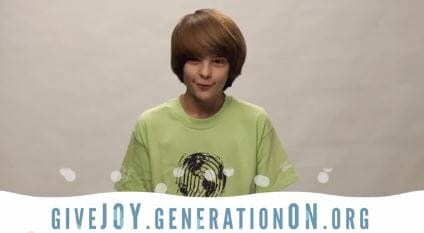
Hear from young stars about becoming a Joy Maker. (Click image.)
“Parenthood” stars Max Burkholder, Xolo Maridueña and Tyree Brown and dozens of other young stars are joining generationOn, Points of Light’s youth service arm, in giving joy to kids in need this holiday season.
From Dec. 3 – 20, for each action a child or teen takes to help others, Hasbro will donate a toy or game to Toys for Tots – up to $1 million worth of toys and games. That’s a lot of joy!
Go to givejoy.generationOn.org to see a video message from celebrity Joy Makers and get details on how to make your actions count. Here are just a few of the ways you can be a Joy Maker at givejoy.generationOn.org:
Download a holiday card to send to a child in need.
Find fun and meaningful ways to help kids in your community.
Find a volunteer project in your city or town.
And invite your friends to join you in giving joy on Facebook or Twitter.
Three Pro Bono Trends Strengthening Communities
This post is by Jenny Lawson, is vice president of corporate strategy at Points of Light and Kate Ahern, vice president of social innovation at the Case Foundation.
Lawson
As we celebrate Pro Bono Week, it’s worth reflecting on the powerful trends that have recently emerged from businesses across the country as they continue to scale and deepen the impact of their community engagement programs.
In the 2013 Committee Encouraging Corporate Philanthropy “Giving in Numbers” report, 50 percent of companies surveyed reported that they offer either a domestic or international
program. This is an increase from 32 percent in 2008, clearly showing a growing trend of companies embracing skills-based service to lead change in their communities.
Ahern
Over the past two years, we’ve also seen more than 500 companies pledge $2 billion in pro bono services to
. Pledge companies are inspiring others to lend their time and talent to nonprofits through the powerful business and social impact that pro bono offers.
A picture is worth a thousand words, so we created an infographic showcasing the broad social impact and business value that the pledge companies are generating. We know that more pro bono is happening, but what innovations have emerged? We’ve identified a few trends, in which we see companies working in creative collaborations that lead to larger-scale success:
1. Increasing cross-company collaboration
More and more, companies are coming together to form collaborative partnerships that pursue shared goals through pro bono service. Sigma-Aldrich, a life science and high technology company, has partnered with nine major employers in St. Louis, Mo., to create STEMpact, an industry collaborative to improve STEM teacher quality in the region.
The collaborative is also working with Washington University to develop an updated science curriculum. Improving education through pro bono is an increasing trend – 77 percent of Billion + Change pledges target education as their pro bono impact area. Through partnerships like STEMpact, companies are leveraging their collective resources to drive tomorrow’s innovators through the power of pro bono.
2. Partnerships with city government
A new generation of mayors is taking on the challenge of reinventing cities for the 21st century. Companies such as IBM, a leadership partner of A Billion + Change, are proving to be an ally through initiatives like the
grant program – a three-year, 100-city initiative.
Through this program, IBM is donating $50 million worth of its employees’ time to help cities execute ambitious projects. IBM dispatches five- or six-person, executive-level teams of experts with a range of backgrounds, skills, and experiences that bring fresh perspectives, and help cities formulate strategies for improving the quality of life and the prospects of their citizens. IBM teams have already completed projects in dynamic cities worldwide – including Philadelphia; Katowice, Poland; and Porto Alegre, Brazil.
Civic Consulting USA is also innovating in this space, and re-shaping how cities work by creating pro bono teams of business experts and government leaders.
in Chicago has a 30-year track record of success – thousands of professionals have achieved real impact, such as increased community college graduation and decreased youth violence. Civic Consulting USA has launched to replicate this model in New York City and nationally.
3. Small businesses stepping up through service
Small companies are stepping up to the plate to contribute more than their fair share. Fifty percent of A Billion + Change pledges, in fact, are small businesses. Through innovative new business models, companies such as
, a global design studio, are giving 50 percent of their work away for free through pro bono. And, recognizing that partnerships are critical to scale, they are growing the movement by teaching other social entrepreneurs about their model. As verynice founder Matt Manos puts it:
“Through our unique business model, all of us at verynice have worked tirelessly to alleviate some of the expenses for nonprofit organizations so that they may re-invest their resources directly into their cause. However, here is the harsh reality: It has taken us 5 years to alleviate only .01 percent of the expenses that organizations are spending each and every year. Clearly, we can’t do this alone anymore.”