Tribute to a Shining Light of Volunteer Engagement – Jill Friedman Fixler
This post is by Beth Steinhorn, president of JFFixler Group; Tricia Thompson, vice president of training and consulting at Points of Light; and Lori Jean Mantooth, director of training programs at Points of Light.
Jill Friedman Fixler
While the field of volunteer engagement shines brightly thanks to thousands of points of light, the field is just a tad dimmer today as it lost one of its shining stars. Jill Friedman Fixler, leader, consultant and mentor to many, passed away over Thanksgiving weekend at the age of 61.
Jill had dedicated her career, first as a director of volunteer services and eventually as a consultant, to shifting the field from traditional volunteer management to a culture of more robust and meaningful volunteer engagement.
A longtime resident of Denver, Jill worked in volunteer engagement at multiple organizations in Colorado, crosscutting many nonprofit service areas, including animal welfare at Denver Dumb Friends League, human services at Arapahoe House, health care at National Jewish Hospital, and the arts and sciences at Ocean Journey, now known as Denver Downtown Aquarium.
By 2000, Jill recognized that her passionate vision for what’s possible when organizations really tap into people’s interests and skills was one she could share more widely through consulting. At the core, Jill believed that when organizations mobilize volunteers meaningfully, they can more effectively better the world.
She founded the company that would eventually be known as JFFixler Group in 2000 with the goal of helping others effect that vision and, within just a few years, landed national clients, published articles and eventually books, built a team of consultants, and became a nationally recognized thought leader on how engaging volunteers in new and innovative ways will, simply put, make the world a better place.
A partner and supporter of Points of Light, Jill often led workshops at the Conference on Volunteering and Service and the Summit on Advanced Volunteer Engagement. She served on many Points of Light committees focused on strengthening volunteer engagement.
She was also a frequent presenter at national and regional conferences those of the Association of Hospital Volunteer Resource Professionals and the American Society on Aging. She led webinars regularly through VolunteerMatch, STAR: Synagogue Transformation and Renewal and elsewhere.
As a dynamic presenter, Jill was often seen at conferences with a bevy of followers trying to get a few minutes of her time for advice or inspiration. She lived her commitment to mentoring by coaching – formally and informally – hundreds of professionals throughout her career, working to strengthen the network of volunteer engagement professionals and nurture a community of practice within our field.
“She understood what makes volunteering potentially so powerful and shared her knowledge and experience with thousands of folks in the field who benefited greatly from her wisdom, passion and compassion,” says Betty Stallings, a fellow trainer, speaker and consultant.
Katie Campbell, executive director of Certification in Volunteer Administration, adds: “Among her lasting contributions was her fearless drive to explore solutions and tackle change that sets an example for all nonprofit leaders.”
Most notable about Jill’s career and her life was her commitment to focusing on what she called “a mindset of abundance.” She truly believed that most organizations already have everything they need to fulfill their mission – that the resources are already in their world in the form of the skills and talents of the volunteers, donors, constituents and advocates. The secret was simply to learn how to strategically harness that resource.
Her professional passion reflected her personal mission as well, in that she embraced on a daily basis an attitude of abundance, focusing on the many blessings she had, even in the face of her terminal diagnosis. That attitude is one of the many powerful lessons Jill leaves to all of us in this field.
Jill began cutting back her work with JFFixler Group in 2012 and officially retired in 2013, but her legacy endures in JFFixler Group’s ongoing work, which continues to build on the foundation of her commitment. And, each of us can carry on her legacy by continuing the important work of mobilizing volunteers in innovative strategic and meaningful ways to make our world a better place. Certainly the world is a better place for having had Jill in it.
Since Jill trained, mentored, collaborated with and coached so many people in the field, we ask those who knew her – or saw her speak – to share a memory, piece of advice or lesson that you learned from Jill and to share it in the comment field below.
Make Your Volunteer Program More Effective by Considering New Roles for Volunteers
This post is by Beth Steinhorn, president of JFFixler Group. She works with organizations and associations across the United States and Canada to embrace volunteer and member engagement as a key business strategy.
Beth Steinhorn
Recently, while facilitating a reunion of organizations that participated in a yearlong High Impact Volunteer Engagement project – which included coaching, mentoring and training – I was once again struck by the powerful potential that one strategic change can have on an organization overall.
Ten staff/volunteer teams had worked to develop one new way each to engage skilled volunteers at their organizations, learning along the way how to effectively recruit, support and acknowledge skilled volunteers. On reunion day, they gathered to share their stories of challenge and success.
One team’s story, in particular, exemplifies how engaging volunteers in high-impact roles can be meaningful far beyond that one position.
Before joining the volunteer engagement program, Home Health and Hospice Care (HHHC) of southern New Hampshire already had an established volunteer program, with volunteers serving many crucial roles. The program included “vigil volunteers,” caring individuals who stay with dying patients, offering company and comfort to the patients and their families.
Despite having a dedicated team of vigil volunteers, HHHC faced a major challenge: one volunteer coordinator handled all vigil volunteer scheduling. Understandably, scheduling is unpredictable and time-consuming. HHHC determined to create a new position of vigil team leaders to coordinate scheduling and communications with vigil volunteers.
Seems simple enough on the surface – but the concept is more complicated given the needs for both technological support and compliance with HIPAA (healthcare privacy standards). They needed user friendly, fast and nimble technology they could afford that would interface with the existing database and meet HIPAA requirements.
They took a two-pronged approach. First, the team developed a team leader position, with volunteer leaders each taking on a week per month to handle the scheduling and support of vigil volunteers. Meanwhile, they systematically explored technology options.
The system in place now includes the volunteer coordinator making one call to the on-duty vigil team leader with details about emerging needs for vigil volunteers; the team leader then broadcasts messages through texts and emails to the volunteer roster. The system now allows volunteers to see a shared calendar, identify empty slots and sign up for time slots that fit their schedules.
The benefits of this new system are far-reaching and truly profound. Here are a few:
Scalability: They now can scale the program without adding any staff. Shortly after launching, HHHC encountered an unusually high need for vigil volunteers. Through this program, they could fill coverage of more than 80 hours, without adding any staff.
Place for Skilled Volunteers: They now have a position to offer skilled volunteers seeking ways to support the organization beyond direct service, as well as leadership opportunities for existing volunteers who aspire for more.
The Big Picture: Most profound, the ability to see the calendar online has helped current volunteers to appreciate that they are part of a bigger team.
Think about not only what that one new position could accomplish, but also whether the project could be expanded to help other areas of your organization and how it might impact the bigger picture within your volunteer culture.
Selecting the right project is challenging – but taking time to be strategic about where to engage volunteers in high-impact positions has the potential to ensure that your efforts have a significant return on investment.
I suppose that seems about as accurate as saying I became an overnight success in Hollywood. But that’s how it feels.
I had a moment this week when a member of my work team confronted me with a challenge – and I thought about it, made a decision and acted. That’s it.
It seems simple. And to many leaders, I’m sure it is. But, since I was a kid, I have often been paralyzed by making decisions. My brain wraps around all the possible scenarios – evaluating actions and outcomes – for what I’m sure seems like an eternity of inaction to others. And, often, while I’m playing out this “War Games” scenario in my head, someone else makes the decision.
I always thought of it as a character flaw until something in my recent training broke through the paralysis and helped me understand my style – OK, so I’m a Pragmatist nearly dead center on the spectrum between Conservers and Originators. That actually makes sense!
So, I’m not wishy-washy, I’m just incredibly open-minded! Ha! And A-ha!
In the past, I might have heard that message, said “a-ha” and gone back to work without any real knowledge of what to do differently. I feel so lucky to have been selected for the American Express Leadership Academy that actually provided the individual assessment and resources to help me not only understand my leadership style, but to use it as a strength.
The American Express Leadership Academy is an intensive, two-day leadership development training program, facilitated by the Center for Creative Leadership and sponsored/underwritten by American Express. Points of Light and American Express include the academy as part of Points of Light’s Conference on Volunteering and Service each year.
This past June, I joined 23 high-performing, high-potential emerging nonprofit leaders from across the country. We each received a 360-degree feedback tool and personality tools to help us recognize strengths and areas of development around our leadership styles.
The program helped us identify potential career derailment and gain an understanding of how our leadership styles are perceived by others. The biggest gift for me was a confidential, one-on-one feedback and coaching session with a certified Center for Creative Leadership executive coach.
At the beginning of the first session, we were warned that the training might be “transformational.” I thought, “Sure. All leadership trainers say that.” Now I realize I had to be ready to receive the information – and this experience had all the meat to go with the promise. A full assessment from my boss, peers and direct reports along with the leadership tools and professional coaching to actually do something with that assessment.
A member of my small discussion team during training said, “You know, sometimes you just have to scream and then move on.” Yes. Now I think I finally have. I cleansed my leadership palate. I trust in myself to make decisions and ask people to help implement them.
A very successful friend of mine says, “You cannot hit a target that you cannot see.” This week, I saw the target and I hit it. What a gift.
If you are interested in applying for the 2015 American Express Leadership Academy, email Stephanie Armelin ([email protected]), who will contact you when the application period opens.
Here’s the Place, Now Save the Date for 2015 Conference on Volunteering and Service
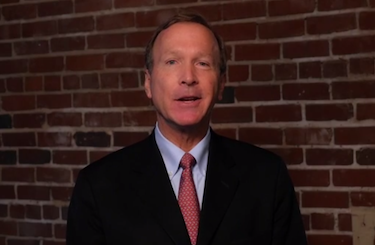
This message is from Neil Bush, chairman of Points of Light.
Neil Bush shares five reasons to mark your calendar for the 2015 Conference on Volunteering and Service.
We usually meet in June, but trust me, the weather’s way better in October down here in Texas.
Consider yourself invited to the biggest, smartest gathering of volunteer leaders from business, nonprofits and government – all under one roof. You’re going to meet fascinating people, learn a lot and have a great time.
I hope you’ll join me as we celebrate 25 years of Points of Light with volunteer leaders from around the world, along with some big names and big conversations about the future of volunteering.
I can’t wait to welcome you to my hometown!
Reserve your spot now and receive 10 percent off the early bird registration rate. The first 500 people to preregister will also be entered for a chance to win an all-expenses-paid trip to the 2015 Conference.
Volunteers Go for the Win at Turner Field
Against the backdrop of America’s national pastime, hundreds of volunteers came together to recognize a national treasure: teachers.
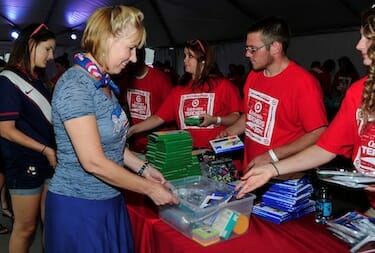
Volunteers help game-goers at Turner Field assemble containers of school supplies for Atlanta teachers.
Before an Atlanta Braves-Philadelphia Phillies baseball game at Turner Field, more than 300 volunteers and game-goers packed 5,000 kits full of school supplies for local teachers. Target team member volunteers stacked tables high with supplies and volunteers visiting Atlanta for Points of Light’s Conference on Volunteering and Service filled plastic bins with water bottles, sticky notes, disinfectant wipes, pens, pencils and more – items teachers too often have to buy with their own money.
The June 16 event was part of Target’s All-Star Teachers program, in partnership with Major League Baseball, designed to engage Target guests and MLB fans in celebrating the nation’s teachers, and Target’s involvement in Points of Light’s Conference on Volunteering and Service as its Official Excellence in Education sponsor. (See below for the July 31 presentation ceremony.)
Target supplied the products, funding, infrastructure and dozens of team member volunteers. Hands On Atlanta – part of Points of Light’s HandsOn Network of 250 volunteer centers – coordinated the service project to distribute the kits to dozens of Atlanta public schools.
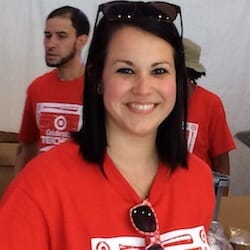
Target team member Jessica Johnson
Across the United States, public school teachers during the 2012-2013 school year spent $1.6 billion of their own money on school supplies and instructional materials, according to the National School Supply and Equipment Association. That’s an average of $500 per teacher.
In addition to assembling kits for the classroom, volunteers at the Turner Field event could vote for their favorite All-Star Teacher at an on-site kiosk and, by way of a photo booth, share photos of themselves via social media. Future MLB Hall-of-Famer and former Atlanta Braves pitcher John Smoltz came by for a few photos and to encourage the volunteers.
Jessica Johnson, who has worked at the Target store in Douglasville, Ga., for the past two years, says she appreciates the service opportunities Target provides its team members.
“It makes you feel good to work for a company that cares about things beyond just money, that cares about the community and the people who live there,” she said, as she reached for more supplies to stock the line. “That comes across in opportunities to go out and do things like this.”
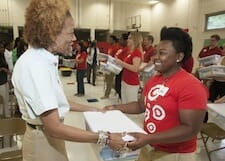
Target volunteers hand out school supplies assembled at the Turner Field service project to Atlanta teachers.
“The Turner Field event, part of the Conference on Volunteering and Service’s opening day, reflects our core values at Target,” said Reba Dominski, senior director of community relations. “Through raising awareness for teachers and celebrating the impact they have on our children, we are also able to demonstrate our longstanding commitment to service.”
“At Target, we believe every child deserves a quality education, regardless of race or socioeconomic status,” said Dominski. “Through our partnership with Points of Light, we’re able to invest in communities by offering programs that help provide the tools and resources educators need to help students succeed.”
Target team members volunteered alongside attendees of the Conference on Volunteering and Service, like Allan Collins. He embraced the chance to participate in a hands-on volunteer experience as part of the Conference, which brought together thousands of leaders from the nonprofit, corporate and civic sectors to celebrate and shape the future of volunteerism.
“Learning about the programmatic side of volunteer engagement is vital,” said Collins, director of HandsOn Inland Empire, a volunteer mobilization organization in Rancho Cucamonga, Calif. But Collins said that engaging in a tangible expression of volunteerism is “a powerful way to bring it all together.”
On July 31, representatives from Hands On Atlanta and Target presented the kits to Atlanta Public Schools teachers and Superintendent Meria Carstarphen at West Manor Elementary School. Target volunteers then helped teachers prepare their classrooms for open house the following evening and the first day of school, Aug. 4.
“Thanks to the generosity of Target, and literally, the hands of Hands On Atlanta, the 3,000 teachers of Atlanta Public Schools were given additional tools to actively engage and instill hope in our students this year,” Carstarphen said. “Target represents the important role of corporate partners in supporting student achievement by connecting the needs of our students and schools with the financial resources and goodwill of the community.”
Three Civil Rights Icons – One Stage
This post is by David Ross, a writer and graduate of the Andrew Young School of Policy Studies at Georgia State University.
Watch the Rev. C.T. Vivian, U.S. Rep. John Lewis, Ambassador Andrew Young and Bernice King talk about the civil rights movement in this half-hour panel discussion.
The Rev. C.T. Vivian had been on the buses with the freedom riders, protesting segregation at interstate bus terminals. U.S. Rep. John Lewis had been beaten after crossing a bridge in Selma, Ala., during a march for voting rights. Ambassador Andrew Young, an adviser to Dr. Martin Luther King, Jr., was in Memphis with Dr. King when he was shot.
The three recipients of the Presidential Medal of Freedom sat on a panel at Points of Light’s Conference on Volunteering and Service in Atlanta last month to discuss what volunteers can learn from the civil rights movement. Bernice King, CEO of the King Center and Dr. King’s daughter, served as moderator.
As Vivian explained, all three men started out with the intention of becoming ministers, “because we wanted to see people taken care of and not put down, and we thought that was important enough to put our lives on. … I think of when we got on those buses and left. Everybody on the bus with us that was white was going against the grain. But they were a part of justice, truth, and they were a part of making a new world. That’s what you need to be a part of.”
Effecting positive change, the three leaders said, often comes with struggle.
Lewis explained to Bernice King how he landed up on that bridge in Selma, where his skull was fractured by an Alabama state trooper: “Your father and others inspired me to get in the way and get in trouble, and I have been getting in trouble ever since. Good trouble, necessary trouble.” (Becoming a U.S. congressman didn’t change that, except today he tweets about it.)
Young, who preceded Lewis in Congress, told the thousands gathered in the audience, “We can change the world politically and economically one person at a time, but we each have to do what we are called to do.”
All three men encouraged the next generation of leaders in the audience to continue serving their communities even when it gets hard. “You must find a way to keep pushing and pulling, and be thoughtful and optimistic,” said Lewis. “Be bold. Be courageous. And be happy.”
Creativity Pays Off for Innovative Nonprofit Programs
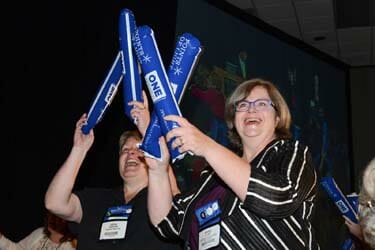
With spectators clapping blue thunder sticks together, jumping out of their seats, cheering for their favorite teams, the gathering looked more like a pep rally than a bid for nonprofit grants.
Zelda Magnuson, left, and Karen Delaney cheer at the forum with thunder sticks.
The pitches fueled the excitement – four innovative programs attracting volunteers and serving communities in creative ways.
At the
JPMorgan Chase and Points of Light have a history of collaborating to find new ways to support and facilitate volunteer service. At last year’s Conference, they kicked off a nationwide
tour focused on uniting unlikely allies to help students succeed, alleviate hunger and improve the environment.
The innovation and social impact forum at this year’s Conference – a celebration of the One America campaign – gave HandsOn Network affiliates a chance to showcase how they are uniting people through service for good.
The innovation forum judges confer to decide which organization will receive the $50,000 grant.
“One America really represents what we’re here at this Conference to talk about: Service unites,” said Points of Light Chairman Neil Bush.
Lois Backon, head of corporate partner marketing for JPMorgan Chase, welcomed forum attendees on behalf of the 250,000 JPMorgan Chase employees who have themselves logged more than 1.5 million hours of volunteer service over the past four years, including 56,000 skills-based hours in 2013 alone.
Backon said the forum was a great opportunity for JPMorgan Chase to combine two core values: service and innovation. “JPMorgan Chase is committed to investing in service innovation,” she said. “We know that when we harness what our best and brightest have to offer, we can make a tangible difference in every local community we touch.”
Then it was pitch time.
Brian Williams, center, of Hands On Nashville receives words of congratulations after the forum.
The four competing nonprofits – part of Points of Light’s HandsOn Network of 250 volunteer centers – showed video presentations of their work and answered questions from a panel of judges. The panel picked which organization would take the top grant of $50,000, included Lamman Rucker from “Tyler Perry’s Meet the Browns”;
came out on top for its work mobilizing volunteers to make homes in low-income neighborhoods more energy efficient, saving homeowners as much as $500 a year on their utility bills.
Hands On Nashville launched the program in the wake of the city’s historic flooding in 2010. Since then, nearly 1,000 volunteers have repaired 311 homes, including 156 damaged by the flooding. Volunteers install attic insulation, replace traditional light bulbs with compact fluorescent bulbs and more.
Brian Williams, president and CEO of Hands On Nashville, said the $50,000 grant will allow his organization to add program components that will further reduce energy consumption and engage donors in ways Hands On Nashville hasn’t done before. Hands On Nashville can also use the funds to start working with the city of Nashville to “expand service in a very thoughtful way and within a much quicker timeline than we imagined.”
Each of the three runners-up took home $15,000 to invest in their own innovative programs:
Volunteer Center of Santa Cruz (California) Senior Tech Day – a program that invites teen volunteers to help seniors navigate the digital age by teaching them how to use e-mail, how to view and share photos electronically and more.
HandsOn Twin Cities (Minnesota) Skills-Based Summit – an event that brings together skills-based volunteers who facilitate workshops exploring topics from marketing and social media to leadership development and finance.
HandsOn Genesee (Michigan) Community Service for Success – a three-week program that connects clients receiving cash assistance from the state of Michigan with volunteer opportunities that help sharpen life and job skills.
Emily Gilliland, HandsOn Network’s executive director, said the programs featured at the forum reflect the creativity, commitment and passion of HandsOn Network affiliates across the country.
“They have perspective and vision about what is needed and how to get it done,” Gilliland said. “And they each are doing it in unique, creative, incredible ways that are inspiring their communities.”
The grant program, which Backon called an extension of JPMorgan Chase’s “commitment to innovation and to helping communities and cities thrive,” is the kind of support that Williams said helps service organizations have a greater impact.
“JPMorgan Chase encourages organizations to be very thoughtful about their programming and then they reward those organizations for doing so,” Williams said. “It’s a very productive path for donors to take.”
`Service Unites’ as Conference Sessions Encourage Cross-Sector Collaboration
Zelda Magnuson, left, and Karen Delaney cheer with thunder sticks at the HandsOn Network Innovation and Social Impact Forum.
Today attendees of the Conference – sponsored by UPS – witnessed the principle in action, as dozens of educational sessions and forums focused on creating cross-sector alignment and new alliances to help address pressing community issues.
Speakers and attendees explored the relationship between the business and nonprofit sectors, looking for opportunities to expand skills-based volunteering while helping volunteer-driven organizations grow vital programs.
During the Business Track Opening on Building a More Creative Workforce,
CEO Jean Oelwang gave a TED-style talk about how companies are redefining the way they think about their volunteer programs, which help employees build skills they can use in their jobs and even in their personal lives. “We need every single person to be empowered with purpose right now,” Oelwang said.
Later during the Business Track Luncheon, Points of Light honored The Advisory Board Company and UnitedHealth Group with the 2014 Corporate Engagement Award of Excellence.
Deon Jones of Be the Change Inc., opens the Creating a Bright Future for Our Kids Forum.
Nonprofits and social entrepreneurs will have the opportunity to bring key initiatives to scale, thanks to collaboration and support from corporate partners participating at this week’s Conference. At the HandsOn Network Innovation and Social Impact Forum, sponsored by JPMorgan Chase & Co., four HandsOn Network affiliates took home a combined $100,000 in grants.
HandsOn Nashville earned the top grant of $50,000 for a program that makes low-income homes more energy efficient and safe, while the Volunteer Center of Santa Cruz (Calif.), HandsOn Twin Cities (Minn.) and HandsOn Genesee (Mich.) shared another $50,000 in grants.
The Civic Accelerator Demo Night showcased the work of startups aiming to solve pressing social and environmental issues. Ventures had three minutes to pitch inside the theater at the World of Coca-Cola to compete for some startup essentials from prize sponsors CSRwire, NEX Atlanta and more.
The Global Forum on Disaster Preparedness and Recovery, sponsored by UPS, offered an opportunity to discuss how various government agencies, nonprofits and individual volunteers can better cooperate to help communities prepare for disaster. Four U.S. mayors – Karl Dean of Nashville, Laurie Gill of Pierre, S.D., Edna Branch Jackson of Savannah, Ga., and Dayne Walling of Flint, Mich. – joined Corporation for National and Community Service CEO Wendy Spencer for a discussion about the critical role volunteers play when disaster hits, and the need for a plan to coordinate volunteers well before disaster happens.
Spencer later led a National Service Town Hall meeting that included a panel of AmeriCorps Alums who have each deepened their commitment to service in both the public and private sectors. She highlighted public-private partnerships, such as
, which use national service to help solve our nation’s most pressing challenges.
Conference speakers and attendees also discussed how to disrupt silos and engage more volunteers and strategic partners to support students. The Creating a Bright Future for Our Kids Forum, sponsored by Target, focused on the power of caring adults to affect the lives of young people and took a deeper dive into the complexities of mentoring. “Caring is important and necessary but not sufficient,” said John Gomperts, president and CEO of America’s Promise Alliance.
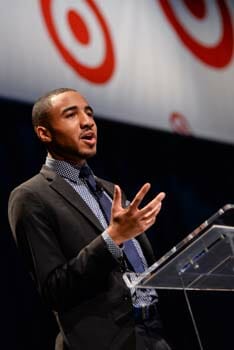
Mentoring was also a hot topic of conversation during a panel on Black Male Achievement that included actor and activist Lamman Rucker; Dillard University President Dr. Walter Kimbrough; civil rights and criminal attorney Mawuli Davis; MiWae co-founder and life coach Awo Thurmon; and mentor, community activist and entrepreneur Dakori Thurmon. The panel stressed the importance of mentoring and community support help create level playing fields academically and on the job.
“Regardless of what you do for a living, regardless of how much money you make… you have an opportunity to serve,” said Rucker, who later in the day received the Daily Point of Light Award for his commitment to community service. “All you’re doing is contributing to the dysfunction around you by thinking you can’t have an impact.”
40 Million Puppy Adoption Fees, Clean Water for 160 Million People and More – the Possible Result of This Small Business Practice
This post is by Matthew Manos, founder and managing partner of verynice, a global design firm that gives more than half of its work for free to nonprofit organizations. Hear from Manos June 16 during the Points of Light Conference on Volunteering and Service in Atlanta.
Matt Manos
When I was 16 years old, I took on my first pro-bono project. I found myself in a skate park in the Silicon Valley. You could find me there on most weekends, but this particular weekend, something spectacular happened.
I saw a man in a wheelchair ripping around the park far better than everyone else, myself included. Intrigued, I rolled a bit closer to the man only to find that he was not alone, but he was actually with a group of kids, also in wheelchairs.
I came to find out that this man was the founder of a nonprofit organization that taught handicapped children how to participate in extreme sports. Incredibly moved, I volunteered to design some stickers to help promote the organization. Just starting to learn how to use Photoshop, the stickers really were not my best work, but they did have a profound impact on me that would define the next 10 years of my career as a designer.
I’m the founder of a company in Los Angeles called verynice. We are a global design and innovation consultancy that gives more than half of its work away for free. So far we have been able to save nonprofit organizations almost $1.5 million, which has been directly reinvested into each organization to generate more impact. It is our sole mission to invent new models of business that allow for the alleviation of expenses for nonprofit organizations.
In more recent years, we have started to pioneer a new kind of movement amongst service providers. As a result, there are now dozens of other businesses and individuals that are giving half of their work away for free, on top of thousands of practitioners that have begun offering pro-bono services, inspired by our mission.
Why do we do this? Let’s start imagining something pretty remarkable.
If nonprofit organizations can save billions a year, and if service providers in my industry alone waived fees for nonprofit clientele, we could accomplish some pretty amazing things on an annual basis. This is the equivalent of 40 million puppy adoption fees, clean water for 160 million people, and the labor and materials required to build homes for 160,000 families.
I’m constantly asked why we give half of our work away for free instead of 10 percent, 20 percent, 30 percent… The reason is far less logistical than everyone might imagine. It really is a philosophical decision. I truly believe that if we want to create social impact, we need to make giving back an integral component of our day-to-day lives, not an extracurricular activity that we do on the weekends.
We might not think that we can each individually change the world through our work. In reality, we can’t. But what we can do is resist the societal norm of charging for our work in the social sector so that they may move onward and upward with an abundance of resources.
Collaboration. It’s one of the most frequently used words in the philanthropic space, but is it being done successfully? Clearly, there are some great examples of collaboration, but what you typically find is that many collaborations start off with the best of intentions, but don’t accomplish what they set out to do.
Collaborations are a lot like families. There can be a number of competing opinions and priorities and often times each family member thinks he or she knows how best to get something done. But at the end of the day, you’re passionate about what you’re doing so you try to make it work. Does this sound familiar?
Several years ago I was having breakfast with a colleague. We were talking about the need for regional businesses to work together to solve the challenges that are bigger than what we can tackle individually. My colleague told me she had this same conversation with another one of our peers and encouraged me to reach out to connect.
Shortly after that call, I became part of a group representing 10 major St. Louis-based companies focused on STEM (Science, Technology, Engineering and Math) education and a leading higher learning institution. We came together to talk about how to address the shortfall of STEM-based education in the region, which was affecting the talent pipeline.
As a group, we spent two years gaining an understanding of the ecosystem. We talked to teachers, school administrators, state officials, the region’s higher education leaders, our own talent acquisition teams and conducted countless studies on best STEM education practices around the world.
While two years without any tangible outcome might seem like a waste, it was one of the smartest things we could have done. We had an intimate knowledge of the subject. We spoke a common language and agreed to a common vision.
Instead of funding enrichment activities outside of the classroom, we saw an opportunity to partner with school districts and invest in their greatest assets – their teachers – who are the constant in the education equation. Without having this foundational agreement in place there is no way we could be where we are today.
For several years our group went without a name. We now have one, STEMpact, a play on the word “impact” and our belief that STEM-capable learners are a big part of solving the challenges we face. We didn’t realize the importance of our work or the interest from the St. Louis region until we received reports back from people who had heard that this “clandestine group” had gotten together to talk about STEM.
We’re not a formal organization. We all have to dig deep and pitch in. We’re doing the dirty work, with the help of several brilliant individuals who are leveraging their experience to make sure we stay on the right track. This July, we’ll host our third two-week, intensive STEM Teacher Quality Professional Development Institute. Initial results are positive. We’ve seen test score improvements in math and science in our evaluation results from year one and are eagerly awaiting the follow-up results from our 2013-2014 school year investment.
We’ve been successful because we’ve been deliberate about communicating our expectations, we’ve been forthright in our disagreements and we’ve worked collaboratively to find solutions to the problems we face. Through collaboration, we are charting a new course for the fast-changing world in which we live.