The Power of Youth: Making Their Mark on the World Through Volunteer Service
International Youth Day on Aug. 12 is the perfect opportunity to celebrate the importance of youth service and the ability of kids and teens to create meaningful change through volunteerism. As today’s youth continue to grow in our modern technological world, it is important to remember the power of uniting together in service. generationOn, our youth division, creates spaces and resources to empower youth to come together with fellow changemakers, share ideas and inspire their communities.
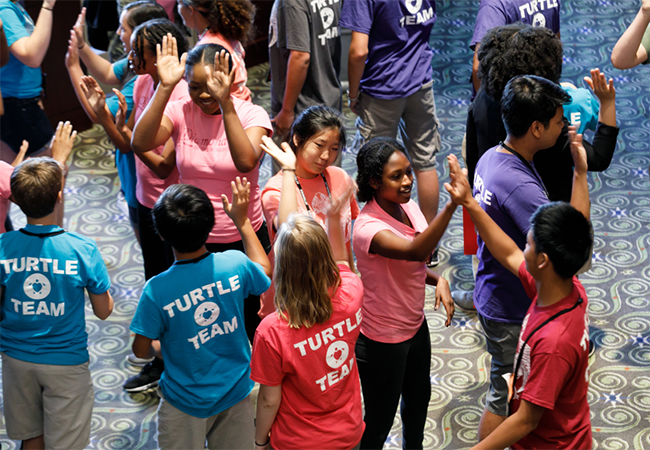
Earlier this summer, more than 50 youth came together in Atlanta for the second annual Points of Light Youth Summit at the Service Unites 2018 conference, demonstrating the power and dedication of kids and teens to make the world a better place. Participants, aged 11 to 18 years old, spent a full day in workshops that included important skills such as community mapping, how to budget, and how to pitch your ideas to funders. Finally, the groups pitched their community improvement projects to a panel of judges, including actress and activist Eden Duncan-Smith, artist and youth activist De’Andre Kind, and Hsuan Shen, district manager for Starbucks.
The kids and teens who participated in this year’s Youth Summit are inspiring examples of the power of youth to create meaningful change in their community. Here are a few highlights and key takeaways from the participants:
The Floating Island Project
Brooke Sullivan, 17, and her team, based in Greenville/Pitt County, North Carolina, pitched The Floating Island Project. She shares:
“This project will fill a void and provide a natural filtration system to the existing lake water sites at our city’s flagship park and nature center.
The Points of Light Youth Summit provided us with the opportunity to learn the important aspects of a speech, and how to enhance or change your pitch according to different factors such as audience members. This knowledge will allow us to enhance future grant funding pitches. The money enables us to purchase non-recyclables needed in the project’s construction, zip ties, spray foam, and additional native wetland plants, plus marketing and promotional materials, and water quality and habitat survey supplies.
My original initiative with this project was to raise awareness about the lack of recycling in our local school cafeterias and ensure plastic bottles are repurposed, kept out of our landfills, or recycled. Through this project, we are utilizing recycled materials to reduce landfill waste, preserving native species, increasing plant and animal habitats, creating awareness of our environment and water sources, and helping others understand the importance of youth service.”
“Fresh and So Green Green”
Jayden Philpot, 16, from Decatur, Georgia, presented, “Fresh and So Green Green,” his team’s plan for addressing food deserts through urban gardening. He shares:
“Through my experience of preparing for the Youth Summit, attending, presenting and meeting adults and other youth, I learned a great deal about food and nutrition, about other participants and about myself.
Communities that have limited access fresh produce have a higher rate of preventable diseases. I realized that I can make a difference by learning how to grow produce in those communities, teaching others how to start and maintain gardens, and by having community farmers markets.
I am encouraged to know that making change does not have to be some big elaborate plan involving lots of people and groups. I can start making a difference by myself with one person, one group, one neighborhood.
We plan to start a garden near our center and invite speakers to come and talk about gardening, nutrition and healthy food preparation. We will charge a small fee for the classes, sponsor farmers markets where vendors will pay a fee for booths, and we will also sell produce that comes from the gardens that we help start. Eventually we would like to have a mobile farmers market!”
The FLY Life
Ishaa Hope, 15, from College Park, Georgia, and her group pitched an app called the FLY Life. She shares:
“The FLY Life app allows girls to post and answer questions anonymously, and also allows them to direct message mentors. This app was created to give middle and high school girls someone to talk to in their times of need.
Through my experience at the Points of Light Youth Summit, I learned many helpful tips on public speaking, how to make a good pitch, and being confident. I will use what I learned to become a better speaker and to continue the development of the FLY Life app. The grant money we received will help support our work by helping us finish the coding for the app.
It is important for me to make a difference in my community because that is the only way to make a change. If we start making a change now, the world can be a better place in the future.”
Blessing Bags and The Drama Free Campaign
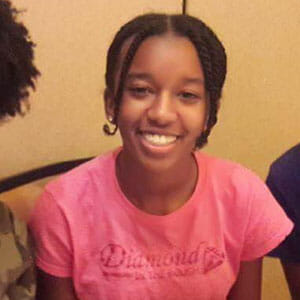
Jadyn Steele, 16, is a long-term member of Diamond In The Rough, a youth development program that creates a variety of activities designed to build self-esteem, character and leadership skills among girls of all ages. Their youth action team attended and pitched two ideas. She shares:
“Our youth action team, which included me and seven of my peers, attended the 2018 Points of Light Youth Summit. The event was very inspirational, and we saw many other youth leaders like us who wanted to see change in their community. My organization presented both the Blessing Bag project and the Drama Free Campaign.
I am very passionate about making a difference in my community. The issues facing our nation and world will have an affect me in one way or another, so helping to offer solutions and help change these issues is very important to me and many of my friends.
I personally learned a lot during the conference, including new presentation tactics, more team-building skills and the importance of participation. These major points that my peers and I learned will help us both in our organization and in our everyday life. Most importantly, these tools will help us in implementing our projects!
Here I Am: Reflecting on Service Unites 2018 with Repair the World
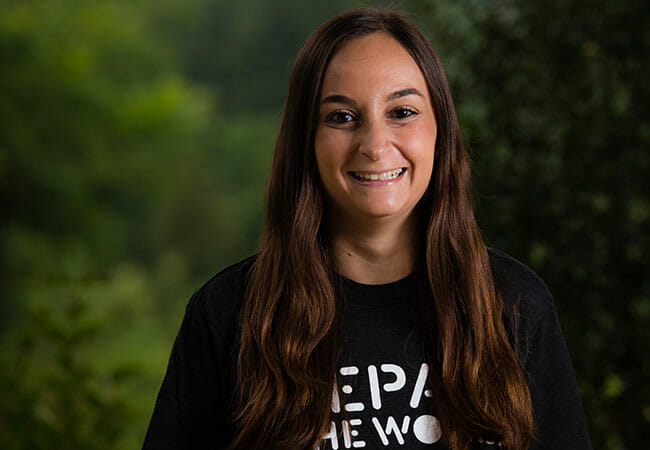
By Emma Saltzberg, Education Justice Fellow, Repair the World NYC
The first time I visited Atlanta was on a civil rights driving tour of the American South when I was in high school. We visited Dr. Martin Luther King Jr.’s birthplace and final resting place, as well as the historic Ebenezer Baptist Church. How fitting it was, then, to return to Atlanta again almost 10 years later, in a continuing fight for human rights and social and racial justice with Repair the World.
Last month, I traveled to Points of Light’s Service Unites conference in Atlanta as a member of Repair the World’s delegation. This three-day marathon of learning around volunteering and service brought together the nation’s leaders in service to share best practices and learn from one another. Repair the World’s delegation brought the unique approach of volunteering rooted in Jewish values to the group of more than 2,000 conference attendees.
As an education justice fellow at Repair the World NYC, I have spent the last year living, volunteering, and learning in the Crown Heights neighborhood of Brooklyn. Service Unites offered a powerful space to see what the merits of volunteer work and service programs in action look like on a larger scale. The location also felt particularly appropriate, as Repair the World is about to launch a new Community in Atlanta; the conference was a fabulous opportunity to share our work with stakeholders such as local nonprofit leaders, motivated volunteers, and board members.
Civil and Human Rights in Atlanta
After the conference, I visited the new Center for Civil and Human Rights. During this version of my civil rights tour of Atlanta, I entered with a much deeper understanding of the issues of racial justice that remain in our society today, thanks especially to my educational year as a Repair the World fellow. The most moving part of the museum was a simulated lunch counter sit-in, just like students in Greensboro, North Carolina would have experienced in 1960. I felt shivers down my spine as the harassers “whispered” in my ear (via a headphone recording) and the experience was nearly unbearable. The patience and self-discipline the nonviolent activists of the civil rights movement displayed is remarkable.
In 2018, we cannot afford to sit still and let the bullies of this country dominate society and the political sphere. While all of Repair the World’s Communities focus hyper-locally, one can imagine that the issues faced by people I’ve met in underserved neighborhoods in Brooklyn could be similar to communities in Atlanta and other cities around the country. This fellowship year has been spent in deep learning around racial justice, the needs of our local community, and why giving back through service is an inherently Jewish value. Visiting Atlanta for Service Unites and the Center for Civil and Human Rights only affirmed this understanding further.
Here I Am: Interfaith Conversations on Service
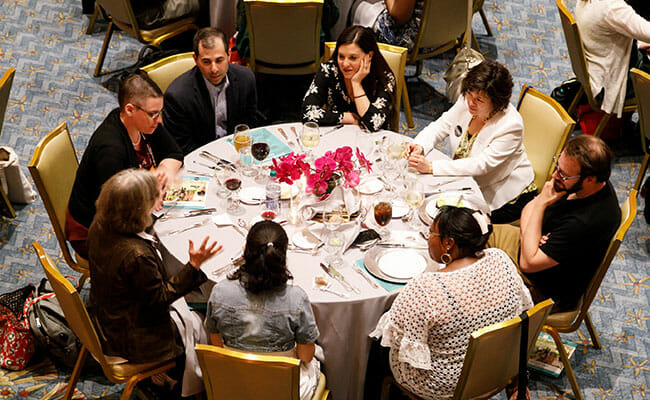
At Service Unites, Repair the World co-hosted the annual Service Supper, a dialogue around the influences of faith traditions on volunteering. Guests heard from local clergy who led interfaith blessings over the food and our presence there together. As a table facilitator, my role was to guide the discussion at my table of eight guests; the theme of the evening was “Hineni: Here I Am.” The goal of the evening was for participants to come away with an understanding that meaningful service should not divide us; in fact, it is one of the only actions that may bring people together to effect change.
One of the guests at my table felt comfortable sharing her personal story with the group. She spoke about a rough period she had gone through about two years prior, when this person found herself functionally homeless. She had a job, and she woke up and went to work every single day. She just didn’t have her own apartment to go home to.
This is the kind of homelessness we never speak about. The most common visualization of someone experiencing homelessness is of a person who abuses drugs, suffers from mental illness, or can’t keep a job. This paradigm ignores the thousands of hard-working American citizens who put in so much effort yet are consistently ignored and abused by the very system that proclaims to provide them with the American Dream.
What does Hineni mean to me? Saying “Here I Am,” or being truly present means showing up humbly with an open ear, ready to listen. It means never relying on preconceived notions or stereotypes, but rather approaching each individual where they are and truly listening to their story. It means breaking bread across vast differences, and showing up together.
Bringing my Service Unites Experience into the Future
As I transition out of my role as a Repair the World fellow in a couple of weeks, having the opportunity to attend Service Unites was a meaningful way to tie all the pieces together. From engaging in rich storytelling and listening at Service Supper, to sessions I attended around millennial engagement in service, to the wisdom gained from our constituents and colleagues at the Repair the World Delegation Summit, I was able both to share with others what I have learned this year applying Jewish values to service, as well as learn from others doing this work around the country, whether faith-based or secular. Seeing so many talented nonprofit leaders in action at Service Unites reinvigorated my belief that it is through honest conversation and humble service of others — in addition to through political action and systemic change — that we could actually have a shot at achieving racial justice as Dr. King imagined. Hinenu: we are here.
Emma Saltzberg recently completed a service year as an education justice fellow at Repair the World NYC. Emma took a gap year before college and lived in Israel volunteering at a kindergarten in Bat Yam. In this suburb of Tel Aviv, Emma realized how rewarding it was for her to help improve quality of life through hands-on education reform. Upon returning from Israel, she attended Tulane University and majored in ecology and evolutionary biology. Her favorite part of living in New Orleans was the multitude of food and music festivals to explore!
When President George H.W. Bush was in office in 1990, and after Nelson Mandela was released from prison, as a young civil rights lawyer living in Chicago reflecting on the need for more light, I wrote a poem. It was a privilege to share this poem last night at the opening plenary session of Service Unites 2018, as more than 2,200 volunteers, nonprofit, business and civic leaders gathered together for an exciting, star-studded event – part education, part activism, all inspiration – that celebrated and pushed the boundaries of civic culture and volunteerism.
Many of you have requested a copy of this poem, “How I Read a Poem Like This,” and we are pleased to share it with you, our community of changemakers – points of light in communities around the world, who are helping to ignite a civic culture. Thank you.
How I read a poem like this.
How it provoked thought.
How I’d like to do the same.
Provoke thought…
about racism
about sexism
about classism
about choice.
About basic human rights
human needs
human dignity.
About action.
About empathy.
About apathy.
How I think about life in America.
How I think about its economy.
about its drug problem
about health care,
“mental” health care.
How I think about its people.
about the rich.
about the poor.
about the average Joe and Jane on the street.
About our leaders.
about our illiterate and our homeless.
About what I can do
to make a difference.
Oh…..how I think about the crime in my neighborhood.
Exhausting.
How I think about the victimsand the victimizers.
the thieves and con-artists.
the moms with bills and babies.
and our gun-toting teens…who carry and represent for freedom?
How I think about the success
in my neighborhood.
Invigorating.
About our doctors.
our lawyers,
and our engineers,
and our teachers,
and our tech heads.
About our beautiful artists whose words,
and songs,
and pictures inspire us to skip from one scene to the next.
about those who tap into our natural hopes and joy.
About every day leaders
whose life it is to care for others.
How I think about our complex judicial system.
About the laws and their impact and their intent.
About equality.
How five opinions can change the lives of millions?
Think about it.
How I think about my education.
About the education of my children,
of your children,
of our children,
of all children.
PEOPLE!
What is we gon’ do?
We gon’ wake up.
Read up.
Get up.
Speak up.
We gon’ count.
Do the math.
And add it up.
We gon’ rise up.
Lift up.
Ourselves andOthers.
Today.
Today.
Today.
How I think about my lot in life.
How I ask you to think about yours.
How I read a poem like this.
How it provoked thought and action.
How I’d like to do the same.
Top 5 Reasons for Businesses to Attend the Service Unites Conference
By Roger Hancock, Manager of Community Affairs, CSAA Insurance Group, a AAA Insurer
As communities around the world face continuous societal shifts, including, diverse political, economic and social challenges, companies are stepping up as leaders and advocates in social action, policy and community-building. Participants in the Business Path at Service Unites will leave inspired and equipped to amplify corporate values through employee engagement and position their businesses as a force for good.
My first “volunteer conference” was on the college campus of Southern Methodist University in Dallas in 1986. This year, my decades-long journey across America to attend Points of Light’s annual conference on volunteering and service – now called Service Unites – continues in Atlanta, June 18-20. I hope to see you there.
Yes, the original national volunteer conferences were held during the summertime on college campuses, when 500–600 community leaders from corporate America and nonprofit organizations would sleep in empty dorm rooms at Yale, Stanford, SMU and my alma mater, the University of Southern California. We would attend volunteer workshops in available classrooms and lecture halls during the day and we would network in the evening.
In the many years I’ve spent attending the Points of Light’s conference, I’ve seen a lot. I’ve met presidents and first ladies, the son and brother of a president (here’s looking at you, Neil Bush!), members of Congress, entertainers and athletes – and Jon Bon Jovi.
More importantly, I’ve met people like you who I have learned from, networked with, enjoyed a beer with, and who have helped me be a leader in the field of corporate volunteer management.
And, after more than two decades, I eagerly keep coming back to the Service Unites conference, just like Parrotheads annually migrate to Jimmy Buffett concerts. I registered for the June 2018 conference in Atlanta, paid my ridiculously cheap conference fees, booked my flight and reserved my hotel … all at the end of last year.
If you have attended the conference, you know why you need to go and why you want to go. But if you have not attended the conference before, here are five reasons why you should join me in Atlanta in June.
1. It’s a Bargain
The conference registration fee runs from $350 to $550. It’s a real bargain for a three-day conference filled with incredible, inspiring, and gifted speakers and presenters. Geez, there are some other corporate social responsibility conferences that cost $2,500 for two days of meetings. And rarely are there old guys like me at the podium. Service Unites speakers are diverse, vibrant and inclusive. Heck, I brought my daughter (who was in high school and then college at the time) to three conferences in Washington, D.C., Chicago, and San Francisco – she had a blast meeting and engaging with other service-minded students at these conferences. Today, this mighty millennial proudly works in our field.
2. One Nugget
Every year I walk away from the conference with at least one huge nugget of information that is a game-changer for how I do my job and lead my company in the community. Examples of recent “one nugget a year” learnings include: the launch of the Civic 50, as thought up by former New York City Mayor Michael Bloomberg; the release of the UN Sustainable Development Goals; United HealthCare’s study about the wellness benefits of volunteering; that “Volun-told-ism” is definitely acceptable (thanks Bea Boccalandro!); and that Bon Jovi’s acoustic rendition of “Livin’ on a Prayer” echoes in my ears louder when whispered solo on a simple acoustic guitar. (Jon Bon Jovi has meaningfully presented at two Points of Light conferences!)
3. Workshops, Plenaries and More
Service Unites. It sure does. Nothing like 3,500 people in a ballroom riveted to an inspiring and informative plenary speaker. And, sometimes that incredible featured special guest speaker is only 12 years old! And, the workshops – there is so much to choose from in your area or field of interest: business, nonprofit, government, faith, national service, higher education, youth and more. Pick your path and run down it. It’s your time to learn and share with like-minded colleagues.
4. The Hotel Lobby
Everything I wanted to learn about volunteer management … With 3,500 attendees, it can be a bit challenging to develop a relationship or build a network in a large plenary or at the workshops. Thus, the hotel lobby (and the bar) is the mecca to meet people from across the country and the entire globe to simply chat. I wear my conference name badge with company name and geographic location. The relationships and the network I have built from simply talking with a small group of folks in the hotel lobby from an array of cities, states and countries has allowed me to engage in conversations that provide insights on how I can do my job better. And, I have built a network that I can call on later when I am stumped or struggling with a community issue.
5. Baseball!
Father’s Day, Sunday, June 17, it’s Padres at the Braves! Hats off to Points of Light and the conference planning committee. These folks always book the conference in pretty cool baseball towns when the local team is on the field. Highlights have included the Chicago Cubs, Chicago White Sox, New York Yankees, New York Mets, Kansas City Royals, San Francisco Giants, Philadelphia Phillies, Seattle Mariners, Washington Nationals, Atlanta Braves and Detroit Tigers. I have been to all of these baseball stadiums (“cathedrals”) while attending Service Unites.
That’s it. Five reasons to attend Service Unites. I hope to see you in Atlanta in June! Come to the conference for three days of engagement and learning how you and your organization can best serve others. Yes, Service Unites!
“Take my hand and we’ll make it, I swear. Whoa, livin’ on a prayer.” – Jon Bon Jovi
Top 5 Reasons for Nonprofits to Attend the Service Unites Conference
By Amy Lytle, Executive Director, HandsOn Northwest North Carolina
Since beginning my work in the volunteering and service sector in 1998, I have attended all but two Points of Light conferences. And I go back year after year, even during the tightest of budget times – something I know many nonprofit professionals understand – because I continue to find unmet value in the opportunities the Service Unites conference has to offer. Here’s why:
1. Learn from Leaders Like You
The Service Unites conference is your one big chance to connect with people doing that exact same work as you – a chance that usually doesn’t exist in our home communities. Amy Poehler, in her memoir “Yes, Please,” says that two of the most powerful words in the English language are, “me, too!” From informal meet-ups and networking events, from workshops to the main stage, this conference is an opportunity to meet and learn from other leaders in our field who are facing the same challenges, creating innovative solutions for the same problems, and making the same commitments to their communities as you are every day.
2. Make Face-to-Face Connections
I don’t know about you, but webinars just don’t cut it as a way of creating peer learning networks. I have to see someone face to face, build a rapport, share a meal or a drink before I feel I know them well enough to pick up the phone and ask them how they do X, Y or Z. Attending the Service Unites conference has given me the opportunity to build strong, personal relationships with other leaders in our field. There are some colleagues who I see only at the conference, but I know that I can pick up the phone any time, and get advice and support from them. I’ve picked their brains, “borrowed” their ideas and learned from their experience. None of this knowledge would have been available to me had I decided to sit in my office alone. As an Points of Light Network affiliate leader, I’ve learned that creating and strengthening my peer network has been crucial to my success, both personally and organizationally.
3. Get VIP Treatment
It will make you feel like the VIP you really are. Nonprofit work is not glamorous. And in some communities, we’re considered “the best kept secret.” (Ugh!) But, at the Service Unites conference, that changes. This event is all about service and nonprofits, and celebrating the impact of the work we do every day. And the organizers demonstrate that with who they bring to be there with us. I’ve shared some of the best macaroni and cheese I’ve ever eaten while being serenaded by John Legend at a Sunday Supper event. I’ve met Kevin Bacon and Jon Bon Jovi. I’ve shaken the hand of a U.S. president. I’ve also met amazing volunteers and people who are doing incredible, inspiring work in their local communities. Going to this conference never fails to reinvigorate m, and make me feel like the work we do is important – and deserves such a high-profile event to celebrate it.
4. See The Whole Picture
Because you need to step back to see the whole picture. Look, I get it. Summer is busy. The conference is in Atlanta (and, unless you are already in Georgia, that may seem far away.) Too often we are buried deep in the weeds, unable to see the beautiful, grassy plains in front of us. For years now, I have set a personal goal to not let the urgent get in the way of the strategic. I may not meet the challenge of that goal every day, but making the time – claiming the time! – to attend the conference is one way I do rise to that challenge. Service Unites provides that chance to see the whole picture, to discover where the work you’re doing fits into the greater service movement. Service Unites is strategic. Yes, the urgent will be even more urgent when you get back – but wouldn’t it be, anyway, even if you stayed home? Don’t lie – you know it would!
5. Ideas You Can Implement
There is always something new to learn. My goal for each conference is always the same: at least one new idea I can instantly implement when I get back. I really should create a stronger “stretch” goal, because this has been so easy to fulfill. We all have the experience of leaving a conference with dozens of good ideas, which are instantly forgotten in the rush of urgency that awaits you when you get home (see my point above). But by focusing on my ONE INSTANT IDEA, I’ve been able to focus in on those things that are easily implemented and truly impactful. At past conferences, I’ve gotten key advice about implementing technology solutions, learned how to build a managed projects program, and gained confidence in working with corporate partners. Our organization has been able to improve service delivery, build new programs, and create new revenue streams – all with those single ideas that I’ve brought back with me. While Service Unites is, without a doubt, a significant financial investment, we’ve found that that our conference ROI is really quite high when we’ve measured the impact from those ideas take home and implement.
There is a steady drumbeat of stories that focus on our differences. No matter how you consume your news, you’ll see or hear stories about intolerance in our daily lives and political stalemates at every level of government. At the beginning of the year, the Pew Research Center released a poll and said that Americans predicted the country’s deep political divisions to persist – with 86 percent saying the country is more politically divided than ever.
Shortly before that poll was released, however, Points of Light affiliate New York Cares reported that, just a week after one of the most divisive national elections in our country’s history, there was a 137 percent increase in people who came to them with an interest in volunteering.
As we approach the end of 2017, the two sides of this story continue to play out. Yes, we are still seeing rallies of hate and intolerance and our elected officials still don’t agree on solutions to some of the toughest challenges we face. But on the other hand, people are seeking out ways to do something that makes their community better or helps an individual in need. It’s the inclination to help in times of need. It’s what Americans do. And it binds us together as a nation.
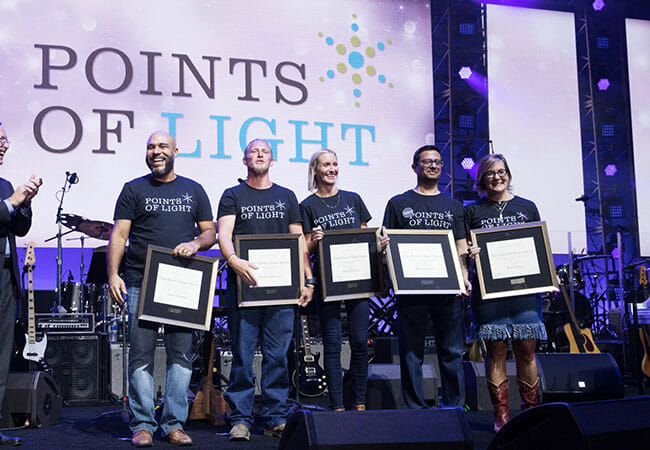
Photo Credit: Paul Morse
Daily Point of Light honorees Derek Auguste, Zachary Dearing, Leah Halbina, Murad Ajani and Kat Creech are recognized on stage at the “Deep From the Heart: One America Appeal” hurricane relief benefit concert.
The recent series of natural disasters has offered a striking visual – a national story about the power and impact of volunteers. Communities darkened by flood damage ultimately shine with the bright light of neighbors helping neighbors.
Some people walk out of their front doors to help others in their community. Some drive across the country to volunteer. And those who aren’t able to deploy, organize relief efforts from home.
The truth is, people committed to serving others unite around our common humanity.
When it comes to helping – whether it’s rescuing people from flooded homes or pulling up damaged floors after a storm – it doesn’t matter if you are a Democrat or Republican; rich or poor; black or white; religious or not. Volunteers unite in service. And, strength, resiliency and generosity flow from those simple acts of service.
This ability of service to others to unite us was most visible on stage at the recent “Deep From the Heart: One America Appeal” concert to support hurricane relief efforts in Texas, Florida, Puerto Rico and the U.S. Virgin Islands. How often do you see pop icon Lady Gaga share a stage with the legendary country band Alabama, R&B “Soul Man” Sam Moore and gospel sensation Yolanda Adams? How about President Barack Obama sharing a stage with President George W. Bush, President Bill Clinton, President George H. W. Bush and President Jimmy Carter?
This group of musicians gave their time and talent, and this bipartisan group of former U.S. presidents stood together to recognize volunteers with Daily Point of Light Awards for their efforts to help their neighbors and fellow Americans in the wake of these devastating storms.
What may seem like fleeting moments of unity in response to major disasters, actually take place all the time. Just this past weekend, thousands of people created or joined volunteer projects in communities across the country for Make A Difference Day – one of the largest single days of service in the United States.
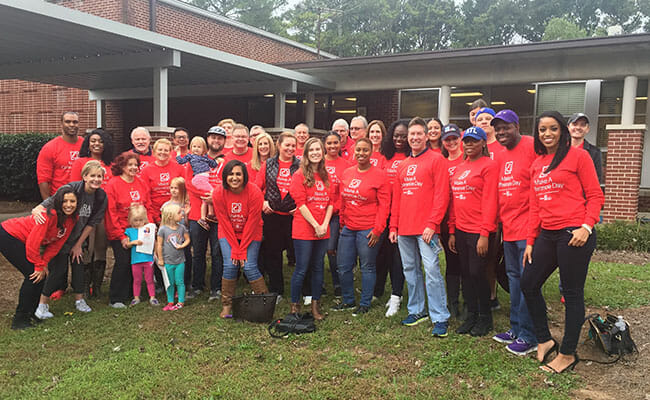
During Hands On Atlanta Day in October, organized by Points of Light affiliate Hands On Atlanta, more than 3,000 people rolled up their sleeves to participate in 64 volunteer projects across the city. Members of one community spent the day building a playground for children in their neighborhood. In another community, they planted trees. Parents of students at a downtown Atlanta school came together for a school revitalization project. And in the 48in48 hack-a-thon, skills-based volunteers gave their time and talent to build 48 customized websites for local nonprofits, in 48 hours.
In the collage of photos from these days of service you will see hackers, neighbors, parents and strangers – each freely giving of their time, talent and light. They represent a rich diversity of humanity where service really does unite.
How Higher Education Institutions Use Service to Develop 21st Century Citizens
examined the question of how colleges and universities can equip students to be 21st century citizens. Over the course of three sessions and a keynote presentation, speakers shared insights and concerns about how higher education institutions engage with broader society, provide opportunities for students to deepen their learning through volunteerism and service learning, and encourage interaction with people, cultures and views different from their own. The track, which was sponsored by
, brought together leaders from higher education, community intuitions and the private sector.
The first session, “Bridging Democratic Engagement and Service Learning Roundtable,” examined how institutions of higher education could encourage democratic engagement with service learning as a means to equip students with the necessary skills to prepare them to be active agents in their communities as well as strong members of the workforce.
Speakers from the University of Houston-Downtown, Tulane University and Colorado State University shared examples of programs and initiatives at their institutions. John Locke, a University of Houston-Downtown graduate talked about how he founded the
program on his campus to encourage college students to vote. The program has now grown to be a national model for student civic organization.
While the first session focused on examples from individual departments or programs, the second session invited college presidents to share their perspective on the role higher education plays in creating civic leaders.
One theme that emerged was that colleges and universities are seeing a resurgence and demand from students to offer volunteer and service learning opportunities connected to current political issues. For example, Dr. Bill Flores, provost, CEO and associate vice chancellor of Antioch University, and Dr. Otto Lee, president of Los Angeles Harbor Community College, shared that they have seen an increased interest from students in the politics of immigration and rights of undocumented students.
The third session, “Dialogue on Social Responsibility: How Corporations and Nonprofits Promote Social Responsibility and How Can Higher Ed Better Partner With Them,” brought together speakers from KeyBank, Starbucks and Youth Service America. The panelists shared how their organizations are partnering with higher education institutions to advance their philanthropic goals. Eric S. Brown, senior program officer for corporate philanthropy, at KeyBank shared that they believe we don’t have a single student to lose – their investments in education are about making sure every student gets an opportunity and succeeds in completing their education.
The day ended with a presentation by David Mathews of the Kettering Foundation. David startled the room by starting his speech, “We have a new challenge, our democracy is in trouble. Everyone in this room grew up with the assumption that you were going to live in a functioning democracy. There is a survey done by The Economist every year on the health of democracies in the world. The United States has fallen. Nobody would have ever believed that would happen, but it has. This trend has been developing for decades and nobody has paid any attention to it.”
David hypothesized that higher education is no longer seen as an agent of democracy, as a public good serving a public good, but simply as a vehicle for students to get high-paying careers. He challenged the room to rethink how colleges and universities equip students to be citizens and take home the lessons from the day to rethink their work.
Dr. Flores closed the track by reminding everyone of the important role they play and asking them to keep the conversation going. “We want to have an ongoing dialogue, not something that takes place one time, but something that we can build off of. We would like to work with you. You are the leaders and your community needs your leadership. It needs your discourse and engagement. This society, this country belong to us.”
Solutions for Community Resilience: Meeting the Urgent Needs
When government agencies, nonprofits and community changemakers focus on strengthening educational and economic advancement for youth and families, social equity and cultural expression, their collective action can lead to clear, measurable impact and sustainable long-term change.
Participants of the
learned about successful models that empower and equip everyday citizens to create healthy, vibrant, thriving communities, as well as best practices for engaging volunteers from across the community in consensus building and community organizing to tackle some of today’s toughest issues.
Citywide Volunteer Initiative Sparks Youth Interest In Careers
Local schools issued a challenge to 11 of the largest employers in Indianapolis: Open your doors so our kids can learn about the world of work and the skills they need to succeed. “Schools with 95 percent of their children living in poverty are a complex environment with complex issues,” said Joe Gramelspacher, special assistant to the superintendent of Indianapolis Public Schools. Fifteen months later, a broad cross-sector collaboration delivered an answer.
Workshop attendees learned how the
initiative – a team of businesses, educators, government agencies and nonprofits in Indianapolis – brought together 115 of the city’s employers, more than 3,000 volunteers, and 400 educators to build a two-day event to spark career inspiration for more than 7,000 eighth graders. Filled with hands-on learning experiences and demonstrations, the event presented on the types of jobs needed in the future for different industries, the skills needed and the pathways to acquiring them.
Whereas schools are primarily focused on closing the achievement gap, Jennifer Burk, president and CEO of Junior Achievement of Central Indiana, explained that, “JA JobSpark’s goal is to tackle the ‘exposure gap’ – the lack of opportunities for a student to see something that inspires them to consider what their future could look like.”
Engaging Veterans: The Second Mission
Veterans who served in the last decade represent less than half a percent of the total population, but their dedication to service and American democracy supports 100 percent of Americans. Jason Alves, program manager for the Washington State Department of Veterans Affairs, and Peter Schmidt, program coordinator for the Washington State Department of Veterans Affairs, led an engaging conversation around how we can access the strengths, skills and talents that exist in every service man and woman leaving our nation’s military. Workshop attendees discussed how it is crucial to evaluate situations from multiple perspectives when considering how a veteran’s experience and skill set can be used in a civilian volunteering opportunity. Jason and Peter also encouraged attendees to reframe post-traumatic stress as an opportunity for post-traumatic growth, as Jason explained it, “the experience of positive change resulting from the struggle with major life crisis.”
New Pathways to the American Dream for Youth
The path to college and career success is not always a straight one. More than 5 million youth are in need of new opportunities to participate in the labor market or continue school. Marcia Page, president and CEO of Education is Freedom, Terra Gay, senior vice president of programs at Points of Light, and Stephanie Lloyd, director of monitoring and evaluation at Points of Light, shared how volunteer service has provided opportunities for success for youth, as well as become an integral part of the solution in closing the opportunity gap via the
program.
A joint partnership between AmeriCorps, the Citi Foundation and Points of Light, ServiceWorks had a three-year charter, from 2014 to 2017, to provide 25,000 low-income youth scholars with the specific tools and platforms needed to increase their access to economic advancement through college and career success. “The idea isn’t to go and serve simply to fulfill a gap. It’s to help [opportunity youth] understand the need to serve as a volunteer so they can become the ones to teach it to their peers; it’s a building process,” Terra said. “ServiceWorks takes them through the process of elevating their thinking of how they are citizens within their own community and agents of change.”
In spring 2017,
, Lincoln Filene professor of citizenship and public Service and associate dean for research at Tufts University’s Jonathan M. Tisch College of Civic Life, conducted a review of ServiceWorks based on an assessment of program data and documents, plus interviews with participants and stakeholders.
Recent scholarship suggests a path to economic mobility lies in investing in low-income neighborhoods. Brian Humphreys, director of financial empowerment at South Sound Outreach; Megan Karch, CEO of FareStart; Catherine McConnell, vice president of advancement at Goodwill; and Kim Vu, senior vice president, Seattle market manager of enterprise business and community engagement at Bank of America, shared how community-level problem solvers, resident volunteers and local nonprofits can accelerate and sustain change by promoting financial empowerment while also re-imaging neighborhood community spaces to stabilize and, optimally, boost economic opportunity. “Where we are most successful are in the relationships that we build over time,” Megan said. “How we engage with volunteers is more in how they are establishing relationships and the appropriate boundaries with those that are being served.”
Nonprofits and government agencies’ abilities to solve societal issues are often constrained by organizational capacity. When your roof is leaking, you focus on the immediate issue of repairs and may put off a much-needed basement remodel. The same can often be said for capacity building initiatives; they take time, resources and staff capacity that many nonprofit organizations don’t feel they have, even if it would pay off in the long run.
The
, sponsored by JPMorgan Chase & Co., focused on these issues and offered attendees proven and feasible solutions for increasing nonprofit capacity. Across the nine sessions, three trends emerged as to how nonprofits can leverage existing assets and resources to do more.
1.
Move from Partnerships to Collaboration
The biggest trend across all the sessions was the need for a pragmatic shift in how nonprofits engage companies and work with other organizations. During the “Corporate-Nonprofit Partnerships Blown Way Out of Proportion” session, Bea Boccalandro, president of VeraWorks, pushed attendees to think about how they could triple their impact by focusing on cultivating integrative partnerships – where the success of both the nonprofit and company are intertwined. “Most relationships between business and nonprofits are philanthropic or transactional. But to get at impact, we need to push towards integrative,” Bea said.
Bea recommended starting small, with pilot initiatives. This was echoed by Rebecca Wang, senior manager of corporate affairs at Hewlett Packard Enterprise, who offered a corporate perspective. Rebecca compared the process of entering a new partnership to taking it slow with a new romantic partner. “When I am working with a newer organization that maybe another company has referred to me, it’s kind of like the dating phase. You are really thinking more about your own benefits. As you go through multiple dates, you start to understand each other better. You may decide to become exclusive. At that point, the commitment to each other becomes integrative.”
Sessions also encouraged nonprofit sector attendees to rethink how they partner with each other. Too often, nonprofits feel that they are competing against one another and therefore cannot truly collaborate. Shonna Ferree and Rikki Wheatley-Boxx of the Public & School Partnership, an AmeriCorps VISTA program, shared best practices for collaborations between organizations and recommended leveraging
mandated days of service as platforms for local collaboration and outlets for raising awareness of national service efforts.
2.
Be Data Driven, Not Numbers Numb
Two sessions focused on the importance of leveraging data, but in strategic and creative ways in order to see real community impact, not just a shift in numbers. In the hands-on “Survey Sense/Let the Creativity In: Exploring Alternative Methods for Data Collection” workshop, Stephanie Lloyd, manager of evaluation and performance measurement at Points of Light, walked participants through a visual survey methodology called SHOWeD, first developed by Wang and Burris in 1997.
For attendee Leah Vanhoeve, the session was thought-provoking. “It was great to be engaged and feel like we could be engaging other people through this instead of staring at a computer screen codifying qualitative data, because it’s really not that different from quantitative data, it’s just two sides of the same coin,” she said. “This felt very out of the box and applicable, and not something I had ever heard of before.”
3.
Leverage the Power of Pro Bono
Many nonprofits are interested in recruiting pro bono and skills-based volunteers but are unsure how to start or struggle to find ways to effectively leverage these volunteers to build capacity within their organization. Yet, pro bono volunteers can provide up to 500 percent greater value to nonprofits than the value of traditional volunteering, by supporting needs such as general operations, technology and professional services.
Panelists at the Making the Most of Corporate Skills-Based Volunteering: A Fireside Chat with JPMorgan Chase & Co. session shared tips and best practices for developing a pro bono strategy. Attendees broke into small groups and worked through Common Impact’s skills-based volunteering
.
“We are a volunteer-based organization, so we are very familiar with plugging volunteers into our actual programs, but thinking about pro bono from a capacity building standpoint is something we are just starting to dig into,” said Jessie, an attendee from Grid Alternatives. “It was helpful to hear some examples of how other organizations have done that, but also just some of the resources that Common Impact provided around potential projects and the questions you need to think about before you even approach a company with a pro bono idea.”
These are just a few of the highlights from the Capacity Building track. Across the sessions, attendees were exposed to new ideas, trends and resources to take back to their organizations.
This post was written by Gigi Raffo, an Atlas Corps Fellow from Venezuela who attended the 2017 Points of Light Conference on Volunteering and Service. It originally appeared on American Express Leader Stories.
Dr. Martin Luther King Jr. noted, “Life’s most persistent and urgent question is, what are you doing for others?”
The
– the largest service-related convening of nonprofit, government, business and civic leaders in the world – brought thousands of people to Seattle the last week of June to answer this question, both for themselves and their societies.
This year’s conference affirmed the critical role that volunteers play in addressing some of our societies’ biggest challenges. It also tackled timely and relevant themes, like empowering women, working across cultural and national boundaries and redefining what it means to volunteer by putting people at the center of transforming their communities.
As an international attendee from Venezuela, I was impressed by how the power of collaboration can be used to solve targeted and urgent problems, especially if individuals, foundations and corporations come together to create innovative projects to positively impact the neediest communities.
Inspiring Women, Inspiring Us
At the Conference we learned that we can’t wait for inspiration. We have to go after it. I was inspired by the strong, smart and professional women speaking – and participating – at the Conference.
One panel brought together Umran Beba, CHRO, human capital management for PepsiCo; Cheryl Strayed, author of “Wild;” Sarah Hurwitz, former speechwriter for Michelle Obama and Zoe Terry, 10-year-old CEO of Zoe’s Dolls. Another featured a touching talk about refugees from Libyan Lubna Yousef, who is a fellow Atlas Corps member serving at Airbnb. This conference was an amazing opportunity to connect with like-minded people and hear great ideas and stories that I will try to replicate in my home country, Venezuela, and during my Atlas Corps Fellowship.
Bridging Barriers and Building Global Movements
What does it take to move ideas across national and international borders to change people’s lives? This was the topic of one panel during the Global track session, “Changemaking Across Borders: What’s Possible?” I had the pleasure to participate as a speaker with MovingWorlds volunteers Sarah Horrigan and Melissa Sassi, of Microsoft.
We spoke about how volunteerism, aid and development are viewed, why we should refocus our efforts on challenging power and inequality and how we can lead and facilitate in new ways to create the positive change the world needs right now.
We also talked about the amazing work that Atlas Corps and MovingWorlds, two global service exchange organizations, are doing to build bridges among leaders all around the world. By promoting innovation and cooperation these two institutions are changing the way that talent and opportunity are perceived. While the problems of the world are too great to solve alone, there is no challenge we cannot tackle together. We are building a global movement of superheroes!
Translating Vision into Reality
One of the many things that resonated with me at the Points of Light Conference was the belief that individuals have the power to spark change – from this, leaders are born and can start their journey creating social change and wellness in their communities. Leadership is the ability to translate vision into reality!
On that note, I had the pleasure to attend the first night of the
, which takes place in conjunction with the Points of Light Conference on Volunteering and Service. The Academy program is developed and delivered by the Center for Creative Leadership and funded by American Express. Forty-eight emerging leaders participated in a two-day leadership development training program that included a feedback-intensive learning environment and hands-on activities to enhance the leadership capacity of all the attendees. These leaders are in the volunteering and service sector and share the interest of advancing their positions to a greater leadership role. I had the opportunity to connect with other nonprofit professionals, who provided me with some great ideas on how national and international service is the new ally for social change.
This year’s American Express Leadership Academy at Points of Light by the numbers:
The Academy kicked off with dinner and inspiring words by Aaron Hurst, co-founder and CEO of Imperative and founder of the Taproot Foundation. “Leadership begins with defining the core role of work in your life as helping others and being personally fulfilled,” Aaron shared.
Aaron also shared a surprising statistic from his research from Imperative: Only 45 percent of the people who work in the nonprofit sector are purpose-oriented! That means that the majority of people working in the sector who are primarily responsible for helping our society are not purpose-oriented.
This made me think: the single most powerful way to grow as a leader is to become truly self-aware, which means to cultivate, on a daily basis, an accurate sense of how I show up in the world and what motivates me. What impact do I have on others? What do I care most about? These are some of the questions that I have to ask myself – and that the other leaders in the room have to answer in order to develop as leaders in this sector.
To help leaders become more purpose-driven and more effective, Aaron shared his
, the youth division of Points of Light, and asked about her reaction to the training. She told me: “This training was the perfect opportunity to share experiences with those of like minds and from across the globe. Being from Kenya and having the opportunity to have conversations with other professionals from India, Nigeria and the United States was very impactful and encouraging.”






 As communities around the world face continuous societal shifts, including, diverse political, economic and social challenges, companies are stepping up as leaders and advocates in social action, policy and community-building. Participants in the Business Path at Service Unites will leave inspired and equipped to amplify corporate values through employee engagement and position their businesses as a force for good.