Boston Cares Wins Romney Award for Giving Kids in Need Beds of Their Own
Thousands of Greater Boston school children do not have a bed, which affects their self-esteem, ability to learn and likelihood of graduating from high school. This year’s George W. Romney Award winner, Boston Cares, decided to tackle this problem by creating the Bed Project, through which volunteers build beds for kids who need them.
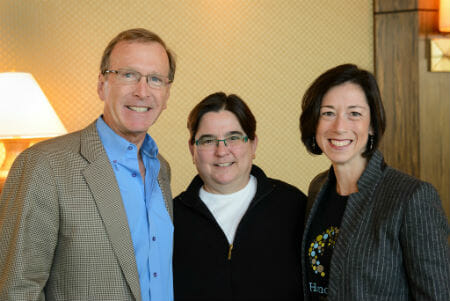
From left, Neil Bush, chairman, Points of Light; Patrice Keegan, executive director, Boston Cares; and Amy Smith, Points of Light chief strategy officer and president, Action Networks
Each year during the Points of Light Conference on Volunteering and Service, HandsOn Network honors the outstanding work of an affiliate through the George W. Romney Award. The award is the pinnacle of excellence, presented to honor the collective success of an affiliate in making a meaningful difference through volunteering and service in their community and across the sector.
Boston Cares, which received the award in Houston on Sunday, sought to help children who have no choice but to share beds with family members, sleep on the couch or sleep on the floor.
In creating its Bed Project, Boston Cares located skilled woodworkers – Nick Roulleau of Mansfield Fine Furniture and Eli Cleveland of The Rough Cut – who donated their time to develop a toddler bed prototype that is easy for volunteers to replicate.
“One of the most exciting things about Boston Care’s Bed Project is that it can be replicated by our global network of over 250 affiliates, so they are not only helping children in Massachusetts, but around the world,” said Alison Doerfler, executive director of HandsOn Network, an enterprise of Points of Light.
The nonprofit built a partnership with the New England Regional Council of Carpenters, through which apprentices have handled much of the advance work of cutting, milling and fabricating the lumber – although volunteers can handle this stage of the Bed Project if need be, using a series of customized “jigs” designed by Roulleau and Cleveland.
On Martin Luther King, Jr. Day 2014, Boston Cares launched the Bed Project with a goal to build 500 beds for kids in 2014. Since then, close to 1,400 volunteers have produced 700-plus beds for children served by 22 community partners in Boston, Somerville, Lynn, Lowell, Worcester and other nearby communities. The goal is to hit 1,000 beds by the end of 2015.
“We truly appreciate the beds the Boston Cares Bed Project has made and donated in the past and look forward to receiving and distributing many more to families in need thanks to this amazing program,” said Donna Hunnewell, executive director of The Wish Project, a recipient of Boston Care beds. “What a unique and effective way to use volunteers to help families.”
The George W. Romney Excellence Award was established in 1996 to honor Gov. Romney of Michigan and his personal commitment to volunteer service. Romney was chairman and CEO of American Motors, a three-term governor and U.S. Secretary of Housing and Urban Development. He was also founding chairman of the National Volunteer Center and a founding member of the board and executive committee of Points of Light.
“It is a great honor to be recognized for our work,” said Patrice Keegan, executive director of Boston Cares. “We have been so inspired and motivated by other affiliates and past Romney Award winners. Boston Cares is excited to move the Bed Project forward and thanks HandsOn Network and Points of Light for this honor.”
Top Six Resources for Nonprofits
From managing volunteers to making your organization more hospitable, these key resources will give you effective strategies for addressing challenges that face nonprofits today. For more resources, check out the searchable resource library managed by Points of Light’s HandsOn Network.
Bringing on Highly Skilled Volunteers
There are likely skilled professionals – specialists in accounting, information technology, human resources and more – in your community ready to volunteer at your nonprofit, but are you ready to receive them? The Skills-Based Service Engagement Tool, which takes about 10 minutes to use, can help your nonprofit determine how prepared it is to engage skills-based volunteers.
Through thought-provoking questions and instant feedback, the tool provides tangible recommendations for nonprofits looking to boost their ability to meet their missions by attracting talented professionals as volunteers.
Managing Volunteers
For many nonprofit organizations, volunteer help is vital. However, recruiting and engaging volunteers in an organized way can be tough. This HandsOn Volunteer Management Guidebook can help.
The guide outlines various strategies for organizing a strong volunteer structure, from recruiting and scheduling volunteers to retaining and recognizing their efforts. Paired with questions to consider and activities to help map out goals, the Volunteer Management Guidebook provides resources you can adapt to meet your local program needs.
Calculating Economic Impact of Volunteers
There are many ways to recognize the value of volunteer work. For nonprofits, this often means calculating the monetary worth of volunteer duties, which varies. To make it easier, Points of Light has created the Economic Impact of Volunteers Calculator.
By providing a complete list of volunteer jobs, the calculator can help give your nonprofit a better idea of your volunteers’ economic impact. The calculator lists standard hourly rates and hourly benefits of specific positions. After you input the number of hours, the calculator does the rest of the work.
Nurturing Volunteer Leaders
A solid corps of volunteer leaders can make a big difference in helping your nonprofit achieve its mission. Points of Light’s Volunteers as Leaders guidebook is designed to help your organization establish the processes needed to develop a strong volunteer leader program.
This guide outlines various stages of program evolution, from development to volunteer leader recruitment, training and support. Equipped with user-friendly questions, tools for brainstorming and suggestions, Volunteers as Leaders provides pointers and resources you can adjust to meet the needs of your nonprofit.
Assessing Volunteer Leaders
Volunteer and staff feedback on organizational management is your nonprofit’s key to growth and success. The Organizational Assessment for Volunteer Leaders, created by Points of Light, provides a thorough questionnaire to help extract important responses about how your project is running, from a volunteer perspective.
This resource includes activities that help staff or the volunteer coordinator assess organization readiness, recruitment, retention and recognition.
Making Hospitality Part of Your Organization’s Culture
Hospitality is crucial in any company culture, and the same is true for nonprofit organizations. Created by Hilton Worldwide, Points of Light and Taproot Foundation, the Hospitality + Service curriculum is designed to help you serve your clients better by improving communication and connections with clients, creating warm and welcoming environments and effectively managing challenging situations.
Hospitality + Service’s leadership toolkit, Hospitality by Design, shows how to build hospitality into your organizational culture from the ground up, deliver more to your clients, strengthen your team and build your reputation and impact in the community.
How Volunteers Are Helping Refugees – And What You Can Do
In central Rome, a former cultural center has found new life as a temporary home for hundreds of refugees. Without formal leadership or organizational structure, citizens have transformed the Baobab center into a safe haven where refugees can arrive at any hour and find food, shelter and someone who is willing to help.
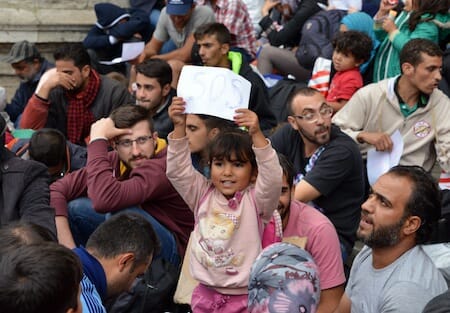
Refugees gather at Budapest Keleti railway station in Hungary.
Volunteers provide meals, hand out clothes and work a small first aid station, all made possible by donations and cash contributions from the people of Rome – including the Pope, who recently donated medical supplies to the center. As migrants prepare to move north, volunteers provide travel packs containing bottled water, a sandwich, a basic dictionary, a map of Europe and often a train ticket.
“Baobab represents a symbol of hope, of ordinary citizens not closing their eyes in front of need. It is a real example of people realizing their potential to make a difference,” says Mauro Cipparone, president of
.
RomAltruista, inspired by the actions of these “ordinary citizens,” has joined the effort, too. In addition to lending a hand at the center, the organization is promoting volunteer opportunities to help fill additional needs.
The Baobab center is not alone. The outpouring of volunteers is a common theme in places where refugee numbers are the highest, where citizens are desperate to help and official direction is lagging or non-responsive. And the refugee crisis has only accelerated in recent months.
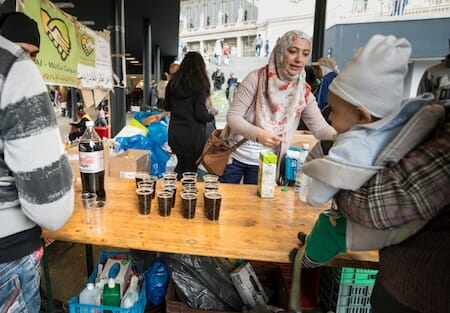
A volunteer serves beverages to refugees near Budapest Keleti train station in Hungary.
Following a spike in refugee populations in 2014, the number of migrants arriving in Europe has already doubled in 2015. The unprecedented movement of people around the world has created the highest number of displaced persons – many fleeing civil war in Syria – since World War II.
More than half of the nearly 400,000 registered refugees are children and youth. Upon arrival, refugees must stay in detention camps or reception centers until they either begin to travel to another country or find a way to stay in the nation in which they arrive.
However, many nations lack the infrastructure to respond, given the current influx of refugees. Volunteers are playing a key role in helping solve this problem.
Like the volunteers at the Baobab center, many Hungarians are helping refugees however they can. Points of Light partner
sees citizens donating their time at nearby railway stations to pass out food and water, collect trash and help refugees bridge language barriers.
One group set up a projector to entertain kids with their favorite cartoons, right in the middle of Budapest’s central train station. Corporations have also stepped up. Telekom, the country’s leading telecommunications company, is providing free wi-fi at rail stations – which not only allows refugees to connect with loved ones, but supports volunteer groups that are organizing via social media.
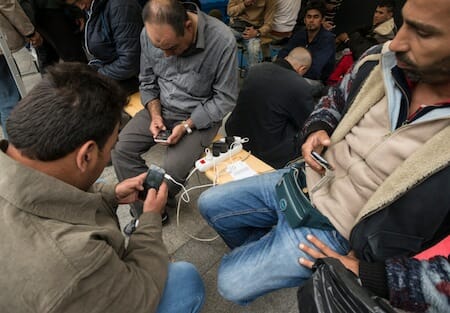
Refugees use donated mobile phones to keep in touch with their families near Budapest Keleti train station in Hungary.
is working with nongovernmental organizations (NGOs) to help coordinate the volunteer response. The group’s website has become a virtual corkboard where organizations can post requests for specific volunteering services, as well as a repository for educational materials and tools for NGOs – a precursor to an upcoming seminar on the best practices of volunteer management during times of crisis.
And, while Greek citizens are eager to help, the country’s geography makes an effort like the one at the Baobab center more challenging. Most refugees passing through Greece end up on one of its many islands, where volunteers are doing their best to keep up with limited resources.
Costs for volunteer travel and the shipment of donated goods can be prohibitive. Volunteer4Greece is working to connect NGOs with private companies willing to support these efforts.
Farther north, in countries that are more removed from the crisis than their Mediterranean neighbors, volunteer efforts are just beginning to take shape. However, Points of Light network members such as
are taking steps to respond. The group will donate warm clothing collected at its annual Wrap Up London coat drive in November.
The outpouring of volunteers across Europe is inspiring, and we will surely see more stories like these emerge as volunteer centers are able to develop sustainable plans to support these efforts. Points of Light provides programmatic support to our global affiliates and encourages our domestic affiliates to host donation drives to support local response entities.
What can you do?
Many organizations have been overwhelmed with donated goods that have created logistical challenges in storage and transportation. Cash donations are the fastest and most efficient way to reach vulnerable populations.
Such donations allow relief organizations to respond to changing needs throughout the region’s response and long-term recovery. You can also host a fundraising event to increase your community’s collective impact.
Volunteer domestically with the International Rescue Committee to mentor refugee families, develop job skills and maintain a
. Consider volunteering with your local HandsOn Network volunteer center, and keep up to date on our response by following the HandsOn Network Facebook page.
For more about how to help, check out this article from The Guardian and this notice from the UK government.
Her Love for a Bear Led to a Cherished Volunteer Journey
Patty Bailey loved a Bear. Well, a dog named Bear. An adopted flat-coated retriever/Newfoundland mix, which she traveled from New Jersey to Georgia to find, had what some might describe as a higher calling.
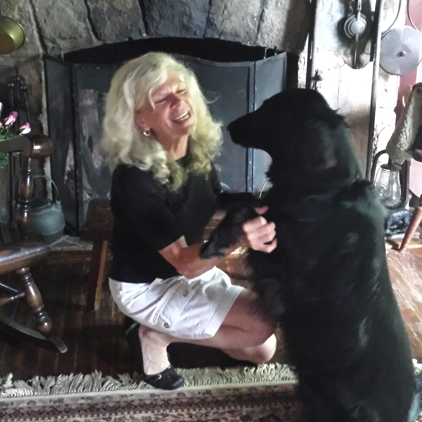
Patty Bailey
“From the moment we picked Bear up he was so full of love and compassion, we just had to share him with others,” says Bailey, of Sparta, New Jersey. “What we decided to do was very simple – bring Bear to hospitals and nursing homes to interact with children and seniors.”
Through Pass It Along, part of Points of Light’s HandsOn Network, Bailey would bring Bear to visit with folks of all ages in need of a little extra joy in their lives. Her favorite part was seeing faces light up and helping seniors remember their own pets from the past. Bear was so loved that he was voted Volunteer of the Month.
Bailey grew up in northern New Jersey and eventually became a schoolteacher. She taught elementary school for 30 years before retiring in 2001. In retirement, she still had lots of energy and wanted to get involved and help her community.
Along with her work for Pass It Along, she also volunteers at a local church soup kitchen and is a bell ringer for the Salvation Army.
For her volunteer work, Bailey was just honored recently as a Cabot Community Celebrity. Points of Light partnered with Cabot Creamery Cooperative this summer to recognize outstanding volunteers as Cabot Community Celebrities.
The farm families who own the cooperative are sending Bailey and other volunteers on a seven-day Caribbean cruise in November, to celebrate the volunteers’ contributions to communities across the country.
Bear has passed away but his spirit lives on through Jolly, a rescued flat-coated retriever and certified pet therapy dog that Bailey brings to those in need.
“I wanted to give back, share the love that I have for dogs,” Bailey says. “For the people in the nursing home, it’s their home, and bringing a smile to their face can help them get through the rough times.”
How an Earthquake Deepened My Commitment to Volunteer Service
This post is by Annette Sayre, a student at the University of Notre Dame. For seven years, she lived with her family in Japan, where she developed a love of volunteer service as a teen.
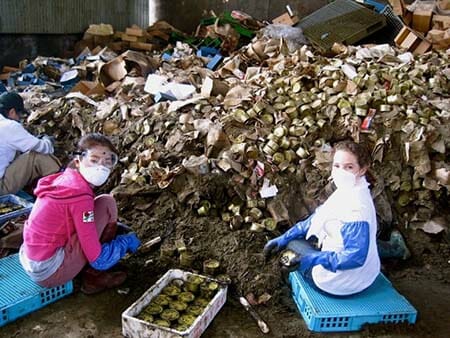
Annette Sayre, right, and another volunteer clean a fish canning warehouse after a tsunami in Japan.
Some volunteer experiences stay with you forever. Mine was in northern Japan, after a 9.0-magnitude earthquake.
March 11th, as the 2011 catastrophe is commonly known in Japan, profoundly affected the nation. Having suffered the massive earthquake, a consequent tsunami, seemingly perpetual aftershocks and a subsequent nuclear explosion in Fukushima, the Japanese people were undoubtedly united in suffering, but also in hope.
Immediately after the disaster struck, volunteers from HandsOn Tokyo – part of Points of Light’s HandsOn Network – were traveling north in buses to the devastated Tohoku region to offer their services. In June of that year I decided to go on one of the weekend Tohoku relief trips.
On the first day, our group arrived in the rice fields of Iwanuma to assist in debris cleaning. We cleared flooded homes of their furniture and valuables, discarding ruined technical equipment and soaked mattresses, and walked through flooded rice fields collecting debris that had settled on the grain.
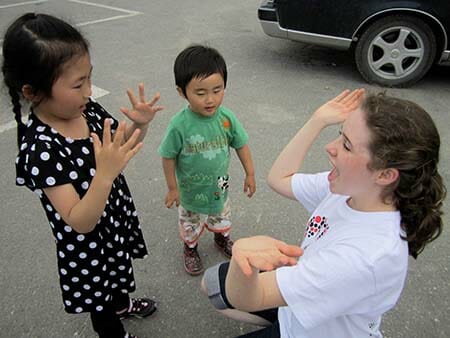
Annette Sayre, right, plays a traditional Japanese hand game called “Arupusu” with local children during a earthquake relief trip with HandsOn Tokyo.
We spent the night in Sendai, the nearest major city, and the following day we drove out to support the local residents of the severely ravaged area, Ishinomaki.
Roofs floating in the middle of the ocean, houses with broken windows jammed into gas stations and fishing boats lying sideways on main roads were a few of the images that struck me as our bus wound down a mountain to the coastal fishing city.
On the same ground that had once washed away thousands of lives, we set up our folding table and coffee maker next to a menu listing the baked goods we would be handing out at our little “cafe.”
People from the village formed two long lines to receive their share of fresh fruits and vegetables, which they had come to rely on from the HandsOn Tokyo volunteers’ weekly visits.
We then entered a crowded classroom in the refugee building on the highest hill in the area and played hand games and made crafts with children in desperate need of comfort during a traumatic and confusing period of their lives.
On the last day, we cleaned the remains of a fish canning warehouse, separating cans that were punctured and leaking from those that were still saleable.
I often think about my time in Tohoku, as it renewed my commitment to volunteer service. Wherever I call home, service will be a significant part of my life.
There are 250 HandsOn Network volunteer centers around the world. Click here to find one near you, or to search for local volunteer opportunities, visit AllforGood.org.
Teaching Children Around the World About Helping Others and the Power of Friendship
Showing that volunteering with friends and family can be lots of fun, parents and kids came together in Singapore last Saturday to do some good, while celebrating International Friendship Day.
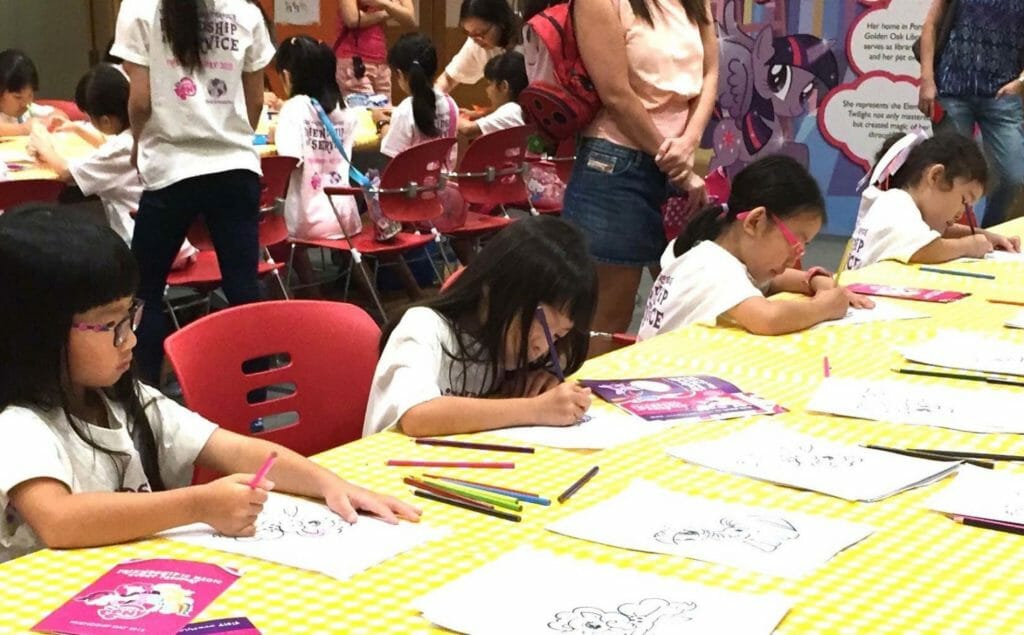
Girls take part in a drawing activity during an International Friendship Day event in Singapore.
– the youth division of Points of Light – have launched a global campaign to encourage kids to volunteer in their schools, neighborhoods and communities.
Find out how you can your kids can celebrate by visiting
characters to teach children about helping others and the power of friendship. Four international events are set to engage hundreds of children in volunteer activities inspired by each of the six main My Little Pony characters. The first event was Saturday’s Singapore gathering, which will be followed in the coming days by events in New York City, São Paulo and London.
In Singapore, about 150 children and parents came to the Lifelong Learning Institute. In the spirit of My Little Pony, the room was filled with the magic and power of friendship.
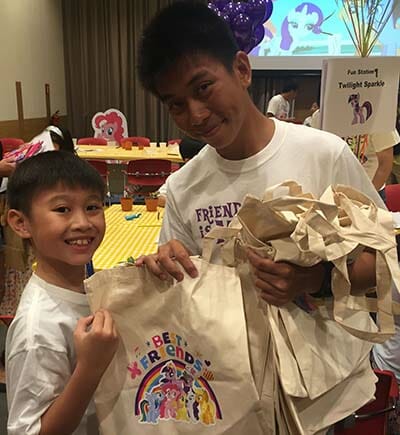
Singapore International Friendship Day volunteers left with smiles and goody bags.
Several volunteer stations were set up in a large room, each representing a My Little Pony character. At a Rainbow Dash station, kids put together “health and happiness kits” for the elderly; each kit included coffee, cookies, a toothbrush, toothpaste and more.
At a Pinkie Pie station, children decorated recycling bags that they could take home and pack with toys to donate to kids in need.
The event concluded with reflection and, in true Singapore style, a
makan
session (food with friends). Children and parents walked away with smiles on their faces and goody bags that included Play-Doh sculpture reminders to love and care for animals and plants to enhance the environment.
It was a wonderful way to celebrate International Friendship Day!
Giving Back Is a Responsibility and a Privilege for These Workers
Elaine came straight from her graveyard shift to do some good for her community. She joined a couple thousand of her co-workers from TELUS International Philippines to volunteer for Brigada Eskwela, an annual Philippine Department of Education program that invites volunteers to help maintain school buildings and create good learning environments for students.
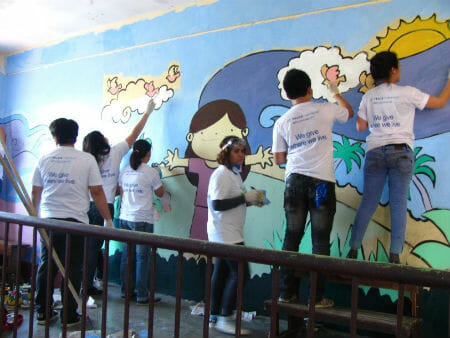
TELUS International Philippines volunteers paint a mural at a local school.
“I am grateful that I am here today; I also studied in a public school,” she said. “I’m happy that I am able to help the 50 students using the classroom we are repainting.”
TELUS International Philippines, one of the country’s pioneering companies in the global call center outsourcing and IT development industry, considers corporate social responsibility as the cornerstone of its culture. Its philosophy – “We give where we live” – is anchored on the premise that it is both a responsibility and a privilege to give back to the community.
For the past three years, TELUS has partnered with Hands On Manila to take part in Brigada Eskwela, in line with the company’s annual TELUS Days Of Giving. During those days, TELUS employees have opportunities to volunteer in community-building efforts.
This year’s Brigada Eskwela venue was Tenement Elementary School in Taguig City, in metro Manila. More than 2,000 TELUS employees who came to the May 16 event repainted 54 classrooms in four buildings, refurbished 2,000 chairs, painted 54 mini-fences and potted 600 ornamental plants.
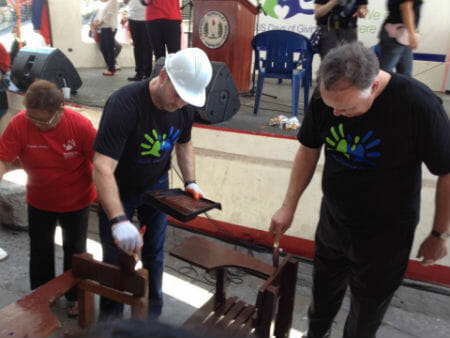
From left, Tenement Elementary School Principal Geronima Garcia, TELUS International President and CEO Jeff Puritt and Canadian Ambassador to the Philippines volunteer at Garcia’s school during Brigada Eskwela.
Some groups painted 12 murals along the school’s staircase and helped 50 kids participating in a hygiene workshop. On the same day, TELUS broke ground to start construction of a two-room kindergarten building the company is donating.
Hands On Manila, which brought 130 volunteer leaders to help manage the projects and volunteers at Tenement Elementary School, actively fosters volunteerism in the corporate world. The nonprofit – part of Points of Light’s HandsOn Network – has partnered with hundreds of corporations like TELUS, an average of 50 partners a year for community service in metro Manila and elsewhere around the country.
Events like Brigada Eskwela show the good that nonprofits and businesses can accomplish together.
As TELUS International President and CEO Jeff Puritt said, “In order to do well in business, you must do good in the communities where you work, live and serve.”
After the Baltimore Riots, Volunteers Have a Long-Term Role to Play
The recent riots in Baltimore – sparked by unrest over the death of Freddie Gray, a 25-year-old black man in police custody – brought out the worst and the best in the city’s people.
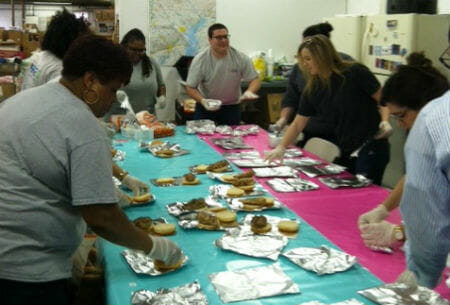
Volunteers from Business Volunteers Maryland help make sandwiches for people in West Baltimore through the Salvation Army’s FeedMore program, three days after the riots.
The day after rioters smashed windows, set fire to police vehicles and tore through businesses in the West Baltimore neighborhood, neighbors volunteered to help. They swept up broken glass, cleared debris and helped business owners clean up their stores.
That immediate outpouring from volunteers was heartwarming to see, says Kelly Hodge-Williams, executive director of Business Volunteers Maryland, but there’s more volunteers can do in the long term.
“Decades of systemic problems have led to two Baltimores,” Hodge-Williams says. One is poor and mostly African-American, with low-performing schools and high unemployment. The other is middle and upper class and more diverse, with better schools and more job opportunities.
Business Volunteers Maryland, part of Points of Light’s HandsOn Network, is exploring ways it can channel volunteer power toward addressing deep-seated problems that have plagued Baltimore – and other cities – for decades. The organization is focusing on four key issues: youth development, quality education, employment and services for those in poverty.
Kelly Hodge-Williams
“Our unique platform is that we mobilize human capital,” Hodge-Williams says of Business Volunteers Maryland. The nonprofit matches professionals skilled in such fields as marketing, human resources, finance and more with local nonprofits who need their volunteer services, in addition to connecting people with more traditional volunteer opportunities through its Volunteer Central website.
Hodge-Williams says that while direct-service, hands-on volunteers are essential in the ongoing cleanup and restoration of West Baltimore, “high-level thinking and talent” are also critical in the years to come. Such volunteers – whether they come through corporate employee volunteer programs or on their own – are able to help nonprofits develop and execute plans to better meet their missions.
On June 17, Business Volunteers Maryland will hold its annual doSOMETHING! for a Better Baltimore event, during which prospective volunteers can meet with representatives from a host of nonprofits. This year, given the recent violence on the streets, the event will host nonprofits that address youth development, education, employment and poverty.
A public-private partnership called One Baltimore launched this month to focus on the systemic problems facing the city. Business Volunteers Maryland is planning to be part of the initiative.
“We’re all at a point of trying to figure this out,” says Hodge-Williams, adding that her organization is planning regular meetings with corporations and businesses to determine the best ways to get their employees involved. “We see this as an opportunity.”
Where Some See Hopelessness, These Volunteers See Promise
Central America is one of the toughest regions in the world to be a child. Poverty, violence and lack of opportunity are prevalent. Access to quality health and education services is limited. Migration from the region separates family members, and child migrants face life-threatening journeys.
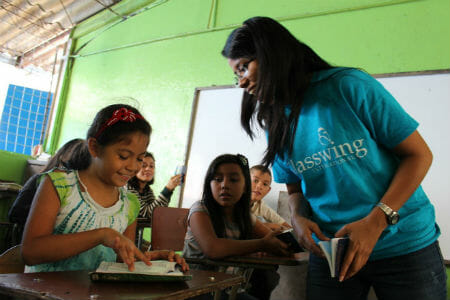
A Glasswing International volunteer teaches students during an after-school club at an El Salvador public school.
Despite these challenges, Glasswing International – part of Points of Light’s HandsOnNetwork – believes that Central America still holds the potential for great promise. The organization works to confront the obstacles its countries face in order to enable its children to thrive.
Since its founding in El Salvador in 2007, Glasswing has mobilized more than 85,000 corporate, community-based and medical volunteers. Through extreme school makeovers, after-school clubs, medical professional and first responder training, and community health projects, Glasswing volunteers have touched the lives of more than 600,000 people.
“Glasswing believes in strengthening communities’ existing resources, such as public schools, hospitals and health clinics rather than building anew,” said Celina de Sola, Glasswing’s co-founder and vice president of programs. “Through the organization, volunteers have an accessible way of making a huge impact on the lives of children and youth in the region.”
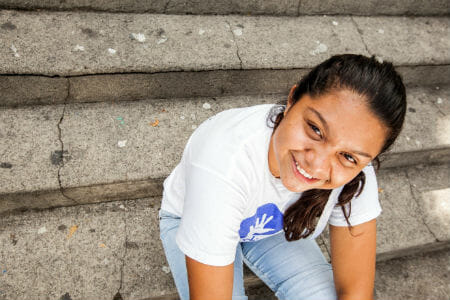
Ninth grader Claudia says participating in Glasswing International after-school clubs has helped her improve her attitude at school and better express herself socially.
Glasswing’s cross-sector approach forges partnerships with international and local governments, corporations, nonprofits and civil society. Although globally minded, the organization is locally driven, allowing the organization to design, implement and oversee all of its projects and accomplish more for less.
Some highlights:
More than 20,000 mothers and children have benefitted from Glasswing’s pediatric and community health services.
Volunteers have renovated more than 550 public schools, to help improve enrollment, retention and learning.
More than 22,000 young people participate in after-school clubs; 92 percent improved relationships with family and peers, 86 percent experienced improved self-esteem and 85 percent improved their grades.
Ninth grader Claudia – who started participating in Glasswing after-school clubs four years ago – is one such student. The 14-year-old grew up in the Las Palmas neighborhood of San Salvador, an area defined by poverty and violence.
“Growing up in Las Palmas was difficult,” Claudia says. “I was very combative with my teachers and didn’t do well in school.” Now she’s a member of several clubs, including the leadership, debate and girls’ clubs.
“Participating in these clubs has made a positive impact on my life,” Claudia says. “They have helped me improve my attitude in school, and better express myself socially.”
Currently, Glasswing has permanent programming in six countries in Central America and projects in an additional eight countries in Latin America and the Caribbean. In 2015, Glasswing was invited to join the Clinton Global Initiative, an program of the Clinton Foundation dedicated to helping its member organizations maximize their social impact.
Interested in finding out what you can do to help Glasswing and the people it serves? Please visit www.glasswing.org.
Here’s How We Prepared Communities for Disaster and How You Can Get Prepared, Too
America’s PrepareAthon! – a grassroots campaign to get more people prepared for disaster – urges all of us to take action to keep ourselves, our neighbors and our families safe. To support the campaign, throughout April Points of Light informed and equipped local communities to be able to more quickly respond to and recover from disaster.
Community members in Orange County, California, take part in a disaster simulation as part of OneOC’s America’s PrepareAthon! activities.
Members of Points of Light’s Community Emergency Preparedness Corps organized service projects and informational fairs to distribute preparedness information.
With the help of corps members, thousands of disaster preparedness kits were assembled and distributed in diverse locations, such as food pantries and senior centers, and preparedness scavenger hunts were conducted to engage youth in how to become better prepared.
Affiliates of Points of Light’s HandsOn Network participated in various ways. Here are some highlights:
The AmeriCorps member at OneOC distributed preparedness material during a beach cleanup in Orange County, California, and organized a mock disaster in the community.
AmeriCorps members at Metro Volunteers in Denver canvassed four apartment complexes over six days, distributing more than 560 information packets to senior, low-income and immigrant residents.
The Allstate Foundation, which is currently supporting a 14-city disaster preparedness tour with Points of Light, printed more than 100,000 preparedness brochures and information sheets to support the AmeriCorps members’ efforts.
To learn how to better prepare yourself and your family and to take the preparedness pledge, visit www.goodandready.org.