Looking for Femininity, Volunteers Unearth Stories of Strength
When 100 volunteers took to the streets of São Paulo, Brazil, to interview ordinary women, they found stories of courage, resilience and perseverance.
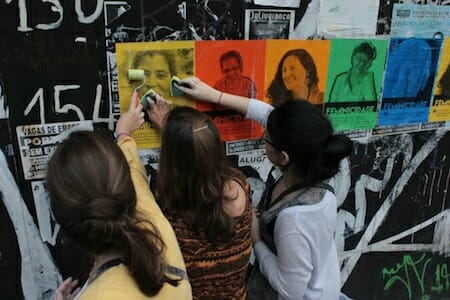
Volunteers hang fliers showcasing the FEMINICIDADE campaign.
Dona Francisca, a 57-year-old rural worker who used to “work like a man” in the crops told one volunteer: “My dream was to be a truck driver. My father would not let me. For him, it’s a man’s job. I think I will die without fulfilling my dream. When I talk to God I tell him that if one day I get my driver’s license I will be the happiest person in the world.”
The interviews for the recently completed volunteer project took place last month in celebration of International Women’s Day, March 8.
The objective: to recapture the original meaning of the day, which throughout the years has become more commercial.
With cameras and notebooks in hand, the volunteers fanned out across the city in search of stories that would inspire other women to continue the fight against oppression and for equal opportunity.
Many of the women shared their experiences of living in a male-dominated society, like 78-year-old Arlete Viera, who said:
“It is harder to be a woman when you don’t get to make choices about your life. Look at my brother. He was going to be a pastor, was prepared for that. He was the only one able to finish school. We all had to work, instead, and I ended up not being the great woman I wanted to be. I hope today girls will allow themselves to be different, so they can help us to rewrite this story.”
The volunteers, who interviewed about 50 women, reconvened at Roosevelt Square in the center of São Paulo to share the stories they heard, tell about their experiences and engage in meaningful conversations about such topics as religion and the role of the women in modern society.
“I hope we don’t stop here,” said volunteer Laleska Walver. “I hope this campaign will remind people that these conversations are not only necessary, they are urgent.”
are growing quiet. However, three students aren’t part of the stampede of their peers racing for the exits.
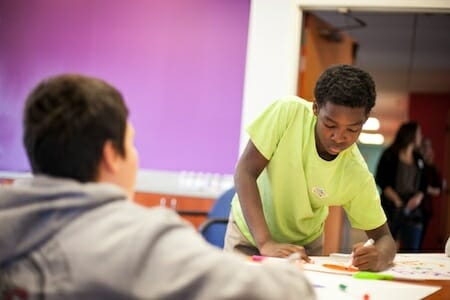
They’re in a classroom on the second floor, making phone calls to local business owners to enlist help in putting on a pancake breakfast for families staying at the
.
These are the students of United Way for Greater Austin’s Volunteer Project Leaders (VPL) program, and this isn’t their first rodeo.
The kids in the VPL program at Webb have been conducting volunteer projects to help out around their community since the program’s inception four years ago.
They’ve organized and led campus cleanups, campaigns to gather thank-you notes for school librarians, community needs assessments, and a host of other initiatives designed to encourage their classmates and neighbors to give back to their community.
While the idea of middle school students dedicating so much of their free time to philanthropic projects may seem extraordinary to many, it’s a no-brainer to the VPL kids.
“What would you do if you just saw someone throwing trash around your neighborhood?” says LaDascious, an eighth grader who’s been a part of the program since he arrived at Webb Middle School.
He’s just left a voicemail for a manager at
, a frequent United Way of Greater Austin collaborator, asking for pancake mix donations and any helping hands they could provide.
Kids in the program get many opportunities to practice this sort of outreach, helping them to develop a set of communication and leadership skills that will be useful to them throughout their lives.
LaDascious believes being part of this group has taught him to think about people other than himself. According to Nikki Krueger, United Way of Greater Austin’s director of volunteer engagement, who oversees the program, that’s exactly the point.
Krueger believes that by providing students with the tools they need to create positive change in their communities at an early age, they’re instilling a “philanthropic gene” that will last a lifetime – and it seems to be working.
Kids at each of the three VPL programs LaDascious’ sentiments. Chrishana, another program participant, said because of the program, she now “look[s] at the world with a different viewpoint.” Her classmate, Jaylon, agreed, stating, “It has taught me how to be a better person.”
In total, the three chapters have empowered about 150 students to better both themselves and their communities. That’s a lot of young philanthropists, and
.
It’s now 4:30 p.m. at Webb Middle School, and after a long day of classes the kids have hit their limit. They sprint out of the room and down the stairs with that boundless, restless energy unique to middle school students.
It’s an energy they bring to everything they do – including volunteering – and, thanks to the VPL program, it’s an energy that’s helping make Austin greater.
The Harrilal family loves volunteering, and volunteering loves them right back.
The family – and other dedicated volunteers – received surprise Valentines last week from staff members of the Florida nonprofit HandsOn Broward.
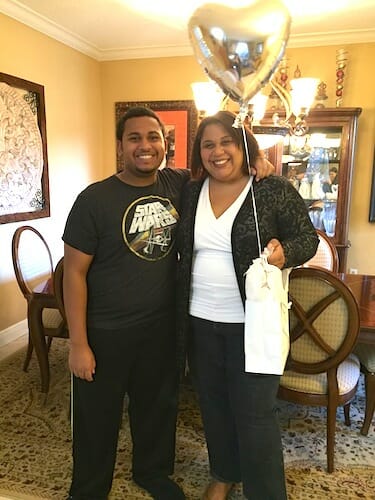
Justis and Paula Harrilal show their surprise Valentine’s Day gift from HandsOn Broward.
With balloons, candy and other goodies in hand, the staff members visited the homes, offices and nonprofit service sites of several of its most dedicated volunteers, including the Harrilals, who got a visit from HandsOn Broward’s director of youth programs, Melissa Sutliff.
“When we opened our door and saw Melissa’s smiling face on a cold winter morning – that enough would have warmed our hearts, much less the beautiful gift bag and balloon that she presented us with from the HandsOn Broward team,” said Paula Harrilal, of Miramar, Fla. “We love being part of their family and moments like this remind us how special they are.”
The Harrilal Family – Paula, Charles and Justis – participate in and help lead a variety of projects with HandsOn Broward, which provides opportunities to volunteer in Broward County, Fla. Justis is the founder of Team Justis, a group of volunteers who provide support to local nonprofit agencies that focus on the hungry and homeless.
HandsOn Broward’s show of appreciation continued from the city of Sunrise to Fort Lauderdale, as deliveries were made to 12 more volunteers who have spent countless hours providing support to projects that help strengthen communities and help local nonprofits provide services.
“We wanted to spend Valentine’s Day saying thanks to some of our volunteers who show great love for our communities,” said Dale Hirsch, president and CEO of HandsOn Broward, part of Points of Light’s HandsOn Network. “By contributing their time and talents, these volunteers are making a significant impact in the lives of others every day.”
Digital Connections Get Personal on These Special Days
Alex, a teen volunteer, regularly visits with Anne to help her stay digitally connected. Since her stroke, Anne has had difficulty remembering things, especially passwords for online accounts and her email. Alex shows her how to use the Reminder App on her iPhone, which provides an easy and convenient way for Anne to always have access to her passwords.
Young people and older adults benefit from volunteer projects that bring them together.
The YouthSERVE program at the Volunteer Center of Santa Cruz County, which connected Alex and Anne, recognizes that as “digital natives” young people are the perfect candidates for helping seniors learn how to better connect with online technology.
The program coordinates monthly technology workshops – Senior Tech Days – during which seniors are invited to drop in and receive one-on-one training with teen tutors. The workshops open the potentially daunting online world to seniors while giving youth a chance to practice communication and leadership skills.
“To me teaching is something that not only helps others but also is the best way for me to learn,” says Suresh, a youth volunteer and senior tech leader with the program. A senior who has participated in the program adds, “I am impressed with the youth, not only about their skills and knowledge, but also the politeness, patience, and respect and eagerness to help out.”
The Volunteer Center of Santa Cruz has expanded the program with the help of a JPMorgan Chase grant focused on innovation, which the center won at the 2014 Conference on Volunteering and Service.
Participants still bring in their own smartphones, tablets, laptops and even full desktop systems, but the center now has its own equipment, too. The center has been offering Senior Tech Days in four locations since 2011 and expects to expand to three more in 2015.
A new documentary demonstrates the possibilities such programs by focusing on a similar project called Cyber-Seniors. In 2009, high school students and sisters Macaulee and Kascha Cassaday started Cyber Seniors to help seniors learn how to use Facebook and Skype to reconnect with grandchildren. Participants demonstrate the ability to learn at any age. Teens and seniors become friends and partners. Youth begin to be lifelong leaders.
To learn more about Senior Tech Days check out the Volunteer Center of Santa Cruz County’s website. You can also request a screening of Cyber-Seniors and learn more about the movie here.
Fidelity’s School Transformation Days Breathe New Life Into Schools
Nicky Niewinski’s school was built in 1961 and looked like it.
With about 83 percent of her students qualifying for free or reduced-cost lunch, Niewinski worried the dated appearance could be sending the wrong message.
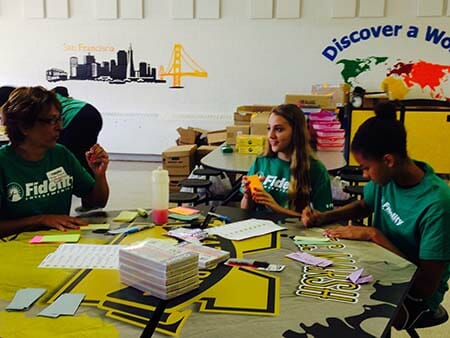
Fidelity employees and Marsh Preparatory School students put together financial literacy kits at the Dallas school during its School Transformation Day.
“I believe that perceptions influence behavior,” said Niewinski, principal of Marsh Preparatory School in Dallas. “One of the things I have wanted to do here – with help – was change the appearance of the building on the inside.”
Fortunately, help wasn’t far away.
Since 2010, Fidelity Investments, one of the world’s largest providers of financial services, has partnered with HandsOn Network by engaging thousands of employees, families and friends via Fidelity Cares – the company’s employee volunteer program, which, among other things, strives to revitalize the learning environments for students in need.
The mission of Fidelity Cares is to support a solid education foundation and reinforce or, in many cases, introduce financial education principles. This is often achieved through the projects implemented, whether creating financial literacy kits, hosting a STEM (Science Technology Engineering and Math) fair or designing or constructing a bucolic reading garden.
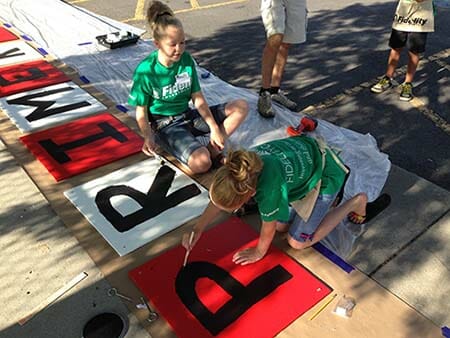
With help from Fidelity employees, students paint boards for a sign during School Transformation Day at Jackson Elementary School in Salt Lake City.
Affiliates of Points of Light’s HandsOn Network organize School Transformation Days, developing and managing the volunteer tasks and logistics for each daylong project. School Transformation Day has taken place at 23 schools across the country, reaching an estimated 35,000 students.
Nationwide, 81 percent of students graduate from high school with a regular high school diploma and more than 7,000 students drop out of school every day, according to the U.S. Department of Education. Nearly half of dropouts occur in the ninth grade.
School Transformation Day projects are identified through collaboration with a number of relevant stakeholders, such as school administrators, teachers, students, parents, civic leaders, Fidelity employees and HandsOn Network staffers. Projects are designed to enhance the learning environment, reinforce college messaging, support school needs, and encourage and inspire students.
School Transformation Days have become Fidelity’s largest annual employee volunteer effort.
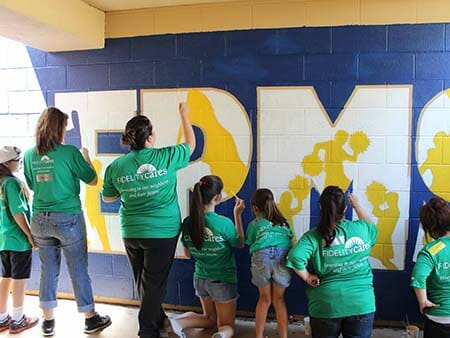
Fidelity volunteers and Ernie Pyle Middle School students paint a mural at the Albuquerque, N.M., school during its School Transformation Day.
“School Transformation Days are one of our most popular volunteer events, engaging thousands of employees to help thousands of students year after year.” said Gary Blank, senior vice president of regional public affairs and community relations. “There’s no other event like it where our employees can join together in such large groups and make an impact for students that they can see and feel at the end of the effort.”
Since its launch, the Fidelity Cares program has received positive feedback and praise from Fidelity employees, students, teachers, HandsOn Network affiliates and partners, along with recognition from local, state and national elected officials.
John Chickering has volunteered as both a participant and a leader for School Transformation Day since the project’s inception at two Rhode Island public schools in Providence and Pawtucket. His volunteer tasks have included building cabinetry, painting, assembling benches, removing safety hazards and even scraping bubble gum off the underside of classroom tables.
Volunteering “is just in my DNA,” said Chickering, who also participates in regular service projects through his church and with his family.
He’s drawn fulfillment from hearing teachers and principals talk about how valued the work has been by students. He has also enjoyed watching coworkers come together around their projects.
“Part of it is a chance to reinforce the working bonds I have with people that I have already established and the other is to build new connections,” he said. “There’s a personal development aspect to this.”
For Fidelity, proof of its popularity has been in the growing number of volunteers. Niewinski counted 100 volunteers at Marsh in 2013 and 250 volunteers last summer. They painted classrooms, offices and hallways and built outdoor benches around trees. Some Fidelity employees partnered with student volunteers to put together 1,200 financial literacy kits containing information such as how to start saving money and how to calculate interest.
School Transformation Days have done so well at Marsh, it has led to other projects. Fidelity has also invested in a new Lego robotics program at Marsh, supplying funding to help the school buy equipment.
“I don’t believe that would have happened had it had not been for School Transformation Days,” Niewinski said.
`A From-the-Top Type of Priority’ – Altria’s Volunteer Program Challenges Employees to Serve Their Communities
For an hour-and-a-half most Mondays, Debbie Colvin’s work schedule is full. That’s the block of time she spends with her “little” through
. “There is nothing more important than that child during that time each week, because they are not going to understand if [I] don’t show up,” says Colvin, a program manager at Altria.
Debbie Colvin, a program manager at Altria, participates in an Altria-sponsored volunteer project.
and a number of other nonprofits in the Richmond, Va., area. Colvin, like many other Altria employees, are allowed and encouraged to volunteer with local organizations throughout the year such as mentoring local middle school students through Big Brothers Big Sisters.
“One of the great things about working here at Altria is that the company supports our volunteerism,” says Colvin. “That makes it really nice and really easy for us to give back to our communities.”
Employees like Colvin are just one example of how Altria is able to give back to the communities where its employees call home.
Over the last decade, Altria, headquartered in Richmond, has given $1 billion in cash and in-kind contributions to hundreds of nonprofit organizations and supported hundreds of thousands of hours of volunteer service. Giving is mainly focused on the key areas of middle school-age youth and the goal to reduce underage tobacco use, the environment, civic engagement, and arts and culture.
An Altria employee, foreground, helps out at a company-sponsored volunteer service project.
Altria involves employees in volunteer efforts across the country through its partnership with the
, part of Points of Light.
In 2013, volunteer activities at the Altria family of companies generated more than 34,000 hours of service. Altria also matched more than $1.2 million in employees’ charitable contributions.
But volunteering at Altria is more than just allowed; it’s rewarded. In 2013, Altria sought to inspire greater participation by challenging various divisions across its family of companies to work together to better their best volunteer efforts.
Called the Volunteer Challenge, employees were encouraged to identify projects that aligned with their work – for example, engineers building a greenhouse for a community garden.
In one project, nearly 50 volunteers participated in a makeover of
, renovating the art courtyard and learning garden, creating murals on the library and cafeteria walls, and building a portable kiosk to serve as the school store.
Altria employees participate in a company-sponsored volunteer project.
During the Volunteer Challenge, nearly 5,000 employees contributed more than 30,000 hours of time in company-sponsored events. This represents a 90 percent increase in participation in volunteer efforts during the same period the prior year, growing from a 30 percent participation rate to a 57 percent participation rate.
Another result of the challenge was the creation of a Volunteer Council. The group represents leaders from across Altria’s divisions working to build on the volunteer program by raising awareness within the company, collecting stories from volunteers like Colvin to encourage others to get involved and sharing feedback with nonprofits.
“One of the big elements of the Volunteer Challenge was really raising awareness of telling a better story,” said Amber Roos, community relations manager at Altria. “We knew we had more people engaging in projects than we were talking about because they weren’t putting [their volunteer hours] in the volunteer management system.”
Recognition was key to the success of the challenge. At the end, individuals were honored during a lunch with executives followed by a volunteer event at a
, where participants built furniture, completed a makeover of the teen center and prepared the center for after-school programs, among other projects.
For Colvin, recognition recently came in the form of a Presidential Volunteer Service Award honoring her work at Big Brothers Big Sisters and numerous other company-sponsored and personal volunteer efforts.
“I’ve found that the more you give, the more you want to give,” she said. “It’s one of those things that no money could pay you what you get back here.”
“They are a vital, engaged, intentional partner in the community,” said Regais Wilson, corporate program manager at
, which helps about 500 nonprofit agencies in the community find volunteers. “They recognize it as a from-the-top type of priority companywide.”
In 2013, Altria partnered with HandsOn Greater Richmond for 23 projects between its service months of April to June and September to November. In one project, Altria provided $39,000 and 125 volunteers to make over the
. According to Wilson, “The money was used to pay for playground equipment and furniture for a new elementary school on the organization’s campus, as well as building renovations and maintenance projects.”
In addition to Altria’s volunteer and recognition programs, employees who volunteer more than 25 hours a year with an eligible nonprofit organization can earn a $500 grant for that organization through its Dollars for Doers program.
“They have some of the best volunteers I’ve ever come across,” Wilson said. “They’re excited about projects. If you put anything in front of them, they’re going to knock it out of the ballpark.”
Don’t Let Winter Volunteering Wane – Disaster Recovery Is Year-Round
After a disaster, all of us watch the news as people are airlifted from floodwaters and volunteers surge to provide shelter and food. But what happens when the media are gone and the communities are left with damaged homes and displaced citizens?
(Photo courtesy of FEMA)
Many of us do not consider that long-term recovery can be a process that lasts for years – or even decades – after the disaster strikes. Areas located in colder climates may experience surges of volunteers during the spring and summer and then struggle to meet the community’s needs for other seasons.
In 2013, Colorado experienced flooding that caused catastrophic damage across 200 miles affecting 17 counties. Fortunately, Denver’s Metro Volunteers, part of Points of Light’s HandsOn Network, was and continues to be there.
A year after the devastating floods, many residents are finally getting utilities restored and beginning to rebuild their homes.
Kristy Judd, executive director of Metro Volunteers, explains that long-term recovery requires strong partnerships – organizations working toward a common goal, as evidenced by the partnership between Metro Volunteers and the Long-Term Recovery Group of Northern Colorado – composed of more than 50 nonprofits, government agencies and faith-based groups.
“Collaboration and cooperation matter a great deal,” Judd said. “We have small communities with limited capacity to manage large scale disasters. Together, we’re stronger.”
As winter closes in, volunteering rates drop, although requests for assistance still come in daily.
Help those who need it most this winter season by volunteering. To find opportunities to support ongoing disaster recovery efforts, visit www.allforgood.org/disasters or contact your local volunteer center.
In Ferguson, Volunteering Strengthens the Community
For many Ferguson, Mo., residents living around the Canfield Green apartments, financial hardships and stress already were part of daily life. When the neighborhood experienced looting and civil unrest (after the Aug. 9 shooting of 18-year-old Michael Brown by a police officer), the struggling community was thrust into turmoil.
Carmie, a single mom who lives only a few blocks from the Ferguson police department, witnessed firsthand the fear and uncertainty that developed in her community.
“When everything happened we were stuck in our home. I saw people running down the street after looting and it felt like I was watching something on TV. It knocked the wind out of me because I was in a situation I couldn’t imagine,” Carmie said.
Besides forcing many people to take shelter in their homes in early August, the disruptions in the community took a toll on residents’ work and daily life.
Since Carmie’s daughters, only 6 and 7, could not attend school, Carmie was forced to miss work to care for them. A counselor who regularly made in-home visits to help her daughters cope with the death of their father also was unable to provide services during that time.
“I really tried to shield my girls from what was going on outside of our house. Everything felt so negative, and it was hard to protect them when we could hear people protesting at the police department and helicopters flying overheard,” Carmie said. “They were traumatized.”
Dealing with a community in upheaval only added to Carmie’s worries. Her income only barely covered the basics for her family. Behind on the gas and electric bills, she was unable to buy her girls school supplies and clothes.
“Sometimes you have to make hard decisions about where the money will go that month,” Carmie said.
During the events in Ferguson, United Way of Greater St. Louis
to provide a Community Resource Drop-in Center for Ferguson residents whose needs were exacerbated by what was happening in their neighborhood. After hearing about the drop-in center from a friend, Carmie visited and received help with her gas and electricity payments.
“I haven’t been able to pay off my entire gas bill for a year, so bringing my gas bill all the way to zero was a blessing. I was able to buy the necessary school supplies for my girls and now everything feels much more manageable,” Carmie said.
For five days, the drop-in center helped nearly 1,200 residents like Carmie from the affected area by providing hot meals, food staples, counseling, utility and rental assistance and respite activities for children. These resources were greatly needed by a community tragically thrust into the spotlight.
“There are a lot of people (in the area) going through things that people aren’t aware of,” Carmie said. “We don’t have access to a lot of resources. The drop-in center was truly a blessing for my family and a lot of my neighbors.”
After receiving help, Carmie got an email about volunteering at United Way 2-1-1 and St. Louis County’s Multi-Agency Resource Center (MARC) in mid-October. Developed to offer additional assistance to eligible Ferguson residents, the MARC represented the first portion of the work through the St. Louis County contract with United Way.
Since she no longer needed help, Carmie saw volunteering at the MARC as an opportunity to give back to an organization that helped her when she needed it most.
At the MARC, Carmie was tasked with handing out food tickets and gave up a Saturday to serve others in need in the area.
“Volunteering was well worth it,” Carmie said. “I didn’t require any help the second time, so it was awesome to be a part of serving people in my community.”
Top Five Resources for Volunteers Who Want to Create Projects
Whether you’re a budding or longtime volunteer, these resources can get you on your way to developing your own projects with your family, friends and neighbors. For a searchable list of volunteer resources, please visit the HandsOn Network Resource Library. And if you aren’t quite ready to start your own project, you can search for local opportunities on All For Good.
Volunteer With Your Family
What better way to teach your children the joy of helping others than through community service? If you’re a parent looking for family-friendly volunteer opportunities, generationOn’s Family Project Guide can help.
This step-by-step guide teaches you how to shape your family volunteer project as it evolves. By offering questions you discuss as a family, you can find service opportunities that mesh with everyone’s interests, ages and energy levels.
Organize a Food Drive
Imagine never knowing if, when or how you were going to get your next meal. For 45.3 million Americans, that is what life is like every day. There are ways you can help, including organizing a food drive in your community. See this guide.
Organizing a food drive is a manageable project for volunteer veterans and beginners alike. These comprehensive instructions map out the steps, including such essential questions as: Who will lead this project with you? And, how do you promote the food drive?
Organize a Disaster Kit
Preparing a disaster kit – ready to grab on the go – can lessen the fear, anxiety and losses that stem from a disaster. Organizing a disaster kit project in your community can help educate and prepare others in case disaster strikes.
You don’t have to be a disaster expert to organize a community-wide disaster kit project. With these guidelines, planning this project is straightforward and easy. Also check out Good & Ready for more tips and advice.
Become a Volunteer Leader
Sure, you care about the quality of your community, but what can you do to improve it? With the HandsOn! Volunteer Leader Guidebook, you can help lead volunteers in making positive change.
The guidebook walks you through how to successfully organize and lead a community service project. Equipped with tools and tips, including worksheets, the guidebook outlines how to develop, implement and wrap up a project in seven simple steps.
Tell Your Story
Gathering a strong and supportive team can be one of the most challenging aspects of a community service project. If you’re looking to educate, inspire and garner support, check out HandsOn Network’s Passion into Action: Telling Your Story.
The guide lists a wide range of ways to publicize your message, from posters to media campaigns to online social networks, and more. This resource also offers recommendations about marketing and provides tips on how to publicize your cause.
Days of Service Spark Commitment to Volunteering Among Belk Employees
Belk’s plan was ambitious – 125 days of volunteer service to celebrate the department store chain’s 125th anniversary.
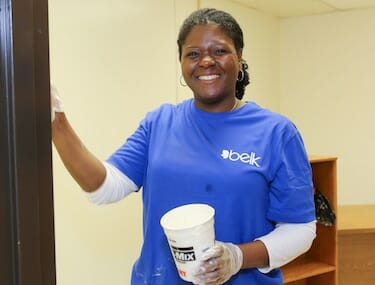
Nicole Dean, Belk’s vice president of internal audit, participates in a day of service at Reid Park Academy In Charlotte, N.C.
“Giving back to and being involved in our communities has been a part of our DNA since our founding in 1888,” said Jessica M. Graham, vice president of communications and community relations for Belk. “We have a rich history of supporting our local communities and of encouraging our associates to get involved.”
The 125 Days of Service events last year – 8,000 associates participating in 304 projects at schools in 16 states – helped deepen that commitment and forge relationships that have lasted beyond the endeavor.
The idea was “to not only do a one-day project, but to continue those ties after the 125 days were over,” said Eric Law, executive director of Hands On Charlotte. The organization, a local affiliate of Points of Light’s HandsOn Network in Belk’s North Carolina hometown, helped plan and carry out the 125 Days of Service program.
Hands On Charlotte helped identify schools that needed improvements and were near Belk stores, and they worked with principals to design projects that met the schools’ most pressing needs.
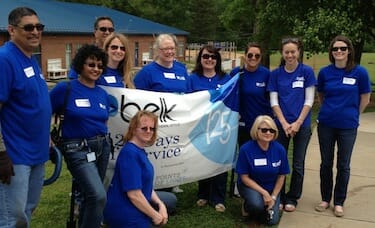
Belk volunteers gather for a day of service at Ashley Park PreK-8 School in Charlotte, N.C.
“What we were looking to do was to make it a better place to learn and a better place for teachers to do their jobs,” Law said.
Belk employees signed up for two-hour shifts to work at the schools, though some of them went back to help out on their own time, Law said.
The 125 Days of Service project was the catalyst for forging a deeper relationship between an Alabama school and the Volunteer Center of Morgan County, the local HandsOn Network affiliate, as well as solidifying the center’s ongoing relationship with Belk.
The center helped managers from the Decatur, Ala., Belk store plan their service day at Austinville Elementary School, where many students come from low-income households. Belk associates delivered 300 to 400 books they had collected during an in-store book drive. Employees built bookshelves and picnic tables and painted murals, among other projects at the school.
While the Belk employees worked, the children sang songs and started reading some of their new books. Some of the kids even helped employees build picnic tables.
As a result of that day of service, several of the employees remain involved with the Decatur schools, said Heidi Parkhurst, who was store manager of the Decatur Belk at that time.
“It just really inspired them to continue their volunteer work,” said Parkhurst, now store manager at a Huntsville, Ala., Belk.
The Belk event at Austinville Elementary led to an ongoing relationship between the school and the Volunteer Center of Morgan County that has encouraged children to volunteer. The students participated in a can-a-thon the center and Belk conduct each year, collecting food to be donated to a food bank, and have been involved in a community garden and a drive to get restaurants to donate leftovers.
Some of the students and their parents also attended a summit on childhood hunger that the center organized, and several have toured the center to see the operation first-hand, said Kay Woller, the center’s executive director.
As the work at Austinville Elementary has been so well received by the school, students and Belk associates, Belk asked the volunteer center to plan a similar day of service project for a Cullman, Ala., school, probably in January, Woller said.
Going forward, Belk is continuing to build on the relationships the company made during the 125 Days of Service. This fall, Belk associates learned more about developing and leading volunteer projects for their stores by participating a Points of Light volunteer leader training webinar. They also received tactical and practical tips through a new quick reference guide.
And, in early 2015, HandsOn Network affiliates will develop and manage school-based projects for Belk associates in five regions.
“This year we are implementing a fundraising campaign during the holiday season that will benefit local schools in all of our markets – many of the same schools that we partnered with last year,” Graham said, adding that the department store chain this year launched a tracking program, Belk Associates Give, to keep up with volunteer work by its employees.
Law, of HandsOn Charlotte, said that when Belk employees give their time, even for just a day, it matters: “A lot can be done in a one-day service project.”