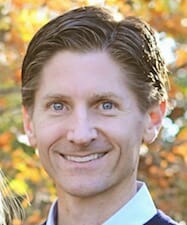
This post is by Gared Jones, vice president of global service at Points of Light.
Gared Jones
I arrived in Lagos a few weeks ago as part of Points of Light’s partnership to support GE Garages Nigeria, an initiative through which GE is using the leading edge of its business – principles of open innovation and technologies in advanced manufacturing – to spur job growth and build entrepreneurship in Nigeria.
The launch platform in which I participated was a pop-up, three-week innovation and manufacturing center where aspiring makers, entrepreneurs and students could go to develop new skills and learn about advanced manufacturing technologies.
Points of Light’s job is to help connect the volunteer skills, talent, leadership, innovation and compassion of GE employees to the development of the power-sector workforce and the growing number of tech manufacturing entrepreneurs in the country.
GE understands that building Nigeria’s human capital will be critical to solving the near 25,000 megawatt shortfall of power generation capacity in its recently privatized power generation sector – a critical issue that GE has also committed to address.
The last time I was in Africa was nearly 15 years ago when I was working for Deloitte as a strategy consultant in the energy sector. It was there that my passion for volunteering took root through a connection I made with Paradise for Street Kids, a shelter for 120 boys ages 4-18 in the heart of Johannesburg, South Africa. I helped with math and English homework, got other colleagues involved and adopted a “little brother,” Tinashe, who is still part of my family today. It is uncanny how life has brought me full circle.
During the week I spent as part of the Nigerian Garage, I was privileged to witness the powerful beginnings of a social change initiative that exemplified the best of what companies can do to address broader social issues where they do business.
GE Power & Water executives met with government ministers and business partners to discuss their shared commitment to building both infrastructure and human capacity in the country. Tech entrepreneurs and angel investors met within the Garages space to develop strategies for catalyzing startup growth with the support of GE resources.
Leaders from one of Nigeria’s top technical institutes and Dangote Foundation formulated plans with GE for the long-term skills-building initiative that the three-week Garage will launch. And school children designed a lighter-weight prototype for a generator they had created that converts urine to power. They also prototyped easy-to-make tiaras.
All the while, GE field engineers, operations managers, power generation salespeople, and HR and finance professionals worked on plans to engage the skills and passion of GE volunteers, 300 strong in Nigeria and 118,000 strong around the world, to improve the lives and capabilities of the mechanical and electrical engineering trainees, tech entrepreneurs and students.
The currency across all of these connections – and something that had not been known to me – was how quickly Nigerian people are to laugh. Many times throughout the days, ebullient outbursts drowned out the noise of the manufacturing equipment.
It’s clear to me that there is a lot of work to be done. It’s also clear that there is excitement, creativity, passion and laughter – in equal measure – to sustain this effort along the way and to ensure its success.
Where Can Volunteers Do the Most Good?
This post is by Gary Bagley, executive director of New York Cares – an affiliate of HandsOn Network and Points of Light. He provides a great example of how a volunteer action center strengthens local volunteer engagement. For more about HandsOn Network and local volunteer action centers, go to www.handsonnetwork.org.
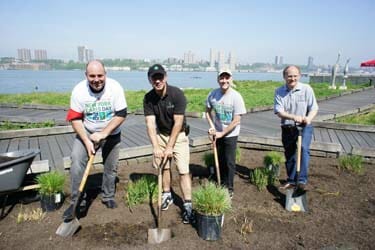
Gary Bagley, second from right, works with volunteers on revitalizing Riverside Park on New York Cares Day.
Since the report in February that volunteering numbers are down in the U.S., I have spent much of my time telling well-meaning people poised to make a call to service to please put down the bullhorn. A call to service is important, but a greater problem needs to be addressed first – improving the ability of nonprofits, schools and community groups to use volunteers strategically to drive impact.
At New York Cares, we think of volunteers as employees who get “paid” with something other than money. That “something else” may be different for each of us. Regardless, the same tenets that make for top-notch HR practices hold true for volunteer management. If a business mismanages its employees, it will lose them. New York Cares was founded in 1987, expressly because so many schools and nonprofits lack staff, money and know-how to use volunteers effectively, if at all.
Our strategies are twofold:
We provide free volunteer management to our Community Partners, allowing them to outsource their volunteer needs to us, at no cost to them or their clients. We have full-time staff who manage every program detail. They diagnose community partner needs, develop programs, create curricula, buy supplies and recruit and train volunteers and volunteer leaders.
We also train Community Partners to grow programs by leveraging volunteers. In 2012, we launched our Volunteer Impact Program (VIP) to go beyond our outsourcing model. During the three-year pilot phase, we developed multiyear volunteer management plans with 15 Community Partners and provided ongoing training and staff support for achieving the goals. The results were dramatic. Our VIP participants from year one had a 138 percent increase in the number of volunteer projects, compared to a 29 percent increase in nonparticipating Community Partners. We are committed to scaling up our VIP work by expanding to more nonprofits through a combination of training and consulting services with New York Cares. These VIP results reaffirm our belief that the question is not whether volunteers are willing and available, but rather, how to better prepare organizations to use volunteers well.
By the way, the numbers may be down nationally, but this is not the case at New York Cares. We orient approximately 18,000 new volunteers annually, and this number is holding strong. Thank you to all of New York Cares’ volunteers, current and future, who are committed to making NYC a better place to live for all New Yorkers.
If you would like to read more of my musings, go here or follow me on Twitter at @GBagley_NYCares.
One Person Changed His Life, Now He Wants to Be That One for Others
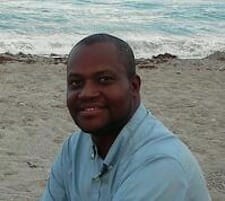
Meet Sherman Williams, a volunteer at HandsOn Broward – part of Points of Light’s HandsOn Network of 250 volunteer centers. Williams is using his expertise in business to help people from low- and moderate-income households achieve financial stability.
Sherman Williams
As a teenager, Sherman Williams experienced the powerful difference one person could make in someone’s life. A native Trinidadian, he had moved to the United Sates when he was 5.
“Early on, the motivation to adapt to the American culture was a priority,” Williams says.
But adapting was difficult. Teased for his accent, he became a quiet boy who noticed everything but said little. That changed in the eighth grade, when Williams wrote an essay about homelessness and the environment.
“Back home [in Trinidad], homeless people were everywhere,” Williams says. “Then I saw them in the United States and I made the connection that homelessness was a serious issue.”
Williams’ heartfelt writing won him first place in the contest and earned him a spot in the oratory contest that followed. Having never given a speech, and self-conscious of his accent, Williams was dismayed. But a dedicated teacher stepped in to help. She coached him daily, working with him on projecting his voice and slowing down his speech.
“I took her teaching to heart,” Williams says.
Under the teacher’s guidance, Williams practiced diligently and won third place in the districtwide competition. “That was a life-changing experience for me,” he says. “The event gave me the confidence to be whoever I wanted to become. It was an empowering moment in my life.”
Williams wanted to help others feel that same empowerment. Inspired in part by Dr. Martin Luther King, Jr. and the power of one, he began to volunteer here and there. President Obama’s call to service, however, was the final impetus Williams needed to become a committed volunteer. In 2011, he signed up with HandsOn Broward and has been actively engaged ever since.
When Williams learned about the Financial Opportunity Corps – a partnership between Points of Light, Bank of America and the Corporation for National and Community Service – he quickly signed up for the first volunteer orientation and training. The program recruits and trains volunteers as financial coaches who help people from low- and moderate-income households get their finances on track.
Williams, who holds a bachelor’s degree in business management and an MBA, felt he could use his business background and speaking skills to benefit the program, run locally by HandsOn Broward.
“I chose (the Financial Opportunity Corps) because the information it offers is basic but is widely overlooked,” Williams says. “It can make positive impact in communities. … On my path, it took only one person to bring change, the proverbial power of one. Now I can empower others to make positive financial decisions.”
Creativity Pays Off for Innovative Nonprofit Programs
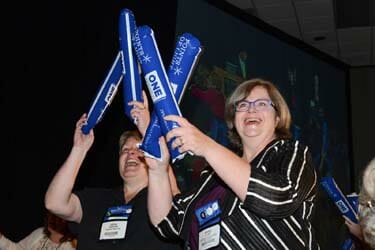
With spectators clapping blue thunder sticks together, jumping out of their seats, cheering for their favorite teams, the gathering looked more like a pep rally than a bid for nonprofit grants.
Zelda Magnuson, left, and Karen Delaney cheer at the forum with thunder sticks.
The pitches fueled the excitement – four innovative programs attracting volunteers and serving communities in creative ways.
At the
JPMorgan Chase and Points of Light have a history of collaborating to find new ways to support and facilitate volunteer service. At last year’s Conference, they kicked off a nationwide
tour focused on uniting unlikely allies to help students succeed, alleviate hunger and improve the environment.
The innovation and social impact forum at this year’s Conference – a celebration of the One America campaign – gave HandsOn Network affiliates a chance to showcase how they are uniting people through service for good.
The innovation forum judges confer to decide which organization will receive the $50,000 grant.
“One America really represents what we’re here at this Conference to talk about: Service unites,” said Points of Light Chairman Neil Bush.
Lois Backon, head of corporate partner marketing for JPMorgan Chase, welcomed forum attendees on behalf of the 250,000 JPMorgan Chase employees who have themselves logged more than 1.5 million hours of volunteer service over the past four years, including 56,000 skills-based hours in 2013 alone.
Backon said the forum was a great opportunity for JPMorgan Chase to combine two core values: service and innovation. “JPMorgan Chase is committed to investing in service innovation,” she said. “We know that when we harness what our best and brightest have to offer, we can make a tangible difference in every local community we touch.”
Then it was pitch time.
Brian Williams, center, of Hands On Nashville receives words of congratulations after the forum.
The four competing nonprofits – part of Points of Light’s HandsOn Network of 250 volunteer centers – showed video presentations of their work and answered questions from a panel of judges. The panel picked which organization would take the top grant of $50,000, included Lamman Rucker from “Tyler Perry’s Meet the Browns”;
came out on top for its work mobilizing volunteers to make homes in low-income neighborhoods more energy efficient, saving homeowners as much as $500 a year on their utility bills.
Hands On Nashville launched the program in the wake of the city’s historic flooding in 2010. Since then, nearly 1,000 volunteers have repaired 311 homes, including 156 damaged by the flooding. Volunteers install attic insulation, replace traditional light bulbs with compact fluorescent bulbs and more.
Brian Williams, president and CEO of Hands On Nashville, said the $50,000 grant will allow his organization to add program components that will further reduce energy consumption and engage donors in ways Hands On Nashville hasn’t done before. Hands On Nashville can also use the funds to start working with the city of Nashville to “expand service in a very thoughtful way and within a much quicker timeline than we imagined.”
Each of the three runners-up took home $15,000 to invest in their own innovative programs:
Volunteer Center of Santa Cruz (California) Senior Tech Day – a program that invites teen volunteers to help seniors navigate the digital age by teaching them how to use e-mail, how to view and share photos electronically and more.
HandsOn Twin Cities (Minnesota) Skills-Based Summit – an event that brings together skills-based volunteers who facilitate workshops exploring topics from marketing and social media to leadership development and finance.
HandsOn Genesee (Michigan) Community Service for Success – a three-week program that connects clients receiving cash assistance from the state of Michigan with volunteer opportunities that help sharpen life and job skills.
Emily Gilliland, HandsOn Network’s executive director, said the programs featured at the forum reflect the creativity, commitment and passion of HandsOn Network affiliates across the country.
“They have perspective and vision about what is needed and how to get it done,” Gilliland said. “And they each are doing it in unique, creative, incredible ways that are inspiring their communities.”
The grant program, which Backon called an extension of JPMorgan Chase’s “commitment to innovation and to helping communities and cities thrive,” is the kind of support that Williams said helps service organizations have a greater impact.
“JPMorgan Chase encourages organizations to be very thoughtful about their programming and then they reward those organizations for doing so,” Williams said. “It’s a very productive path for donors to take.”
Are You Part of the Unprepared 85 Percent?
Read about how folks in Tampa, Fla., Indianapolis and Baton Rouge, La., are preparing for disaster. To help your family take action, visit Good & Ready, where you’ll learn how to create a disaster plan, build a preparedness kit and more.
Kevin Sloan, center, and one of his sons receive a disaster preparedness kit in Tampa, Fla.
Charley, Frances, Ivan, Jeanne. Anyone who lived in the Tampa Bay area in 2004 remembers them well – the four hurricanes that battered Florida in less than six weeks.
Luckily the area was mostly spared, suffering power outages and some flooding. Those who moved to the area in the last decade have no memory of the constant hurricane watches and warnings that left people on edge for weeks. And even many who lived in the area during the storms have let their guards down.
“We want to engage people to get them to think about a hurricane,” says Gus Rodriguez, an Allstate insurance agency owner in Belleair Bluffs, Fla. “Everybody’s complacent. We live in hurricane alley.”
Rodriguez was one of the Allstate agents taking part in a disaster preparedness event last Saturday before a Tampa Bay Storm arena football game. The event was part of a public awareness campaign and 14-city tour brought to town by the Allstate Foundation and Points of Light. On the same day, the tour also stopped in Indianapolis at PBS KIDS in the Park and Baton Rouge, La., at the Mall of Louisiana.
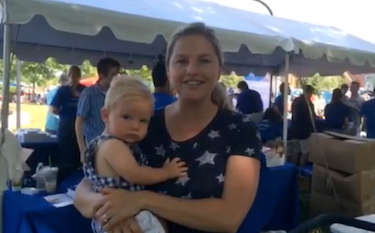
Sheila Ungerer of Indianapolis, holding her son Will, shares what she learned during a disaster preparedness event.
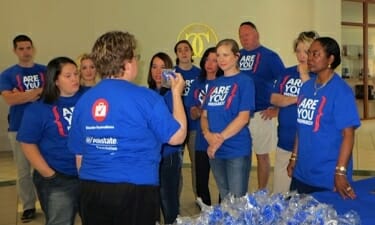
During the events, with the help of volunteers from Allstate and local affiliates of Points of Light’s HandsOn Network, participants assembled their own disaster preparedness kits using items provided.
In blue sacks, the kits included water bottles, hand-powered flashlights that don’t require batteries and other essentials. Participants and volunteers put together more than 2,000 kits at the three events combined.
“Eighty-five percent of us are not prepared for disaster,” said Ranj Puthran, an Allstate agent from Carmel, Ind., who volunteered at the Indianapolis event. “We’re so comfortable, and our first responders are so good, that I think we’re almost lulled into comfortableness instead of preparedness. We need to take more initiative.” (See a short video of Puthran here.)
The Indianapolis tour stop had special meaning for Emily Gilliland, executive director of HandsOn Network. An Indiana native, she has lived through two tornadoes.
“In 1979 I remember being at my grandmother’s house in Westport, Ind., and saw a tornado coming down the street,” Gilliland said. “My aunt’s house, halfway down the block, was hit. The roof was taken off.” (See a short video of Gilliland here.)
Baton Rouge, La., volunteers are briefed on how to assemble disaster preparedness kits.
As Gilliland spoke, people were lining up behind a row of tables at the Allstate booth, waiting to assemble their free preparedness kits. As they picked up the items volunteers explained the significance of each in an emergency situation.
The kits also included cards about tornado safety and other information, such as the need to have enough supplies on hand for at least three days in case of an emergency or disaster. Basic supplies include a gallon of water per person and non-perishable, easy-to-prepare food.
Sheila Ungerer, who moved to Indianapolis four years ago, learned at the event in her city about each of the items in her new disaster kit, which included a whistle.
“I’m from Virginia and my husband is from Syracuse, N.Y., and we know that tornadoes can happen here,” said Ungerer. “I came away with some good tips. I didn’t know about the whistle – that three short bursts means `help.’ That’s not only good for me, but good in case I ever hear it.”
Having a kit is only part of being prepared, the participating Allstate agents in all three cities said. Also having an emergency plan in place is critical. If your town imposed an evacuation order, would your family know what to do?
“Education is a part of planning,” said Baton Rouge volunteer and Allstate agent Agnes Andrews. “Education will take care of a lot of the problems that could occur in a disaster, because if you have things in order, you’re less likely to have problems.”
Along with emergency kits, “be sure to include some cash, not to be touched except in the event of a catastrophe like a hurricane,” Andrews added.
Beth Dudley of Natchez, La., was visiting the mall on the day of the Baton Rouge event. “I stopped by to get a kit,” she said, “because you can never be too prepared for an emergency. I’ve never experienced a natural disaster, so it’s great that this event provides all the basic things people might need.”
Meet These Heroes, and Create the Next Generation
This post is by Tracy Hoover, president of Points of Light.
Kellon Oldenettel
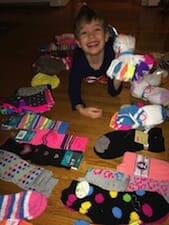
At age 5, Illinois’ Kellon Oldenettel has already tapped into his power to spark change.
As a 3-year-old, he participated in a neighborhood clean-up project with his family. Last Christmas, when Kellon began to understand that some kids don’t get holiday presents, he asked his mom what else kids are missing.
She talked about kids without homes and enough food to eat. “Does that mean they don’t have socks?” Kellon asked. When he got his answer, Kellon set out to collect and donate socks for children and adults in his community. So far, he’s donated more than 1,200 new pairs to people who need them.
Kellon’s story shows that kids are never too young to serve – and to lead. They bring fresh perspective, new tactics and renewed energy to the world of volunteer service. They create real change, and while they’re at it, they inspire their friends and the rest of us to join them.
Each year, Hasbro and generationOn – Points of Light’s youth service enterprise – gather to honor young people who are making a difference. Last week in New York City, Paula Abdul and Olympic medalists Shannon Bahrke and Billy Demong presented the 2014 Hasbro Community Action Hero award to Kellon and five other change-agents. I hope you’ll take a minute to read their amazing stories here.
When I had the chance to talk to Kellon and the other action heroes, I was struck by how clearly they see the ways that volunteering changes people and changes the world. I think Kellon summed it up best when he said, “When you are nice, other people might be nice back, and then maybe they will do something nice for other people.”
Kellon’s mom helped him turn community observations and an instinct to help into an action plan. Here’s how you can be a partner to the young people in your life:
Find volunteer projects families can do together at All for Good.
Encourage kids to join the hundreds of thousands of other young people who making a mark on the world through generationOn.
I’m inspired by the vision and drive of these young change-makers. They bring their time, talents, families, friends and resources to causes they care about most.
This post is by Eric Nankervis, program manager of disaster services at Points of Light.
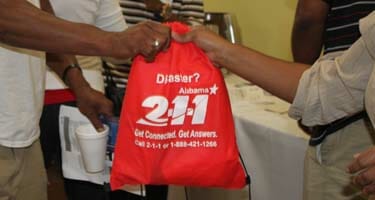
Izola Nichols tells her story during last Saturday’s disaster preparedness event in Birmingham, Ala.
As Izola Nichols stood in her house, floodwater rising up her calves, she remembered the words she heard during a preparedness training session two weeks prior: “Grab your medicines and prescriptions. Get your purse and passwords. Grab your evacuation kit and a change of clothes. And get out!”
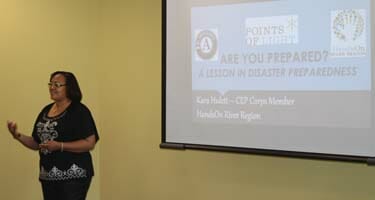
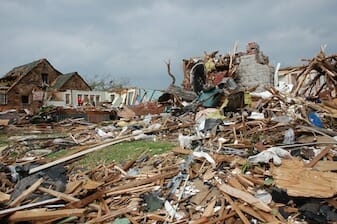
The training was one of a series led by Kara Hulett, a Points of Light Community Emergency Preparedness Corps member, in the Pratt City neighborhood of Birmingham, Ala. No stranger to disasters, Pratt City was devastated by tornadoes on April 27, 2011. Hulett’s presentation focused on tornado awareness and safety, but as Nichols witnessed, one needs to be prepared for anything, at any time.
“I knew the hazards of a tornado,” Nichols recalled, “but was I prepared for a flood?”
She had stayed up all night with her husband, a local pastor, watching the weather and monitoring for signs of a tornado. Only after the storm blew over did they get to sleep. At 4 in the morning the pastor was awakened by a strange noise. As he got out of bed to investigate, his feet hit water.
Birmingham, Ala., Mayor William Bell talks about the importance of preparing for disaster.
The April 7 storm flooded the nearby creek and water was gurgling through the home’s floorboards. He went outside and witnessed the water continuing to rise – off of the front steps the water was up to his waist.
The pastor waded through the rising water to get the family’s small boat as Nichols gathered their supplies. “You prepare for one hazard, and forget there are others,” she said. “But I knew what to get. There are only a few things you can grab and you only have a few precious minutes.”
Nichols credits Hullett’s presentation for helping her family prepare for the flood. The training Hullett offered is part of her service as an AmeriCorps member. Serving at HandsOn River Region in Montgomery, Ala., Hulett had partnered with Birmingham City Council member Marcus Lundy and Hands On Birmingham to better prepare the citizens of Pratt City in the event of another disaster. (HandsOn River Region and HandsOn Birmingham are part of the Points of Light’s HandsOn Network.)
“Storms in life do come,” said Lundy. “How you prepare is what is important.”
Birmingham, Ala., residents receive disaster preparedness kits at last Saturday’s event.
Since the 2011 tornadoes, Pratt City has been rebuilt with new homes with storm cellars and new infrastructure, including a new library and fire station. Yet more than a third of the residents did not return.
“The majority of the people have hung in here. They have endured,” Lundy said. “And these trainings cannot be more important. “
The Nichols family’s story proves it. Nichols and her husband were able to take their son, their dog, a few precious belongings, a disaster kit and what they learned at the preparedness training to evacuate their house safely. Lundy invited Nichols to share her story last Saturday at another disaster preparedness training session, as a part of a tornado memorial day in Pratt City.
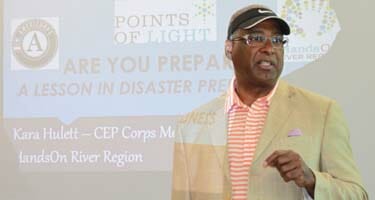
With basic disaster kits provided by Lundy, HandsOn River Region and HandsOn Birmingham – all assembled by local schoolchildren – the training session was kicked off with welcoming remarks by Birmingham Mayor William Bell, who praised the timing of the training and warned residents of the potential of tornadoes that followed earlier this week.
Fortunately, Pratt City was spared this time but its citizens are ready. “Being prepared on the top end is vital,” Nichols told those at the training event, again led by Hulett. “You will learn what you need to get, and when you need to get out.” And sometimes, that is just in time.
The Community Emergency Preparedness Corps is an AmeriCorps program implemented by Points of Light, with funding from The UPS Foundation and the Corporation for National and Community Service. With 22 members serving in 13 sites across the United States, the program helps Americans better prepare for and recover from disasters.
Here’s How You Can Help Tornado Victims
Beginning on April 27, a dangerous storm system sparked a series of tornadoes causing extensive damage and power outages across the central and southeastern United States. The severe storm threat continues as the storm systems move east.
Points of Light’s HandsOn Network is the expert in volunteer engagement and our affiliates often lead their local communities in managing spontaneous, unaffiliated volunteers throughout response and recovery efforts. Points of Light is coordinating with HandsOn Network affiliates in the affected areas and connecting with Voluntary Organizations Active in Disaster (VOAD) chapters across the U.S. to assess the situation and offer support.
If you would like to support the recovery effort, here’s what you can do to help:
PLEASE DON’T:
Don’t self-deploy at this time. The situation is still critical and travel is extremely difficult or impossible throughout much of the affected area.
Don’t bring supplies or donations to fire stations, police departments, etc. First responders need to focus on immediate needs and emergency situations.
PLEASE DO:
Do donate to help Points of Light and HandsOn Network affiliates support the mobilization of volunteers in ongoing response and recovery efforts.
Do register your interest to volunteer on All for Good and check this page often for the latest updates on how you can help. (For Alabama, Mississippi and Arkansas, include the words “spring 2014 tornados” in the Volunteer Opportunity Name. For Alabama coastal and Florida coastal responses you should include the words “spring 2014 flood” in the Volunteer Opportunity Name.)
Do be prepared! As the devastation caused by these tornadoes reminds us, disasters can happen anytime, anywhere. Please take steps now to help your family and community recover more quickly from disasters. Visit www.goodandready.org/resources to download an emergency preparedness checklist and create a disaster readiness plan for your family.
Would You Do This to Help Your Neighbors?
As snowstorms give way to spring showers, we give thanks to those who stepped up during the rough winter season – like the volunteers of Serve Rhode Island.
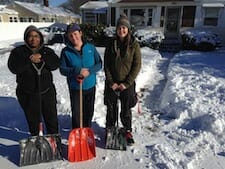
East Bay Community Action AmeriCorps members, shown here, were among the volunteers who responded to Serve Rhode Island’s call for volunteers to shovel snow.
In response to several snowstorms in the area, the Providence-based volunteer center, dispatched hundreds of volunteers to shovel sidewalks and driveways at residences of the elderly and the disabled. During the past two winters, volunteers have helped at 500 residences.
“Shoveling a driveway seems so simple, but to seniors, elderly and disabled folks it impacts their ability to get medical care, go to doctors’ appointments and get food delivered,” says Marisa Petreccia, director of operations at Serve Rhode Island. “So from our vantage point we are making sure that their basic needs are still being met in times of disaster.”
The snow-shoveling program began in February 2013 when Serve Rhode Island recognized there was no statewide or community effort to help residents clear the snow from around their homes.
Serve Rhode Island, part of Points of Light’s HandsOn Network, contacts residents to assess what kind of help they need. Homes are then posted as assignments volunteers can sign up for online. The volunteers – community members, neighbors and AmeriCorps members – are enthusiastic about the work.
William Volpe, a teacher and counselor from Central Falls, R.I., helped shovel out 10 residents during the winter.
“When I helped out during Winter Storm Hercules, not only did I get to help elderly and disabled residents in my neighborhood, but I also enjoyed my time and was able to get some great exercise,” says Volpe. “Giving back is certainly a way to show my gratitude to the many elderly and disabled residents who have given much to the community.”
Petreccia says the volunteers generally share that sentiment: “There’s a growing aging population in our state and so I think many of the volunteers are paying it forward by helping their neighbors and with the idea that, ‘I hope this program continues so that if I am ever in this situation I will also have the resources.’”
Debra Garrett’s house went green, but she didn’t have to spend any green. Thanks to Hands On Nashville, Garrett’s home has new lights, water filters, thermostats, smoke detectors, and a new showerhead and fire extinguisher.
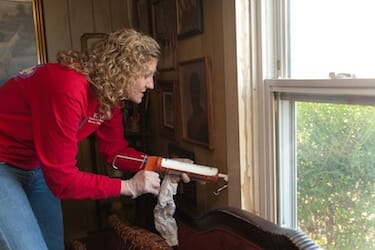
A Hands On Nashville volunteer fixes a window pane in an old home.
Garrett is one of 160 homeowners to benefit from Hands On Nashville’s Home Energy Savings Program since 2011. The program engages volunteers to make energy and safety improvements at no cost for qualifying low-income Nashville residents.
“I really appreciate everything they have done to my home,” Garrett says. “I did not realize how important these improvements could be for me, and the volunteers were absolutely wonderful to work with.”
The Home Energy Savings Program is funded by the profits of Go Green Home Services, which provides high-quality home energy improvements for an affordable fee. The socially responsible business is a joint venture of Hands On Nashville and Nashville residential real estate firm Village Real Estate Services.
The Home Energy Savings Program has three key goals: decrease low-income homeowners’ utility bills, decrease energy consumption in the area with sustainable improvements and engage community volunteers in service.
The program has saved each homeowner an average of 16 percent – or $600 – a year on their utility bills. For low-income households, that money can help a great deal, says Brian Williams, Hands On Nashville’s president and CEO.
And while the homeowners learn how to keep their utility bills down, so do the volunteers.
“Throughout the process both the volunteers and the homeowners learn innovative ways to decrease energy consumption and make sustainable home improvements,” Williams says.
Volunteers can choose from a list of Home Energy Savings projects online. Occasionally corporate teams will volunteer together.
Williams says Hands On Nashville would like to increase the number of volunteers and homeowners helped, perhaps reaching hundreds of homes each year.
“We are really proud of how our programs have become a wrap-around service in a way to help all segments of the population through both paid and unpaid services,” says Williams.