This Island Knows How to Throw a Volunteer Service Party
This post is by Janis Vinck, Curaçao Caresprogram manager and project coordinator.
The first national volunteer initiative on Curaçao, CURA DOET, sent a huge wave of positive impact throughout this tiny Dutch Caribbean nation of 150,000 people. On March 21 and 22 more than 2,500 volunteers from all walks of life tackled 132 service projects in almost every neighborhood on the island – coordinated from the headquarters of Curaçao Cares, a new international member of Points of Light’s HandsOn Network.
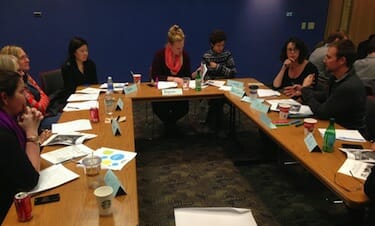
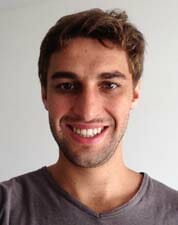
Author Janis Vinck, left, celebrates CURA DOET with fellow participants.
To prepare for CURA DOET (translation: Hands-on Curaçao), we first reached out to social organizations and then launched a massive media campaign to make as many people as possible aware of this service weekend and recruit volunteers.
We invited nursing homes, primary schools, cultural organizations, foundations, neighborhood centers, sport associations and afterschool programs to propose volunteer projects. Our team spent many days on the road visiting social organizations in order to plan activities. It was a great opportunity for us at Curaçao Cares to build relationships with organizations, schools and even companies we hadn’t worked with before.
Many organizations saw CURA DOET as the perfect opportunity to get things done that they did not yet have the time, manpower or resources to do. This included hands-on jobs such as painting neighborhood centers, fixing playgrounds in a school, sprucing up the garden at a home for the elderly and giving special attention to clients and patients by organizing a special breakfast, celebration or a nice outing. Our goal was to reach at least 100 projects, so we were pleasantly surprised when we surpassed that mark!
On the eve of the big weekend, the governor of Curaçao kicked off CURA DOET in the company of several community partners and other invited guests. It was a festive start to an unforgettable two days during which we saw families, colleagues, teammates and classmates all roll up their sleeves and join forces.
It was fulfilling to see young and old having fun while lending a hand and many volunteers were gratified to see the result of their work.
“Dun’un man, gan’un Kurason” – “Lend a hand, win a heart” – is the motto we chose for CURA DOET and we are proud that it inspired so many to take action for Curaçao. We are already looking forward to CURA DOET 2015!
Leaning Toward Leadership? Consider a Nonprofit Board
Once involved, volunteers often see they can make a difference – and want to do more. Feeling that pang, longtime volunteer Anne Fisher considered serving on a nonprofit board of directors to make more of an impact on her community.
Anne Fisher
“I thought joining a board might be a great way to do that, but I wasn’t quite sure where to start,” Fisher said.
Having no prior board experience, Fisher decided to take part in The Bridge, a Seattle Works program that prepares people for board service.
About 10 years ago Tara Smith, the executive director of Seattle Works, saw the organization’s method of placing people on boards for a yearlong trial period wasn’t ideal. “We wanted to connect people more quickly to boards,” Smith said.
So The Bridge was born. During the one-day program, participants learn from experts in different fields about fundraising, finance, leadership development and different board structures. The program also includes an interactive board simulation. The goal is to help participants figure out whether board service is right for them. (If you’re not in the Seattle area but would like to find out more about serving on a nonprofit board, check out these resources from The Bridgespan Group.)
“The Bridge was a helpful introduction to board service,” Fisher said. “It helped me understand what questions to ask when considering an organization and how to articulate both what I had to offer and what I wanted out of the experience.”
Prospective nonprofit board members participate in a Bridge session at Seattle Works.
Aside from training participants how to be board members, Seattle Works – part of Points of Light’s HandsOn Network – helps program graduates meet and get paired with different boards.
These Board Speed Dating nights, as Seattle Works calls them, bring together Bridge graduates and prospective nonprofits looking for board members.
Ben McCarthy, who heads The Bridge, says Seattle Works partners with more than 40 nonprofit partners focused on such issues as community engagement, the environment, health and wellness, the economy, the arts, education and more.
Following Fisher’s graduation from The Bridge she became a board member for Youth in Focus in 2011 and is currently the board’s president. Youth in Focus, now celebrating its 20th anniversary, uses photography to help at-risk youth see the world in new ways so they can make positive choices in their lives.
“I’ve found my board service to be an incredible learning experience,” Fisher said. “It’s been a chance to take on new challenges, build my leadership skills and feel like I’m making a meaningful impact. It can be a lot of work at times, but it’s very rewarding.”
Trina Gadsden, executive director for Youth in Focus, acknowledges how The Bridge has helped Fisher and in turn Youth in Focus: “The Bridge program prepared Anne for the role of board president because it gave her the necessary tools and experience to navigate and lead positive change.”
Seattle Works runs The Bridge four times a year for the public in addition to holding private sessions for corporations, such as Microsoft and Boeing. Since its first year The Bridge has prepared approximately 1,500 people.
Because of The Bridge’s success and in response to feedback from people who wanted more training and support, Seattle Works created Bridge 201 – a six-hour advanced training session designed for current board members to become more effective leaders.
For those thinking of board service Fisher has some advice: “I believe that having a passion for the organization’s mission is essential. … Spend time understanding an organization’s missions and goals, what they need from their board, their greatest challenges and opportunities, as well as the time and financial commitment required from their board members. Clear expectations and the right fit help to create a fulfilling and valuable experience.”
In the last quarter of 2013, a series of natural disasters hit several parts of the Philippines, leaving thousands of people homeless and infrastructures worth millions of pesos destroyed. Although Hands On Manila didn’t specialize in volunteer management during disaster, we became one of the coordinating hubs after Typhoon Haiyan for people who wished to help either through donations or as relief volunteers.
Given the need and demand from the volunteers, it was natural for Hands On Manila – part of Points of Light’s HandsOn Network – to recalibrate to respond to disaster-related scenarios.
Through the help of Points of Light, Hands On Manila was able to start incorporating volunteer management in the context of disaster through a weeklong immersion facilitated by Colleen Clay, Point of Light’s senior director of disaster services. We started with a workshop attended by Hands On Manila’s volunteer leaders (called Sherpas) and other partner organizations. We learned not only about the ABCs of disaster but also how to effectively manage volunteers before, during and after a disaster.
Colleen and I then flew to Bohol, one of the affected areas in the country, to meet potential local partners and visit some of the vulnerable sites.
Bohol experienced three major natural disasters last year: a 7.2 magnitude earthquake in October, Typhoon Haiyan in November and Typhoon Zoraida a few days after. Hands On Manila already had a relationship with some communities in Bohol through its Volunteer Vacations program, which aims to provide tourists with flexible volunteering and traveling opportunities in the Philippines. So we decided to pilot our disaster program in Bohol.
In line with our existing Hands On Schools program, which partners with public schools to help improve infrastructure, the disaster program will focus on rebuilding and reconstruction of select affected schools in Bohol.
After visiting Bohol, Colleen and the rest of the Hands On Manila team met with our partner corporations to give a preview of the disaster program. The response was very encouraging, as most of them see the value in allocating money and volunteers to the program.
Although we’re still developing the program, our entire team is inspired by the passion and dedication of our volunteers to help.
How Serving in AmeriCorps Led to Working for Google
Today’s post is by AmeriCorps Alums member Ben Weaver, who served as a member of AmeriCorps VISTA with Points of Light, in partnership with HandsOn Network and Google. He’s now an administrative assistant with Google’s Site Reliability Engineering team in Pittsburgh.
Ben Weaver
In 2011, I spotted a tweet from @iheartpgh that simply said “Like technology? Like helping nonprofits?” with a link to a blog post. The link eventually lead me to the application for HandsOn Tech, an AmeriCorps VISTA program created by Points of Light in partnership with HandsOn Network and Google.
At the time, I had a full-time job and I was somewhat worried about the very small AmeriCorps stipend, but it seemed like a great opportunity to use my talents and experience with technology to help local nonprofits fulfill their missions. The opportunity to work with the local Google office in Pittsburgh was an added bonus. I knew that Pittsburgh had one of the highest numbers of nonprofits per capita and an ever-growing university landscape and technology sector; I felt that the potential to match these two was huge. I was fortunate enough to be accepted into the program.
At the beginning of our service year, we visited Google’s headquarters in Mountain View, Calif., for training on nonprofit technology solutions. In addition to the support of HandsOn Tech itself, the trip gave me a lot of insight into Google’s nonprofit outreach, employee volunteering and community affairs teams. It was great to see the involvement they had in the communities where each office was located.
Our Google mentors at the Pittsburgh office were incredibly helpful in providing meeting space, guidance with technology questions and – most importantly to AmeriCorps members tasked with living at the poverty line – free lunch every two weeks. Googlers, along with volunteer staff from Microsoft, LinkedIn and local Pittsburgh technology consultants provided training for nonprofits and onsite support on several occasions.
A VISTA member’s service term is limited to one year, but I saw great potential in the program and wanted to remain involved and expand upon it, especially in matching skills-based volunteers from Pittsburgh’s many technology companies and universities with local nonprofits.
Pittsburgh Cares worked with me to create a full-time staff position in order to continue this mission locally. In the new role, I helped to bring onboard a second group of VISTA members and was able to participate in their training in Mountain View. As community programs and technology coordinator at Pittsburgh Cares, I supervised the VISTA team, sharing knowledge acquired the year before, and continued working with Google Pittsburgh on general Pittsburgh nonprofit initiatives.
A job became available in Google’s Pittsburgh office, and I jumped at the chance for a role at Google, especially one that would allow me to continue to work with the HandsOn Tech team, Pittsburgh Cares and the local nonprofit community as a whole. I became an administrative assistant with the Site Reliability Engineering team in Pittsburgh.
Recently, I helped HandsOn Tech Pittsburgh present a social media strategy workshop to more than 40 nonprofit staff members, one of several dozen workshops that I’ve helped with before, only this time as a Googler.
Do you have a similar story of how your current position is rooted in your AmeriCorps service? Tell us how you were Made In AmeriCorps here.
Volunteering and Hong Kong, With a Dash of Ginger Rogers
In a nod to the recent International Women’s Day and the HandsOn Network affiliates across the globe that make it easier for people to volunteer, we feature this Q and A with Caroline Sprod, executive director of HandsOn Hong Kong.
Caroline Sprod
Q. What inspires you about HandsOn Hong Kong, and can you tell us about your work?
A. HandsOn Hong Kong removes barriers that hold people back from volunteering, and enables small grassroots NGOs (nongovernmental organizations) to get the helping hands they need. Hong Kongers want to get involved and make our city a better place for all, but their busy schedules often prevent them from committing to a regular volunteer activity. In addition, many people are not sure where to find volunteer opportunities. Small NGOs are busy with their frontline services, and lack the resources and know-how to recruit and manage volunteers. By having HandsOn Hong Kong in the middle, these two parties are able to come together and both benefit. I know from personal experience how volunteering is not just about giving but about gaining too, so I’m really passionate about facilitating the opportunity to volunteer.
Q: What does leveraging the creative talents, energy and power of youth for volunteer initiatives mean to you?
A: Every journey begins with a single step. When a young person takes their first step to volunteer, it can empower them to journey through life being deeply and actively involved in giving back and making their immediate community and the wider world a better place. And as I’ve already mentioned, community service is not just about giving, it’s about gaining too. Volunteering offers our young people wonderful opportunities to learn new skills, increase their self-confidence and of course have fun and make friends.
Q: Why are women’s leadership and empowerment important to you?
A: I’ve had fantastic opportunities in life. I had a great education, I have traveled widely and I’ve had a variety of intellectually stimulating and challenging roles in my career so far. I would never have had these chances if my mother’s and my grandmother’s generations hadn’t stood up, spoken out, fought for women’s rights and refused to take no for an answer. My generation, and coming generations, need to continue to take action to ensure that future generations of women will be defined only by their abilities and how they choose to use them, not by their gender, or other circumstances of their birth.
Q: Are there websites or books that are inspiring you right now about gender equality, women’s empowerment and education?
A: I actually love some of the memes that are popping up online at the moment. They make us stop and think, and smile at the same time. This morning I saw one quoting Sheryl Sandberg: “I want every little girl who is told she is bossy to be told she has leadership skills.” Another I enjoyed was, “Who’s behind every great woman? That’s right – no one. She has to get there by herself.” And of course there’s, “Ginger Rogers did everything that Fred Astaire did, except backwards and in high heels.”
A longer version of this interview posted originally on the website of Women LEAD. If you are looking for volunteer centers in your area, search the map on the HandsOn Network website. If you’re looking for specific volunteer opportunities, search AllforGood.org
So You Want to Volunteer. Now What?
This post is by Katie Greisiger, a writer, yoga teacher and social service professional in Phoenix, where she co-operates the blog phoenixhealthgeek.org.
Katie Greisiger
You care about helping your community and those who are less fortunate. But, how? What’s the first step? If you narrow down your ability of service to a niche like volunteering at an animal shelter, reading to the elderly or promoting AIDS awareness you may get up and move quicker than, say, someone like me who wants to just save the world and accomplish it all overnight.
When it comes to figuring out what you have to offer your community, or one agency in particular, a little self-reflection time should be first on your to-do list.
Think about how much time you can give. Before you can commit to volunteer work you have to determine what days and times you are available to make the commitment and for how long. Luckily we have the Internet and some volunteer work could be done remotely. Maybe you have some writing or website-building expertise and could help out a small nonprofit that’s lacking in the social media department. If web work is not an option, find a place that’s close to your job, home or school. You’ll be more likely to commit if your volunteer work is easily accessible.
Determine what you want to accomplish. It’s a heart-warming feeling to give to others but it doesn’t hurt to try to polish up the ol’ resume, too. If you’re working on developing a specific skill, such as event coordination or volunteer management, offer up those services. After all, the relationship you build with the volunteering organization should be mutually beneficial. Also, it doesn’t hurt to set up goals through your volunteer gig – help someone raise X amount of money or help develop relationships to build community gardens at schools.
Choose your top three volunteer gigs. Research a few organizations, programs or city projects that you’d like to join. AllforGood.org and www.handsonnetwork.org can provide a launching point. Narrow down your top three volunteer opportunities or organizations to approach, then pick up the phone or write an email. Because nonprofits can have small budgets and busy staffs, stay persistent and remember to be patient.
Now, get moving. Have some fun, meet new people, support your community and remember that you can’t do it all overnight. We might not be able to save the world tomorrow but we can start to make a positive mark by turning to local service today.
Already an ambitious volunteer or have some ideas? Share your experiences with Points of Light at [email protected].
Worlds Away, but Our Goals Are the Same
This post is by André Cervi, one of the founders of Atados, which connects volunteers and nonprofits in Brazil. He is responsible for corporate volunteering projects.
André Cervi
The strike against political corruption in Brazil last June illuminated a desire among Brazilians for change, including ways to improve the lives of ordinary citizens. Volunteering is a novel approach to create better public services through citizen involvement, and Atados – one of the newest HandsOn Network international members – is an answer to the growing demand for volunteer opportunities in Brazil.
In April 2012, four friends and I had the idea of creating a marketplace to connect people who are willing to help with nongovernmental organizations (NGOs) in need. In São Paulo, we created a platform called Atados (bond), and launched it within seven months. We fielded more than 100 volunteering opportunities from more than 70 NGOs in that short time. From providing English classes to serving as entrepreneurial coaches to developing cultural activities, many citizens contributed to social change with the skills and the time they devoted as volunteers.
The launch was an epic success. The media feasted on our newly bonded project, and as a result many interested citizens started volunteering with NGOs. However, the greatest challenge was yet to come. Right after the website was launched, we discovered that the NGOs wanted to work with volunteers but were really ill-prepared to receive and manage them. To better serve our purpose, we started to train our NGO partners in increasing their efficiency through volunteer management. But the system was still lacking.
Fortunately, when we were approached by Jonathas Barreto of the HandsOn Network/Points of Light Global Team in early 2013, we understood better that we could also learn more by getting to know HandsOn Network affiliates and accessing a pool of resources globally. A few months later, we decided to become a HandsOn Network international member and with that, Atados made more bonds than ever before.
One of the perks of being in the HandsOn Network family is learning best practices from other members. I was able to do that when I visited New York Cares and The Volunteer Center of United Way in November. I found out how these U.S. affiliates deal with fund-raising, implementing corporate projects and managing NGO relationships, which are clearly the same challenges we experience in Brazil.
The meeting, more than face-to-face networking, was a learning experience indeed. The stories they told me gave me better foresight in solving current volunteering issues and planning programs for the future.
This year, our main thrust at Atados is partnering with major Brazilian companies to add to our volunteer opportunity offerings. We believe we have made a good head start in this regard and many other organizations are getting interested in cooperating. It feels good to see that NGOs and the private sector are now appreciating our work.
We are still at the beginning of our quest to make volunteering commonplace in Brazil, but we know that we are making progress toward social equality.
A Young Olympian and Volunteer at Heart
In Sochi, he’s an Olympian. Back home in Highland Park, Ill., he’s a volunteer.
Jason Brown
Jason Brown – who at age 19 is the youngest American men’s skater to qualify for the Olympics in nearly 40 years – participates in service projects through Chicago Cares, a HandsOn Network affiliate.
“The Jason Brown you’ve seen as part of Team USA is authentic, humble and full of positive attitude – the very same Jason Brown who shows up to volunteer,” says Katie Stearns, who worked with Brown at Chicago Cares.
“His family, friends and community –including those who know him through his volunteer service – are rooting for him to do his personal best at the Olympics because he always does his best for those around him,” says Stearns, now Points of Light’s vice president, corporate partnerships, action networks.
NBC recently featured Brown’s commitment to volunteering as part of the network’s Olympic coverage; read it here. On Feb. 9, Brown helped the men’s team win the bronze medal. (The men’s figure staking competition continues Feb. 13.)
Brown’s volunteer work has included organizing a community service project for his Bar Mitzvah in lieu of a traditional party. He invited hundreds of family members and friends to join him in service at an elementary school outside of Chicago.
These volunteers of all ages completed several projects, including organizing the school library, installing an outdoor classroom, painting a U.S. map and line games on the playground, creating inspirational murals and mosaics and planting a garden in front of the building. They also made teddy bears and fleece blankets by hand for a local children’s organization.
“Jason is the best kind of volunteer,” Stearns says. “He’s filled with energy and a real desire to make a difference and ready to share that passion with those around him so they, too, get excited about volunteering.”
Helping Kids They’ve Never Met
As Hilton Bogotá volunteers planted pine trees, repaired a basketball court, painted picnic tables and more at the nonprofit school Fundación Colegio Nueva Granada during a school day, they had an eager audience.
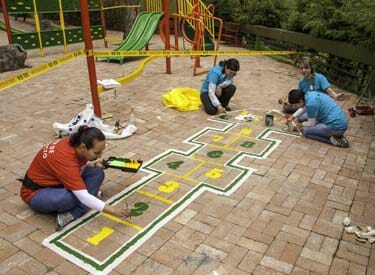
Hilton Bogotá paint a hopscotch grid on Fundación Colegio
Nueva Granada’s playground.
“A major impact of the project was the fact that the children were watching the volunteers, people they had never seen in their lives, work so hard throughout the entire day,” says Marcela Campos, project manager with HandsOn Bogotá, a HandsOn Network affiliate that facilitated the volunteer project. “I think it gave them a sense of belonging, a sense of, ‘Wow, we matter and look at these amazing people doing something for us.’”
The activities, which took place during Hilton Worldwide’s Global Week of Service in October, show how the leading global hospitality company brings their employees together to serve the communities in which they live, work and raise their families.
During that one week alone – just part of Hilton’s year-round efforts – Hilton employees participated in more than 2,400 service projects, making a difference in more than 730 communities in 72 countries, and bringing to life what hospitality is all about.
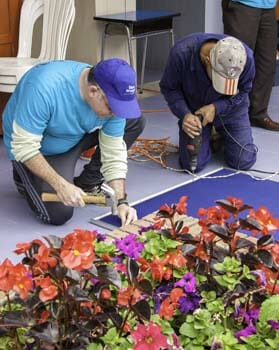
Hilton Bogotá volunteers help with a project
at Fundación Colegio Nueva Granada.
For the Bogotá project, beyond planting trees, fixing the basketball court and painting picnic tables, Hilton volunteers also painted a hopscotch course on the playground, created a vegetable garden and installed corkboards in hallways and classrooms throughout the school.
“I loved seeing the smiles on the little kids’ faces after we went to improve their school,” says Felipe Godoy, one of the 48 Hilton Bogotá volunteers. “The fact that I was able to help other people – especially kids that are less fortunate – was inspiring.”
HandsOn Bogotá also partnered with HandsOn Broward for an artwork exchange involving the Hilton volunteers. After their shift at the school, the volunteers traced their hands and painted and cut out the tracings to be arranged on a canvass. Volunteers associated with HandsOn Broward will do the same, and the two nonprofits will display each other’s artwork.
The school volunteer project with Hilton was HandsOn Botogá’s first major endeavor with a corporate sponsor. The nonprofit anticipates similar collaborations in the future.
“We hope this project will give us more exposure and help us reach out to more companies,” says Campos. “I think it shows that we really can be well-organized, cover every detail and help people see the beauty of volunteering.”
A Fun, Productive and Rewarding Use of Your Time
This post is by David Bulmer, CEO of Hands On London – part of the HandsOn Network, Points of Light’s global network of volunteer centers.
David Bulmer
Living in London, and coming from the north of England, I have seen first hand how recent years have been difficult across the U.K., with rising levels of poverty and homelessness, public services being cut back or closed and unemployment becoming a major issue.
The charity sector is responding with the opening and expansion of food banks, job search groups, community centers, homeless shelters and programs aiming to get people back to school, work and a stable place to live. These initiatives are staffed, in whole or in part, by hard-working and dedicated volunteers, and I have been privileged to work with many of those based in and around the capital since joining Hands On London.
Charities in the U.K., and those in the voluntary sector in particular, are alive with ideas, activity and brilliant people, and it’s a pleasure to have your work life be part of that. We are seeing real change as many adults and young people are starting to realize that charities need money, but they also need time, human resources and skills.
I still come across many people in London, however, who think volunteering is either something that young people do when they’re in school to earn credit, or something that has to be done to make you look or feel like a good person.
While lots of people in the U.K. now recognize that volunteering can (and should!) be a fun, productive and rewarding use of everyone’s spare time, there are still those who remain to be convinced.
I think part of the job of everyone at Hands On London is to be an ambassador for volunteering itself, not just for the charities we partner with, the work we do and the changes we make, but for the simple act of giving your time to someone who needs it, and enjoying yourself while doing so.
When we take corporate groups to clear the Lady’s Lake at Battersea Park, and everyone gets their waders on, splashes about in the water and has a great time, one of the things we hear most often is, “That was so much fun, it didn’t even feel like volunteering!”
In a strange way, that’s the biggest compliment I think we can get as part of the voluntary sector; the activities we organize shouldn’t feel onerous or trying, they should be challenging, engaging and fun.
My aim for the coming year is to keep spreading the message that volunteering is something everyone can get involved in, something everyone can contribute to and something everyone can enjoy, and to keep growing the numbers of volunteers we work with and charity partners we serve.