For Kids, Volunteering Can Be a Fun Play Date, on Friendship Day or Any Day
“Volunteering can be fun. And you can make a difference just by going to the park and cleaning up,” says 10 year-old actress Emmy Perry, best known for her role as Kitty in “Wiener Dog Internationals” and currently filming the feature film “Scales.” “You can help your community; it’s really easy. You can make it a play date.”
Emmy Perry
Volunteer service has always been an integral part of Emmy’s life. She makes use of all the resources at her disposal – including her celebrity platform and passion for animal welfare – to give back.
She started Emmy’s Hope, a Laguna Beach, California-based charity devoted to helping homeless animals, and often includes friends in her efforts. For her past few birthdays, for example, Emmy has enlisted friends in providing supplies to animal shelters.
“I get my friends involved,” says Emmy, who gave up her last movie paycheck to help save a homeless dog. “I ask them to buy things off the shelter’s wish list for the animal shelters I volunteer at, on my birthdays.”
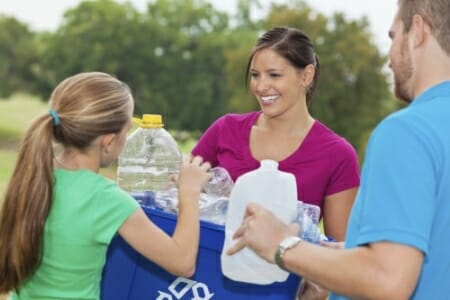
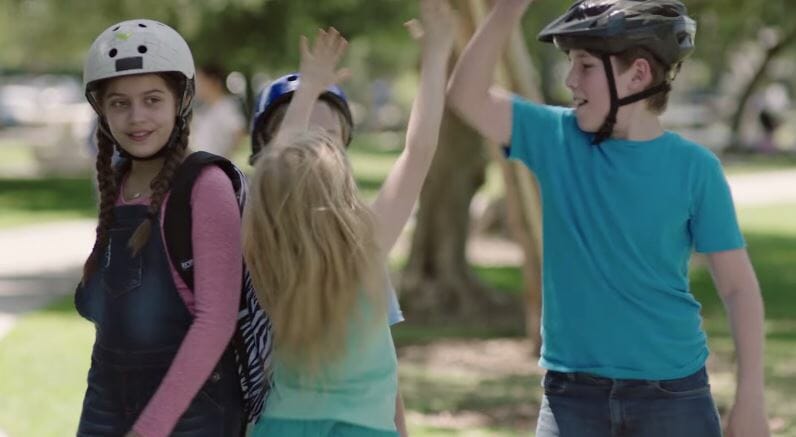
Now Emmy is asking kids around the world to get involved for International Friendship Day, July 30. She recently shot a public service spot to show how something as simple as cleaning a park with friends can be fun and make a difference in the community.
“She told me about how good she felt doing it because the trash affects the animals,” says Emmy’s mom, Elaine. Emmy told Elaine that she “would rather pick up the trash than have it end up in a bird’s mouth.”
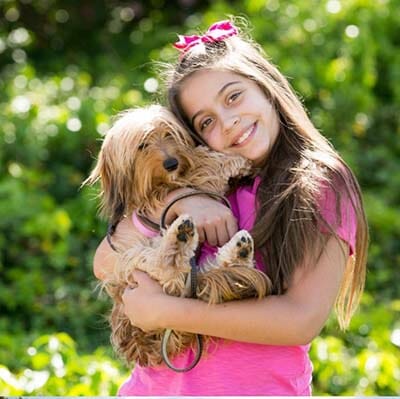
Watch Emmy Perry, pictured left, in this 30-second spot, as she shows how fun cleaning up a park with friends can be.
The public service announcement was filmed as part of the generationOn and Hasbro, Inc. My Little Pony brand Friendship Day campaign – a global initiative that encourages kids to volunteer with friends in their schools, neighborhoods or broader communities.
The campaign is tied to International Friendship Day – a day when children and their families from all over the world are invited to celebrate friendship by completing acts of kindness and volunteering.
Emmy’s passion drives her action and makes giving back fun, particularly when her friends are involved. Her proud mom offers advice to other parents who want to get their kids interested in volunteering.
“Have a heart-to-heart with your kids to find out what they are passionate about. Then use that passion to get them involved,” Elaine says. “Kids are capable of so much more than we give them credit for.”
6 Ways the Internet Has Changed How You Can Volunteer and Give
This post is by Sarah Landrum, a freelance writer and founder of Punched Clocks, a site on which she shares advice on finding career happiness and success.
Volunteering isn’t what it used to be and that’s a good thing. More nonprofits are modernizing and utilizing the Internet. Whether it’s stay-at-home volunteer work or detailed listings of volunteer opportunities, both nonprofits and potential volunteers are benefitting. Here are six ways the Internet is changing how you can volunteer for and give to nonprofits.
1. Makes It Easy to Find Opportunities
Not too long ago, nonprofit organizations relied on word-of-mouth and newspaper listings to find potential volunteers. Now, through a number of websites, you can search for volunteer opportunities by your location and the causes that most interest you.
AllforGood.org, a Points of Light website, is one of the biggest sites that connect volunteers with organizations looking for help. You can find opportunities from thousands of organizations big and small, touching on a vast array of issues.
2. Raises Awareness About Organizations
If you are looking to contribute your valuable time to a cause, you’d probably like to know what kind of difference an organization is making. What was once difficult to assess is easier to determine, thanks to a wealth of online resources. Sites like GuideStar rate charities based on their transparency and finances, while highlighting dubious organizations.
3. Allows More People to Help From Home
Some volunteers don’t need to leave home to help. Thanks to tools like Google Docs, Skype and Facetime, volunteers can contribute in meaningful ways without having to show up to the office.
Organizations of all shapes and sizes are welcoming online-only volunteers to help contribute – from grant writers to mentors to web developers. (On AllforGood.org, click “More Options” when doing your search, and check the “Virtual opportunities” box.)
4. Allows Crowdsourcing to Make a Difference
The British Museum had a problem. With limited resources and 30,000 catalogue cards that needed to be transcribed, its staff soon found a solution: crowdsourcing. They turned to their online supporters – a virtual crowd – to help.
The information has been invaluable, and volunteers are also contributing digital photographs of ancient, Bronze Age artifacts that can be used to freely print 3D copies of the items. “Opening the treasures of the Bronze Age to the widest public is why I get up,” said the museum’s curator in The Guardian.
Many organizations are turning to the wisdom of the crowd, and volunteers with interests in the project can easily help.
5. Empowers Supporters
Nonprofit organizations are ditching old-fashioned mailers and expanding their online presence to raise funds. Through social media campaigns and crowdfunding, supporters are better able to help their favorite causes.
Online crowdfunding allows dedicated supporters to actively obtain support from their friends who would otherwise not donate. Plus, the ability to donate online saves time and makes it easier to give.
In the past, volunteers and donors had to make an effort to help, whether donating their time or sending a check. Thanks to sites like Amazon Smile and eBay, part of the purchase price is donated to organizations chosen by the buyer and/or seller, allowing the consumer to easily help out. Sometimes making an impact requires doing just a little.
How has your volunteer or giving experience changed, thanks to the Internet? Let us know on Facebook or Twitter.
5 Ways Volunteering Can Help Your Career
This post is by Sarah Landrum, founder of Punched Clocks, a site dedicated to sharing advice on navigating the work world.
“It’s easy to make a buck. It’s tougher to make a difference.” – Tom Brokaw, journalist
Volunteering for a good cause changes lives and doesn’t just benefit the people you’re helping. Beyond the obvious benefits of helping out in the community and making a difference, volunteering can both further your career and improve your life. Everybody wins.
Here’s how volunteering can help boost your career and your personal branding in ways you might not have expected.
1. It’s a Chance to Network
By volunteering, you’ll meet people you otherwise never would have met. The bonds formed between volunteers are strong, and friendships quickly form. These friendships could be a big benefit by expanding your network of contacts. It’s a nice side effect of the work you’ll be doing.
2. You Could Discover Your Passion
Barbara Abbot was out of work for almost a decade when she decided to start working again. Instead of focusing on corporate management again, she volunteered at the San Francisco Food Bank. Her diligent work lead to a full-time position. She never expected that to happen.
“The first day I volunteered here, I never thought I’d end up with a full-time job,” she told Monster.com. “Looking back, though, it seems that was a sensible way to make an impression and get in.”
Abbot’s story isn’t uncommon. There are countless examples of people who have turned their volunteer experience into a satisfying job.
3. Hiring Managers Value Volunteers
Even if your volunteer work is unrelated to your desired job, hiring managers take notice. A LinkedIn survey found 41 percent of hiring managers view volunteer work as equal to a paid job. This is especially beneficial to anyone who has been unemployed but volunteered while searching for a job.
There’s a disconnect between applicants and hiring managers based on how they value volunteering. Eighty-one percent of hiring managers feel volunteer experience is valuable, according to the Deloitte Volunteer Impact Survey. Despite that, only 46 percent of college students felt volunteering would help them land a job.
It turns out volunteers aren’t sharing their experience in their resumes. Another LinkedIn survey found 89 percent of people volunteered, yet only 45 percent listed it on their resume. Talk about a missed opportunity.
4. You’ll Learn New Skills
Employers also value volunteering efforts because they engage employees and help them build new skills. There are no shortages of nonprofit organizations in any city, and their missions can range from education to advocacy to animals. With many nonprofits short-staffed and lacking resources, there are a number of potential tasks out there.
You could work on the website, track donations using special products or organize large-scale events. If you’re interested in trying anything, local organizations will welcome you on board. Every new skill you pick up is a chance to improve and expand your personal branding. You won’t be paid, but you’ll receive valuable hands-on experience that you can take ownership in.
5. You’ll Grow as a Person
Volunteering makes most people happier in life and improves their mental health. A study found volunteers have a 20 percent lower risk of death than people who don’t volunteer. Being happier in life can have a huge impact in your “real” job and ensure you don’t get burned out.
Your disposition and energy levels will improve, while the risk of burnout decreases. Happiness makes the day-to-day work more enjoyable.
Self-confidence goes a long way in furthering your career, and volunteering provides the outlet to improve this valuable trait. It doesn’t matter what you’re doing as long as it gives you a sense of purpose and satisfaction.
Make Volunteering Work
The most important thing when choosing how and where to volunteer is to find something you’re passionate about. Keep an eye on Facebook and check with your friends about any volunteering opportunities. Sites like AllforGood.org and Idealist.org can also lead you to some promising volunteering options. When you find something you enjoy doing, all the above benefits will come to fruition.
Would You Know What to Do in a Disaster? We Can Help You Get Prepared
Summer officially starts this weekend, which means we can look forward to some warm and sunny weather across the country. It also means that hurricane season is in full swing in the mid-Atlantic region; tornado season is rolling across the plains states and the Midwest; and the West coast is bracing itself for wildfires.
Eight-year-old Cash, center, learns about disaster preparedness from an Allstate volunteer in Cincinnati. He later said, “I got a backpack of tools to keep my sisters safe!”
Since 1980, weather-related disasters have more than doubled. Yet, research shows that 85 percent of Americans are not prepared for disaster.
Are you?
Education and preparation are essential in helping to prevent unnecessary loss of life and property. To help people across the country get prepared, The Allstate Foundation and Points of Light have launched a 14-city disaster preparedness and education tour. Throughout the tour, tens of thousands of people will have the chance to put together their own disaster preparedness kits – including hand-crank flashlights, first aid kits and other essentials – and to learn strategies they can use to stay safe.
This weekend, the tour stops in Seattle and Reston, Virginia. In Seattle, we’ll team up with local Allstate agents and volunteers from Seattle Works at the Fremont Fair from 10 a.m to 2 p.m. on Saturday. And in Reston, just outside Washington, D.C., we’ll join local Allstate agents and Volunteer Fairfax at the Taste of Reston from noon to 4 p.m.
A sample disaster preparedness starter kit
Both events will give members of the community a chance to learn valuable information about disaster risks in their areas and to take home a disaster kit of their own.
So far the tour has stopped in Oklahoma City; Springfield, Missouri; Houston; West Palm Beach, Florida; and Cincinnati. Future stops include New Orleans; Bergen County, New Jersey; Boston; Charleston, South Carolina; Coney Island, New York; Oakland, California; and Chicago.
Can’t Attend an Event? Here’s What You Can Do to Get Prepared
One of the most effective ways to stay safe in the aftermath of a disaster is to have a plan and supplies in place. Getting ready is a matter of three simple steps:
Build a disaster preparedness kit. Our starter kits (see photo above) include a first aid kit, hand-crank flashlight, blanket, water bottle, rain poncho, whistle, dust mask, hand sanitizer and a trash bag. Start there, then add to it until you have everything you need.
Create a household emergency plan. Make sure it includes a designated family meeting place in your neighborhood.
Help your community get ready for a disaster. Spread the word of disaster preparedness and consider participating in an official disaster training. Visit goodandready.org/trainings for more information.
It doesn’t matter where you live, disasters can strike anywhere, at any time. Don’t wait. Get Good & Ready today!
What’s Your Path for Change? Here’s One to Try
This post is by Kori Reed, vice president of cause and foundation for ConAgra Foods.
Mahatma Gandhi’s teachings tell us: “Be the change you want see.”
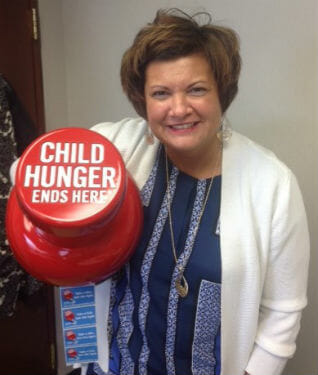
Kori Reed holds an oversized push pin promoting ConAgra Foods’ Child Hunger Ends Here campaign.
OK, but that’s not always easy to do. Where do we start? Where is the path?
Those are questions many of us ask ourselves – and struggle with. Including me. I have found some answers in
a book about evidence-based ways to create opportunity among our world’s most vulnerable, those in poverty.
In the book, award-winning journalists Nicholas Kristof and Sheryl WuDunn sound a call to action for individuals, communities and corporations alike, to be courageous and show kindness by helping others. (The book also showcases the personal benefits of volunteer work. Helping others really helps us, too!)
Kristof and WuDunn based the book title on a Chinese proverb about a path that becomes more visible the more it is walked upon. On the path to happiness for each person there are a number of milestones – starting with
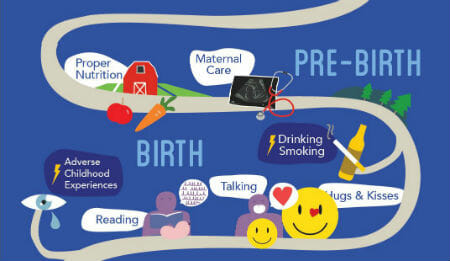
concept (the idea that your lot in life hinges to a large degree on your birth) – and detours. Therefore, it also can be a roadmap to take action to help progress.
When I read the book, and as a visual learner, I wondered whether it was possible to capture all these lessons, research and evidence in one page. I reached out to WuDunn to develop the map of a path, a kind of a Chutes and Ladders for life.
A segment of the what Kori Reed calls “a kind of a Chutes and Ladders for life”
Why? I hope it shows how possible it is for us all to be kind and help a person at any point on the path, and ultimately, do our part to break the cycle of poverty – a large, complex issue that so encumbers our society and societies around the world.
The authors include the role of business in creating these pathways, and that hit the sweet spot for me. At ConAgra Foods, where I work, we know so well how hunger at a young age can harm a child’s chances for future growth, both physically and mentally.
The greatest gift we can give is opportunity. So, here’s hoping this visual path gives people the courage to jump in and sparks an idea for how to be kind to others in a way that creates opportunity for all.
More importantly, walking the path again and again will help others see it more clearly and spark catalytic change.
Have courage. Be kind.
Join Us Online to Learn the Best Ways to Serve After a Disaster
Have you ever wanted to help after a disaster? There are many ways to get involved – whether you have just one day to volunteer or can commit to a longer stint of service.
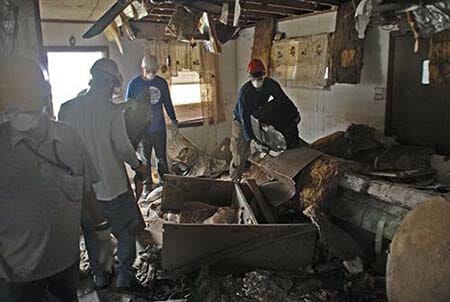
Volunteers remove debris from a house in New Orleans after Hurricane Katrina. (FEMA photo)
In 2005, Hurricane Katrina devastated coastal towns throughout the United States and caused mass evacuations. After the cameras left, residents were still picking up the pieces and reorganizing their lives.
In 2007, Cameron Lewis supported long-term recovery efforts by joining AmeriCorps NCCC (National Civilian Community Corps) for a 10-month term of service. During that time he traveled throughout the Gulf Coast region to support local recovery groups, rebuilding homes and providing education through the Red Cross Masters of Disaster program.
“This experience taught me the importance of becoming affiliated with an organization after a disaster and working through coordinated channels to rebuild communities,” said Lewis, now a program manager for disaster response and recovery at Points of Light.
Join us Tuesday, March 17, from 11 a.m. to noon Eastern, for a special discussion on Twitter about disaster volunteerism: #GoodandReady: Disaster Response and Recovery. Points of Light, HandsOn Network and national partners will answer your questions and share professional volunteer tips.
Follow along at #goodandready. Encourage your friends and families to join the conversation by sharing this message: “I’m joining #goodandready 3/17 at 11am ET to learn more about supporting disaster volunteer programs and so should you!” We look forward to chatting with you.
The campaign challenges kids and teens to take action to address the issue of hunger in the U.S. through meaningful hands-on service in their communities. For every youth engaged in service through April 30, the ConAgra Foods Foundation will donate the monetary equivalent of one meal to Feeding America – up to 10,000 meals.*
The goal is to engage 10,000 youth volunteers in service to their community.
Here’s how to get involved:
Sign up on the generationOn website. Kids and teens can sign up on their own, or teachers, administrators, parents or youth workers can sign up their groups, organizations or students to take part.
After signing up, youths are asked to complete a volunteer service project addressing the issue of hunger.
To inspire others, kids can share their stories.
By signing up, you and your kids will receive access to project guides, media tools, reflection activities and lesson plans, all designed to support youth in learning about – and taking action to address – the issue of child hunger in the United States.
* For each youth engaged in service recorded on www.generationon.org/hunger from March 15, 2015 through April 30, 2015, the ConAgra Foods Foundation will donate 10 cents, the cost for Feeding America to provide one meal through its network of local food banks. Maximum donation of 10,000 meals ($1,000). Valid in the U.S. only.
Looking for Love or to Strengthen Your Bond as a Couple This Valentine’s Day? Try this.
On Valentine’s Day – if you’re part of a couple – you might go out for a romantic dinner or catch a movie. If you’re single, you might celebrate your independence or avoid thinking about Valentine’s Day altogether.
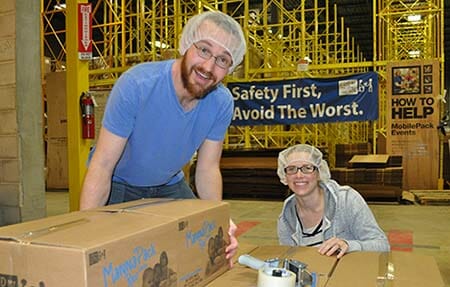
Chris and Shelly Zenner help pack food for Feed My Starving Children in Coon Rapids, Minn., which sends meals specifically formulated for malnourished children to nearly 70 countries.
But I’ve got a better alternative for you: Go volunteer!
Why volunteer on Valentine’s Day? First, volunteering makes you feel better. If the idea of Valentine’s Day gets you down, research shows that volunteering may improve your mental health and make you feel happier. Doing good makes you feel good.
Second, it will save you money. No need to spend big bucks on dinner and a movie. All you need is a good attitude and the willingness to help.
Third, volunteering is an excellent way to meet new people. Possibly, single people who are compassionate and caring.
In many ways, my wife Shelly and I started off like most couples; we opened up to one another about what we wanted out of life. The catalyst in our relationship was when we discovered we had both wanted to join the Peace Corps.
A year after we started dating we got married and six months later, in 2009, we were Peace Corps volunteers serving in Hukuntsi, Botswana.
Chris and Shelly Zenner, serving as Peace Corps volunteers, spend time with orphans during a camping trip in Botswana.
We participated in HIV/AIDS education and training events, assisted individuals in computer skills development, helped entrepreneurs with their business plans and coached youth basketball. It was an empowering experience.
Not only did the Peace Corps bring us together, it made us stronger as a couple. Living in a remote village in Botswana’s Kalahari Desert with your partner will do that. At the end of the day you are each other’s main support system. Our time in the Peace Corps has made a huge impact on our relationship and our lives.
The Peace Corps made us realize that volunteers share a lot of the same values and ambitions. On top of that, we noticed that Peace Corps volunteers regularly end up marrying other Peace Corps volunteers.
After putting two and two together Shelly and I decided to start iHeartVolunteers, an online dating service for people who volunteer. We want the love of service to bring people together, as it did for us.
So get out and volunteer this Valentine’s Day! You could meet someone who shares your passion. If not, check out iHeartVolunteers and sign up for free for a limited time as our community grows.
Do good, together!
To find volunteer opportunities in your area, please visit AllforGood.org.
5 Selfish Reasons to Volunteer
This post is by Marianne Stenger, a writer with Open Colleges, an Australian online education provider. You can find her on Google+ and Twitter, or view her latest articles here.
Volunteering tends to be viewed as the ultimate selfless act – after all, you’re giving up your own time and resources to help others without receiving anything tangible in return.
But a growing body of research suggests there are actually numerous social, physical and psychological benefits to be gained from charitable pastimes.
Of course, most people don’t set out to volunteer with personal gain in mind, but if you ask any volunteer about the motivation behind their selfless acts, they’ll tell you that they’ve gotten so much more back than they ever gave.
So what exactly is it about volunteering that makes it so satisfying? Here are five selfish reasons to give up your time without any expectation of monetary reward.
It can keep you physically fit.
A study led by the Rotman Research Institute showed that volunteering can lead to a number of positive physical outcomes such as greater happiness, better overall health, and fewer functional limitations.
Research from the University of Wales also found that people who volunteer on a regular basis tend to live longer than those who don’t – likely because they tend to be more physically active, but also because they often live a healthier lifestyle.
For instance, the report showed that smokers who volunteered in stop-smoking services later gave up smoking themselves, and students who volunteered drank less than those who didn’t.
It can help ward off depression.
Numerous studies have shown that when people volunteer their time, they tend to feel more socially connected, which can help to ward off loneliness and depression.
The University of Wales research also showed that volunteers had improved self-esteem and sense of purpose, which can also have a positive effect on a person’s mental health.
It can motivate you academically.
More and more students these days are choosing to take time off from school to combine travel with volunteer work. And although parents often worry that this will get in the way of their studies, research shows that these students are actually more likely to attend college after their time off.
One study in particular found that students who took a gap year before starting their tertiary education were more motivated during their college years than those who had jumped straight into their studies after high school.
It can benefit your career.
Volunteer experience looks good on your resume and can enhance your career prospects.
If you’ve just graduated from college, spending some time volunteering will provide you with valuable working experience and can help your resume stand out. For students, it can also be a good way to gain community service hours for university courses.
And, if you’re between jobs and the job hunt is taking longer than expected, volunteering can help prevent too many gaps from forming in your work history.
It can be a great way to make new connections.
Research by Gary Gregory, senior lecturer and undergraduate program coordinator at the Australian School of Business, indicates that for both older and younger volunteers, making new social connections is a big motivator.
Older females, particularly empty nesters or retirees, often volunteer as a way of keeping busy, meeting and interacting with new people, and also giving something back to the community.
For younger volunteers who aren’t in their careers yet, social groups are very important. Volunteering gives them a way to be in a group, meet people who share similar interests, and make valuable social connections that will help them later on in life.
Top Five Resources for Volunteers Who Want to Create Projects
Whether you’re a budding or longtime volunteer, these resources can get you on your way to developing your own projects with your family, friends and neighbors. For a searchable list of volunteer resources, please visit the HandsOn Network Resource Library. And if you aren’t quite ready to start your own project, you can search for local opportunities on All For Good.
Volunteer With Your Family
What better way to teach your children the joy of helping others than through community service? If you’re a parent looking for family-friendly volunteer opportunities, generationOn’s Family Project Guide can help.
This step-by-step guide teaches you how to shape your family volunteer project as it evolves. By offering questions you discuss as a family, you can find service opportunities that mesh with everyone’s interests, ages and energy levels.
Organize a Food Drive
Imagine never knowing if, when or how you were going to get your next meal. For 45.3 million Americans, that is what life is like every day. There are ways you can help, including organizing a food drive in your community. See this guide.
Organizing a food drive is a manageable project for volunteer veterans and beginners alike. These comprehensive instructions map out the steps, including such essential questions as: Who will lead this project with you? And, how do you promote the food drive?
Organize a Disaster Kit
Preparing a disaster kit – ready to grab on the go – can lessen the fear, anxiety and losses that stem from a disaster. Organizing a disaster kit project in your community can help educate and prepare others in case disaster strikes.
You don’t have to be a disaster expert to organize a community-wide disaster kit project. With these guidelines, planning this project is straightforward and easy. Also check out Good & Ready for more tips and advice.
Become a Volunteer Leader
Sure, you care about the quality of your community, but what can you do to improve it? With the HandsOn! Volunteer Leader Guidebook, you can help lead volunteers in making positive change.
The guidebook walks you through how to successfully organize and lead a community service project. Equipped with tools and tips, including worksheets, the guidebook outlines how to develop, implement and wrap up a project in seven simple steps.
Tell Your Story
Gathering a strong and supportive team can be one of the most challenging aspects of a community service project. If you’re looking to educate, inspire and garner support, check out HandsOn Network’s Passion into Action: Telling Your Story.
The guide lists a wide range of ways to publicize your message, from posters to media campaigns to online social networks, and more. This resource also offers recommendations about marketing and provides tips on how to publicize your cause.






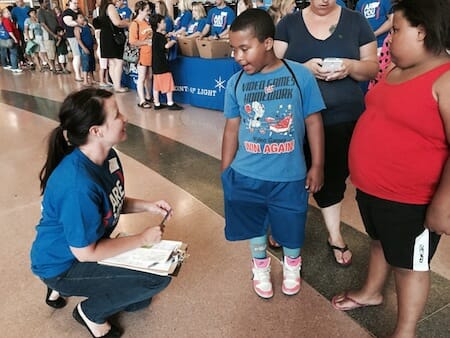 Eight-year-old Cash, center, learns about disaster preparedness from an Allstate volunteer in Cincinnati. He later said, “I got a backpack of tools to keep my sisters safe!”
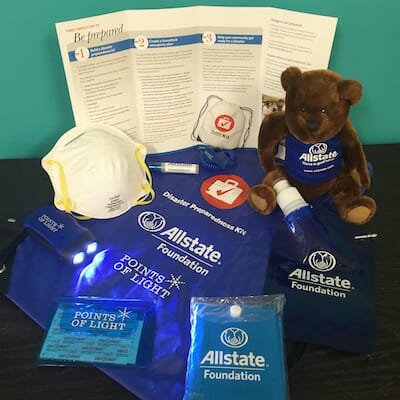 A sample disaster preparedness starter kit