



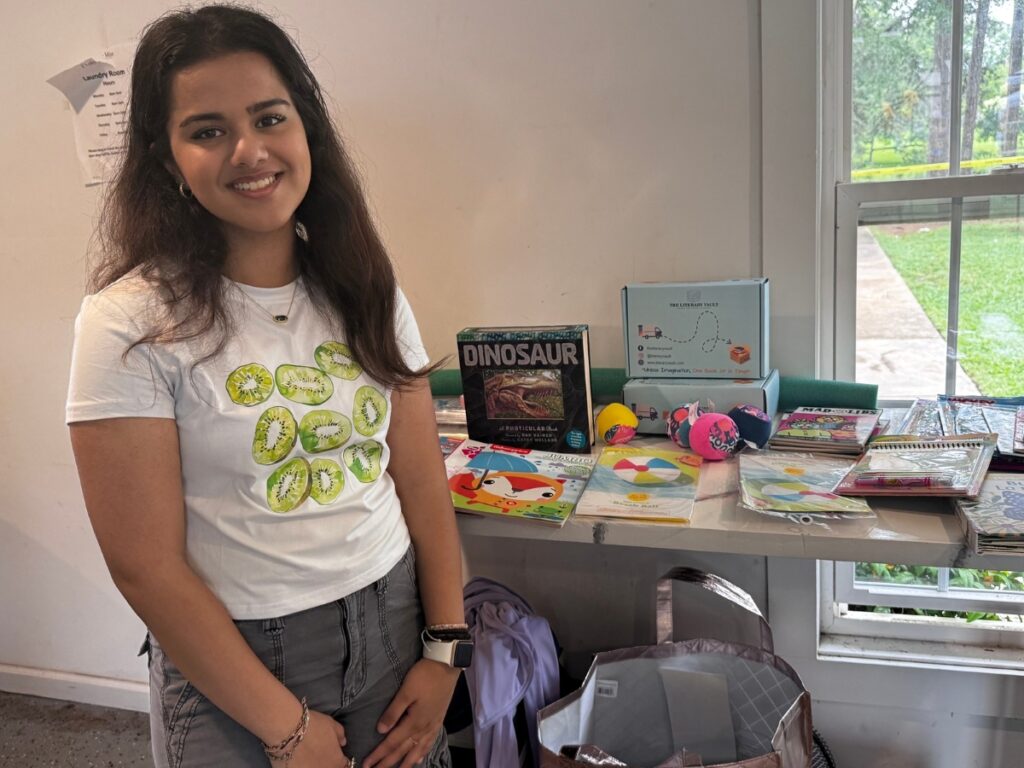
Meet Daily Point of Light Award honoree Cyra Aggarwal. Read her story, and nominate an outstanding volunteer or family as a Daily Point of Light.
Cyra Aggarwal believes every young person deserves to see themselves as a reader, a writer, and a storyteller whose voice matters. That conviction became READefining Futures, the registered 501(c)(3) global youth literacy and storytelling nonprofit she founded and continues to lead. What began as one student’s mission has grown into an organization spanning more than six chapters worldwide, powered by 30+ youth ambassadors and reaching more than 1,000 students nationally and internationally through books, mentorship, and storytelling programs designed to build both skills and confidence.
At the heart of Cyra’s work is access. She has forged partnerships with 25+ organizations—low-income schools, shelters, youth community centers, and free medical clinics—to deliver literacy resources directly to the children who need them most. Dedicating roughly four hours each week to the cause, she organizes and distributes books, leads literacy workshops, and mentors students through writing and storytelling activities. During the summer she hosts literacy-focused workshops, and throughout the school year she runs monthly sessions in schools, steadily strengthening reading and writing skills while nurturing a genuine love of literature.
READefining Futures has grown into myriad initiatives, each one led personally by Cyra. The Literary Vault, the organization’s book blog for young adult audiences, features over 100 book reviews, reading recommendations, and author interviews that spotlight diverse authors around the world. Its Monthly Book Subscription Box Service donates proceeds and curated book boxes to underserved communities in partnership with organizations like Read Charlotte and Promising Pages. Most recently, Care & Pages has begun placing free mini-libraries in clinics and community spaces—meeting families where they already spend time—with an active push to expand to seven locations across North Carolina, building on the 300+ books already collected.
Cyra’s impact has not gone unnoticed: she was named a Read Charlotte Hero in 2024 for her contributions to literacy in the Charlotte community. Yet recognition is not the point for her; expanding opportunity is. Year after year, she personally drives READefining Futures’ growth, opening new chapters, mentoring the next wave of ambassadors, and widening the circle of children who can reach for a book that might otherwise never have reached them.
Tell us about your volunteer role.
I’m the founder of READefining Futures, a 501(c)(3) youth-led literacy initiative built around three ideas: Read, Write, and Rise. What began with my own love of books has grown into a network of young people using literacy to create change in their communities.
Through Read, I organize book drives and lead Care & Pages, our free mini-library initiative. We have established libraries across North Carolina in community spaces where families can freely reach for books, puzzles, games, and activities. I wanted reading to be available not only in traditional libraries, but in the everyday places where people already are.
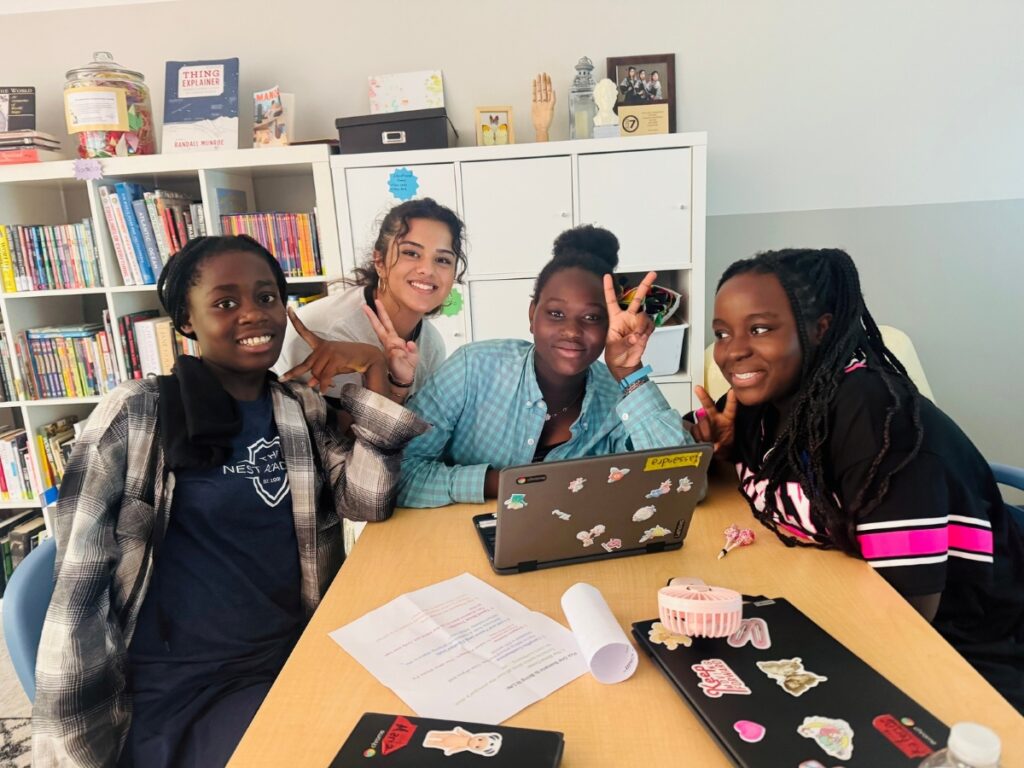
Through Write, I host interactive creative-writing workshops where young people experiment with storytelling, respond to imaginative prompts, develop characters and ideas, and share their work in an encouraging environment. I want students to experience writing as something playful and personal—not simply another assignment with a grade attached. The goal is not to create a “perfect” piece, but to help students realize that they already have stories worth telling.
And through Rise, I help other students become leaders themselves. Our ambassadors and chapters organize book drives, workshops, and literacy projects based on the needs they see in their own communities.
My role moves between dreaming up programs and doing the small work that makes them possible: contacting community partners, coordinating volunteers, designing workshop activities, sorting donations, stocking bookshelves, and supporting student leaders. I love that no matter what I am doing that day, it ultimately comes back to putting stories—and opportunities—within a young person’s reach.
What inspired you to get started with this initiative?
READefining Futures grew out of a question I could not stop thinking about: “What if stories could do more than inspire people online? What if storytelling could become action?” I started The Literary Vault in 2023 because I loved reading and wanted a space to talk about books. I reviewed novels, interviewed authors, and built a community around literature. But eventually, I began wondering what it would look like to take that enthusiasm beyond a screen.
In 2024, I created The Literary Vault Book Box, a book-subscription project designed to make reading feel exciting and personal. I curated themed boxes filled with books and reading-related items so young readers could experience some of the same anticipation I felt whenever I discovered a new story. Putting those boxes together changed the way I thought about my work. I no longer wanted only to celebrate literature online; I wanted to create tangible experiences that made books more accessible and gave young people a reason to feel excited about reading.
From there, the idea kept expanding. I began thinking about children who might not have books waiting for them at home, young people who had few opportunities to explore writing creatively, and students with ideas for improving their communities who simply needed someone to tell them, “You can start.” Those realizations became the foundation for READefining Futures.
What I love most is that the organization has never felt finished. Each program has grown from something I encountered, a conversation I had, or a need I began noticing. It has taught me that service does not always begin with having a perfect solution. Sometimes it begins by paying attention closely enough to ask a better question.
Why is this issue so important to you?
Books have been constants in a life that often was not. I moved frequently growing up and attended many different schools, so I became very familiar with being the new person walking into an unfamiliar classroom. Even when my surroundings changed, stories were something I could return to. Reading gave me an escape when I needed one, but it also gave me perspective. I could enter lives, cultures, and experiences completely different from my own.
Later, I began understanding how much of a privilege that easy access had been.
A book can seem ordinary when you have always had shelves of them nearby. But access to reading materials is not equally distributed, and neither are the opportunities young people receive to explore their creativity. Through volunteering, I began seeing that gap much more clearly.
That’s why literacy means more to me than whether someone can technically read. It’s also about curiosity, confidence, empathy, imagination, and belonging. A child who finds a character who looks like them may feel less alone. A student who discovers that writing can be creative rather than simply academic may begin trusting their own ideas. A teenager who leads a book drive may realize they do not have to wait until adulthood to create change. That is what READefining Futures is ultimately trying to build: not simply more readers, but young people who feel seen, heard, and capable of shaping the world around them.
Any future partnerships, programs, or events that you are excited about?
One of the programs I’m most excited to expand is Voices of the Vault, a platform I created where young people can submit original poetry, essays, short stories, and reflections for the opportunity to have their work published and celebrated. Right now, it’s still in its early stages, and my goal is to grow it into a genuine home for youth voices. During our creative-writing workshops, I have watched students take a simple prompt and turn it into characters, poems, memories, and ideas entirely their own. I want Voices of the Vault to give that creativity somewhere to go after the workshop ends.
My hope is that a student could begin with an idea scribbled during an activity, keep developing it afterward, and eventually decide, I want someone else to read this. I would especially love to introduce the platform to the schools, shelters, and community organizations we already work with. Many young people may never think of submitting their writing to a traditional literary publication, so I want to make that process feel approachable. Eventually, I hope students can move from experimenting with an idea in one of our workshops to polishing a piece, submitting it, and seeing their name and words published. Through our planned Literary Luminary feature, I also hope to spotlight exceptional submissions and give young writers an additional moment of recognition.
Beyond Voices of the Vault, I’m excited to continue growing Care & Pages and deepening partnerships with schools, free clinics, shelters, and other youth-serving organizations. We have already established Care & Pages libraries across North Carolina, and I hope to bring them into even more spaces while building lasting relationships with the communities that host them.
What are your long-term plans or goals for the organization?
Long term, I want READefining Futures to become something that can continue growing without depending on me. That means building strong chapters where young leaders have the freedom to respond to their own communities. A student in one city might see a need for children’s books in a shelter, while another chapter might realize students at a nearby school would benefit more from creative-writing workshops. I do not want to hand every chapter an identical checklist. I want to give young people the structure, resources, and confidence to ask, “What does my community actually need?”
I also want Care & Pages to be sustainable. Installing a library is only the beginning. The harder and more important work is making sure it remains stocked, welcoming, and genuinely useful months and years later. Ultimately, I would love READefining Futures to bridge all parts of literacy: access to books, opportunities to create, and pathways for young people to lead. I hope we eventually reach thousands more students, but I do not want scale to become the only definition of success.
I would rather know that a child found the book that made them love reading, that a student wrote something they were finally brave enough to share, or that a teenager realized they were capable of creating change in their own neighborhood. Those individual moments are what I want the organization to keep multiplying.
What’s been the most rewarding part of your work?
Some of the moments that have stayed with me most have happened away from spreadsheets, donation counts, and program plans. Through volunteering in shelters, visiting lower-income schools, and leading literacy and creative-writing activities, I have had the opportunity to see disparities in access up close. What’s struck me most is not a lack of interest—it is the opposite. I have watched children eagerly sort through books, volunteer answers during activities, ask questions about stories, and light up when they are given the freedom to invent something of their own.
Writing has been that kind of outlet for me personally. I spent nearly three years writing and revising my first novel, The Architect of the Minds, before publishing it. The process taught me resilience, but more importantly, it gave me a space to explore ideas and express my own voice. Through READefining Futures, I wanted to offer that same outlet to young people who may not have had the chance to see writing as an opportunity to express themselves.
It’s easy to discuss literacy disparities as statistics. It feels completely different when you are sitting across from a child who is excitedly flipping through a book, asking whether they can take one home, or proudly sharing an idea they came up with during a writing activity. In those moments, the issue stops being abstract. You begin thinking about all the curiosity that already exists and how often the missing piece is simply having the resources and opportunities close enough to reach.
What have you learned through your experiences as a volunteer?
Volunteering has taught me to become much more comfortable asking, “What would actually be helpful?” instead of assuming I already know the answer. I have walked into schools, shelters, and community spaces with an idea of what I thought a program should look like, only to realize that the people there understood their needs far better than I ever could from the outside. Sometimes that has meant changing an activity for a different age group, rethinking which books would actually be useful, or reshaping an idea after a conversation with a community partner. I have learned that caring deeply about a cause does not automatically mean I know the best way to serve it.
I have also learned how much of volunteering happens after the exciting part. It’s following up with a partner, adapting a workshop that did not land the way I expected, sorting another box of donations, or returning to restock a space I had already spent hours setting up. Those moments have taught me that consistency can matter more than one big gesture.
Most of all, volunteering has made me a better listener. The more communities I have worked with, the less interested I have become in arriving with all the answers. I would rather show up curious, ask questions, and build something with people instead of assuming I should build it for them.
Why is it important for others to get involved with causes they care about?
I think caring about something and acting on it are two very different things. Most of us encounter issues that frustrate us, move us, or make us think, “Someone should do something about that.” Volunteering gives us the opportunity to become part of that “someone.”
Getting involved also changes the way you understand an issue. When you spend time with people whose experiences differ from your own, statistics become people, assumptions become conversations, and problems that once seemed distant become personal. That kind of perspective is difficult to gain from simply reading about an issue.
I also think communities become stronger when people stop seeing problems as belonging only to someone else. We all have different interests, skills, and amounts of time to give, but those contributions add up. You do not have to solve an entire problem yourself to become part of its solution.
For me, that’s one of the most powerful parts of volunteering: it turns caring from a feeling into a choice.
Do you want to make a difference in your community like Cyra? Find local volunteer opportunities.