John William Dadouris
The role sports plays in our society is vital. Though it is mostly viewed as entertainment or a form of exercise, sports is often used as a tool to better one’s character as well as strengthen their academic performance. When comparing attendance records, graduation rates and test scores, it’s not a coincidence that athletes are proven to perform better than those non-athletes.
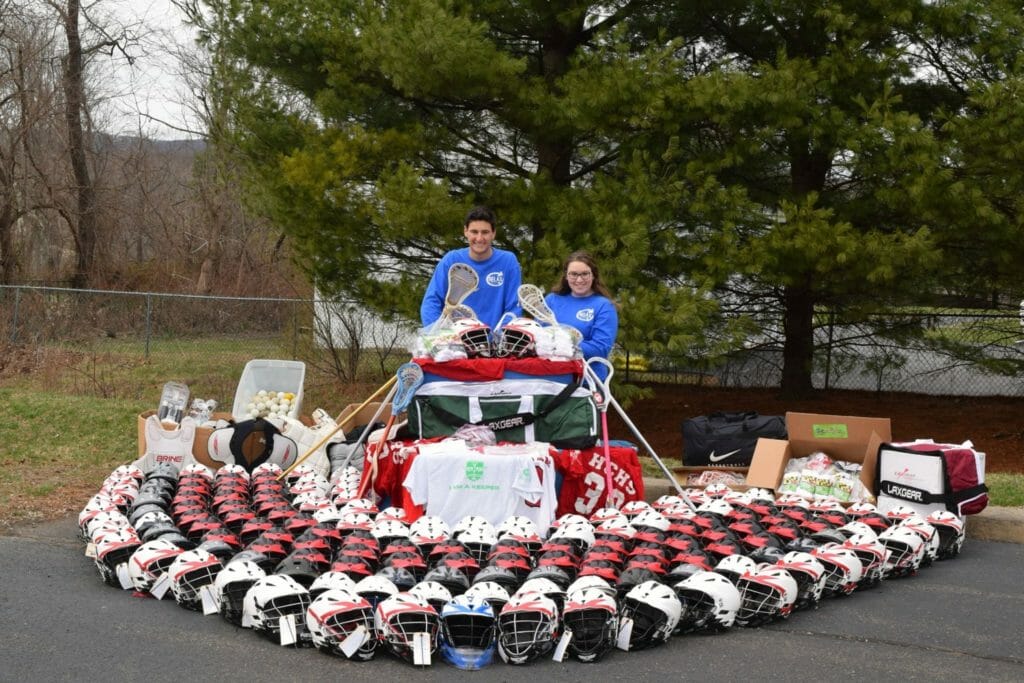 Dadouris with Kaitlyn Sleyster at their fourth equipment collection.
Will Dadouris has not only noticed the correlation of sports and academic success, but he has embraced it. As a junior goal keeper on the Gill St. Bernard’s High School lacrosse team, William knows a thing or two about balancing his on-field and in-the-classroom activities.
In 2012, hoping to grow the game of Lacrosse while attempting to improve academic performance, William started ReLax Collections. ReLax Collections is a non-profit company aimed at collecting and distributing lacrosse equipment to individuals, organizations and schools, both locally and abroad. By establishing and strengthening these lacrosse programs, William knows that the end result isn’t just production on the field, but production in the classroom as well.
“Sports, especially lacrosse, have allowed me to unwind and have fun with my friends,” said William. “As a team, we help each other achieve academic excellence, athletic achievement, and social responsibility. I started ReLax because I believe everyone should be a part of a true team that supports one another.”
William’s selflessness coupled with his joy for the game of lacrosse has taken his non-profit efforts to new heights. Today, ReLax Collections is responsible for collecting and donating over $28,000 of lacrosse equipment, and servicing student athletes as far as Jamaica, Colombia and Uganda.
Whether it’s used to build character, or simply as a tool to keep students in school, sports has proven to be essential in bettering and growing our society.
Pedro Caro
At every turn, volunteerism defines Pedro Caro’s life. He took his biggest step into being a volunteer when he enlisted in the U.S. Navy – but, he’s delved deeper since then. And, he hasn’t looked back.
Today, he’s a culinary specialist 1st class in the U.S. Navy. When he’s not concentrated on actively serving the country or his fellow sailors, he turns his attention to others in need.
The biggest bulk of his time, since being assigned to the U.S.S. Constitution in Massachusetts, has been spent with the New England Center and Home for Veterans (NECHV), one of the nation’s largest private resource providers for homeless veterans.
“Caro has set himself apart from his peers in a very short amount of time. He commits his time to serving others and seeks no recognition” said Jonathan Chaison, the NECHV volunteer program coordinator. “It is simply what he does. No one I have ever encountered in my naval career is more deserving of such an award.”
In his first seven months on the U.S.S. Constitution, Caro completed 268 hours of community service with NECHV. As a volunteer, he’s helped veterans with employment services, securing internships, and finding temporary and permanent housing. According to Chaison, Caro has positively impacted the lives of more than 90 sailors who come to NECHV for help. He’s also encouraged an additional 56 active military service members to donate 435 hours to community service.
Although Caro has devoted hundreds of hours to helping homeless veterans first-hand, he also devotes his time in other ways. Recently, he volunteered with Run to Home Base, a race that supports Home Base, a Red Sox Foundation and Massachusetts General Hospital organization dedicated to healing the invisible wounds of war for soldiers who have served post 9/11.
And, even though the bulk of his volunteer efforts focus on giving back to those who also serve – either actively or retired – Caro spends a significant amount of time to community organizations, too. Since arriving in Massachusetts, he’s worked with Pets in Need, Live Life Family Day, Revere Beach Clean Up, Salem Maritime Festival, Petpalooza, Charlestown Brown Bag, Harvest Happening, and Toys for Tots.
Ultimately, by giving so freely of his time and energies, he’s fully living a life of service that helps others.
“Caro is a catalyst for volunteerism and an example for his peers to adhere to,” Chaison said.
David Kline
For Fairfax County transportation planner David Kline, helping people navigate life’s traffic jams and road blocks is a natural calling – in his personal life, as well as his professional one.
Most Saturday, from 9:30 a.m. to 4 p.m., you can find him at the Fairfax County Juvenile and Domestic Relations District Court. He’s donating his time as a visitation monitor volunteer through Stronger Together, a program that helps families stay connected during child custody and visitation controversies.
Those days – and some Mondays and Thursdays – it’s his job to escort children, babies to 17, to court-appointed visits with their non-resident parents. Not only does he ensure these weekly or bi-weekly, 90-minute sessions are advantageous to the child, but he also helps parent and child remain calm so they can maximize their time together.
It’s imperative that someone help families navigate these tough times so they can provide as much normalcy for children as possible, he said.
“I’ve wanted to do this type of thing for a quite a while,” he said. “I like being able to, hopefully, do something to change things that can negatively impact a child’s future.”
That’s why he didn’t hesitate to get involved in 2007 when the county court system sent out a blast email to the nearly 11,000 county employees, looking for volunteers. Volunteer Fairfax, an organization that supports and facilitates volunteering in the county, also called attention to his service last year. He received a benchmark award for volunteering at least 250 hours during the previous 12 months.
With enough volunteers, instead of relying on salaried monitors, the court system can keep the visitation program affordable. In Fairfax County, non-resident parents only pay between $6 and $30 per visit. Most communities don’t have access to a community-funded program that operates at a low cost, leaving private supervision providers to charge several hundred dollars per visit, he said.
“I feel very strongly that children shouldn’t be damaged by their parents. We bring them into this world, and they have their own personalities, needs, and wants,” Kline said. “We need to mentor the children to help them live happy and stable lives.”
As a monitor, Kline plays many roles. He can help parents and children start conversations, or – thanks to his training – he can offer parenting advice to the estranged mother or father. In addition, he mentors new volunteers and interns.
Although the visitations can be fraught with high emotions, Kline said he’s received email feedback from parents, expressing gratitude for being treated with respect throughout the process.
“Parents are going through the process of divorce. They may have lost many financial things or physical things, such as their children,” he said. “They aren’t happy campers, but they come to the program, and we always make a point to treat them with respect and dignity.”
Jamie Schanbaum
On November 13, 2008, Jamie Schanbaum, then 20 years old and enjoying the life of a typical college student, was feeling ill. Her symptoms were similar to those of the common flu but within hours she was admitted to a hospital in Austin, TX. Two days later, doctors explained that her lack of feeling in her extremities and discolored limbs were the result of meningococcal disease, a rare but serious disease. Up to 1 in 10 people die from meningitis in 24 hours. Up to 1 in 5 will survive but with lifelong consequences; in Jamie’s case, all her fingers and both legs below the knee had to be amputated.
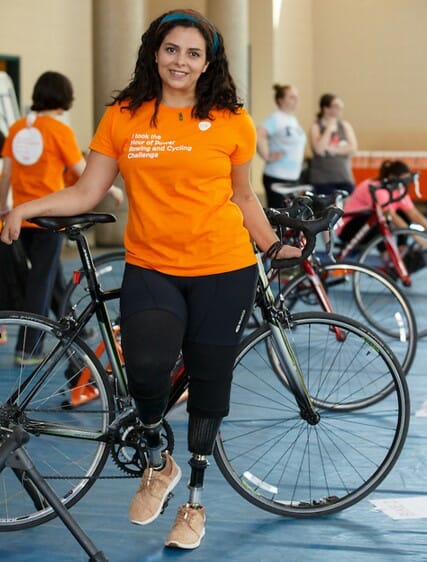 Schanbaum participated in a cycling and rowing challenge in Philadelphia on World Meningitis Day.
During Jamie’s seven-month recovery in the hospital, she went from wondering “why me?” to wondering “why anybody?” She has made it her life’s work to spread the word about meningitis and educate young adults and parents about the disease. Jamie’s passion for sports and determination to go on after meningitis, led her to become a paralympian cyclist. Jamie won a gold medal in the 2011 US Paralympic cycling games.
Jamie started The J.A.M.I.E. Group to advocate for meningitis awareness in her home state of Texas and around the country. In the summer of 2009, The Texas Legislature passed Texas Senate Bill 819, or The Jamie Schanbaum Act, requiring meningococcal (A, C, W, Y) vaccination of in-state college students, the despite two previous unsuccessful attempts. Now more than 350,000 students in Texas each year are receiving the vaccine against serogroups A, C, W and Y. Since late 2014, vaccines have become available to protect against serogroup B.
Jamie is now working to raise awareness of the two vaccines that together protect against the five most common serogroups of meningitis. In 2016 she started working as a GSK spokesperson to educate parents and young adults about the risks of meningitis and she is traveling around the country talking to media, students and parents about meningitis.
According to a recent poll, less than half of young adults (49%) know that meningitis can lead to serious health complications and 88% of parents who vaccinated their children against meningitis don’t know which serogroups of bacteria their child is vaccinated against. Jamie’s message is simple: Please get educated. Young adults need to speak to their parents and doctors.
Andrea Stern Ferris
After her mother died of lung cancer in 2008, Andrea Ferris and her family decided to make a generous gift to support research on this devastating disease. But the organizations they found were either young and not very large, or established nonprofits that didn’t specifically focus on lung cancer research.
They decided to start their own nonprofit, Protect Your Lungs. “We encountered some amazing researchers who took a leap of faith with us,” says Ferris, 48. “Together, we figured out what was missing in terms of the science arena and where our $5-$10 million could be most impactful.”
The disease, America’s number one cancer killer, remains mysterious and is not as closely connected to smoking as one might think. “About 85 percent of smokers don’t get lung cancer,” Ferris points out. “That means there’s something to discover in the 15 percent who do, so that became a focus of our research.” Additionally, 60 percent of Americans diagnosed with lung cancer have either never smoked a cigarette in their lives or have quit smoking.
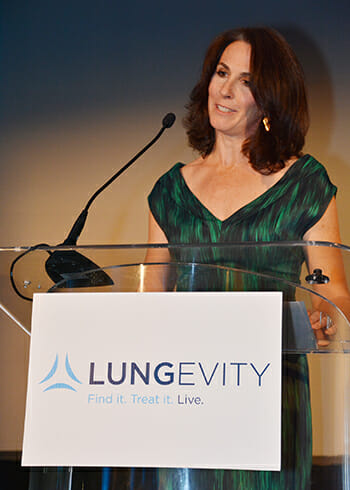
By June of 2010, Protect Your Lungs was ready to grow and Ferris led a merger with LUNGevity Foundation, which was founded in 2001 by seven Chicago-area lung cancer survivors. Its grassroots activism made for a perfect marriage with the research interests of Protect Your Lungs, says Ferris. Now, as one larger organization, LUNGevity oversees a packed schedule of about 80 events and fundraisers each year, including 45 Breathe Deep walks and runs nationwide. LUNGevity also maintains a comprehensive web presence that brings together patients, caregivers and survivors, while continuing Protect Your Lungs’ strong commitment to research.
The research efforts are three-pronged, according to Ferris. The first is early detection and disease intervention aimed at finding ways to non-invasively diagnose malignant nodules. The second is therapeutics, like targeted therapy and immunotherapy and the unveiling of drug combinations that might offer the increased efficacy that AIDS ‘cocktails’ have. Third is career development, with the organization providing funding to scientists in an effort to keep the field of lung cancer research vibrant with new ideas.
“It’s a really exciting time in lung cancer research right now,” says Ferris. “There were six new drugs approved last year. That’s amazing, and we’re proud to be a part of this ongoing research.”
To bring together patients and the possibilities that go into working toward a cure, LUNGevity also offers an online clinical trial finder. “A lot of people living with lung cancer survive by moving from trial to trial,” says Ferris, “and our tracker allows the user to identify what’s out there. It empowers the patient with information and encourages them to present that information to their doctors.” A new support service, Clinical Trial Ambassadors, brings together those who have participated in clinical trials and those considering the option. It mirrors the organization’s existing Lifeline phone buddy system, which matches people according to their age, disease stage and other factors.
Once a year, all of LUNGevity’s efforts intersect at a three-day HOPE Summit. This conference by and for those living with the disease started six years ago, with just 15 attendees. This year, 175 survivors will attend with their caregivers.
“When I go to the summit and see people doing well and I learn how they’ve benefited from the services we provide, it’s incredibly rewarding,” says Ferris. “I got involved in this fight because I was looking to make a difference after my mom died, and that includes not just fostering research but encouraging patient education and empowerment. I want to make sure that others don’t have the negative experiences that we did.”
For those looking to echo her commitment, there are many ways to get involved. Ferris suggests joining a Breathe Deep event in your area, learning about the disease and getting the message out there that there’s hope. For more information, visit lungevity.org.
John May
True heroes are those risking their own safety for the sake of others. Knowing that you can possibly lose your life while attempting to save another is a threat John May faces quite often. If you’re uncertain of what a hero may look or act like, look no further than May and his team of volunteers.
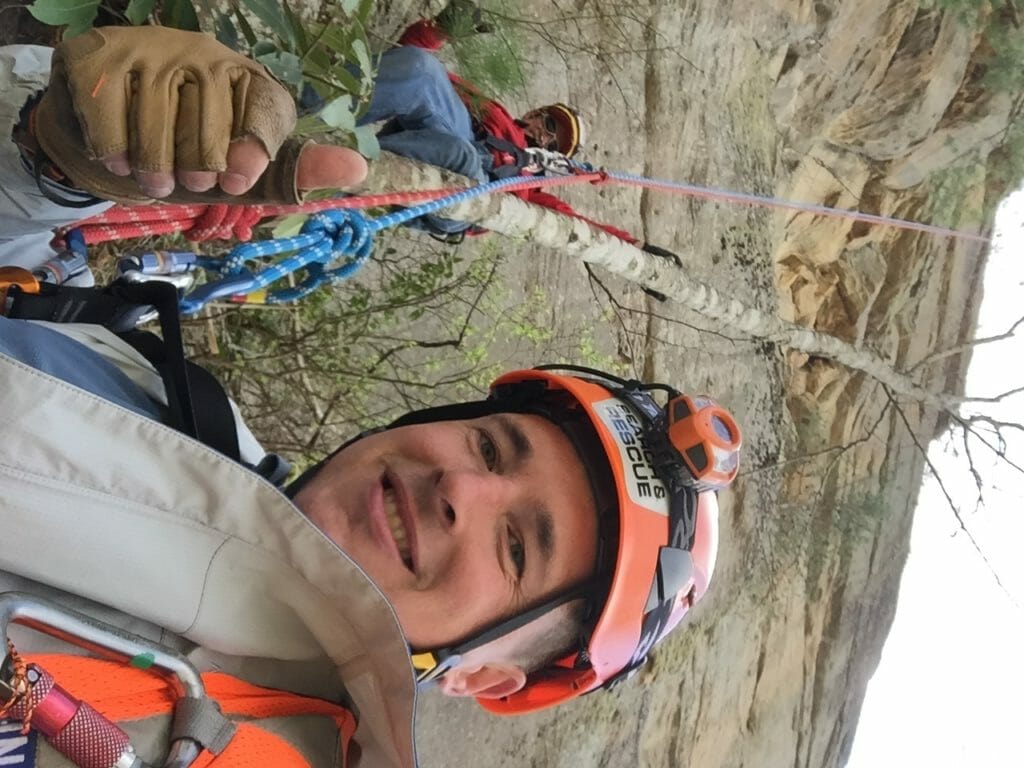 May conducting a search and rescue training.
Born and raised in Campton, Kentucky, May routinely sacrifices his own safety in hope of bettering his hometown. Helping lead the Wolfe County Search and Rescue Team, May and his crew of about 40 volunteers provide emergency relief to the Wolfe County community. With over 70 miles of rugged trail located in the Daniel Boone Forest, the Red River Gorge serves as the town’s main tourist attraction. Though the scenery may be aesthetically pleasing, the threat of danger is very real.
“Tourist often get lost on trails, and unfortunately at times they fall off the cliffs,” said May. “Last year we had four fatalities.”
While his day job consist of managing administrative services at a local electric company, his volunteer work consist of saving lives. Trained in technical rope and swift water rescue, May uses his skill set to conduct 40 or more rescue missions a year.
May’s dedication was evident when he broke his ankle during a rescue of a man who was lost for 11 days. While his ankle served as the sacrifice, it is a price he is willing to pay when it to comes to saving lives.
“It’s rewarding when you can find someone and get them back to their family. That’s what it is all about,” said May.
Whether it’s his specific skill set for rescue, or his bravery to act in the face of danger, May’s willingness to give back is making his community a better place.
Margot Griswold
The mission of the Los Angeles Audubon Society (LAAS) is to promote the enjoyment and protection of birds and other wildlife through environmental education, conservation and habitat restoration. An important strategic goal is to provide after-school environmental education targeting under-served youth and their communities in the urban core of greater LA.
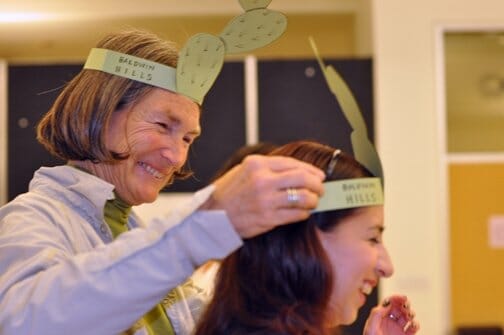 Griswold, left, at the LAAS Cactus Commencement.
Since joining LAAS Margot Griswold has served at-risk youth, first as a volunteer project manager for LA Audubon and now as volunteer VP and Education Chair.
Griswold oversees LAAS’ environmental education programs that reach more than 5,000 students each year, supplementing under-served schools with much needed environmental/science studies and a connection to nature. In Los Angeles Unified Schools, 80 percent of the students live in circumstances, with little access to nature. In addition to her work with LAAS, she has also created a Teacher Fellowship program.
Under Griswold’s direction, LAAS’ youth education programs have grown from serving 100 students in 2008 to more than 5,000 students in 2015, with eight programs serving grades 3-12. The Los Angeles Times profiled LAAS’ efforts with Politi School, where a schoolyard habitat replaced an under-utilized schoolyard with native plants attracting birds and insects. The schoolyard now serves as an outdoor lab and has improved student test scores six-fold. Another similar habitat is planned for Esperanza School.
Griswold’s focus involves at risk students who are paid interns in the program that mentor younger students in environmental stewardship. Creating a work force in the fields of natural resource management, environmental science, urban planning, and environmental education that reflects a true diversity of communities will be key to keeping these fields relevant, innovative, and effective.
Griswold has devoted herself to serving Los Angeles inner-city youth, predominantly Hispanic, African-American, and Asian, and works tirelessly in the field to work one-on-one with students pursuing environmental studies. Graduating seniors from LAAS’ Greenhouse internship have a 100 percent college acceptance rate. Through Griswold’s leadership and dedication, LAAS has high expectations for student performance, exposure to new career paths, and experience with science and technology.
Griswold believes that urban-core communities are a key component to achieving long-term conservation nationwide.
James Wall
Retirement represents a stage of completion, a finality to a long career. For some, it’s finally a period of rest and relaxation. For others, it can be a period of fear and unfamiliarity.
Helping with the uncertainties that are associated with retirement is a task James Wall Sr. fully embraces. As a retiree himself, he knows first hand the difficulties many seniors face.
After serving in the United States Air Force, followed by a successful career in health administration, Wall has used his time to benefit those who need it most. Working with AARP, he has consistently shown an effort in fighting for the fair treatment of seniors. Though he may be retired, he has definitely not stopped working.
As the AARP North Carolina Volunteer State President, Wall has worked diligently to assimilate seniors into retirement. Whether it’s working to tackle adult hunger, assisting those who are uninsured, or helping to preserve state funds for the elderly, Wall is ingrained in the community.
For all of his efforts to improve the health and financial security of North Carolina seniors, Wall was honored with the AARP Andrus Award for Community Service. The Andrus Award is the association’s most prestigious volunteer tribute, recognizing outstanding individuals who share their experiences to enrich the lives of others. For Wall, and all his selflessness, the award is truly deserved.
Mallory Brown
Millennials don’t give to charity by writing a check. In fact, more than a fifth of all millennials have never written a physical check to pay a bill, according to global payment technology solutions company First Data.
Mallory Brown gets it. The 29-year-old founder of World Clothes Line, a buy-one-give-one clothing company run on a global philanthropic model, considers herself a flash fundraiser. Through a partnership with Crowdrise, the number one fundraising website for personal causes and charity, Brown raised more than $100,000 in 2015 for seven different charitable projects, from relocating a displaced family to a new house in Haiti to raising money for Nepal earthquake relief to creating a home for CommuniD BBQ, a weekly meal for the homeless run by Elevate Detroit.
Her campaigns typically last 24 hours, a day where, through video, donors meet Mallory, see where she is and what the needs are, and then have the satisfaction of seeing their $5, $20 or $50 put to work to solve the problem.
“Millenials want to feel connected – they don’t want a lot of red tape in between them and the good they are trying to do,” said the Farmington Hills, Michigan native.
Although she always considered herself a compassionate person, it wasn’t until her wanderlust sent her backpacking in Southeast Asia nine years ago that her commitment kicked in. “That was the first time I saw true poverty,” she recalled. “And that changed my outlook on life. I wanted to make a difference to the people I met.” That led to her founding her company in 2010, but she still wanted to do more.
“So often I’d be traveling and I’d think – if I was rich, I could solve so many problems that I see in front of me.” That led to her first effort on Crowdrise, a 24-hour campaign that raised $10,954 for a Haitan family. “I’d hoped to raise $5000,” she said. “It was just amazing.”
Brown relies on corporate sponsorships to get her on the ground and in the middle of whatever the particular cause or crisis is. Then using high quality video in real time, she makes her case, shows the viewer exactly what she sees and why funds are needed.
“I guess what I do is catchy and people pay attention,” she said. “Being able to see results right away – to see the people you are helping, makes all the different. It’s a different twist on the traditional form of charity,” she said. So successful are her efforts that Brown is now sharing her methodology with others, including big organizations that are intent on reaching the millennial giver. “This is a very engaging way to raise money,” she said. “All of what we raise is used for the cause – there are zero administrative costs. That matters to young people. I think it’s a good model for the future.”
DPOL -Becky Bongiovi and Karen Bryant
When Karen Bryant and Becky Bongiovi met at a New Jersey high school decades ago, they probably didn’t realize how intertwined their lives would become. At one point, the two even worked in the same field (information technology) at the same firm.
Although they’ve since moved on, their friendship has remained steadfast.
One of the things that has continued to bind them is their shared commitment to volunteering. Most recently, that’s taken the form of coordinating other volunteers at Midland Adult Services, a nonprofit which eases the transition from school to adulthood for those with intellectual and developmental disabilities.
“We’ve both always felt a desire to give back,” says Bongiovi. “Giving of yourself and your time can be just as valuable as giving money,” adds Bryant.
Both are interested in healthy eating — Bongiovi enjoys farm-to-table cooking and Bryant is sensitive to the importance of diets because several members of her family have diabetes — so they’ve made it a point to seek out food-related opportunities. “At first, we were working with a soup kitchen but we wanted to take it a step further,” says Bryant. “We started assembling bagged lunches on our own to help those who couldn’t make it to the kitchen. We got such great feedback that we were inspired to see what else we could do closer to home.”
They stumbled on the Cooking Creations initiative from Jersey Cares, a Points of Light’s HandsOn Network affiliate nonprofit that creates programs to bring together volunteers and organizations in need of help. Now, this dynamic duo visits Midland Adult Services twice a month, once to the women’s residence and once to the men’s residence.
Typically, Bongiovi says she plans both menus, making sure they “introduce different spices or ethnic themes. “It’s been great to turn my hobby into a volunteer opportunity,” she adds. “This is fun for me. I love pouring through cookbooks and magazines and Pinterest.”
Meanwhile, Bryant gets in touch with the other five or six volunteers to assign and schedule tasks like food prep and table service. “As a leader, I try to put myself in the place of the volunteers,” says Bryant. “I get an understanding of their personalities and what kind of jobs they like. Some people want to stay in the background, so maybe I have them do some cooking or help with molding pumpkin spice cookies. Others like to get out there and mingle with the residents. For me, I get the satisfaction of seeing all of these people enjoying the fruits of their labors.”
Their visits also gift Midland staff members with a much-needed break for the afternoon, while residents benefit from the social interaction and life skills that communal cooking offers. And, of course, everyone partakes of a great meal.
It can be a challenge, Bongiovi admits, to cook for 12 to 15 people on a budget limited to $25, but by turning to regional producers she’s managed to come up with a tempting — and healthful — array that ranges from winter stews to grilled entrees during the summer. Because of their involvement with local farmers, in fact, Bongiovi and Bryant, were recently treated to a cruise to the Caribbean by Cabot Creamery, a dairy cooperative.
The cruise was a learning experience for these two volunteers, according to Bryant. “It was interesting to discover the impact of social media, for example,” she says. “By posting pictures on Facebook or Instagram, you can get your friends curious about what you’re doing and spark them to get out there in their own community.”
For Bongiovi, relaxing under the sunny skies with so many other volunteers gave her further inspiration. “I’m not going to go back to school and become a chef,” she laughs. “But realizing that I can challenge myself to make creative meals in ways other than professionally has been an eye-opener. I feel really lucky to have discovered the chance and I’d recommend following your passion to anyone else looking for a volunteering opportunity.”