Storied Life of Social Justice Advocate Serves as Inspiration for Younger Generation
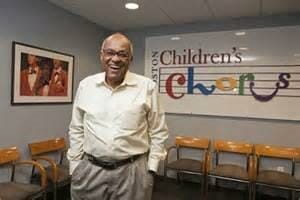
Few people have made their mark on a place as indelibly as Hubie Jones has.
He is responsible for helping start more than two dozen nonprofits that have done amazing work for Boston’s residents.
His broad efforts to blend people from all socioeconomic levels, races, ethnicities, religions and backgrounds to work toward social justice and common goals to improve their city have earned Hubie a reputation as a tireless doer, as well as numerous accolades, honorary degrees, and awards.
Hubie, who grew up in South Bronx, N.Y., says he knew from an early age the direction he’d be heading in life.
“By the time I was a junior at City College [of New York], I had made the decision to be a professional social worker,” he explained. “I was very much taken by working with young people in groups, and I was good at it. And I wanted to provide some leadership to change some things, too.”
He credits strong role models, starting with his parents, with instilling in him the importance of making a difference in the world. While working as a Pullman porter for 40 years, his father also volunteered for his union, advocating for coworkers’ rights. Jones’s mother went to college, became a teacher, and earned a master’s degree while raising a family. The Joneses brought their five daughters and son up in the Pentecostal faith, which Hubie recalled being “warm and supportive.”
Hubie also had the honor of being taught in college by noted psychologist, scholar, and civil rights activist Kenneth Clark, and of hearing The Rev. Martin Luther King Jr. speak in person.
He remembered that life-changing talk – Oct. 28, 1956 in Boston – because he was so taken with King’s “oratory, philosophy and intelligence that when I left Jordan Hall, I felt like I was levitating – like my feet weren’t touching the ground! That’s the night that sealed my decision to work toward social justice. I was already on that path, but then it was like, ‘Oh! Here we go!’”
By that point, he was earning a master’s degree from Boston University’s School of Social Work (where he later was a professor and dean) and wanted instant improvements for his adopted city. Over six decades, he said he came to accept the concept of “revolutionary patience.”
Patience paid off. When asked about his far-ranging accomplishments, Hubie said he is most proud of helping to erase the racist reputation Boston earned because of ugly riots during school-bus desegregation in the 1970s, and for the work he’s done to ensure that all children are educated fairly.
And he made note of City to City, an ongoing program that sends diverse groups of Boston leaders to a different city or country each year to learn best practices that could help Boston. Delegates pay their own way, and Hubie raises scholarship money to cover those who can’t afford the trips.
The first venture in 1997 was to Atlanta, to help learn more about solving racial issues. In subsequent years, groups went to Northern Ireland in 1998 when the peace accord was signed; to Barcelona, which had turned around its seaport; to China; to Silicon Valley; to San Francisco – each time learning more ways to help Boston.
“This was important because Boston was pretty parochial, with people always feeling like others should learn from us, not the other way around, when the fact was we had a lot to learn,” said Hubie.
The group’s 2001 trip made a particular impact on Hubie. He had been hoping to start an organization that could provide “authentic social integration” for kids and found it when listening to a Chicago Children’s Choir performance.
By 2003, after a lot of persuasion, he had secured enough support to start the Boston Children’s Chorus with 30 diverse students. Today, the elite, high-level chorus has more than 500 members, and it still draws all types of students – from struggling inner-city to wealthy suburban neighborhoods.
Through their travels all around the globe – “these students serve as ambassadors of the city and also get to know that they are global citizens with a responsibility to help others,” Hubie said. “I’m extremely proud of this chorus. Its members are committed to singing at a high level and doing work in the community. It’s joyous.”
Not surprisingly, the BCC sparked other ventures for Hubie, including a program to help create a new generation of leaders.
Isabel Koyama, a Bates College junior, had warm memories of her time in the chorus – and of Hubie Jones.
“The BCC was such an integral part of my growing up, and he was there a lot in the first couple of years that it started,” said Isabel, a member from ages 10 to 18. “He was an authority figure that I always wanted to be my best self around. He has such integrity.”
She recalled having little awareness – especially early on – of the differences between chorus members’ backgrounds and circumstances.
“We didn’t think about any of that stuff. We were there to sing together.”
And when she did start to recognize the diversity, friendships and respect for one another had been solidified, and any differences were immaterial.
Isabel said her longtime involvement and traveling with the chorus sparked her interest in anthropology, her major, and in Buddhist studies and music, her minors – and taught her to embrace differences.
That’s been Hubie’s goal all along.
“When you’re willing to be collaborative, anything is possible,” he said.
Breast Cancer Patient Takes Every Opportunity to Volunteer, Even in Face of Death
“Just because you have a medical problem doesn’t mean you have to stop living life.”
These are the words Lynn Hubach says to the patients at the clinic where she volunteers — and also the words she herself lives by.
Lynn, 58, was diagnosed with breast cancer 12 years ago and after being cancer-free for 10 years, it returned. She is now facing stage 4 breast cancer.
“I was totally devastated,” Lynn said as she recalled the moment she found out her cancer had relapsed. “[Just] the day before, I walked in a cancer survivor’s lap at a Relay For Life thinking ‘Hey! I’m one of the lucky ones.’”
While her doctor told her that she might only have three to four years to live, Lynn is not letting that stop her commitment to volunteerism.
“If I see something that’s interesting, I jump right on it and say ‘I want to do that!’ I don’t stop and think about it.” Lynn explained.
When it comes to volunteer work, Lynn doesn’t discriminate. She’s done it all — renovated houses for homeless veterans, helped at-risk high school students with their resumes and even weeded out a butterfly garden.
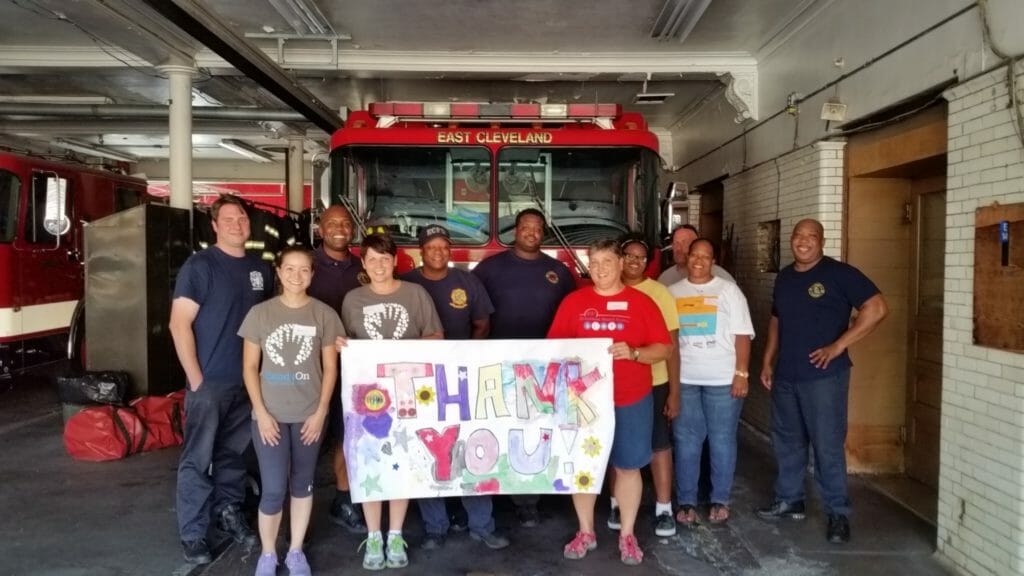
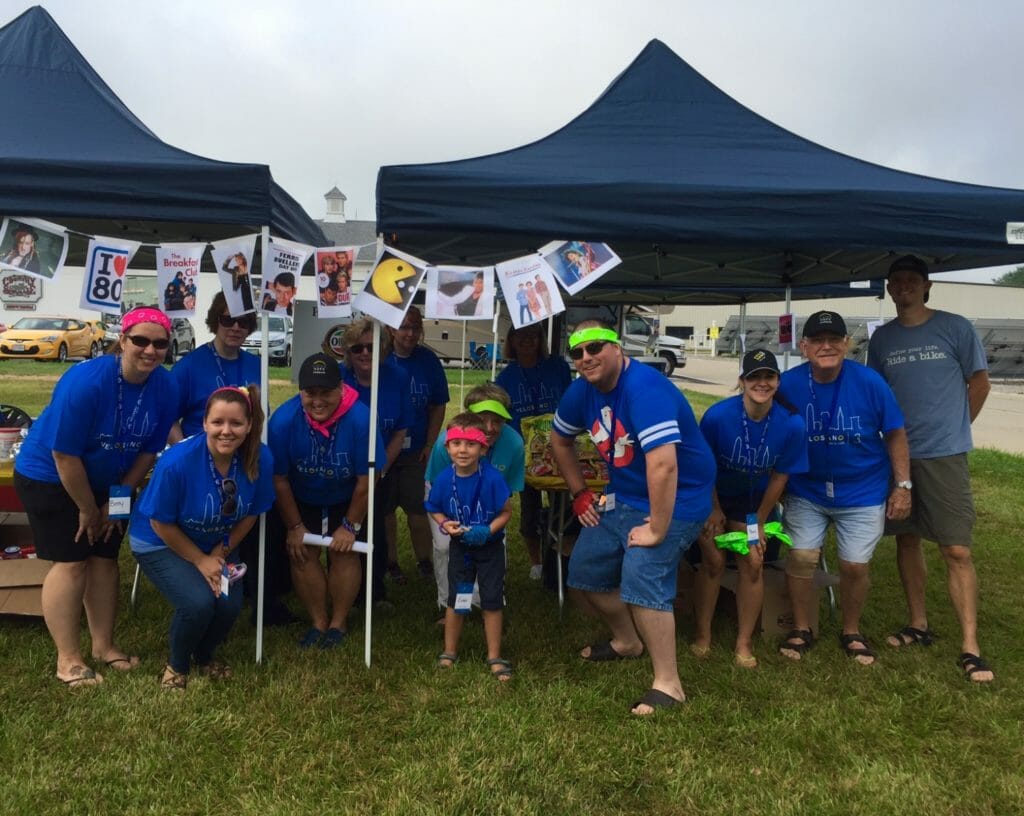
Currently, Lynn volunteers regularly with several organizations: HandsOn Northeast Ohio, Portage Animal Protection League, VeloSano, a biking fundraiser to support cancer research and MedWorks, a clinic that provides free health care.
Out of all the volunteer work that she has done, Lynn said the organization closest to her heart is Medworks because she empathizes with the patients.
“I like doing the medical [volunteer work] because some people come in very nervous about their health and I can reassure them,” Lynn said.
As her cancer progresses, Lynn finds it difficult to do volunteer work that requires physical labor. Even so, she finds her own ways to give back, such as sitting down and helping with registration at events.
Emely Vallee, the director of programs for HandsOn Northeast Ohio, has worked with Lynn for the past two years. She described her as a volunteer who goes the extra mile to make sure the community gets what they need.
“She inspires me in that no matter what, you don’t give up and keep doing good for other people — no matter what situation you might be in,” Emely said.
When asked why she volunteers, Lynn said, “You just want to help people. You see what needs to be done and you know it’s going to be appreciated. And if not, at least I got something out of it. I just get a lot of satisfaction from helping people.”
Lynn believes that people who don’t live paycheck to paycheck have a moral obligation to give back. She also believes that by volunteering, people can better the world and better themselves. Lynn, who grew up in an upper-middle class, suburban home was able to visit different parts of her city and meet people of different backgrounds, through volunteering.
“I found so much more understanding of racial differences, religious differences and a lot of things through volunteering,” Lynn said. “If more people volunteer, that could be a possible one of many solutions to the current race problems the country is having.”
Lynn plans to keep volunteering as long as she can and she hopes she can inspire others to go out and volunteer themselves.
Lynn’s personal passion project is rescuing animals, especially cats. If you’re inspired by Lynn’s story, consider adopting a pet or volunteering at animal shelter near you. Check out All For Good to find other ways to make a difference, in your area.
“I know that it’s very likely that I’ll be passing away soon, but I’ll be satisfied that I did everything I could,” Lynn said.
Utah Family Puts Volunteering at the Top of Their To-Do List
In honor of Family Volunteer Day, Nov. 19, Points of Light and Disney are recognizing families with the Daily Point of Light Award. Meet today’s winning family, the Gonzales family of Logan, Utah, and nominate someone in your community.
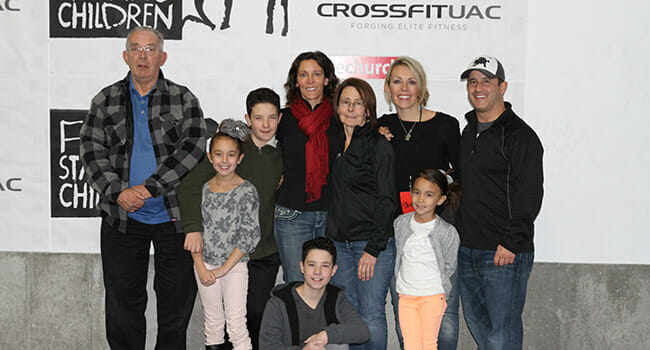
Back row, left to right: Harold Robinson, Gabby Gonzales, Hunter Gonzales, Rebecca Robinson, Kay Robinson, Shelly Gonzales, Shane Gonzales.
Front row: Logan and Avery Gonzales.
The Gonzalez family attends a Feed My Starving Children event with Shelly Gonzales’ parents and sister.
Getting involved with volunteer service can seem like a daunting task for busy families. School, sports, music, dance, Scouting and other activities leave little time for anything else.
But Shelly Gonzales, a mother of four, has found the solution: Get the entire family involved in volunteering while working it in with the family’s regular activities.
Shelly and her husband, Shane, are convinced that their kids are becoming better people because of it.
“We want kids to know that service is fun, it’s really exciting,” she stressed. “You get more out of it than you ever give. It just changes you and makes you better, more compassionate.”
Shelly welcomes her children’s original ideas for community service – for example, her youngest daughter, 9-year-old Avery, came up with “Socktober,” where she rallied classmates to donate socks for the homeless last October.
The three older Gonzales children, 14-year-old twin sons, Hunter and Logan, and 12-year-old daughter, Gabby, who are all in middle school, came up with an idea to collect canned fruit for the needy after learning that food pantries get a disproportionate amount of items, like peanut butter and spaghetti sauce, but relatively little fruit.
“We did a ‘Fast for Fruit’ party,” said Shelly. “They invited as many middle schoolers as they could think of and added other friends. Nobody ate for 24 hours and then we had a party with a DJ at the end. All the kids had to bring canned fruit.”
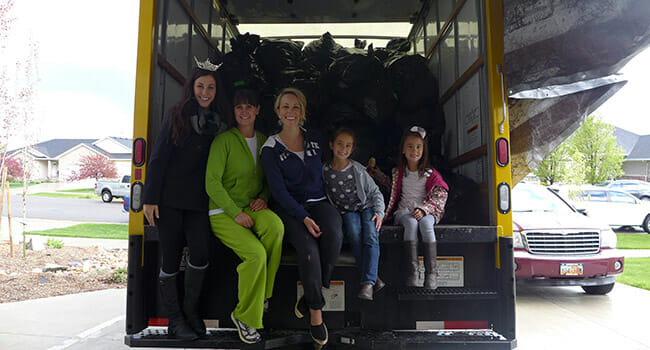
Left to right: Karlie and Stephanie Major, Shelly, Gabby, and Avery Gonzales
Shelly Gonzales and her daughters Gabby and Avery posed with Miss Utah 2014 Karlie Major and her mother, Stephanie, at a shoe drive led by the Miss America pageant.
“We don’t align ourselves with one organization or cause,” said Shelly. “There are so many needs that we haven’t been able to pick just one thing. We will do stuff with organizations, but we also create projects ourselves and try to get the community involved in it.”
A favorite cause for the Gonzales family – especially the girls – is putting together care packages for Utah’s Little Lambs Foundation for Kids to be distributed to babies, children and teens in crisis situations. “My daughter had a friend once who’d been homeless for a year,” said Shelly. “This cause has just softened my girls’ hearts. They make videos for the organization, they deliver the kits and help sort and organize the items. They have a ton of fun with that.”
Shelly said it’s important for families like hers, who are better off than many, to be aware of the pockets of suffering in their communities and turn their own talents and interests into ways to help others.
“Our culture seems so focused, as we’re raising kids, with competitive sports and competitive dance and … their own needs and their own self and being number one,” noted Shelly. “If we can give kids some early experiences in community service, they’ll see how much better it feels to help someone else than to get first place.”
Shelly credits her son, Hunter, for rallying the entire Gonzales family to give back. When Hunter was 11, he developed a rare allergic condition that left him unable to eat most foods. The family got to thinking about hunger and how there are so many people locally and in other countries without sufficient food. Seeing Hunter’s suffering inspired the entire family to get “involved in service and to be involved in helping the weak among us,” Shelly said.
She says other families can take a similar approach. “Look at a trial or hardship you’ve had in your life, whether it was being in the hospital or something. Think: What could I have used? It might be, hey, I could have used a purse,” Shelly suggested.
Once an idea forms, work it into the family’s school schedule or other plans. For example, Hunter and Logan study music, so they decided to perform at a nursing home.
“When we just incorporate volunteering into our regular activities, it’s easy,” said their proud mom.
See how your family can get involved on Family Volunteer Day.
Retired Web Designer Lends His Time and Talents to Maryland Volunteer Center
Sometimes, volunteering means hard physical work, such as delivering boxes of food to the hungry, shoveling snow for shut-ins or doing clean-up work at disaster sites.
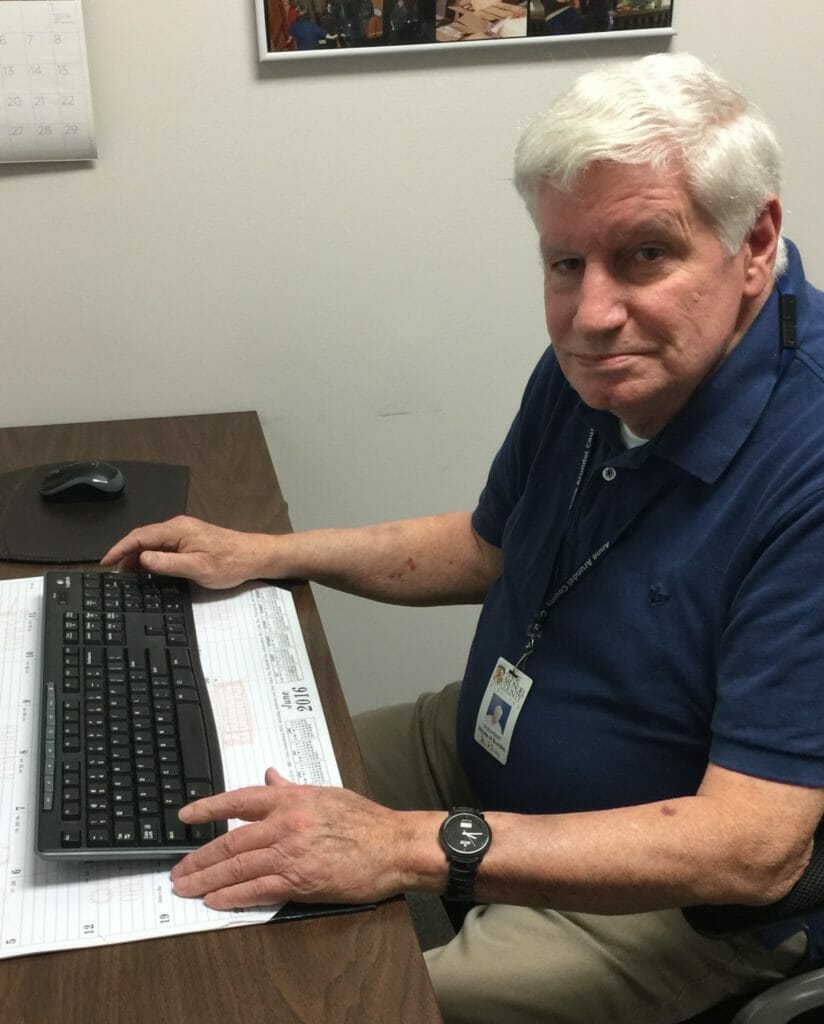
For Steven Sunday of Cape St. Claire, Md., who’s 71 and has been forced to slow down due to health reasons, it means using his technology skills to post and coordinate schedules for multiple volunteer groups doing every imaginable type of community service. He also does plenty of ongoing site clean-up – of the web variety.
Sunday, who worked in information technology at the U.S. Naval Academy in Annapolis, Md., for 36 years, wanted to keep busy and do something productive when he retired in 2010.
These days, a common way to learn about volunteer opportunities is to search online, and that’s what Sunday did. He came upon the Anne Arundel County Volunteer Center’s website and applied to become a volunteer. The volunteer center, which goes by the acronym AACVC, coordinates community service for nearly 400 nonprofit groups in the county.
But the AACVC ‘s small staff jumped at the chance to ask Sunday to do them a favor: they’d been wanting to improve and expand the center’s website.
“I was doing some of it myself, but we just limped along,” says Bill Crabb, a part-time staff member at AACVC. “It was just a more or less workmanlike website before he came. Now he takes pictures at events and puts them together into slideshows. He’s come up with graphics that are attractive. We have a lot of things on the website now that we didn’t have before.”
“I took my experience with me,” says Sunday, of his now continuous volunteer work at the center. “At the Naval Academy, I was designing websites, using HTML code and different tools. “
Sunday ended up liking his work for the AACVC so much – he hit it off especially well with Crabb, who is also a retired Federal employee – that he’s continued to volunteer at the center’s office four days a week ever since – saving the center an immeasurable amount of money by not having to hire another person or outsource the web upkeep work.
One website feature Sunday is especially proud of is one of the first things visitors to the AACVC website see: a revolving window on the home page that advertises special events.
“I do a lot of linking to YouTube,” says Sunday, who added an entertainment page, called the Fun Page, to the site. “I’ve also added more heartwarming things, too.”
It was Sunday’s idea to add galleries of photos taken at volunteer sites and special events around town.
But Lisa Spalitta, AACVC’s executive director, says Sunday diligently updates the nitty-gritty components of the website that helps the center match community volunteers with needs.
For example, Sunday updates an online calendar. Visitors to the site can click on a date to see volunteer opportunities occurring throughout the county. They can click further for more information and to be linked to the website of the organization in need of help, whether it’s a homeless shelter, literacy group or an agency that works with senior citizens.
Another highly effective online tool that promotes community service in Anne Arundel County is an interactive box where viewers can enter their ZIP codes and keywords that reflect their interests or skills, to narrow their search for compatible volunteer opportunities. Viewers can also browse hundreds of nonprofit organizations.
“Steve helps many organizations to get their listings on our website so that people can find them,” says Crabb. “A lot of people don’t know how to post information online, so we have to work one-on-one with them.”
In addition, Sunday works “behind the website” to help the center use a workforce program to sign up volunteers and coordinate them with participating agencies.
Sunday’s volunteer work frees up the AACVC’s tiny staff to do other duties.
“It would be impossible to keep this up without him,” says Spalitta. “He jumps on everything that needs to be done. Our website is where we direct everyone to get to know us and to find opportunities. It’s where nonprofits go to post their volunteer needs. Without that website, we couldn’t connect to anybody really.”
But Sunday looks at it differently.
“This place literally saved my life,” says Sunday, who has been widowed for years and who recently lost his mother. “I’m not a gung-ho person. I’m not a volunteer freak. I’m surprised they’re making such a big deal out of it. If I’d stayed home, I would have rotted over the past five years. You have to have something to do with your life.”
By using skills he’s comfortable with and enthusiastic about, Sunday says, “I feel I contribute in my own way.”
“This place keeps me young – well, maybe not young, but it keeps me active,” says Sunday, with a laugh.
New York Native Helps Hometown Students Succeed Academically After Disaster
When Hurricane Sandy ravaged parts of New York City, Kimberlee Gonzalez knew she had to get involved to help her hometown recover. For her, that meant working with children to help them stay academically on course.
In 2013, she volunteered with New York Cares, an 62,000-volunteer strong organization that helps approximately 400,000 in-need New Yorkers yearly. She jumped in, head first, to lead the Homework Help Afterschool program at PS 253Q in Far Rockaway.
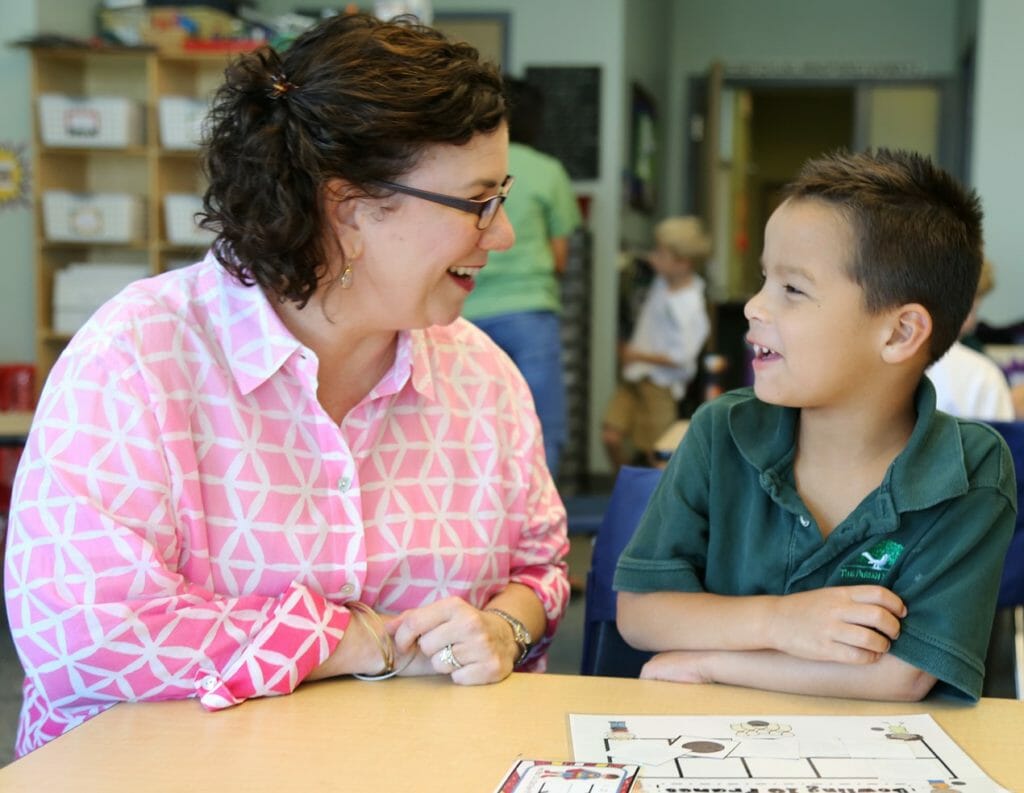
Twice weekly – Mondays and Wednesdays – Gonzalez makes the 1.5-hour, one-way commute from her home to tutor 1st- and 2nd-graders. She, and other volunteers, tutor from 2:15 p.m. to 5 p.m, helping with math and literacy homework.
“Parents work hard,” Gonzalez said. “Being able to help students with their homework before they go home not only helps students, but it helps the parents, too.”
Homework Help is vital, she said, because public school funding is diminishing. As the project leader, she assigns volunteers to groups of four or five children. After finishing homework assignments, Gonzalez said she brings out fun worksheets, dice, dominoes, cards, and fake money to further reinforce students’ math skills. Additionally, she provides sight word cards students can play with to test each other’s knowledge.
Her efforts have been successful, she said, as she has watched students who have floundered academically at year’s start excel by year’s end. Many have given her cards and posters, expressing their thanks and gratitude for her help.
In fact, the program has been so popular and effective school leaders have requested New York Cares expand the program to Mondays through Thursdays, adding additional days for students to receive needed assistance.
Ultimately, Gonzalez said, Homework Help has given her the opportunity to use her childhood education degree exactly as she wished.
“I always wanted to make learning fun,” she said. “And, New York Cares made it come true.”
Former Foster Child Now Advocates for Child Welfare and Struggling Families
Meet Daily Point of Light Award honoree Ashley Rhodes-Courter. Read her story and nominate an outstanding volunteer, family or organization as a Point of Light.
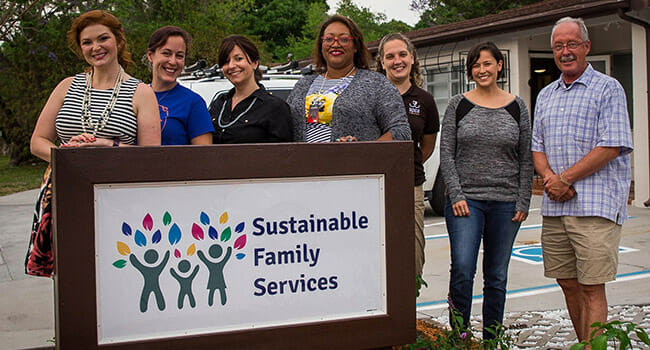
Courtesy: Ashley Rhodes-Courter
Ashley Rhodes-Courter (far left) opened an “experimental care farm” where families can come to seek the support they need.
“You just say yes and you figure it out!” That’s the mantra that has led 30-year-old Ashley Rhodes-Courter throughout her life as a college graduate, fundraiser, best-selling author and now the leader of her own nonprofit organization, the Foundation for Sustainable Families.
Ashley and her husband Erick Smith started the foundation in 2013. It focuses on a broad range of services to help educate and rehabilitate families in areas such as nutrition, breastfeeding, adoption services, mental health and more. The goal is to provide preventative care and expertise to stabilize struggling families before things get too bad.
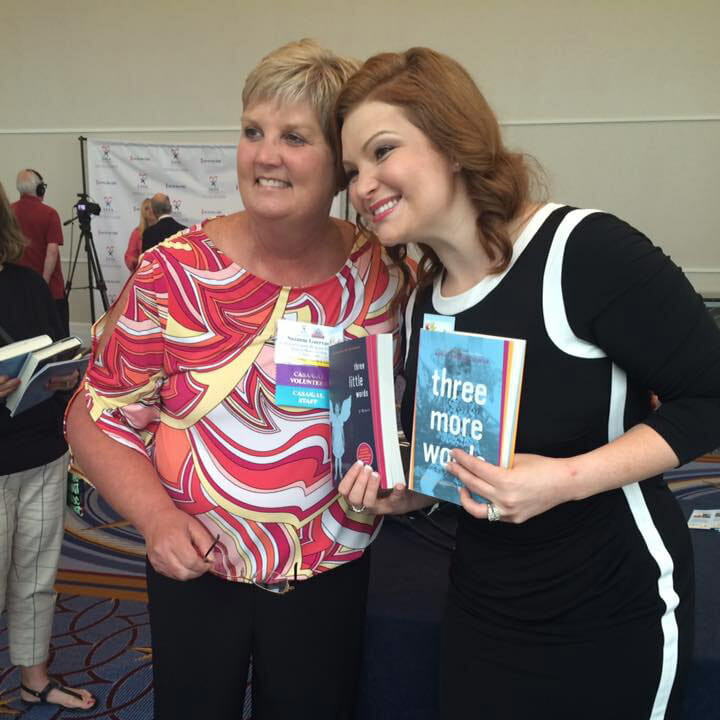
Courtesy: Ashley Rhodes-Courter
Ashley Rhodes-Courter is the author of “Three Little Words” and “Three More Words.”
Though Ashley, a best-selling author of the book “Three Little Words,” has often been called upon to use her notoriety to help raise millions for other child-welfare organizations, she and husband Erick have bootstrapped her nonprofit – liquidating her savings to help those that need her services.
“I’m actually a really shy person and I tend to be super introverted,” Ashley explained. “It’s always been so much easier for me to advocate for other people [and] I have found it to be a personal challenge to advocate for myself and my own projects.” She’s now learning how to put herself and her organization first, to ensure its long-term success.
The Florida-based philanthropist is so driven to provide for others no matter the cost because she knows first-hand the type of pain that the children and parents she helps have experienced.
“I’ve been an advocate ever since I was a teenager because I grew up in foster care,” she shared. “And so I’ve always been very passionate about child welfare.”
After her own teenage mother succumbed to an abusive relationship and drug addiction, Ashley was taken by the state as a young child and spent nearly 10 years in the foster care system. Ashley went through 14 homes – some abusive – before she was uncharacteristically adopted at the age of 12.
“In my foster homes, I was beaten and starved … it was just horrible,” she said. Though she lives with scars from her past, Ashley said these experiences motivate her to help others who haven’t been able to succeed through it all, as she was.
These days, her motivation not only comes from her own experiences as a foster child but also from her time as a foster parent. Over the course of five years, Ashley fostered 25 children, helping to rehabilitate their families and reconnect them along the way. Ashley and Erick eventually adopted their oldest son out of the group. Ashley says her children fuel and inform her – she has since had two more children of her own and is now the mother of three sons.
“I think about my kids and I think about what their needs are and the kind of world that I want for them,” Ashley said.
By noticing the needs of her own family, she has a better ability to help others. She has taken her experiences from both sides of the system and applied them towards building an organization to help promote a rounded view of community welfare.
Courtesy: Ashley Rhodes-Courter
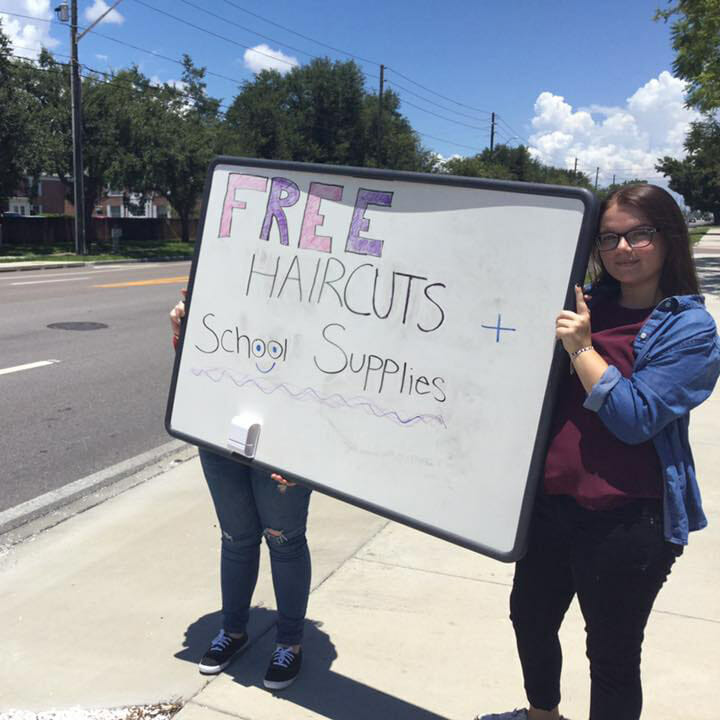
Ashley Rhodes-Courter founded the Foundation for Sustainable Families which organized “Haircuts from the Heart,” an event where students heading back to school could come to get free haircuts and school supplies.
Ashley said the Foundation for Sustainable Families strives to meet needs that are sometimes overlooked but still necessary. For example, this year during school-supply drives, her organization not only collected pencils and backpacks, but also organized an event called “Haircuts from the Heart,” where students could come and receive free haircuts for school.
However, it wasn’t just the students who benefited. Ashley said some of the parents also took advantage of the grooming service as well.
Though she has a tremendous amount of motivation and perseverance, Ashley admitted it has been a challenge running a foundation. The biggest challenge simply being a lack of knowledge when it comes to the business aspects of running a nonprofit.
“It’s hard to go against the grain sometimes, but I don’t think there’s anyone who’s an advocate that says that advocacy is easy,” Ashley said.
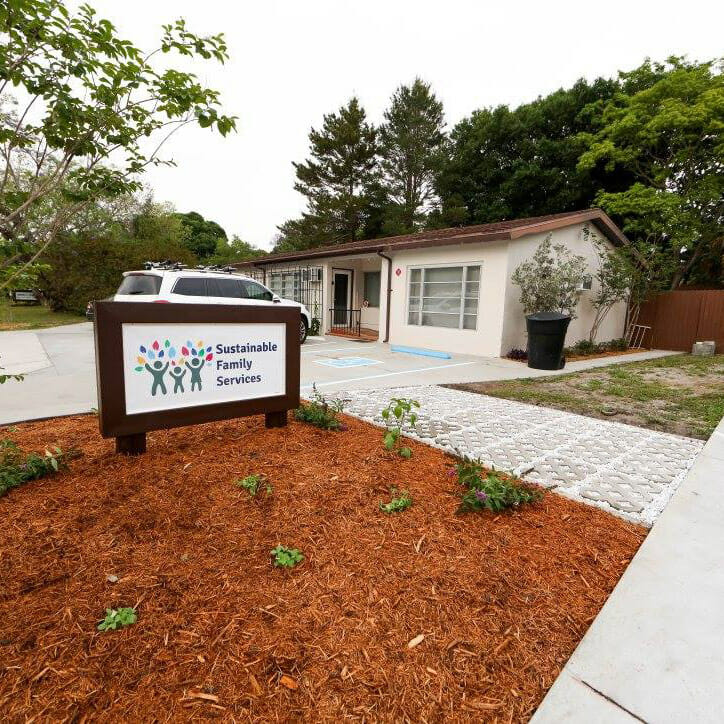
Now, her ultimate goal for the foundation is building an “experiential care farm.” She said the organization has purchased a one-acre property in Tampa Bay, Florida, with a 3,000 square-foot farmhouse where the foundation intends to incorporate all the different aspects of the couple’s philanthropic passions.
Courtesy: Ashley Rhodes-Courter
The “experiential care farm” Foundation for Sustainable Families will support families in all aspects of their lives.
The yard will be used to grow and donate organic food. The house will have rooms where children can take advantage of therapy and educational services, supervised parental visitation and case management, animal-assisted therapy in partnership with a local animal shelter, as well as a donation center where families can receive assistance varying from school supplies to beds.
Ashley said she knows that it’s a broad concept but she feels the community needs a central location for welfare services.
“We have something for people who … have a passion for animals, who have a passion for food and nutrition, who have a passion for mental health and foster children and adoption. This is really going to be a one stop shop for philanthropy,” Ashley said.
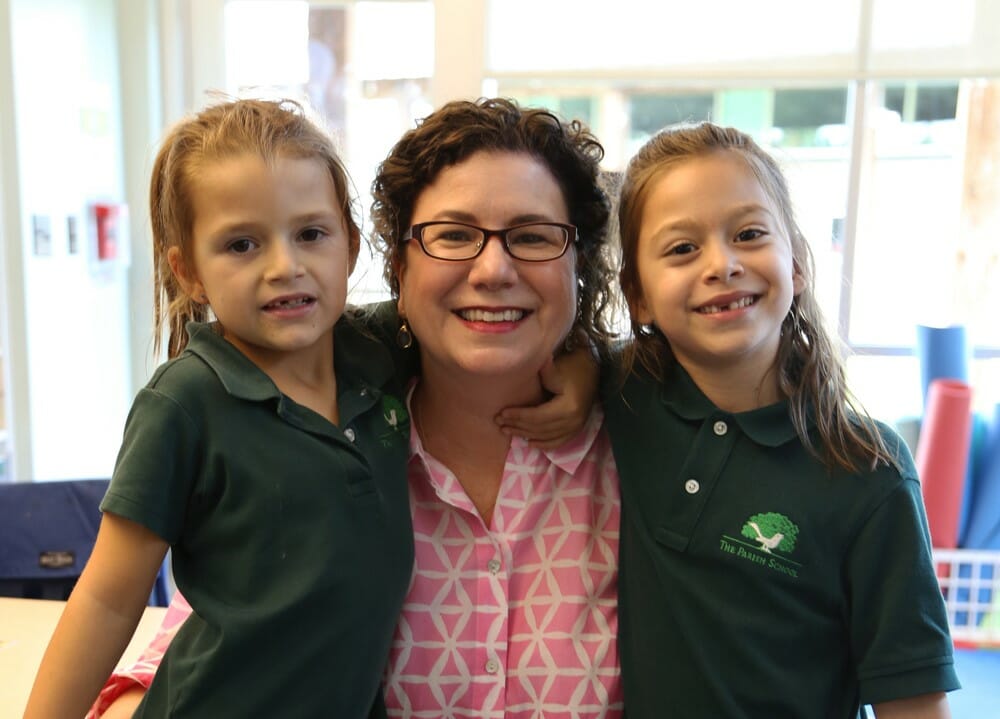
Board Member Mom Gives Back to School That Helped Son Triumph Over Learning Delays
Laurie Gutierrez turned an unfortunate set of circumstances into an opportunity to better lives. Finding out her son, at age two, was having trouble communicating was one of the scariest moments of her life.
Laurie’s son, Hudson, was diagnosed with an expressive and receptive language disorder. Unable to speak, and showing frustration in his ability to communicate, the family immediately sought help. From pediatrician visits, to frequent test and speech therapy sessions, it all changed when Laurie found The Parish School.
For the past 33 years The Parish School, located in Houston, Texas, has provided individualized intervention for children ages two through 12 who express language and learning differences.
Hudson entered The Parish School at age two, and his skills quickly improved. By age five, his speech and social interaction had strengthened to the point he was able to leave The Parish School and enter kindergarten at a nearby elementary school.
“The Parish School really gave him the foundation,” said Laurie. “They taught him how to speak and they addressed all his communication skills.”
Knowing the impact the Parish School has had on her family’s life, Laurie has decided to return the favor. Using her experience as a certified public accountant, Laurie serves on Parish’s Finance Committee. She has also been a Board Trustee since 2010, and even served as Board President from 2011-2015.
Though her son no longer attends The Parish School, Laurie gives back because she knows how instrumental they have been in Hudson’s success.
Hudson is currently 12-years-old, he’s excelling in the classroom, performs in the theatre, and even sings in the choir.
“I owe everything to The Parish School,” said Laurie. “I stay involved with them because I want other kids to have the same opportunities as Hudson.”
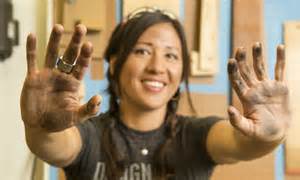
Using Design and Creativity to Empower Students and Serve Community
Emily Pilloton is a designer, teacher, motivator, community builder, and a true force of nature. Pilloton studied architecture and product design at UC Berkeley and the School of the Art Institute of Chicago, and soon became frustrated by what she describes as the “consumption-for-consumption’s-sake mentality” in commercial design. In 2008, Pilloton co-founded Project H, an education and social advocacy nonprofit, the mission of which is to use “the power of creativity, design, and hands-on building to amplify the raw brilliance of youth, transform communities, and improve K-12 public education from within.” In Project H, “H” stands for “Humanity, Happiness, Health, Habitats.”
Project H’s first major undertaking—aided by grants from the W.K. Kellogg and Adobe foundations—was Studio H, an experimental course that combined classroom study of basic design with instruction in using building equipment and eventually actual participation in construction. To launch Studio H, Pilloton and co-founder Matthew Miller moved from San Francisco to the rural and economically depressed small town of Windsor, N.C. in 2010. Coordinating their class with the local school district and working out of a converted auto body shop, Pilloton and Miller taught a group of ten 11th-graders for three hours a day. The students ultimately designed and constructed their own 2,000-square-foot farmers’ market on land donated by the city. The market, completed in 2011, created four new businesses and 15 new jobs and was featured in “Architectural Record.”
“Design is nothing more than creative problem solving and a lot of chutzpah,” Pilloton said. “It is creating smart solutions to necessary problems, and doing so with a sense of critical optimism: the idea that the world can always be better and that we can have a hand in making it so. For kids, this is incredibly empowering. It gives them the space and permission to voice their craziest ideas and push them out in to the world. It also gives them the confidence that their voice matters, and that there are always tools at their disposal to grow and implement their ideas publicly and with impact.”
Pilloton moved back to the West Coast, where Studio H is now a permanent part of the curriculum at Realm Charter School in Berkley, Cal. More than 200 students, grades 8-11, take the course each year.
Project H, which is now supported by the National Endowment for the Arts and other prominent partners, also operates Camp H, an after-school and summer program that enables girls ages 9-12 to learn design skills, operate jigsaws and even welding equipment, and create projects of social relevance.
“I’m proud of my 10-year old camper girls who walk into our space with many doubts, then pick up a welder and leave thinking ‘What CAN’T I do?’” Pilloton said.
For adults, Project H offers Workshop H, a program in which teachers, education and community leaders, and young designers can learn professional development and new creative skills based on the Project H core ideas.
Over the past five years, more than 450 youth have participated in Project H design and building programs ranging from roadside farm stands to concrete sculptured furniture and laser-etched skateboards.
For her innovations in education and community building, Pilloton was featured as a TEDGlobal presenter, appeared on “The Colbert Report,” and has won prominent national honors. For its work in on the Windsor farmers’ market, Project H was written up in “The New York Times.”
Pilloton’s main focus is always on the future.
“I feel like I have a lot more work to do,” says Pilloton. “Maybe this is the blessing and curse of the design mentality: I celebrate our victories, but I know that we can always be better, and that we can always serve kids better.”
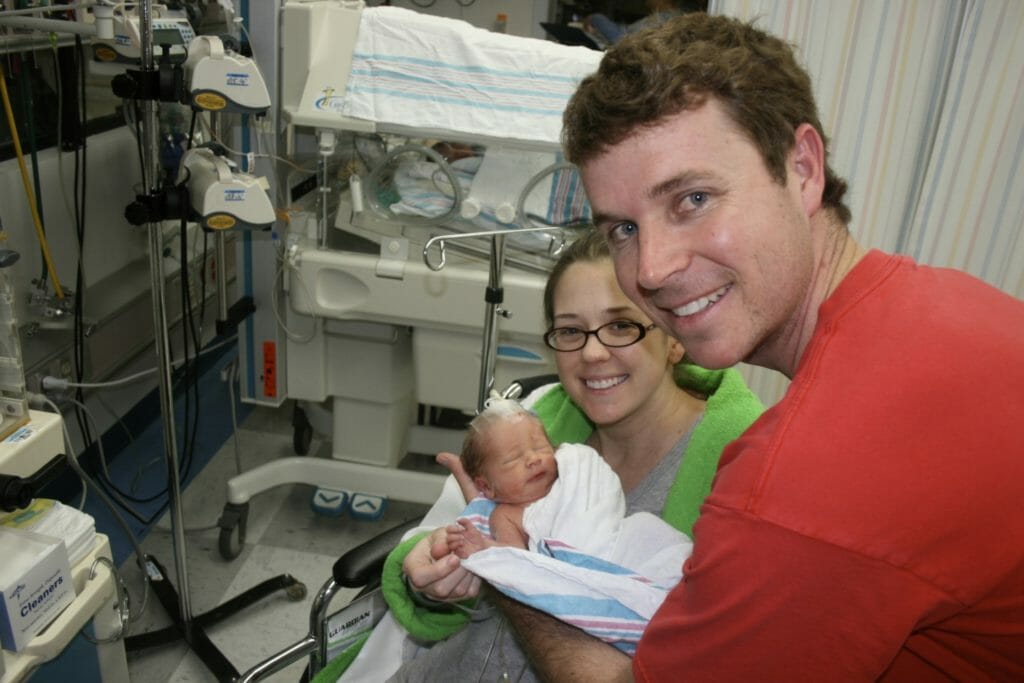
Parents Launch Nonprofit To Help Other Parents Facing Premature Births
Few things can put a damper on the joy of an impending birth faster than the scare of premature delivery. That’s what happened to Heather Barrow at 24 weeks. Thanks to St. Joseph’s Hospital in Tampa, Fl., she brought home a healthy baby boy, and that experience prompted her to help other parents in the same position.
In 2011, she and her husband launched High Risk Hope, a non-profit organization dedicated to giving bedridden, hospitalized mothers and their partners the resources needed to make their time as inpatients as comfortable as possible.
“I know you can leave the hospital with a healthy baby because that’s what I did,” Barrow said. “But, a little bit of hope is something that can be life changing.”
Globally, 15 million children are born prematurely annually – 450,000 are born in the United States. Overall, 700,000 American women experience a high-risk pregnancy, making them more likely to face early-term birth. It’s these women that High Risk Hope serves.
Through four hospital partners – three in the Tampa Bay-area and one in California – High Risk Hope will have impacted 6,000 parents and babies by the end of 2016.
To make parents as comfortable as possible, Barrow and her 175 volunteers take care bags with more than 50 items to women on bed rest, such as adult wipes for days when they can’t shower or 24 oz. acrylic cups that hold larger drinks, limiting the need to ask nurses for beverages. The organization also makes bags for parents with babies in the NICU. These include toothbrushes, toothpaste, homemade baby blankets, acrylic cups mothers can drink from during breastfeeding, and books to read to their babies.
In addition, High Risk Hope also sponsors the Belly Flop Challenge, a campaign that raises awareness of premature birth and collects donations for mothers and babies. Participants post videos of belly flops on social media and request donations for High Risk Hope.
Overwhelmingly, Barrow said, parents who have received services have returned to help other families facing the same circumstances.
“We knew support would be crucial for the families in the hospital,” she said. “We just never anticipated how much it would stick with them.”
After Accident, This Young Dancer Finds New Purpose in Bringing Comfort to Others
Courtesy: Amara Riccio
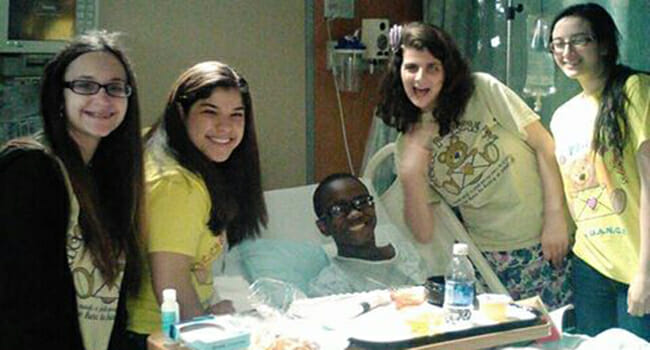
Amara Riccio created “Riccio Pick-Me-Ups” to share joy with others. Here she and fellow volunteers visit a patient in a children’s hospital.
As a child, Amara Riccio was a self-proclaimed diva. A dedicated student and performer of dance, drama, music, acrobatics and gymnastics, Amara was always on the move. She used the arts and movement to release energy, cope with stress and express herself creatively.
On June 1, 2008, Amara was crossing the street on her way to perform in her second dance recital of the day when she was struck by a car. She remained in a coma for nine days and sustained a traumatic brain injury. When she woke up, the active 13-year-old had to relearn how to walk, talk and even eat. She worked diligently during her rehabilitation and upon leaving the hospital, she was deemed a “miracle.”
“But I wasn’t the same,” Amara said. “I still had a lot of issues, but it was kind of the invisible type of injury.”
She no longer had the ability to process emotion the same way she had before her injuries. Amara felt herself sinking into depression.
While undergoing counseling, as well as physical, occupational and speech therapies, Amara wondered what she would do with her life.
“If I’m not doing dance and acrobatics and drama and chorus and all this stuff I used to do, what am I going to do?” she said.
Courtesy: Amara Riccio
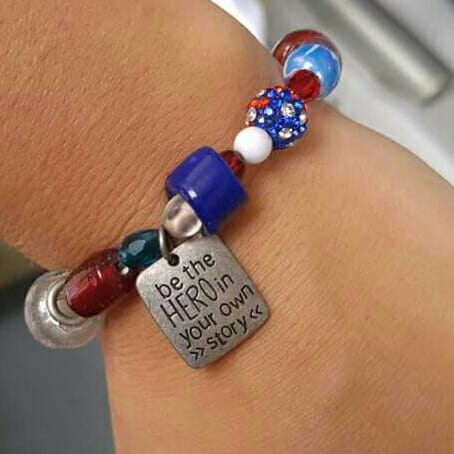
This inspirational hero bracelet is one of Amara’s handmade “pick-me-ups.”
Amara decided that she would express herself creatively. With the help of her mother, Lori, she began writing cards and making jewelry and crafts, which she then shared with other patients as a “pick-me-up.” She found that by sharing these gifts with others, she brought joy not only to their lives, but also to her own.
Amara said she realized how lucky she was to be alive. She loved connecting with people and she knew there were so many other people that also needed more joy in their lives.
Amara’s organization, Riccio Pick-Me-Ups, began with homemade cards, or “happy mail,” as she calls it. But it quickly expanded due to Amara’s desire to impact more people and share how the arts have helped her.
“It’s just like putting your heart out there,” Amara said. “Someone who had such a bad day, like in the hospital or at the doctor’s [office] and they see like, this package from someone they don’t know that much and that you care. [It] made a difference. That’s when I was like, ‘Wow.’ This Pick-Me-Up movement can go so much bigger.”
She and volunteers for RPMU now visit rehabilitation centers as part of their “Share the Gift” program, where they put on small-scale shows for patients and their families. This idea is to encourage patients to use dance, music, visual art and writing as tools to share their own gifts and experiences with the world.
“I never realized how much I love dance until I almost lost my ability to dance,” Amara said.
Because Amara herself wanted to give back to her community at such a young age, RPMU provides unique opportunities for children as young as 8 years old to get involved, as well as people of any other age or ability. Amara calls them her FAVs – her Friendly Ability Volunteers.
Amara also raises awareness about traumatic brain injuries, disabilities and other issues by presenting to schools and other community organizations through her DANCE Awareness program. DANCE stands for Discover, Accomplish, Nourish, Create and Embrace. Amara said DANCE has become her personal motto because it applies to everything.
Courtesy: Amara Riccio
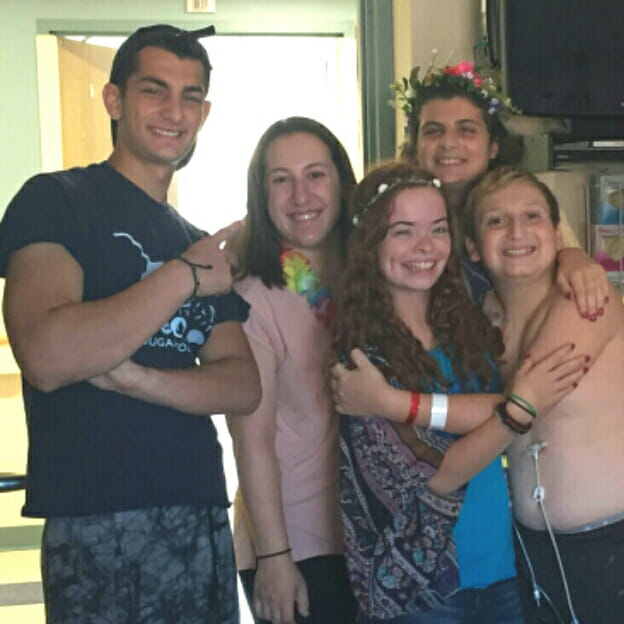
Amara Riccio and her Friendly Ability Volunteers sang, joked and spent time with a patient this past summer.
The support that Riccio Pick-Me-Ups provides, however, is not only emotional; RPMU provides financial support for those in need, too. The organization hosts fundraisers throughout the year – such as talent shows and community fairs that raise money to pay for medical expenses and to offer “Caregiver Retreats” for families undergoing medical hardship.
One recipient, Jennifer Bernstein, received a donation from the organization that allowed her family to get a life-saving hyperbaric oxygen chamber for her son, Mike.
Jennifer said of Amara, “She puts her heart into everything.” Jennifer now sits on the board of RPMU and volunteers for the organization.
Amara said she quickly learned her life purpose after her injury – to continue to offer emotional and financial support to people of all ages and abilities. She is now studying therapeutic recreation at Kean University and plans to bring creative arts therapy to everyone who needs a “pick-me-up.”
To anyone facing hardship, Amara offered this advice: “There’s just always hope and just don’t give up. And just believe that you still have purpose for this life and you’re still worth it. And I’m here for you.”