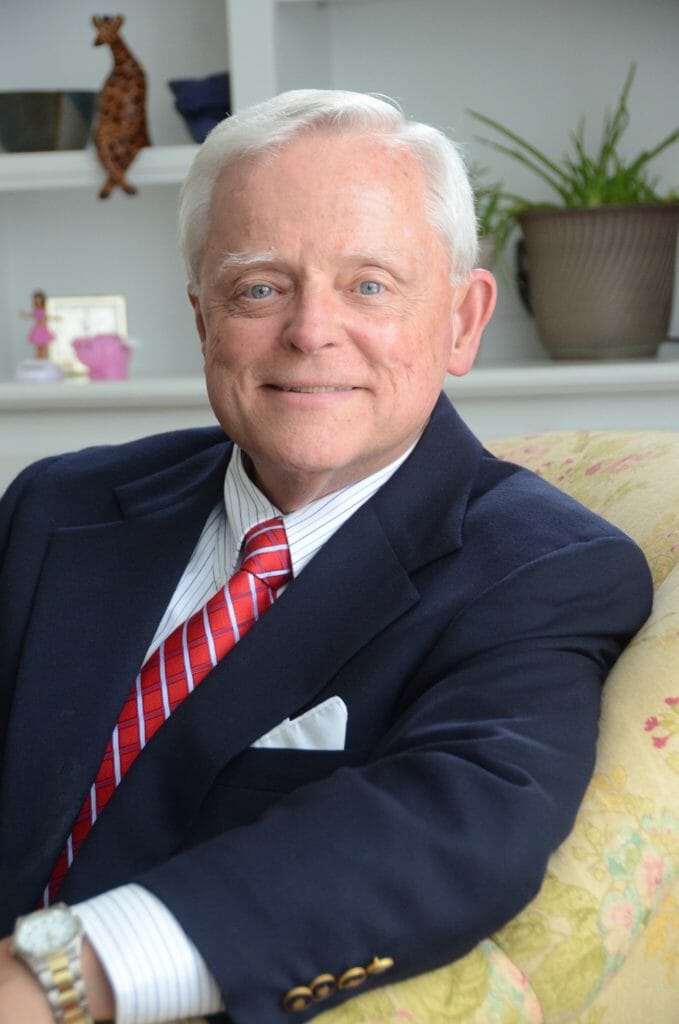
Houston Woman Opens Her Heart and Home to Pets in Need
The inspiration to volunteer could come at any given moment. You can be inspired by something you see, or maybe something you hear, but when that moment comes, it’s best to act on it.
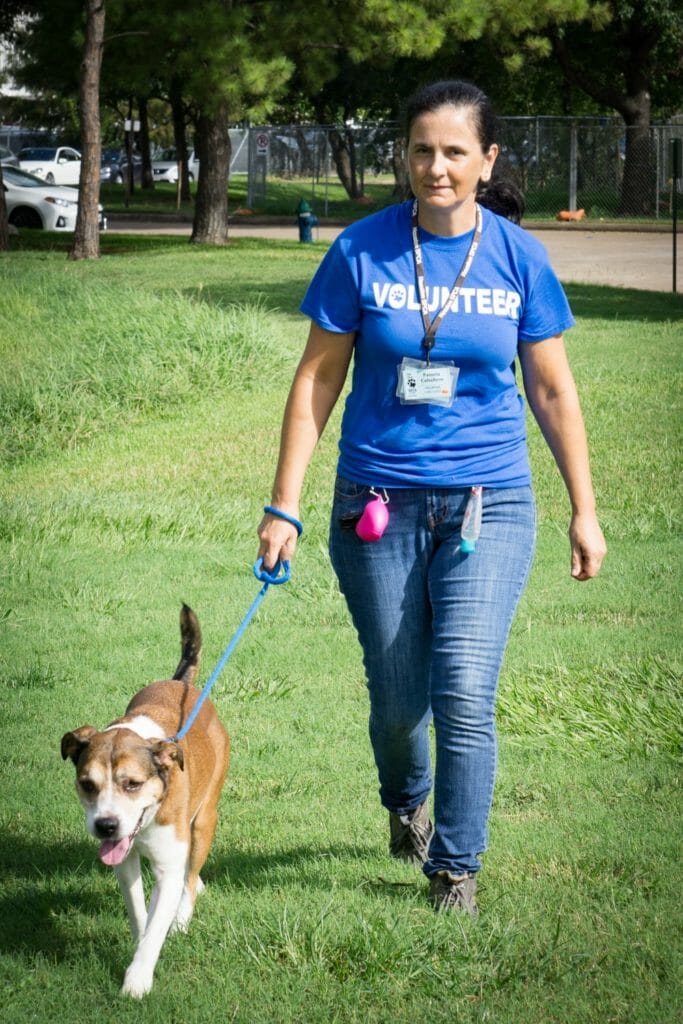
Pamela Caballero’s moment came in February 2014, while sitting at home in front of a television. During an episode of “Animal Cop,” Pamela discovered the Houston Society for the Prevention of Cruelty to Animals (SPCA). She immediately knew she wanted to get involved. The very next day she visited the SPCA to see how she could help, and she’s been volunteering ever since.
“I’ve always been an animal lover,” said Pamela. “It feels good to be able to help these animals get the love, care, and attention they so desperately need.”
Volunteering over 1,800 hours in just two years, Pamela has done it all. From her work with different outreach events, to hosting parties, she has been invaluable to the Houston-area SPCA community.
Pamela is so dedicated; she even takes work home. When a pet is waiting to be adopted, Pamela happily opens her home as a foster parent. While she may not be able to keep them all permanently, her welcoming heart has saved countless animals. Having a full-house of furry friends is nothing new to Pamela, just a small sacrifice in helping these pets find a home.
“I’ve always had pets growing up, such as dogs, cats, birds, a pony, a bunny, and even a skunk, said Pamela. “So for me, it is very rewarding when an animal finds a forever home, to know that they are getting the love they deserve.”
Family Began Volunteering to Help Their Daughter Socialize, Discovered Passion for Service
In honor of Family Volunteer Day, Nov. 19, Points of Light and Disney are recognizing families with the Daily Point of Light Award. Meet today’s winning family, the Lamy family of Winston-Salem, North Carolina, and nominate someone in your community.
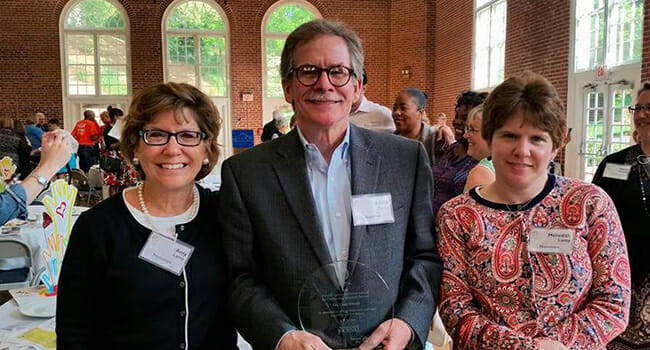
Left to right: Amy, Bobby, and Meredith Lamy
The Lamy family received a Forsyth County Governor’s Volunteer Service Award, sponsored by United Way of Forsyth County and HandsOn NWNC.
For the Lamy family, volunteering together began as a way to help their oldest daughter, Meredith, who lives with a form of autism, build social skills.
Bobby Lamy was already volunteering with the Second Harvest Food Bank, but his hours there were spent stocking shelves, not interacting with others. A fellow volunteer suggested Samaritan Ministries Soup Kitchen. After one visit, Bobby was certain the organization was the right place for their daughter, said Bobby’s wife Amy Lamy.
Soon, the entire family was working together, increasing their oldest daughter’s comfort level with people she doesn’t know, said Amy. Volunteering as a family has been important because it has taught her children the importance of helping those in need.
“We wanted to do something to help our children get a good understanding of how communities handle needs,” she said. “We wanted them to understand being in a position to lend a hand to those who are less fortunate in a way other than writing a check.”
On the third Sunday of every month, the Lamys are at Samaritan Ministries Soup Kitchen preparing meals cooked by professional staff with food donated from local businesses, restaurants and supermarkets, which can include soups, pasta, salad, fruit, bread and dessert. Food preparation begins around 9:30 a.m., with lunch served from noon to 2 p.m. – in that time, volunteers arrange and serve trays to approximately 200 individuals.
Even though their children are grown, Amy and Bobby continue to work with the soup kitchen – not only because doing so has become a big part of their lives, but also because they believe consistency in volunteerism matters.
Having a reliable group of volunteers helps Samaritan Ministries create schedules and budgets based on the known number of volunteer and professional helpers. It can also make a difference in how comfortable people feel returning to the soup kitchen for the nutrition they need.
“For a lot of people, seeing familiar faces gives them some hope,” said Amy. “And, I think it’s nice for them to see the same people when they come to Samaritan Ministries.”
See how your family can get involved on Family Volunteer Day.
Campus Initiatives Spark Gratitude and Desire to Give Back
Frandy Osias-Louis grew up not expecting a lot. Haitian born, his family immigrated to the U.S. after his father’s death, and life was difficult. His mother became gravely ill, the family struggled. So when a way was opened for him to go to college, a profound sense of gratitude took hold of Osias-Louis, who graduated in 2012 with a degree in psychology from Dominican College in Orangeburg, NY.
“The spark really started when I was in college,” recalled the energetic young man. “I wanted to do something positive, so when I heard about the alternative spring break program, I signed up.”
Working with Habitat for Humanity, Osias-Louis volunteered in New Orleans after Katrina and his passion for making a difference took hold. The following year he went with a group to central Alabama in the wake of devastating tornadoes. The trip proved epic in more ways than one – he met his wife Elena on that trip. The recently married couple lives in Nyack, New York.
Working with the Rotary Club, Osias-Louis started what he calls his midnight runs, trips into New York City to provide food and other necessities to the homeless population, forays he continues several times a year. “This population is barely recognized. They can feel invisible. People tend to think that being homeless is the person’s fault – but sometimes it’s just how life goes.”
Osias-Louis’ penchant for service extends into his profession – he works for the New York State Office for People With Developmental Disabilities, assisting and promoting independence for managers of group homes. Despite full time jobs, Osias-Louis and his wife continue to volunteer. The couple regularly works with Soup Angels, a Nyack group that provides weekly healthy meals in a dining room setting to anyone in need.
They coordinate volunteers for two midnight runs a year into the city and offer ongoing support to Habitat projects. His wife works for Volunteer New York!, which gives Osias-Louis another volunteer outlet to support the non-profit’s regular schedule of community safety days, park clean up events and charity 5Ks.
“When you’ve been there, when you know how easily life can change, situations can change, that’s something you don’t forget,” he said. “Volunteering is simply a part of life for us, something we will always do.”
Former Foster Child Turned Country Star Seeks to Help Other Kids in Need
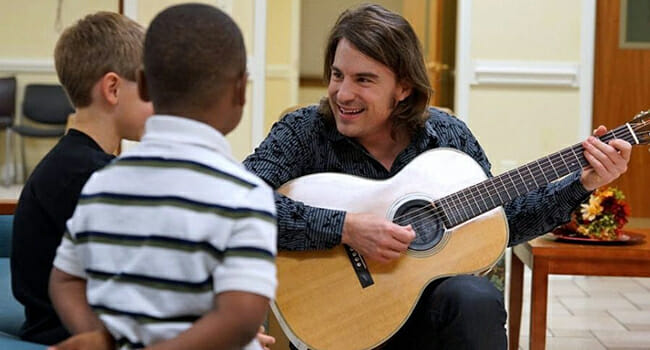
Courtesy: Jimmy Wayne
Country artist Jimmy Wayne sings to children in Mobile, Ala. The children were homeless and living with their mothers in the battered women’s shelter.
In 1994, a class of criminal justice students from a community college in North Carolina took a field trip to a local youth detention center. The guard at the center greeted the class by saying, “Good morning. In here we have all kinds of trash.” One of the students raised his hand and said to the guard, “You may not remember me, but my door was the last one on the right and you were the officer that checked me in on my 15th birthday. We’ve all made mistakes, but none of us are trash.”
That student’s name was Jimmy Wayne. And that was the moment he knew he had to do something for America’s foster kids. And it had to be big.
Born to a single mother who suffered from bipolar disorder, Jimmy spent his childhood being shuffled in and out of foster homes, while his mother spent time in the hospital or behind bars. Crystal Friday had Wayne in her sixth-grade writing class, twice.
“His anger is what I remember the most,” Friday said. “But I worked with him and told him to just write it out. Everyone had to have a journal. But if they wrote something they didn’t want me to read, I told them to fold that page down and I respected that.”
Friday said Wayne’s journal was full of folded pages, but from the pages she was allowed to read – she could tell he had a gift for storytelling.
When he was 13 years old, Wayne’s mom got out of jail and drove him to Florida where she abandoned him in the middle of the night at a bus station. Suddenly he was a homeless teen who had to learn how to live on the streets. He got into his share of trouble but eventually figured out the key to survival.

Courtesy: Vickie Ferrante
Jimmy Wayne on the road with Brad Paisley’s American Sunday Night tour, singing “Sara Smile,” the song that helped land his first record deal.
“Work. That’s what saved my life,” Wayne said. “Learning how to physically work and earn money. It made me brave enough to walk up to people and ask for help.”
For the next three years, Wayne worked any job he could find while couch surfing among foster group homes and receiving homes. By the age of 16, Wayne had aged out of North Carolina’s foster care system and was back on the streets.
That same year, he met Bea and Russell Costner. The elderly couple took him in and helped him turn his life around. He graduated from Bessemer City High School in 1992 and went on to earn an associate degree in criminal justice from Gaston Community College. Inspired by Bea’s love of music, Wayne also started writing songs and before long, he had moved to Nashville, Tennessee where he landed his first recording contract and publishing deal with DreamWorks. The homeless teen turned rising country music star was now sharing the stage with the likes of Vince Gill and Brad Paisley. But something was still missing.
“I was standing in the foyer of my house, staring at my cup of coffee and thinking about the past years of success,” Wayne remembered. “I looked outside and it was very cold. But I was inside. I had a housecoat and comfortable shoes on. I turned the thermostat up and when I heard the furnace turn on and I felt that heat blowing through the vents, it just sent me over the edge. I started feeling really guilty.”
Courtesy: Jimmy Wayne
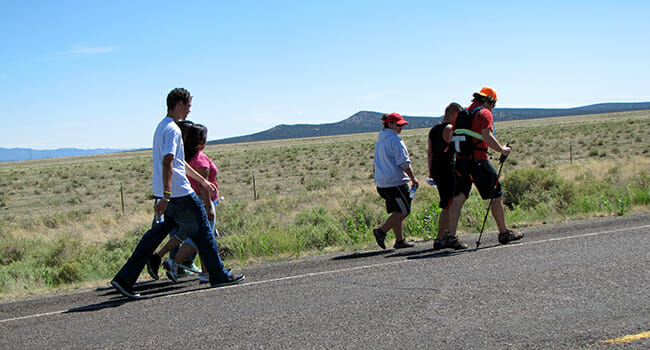
Jimmy Wayne walked through New Mexico with children who were in the foster care system.
Wayne said his mind immediately flooded with the harsh and painful memories of what it was like to be abandoned and homeless.
“When you live outside, and you’re asking people for food and work, that never leaves your mind,” he explained. “You never really forget how that felt.”
Within minutes, Wayne decided to make good on the promise he had made to himself in that detention center. He came up with the idea to walk halfway across America to raise awareness for the more than 20,000 foster kids who age out of the system and become homeless each year.
On Jan. 1, 2010, Wayne set out on a six month, 1,700-mile journey from Nashville to Phoenix. He named the project “Meet Me Halfway.”
“In other words, I’m not going to do it all for you, you have to at least meet me halfway,” said Wayne.
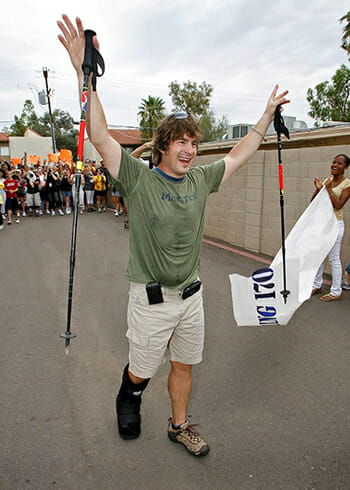
Courtesy: Jimmy Wayne
Jimmy Wayne seen crossing the finish line, after his 1,700-mile journey to raise awareness about the country’s foster care system.
He chronicled his walk in a New York Times bestseller titled “Walk to Beautiful: The Power of Love and a Homeless Kid Who Found the Way.” Project Meet Me Halfway is now a 501(c)(3) dedicated to building transitional homes for foster children who age out of the system.
Since completing the walk, Wayne has also shared his story with state legislators to help pass bills extending the age limit of foster care from 18 to 21 in California, Tennessee and his home state of North Carolina. Jimmy said giving those kids just three extra years to finish school, find work and transition into adulthood can make a world of difference.
But ultimately, Wayne believes the biggest impact is not going to come from the government.
“It comes down to ordinary everyday folks like us to get involved,” he said. “We all have resources that we can offer these kids. Mine was singing and writing and performing. So we all have to identify what our resources are and then ask ourselves, ‘How can this resource help a kid?’”
Wayne says it doesn’t take much time or money to give a kid hope. Visit his website for more ideas and inspiration on how you can help change the lives of America’s foster and homeless children.
California Teen is Making Her Community Healthier, One Corner Store at a Time
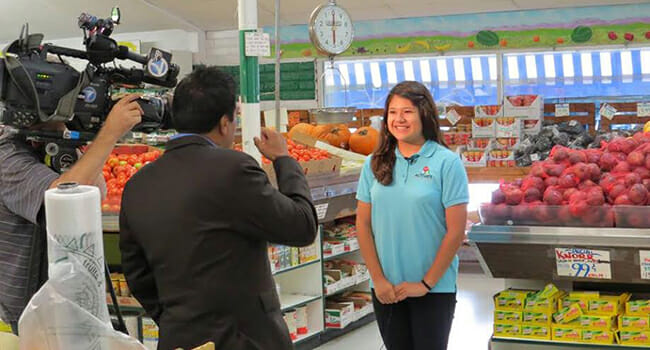
Courtesy: Analaura Amezquita
Analaura Amezquita has become the face of healthy eating in Whittier, California.
More than one out of every four teenagers are overweight or obese in the city of Whittier, according to the County of Los Angeles Public Health. Officials knew they needed to figure out a way to combat the obesity epidemic in the southern California community. And that’s where 17-year-old Analaura Amezquita comes in.
The high school junior has become the face of healthy eating, by promoting Healthy Picks – an initiative that highlights better food choices for families by encouraging corner stores to stock and label healthy items.
It takes dedication to get stores to sign on and keep the program going. Amezquita has embraced the challenge, but at first, she said, it wasn’t easy.
“It’s a bit nerve-racking. You don’t know if they’re going to reject [you] … it’s not like you want to dictate what’s going on in their stores, it’s just adding something to make their stores better and healthier, in my opinion,” Amezquita said.
But with each store, it gets easier, according to Amezquita. As she spreads the word of healthy eating, store owners have become enthusiastic about making a difference. She also designed the Healthy Pick logo, which is featured in the stores next to certain items that meet or exceed California’s nutritional standards.
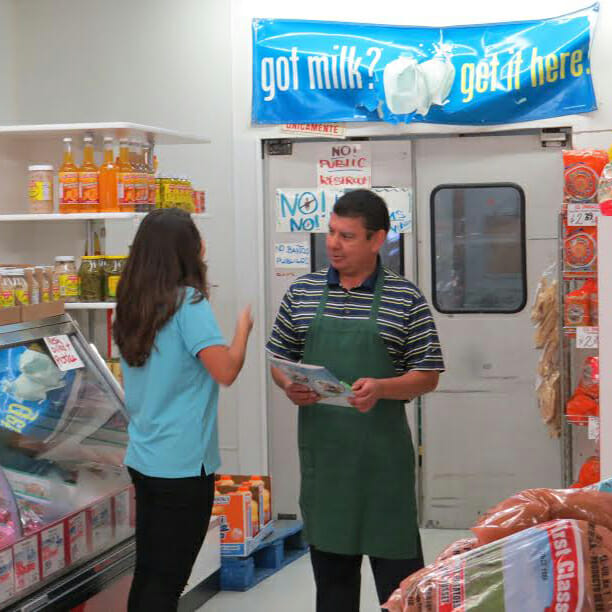
Courtesy: Penny Lopez
Analaura Amezquita speaks with a local grocery store manager about healthy food items.
Amezquita’s interest in healthy eating was sparked when she was in 7th grade. Her mother received a flier to attend a program called Change Begins With Me, sponsored by Activate Whittier, a collaboration of local organizations working to build a healthier, more active Whittier.
Through the class, which encourages individuals to develop long-term, healthy living habits within the community, Amezquita discovered the enormous obesity issue Whittier was facing. She set her focus on not only changing her own personal eating habits, but helping to lead others as well.
How does Amezquita explain her commitment? “I’m very passionate about healthy eating.” But she has a greater mission: “Giving a voice for the people who don’t have one.”
Penny Lopez is a project manager for Activate Whittier, which Healthy Picks operates in conjunction with. She said Amezquita’s dedication to the neighborhood sets her apart from others.
“Health in your community is based a lot on hope. If you believe that you can make a better community, then you’re more willing to risk saying something about [what] you want to see changed,” Lopez said. “It’s not that we saw anything outstanding that wasn’t there already. [Analaura] was already this child who was ready to take on the world – it’s just that she needed someone to show her that she could do it.”
Amezquita’s former principal at Whittier High School, Lori Eshilian, agreed. “She is comfortable standing out by making a positive contribution but does so with humility and appreciation for every opportunity. Analaura is not focused on looking cool or being in the popular crowd; she is focused on contributing to make the world a better place.”
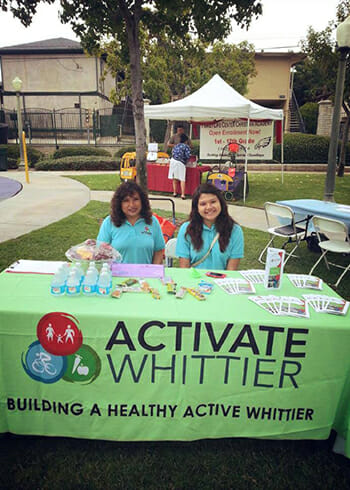
Courtesy: Analaura Amezquita
Analaura Amezquita and her mother, Rosalia Calam, support Activate Whittier’s mission by promoting the importance of a healthy lifestyle.
Lopez said Healthy Picks has been a success. Members of the community notice the labels, and at one of the stores, people started buying more fresh fruits and vegetables because of the labels, according to Lopez.
Amezquita’s mother, Rosalia Calam, who accompanies her daughter on trips to stores on behalf of Healthy Picks, said she’s inspired by how her daughter leads by example.
“There are people, like Analaura, who want to be the voice of the community, who serve unconditionally, who are willing to listen and do whatever it takes to help; you just have to find them. I’d tell them to not stay at home, to get out there and find that help that they need.”
Amezquita said working with Healthy Picks and eating better hasn’t just changed her physically, it has motivated her to do more. Her next goal? Getting larger grocery chains to pick up Healthy Picks.
“Activate Whittier has been essential in just helping me grow as a leader … if you don’t go and ask, you’ll never get anything done.”
Two Decades, One Mission: Board Member Crusades to Preserve the Performing Arts
Whether it’s a small act of gratitude, or a large monetary donation, building and bettering a community takes contributions of all proportions.
As a 22-year board member for the Society of Performing Arts in Houston, Texas, Theresa Mallet knows that every contribution, no matter how big or small, plays a significant role. From the pebbles to the boulders, Theresa has turned over every stone attempting to strengthen the art landscape in her city.
Her role as board member gives her a unique experience as it relates to volunteerism. As the current Vice President of Education and Community Engagement, Theresa involvement is extensive to say the least.
There’s a duality to her duties. She’s not only in those weekly meetings, discussing budgets and strategy, helping to make crucial decisions, but she also does the work of an average volunteer, in the field assisting with day-to-day activity, loaning her time and energy to assure projects are complete.
Because some schools may lack in budget, and programs are frequently shut down, special care and attention must be paid to the arts.
“With the limiting of funding for the arts, some of us have to take up the slack somewhere … We have to make sure that art is still in our schools and community because it very vital,” said Theresa.
The creativity and self expression that results from artistry could never be replaced, and because of that, Theresa has made keeping and restoring art throughout the city her prominent concern.
“The arts are probably one of the most important tools for a child’s education for a zillion reasons,” said Theresa. “As we all know, children who are exposed to the arts test better, and they possess better learning skills.”
Couple Volunteers 2,800 Hours Helping Community Members in Need
For many low-income, limited-English, or elderly individuals, accessing needed services can often be difficult. Having someone available to make the process easier is always appreciated.
That’s where Thomas and Barbara Britt come in. Since 2004, they’ve helped those in need. And, they’ve done it side-by-side through the RSVP program.
“We have always enjoyed doing things together and believe it is good to have mutual interests which help to strengthen our marriage,” Barbara said. “By volunteering together, we are able to do more by utilizing each other’s strengths.”
The RSVP program is a volunteer service organization for individuals over age 55. Volunteers choose activities based on their skill sets, and they dedicate up to 40 hours per week. Thomas currently serves on the advisory board.
Since becoming involved, he and Barbara have recorded 2,863 volunteer hours through Meals on Wheels and VITA tax (Volunteer Income Tax Assistance), a program serving low-income, disabled, or limited-English speaking individuals. They also work with Tax Counseling for the Elderly, a tax-assistance program for adults over 60. According to Barbara, they both prepare tax returns because the IRS is scary for many people. In 2016 alone, the Britts completed 900 tax returns.
Alongside their tax work, the Britts volunteer through their community Meals on Wheels program. To date, they’ve delivered 8,372 meals to home-bound senior citizens. Additionally, they give their time to their church in Pennsylvania, St. Vincent DePaul, and to their local Interfaith organization. Through Interfaith, they help older adults stay independent by taking them grocery shopping or to the doctor.
And, at every turn, they make the effort to engage their clients in conversation, prompting a smile or laugh.
“Tom and Barb Britt are two of the most giving and unselfish volunteers I’ve ever seen,” said RSVP program director Magan Aston. “They are dedicated to helping others who need it and expect nothing in return.”
Type-A Executive Dedicates Retirement Years to Giving Back
To say that Karl Yena is a man with a plan would be quite the understatement.
The 75-year-old Winston Salem resident retired from R.J. Reynolds as Director, Worldwide Organization Development and Training in 1997 after 33 years with the company. The self-described type A corporate executive was just 56 and had, as he says, “worked darn hard to get to where I was. I knew I still had a lot more to give.”
So he set an intention, actually many years’ worth of intentions, to first consult with for-profit companies and gradually supplant that with non-profit volunteerism. “Within five years my idea was to be consulting 100 percent for non-profits,” said the vigorous septuagenarian. It’s certainly worked out that way.
Yena has partnered with some 120 local and regional nonprofits over the past 15 years as an active board member or as a “connector”; cajoling others to participate or to enlarge their volunteer service. His expertise includes mentoring, strategic planning, board and staff development and facilitating the merging of cultures.
“The non-profit world doesn’t take the risks, they can’t move as fast, as the corporate world, nor should they,” he said. “Helping folks understand structure, policies and processes, assessing talent, working on efficiency and effectiveness, it’s all important. It’s about adopting more of a head sense than a heart sense, finding a balance of the two.”
A lifelong learner, Yena took a thoughtful approach to which non-profits he would target. He has stretched out of his comfort zone in some cases, and has learned mightily and been inspired along the way. Yena started in the education sector, moved into health and senior organizations, then human services as well as the faith based community and municipalities.
The last group on his list was the arts. “I don’t deal well with artists intuitively.” But to his surprise, coloring outside the lines wasn’t such a stretch. He found creatives stimulating for their outside the box thinking and boundless energy. “Sometimes they drive me nuts because they aren’t always in touch with reality, but I’ve learned a lot.”
Whether he’s working to save a school system millions in operational funds, which can then be applied in the classroom, or helping a struggling arts organizations thrive, Yena
gets tremendous satisfaction from bringing the his skills into the non-profit world. Typically he spends 40 to 45 hours a week on his boards. “I seldom say no.”
Yena’s plan is to gradually slow down, to step aside by 2018 – if he can. “I’d recommend this to anybody,” he said. “If you like being around people and seeing the difference you can make in other people’s lives, there’s nothing like it.
From Disaster Victim to Rescuer: American Red Cross Volunteer Heeds Call to Serve
Seven days before Sept. 11, 2001, a flood hit Houston, trapping many residents in their homes. Julie Knobil was one – but, instead of sitting by and waiting for help, she reached out to help others. From that day on, she’s been a consistent volunteer with the American Red Cross.
Throughout the past 15 years, she’s helped hundreds of people who’ve been impacted by floods, fires, and other disasters. She’s on call 24-7 because it’s important to be able to help others as quickly as possible, she said.
“As a volunteer, you really feel like you’re in a position to help people who really need it,” she said. “It makes you feel good to help others get on the road to recovery.”
Since beginning, Knobil has worked in client services, interviewing disaster victims immediately after an event. She finds out what they need and who might be best positioned to help them. For example, she connects people with the Salvation Army for shelter or with surrounding nurses and doctors for medical care. Throughout her volunteer career, she’s helped a woman obtain a replacement for a glass eye and helped a young mother receive new asthma equipment for her 3-year-old after losing it in a house fire. She also works with other Red Cross volunteers to provide mental health services when they’re needed.
On top of her on-call duties, Knobil volunteers her time to teach others how to design, build, staff, and run shelters that will house displaced individuals and families during times of disaster.
Recently, Knobil moved to Pennsylvania. She hasn’t yet resumed her Red Cross work, but she plans to do so soon. The impact she’s able to make on others during their times of need is vital, she said.
“You can’t do everything for people – in many cases, we can only refer them to services,” she said. “But, often, based on my interviews, people are visibly more relaxed once they’ve talked with me and have a plan. Many ask to give me hugs.”
After More Than 22 Years in the Military, Veteran Finds New Ways to Serve His Community
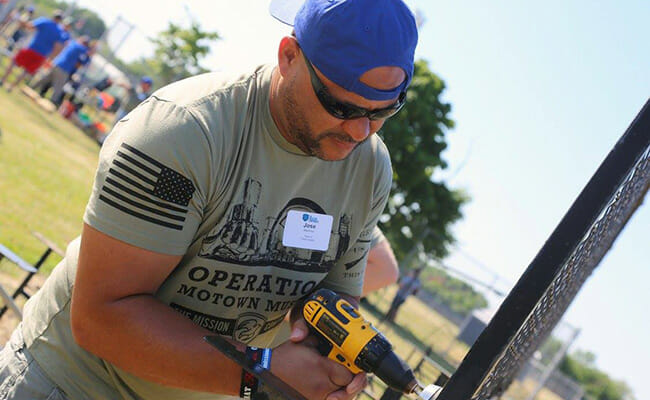
Courtesy: Jose Martinez
Jose Martinez works on various projects to help other veterans in need.
Philadelphia is called the city of brotherly love, and for one resident, it’s a motto he lives by. After more than 22 years in the U.S. Army, Jose Martinez now dedicates his time to bettering the lives of other veterans.
“I joined the National Guard when I was 17 years old. To be honest, it was just something to do,” Martinez said.
That was in 1989. For years, Martinez worked in construction for a telecommunications company, serving one weekend a month as a part of the National Guard. That is, until Sept. 11, 2001.
“I was actually on a job in Pennsylvania, nearby to where United Flight 93 crashed,” Martinez said. “I contacted my unit immediately. I said, ‘If there is a mission, I want to get in on it.’”
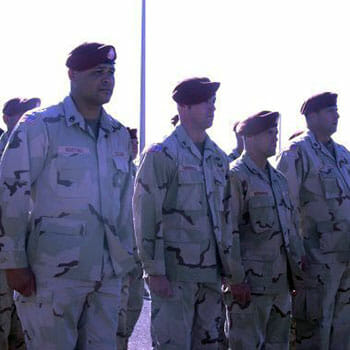
Courtesy: Jose Martinez
Jose Martinez (far left) with the 50th Brigade Combat Team in Egypt.
Martinez was activated three days later. His National Guard unit was one of the first sent to New York, to help at Ground Zero. It was then that Martinez decided his country needed him and he made the move from reserve to active duty.
After returning from deployment in 2004, Martinez became an instructor for the National Guard and hit his professional stride.
“I rose through the ranks of the training world in the army, developing and managing courses for the infantry school,” he explained.
He was teaching soldiers to be warriors and he had earned a great deal of responsibility – but when he retired in 2013, everything changed.
“When you leave the military, you’re starting all over. And you lose that – whatever it was in the military that you were – sergeant first class, a private, even your name because in the military we go by last name or nickname. You’re no longer that person anymore. And that was really hard for me,” Martinez said.
He tried to go back to working in telecommunications but he really struggled, only finding offers for entry level jobs. He tried to start his own auto restoration business but was barely breaking even. By this time, he had children to care for and he knew he needed to make a big change.
“I felt like I was going backwards, so I decided the best course of action for me would be to go to school,” he said.
At age 40, Martinez enrolled at Drexel University, in Philadelphia. It was there that his future started to take shape.
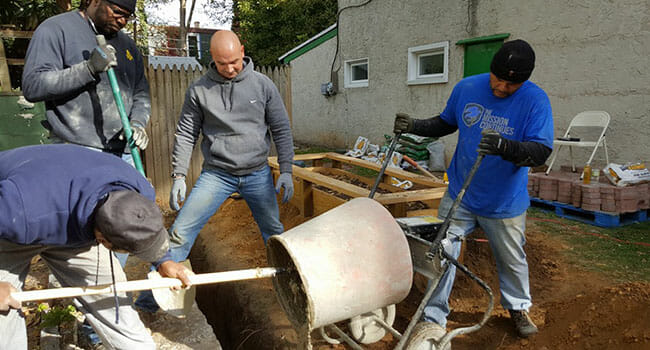
Courtesy: Jose Martinez
Through The Mission Continues, Jose Martinez works alongside fellow veterans to repair a damaged wall.
“When I moved to Philadelphia, it really put everything into perspective for me,” Martinez said. “I saw how much need there was in the city, for veterans [to be assisted.] There were so many veterans suffering from homelessness, struggling with alcohol and drug dependency and struggling to secure VA benefits.”
On top of his studies and dad duties, Martinez started volunteering anywhere he could to help veterans. He joined Drexel University’s Veterans Association and Veterans Task Force. Martinez felt that because of his exposure to academia in the military, he had an easier transition from warrior to student than others. So, he sought out opportunities to help those who were struggling. He established himself as an undeniable resource and veteran advocate. And people noticed.
The Mission Continues is a non-partisan, nonprofit organization that evokes veterans’ inner call to service and engages them in projects that will improve their communities. The organization creates chapters – or platoons – that have the same internal structure as the military. Platoons are assigned missions that range from painting walls at homeless veterans’ shelters to making improvements for schools in impoverished neighborhoods.
The organization reached out to administrators at Drexel, which has a large veteran population, looking for a student veteran who might make a great platoon leader. With nearly 900 students to choose from, the university suggested Jose.
“They said, ‘Yea, we got a guy!’” Martinez said.
“I think what [The] Mission Continues did for me in Philadelphia was it kind of validated me. Before I was just going into an organization saying ‘I’m Jose Martinez; I help veterans.’ No one knew who I was. So, being able to say I am the project manager for [The] Mission Continues, I am here to engage veterans…it immediately validated who I was.”
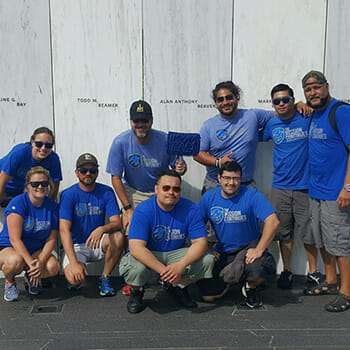
Courtesy: Jose Martinez
Martinez and The Mission Continues platoon at a service project for the United 93 Memorial.
According to Rebecca Weidensaul, assistant vice president for student life at Drexel University, Martinez was the perfect choice.
“He takes every moment with every person as an opportunity to educate them and really enlist people beyond, ‘Thank you for your service.’ He will call you to action and that is what helps him advance his personal mission to ensure that no veteran is left behind,” Weidensaul said.
Martinez quickly learned that The Mission Continues does more than just service projects. He saw that it gave the veterans back that missing piece of their identity, something they may have lost in the transition to civilian life.
“What happens to a lot of us is we tend to isolate ourselves when we get out of the military. We don’t want to build relationships with people who don’t understand the struggle of what it is to be in the military. [The] Mission Continues allows us to make those relationships again, to serve again and be part of something that’s bigger than we are,” he said.
Christopher Jimenez, a member of Martinez’s platoon, pointed out another successful outcome of Martinez’s work.
“I feel like he’s helping others in the city see that veterans are out making a difference and that we can be positive contributors in the community,” Jimenez said.
Martinez’s children are also following his example. His two oldest sons, Jose and Isaiah, are frequent volunteers. Martinez encourages platoon members to bring their children along – “so that we can start building a community that is dedicated to service.”