Fresh Start for Single Mothers and Their Children Community Outreach Project empowers single mothers so they can become self-sufficient and create positive outcomes for their children.
Bringing together support, information and shared community resources, the program seeks to end the cycle of generational failure in the Richmond, VA area and equip the next generation for success.
According to program director Sylvia Stewart, many Fresh Start moms come from abusive relationships trying to restore their self-esteem. Fresh Start helps them learn new life skills and coping skills, not only offering guidance on managing their finances and getting a job, but also learning how to forgive and move forward in a positive direction.
“One of our mottos is ‘You can’t drive a car looking in a rear view mirror,’” Stewart says.
Families are invited to special events hosted by community partners that include dinner, a specialized skills class, childcare, special K-5th program, teen group and discussion time. During the 20-week program, a stable of expert speakers help single mothers learn concepts for everything from personal finance and seeking employment, to parenting advice, health and wellness tips, basic car care and more. The program also runs an emergency fund that awards small grants to help single mothers actively participating in the program offset unforeseen gaps with money for housing, medical, car and other basic needs.
Run exclusively by volunteers, the program has assisted more than 1,000 single moms and 2,000 children since it began more than a decade ago. A handful of the volunteers that contribute to Fresh Start for Single Mothers and Their Children have gone on to receive the President’s Volunteer Service Lifetime Award.
“Most of our volunteer are single moms who have come thru the Fresh Start program and loved it so much when they graduate that they come back to serve and inspire the new moms,” Stewart explains. “This is a powerful testimony to the success of the program. The women are so transformed.”
Fresh Start also brings on additional volunteers and community partners who work on special needs for families and events throughout the year. The organization is looking to apply its best practices nationally, offering Fresh Start curriculum to other organizations that help single moms and families in transition.
What does Stewart suggest to others who want to make a difference in their communities but don’t know where to begin? “Don’t wait till circumstances are perfect to volunteer,” Stewart says. “Come as you are. No special skills are needed. Just bring a smile and willing heart to help.”
Ridgewood Mentoring Mission
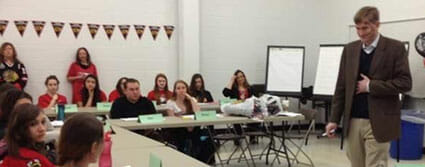
Charles Duncan teaching senior students mentoring
and leadership skills.
For many students, the move from middle school to high school can be a daunting transition. Because of high school’s independent learning environment, many incoming freshman struggle academically and socially. Even the highest achieving students can struggle with the raised expectations. Ridgewood High School, of Norridge Illinois, has been working since 1999 to help ease this transition with the Ridgewood Mentoring Mission.
Carol Valentino-Barry of Ridgewood Mentoring Mission explains, “It’s part of our school’s mission statement that students set and accomplish goals.” For some students, their goals may not be achieved because they fall behind or get lost in the fast paced environment of a new high school.
Many students find it hard to make the most of the opportunities presented to them in high school. By setting goals and having a mentor to help reach them, students are more likely to become engaged and successful young adults. Mentoring Mission reinforces student success by applying executive functioning skills in monthly mentoring meetings. Meetings include volunteer business partner mentors, freshmen and upperclassman assistant mentors and focus on developing skills such as prioritizing, goal setting and decision-making.
Charles Duncan, Vice President of United Airlines in Chicago, teaches the leadership and mentoring course portion of the mentoring program. Mr. Duncan teaches the senior students with Harvard Business School Case Studies. Using the Socratic Method, students analyze and debate cases, sharpening their decision-making skills. Student leaders are offered seasonal employment at United as well as internship opportunities under the tutelage of the Mr. Duncan.
The mentors and freshman students also engage in community service activities, making 1,000 sack suppers each year and delivering them to the underprivileged men and women in Chicago. Students also make breakfast for a women’s shelter and make greeting cards for senior citizens that are homebound.
Laura McGready, a volunteer mentor for more than six years, explains some of the struggles mentors face, “Not every student we mentor is open to being mentored. But students do get something out of it. As a mentor, you don’t see the results right then and there of what you are doing. But the end reward is great.”
The Mentoring Mission establishes a tiered-network for increased support and achievement using the unique architecture of engaged community volunteers and stakeholders. Key constituents including school board members, community/ business leaders, Mayors, the Chief of Staff for the Secretary of State of IL, Police Chiefs, parents and alumni have acted as mentors to 9th graders. Together, these mentoring teams share their life experiences and tools for success.
Fotini Anastopoulos, a current junior at Ridgewood, shares her favorite part of mentoring saying, “The part that I love the most is that I get to work with students that I normally wouldn’t interact with if I wasn’t part of this program. I can help them with problems that I might be experienced with.”
Dylan Tabang, a senior, says, “I like being able to work with the community leaders. We share different philosophies and life experiences. Their advice and perspective are priceless.” Mentors and freshmen alike gain invaluable experiences through the Mentoring Mission.
Over 3,000 freshmen have been mentored by more than 300 volunteers and 600 upperclassmen since the program began over a decade ago. The Ridgewood Mentoring Mission’s network of volunteers and participants allows everyone to benefit from varying levels of mentorship. Freshmen are supported, and upperclassmen (as well as adult mentors) get to hear and repeat the lessons over the course of their years volunteering in the program. Repetition and teaching others makes the skills more “sticky.” Repeating the dialogues and behaviors of success skills reinforces good habits for everyone in the program. For more information, visit http://rhsmentoring.blogspot.com/
The Ridgewood Mentoring Mission is helping students reach their full potential and become active members of their community. If you know an organization like Ridgewood Mentoring Mission, nominate them today for the Daily Point of Light Award at https://www.pointsoflight.org/programs/recognition/dpol/nomination
Update:
Mentoring Mission continues to adapt to the changing needs of high school students, teachers, business and the world. Under the direction of Carol Valentino-Barry, MBAs from Harvard and other universities leverage the virtual learning environment to lead Socratic seminars about business cases to over 600 students in Business, Science, Social Studies, English and AP classes in Chicago Public Schools. Programing has expanded to include mock interviews and career training pipelines in manufacturing and aviation mechanics, all guiding high schoolers to aim high and prepare for their futures.
Family’s Global Volunteer Enterprise Puts Better Oral Care into the Hands of Those in Need
February is National Children’s Dental Health Month, created by the American Dental Association to raise awareness about the importance of oral health. One volunteer family has found a simple, yet meaningful way to help others – both abroad and nationally – who live without access to basic oral care. Learn about today’s Daily Point of Light Award honorees and why their volunteer work has people smiling all over the globe.
We stand over the sink every day and rarely give it a second thought: caring for our teeth is the hygienic ritual that most Americans could easily take for granted their entire lives. In our land of plenty, new toothbrushes and minty fresh tubes of toothpaste are only as far away as the nearest convenience store.
But one family in Woodcliff Lake, NJ has a completely different perspective on the impact a toothbrush can make for those in need. Meet the Alenicks, key contributors to a global effort that has helped put more than 150,000 toothbrushes in the hands of people living in 60 developing countries, fostering healthier futures – and brighter smiles – around the world.
Sisters Ashley and Paige Alenick grew up with an appreciation for community service. At ages 9 and 7 respectively, they were the youngest volunteers to participate in a chorus that performs songs from the 1940s for elderly residents at assisted living facilities. “It was an important part of our upbringing,” says Paige. “Our parents taught us the idea that if you have a lot, you should give something back.”
According to the sisters, the idea to collect and redistribute toothbrushes came on a random day in 2011 when Paige – appropriately – was brushing her teeth. “I thought about it simultaneously as something we take for granted and something others need,” Paige describes of her epiphany. From there, the Alenicks’ Donate-A-Toothbrush cause began to take shape.
The family reached out to Oklahoma-based World Dental Relief, an organization that sends dental experts on hundreds of annual missions abroad, and connected with Dr. Ron Lamb. The conversation confirmed the need for more supply of toothbrushes, as Lamb explained his organization did not have toothbrushes for its dentists to leave with those they treated, which meant the results that these missionaries accomplished to improve hygiene were short-lived at best.
Ashley and Paige also learned that the issue of dental health reached far beyond cavities. Paige describes learning about the links between dental health and heart health, and that AIDS and hepatitis can occur from sharing toothbrushes.
The sisters engage in letter writing campaigns to dentists nationwide, attend dental conventions where they speak with suppliers and distributors, and organize toothbrush drives at schools ranging from nurseries to Universities. To broaden the reach of their call for donations, Ashley and Paige also take their message to social media and news outlets.
The pair have met with name-brand manufacturers of toothbrushes and have even given testimony before the United Nations Youth Assembly. “It was amazing meeting other kids our age, sharing our ideas on how they could develop their own projects and encouraging them not to shrink away from the challenges of changing the world,” says Paige. “People take it seriously,” Ashley adds. “They’re so receptive to this idea and they want to help.”
The Alenicks regularly receive distribution photos that show children in Kenya, Ethiopia, Uganda, Vietnam, Senegal and other countries proudly holding toothbrushes that originated from Donate-A-Toothbrush. “It reminds our family what’s important and it gives us motivation to do more,” Paige says, describing how the children in the pictures appear to hold up the toothbrushes as though they were trophies.
The entire operation is a family affair. While Ashley and Paige lead the outreach effort, it is their father, Scott who built and manages the donateatoothbrush.com website. And Suzanne, their mother, helps wrangle stacks of donations all over the house. In their first year, the Alenicks rounded up 3,000 toothbrushes. Now, donations come in from more than 35 states, as well as from eight other countries – India, New Zealand, Australia, Canada, Italy, Ethiopia, China and England. The family boxes up the donations and ships them to World Dental Relief. Today, Donate-A-Toothbrush is the largest supplier of toothbrushes to World Dental Relief, having brought in more than 150,000 toothbrushes.
“It’s just the four of us,” Paige says of their global endeavor. “We could not have done any of this without support from our parents.”
Ashley is now 22, studying law. Paige is 19, also in college. Speaking about the long-term sustainability of their effort, the two sisters say Donate-A-Toothbrush is a long-term commitment for them. “We have no plans to give it up,” Ashley declares. “We’ve managed it all through college and hope to grow it even more.”
During National Children’s Dental Health Month and every month, this family has found something they can do together that makes a difference on the other side of the globe. “We live in a community that has so much,” says Ashley. “It feels great to give back.” Paige agrees with her sister and partner in making change, adding, “Even the tiniest ideas can spiral into something bigger than you can imagine.”
Who are the people in your community doing good for the greater good? Nominate an exceptional volunteer you know for a Daily Point of Light Award today at https://www.pointsoflight.org/programs/recognition/dpol/nomination
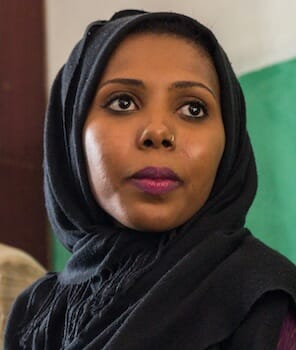
Jaha Dukureh (Photo by Irene Baque / The Guardian)
When Jaha Dukureh was 15, she moved from the West African nation of Gambia to the United States for an arranged marriage. Prior to her move, Dukureh was forced to undergo the most severe form of female genital mutilation and had to be surgically reopened upon her marriage.
The World Health Organization describes female genital mutilation, or FGM, as “partial or total removal of the external female genitalia, or other injury to the female genital organs for nonmedical reasons” and calls the practice an “extreme form of discrimination against women.”
To help girls and women who have suffered like her, Dukureh founded Safe Hands for Girls, an Atlanta-based, grassroots organization against female genital mutilation.
“As a woman and knowing the effects this practice had on me, it was very important for me to break the taboo and culture of silence,” said Dukureh, now 25. “I know how painful this practice is and what it has taken from me, and I don’t want to see any women experience what I have endured.”
Dukureh travels the country to speak to communities affected by female genital mutilation. She also presents workshops and seminars at universities to raise awareness about FGM occurring in America.
FGM is often perceived as a problem that only happens in faraway places like Africa. But in the United States, young girls from immigrant communities – from countries where FGM is a cultural or religious coming-of-age ritual – are subject to the practice.
Safe Hands for Girls supports survivors with legal aid, connects them with referral services and has created support groups for FGM survivors around the country.
“I started Safe Hands for Girls because as a survivor of FGM, I know how hard it was for us and having to deal with alone and I knew I needed to speak up and support other survivors,” she said.
Dukureh has been instrumental in awakening public interest in the campaign against FGM in the United States. Her work includes national media outreach and formidable campaign work that preceded the passage of the Girls’ Protection Act of 2010, sponsored by U.S. Rep. Joseph Crowley of New York. Dukureh also launched a petition on Change.org calling for the Obama administration to develop a strategic plan to end FGM; the petition currently has more than 220,000 supporters.
Meanwhile, Dukureh’s work has inspired a new generation of survivors who are breaking the cycle from mother to daughter. She now trains other survivors to be advisers in their own communities.
“Women’s empowerment is allowing women to enjoy their God-given rights to sexuality, health and freedom,” Dukureh said. “We were born free and perfect.”
If you are interested in helping Jaha Dukureh put a stop to FGM, follow Safe Hands for Girls on Twitter, @SafeHands4Girls and see what you can do.
Ginny McCoy
For 20 years, Ginny McCoy has been helping special needs youth and adults achieve victories on the tennis court that help build confidence off the court. As the Special Olympics tennis head coach in her Virginia Beach, VA community, this dedicated volunteer and coach has grown membership in her organization from five to 33 athletes through her hard work and recruitment.
Her passion for tennis runs deep, going as far back as high school, though Ginny didn’t pick up a racquet again after that until her early-30s. She says tennis helped her cope with family issues as she advanced further into adulthood.
Ginny would later meet her future husband on a tennis court. Her spouse has been involved in Special Olympics for many years, and for Ginny, volunteering with this extraordinary group became an activity they could look forward to doing together.
Ginny coaches, trains and mentors children and adult athletes, helping them experience the joy of competition and sharing their gift with their families and other Special Olympics athletes and the community.
“Each one of these athletes we consider to be our children,” says Ginny of the strong bonds she has formed with her pupils. “For their parents to trust us, they are our family. That’s why we’re doing this.”
Giving three dozen athletes the support they need to become tennis aces requires a team effort. Ginny recruited more than 50 volunteers to pair with her Special Olympics athletes for a special competition modeled after a professional-style tennis match. And the success of her local efforts carried Ginny to the 2014 USA Games as the head tennis coach representing the Commonwealth of Virginia, where a handful of her pupils competed. Her involvement as a Special Olympics coach has also taken her abroad, including going to Ireland for a tennis event.
Even with many other options for competitive sports available – track, swimming, bowling, baseball – parents keep bringing their children back to Ginny because they see her commitment. Off the court, Ginny has facilitated speaking opportunities for her athletes to share their stories and motivate others. There’s always something she can offer as a coach.
In her volunteer and career work, Ginny’s success in leading others comes naturally. A civilian employee in the Department of Defense, she is recognized as a Lean Six Sigma Black Belt e and is routinely sought for process improvement advice.
Adorning her desk at the office is a special gift that has more significance to Ginny than any national award will ever receive. She describes it as a handwritten certificate of appreciation, given to her by one of her tennis athletes.
“I believed I was out there helping others,” Ginny explains. “But this experience has enriched my life more than I could have imagined. Pick something you’re truly passionate about. Find an opportunity to serve and your passion will grow even more.”
McKenna Knight
When the weekend arrives for students at John Rogers Elementary in Seattle, WA, some of them go home to empty cupboards and may not have access to their next meal until they return to the school cafeteria on Monday morning. McKenna Knight is working to change those circumstances for young people in need.
Knight leads the Healthy HIP Packs program, a project of Hunger Intervention Program. Her efforts are contributing to solve a problem that pervades the entire state: according to data from Hunger Intervention Program, one in four Washington youth live in households where families experience hunger.
Healthy HIP Packs addresses food insecurity that many children experience when school lets out for the weekend. Knight coordinates a group of volunteers via United Way of King County who collect, sort assemble and distribute meals and snacks at several schools in Seattle each Friday to give to students who face food insecurity challenges. In one year, as many as 9,700 meals are distributed.
Lending her time and dedication to lead volunteers who help young people in need, McKenna Knight stands out as a Daily Point of Light.
Ann Maxwell
Out of homelessness and into hope
Bound and determined, Ann Maxwell is committed to solving family homelessness. As the founder of Brookview House in Boston, Mass., Maxwell, who is a lifelong activist, introduced a novel idea: safe apartment-style living with on-site support services and specialized childcare to get mothers and their children out of the revolving door of homelessness.
Established in 1990, the Brookview House mission is to help homeless and at-risk families learn the skills necessary to break the cycle of homelessness and poverty. It provides a safe community setting with customized services to give homeless moms and kids the help and skills they need to succeed. Almost all mothers who complete the program continue to maintain a stable home and their kids stay in school and graduate.
By helping families to thrive, Brookview House helps to stabilize the community. Brookview House serves 370 moms and children annually. More than 90 percent of the mothers who complete the program maintain long-term housing, and 87 percent of youth program participants graduate from high school.
What started with six families has now gone on to become a successful nationwide model impacting thousands of women in need. Brookview House is a leader in its sector and convenes annual conferences, advocates for policy changes and fights to ensure mothers and children succeed and thrive.
Maxwell is unyielding in her mission to propel two generations forward, “We proudly work beside moms and kids as partners in their plans to confront obstacles and transform their lives. We listen intently to their hopes & dreams and guide them toward success”
Maxwell served as Board Chair for 10 years and continues to volunteer. She is always willing to roll up her sleeves and climb a roof to check for leaks or throw some high heels and meet with policymakers and advocate for homeless moms.
Gregory Cotton
A recent report from the U.S. Census Bureau’s American Community Survey ranked Rochester, New York as having the fifth highest poverty rate (31.1%) among the top 75 metropolitan areas. The vast needs of this community are growing and evolving everyday. Thankfully, Dr. Gregory Cotton has stepped up and volunteers his time to meet the many needs of his fellow community members.
Dr. Cotton has taken the reigns as Board President of the Northwest Neighborhood Outreach Center. Here, people of the community can come for a hot meal and leave with a full stomach, proper shoes, a warm coat and even a roll of toilet paper.
“The goal is to get these things into their hands,” Dr. Cotton explains. “People come in to eat, and we then proceed to steer them to the thrift shop down the hall.” Dr. Cotton helped restructure a thrift shop for low-income families in a way that allows for more flexibility, which results in more people being clothed. “People should always have warm clothing, shoes, and always a place to eat. There are all of these different needs, and we aren’t judging anyone. We just fill these needs.”
The Northwest Neighborhood Outreach Center served over 18,000 meals last year, which was a 20% increase from the previous year. An increase like this happens because of Dr. Cotton’s direct engagement with potential partners and volunteers. He is proactive in establishing partnerships in order to expand and sustain volunteer efforts. Dr. Cotton explains his strategy, “You form these partnerships and alliances, which results in projects moving a lot quicker and taking care of more people.”
Additionally, the Northwest Neighborhood Outreach Center offers mentoring for working age adults. Many studies have shown a severe skills gap in America; Dr. Cotton is working to help close this gap by providing skills-based mentoring to help these adults gain employment and by engaging high school students with internship opportunities to learn real world business skills.
He led the development of a one of a kind Clean Technology Internship Program at Brighton High School, which focuses on Science, Technology, Engineering, and Mathematics (STEM). Dr. Cotton provides extensive support for these students, offering an open line of communication, exposure to real world business experiences and recommendations for future opportunities such as college and beyond. He is a mentor for these young adults who might otherwise struggle to meet their full potential.
Dr. Cotton recalls a moment that has since inspired his commitment to service, “We had ten people in my family growing up, and we weren’t rich by any stretch of the imagination. But I remember when a man came to our door asking my mom for a sandwich. She went and made him a sandwich, gave him some cookies, and he was on his way.” He remembers his mother stating that because she could help him, she did. This mindset has fueled Dr. Cotton’s volunteer work and shaped his belief on the importance of volunteering. Everyone is capable of making a difference.
Since then, Dr. Cotton has worked to instill a similar mentality in those around him. One of his proudest moments was watching his sons gather their old toys to give to the Northwest Neighborhood Outreach Center. Since then, his sons have regularly helped him with his numerous volunteer projects, without complaint.
Dr. Cotton believes everyone has the capacity to help in some way. “Take a step back from your own life and see what’s going on. Start small. You’d be surprised how much time you really have.”
Dr. Gregory Cotton works tirelessly to meet the needs of his community. But he also works to leverage the immense capabilities of potential volunteers. He believes everyone has something to offer, and simply getting out in our communities to help create change is something of which we are all capable.
If you know someone like Dr. Cotton meeting the needs of their communities, while being a beacon of inspiration, nominate them today for the Daily Point of Light Award at https://www.pointsoflight.org/programs/recognition/dpol/nomination.
Katarina Eckstein-Schoemann
Video provided courtesy of CNN.
Katarina Eckstein-Schoemann is the proud older sister of two autistic brothers. Growing up, Schoemann and her brothers tried out different after-school activities but often walked away discouraged and frustrated. Whether it was soccer, baseball or swimming, her brothers struggled to find an activity they enjoyed, and that also made them feel a sense of normal.
But then, the Eckstein-Schoemann family discovered Taekwondo. Schoemann reflects on why they fell in love with Taekwondo, “We loved it because we were all able to go out on the floor together and help my brothers, and they felt normal because all the other parents were out there helping their kids too.”
Because Schoemann grew up around children with disabilities she has a unique understanding of the assistance and support children like her brothers need. In May 2011, after her eighth grade year, she oversaw the formation of Breaking Barriers Martial Arts, Inc. which is a nonprofit that trains persons with disabilities in the martial arts.
In the last three years, the program has grown from one to 20 students with a growing waiting list. While the students have varying disabilities, including autism, Down Syndrome, Muscular Dystrophy, attention deficit hyperactivity disorder (ADHD), hearing impairments and vision impairments, Schoemann and her team at Breaking Barriers are able to help improve their students’ confidence, focus, discipline, respect, coordination, balance, social skills and overall happiness.
“You have to learn patience,” Schoemann explains.
Working with children with disabilities can be challenging and even frustrating at times. But Schoemann sees improvements in her students every day; one of the most rewarding moments for her was going to the 2013 AAU Taekwondo National Championships. Up until this point, there had been no opportunities for children with disabilities to participate. At the Championships, Schoemann helped children with disabilities from all across the nation compete.
She remembers, “There was a moment when we all walked out on the floor and everyone in the arena just stopped and started clapping. Everyone watched them compete. It was very emotional.”
Since then, Schoemann has run the first special needs Florida state qualifier for the AAU National Championships and the special needs division of the International Martial Arts Festival at Walt Disney World. Schoemann helps teach classes to 20 students, with plans to grow the class sizes soon. As the leader of Breaking Barriers, she also spearheads fundraising missions and has overseen a multi-faceted campaign.
Breaking Barriers is a growing organization that provides a necessary service to children with disabilities, and it wouldn’t exist without her. The success of her efforts is easily seen in the enormous progress her students have made. “By the time they tested for first degree black belt they were confident and ready,” Schoemann remembers from her brothers’ black belt ceremony. Her brothers proceeded to make a speech in front of 50 other testers and many more people thanking them with sheer confidence. Every day Schoemann is rewarded by seeing this kind of progress from her students.
Schoemann has been inspired by watching her students grow and overcome some of the challenges they were born with. She encourages others to seek inspiration and work to make positive changes.
If you know someone like Katarina Eckstein-Schoemann, nominate them today for the Daily Point of Light Award.
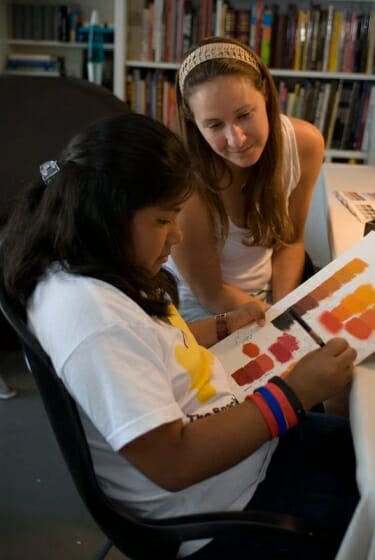
Leah Bernthal, right, works with an art student on a color palette.
“When children are chronically ill, the first thing they lose is their freedom and self-esteem,” says Leah Bernthal. “I wanted to change that.”
Bernthal co-founded CoachArt in 2001 in response to a profound need for support and enrichment programs for chronically ill pediatric patients outside the hospital. The organization offers free services to these children and their families, including scholarships, hospital events and even lessons in the child’s home.
The name of Bernthal’s program was inspired by Art Lurie (1935-1996), a gregarious friend of Bernthal’s family who worked as a cardiac surgeon, and the father of Bernthal’s co-founder Zander Lurie.
Bernthal remembers Art Lurie as a cheerful man, staying positive even when he was diagnosed with cancer. Despite his own illness, he thought only of young people in his situation who had not yet had a chance to realize their potential. Bernthal vowed to never forget the positive impact he had on young people.
CoachArt creates a transformative arts and athletics community for families affected by childhood chronic illness. Founded in partnership with Children’s Hospital Los Angeles, the organization is designed to meet the complex emotional, psychological, education and wellness needs of under-served children in the Los Angeles and San Francisco Bay areas.
CoachArt pairs people with shared passions. Art coaches give in-home lessons to young artists for everything from piano to painting and photography. Sports coaches conduct clubs and leagues for young athletes who play soccer, tennis, golf and other sports.
So far, 1,000 volunteers have contributed a total of 15,000 hours, enriching the lives of thousands of children.
Bernthal remembers at age 23 knocking on countless doors at medical offices to gauge interest and pitch her idea. She knew she would have to convince doctors of the value her idea could add to outpatient care. Advances in medicine were helping chronically ill children live longer. They needed more support at home.
Bernthal’s organization helps address a gap in community health care. Chronic illness affects 15 percent of California’s pediatric population – but upwards of 20 percent live in under-resourced communities.
About 80 percent of the children reached by CoachArt live in low-income households, where access to extracurricular activities is limited. Bernthal has found it easier to attract volunteers to her cause by appealing to their strengths as subject matter experts in art and sports – if a musician is already teaching piano lessons to kids and wants to tap into community service, why not do it with CoachArt?
CoachArt now collaborates with 117 community program partners and 47 local hospitals and health care providers.
As Bernthal explains, young people coping with chronic illness encounter challenges with maintaining a positive self-image. She recounts the story of a young boy dealing with spinal cancer who took piano lessons through CoachArt. Over the years, he excelled and formed a strong bond with his piano instructor, and now the boy attends The Colburn School, one of the most prestigious music schools in Los Angeles, with a full scholarship.
Bernthal grew a tribute to an influential person from her childhood into a full-fledged community program, making a difference in the lives of young people battling illness. She says: “I couldn’t imagine my life without it.”




 Jaha Dukureh (Photo by Irene Baque / The Guardian)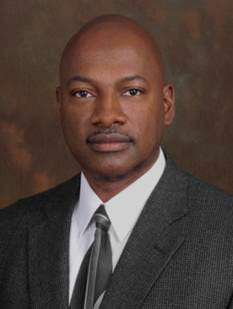
 Leah Bernthal, right, works with an art student on a color palette.