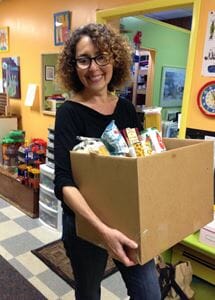
Teresa Abbey provides supplemental tutoring for disadvantaged middle school students in a safe environment. Each week for the past two years, Abbey has tutored middle school students in the Humboldt Park neighborhood of Chicago as a part of an after-school program sponsored by Broader Urban Involvement and Leadership Development (BUILD).
BUILD engages over 3,500 at-risk youth annually in schools and on the streets, so they can realize their educational and career potential. Through the Build tutoring program, Abbey has helped youth increase math grades and enabled the after-school program to expand its services to help more than 25 youth per day. She has also created a book of photography of as a fundraiser in an effort to raise money for the program. Abbey began her service with Build as a way of helping youth perform better in her middle school math class. Now, she has added a fundraising component for the after-school program.
Abbey has always shown a consistent interest in service, including leading a Girl Scout vitamin drive and holding a cupcake sale at an neighborhood garage sale benefiting an orphanage, tutoring young children in grammar school, cleaning-up at the site of the Joplin tornado, volunteering at a nursing homes, children's hospitals, and homeless shelters. In addition, she serves as the vice president of the China Care club at school, which raises money for needed surgeries for Chinese orphans.
Notre Dame Preparatory School
Students at Notre Dame Preparatory School are committed to eliminating poverty housing in their community. By collaborating with Habitat for Humanity Susquehanna, they have helped to build five homes in Harford County for low-income families and donated nearly 200 cumulative hours of volunteer labor.
Several Saturdays a month, Notre Dame Preparatory students can be found at one of Habitat for Humanity Susquehanna’s job sites, swinging hammers, wielding paintbrushes and hanging kitchen cabinets. They work side-by-side with other volunteers and partner families, giving sacrificially of their precious weekend time to serve their neighbors. Their hard work has helped five low-income families to become homeowners and to move into safe, decent and affordable homes of their own.
Located in Towson, Maryland, north of Baltimore City, Notre Dame Preparatory School has a proud tradition of empowering girls to bring positive transformation to the world. They are committed to service, as is evident in their faithfulness to Habitat. They schedule monthly workdays and volunteer even during school breaks. Many of the girls have become regular staples at our work sites, and their sustained enthusiasm is contagious among the volunteer workforce.
Notre Dame Preparatory students have been volunteering with Habitat for Humanity Susquehanna since 2010. They have become one of Habitat for Humanity Susquehanna most frequent volunteer teams, and the organization counts on them to fill in occasional gaps as well.
Chad Klitzman
Chad Klitzman’s volunteer service enables the Travelers Aid International office in Newark, New Jersey to provide a much wider range of services to the clients it serves. This stems mainly from Klitzman’s knowledge of technology and his ability identify less costly options has saved countless members of the traveling public hundreds of dollars.
As soon as he started working for Travelers Aid, the staff knew Klitzman was unique. Within weeks of the start of his work, customers were calling into the office and sending emails to tell us how indispensable Klitzman’s services were to them.
Additionally, Klitzman is one of Travelers Aid’s most active volunteers when it comes to extended cases and this is likely why the staff has received rave reviews about the service he provides. He is always willing to go the extra mile and spend extra time with customers just to make sure that he does as thorough a job as possible. Last year, Travelers Aid honored him at our annual volunteer breakfast for completing one of the highest number of extended cases among our network of volunteers.
The mission of Travelers Aid is to assist people in transit by offering a “helping hand along the way.” The organization was conceived over 150 years ago when Bryan Mullanphy, the mayor of St. Louis, sought to create a program that assisted travelers heading west. Mayor Mullanphy would have been proud to know that people like Klitzman are following his example. Chad embodies the mission of Travelers Aid well.
Many people in the traveling public are apprehensive about the traveling experience. At Newark, customers often find themselves confused by signage, panicked by inclement weather or perturbed about flight delays. Klitzman functions as a touch of humanity in an otherwise impersonal and hectic environment. People like talking to someone that will listen to them and that is exactly what Klitzman does. His patience is one of his greatest virtues and this makes the people he works with extremely pleased with him.
José Andrés
When a massive earthquake decimated parts of Haiti three years ago, acclaimed chef José Andrés was vacationing with his wife in the nearby Cayman Islands.
“There we were, surrounded by every comfort, and we were learning of this terrible disaster that had left people with nothing. I wanted to help,” says the James Beard Award winner. “That was the seed for World Central Kitchen.”
José Andrés cooks with local women in a Haitian village.
Before he began his global humanitarian work against hunger, Andrés had been helping the hungry locally as a volunteer for the nonprofit D.C. Central Kitchen, from peeling potatoes to concocting new recipes.
Washington had embraced the Spanish-born chef, who had become one of America’s most celebrated restaurateurs – by popularizing traditional and avant-garde Spanish cuisine at chic, award-winning restaurants in D.C. and other major cities.
Andrés had learned much from his experience at D.C. Central Kitchen, which works to feed the hungry by using sustainable methods, such as partnerships with food providers, recycling of leftover food and job training for the homeless and unemployed. The organization prepares and delivers 5,000 meals each day to food banks and other nonprofits in the Washington, D.C., area and provides daily meals for eight local schools.
José Andrés picks strawberries in southwest Haiti.
After the Haiti earthquake in 2010, Andrés decided to broaden his fight against hunger. Using the models of sustainability he learned at D.C. Central Kitchen, he founded World Central Kitchen, which teaches communities in poor countries to grow and prepare their own food using sanitary and energy-efficient methods, including solar-powered stoves. (According to the World Health Organization, nearly 2 million people in developing countries die each year from illnesses associated with traditional cooking methods that emit harmful smoke.)
“I feel blessed that I have had a good life, but it is tragic that so many suffer simply because of where they were born,” Andrés says. “I feel it’s my duty to help as many as possible, and to empower as many as possible.”
After he launched World Central Kitchen, using his own funds and a grant from the Vilcek Foundation, Andrés made a relief trip to Haiti, the first of 14.
“First, I went to learn,” he says. “And I became convinced I could help make communities self-sufficient.”
World Central Kitchen has undertaken three major relief programs in Haiti. In the town of Palmiste Tampe, the organization is constructing a kitchen and community garden at the local school to feed its 300 students. When the kitchen is completed, community members will be trained on clean cook stoves to prepare locally grown food.
In Port Au Prince, Andrés and his team of volunteers designed and renovated a bakery at the Zamni Beni orphanage. World Central Kitchen has trained five bakers to work at Zamni Beni and is now teaching the community to increase bread production so that bakery will both serve the orphanage and become self-sustaining by selling its products.
World Central Kitchen is also in the process of creating the Elie du Bois Culinary School in Port Au Prince. Using a curriculum designed by Andrés, the school will help Haitian women to become self-sufficient by teaching them food preparation, sanitary cooking techniques and a variety of other skills aimed at helping them find employment in the Haitian food and restaurant industry.
Andrés hopes to expand World Central Kitchen to serve new communities in Latin America and Africa. He also speaks worldwide on hunger issues and the need for safe cooking equipment.
“The best part of the experience for me is seeing the smiles,” he says. “Nothing sends a more powerful message than the smile of a child. They know you are there for them, trying to help. When someone can give you a smile even when they are amid continuing hardship, it truly puts things into perspective for me.”
Thiry Toone
Thiry Toone volunteers multiple times each week at the Ronald McDonald House in Evansville, Indiana. Through her volunteer work, she is able to impact the parents of critically ill children by providing care, comfort, and shelter for those parents so that they can focus on what they do best – caring for their children.
Toone provides daily support to Ronald McDonald House as well as spearheading efforts to expand the organization’s outreach into the community to increase awareness and scope ensuring parents and families are able to benefit for a long time to come.
Toone's gracious attitude is infectious – her kindness and caring for the families staying at the Ronald McDonald House sets a great example for other volunteers and staff.
Travis Doto
This past year, Travis Doto from Middletown, Indiana served as an AmeriCorps Volunteers in Service to America (VISTA) with the United Way of Madison County. While serving as an AmeriCorps VISTA, Doto focused on establishing and deepening community relationships that engage organizations, businesses, government and individuals in creating economic opportunity in Madison County, Indiana.
During his term, Doto help to establish the first Corporate Volunteer Council in the county that brings diverse business organizations together to make a collective impact on the community. Additionally, he help start a community book club with the goal of educating community members about local challenges and opportunities.
Doto’s efforts to deepen community relations have led him to connect with his local chamber of commerce and serve as a regional ambassador. He also serves as the director of communications for the local Young Professionals Group.
When asked about his background and why he chooses to serve, Doto said, “I come from a disadvantaged background and have been the first of my family to graduate college. I have a desire and passion to want to help my community and empower the people in my community to rise out of poverty and achieve the American Dream. I believe that the only way to truly have a meaningful life is by giving back to others and serving your community in any way that you can. I will tirelessly work to achieve the goal of making my community the best place that it can be for everyone.”
Michael Bourque
Seven years ago on a medical mission to the Dominican Republic, Michael Bourque experienced his first loss of a healthy, young mother in his 30 years as an obstetrician. The 24-year-old woman, Marianna, was struggling with a complicated labor, and Bourque and other American doctors performed a cesarean section.
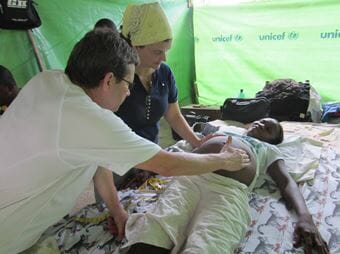
Michael Bourque, left, and Kathy Aries examine a
patient in Haiti.
After the baby was born, Marianna appeared fine. The doctors left her with local nurses for the night. But the nurses weren’t trained to recognize post-operative complications. Marianna suffered a stroke and died.
“It was an inconceivable thought in my mind that I could leave someone in perfect condition, but she died of a stroke because the nursing staff didn’t really know nursing; there was no blood testing, no one was called and there were no medical records,” Bourque recalls. “It was my introduction to third-world health conditions.”
He says he made Marianna a promise to try save other young women from what happened to her.
Bourque’s team has led more than a dozen medical missions and delivered care for more than 2,600 people. It’s now focusing on the small fishing village of Dame Marie, located on the southwestern tip of Haiti. One of every 36 women there die during their childbearing years because of childbirth-related complications. The Blue Team has been delivering medical, surgical and dental care in Dame Marie since the earthquake in Haiti in 2011.
The team works closely with Haitian hospital staff to develop their medical skills. Haitian and American doctors share supplies and work collaboratively. The team’s approach differs from more quick and immediate aid, such as handing out supplies, clothes or food.
“By simply giving free supplies you create a dependent system and harm self-worth,” says Bourque. “You find that you really want to partner with a community and teach them how to do what you do, because ultimately they are the ones who will be there in the long term.”
Bourque plans to go back to Dame Marie four times this year, bringing a separate team each time, some from other hospitals. The hope is to have programs like International Medical Missions in other hospitals around the country. Bourque’s team also plans to build a mission house in Dame Marie, pay for American nurses to work there and create a scholarship fund for people who want to help. (Every missionary pays his or her own way, about $1,500 per trip.)
“We want to create a culture that is all about service of a global nature,” says Bourque. “When you actually get to know people in these unfortunate places, you see they are just like us and they want the same things. You understand all the blessings we have here in the U.S. and in my mind we have an obligation to help them as best we can.”
Concerned Resident Advocates of Schuylkill County – PEER Group
Concerned Resident Advocates of Schuylkill County – PEER Group consists of nursing home and personal care home residents. They are members of a group of resident-advocates known as PEERs (an acronym for Pennsylvania's Empowered Expert Residents). It is their mission to be the voices of those residents who cannot speak for themselves and to advocate for quality of care and quality of life in the long-term care setting. There are over 2,000 PEERs in Pennsylvania. In Schuylkill County, the PEERs began community service projects in 2008. They work cooperatively with members of their staff, family members, and other residents to conduct these projects. Many of them even donate their Personal Needs Allowances (a mere $45.00 per month) to make the projects successful.
While the group has been conducting community service projects for the past 5 years, their most recent project collects funds to aid the cause of Homeless Senior Citizens in Schuylkill County.
Allen Nelson
Allen Nelson serves as the Chairman of the Board for Atlanta Ballet. In addition to serving Atlanta Ballet as a volunteer board member, Nelson is the executive vice president, general counsel, corporate secretary, and chief administrative officer of Crawford & Company.
Arturo Jacobus, executive director of Atlanta Ballet, noted that “Nelson’s time as chairman of the board has been one of many successes. In addition to completing the largest and most successful capital campaign in Atlanta Ballet’s history, the organization achieved several other milestones, including the sale of our former building, the grand opening of the Michael C. Carlos Dance Centre, the return of the Atlanta Ballet Orchestra, five campaign gifts of $1 million or more, critical investments for artistic programming, expansion of the endowment, and the establishment of a case reserve fund and an artistic innovation fund.”
Additionally, Arturo noted that Nelson has the vision that a leader must possess and is able to articulate that vision to the board, and is committed to building the organization through strategic planning, capitalization, stability, and sustainability. “To him, it isn’t a job; he has a genuine passion for this organization, the art form, the staff, and most important, the artists. It is his experience, ability, skill, and nature that allow him to be a knowledgeable and wise leader for the Atlanta Ballet board.”
Pam Koner
Photos in the New York Times, showing ramshackle houses with dirt floors and children going hungry, changed Pam Koner’s life. She was astonished at what she saw. The photos depicted scenes not from an impoverished country, but from Pembroke, Ill.
“I stared at a photo of a little girl in Pembroke and I couldn’t believe it was a scene from the United States,” says Koner, who had left a 20-year career in the New York fashion industry years earlier to pursue more personally meaningful work. “I literally felt compelled, right then and there, to do something to help.”
In 2003, Koner founded Family-to-Family, an organization based on the idea of providing support to the needy by directly linking families with more to those with less. Koner contacted relief workers in Pembroke, who identified for her the 17 neediest families in town. She then recruited 16 of her neighbors, and together they began mailing monthly boxes of food and personal letters to their sponsored families in Pembroke.
Koner began recruiting new donor families online, and – with the help of extensive national media coverage – the organization expanded rapidly. Over the past 10 years, Family-to-Family has provided more than 1.5 million meals to families in 22 communities in 12 states.
Sponsorship has become easier as the organization has grown and technology has advanced. Individual or monthly donations can now be made online, and food is purchased and shipped locally to recipients.
“Online donations have allowed us to reach a much wider base and eased the traffic of packages mailed out,” says Koner, who operates Family-to-Family as a volunteer from the basement of her house in Hastings-on-Hudson, N.Y. “We now work through the Feeding America Network to identify needy families and link them to sponsors.”
Family-to-Family has expanded its services to include emergency response. In 2005, when the Gulf Coast was struck by Hurricane Katrina, Family-to-Family mobilized its sponsor base to assist more than 1,000 families who were displaced to temporary housing. Donors sent household essentials such as blankets, towels and clothing. Family-to-Family also organized a Christmas drive that provided toys to more than 15,000 children affected by Katrina.
Family-to-Family has also recruited donors to assist hundreds of families affected by Hurricane Sandy in New York. Most notably, the group partnered with Peapod, an online grocery service, to deliver care packages containing food for 16,000 meals, along with cleaning products and other necessity items, to more than 800 families affected by the storm.
Last year, Family-to-Family launched a literacy program to serve low-income families. The group works with the Boys and Girls Clubs of America to identify households with children in need of books. Sponsor families are linked with individual kids and send them one book a month, so that every child served receives a dozen books over the course of a year.
The literacy program includes an innovative project, GivingWorks, aimed at transforming impoverished young people into “givers.” Through GivingWorks, Family-to-Family provides low-income middle school and high school students with backpacks containing books for preschoolers. The older students visit Head Start daycare centers and read the books to the preschoolers, who then receive the books and backpacks as gifts.
“GivingWorks is my personal favorite program,” says Koner, who runs a daycare that teaches creative arts to children. “It has such meaning because these older kids have always been on the receiving end. We’re trying to end that by letting them enjoy the giving experience and understand deep in their psyches that they can be providers.”




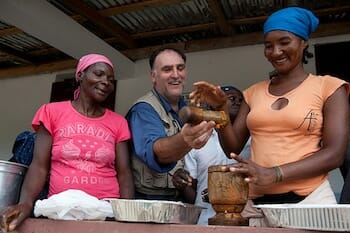 José Andrés cooks with local women in a Haitian village.
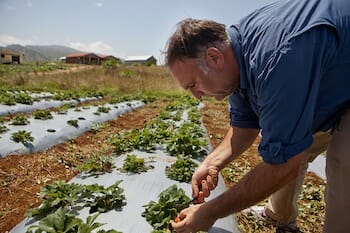 José Andrés picks strawberries in southwest Haiti.