Brad Jamison
Whether it's inspiring others to feed the hungry, save animals, clean up schools or serve in other ways, Brad Jamison knows firsthand the positive effect service can have on individuals and communities.
Last year, Jamison completed Thirty Days of Service – 30 volunteer projects with 30 organizations in 30 consecutive days. Jamison drew from the experience for a blog he created to inspire others to serve. Through daily posts, he showed the personal and community benefits of serving.
“Each act of service brings something different,” Jamison wrote in one of his posts. “Sometimes it’s a great memory, sometimes a profound lesson, sometimes sweat, sometimes fun, etc. And, always a feeling of pride and accomplishment.”
Over the 30 days, Jamison – a former television and public relations executive – worked with organizations addressing a multitude of causes, including homelessness, environmental issues, youth empowerment and more. Based on that experience, Jamison launched www.Good-Citizen.org, which provides resources for improving communities, the nation and the world through service.
Jamison says he believes that only through service, a uniting force, will we ever see an end to so many of the challenges facing our world.
Floyd Hammer and Kathy Hamilton
On July 15, 2013, Kathy Hamilton and Floyd Hammer received the 5,000th Daily Point of Light Award at the White House from President George H. W. Bush, who created the award during his presidency, and President Barack Obama, who said of the winners, “If the purpose of this award is to celebrate Americans who work to make our country and world a better place – not for their own advantage or for any ulterior motive, but just to serve, pure and simple – I cannot think of anyone more deserving than Kathy Hamilton and Floyd Hammer.” (Watch on C-SPAN.) Please read the couple’s story below, check out this short video about the award winners honored at the White House and nominate someone you know for a Daily Point of Light Award.
Floyd Hammer and Kathy Hamilton were preparing to sail the world in leisurely retirement, back in 2004. But first, at the suggestion of friends, the Union, Iowa, couple participated in a volunteer mission to Tanzania to help renovate an HIV/AIDS clinic at a village hospital.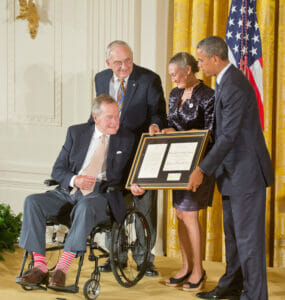
Upon arriving – during the third year of a nationwide drought – the couple saw children suffering, and dying, from malnutrition.
Hammer and Hamilton decided they would expand their volunteer work to help fight starvation. After an experiment distributing food in just one village, they founded Outreach, a nonprofit that has distributed more than 229 million free meals to children in more than 15 countries.
The organization started distributing meals to kids in the United States two years ago, after Hammer and Hamilton visited a food bank in Washington, D.C.“We were startled to learn that one of every two kids in the Washington, D.C., metropolitan area is food insecure,” says Hammer, referring to the fact that many children routinely do not have enough food to eat. “We also learned that nationwide, one in every five children is food insecure over the weekend – when they don’t have access to subsidized school lunches.”
To help, Outreach started its domestic food program, which has given out millions of meals to U.S. kids, usually through Feeding America affiliates.
Outreach uses donations to purchase U.S.-grown vegetables, which make up the core of its packaged meals. Each meal contains rice, soy protein, a dried vegetable and a vitamin. An “Outreach package” contains six meals. The packages are usually put together by volunteers at Outreach events.
“A meal costs 25 cents – including all ingredients, transportation and Outreach overhead,” says Hammer. “The volunteers at Outreach packaging events typically donate $25, then spend one hour packaging meals. As we tell each volunteer, with that $25 and one hour’s work, they produce 100 meals for hungry kids.”
Back in the early days in Tanzania, Hammer and Hamilton started out small, engaging villagers in a barter system.
“The village we visited was filled with skilled craftswomen who made baskets,” says Hammer. “I bought two truckloads of maize, and we traded it to hungry families in exchange for homemade baskets.”
At the end of the couple’s first trip to Tanzania, they brought more than 12,000 baskets back to the United States. When they founded Outreach, they took those baskets with them to help raise funds at churches and community organizations. They made enough from those first basket sales to build a school in Tanzania and distribute more food. Today, Outreach still sells baskets at their events, and basket making has grown as an industry in many Tanzanian villages.
Outreach also conducts twice-yearly medical missions in Tanzania. Since 2005, the group has taken more than 800 medical volunteers there. During each mission, which lasts eight to 10 days, doctors perform an average of 60 major pediatric surgeries, and other medical volunteers treat as many as 1,700 patients. Outreach Tanzania has also overseen the construction of a five-acre demonstration farm (which not only teaches farming skills but also feeds kids and teachers at the school) and the installation of equipment to sanitize drinking water.
Outreach’s growth during its nine years has attracted attention and praise. Charity Navigator gives Outreach a four-star rating and listed Outreach as one of the 10 fastest-growing nonprofits of 2012.
“You don’t have to start with an enormous organization to make a difference,” Hammer says. “It just takes one or two people to start something like Outreach, and if they believe in the mission, it will succeed. It’s the most rewarding thing I’ve ever done.”
Hamilton adds: “I don’t think anything can make you feel better than what we’ve experienced. We’ve watched many of the kids we met in Tanzania grow up. They once had nothing, not a glimmer of hope. Now their eyes are filled with hope. They can dream. And they talk about the future.”
Molly Barker
Molly Barker never expected to be a leader. What she remembers most from childhood is a sense of anxiety and shame. As she neared adolescence, she felt invisible and focused her energy on trying to fit in and win approval.
 “I had stepped into the ‘girl box,’” says Barker. “It’s a place almost every girl has been. Prior to middle school, our bodies are changing, social pressures are increasing and our self-esteem drops.”
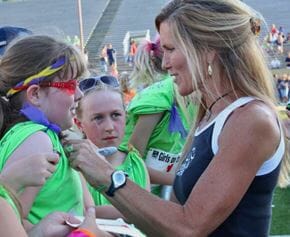
Running had long been the sole activity that brought Barker peace, and it was the inspiration for Girls on the Run, a volunteer organization Barker founded in 1996. Through a 12-week program that blends running with games, conversation, exercises in camaraderie and a variety of other social activities, Girls on the Run helps girls discover their inner strengths and cultivate self-respect.
Barker started with a group of 13 girls in Charlotte, N.C. The idea proved so popular that word spread quickly: Parents eagerly contacted Barker, volunteers appeared and people called from other cities to ask about starting their own Girls on the Run programs.
Today, there are Girls on the Run chapters in 210 cities throughout North America, and more than 600,000 girls have participated. “One of the most amazing things is that everyone found us,” says Barker. “We weren’t promoting ourselves. We were just volunteers who believed in the program.”
As the program evolved, Barker created curricula to serve younger and older girls, grouped by grade – third to fifth and sixth to eighth. Each lesson in both 12-week programs is built around a topic of the day, which might be “Stopping a Gossip Chain” or “How to Be a Good Listener.” The lesson is then divided into an introduction, a cardio warm-up and a workout.
“Even if the girls are just running laps, we always add something social and fun, such as a high fives or a game,” says Barker. “And we find ways to keep focused on the day’s topic.”
Toward the end of the program every girl must design and implement a “community impact project,” something simple the girls can accomplish during one of the sessions, such as creating cards to send to a children’s hospital or holding a bake sale to raise funds for a cause.
“We believe this is critically important to a girl’s sense of empowerment,” Barker says. “What we give to the community, we receive in abundance back, and we want to help girls experience this.”
Barker says the program means different things to different girls. For some girls, it’s a way of making friends. For others, it’s an introspective exercise, or it’s about healthy competition and achievement – reaching new speeds or distances.
“The girls love it for their own reasons,” Barker says. “The most common thank-you letters I get say, ‘When I run, I feel free,’ or, ‘When I run, I feel joy.’”
Estella Pyfrom
When Estella Pyfrom retired in 2008 after a 50-year career with the Palm Beach County, Fla., public schools, she wasn’t ready to stop serving her community.
First, she founded a food pantry that today helps feed 3,000 people a month. Wanting to do more, in 2009 Pyfrom used retirement income and money from a lifetime of investments to buy a bus and turn it into a mobile learning center – outfitted with 17 computers, a satellite receiver and a power generator.
Estella’s Brilliant Bus, as it is known, helps underserved kids throughout Palm Beach County learn vital computer skills. It travels to schools and community centers, 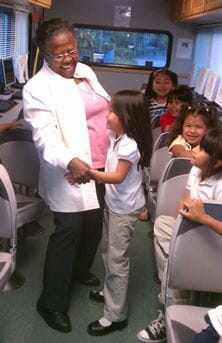 where students take turns working at the computer stations for 45-minute sessions, using software and a curriculum designed around national academic standards.
Pyfrom and more than 100 volunteers have operated the bus for more than 8,000 hours and helped more than 500 kids, from preschoolers to high school seniors.
“Our county has a high percentage of families without Internet or even computers in the home,” says Pyfrom. “Without computer skills, it is very difficult for kids to get ahead in school.”
Pyfrom says any child can succeed against the greatest odds, and offers her own life story as an example. The daughter of migrant farm workers in Belle Glade, Fla., she grew up in poverty, picking beans to help the family make ends meet.
“We were very poor, but my father was lucky enough to be promoted, so we were better off than most of our neighbors,” says Pyfrom. “My first lessons in service came from my father, who usually gave up his extra income to help others.”
By working multiple jobs, Pyfrom was able to go to college and earn her master’s degree. During her long public school career, she worked in various positions, including as a teacher and a guidance counselor.
She came to appreciate how education can lift young people out of poverty, and she created Estella’s Brilliant Bus to help get kids on their way.
When the bus arrives in a neighborhood, it usually remains for six weeks and rotates among five schools or other facilities, visiting each once a week. As students receive their weekly 45-minute lessons, the computers store their work and track their progress. Pyfrom also provides literature for parents about low-cost Internet access and computers available in the area in hopes that their kids will be able to continue their studies.
“This bus started with an idea and a piece of paper and a pencil,” says Pyfrom. “And if I can do it, others can as well. With anything in life, if you can dream it, believe in it, and you’re willing to work, you can achieve it.”
4 Paws 4 Patriots
4 Paws 4 Patriots provides free service dogs to disabled veterans across the United States. The organization utilizes various resources including staff trainers, contract trainers and local animal shelters to provide service dogs, training, and equipment to veterans across the country.
Betty Applegate
In the 1960s, there was a well-known area in Bloomington, IN known as “Pigeon Hill.” Many of the families in this area struggled to make ends meet while working at the local feed mill. Old photos reveal an array of shacks made of scavenged materials clustered on the hill, many with floors made of linoleum over dirt.
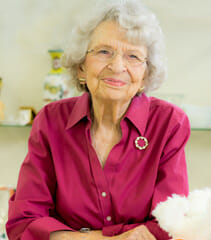
In 1968, a local church rummage sale resulted in a substantial amount of unsold merchandise, and the local church organization, now known as Monroe County United Ministries (MCUM), recognized a way to help the high number of low-income families in the community. The group approached Betty Applegate and Sally Cook, who took it upon themselves to create the Opportunity House resale store.
Betty and a committed group of women turned a small, rundown grocery store into a nonprofit dedicated to providing used merchandise of reasonable quality at rock-bottom prices to low-income families and others. Almost immediately, Opportunity House became a huge success, filling a need for those who were trying to make ends meet. During its first year of operation, Opportunity House raised $6,000, and by the second year, the funds raised rose to $17,000. By the fifth year, they raised $24,000.
As co-director, Betty spent countless hours recruiting, training and managing volunteers, working with the Board, fundraising, outreaching, and marketing. She also worked countless hours preparing items for sale, including sorting, mending, ironing, pricing and displaying used clothing and household items.
She committed herself to this multi-faceted role from the late 1960s to the late 1980s, and although she no longer has the leadership role she once did, Betty continues to volunteer with Opportunity House to this day at age 89.
Though the majority of Betty’s service has been dedicated to the Opportunity House, her impact on the Bloomington community goes far beyond her contributions to the organization. She has served the community in several service organizations for 45 years.
For 17 years, she served Alpha Chi Omega Sorority in positions as Chapter Advisor and Board President. She is a long-standing member and former President of Tri-Kappa, and a 50-year member of a Bloomington Chapter of PEO and Eastern Star, where she served as President. She was an active member on the Monroe County Library Board of Directors, founded and served as Director of the Bloomington Foster Home, and served as Director of Methodist Youth for First Methodist Church.
Betty has dedicated more than 40 years of volunteer leadership and engagement to the Bloomington community. She continues to positively changed lives and passes on the commitment to volunteer service to many.
Maryam Farooq
Maryam Farooq was never bullied at school, but she saw classmates endure teasing and insults. She lamented the crushing effect bullying had on her friends.
So Maryam, of Queens, N.Y., decided to act. In 2011, as an eighth grader, she founded a school chapter of No Place for Hate, a program sponsored by the Anti-Defamation League that aims to fight bullying and create safer learning environments by promoting unity and respect. 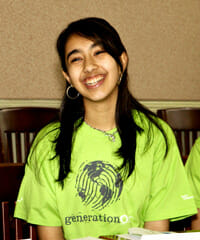 This year, when Maryam entered high school, she founded a chapter at her new school.She successfully secured a grant from the ADL to train 20 students as peer trainers. She has also traveled to several other schools to speak about the dangers of bullying and host anti-bias workshops.
“Some people don’t understand there are extreme consequences to school bullying,” says Farooq. “I observed it for years in school. And then friends who were victims of bullying began to tell me how depressed the experience of being bullied made them. They felt so low about themselves that they wished they could stay home rather than face more of it. Now, think about the fact that suicide is the third highest cause of death among youth. There are many reasons for that, but an unsafe school environment is one that we can and must address.”
Maryam says No Place for Hate appealed to her because, while it provides literature and guidance, the program lets students decide how to deal with bullying at their schools.
“Our No Place for Hate committees are free to brainstorm,” she says. “In middle school, we held No Place for Hate awareness days. … We held an all-school assembly hosted completely by students. And we persuaded teachers of art, English, history and math, to integrate discussing the problem of bullying into their class lessons for an entire week.”
At Maryam’s new high school, the No Place for Hate committee is just getting organized, but it has already held after-school “Snack and Chat” events to talk about bullying and let students know there is help.
Mary and Dave Vandeveld
Mary and Dave Vandeveld have been Care-A-Vanners for Habitat for Humanity since 2001. They travel across the United States to advocate, fundraise and build homes for the families served by Habitat for Humanity. As Care-A-Vanners, Mary and Dave Vandeveld support Habitat affiliates by volunteering to lead and participate in the construction of low-income housing so that families can achieve the dream of homeownership.
Derrius Quarles
When he graduated from high school in 2009, Chicago’s Derrius Quarles set off for Morehouse College in Atlanta after winning more than $1.1 million in scholarships and grants. In national media, he was deemed the “million-dollar scholar.”Not satisfied with his own success, Quarles, in his junior year of college, founded a company, wrote a book, and launched a website—all aimed at helping current high school students find and win college scholarships. 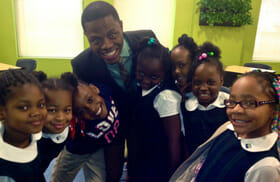 In just one year, his company, Million Dollar Scholar, has assisted more than 10,000 high school students online and helped students receive more than $950,000 in scholarships and grants.
Quarles is an unlikely subject of such a story. When he was four years’ old, his father was murdered. Taken from his mother by the state of Illinois, Quarles spent 11 years in south Chicago’s foster care system, and was told throughout childhood that he would amount to nothing. Quarles says he had a life-changing experience as a high school freshman when a biology teacher told him he had great potential that he was wasting and who encouraged him to work harder to get ahead.
“That’s when I decided to turn things around,” says Quarles. “I boosted my low grade point average by taking advanced-placement courses, and started researching college scholarships. It wasn’t easy. The students with the highest GPAs got direct institutional aid. Others had to look for outside help. There are giant books with names like ‘Go to College for Free’ that tell you little, or that are outdated, and there are profit-making websites that are just fake. Eventually, with guidance from advisors, I was able to find the genuine scholarship opportunities out there, and get tips on how to win them.”
In his final two years of high school, Quarles researched, applied for, and won scholarships and grants from Coca-Cola, Dell, Gates Millennium, Horatio Alger, Nordstrom, and other benefactors. The totals amounted to multiple “full-ride” scholarships. In 2013, Quarles will graduate cum laude from Morehouse with a degree in sociology—and debt-free.
“Given my background, my goal when I got to college was to go into a business with a strong community mission,” says Quarles, who speaks at schools to inspire students. “Million Dollar Scholar—one component of which is my book ‘Winning the Scholarship Race’— is my first venture. Who knows what the future holds. Right now, I’m just deeply moved and excited about what the company has done in its first year—when we were mostly in a learning process. Now we have measurable results, and I think the next two years will be amazing as we refine and build our online platform for helping students.
“I know for a fact I wouldn’t have been able to go to college without many people helping me—pouring into my life’s cup. They were my inspiration to help my own community, and then the larger community—people from all backgrounds—to gain access to the indispensable benefits of a college education and to leave school without the burden of debt.”
Larry Galuppo
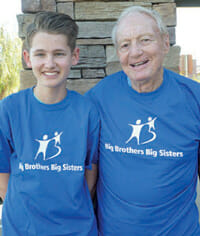
Larry Galuppo’s long-term commitment to mentoring his Little Brother Landon exemplifies the enriching intergenerational relationships that can form as part of Big Brothers Big Sisters, a program that carefully pairs children (“Littles”) with screened volunteer mentors (“Bigs”) and monitors and supports these one-to-one mentoring matches throughout their course.
Galuppo is a retired Navy Commander, serving both active duty and reserve duty. In November 2003, Galuppo registered with Big Brothers Big Sisters of the Desert (BBBSD) after discovering that a retirement built around playing golf was less satisfying than he expected. Galuppo became a Big Brother Mentor to his Little Brother Landon in 2003 when Landon was seven and he was 66.
Now, Galuppo is 76 and Landon is 17, graduating high school and the pair are celebrating their tenth anniversary year as a match in the BBBSD program. The two have developed a family-like bond in the course of learning life lessons from each other. Landon has been inspired to overcome a learning disability and is college bound because of the sincere weekly support of his adult mentor, Galuppo. In turn, Galuppo has been rewarded by his own growth while participating in his Little Brother’s over all development.
Galuppo’s commitment lasting ten years, is BBBSD’s longest such mentoring relationship in the history of the 15 year-old nonprofit organization. According to Galuppo “the beauty of being a volunteer in this program is their motto is Make a Difference in the Life of a Child, and I add on to that, A Child Making the Difference in the Life of an Adult.” As a Senior Mentor for BBBSD, Galuppo serves as a volunteer spokesperson inspiring others to volunteer and to become donors to support the mentoring work in the desert.