Volunteer Partners of Sacred Heart Hospital, Eau Claire, WI
The Volunteer Partners of Sacred Heart Hospital, Eau Claire, WI provide compassionate supportive services for patients, their families and hospital staff; promote community awareness of the Hospital mission; and raise funds for Hospital needs.
Each year, the Volunteer Partners hold fundraisers to help purchase vital hospital equipment not in the budget, and provide tuition assistance grants to employees continuing their education in the health field to provide better service and learn the latest in technology. Additionally, they host an annual pediatric fair for second graders to learn about healthy life styles, and they sponsor an annual Advance Directives Seminar for the community to learn about the importance of having advance directives and how to complete the forms.
Since 1989, the Volunteer Partners of Sacred Heart Hospital have donated over $335,000 to the Hospital’s Healing Place, a Center for Life’s Journeys, a free grief support center serving the community and Western Wisconsin. There is no cost in any of the programs offered which is a tremendous benefit for those in the community and outreaching areas. Last year alone, the Volunteer Partners provided more than 44,000 hours of service and gifted $26,727 to support The Healing Place.
Jean Kamrath
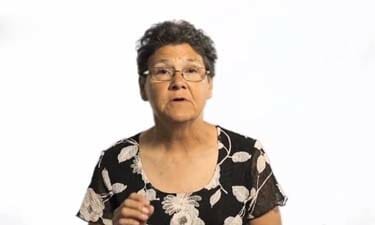
Columbus, Neb., is a small city where, for young people, the largest social event of the year is the high school prom. It’s also a city with high poverty rates, and each year hundreds of girls pass on going to the prom because of the cost of formal dresses.
Hear Jean Kamrath talk about the difference a prom dress can make. (Click image to watch video.)
In 2007, Jean Kamrath, a nurse at Columbus High School, started working to break down this social barrier. She launched Closet Extravaganza, a program that has provided free prom dresses – and often shoes, handbags and makeup – to more than 650 girls who otherwise couldn’t have afforded to attend their proms.
“I’m not trying to cure cancer or solve any other great problems, but I’m grateful that in my community, I can help girls in their formative, adolescent years feel socially included,” says Kamrath, who has worked at Columbus High School for 24 years.
Closet Extravaganza all began with one girl, Tammy, who stopped in Kamrath’s office regularly to have her blood sugar checked.
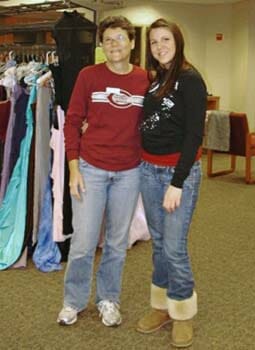
Jean Kamrath, left, and her daughter, Molly, stand among donated dresses.
“During one visit, I asked Tammy casually if she was going to the prom,” says Kamrath. “She looked very sad and told me it was too expensive. For some reason, I asked, ‘Would you go if you had a dress?’ and her face changed and she said, ‘Of course!’ So I called my youngest daughter, Molly, at college, and she said I could give Tammy any of her dresses. We found a nice, white satin dress, which I brought to school. Tammy tried it on in my office, flashed a smile as wide as Texas and said, ‘I’m actually going to the prom!’”
Kamrath then worked behind the scenes to get the girl a free ticket.
“Before I knew it, Tammy was back in my office with three friends, asking if I could find dresses for them as well,” says Kamrath. “I got back on the phone to Molly, who enlisted the help of her Gamma Phi Beta sorority sisters. They were incredible. Molly came home that weekend with a carload of dresses that her friends had donated. I realized then that we were running a program.”
Columbus High School agreed to let Kamrath use its media center for a day to distribute dresses. Kamrath sent letters to the city’s two other high schools. By the time of the first Closet Extravaganza event, Kamrath, Molly and Molly’s friends had gathered 200 dresses. Sixty girls showed up to shop for free, and all found dresses.
The program has grown steadily since. Because all Columbus high schools hold junior/senior proms, Kamrath holds Closet Extravaganza every two years to build up enough stock. Kamrath is now collecting dresses to distribute in February.
After its successful debut in 2007, Kamrath has been invited to appear on local radio to promote the program, and the Columbus Women’s Club has provided donations, including free shopping bags and subsidized prom tickets for girls from low-income families. In 2009, Mary Kay cosmetics came on board as a sponsor, providing free makeup kits to every Closet Extravaganza shopper. In Extravaganza’s biggest year, 2011, 250 girls found dresses from more than 700 that had been donated.
“It’s been a rewarding experience for me,” says Kamrath. “It helps these girls on many levels. First, they get to step out of poverty for a night and look and feel – and be treated – like princesses. But beyond that, it teaches them that they can achieve more, work for greater things in their lives, and live their dreams. I’ve seen it have that effect, and it keeps me excited about going to school each day.”
Northeastern Minnesota Synod “Journey” Volunteers
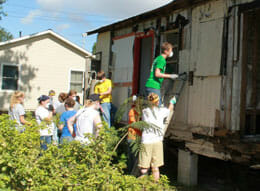
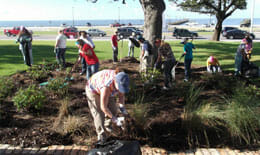
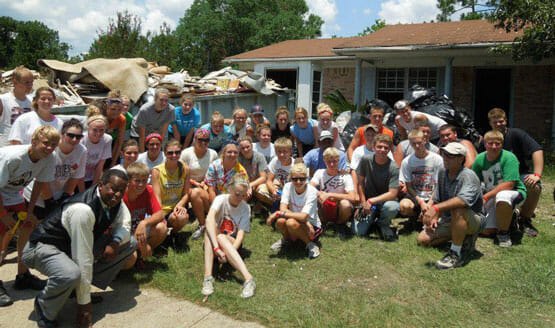
In the summer of 2012, 375 Minnesota high school students, accompanied by 100 adult supervisors and two organizers from the Northeastern Minnesota Synod of the Evangelical Lutheran Church of America, traveled to the hurricane-ravaged shores of Gulfport and Biloxi, Mississippi, to aid residents whose homes had been damaged or destroyed and to clean hurricane debris from the area’s beaches, inland waterways, and forests.
The three-day “servant event” was actually a detour on a longer bus trip to New Orleans, where the students took part in the 2012 ELCA Youth Gathering.
“The Youth Gathering is held every three years in a different city,” says Marty Hancer, senior pastor of Trinity Lutheran Church in Princeton, MN, and a co-organizer of the trip. “In Northeastern Minnesota, we decided many years ago that the we would build a community service element into each trip to the Youth Gathering. We call it the NMS Journey, and this year we chose the Gulf Coast of Mississippi as our ‘servant event’ destination.
Volunteers arrived to discover that many of the coastal residents they met, who were already cash-strapped from the damage to their property, were facing further charges from the government unless they removed debris from their property or made essential—and expensive—repairs to what remained of their homes. Both the students and adult coordinators rushed into action to help whomever they could.
“The students truly humbled me,” says Hancer. “So often kids get a bad rap. These kids wanted to help, and they were determined. They scraped muck with their hands, hammered open walls that were infested with cockroaches, and none of it seemed to even bother them because they knew the work had to be done.”
Hancer adds that outside groups were invaluable in helping plan the ‘servant event.’
“Holly Gibbs of HandsOn Mississippi did an absolutely amazing job of identifying critical work that each of our students could take part in,” he says. “The Audubon society and other conservation groups also helped us identify beach and inland areas that were still badly polluted with debris.”
Co-organizer Catherine Anderson, who is coordinator of the NMS Youth Ministry, says she believes the student volunteers take home valuable life lessons from “servant events.”
“They give, but what they bring home is just as great,” says Anderson. “Many of our students have never traveled outside their home counties before. An NMS Journey connects them with the larger world in life-changing ways. They come home seeing everything differently. They see problems in their own neighborhoods for the first time. And the want to keep serving—back in their own backyards.”
Aaron Hurst
Aaron Hurst has changed business and nonprofit culture for more than a decade. A leader in the nonprofit arena since 16, Aaron has dedicated himself to challenging and empowering each of us to use the power of pro bono to drive social, environmental and economic progress. He is the founder of the Taproot Foundation – a nonprofit recognized as a leader in the pro bono global service movement – and part of the early creative force behind A Billion + Change.
At Taproot, Aaron is known for his striped socks, Post-it® doodlings, and endless supply of bold ideas. Most know him for his tremendous leadership and keen thinking. Aaron is highly regarded as a thought-leader in civic engagement, nonprofit management and corporate social responsibility. He has been recognized as a leading social innovator by the NonProfit Times, Aspen Institute, Social Venture Network, Fast Company, Commonwealth Club, the Manhattan Institute, the State of California, and the Alliance for Nonprofit Management. He has also co-authored the children’s book “Mommy and Daddy Do It Pro Bono” with his wife, Kara Hurst.
Aaron is an inspiration to us all and helping thousands of others shine their light upon the challenges of our time.
David Black
A dentist for roughly four decades, David Black had skills his community needed. So when he got the call from the Virginia Dental Association to help run large free clinics in Roanoke, Va., he knew he could help.
Hear David Black talk about the work of the Roanoke Mission of Mercy Project. (Click image to watch video.)
The association had created Missions of Mercy in 2000 as a statewide program to provide high-quality dental care for Virginians who couldn’t afford it. The association’s director, Terry Dickinson, approached Black to help start the program in his town.
“When Terry asked me to help expand the program to Roanoke, I was enthusiastic about it,” Black recalls. “My family has had three generations of dentists in this city, and I feel that since I’ve been privileged to have a good career, I’m expected to give back.”
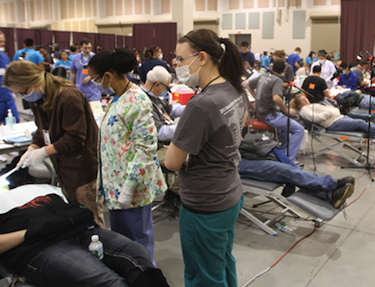
So five years ago Black served as a founding organizer of the Roanoke Mission of Mercy Project. Each year in Roanoke, Mission of Mercy brings together around 800 volunteer dental professionals and students who, during a two-day clinic, provide free dental care to hundreds of uninsured or underinsured local residents.
Black has taken the lead in recruiting volunteers, arranging facilities and managing event operations. And thanks to more than 2,000 volunteers over the years, the Roanoke Mission of Mercy Project has provided more than $5 million in free care to more than 5,000 patients.
Volunteer dental professionals see patients at a Roanoke Mission of Mercy clinic.
An estimated 100 million Americans don’t go to the dentist because they can’t afford it. Even so, the first year Roanoke held its Mission of Mercy Project, volunteers were surprised by the number of people who lined up hours before the clinic opened.
“Even in Roanoke, which has relatively low unemployment, we had more than 1,000 people show up that first year,” says Black. “We were using a simple first come, first-served system. We still use that, but we’ve modified it with a ticketing system to reduce the amount of time people spend waiting.”
Black encourages dental professionals nationwide to get involved in volunteer clinics.
“I won’t tell you that an event like this isn’t hard work, but the need is great,” Black says. “The dentists, dental assistants, hygienists and students who turn out each year are performing a great service to this community. The patients we see have often gone years without treatment, living with pain. And when they leave, the overwhelming gratitude they show us is its own reward.”
Moore, Oklahoma, Public School Teachers and Staff
As a massive tornado touched ground and headed for Moore, Oklahoma, it became frighteningly clear that three of Moore’s public schools were directly in the twister’s path. With only a few minutes’ warning, the teachers and staff rushed to protect the children.
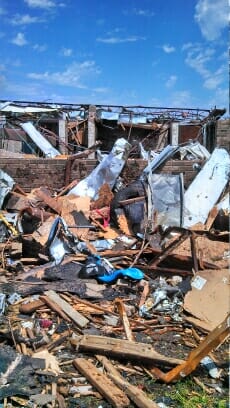
Twisted metal and debris was all that
was left of Valerie Singleton’s classroom
after the May 20 tornado in Moore, Okla.
That afternoon, May 20, seven students died in Plaza Towers Elementary School when the tornado pummeled the building. As horrific as that loss was, it could have been far worse. Winds of up to 200 miles an hour decimated Plaza Towers and Briarwood elementary schools and severely damaged Highland East Junior High. The quick-thinking adults in those buildings, using instinct and emergency training, saved young lives.
Plaza Towers sixth grade teacher Janice Brim remembers ushering four children into a small closet, knowing that the safest shelter would be a small room with short walls. “I had them kneel down and cover their heads with their backpacks,” she recalls. “I had to keep the door forced shut with my arm.”
As the tornado began to hit the school, Brim and her students could hear screams from adjacent rooms, along with a roaring wind.
“I kept repeating, as loudly as I could, ‘We’re OK, we’re OK,’” says Brim. “Over the roar, I could hear them singing a song I didn’t recognize, probably a hymn about protection. I encouraged them to keep singing. They asked if they could pray, and I said, ‘Of course!’ Soon we saw light and knew that the roof was coming off.”
About a mile away, at Briarwood Elementary, third grade teacher Valerie Singleton, a fellow teacher and a librarian brought about 20 children to a storage closet to take cover.
“The lights were already flickering, and the kids began to cry,” says Singleton. “After we got them crouched down into safety positions, I suggested that we start a story round – with each kid telling part of a story. It helped a lot. By the end of the round, the children were laughing.”
They had been in the closet only a short time when they started to feel the force of the tornado. The roof ripped off. Debris pelted them.
Then, quiet.
The children huddled with Brim and Singleton, and so many other teachers and staff members, survived.
“We don’t become heroes when something this terrible happens,” says Brim, a teacher for 20 years. “We all become mommies. It’s just natural. … Students must be safe. You can’t educate them unless you’ve made a safe place for them.”
To hear Plaza Towers teachers tell their stories, watch this FEMA video about an artistic effort to recover and heal.
Jamie Holmes
Jamie Holmes founded Jamie’s Dream Team when she was eighteen years old with the assistance of her Mother, Kim Shidel, and her Grandmother, Bonnie Cottone. Jamie has been a member of the Board of Directors of Jamie’s Dream Team since its inception in 2005. Jamie’s passion is Jamie’s Dream Team. Jamie decided when she was fifteen years old and in Children’s Hospital of Pittsburgh for one (1) of her many surgeries, that she wanted to someday start an organization that would help people with serious medical conditions. Despite the pain and suffering that Jamie has, and continues to endure, her heart has always been with others who are suffering. As such, Jamie started Jamie’s Dream Team to fulfill her dream of helping others who are suffering.
Aesha Rasheed
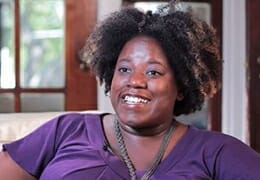
As an education reporter for The Times-Picayune, the daily newspaper in New Orleans, Aesha Rasheed felt frustrated. Her exposure to the city’s mismanaged school district left her wanting to do more to directly help the community. She quit her job in 2005 and began exploring ways to help students and families trapped in an inequitable education system.
(Photo courtesy of Learning Matters)
Then, that year on August 29, Hurricane Katrina hit. “Suddenly, it was a different world in New Orleans,” says Rasheed. “I had been focused on the right to equal education. After Katrina, all of our 128 public schools closed. More than a year later, fewer than 10 had reopened.”
To help displaced and underserved families in New Orleans find out what schools had reopened – and the quality of those schools – Rasheed began to publish the “New Orleans Parent’s Guide.” Now in its seventh edition, the annual guide is widely regarded as the go-to source of data on New Orleans’ public and charter schools.
“Families were trying to return to the city,” Rasheed says. “For those with children, the right to return was inextricably tied to the right to quality education.”
Eighty percent of New Orleans’ schools are now charter schools, with a quilt of organizations providing funds, from national school reform groups to local organizations started by citizens. Rasheed says publishing the “Parent’s Guide” to detail those schools was no easy task. First she considered putting it online, but there were still hundreds of families living in the Superdome, the city’s enclosed football stadium, and other emergency housing, with no access to the Internet.
“For the first few years, the only way to reach families was through a printed guide distributed by organizations and volunteers,” says Rasheed. “We have published 10,000 guides per year, and the response from parents and the school district has been overwhelming” In 2012, Rasheed adds, the school district donated funds to help put out the guide’s seventh edition.
This year, a nonprofit organization developed and donated a smart phone application that gives parents access to the guide. And Rasheed has more ambitious goals for 2013, hoping to put out a multilingual edition.
“I can’t solve the New Orleans school problem by myself,” says Rasheed. “We should all be doing the work of making sure that children are nurtured. The New Orleans Parent’s Guide is simply my piece.”
Challenger Center for Space Science Education
On January 28, 1986, the seven-crew members of the Space Shuttle Challenger/STS-51L “Teacher in Space” mission set out to broaden educational horizons and advance scientific knowledge. Their mission exemplified man’s noblest and most wondrous qualities – to explore, discover, and teach.
To the nation’s shock and sorrow, their Space Shuttle exploded 73 seconds after liftoff.
In the aftermath of the Challenger accident, the crew’s families came together, firmly committed to the belief that they must carry on the spirit of their loved ones by continuing the Challenger crew’s educational mission. In April 1986, they created Challenger Center for Space Science Education.
Challenger Center for Space Science Education offers dynamic, hands-on exploration and discovery opportunities to students around the world. These programs equip students with the knowledge, confidence, and skills that will help better our national, social and economic well-being. The center gives students the chance to become astronauts and engineers and solve real-world problems as they share the thrill of discovery on missions through the Solar System. Using space simulation and role-playing strategies, students bring their classroom studies to life and cultivate the skills needed for future success. Learning Centers reach into communities around the globe, engaging more than 400,000 middle school-age students and 40,000 educators each year.




 Volunteer dental professionals see patients at a Roanoke Mission of Mercy clinic.