Teen Builds Free Resource to Help Immigrant Families Find Schools
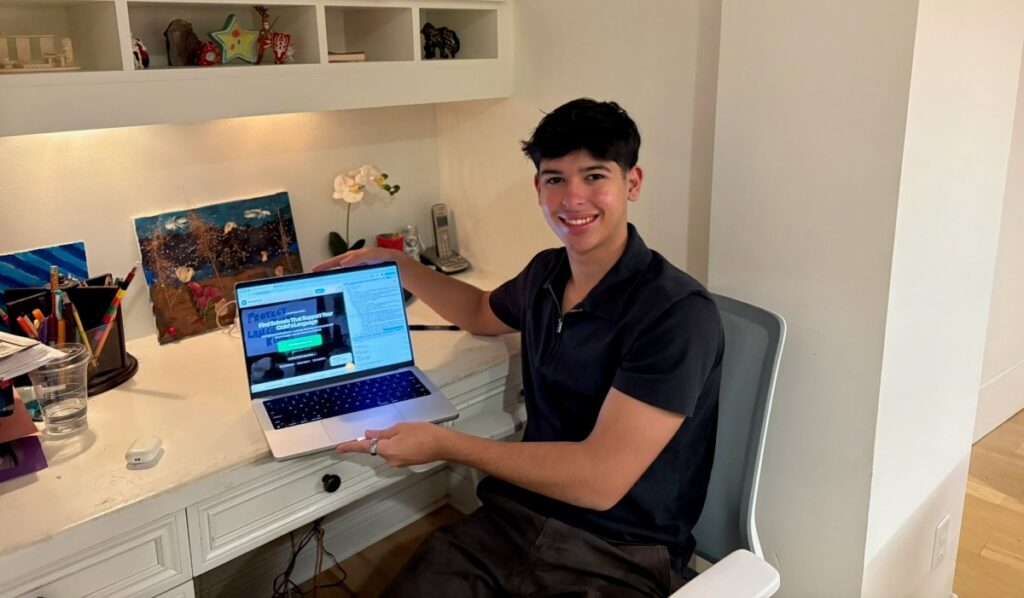
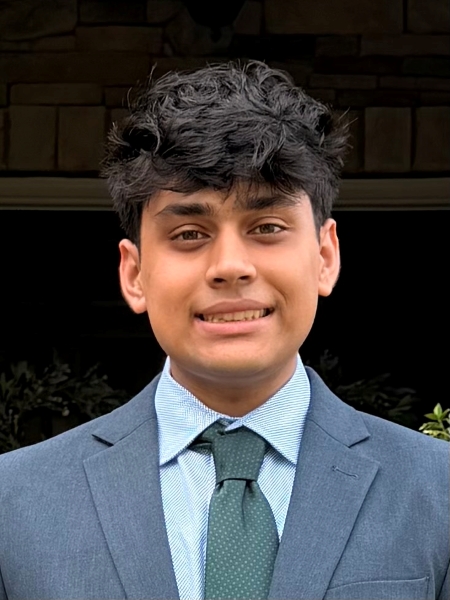
Emilio shows off his NaveganteAZ website that he built to help immigrant families in Arizona find bilingual schools./ Courtesy Emilio Saenz
MeetDaily Point of Light Awardhonoree Emilio Saenz. Read his story, and nominatean outstanding volunteer or family as a Daily Point of Light.
When Emilio Saenz’s friend Andrea moved from Mexico to Arizona about two years ago, she was placed in an English-only program where she couldn’t understand her teachers, and she eventually started to fail her classes. Emilio, who grew up as an English learner himself and whose parents are both immigrants from Mexico, went looking for bilingual programs that could help students like her. He found there was no public directory to turn to.
So Emilio, now a 16-year-old high school junior in Phoenix, began building NaveganteAZ in December 2025. Using an AI-web scraping tool to search school district websites and public records, he built a free website that helps families find bilingual and dual language programs across Arizona. Today, Emilio leads a team of 15 student volunteers and more than 2,000 people have used his site. He also chairs the Arizona State Board of Education Student Advisory Panel and mentors other students through Impactfully, a company he founded to help teens launch community projects.
What inspired you to start Navegante?
Navegante is the only existing directory of bilingual programs in the state. It was inspired because I grew up as an English learner. I didn’t speak English and had to learn it in school because my parents are both immigrants from Mexico, so I’ve always had empathy for English learners. But my focus on bilingual education was motivated by my friend Andrea, who moved from Mexico to Arizona about two years ago. She didn’t speak any English, but she was placed in an English-only program where, as you can imagine, she was failing her classes because she couldn’t understand the words her teachers were saying. That’s when I realized how hard that situation can be. How do we expect kids like Andrea to graduate and go to college when they can’t even understand what their teachers are saying? I learned that English learner graduation rates in Arizona hover around 50%, which is super alarming.
I did some research and found out about bilingual education programs. I also serve as chair of the State Board of Education Student Advisory Panel, so I talked to some people on the board about it. I learned that the scientific consensus is that these programs are optimal for English learners because they learn half the day in Spanish and half the day in English. They get their core subjects, like math and science, in Spanish while still learning English, and it’s proven to be better for their confidence, their academic progression and even their language acquisition.
But there was very limited infrastructure for bilingual programs, and the Department of Education no longer had a public directory of them. So I decided to piece the data together myself. I developed an AI web-scraping model that uses a Python library called Beautiful Soup to scan school district websites and public records, like school board meetings, for any mention of bilingual programs. I verify them and add them to the directory. That’s how Navegante was born. I also crowdsourced it, so now I get emails from teachers and principals saying, “Hey, add this bilingual program.”
How do families find Navegante, and what impact has it had?
It’s tricky to measure how many families end up going to these schools. Since we started, well over 2,000 people have used the website, and I’ve received well over 50 emails from parents and teachers. Sometimes parents reach out directly, like one in Pima County, a more rural part of Arizona. Someone on our team will research, call experts and recommend dual language schools in the area, so we do some custom help.
The most exciting email I ever got was the very first one, from a dad in Gilbert who said there were no dual language programs listed near him and asked if I could help. I was in my kitchen when I saw it, and it was insane to realize that a website I made in my bedroom had actually reached someone. I was going to help this dad potentially make an educational decision that could change his kid’s trajectory, his family’s trajectory, for years. The school you go to can matter so much, especially in Arizona, where school choice means you can attend any school, even outside your home district.
What has been the most rewarding part of your work?
Mentoring other students. After making Navegante, I realized there was a workflow I took to build it: spotting a problem, thinking about a solution, validating it, building it, iterating, and then launching. I learned a lot about pitching to media, launching programs and finding a problem that’s feasible to solve. So, I started a business called Impactfully, where I mentor other students to start the same kinds of passion projects that can do good for the community while also helping them build confidence and strengthen their college applications.
One of my students started out so shy and never imagined he could build a project that could help people, especially so young. He hasn’t launched yet, but he’s working on a website to help teachers better understand their students.
With the students at a Title I middle school called Pueblo del Sol, I’ve taken on a mentorship role. They’ll text me questions about high school applications and general life advice. A lot of them come from harder backgrounds and grow up with fewer resources, without the expensive college counselors some kids have, but they’ re so passionate that they’re going to get there anyway. Being able to mentor them is very fulfilling.
Why does equal access to education matter to you?
I believe every kid deserves an equal shot at chasing their dreams. My parents are both immigrants from Mexico, so I’ve seen firsthand that immigrants are some of the most hardworking people out there, and they’re often misportrayed in media and politics. My mentor always says, “Take care of your mind, and your mind will take care of you.” Education is how these kids, and how I can get where we want to go and have better opportunities than maybe my parents did. The students at Pueblo are hardworking, smart kids who sometimes don’t have the guidance or the resources, but when you put the opportunity in front of them, they take it so quickly and they’re so grateful for it.
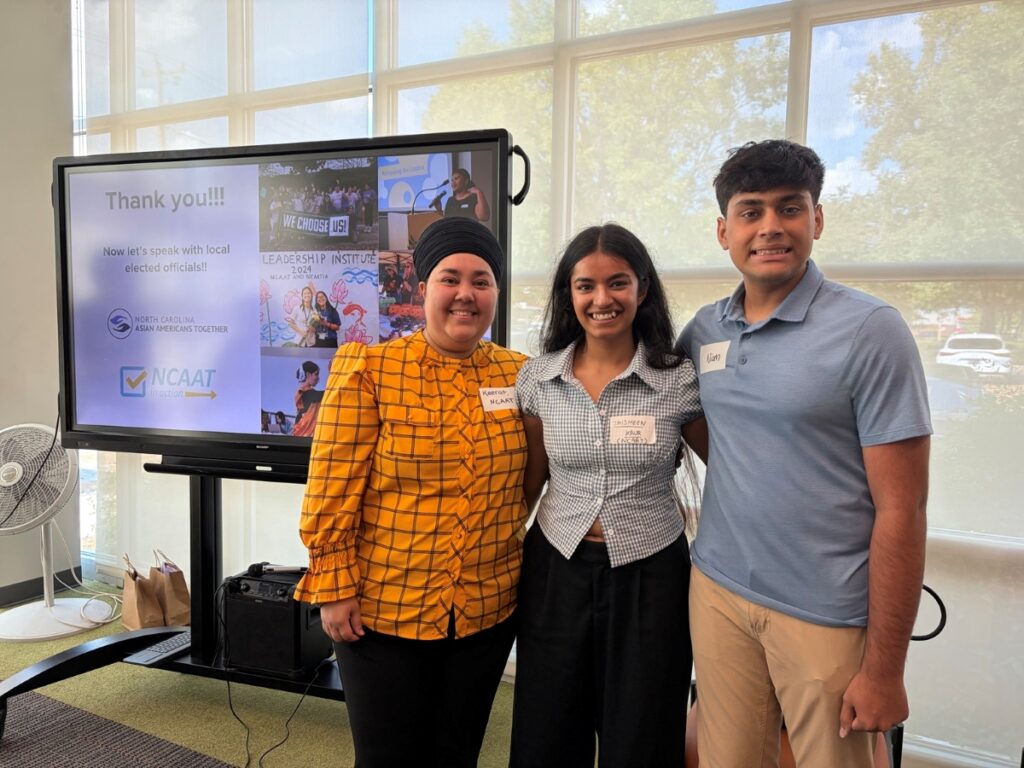
NIAM KATHROTIA (RIGHT) JOINS COMMUNITY ADVOCATES AND KNOW YOUR RIGHTS PARTNERS AT A NORTH CAROLINA ASIAN AMERICANS TOGETHER CIVIC ENGAGEMENT EVENT. /COURTESY NIAM KATHROTIA
MeetDaily Point of Light Awardhonoree Niam Kathrotia. Read his story, and nominatean outstanding volunteer or family as a Daily Point of Light.
Niam Kathrotia saw what was happening in his community, and he knew it was time to take action. Last year, immigrant enforcement operations came to a peak in the Charlotte, North Carolina, area, with enforcement operations around the city. This caused a tremendous amount of uncertainty for the area’s large immigrant population. As the founder of Indian American Youth Leadership, a youth-led nonprofit organization dedicated to empowering young leaders through advocacy, education, and community-driven initiatives to create meaningful change, Niam knew he could use his education and skills to help the people in his community to live safe, stable lives.
Enabled by his education working as an intern at a law firm, Niam developed “Know Your Rights” guides to help immigrants understand their rights. He sought feedback and guidance from qualified attorneys and translated the guides for the diverse Charlotte population. Niam reached out to Charlotte businesses and inquired as to whether they’d be willing to keep the guides in their establishments. Niam would reach out to 50 different businesses, and it was likely that 40 of them would say no. But for the 10 businesses that agreed, Niam had succeeded in providing a tangible tool that helps their clientele. Thus far, he has partnered with more than 30 businesses and organizations across the Charlotte metro, reaching over 10,000 people digitally. On top of his busy school workload, he contributes around 30 hours per month to this important project, and isn’t slowing down anytime soon.
Currently a high school senior, Niam has spent so much time immersed in learning the legal rights of his fellow community members that he’s now interested in pursuing a legal career when he heads off to college. He’s fascinated by the intersection of law, policy, and decision-making, and would love to explore federal regulation or immigration law in a way that betters civil rights. Niam’s dedication to his volunteer work has been so successful that it’s even helped him discover a future career path. His willingness to advocate for his community through volunteerism is a testament to just how much change the willingness to help others can create.
NIAM KATHROTIA IS THE FOUNDER AND PRESIDENT OF INDIAN AMERICAN YOUTH LEADERSHIP. /COURTESY NIAM KATHROTIA
What inspired you to get started with this initiative?
Last fall, a lot of immigrant communities really felt uncertain about what rights they had. Being someone who’s in the South Asian community myself, I saw this firsthand. Having been in legal spaces before as an intern, I did what I could. I reached out to some people I had worked with at a law firm previously, and they were in that same immigration space. I really wanted to reconnect with them and see what we could do. From there, we launched partnerships. We got them to translate our materials and help distribute them. Then, it became a citywide volunteering project. But it really all started because I saw what was happening in the community around me.
What inspires you to volunteer?
Honestly, it’s a personal tie-in. It’s seeing not only how this affects me, but also how my community is impacted by these kinds of issues. It’s knowing what I can do to step in, since I may have more resources, connections, and links to better the community that I live and go to school in. Just knowing that really inspires me to help the people around me that I live and work with.
Tell us about your volunteer role with Indian American Youth Leadership.
As the founder of the organization, I launched this campaign and came up with the idea. I started reaching out to the law firm, and from there I spent most of the summer driving around Charlotte and calling businesses. I’d say, “Hey, I think this would be a resource that would really help you out because you guys are in an immigrant community,” or “You’re in an area where information may not be as readily accessible.” Sometimes that would require Google Translate because it may be a Spanish-speaking business or another language. A lot of my work was outreach and distribution. Then later on, there were opportunities like speaking engagements and advocacy opportunities with elected officials. It really was just about getting those materials out there, driving around the city, putting the boots on the ground, and doing that work.
What are your long-term plans or goals for the organization?
Long-term, I really hope to scale this initiative and bring it across the state of North Carolina to places across the country, because the information is not solely localized to the Charlotte area. It’s simple Know Your Rights information that applies to all across the United States. Especially when we see all these different things on TV about policies and actions, people get really confused. But having a simple guide to demonstrate that is really important. Currently, I’m working with another Asian American organization across North Carolina to expand it into schools and more places that people have to go every single day. Expanding that accessibility into those everyday spaces is really important. In college, if they had their own social justice initiatives or volunteerism initiatives, that would help me continue that work.
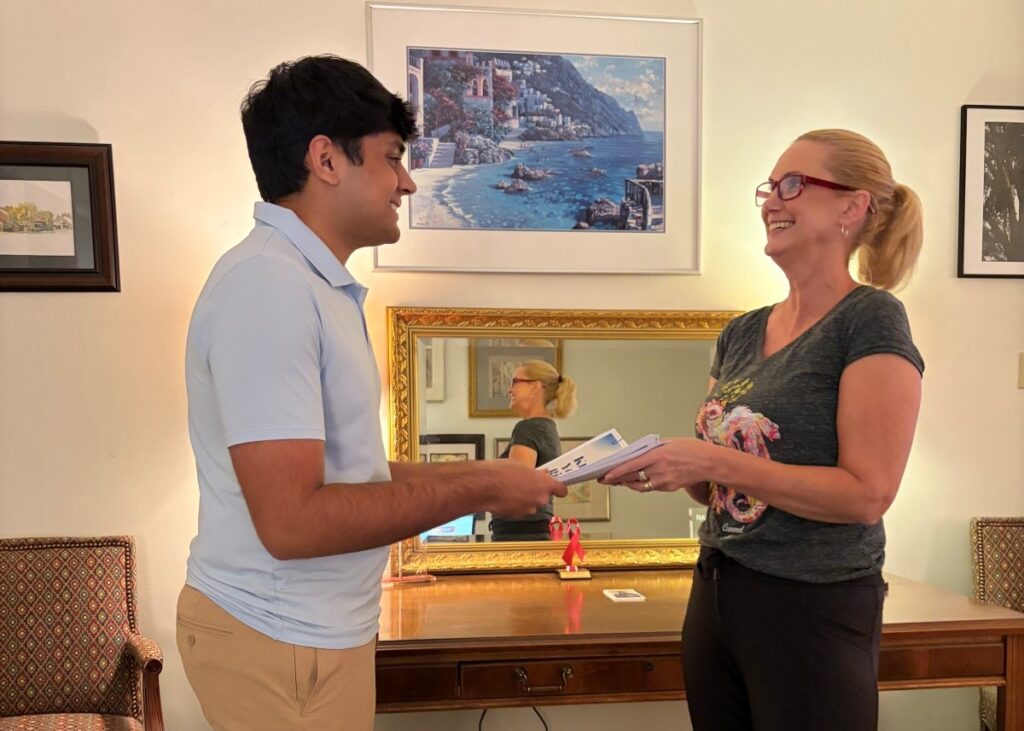
NIAM KATHROTIA (LEFT) DISTRIBUTES BILINGUAL KNOW YOUR RIGHTS RESOURCES AT MYERS PARK COVENANT CHURCH. /COURTESY NIAM KATHROTIA
What’s been the most rewarding part of your work?
The most rewarding part of this volunteer work is just getting to see who’s impacted by this, especially living in those kinds of communities. Seeing people who maybe don’t understand what legal rights they have or what their rights are at school; seeing some classmates who maybe don’t understand what their rights are; seeing them have that access to information, then personally thanking me and saying it’s really helpful. Not just having a guide in a law firm, but having it in a coffee shop or in a Colombian bakery, places that people go every day. People have really told me what it means to them, and that’s been really meaningful for me.
What have you learned through your experiences as a volunteer?
The importance of speaking to people. I’ve really learned the importance of clear communication, especially when it’s an issue that affects people’s lives directly and there’s an urgent need. I’ve learned to communicate in a clearer way and learned to just meet people where they are.
Why is it important for others to get involved with causes they care about?
Getting involved with causes that you care about is so impactful because it affects everything around you. You may not think that it affects you, but all of these issues affect you. If you care about an issue, whether it’s gun rights, environmental safety, or immigration rights, it in some way affects you, your family, and your community. Getting involved can put your own personal experiences and perspectives into play, because there may be someone who has similar experiences to you, but they don’t have your exact experiences. Bringing your own perspective to the table, getting involved is so incredibly meaningful and helps you become a better, more well-rounded person who benefits the community around you.
What do you want people to learn from your story?
I want people to learn how important it is to simply have access to information. Expanding access to that kind of trusted educational information. What are my voting rights? What are my civic rights? What are my healthcare rights? Those are things that affect people’s day-to-day lives, and having access to that information can directly empower them in situations where they may feel uncertain. It just helps them engage and helps them understand what exactly they can do. Being informed is the first step, and it leads to so many better things. Communicating that idea to people and having them learn simple, clear information is one of the most important things for any volunteer project or anything that’s benefiting the community.