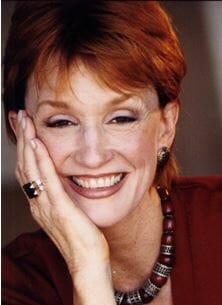
Today, we celebrate the 95th birthday of Nelson Mandela, and Nelson Mandela Day. Like President George H. W. Bush, Mandela has worked to promote and support the capacity of the individual to effect positive change in service to others. At MandelaDay.com, volunteer activities and events demonstrate the global movement for good. Mandela’s grandsons, Ndaba and Kweku, join with President Bush and Points of Light in honoring Kathy Eldon, co-founder of Creative Visions Foundation, as winner of today’s Daily Point of Light Award for her work in Africa and around the world. Read her story below.
As a 16-year-old exchange student living in apartheid-era South Africa, Kathy Eldon experienced the tensions of the time and saw what social injustice looked like.
The Iowa native’s host family was related to Bram Fischer, the anti-apartheid activist who led Nelson Mandela’s legal team during the trial that resulted in Mandela’s life prison sentence. Eldon, who stayed with the family in 1963, came to look upon Fischer as one of her first inspirations for doing good in the world.
In the late 1970s, Eldon returned to Africa, moving from England with her husband and two children to Kenya. There, as a journalist, she witnessed courageous social activism in action. Her son, Dan, who followed her into journalism, would ultimately, tragically die in Africa at age 22 – beaten to death by an angry mob in Somalia while on assignment as a Reuters photographer.
Dan’s death in 1993 inspired Eldon and her daughter, Amy, to found the Creative Visions Foundation. Since its creation in 1998, the Malibu, Calif.-based foundation has helped “creative activists” – people who use the media and arts to effect social change – raise $11.2 million for more than 150 projects on five continents, reaching audiences of more than 90 million worldwide.
“After Dan’s death, we learned that he had kept several journals detailing his commitment to social activism,” says Eldon. “His journals became the basis for three books, and I later learned that his story had served as an inspiration to the activist founders of Invisible Children and TOMS Shoes.”
Eldon began to see a pattern of inspiration. When Dan was a child, he met the courageous Kenyan journalists who worked with Eldon. Later, he heard Bishop Desmond Tutu speak in South Africa and became inspired by the life of Nelson Mandela. When Dan’s journals were published, his own activist spark inspired others, including Eldon. In fact, she is now working with Mandela’s family on a project aimed at inspiring and empowering young people.
“I think Creative Visions is part of an endless process of sparks that ignite creative activism,” says Eldon, an award-winning filmmaker and producer. “We act as an incubator, academy and an agency for creative activists: storytellers using art, music, dance, drama and film to create awareness and ignite positive social action.”
Eldon’s foundation teaches the artists about the basics of fundraising and guides them to funding sources. But most importantly, Eldon adds, the foundation brings those artists together in a nurturing, collaborative environment. Among the projects the foundation has supported: the construction of a school for 50 orphans in a rural African village; a DJ studio arts program for teenagers recovering from substance abuse; and yoga classes for hundreds of homeless people.
Ray Blanchard
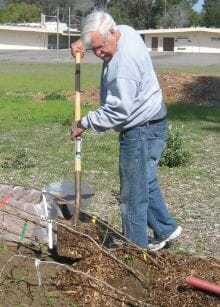
When construction began on the San Carlos Community Garden in San Diego, Calif., in March 2012, retired Navy and federal employee Ray Blanchard was one of the first to volunteer his services. Since then, Blanchard has donated more than 1,000 hours of time – both constructing the raised garden plots and working to solicit donations and other assistance from local businesses, religious groups and community organizations.
Blanchard is credited with building most of the completed garden beds, and thanks to his efforts and those of other volunteers, the project is already more than half completed. Located on the campus of Springall Academy, a K-12 school specializing in special needs students, the San Carlos Community Garden has a unique dual mission: It both provides rental garden plots to community residents and serves as an outdoor classroom where Springall students can learn gardening skills and cultivate food served at the school.
“I was excited about this idea from the moment I read over the plans,” says Blanchard. “Nothing had been done with that land for years, and now it’s both a functioning garden for the neighborhood and a place where these kids can learn everything about the food-growing process. Kids just think of vegetables as something from the supermarket, but these students are planting and growing – and collecting the harvest for use in real meals.”
The Community Garden currently has fruit trees and more than 50 functioning plots used by individuals, the school or organizations. The completed garden will not only include many more growing beds, but also a small amphitheater that groups can use for instruction and presentations. Blanchard, who volunteers 20 to 25 hours a week, says he is still as enthusiastic as he was when they first broke ground.
“This has been very gratifying,” says Blanchard. “I loved the design, and I’ve been amazed at how quickly the community has wholeheartedly embraced the project. … I’m delighted to be a part of it, and I can’t wait to see all the work come to fruition.”
Brad Jamison
Whether it's inspiring others to feed the hungry, save animals, clean up schools or serve in other ways, Brad Jamison knows firsthand the positive effect service can have on individuals and communities.
Last year, Jamison completed Thirty Days of Service – 30 volunteer projects with 30 organizations in 30 consecutive days. Jamison drew from the experience for a blog he created to inspire others to serve. Through daily posts, he showed the personal and community benefits of serving.
“Each act of service brings something different,” Jamison wrote in one of his posts. “Sometimes it’s a great memory, sometimes a profound lesson, sometimes sweat, sometimes fun, etc. And, always a feeling of pride and accomplishment.”
Over the 30 days, Jamison – a former television and public relations executive – worked with organizations addressing a multitude of causes, including homelessness, environmental issues, youth empowerment and more. Based on that experience, Jamison launched www.Good-Citizen.org, which provides resources for improving communities, the nation and the world through service.
Jamison says he believes that only through service, a uniting force, will we ever see an end to so many of the challenges facing our world.
Floyd Hammer and Kathy Hamilton
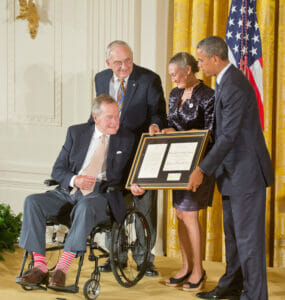
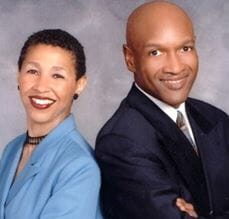
On July 15, 2013, Kathy Hamilton and Floyd Hammer received the 5,000th Daily Point of Light Award at the White House from President George H. W. Bush, who created the award during his presidency, and President Barack Obama, who said of the winners, “If the purpose of this award is to celebrate Americans who work to make our country and world a better place – not for their own advantage or for any ulterior motive, but just to serve, pure and simple – I cannot think of anyone more deserving than Kathy Hamilton and Floyd Hammer.” (Watch on C-SPAN.) Please read the couple’s story below, check out this short video about the award winners honored at the White House and nominate someone you know for a Daily Point of Light Award.
Floyd Hammer and Kathy Hamilton were preparing to sail the world in leisurely retirement, back in 2004. But first, at the suggestion of friends, the Union, Iowa, couple participated in a volunteer mission to Tanzania to help renovate an HIV/AIDS clinic at a village hospital.
Upon arriving – during the third year of a nationwide drought – the couple saw children suffering, and dying, from malnutrition.
Hammer and Hamilton decided they would expand their volunteer work to help fight starvation. After an experiment distributing food in just one village, they founded Outreach, a nonprofit that has distributed more than 229 million free meals to children in more than 15 countries.
The organization started distributing meals to kids in the United States two years ago, after Hammer and Hamilton visited a food bank in Washington, D.C.“We were startled to learn that one of every two kids in the Washington, D.C., metropolitan area is food insecure,” says Hammer, referring to the fact that many children routinely do not have enough food to eat. “We also learned that nationwide, one in every five children is food insecure over the weekend – when they don’t have access to subsidized school lunches.”
To help, Outreach started its domestic food program, which has given out millions of meals to U.S. kids, usually through Feeding America affiliates.
Outreach uses donations to purchase U.S.-grown vegetables, which make up the core of its packaged meals. Each meal contains rice, soy protein, a dried vegetable and a vitamin. An “Outreach package” contains six meals. The packages are usually put together by volunteers at Outreach events.
“A meal costs 25 cents – including all ingredients, transportation and Outreach overhead,” says Hammer. “The volunteers at Outreach packaging events typically donate $25, then spend one hour packaging meals. As we tell each volunteer, with that $25 and one hour’s work, they produce 100 meals for hungry kids.”
Back in the early days in Tanzania, Hammer and Hamilton started out small, engaging villagers in a barter system.
“The village we visited was filled with skilled craftswomen who made baskets,” says Hammer. “I bought two truckloads of maize, and we traded it to hungry families in exchange for homemade baskets.”
At the end of the couple’s first trip to Tanzania, they brought more than 12,000 baskets back to the United States. When they founded Outreach, they took those baskets with them to help raise funds at churches and community organizations. They made enough from those first basket sales to build a school in Tanzania and distribute more food. Today, Outreach still sells baskets at their events, and basket making has grown as an industry in many Tanzanian villages.
Outreach also conducts twice-yearly medical missions in Tanzania. Since 2005, the group has taken more than 800 medical volunteers there. During each mission, which lasts eight to 10 days, doctors perform an average of 60 major pediatric surgeries, and other medical volunteers treat as many as 1,700 patients. Outreach Tanzania has also overseen the construction of a five-acre demonstration farm (which not only teaches farming skills but also feeds kids and teachers at the school) and the installation of equipment to sanitize drinking water.
Outreach’s growth during its nine years has attracted attention and praise. Charity Navigator gives Outreach a four-star rating and listed Outreach as one of the 10 fastest-growing nonprofits of 2012.
“You don’t have to start with an enormous organization to make a difference,” Hammer says. “It just takes one or two people to start something like Outreach, and if they believe in the mission, it will succeed. It’s the most rewarding thing I’ve ever done.”
Hamilton adds: “I don’t think anything can make you feel better than what we’ve experienced. We’ve watched many of the kids we met in Tanzania grow up. They once had nothing, not a glimmer of hope. Now their eyes are filled with hope. They can dream. And they talk about the future.”
Molly Barker
Molly Barker never expected to be a leader. What she remembers most from childhood is a sense of anxiety and shame. As she neared adolescence, she felt invisible and focused her energy on trying to fit in and win approval.
“I had stepped into the ‘girl box,’” says Barker. “It’s a place almost every girl has been. Prior to middle school, our bodies are changing, social pressures are increasing and our self-esteem drops.”
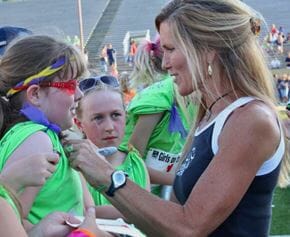
Running had long been the sole activity that brought Barker peace, and it was the inspiration for Girls on the Run, a volunteer organization Barker founded in 1996. Through a 12-week program that blends running with games, conversation, exercises in camaraderie and a variety of other social activities, Girls on the Run helps girls discover their inner strengths and cultivate self-respect.
Barker started with a group of 13 girls in Charlotte, N.C. The idea proved so popular that word spread quickly: Parents eagerly contacted Barker, volunteers appeared and people called from other cities to ask about starting their own Girls on the Run programs.
Today, there are Girls on the Run chapters in 210 cities throughout North America, and more than 600,000 girls have participated. “One of the most amazing things is that everyone found us,” says Barker. “We weren’t promoting ourselves. We were just volunteers who believed in the program.”
As the program evolved, Barker created curricula to serve younger and older girls, grouped by grade – third to fifth and sixth to eighth. Each lesson in both 12-week programs is built around a topic of the day, which might be “Stopping a Gossip Chain” or “How to Be a Good Listener.” The lesson is then divided into an introduction, a cardio warm-up and a workout.
“Even if the girls are just running laps, we always add something social and fun, such as a high fives or a game,” says Barker. “And we find ways to keep focused on the day’s topic.”
Toward the end of the program every girl must design and implement a “community impact project,” something simple the girls can accomplish during one of the sessions, such as creating cards to send to a children’s hospital or holding a bake sale to raise funds for a cause.
“We believe this is critically important to a girl’s sense of empowerment,” Barker says. “What we give to the community, we receive in abundance back, and we want to help girls experience this.”
Barker says the program means different things to different girls. For some girls, it’s a way of making friends. For others, it’s an introspective exercise, or it’s about healthy competition and achievement – reaching new speeds or distances.
“The girls love it for their own reasons,” Barker says. “The most common thank-you letters I get say, ‘When I run, I feel free,’ or, ‘When I run, I feel joy.’”
Estella Pyfrom
When Estella Pyfrom retired in 2008 after a 50-year career with the Palm Beach County, Fla., public schools, she wasn’t ready to stop serving her community.
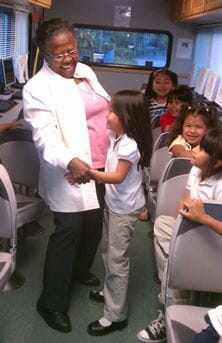
First, she founded a food pantry that today helps feed 3,000 people a month. Wanting to do more, in 2009 Pyfrom used retirement income and money from a lifetime of investments to buy a bus and turn it into a mobile learning center – outfitted with 17 computers, a satellite receiver and a power generator.
Estella’s Brilliant Bus, as it is known, helps underserved kids throughout Palm Beach County learn vital computer skills. It travels to schools and community centers, where students take turns working at the computer stations for 45-minute sessions, using software and a curriculum designed around national academic standards.
Pyfrom and more than 100 volunteers have operated the bus for more than 8,000 hours and helped more than 500 kids, from preschoolers to high school seniors.
“Our county has a high percentage of families without Internet or even computers in the home,” says Pyfrom. “Without computer skills, it is very difficult for kids to get ahead in school.”
Pyfrom says any child can succeed against the greatest odds, and offers her own life story as an example. The daughter of migrant farm workers in Belle Glade, Fla., she grew up in poverty, picking beans to help the family make ends meet.
“We were very poor, but my father was lucky enough to be promoted, so we were better off than most of our neighbors,” says Pyfrom. “My first lessons in service came from my father, who usually gave up his extra income to help others.”
By working multiple jobs, Pyfrom was able to go to college and earn her master’s degree. During her long public school career, she worked in various positions, including as a teacher and a guidance counselor.
She came to appreciate how education can lift young people out of poverty, and she created Estella’s Brilliant Bus to help get kids on their way.
When the bus arrives in a neighborhood, it usually remains for six weeks and rotates among five schools or other facilities, visiting each once a week. As students receive their weekly 45-minute lessons, the computers store their work and track their progress. Pyfrom also provides literature for parents about low-cost Internet access and computers available in the area in hopes that their kids will be able to continue their studies.
“This bus started with an idea and a piece of paper and a pencil,” says Pyfrom. “And if I can do it, others can as well. With anything in life, if you can dream it, believe in it, and you’re willing to work, you can achieve it.”
Gloria White-Hammond and Ray Hammond
Married for 40 years, Ray Hammond and Gloria White-Hammond have walked a remarkable life journey together, serving others. Both enjoyed careers in medicine – Hammond as an emergency room surgeon, and White-Hammond as a community health clinic pediatrician.
But in the 1980s, the couple felt a new calling. Both became ordained ministers and founded the Bethel African Methodist Episcopal Church in Boston. “I love what we did in medicine,” says Ray Hammond. “But we were called to reach out further, to address people’s spiritual and social needs.”
The church began in the Hammonds’ home with five parishioners. Today, with the Hammonds as co-pastors, Bethel AME is thriving, with a congregation of more than 600 and a host of programs that reach out to people in need.
Since its founding in 1988, Bethel AME has helped thousands of at-risk Boston youths to succeed in life through Generation Excel, a program launched by the Hammonds in partnership with local high schools. To reach more kids, and to address gang violence and high homicide rates in Boston during the early 1990s, the Hammonds became partners in the Boston TenPoint Coalition. The faith-based group – which works with community, government and private-sector institutions to help troubled youths redirect their lives – was largely credited with what became known as the “Boston Miracle,” a drop in citywide homicides from 152 in 1990 to 31 in 1999.
Keeping the focus on children, through Bethel AME the Hammonds launched a child literacy program and missions that have sent kids to help the homeless and disaster-stricken in New York, the Gulf Coast and other areas in the United States and to do humanitarian work in more than 10 other countries, including South Africa and Ghana.
In 2002, White-Hammond spearheaded a mission to war-torn Sudan and co-founded My Sister’s Keeper, a women-led organization that partners with Sudanese women to bring peace and reconstruction to the nation. Among its many efforts to improve social stability in Sudan, My Sister’s Keeper built a school for girls and created an adult literacy program for their mothers and other local women.
“Our service is just a small effort to repay a huge debt,” says Ray Hammond. “It’s a gift that my wife and I were able to spend long, rewarding careers tending to people’s physical needs. But it’s a greater gift that we both felt the need to move on, to help people with their spiritual needs and challenges.”
Israel Idonije
Israel Idonije has a reputation as a versatile, hard-hitting defensive end and tackle, most recently with the Chicago Bears and previously with the Detroit Lions. But the 10-year NFL veteran’s truest love is far less public – community service.
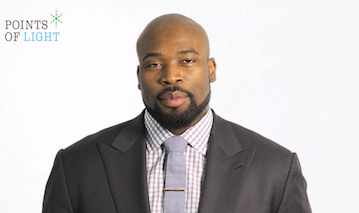
Hear Israel Idonije talk about matching your passions with volunteering. (Click image to watch video.)
Since 2007, Idonije has devoted countless volunteer hours and substantial financial resources to the Israel Idonije Foundation, which provides support to thousands of kids through after-school programs, sports camps and medical missions. The foundation focuses on three places Idonije has called home: West Africa, the Canadian city of Winnipeg and Chicago.
A native of Lagos, Nigeria, Idonije moved with his family to Manitoba, Canada, when he was 4. His parents were Christian missionaries and founders of a local charity that distributed food to needy families; Idonije’s earliest memories are of helping his parents serve the community. As a youngster, he did volunteer work through the local YMCA, and during his years as a student and star athlete at the University of Manitoba, he regularly volunteered at a high school after-school program.
Three seasons into his career with the Bears, Idonije launched his foundation – initially working solo from his garage. He started by asking a local high school principal, “How can I help?”
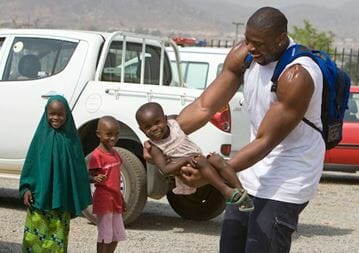
Israel Idonije plays with children during a trip to Africa.
In Chicago, Idonije (known to locals as “Izzy”) sponsors after-school programs through the IZZYz KIDz program.
Through a partnership with the Salvation Army’s Ray and Joan Kroc Corps Community Center, IZZYz KIDz enables teens from more than a dozen Chicago schools to gather at the center after school. The students can receive academic help and lessons in recreational pursuits, such as painting and dancing.
Each year, the foundation sponsors “Shop With a Cop,” which brings 200 Chicago kids from underserved communities together with 75 police officers and 50 volunteers and teachers for a day of fun, including bowling and pizza. The kids, paired with police officers, are given $100 gift cards and sent out on shopping sprees.
Idonije’s foundation also heads an annual All-Star Football and Cheerleading Camp in Chicago and Winnipeg, attracting more than 350 kids from underprivileged neighborhoods each year. While participants learn football or cheerleading skills in a fun atmosphere, they focus on building healthy peer relationships.
In West Africa, the focus is humanitarian. Through its Africa Project, Idonije’s foundation leads annual medical and community-building missions to impoverished communities. Since 2008, Idonije has traveled to Nigeria yearly with a team of volunteers to provide medical aid, community support and sports empowerment camps to kids in need. This year Idonije’s team traveled to a village in Ghana where almost all the children needed treatment for malaria and other diseases.
“We believe every person on this planet has a role to play in using individual abilities to not only achieve personal dreams, but to also make our world better,” Idonije says of his foundation. “Together we succeed.”
Leni Calas
When Superstorm Sandy struck New York City in October 2012, devastating neighborhoods, Leni Calas moved into action to help victims.
“We knew almost at once that hundreds of homes were being destroyed, that hospitals were losing electricity and that streets were flooded,” says Calas, of Queens. “There was no way government emergency services could handle it alone.”
In the days and weeks that followed, Calas operated a food distribution center from her basement and worked with a volunteer from the hard-hit neighborhood of Rockaway to start a health clinic. When the most immediate needs of storm victims had been met, Calas took in a woman and two children facing eviction from a flooded apartment.
“I grew up here. When I was a child, my father took poor families into our home,” says Calas. “When someone is in need … you simply do the right thing.”
And knowing the community helps. After years working in the film and television Industry, in 2009 the mother of two founded The Mama’s Network, an online service enabling parents in Queens to share information and learn about community resources. The network has since grown to include other parts of the city and suburbs, and operating it is now a full-time job for Calas. She says that neighbors helping neighbors is part of the fabric of Queens.
When Sandy hit, Calas learned quickly, just from reading posts on The Mama’s Network, how severe the damage was.
The shortage of food and drinking water was the most urgent problem, so the distribution center came first, says Calas. She opened an online site throughwww.recovers.org, which provided a web platform to recruit volunteers and intake donations. Through this site and The Mama’s Network, Calas was able to get 15 to 20 volunteers; together they were then able to recruit hundreds of drivers.
Calas and her volunteers worked 18-hour days at the food distribution center for weeks. Her husband and 13-year-old daughter Max pitched in to help, and Calas’ mother even moved into the house and cooked for the volunteers at the end of each day.
While still operating the center, Calas learned on a trip to Rockaway that residents had little or no access to medical care.
“Bellevue and other hospitals were still closed,” says Calas. “I met a relief worker in Rockaway who was responding by setting up a clinic in a flooded furrier’s shop, so I partnered with her. Once the clinic was up and running, doctors and other medical professionals from around the city rushed to help us.”
For two months, volunteers at the 20-by-20-foot makeshift clinic tended to 20 to 30 walk-in patients every day. Two mobile units operated by the clinic, along with individual doctors who offered to travel, helped another 50 patients daily.
When the need for food distribution and emergency medical service subsided, Calas wasn’t finished. That’s when she met Kizzy, a single mother living with two kids in an apartment with no electricity. Learning that Kizzy was about to be evicted, Calas rushed to negotiate with the landlord, then brought groceries to the family. But after inspecting the apartment and finding it crawling with mold, Calas invited the family to move in with her.
“It was an awkward situation, but my family was amazing when Kizzy came,” says Calas. “The kids – even my 3-year-old – understood what was going on and did everything they could to help to make Kizzy’s children comfortable. Max even helped Kizzy’s older daughter with her homework. It was a complete family affair.”
After staying many weeks at the Calas house, Kizzy was able to rent a new place of her own.
“It wasn’t easy, by any means, having a family live with us,” says Calas. “But it needed to be done, and I’m glad my kids went through the experience. It’s one thing to talk to children about doing the right thing. But when you show them, it’s indelible.”
Jude Quinn
On a given day in Topeka, Kansas, you might find Jude Quinn and one of his “troops” of volunteers handing out care packages of toiletries to homeless people or cleaning trash from a park. In the winter, they drive the streets dispensing free coffee to anyone who looks cold. In the summer, bottled water is the offering. And if a specific community group or facility has an urgent need, Quinn assembles a troop by putting out a call to his network of volunteers via Twitter and the web.
Jude Quinn, left, talks to volunteers before a “SilverbackKS Sunday” coffee run.
If this mission seems broad, that’s precisely what Quinn intended when he founded SilverbackKS in 2011. Aside from a few regularly scheduled activities, SilverbackKS is primarily a kind of online and social media clearinghouse that enables people with busy schedules to pick and choose where and when they can pitch in to help.
In just over a year, more than 150 people have registered with the SilverbackKS web database to receive Quinn’s regular updates on where donations and volunteer help are needed – information he receives directly from a growing list of organizations responsible for food drives, halfway houses, beautification programs and other vital services.
“I’m a locomotive engineer who’s on call 365 days a year,” explains Quinn. “My wife and I also have six children. When I moved to Topeka, I was eager to help the community, but my schedule didn’t allow me to volunteer for any one service organization for, say, a fixed number of hours each week. As I discussed this with friends, I learned that many of them were in the same situation.”
Quinn says he met most of his friends in Topeka through Twitter groups and discussions, and realized he could use Twitter as a means of recruiting volunteers for immediate community needs.
“If someone can help on a given day, that’s great,” Quinn says. “But we understand that everyone’s free time is scarce and valuable.”
Quinn named the organization after the silverback gorilla, the elder in every gorilla troop in charge of guiding, providing for and protecting the other troop members.
“We started almost spontaneously during a heat wave in 2011,” says Quinn. “My friends and I saw people sitting on their porches because their houses were too hot, and others walking on the streets looking miserable. We decided to get bottled water and start giving out to everyone we saw. When winter came, a local coffee shop, PT’s, agreed to give us free coffee and cups, and we started delivering it every Sunday to the homeless, to halfway houses and to anyone else we saw along the way. We didn’t want it to be just charity. We wanted to help one big community that is Topeka.”
Quinn believes their high visibility during these early deliveries helped them greatly when he later started recruiting volunteers online. And the coffee runs were so popular that they’ve become a permanent Sunday activity, “SilverbackKS Sunday,” for which a full troop of volunteers is always signed up months in advance.
As the number of volunteers grew and became well acquainted with Topeka’s homeless population, Quinn created a spinoff program called SilverBAGS. Using the Web, he solicits donations of toothpaste, shaving cream, bandages and other small-sized essentials. Volunteers then package them and distribute them to the homeless on SilverbackKS Sundays.
There have been two other spinoff programs – SilverMOMS, an invitation-only online group that enables Topeka parents to support each other, and the environmentally minded SilverTHUMBS, which helps with regular beautification projects in Topeka.
“It’s immensely gratifying to witness what our volunteers accomplish,” Quinn says. “And the feeling keeps coming back because every project we’ve started has been successful.”