A dentist for roughly four decades, David Black had skills his community needed. So when he got the call from the Virginia Dental Association to help run large free clinics in Roanoke, Va., he knew he could help.
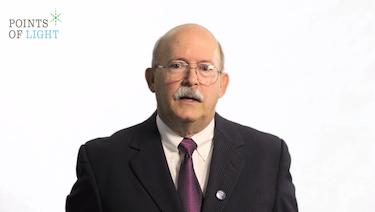
Hear David Black talk about the work of the Roanoke Mission of Mercy Project. (Click image to watch video.)
The association had created Missions of Mercy in 2000 as a statewide program to provide high-quality dental care for Virginians who couldn’t afford it. The association’s director, Terry Dickinson, approached Black to help start the program in his town.
“When Terry asked me to help expand the program to Roanoke, I was enthusiastic about it,” Black recalls. “My family has had three generations of dentists in this city, and I feel that since I’ve been privileged to have a good career, I’m expected to give back.”
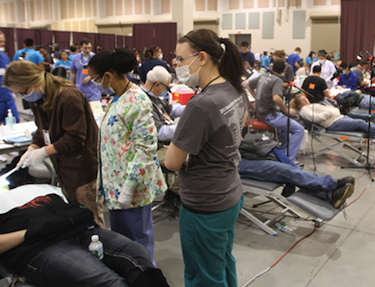
So five years ago Black served as a founding organizer of the Roanoke Mission of Mercy Project. Each year in Roanoke, Mission of Mercy brings together around 800 volunteer dental professionals and students who, during a two-day clinic, provide free dental care to hundreds of uninsured or underinsured local residents.
Black has taken the lead in recruiting volunteers, arranging facilities and managing event operations. And thanks to more than 2,000 volunteers over the years, the Roanoke Mission of Mercy Project has provided more than $5 million in free care to more than 5,000 patients.
Volunteer dental professionals see patients at a Roanoke Mission of Mercy clinic.
An estimated 100 million Americans don’t go to the dentist because they can’t afford it. Even so, the first year Roanoke held its Mission of Mercy Project, volunteers were surprised by the number of people who lined up hours before the clinic opened.
“Even in Roanoke, which has relatively low unemployment, we had more than 1,000 people show up that first year,” says Black. “We were using a simple first come, first-served system. We still use that, but we’ve modified it with a ticketing system to reduce the amount of time people spend waiting.”
Black encourages dental professionals nationwide to get involved in volunteer clinics.
“I won’t tell you that an event like this isn’t hard work, but the need is great,” Black says. “The dentists, dental assistants, hygienists and students who turn out each year are performing a great service to this community. The patients we see have often gone years without treatment, living with pain. And when they leave, the overwhelming gratitude they show us is its own reward.”
Moore, Oklahoma, Public School Teachers and Staff
As a massive tornado touched ground and headed for Moore, Oklahoma, it became frighteningly clear that three of Moore’s public schools were directly in the twister’s path. With only a few minutes’ warning, the teachers and staff rushed to protect the children.
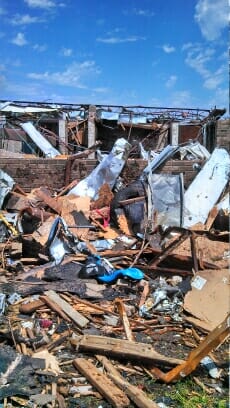
Twisted metal and debris was all that
was left of Valerie Singleton’s classroom
after the May 20 tornado in Moore, Okla.
That afternoon, May 20, seven students died in Plaza Towers Elementary School when the tornado pummeled the building. As horrific as that loss was, it could have been far worse. Winds of up to 200 miles an hour decimated Plaza Towers and Briarwood elementary schools and severely damaged Highland East Junior High. The quick-thinking adults in those buildings, using instinct and emergency training, saved young lives.
Plaza Towers sixth grade teacher Janice Brim remembers ushering four children into a small closet, knowing that the safest shelter would be a small room with short walls. “I had them kneel down and cover their heads with their backpacks,” she recalls. “I had to keep the door forced shut with my arm.”
As the tornado began to hit the school, Brim and her students could hear screams from adjacent rooms, along with a roaring wind.
“I kept repeating, as loudly as I could, ‘We’re OK, we’re OK,’” says Brim. “Over the roar, I could hear them singing a song I didn’t recognize, probably a hymn about protection. I encouraged them to keep singing. They asked if they could pray, and I said, ‘Of course!’ Soon we saw light and knew that the roof was coming off.”
About a mile away, at Briarwood Elementary, third grade teacher Valerie Singleton, a fellow teacher and a librarian brought about 20 children to a storage closet to take cover.
“The lights were already flickering, and the kids began to cry,” says Singleton. “After we got them crouched down into safety positions, I suggested that we start a story round – with each kid telling part of a story. It helped a lot. By the end of the round, the children were laughing.”
They had been in the closet only a short time when they started to feel the force of the tornado. The roof ripped off. Debris pelted them.
Then, quiet.
The children huddled with Brim and Singleton, and so many other teachers and staff members, survived.
“We don’t become heroes when something this terrible happens,” says Brim, a teacher for 20 years. “We all become mommies. It’s just natural. … Students must be safe. You can’t educate them unless you’ve made a safe place for them.”
To hear Plaza Towers teachers tell their stories, watch this FEMA video about an artistic effort to recover and heal.
Jamie Holmes
Jamie Holmes founded Jamie’s Dream Team when she was eighteen years old with the assistance of her Mother, Kim Shidel, and her Grandmother, Bonnie Cottone. Jamie has been a member of the Board of Directors of Jamie’s Dream Team since its inception in 2005. Jamie’s passion is Jamie’s Dream Team. Jamie decided when she was fifteen years old and in Children’s Hospital of Pittsburgh for one (1) of her many surgeries, that she wanted to someday start an organization that would help people with serious medical conditions. Despite the pain and suffering that Jamie has, and continues to endure, her heart has always been with others who are suffering. As such, Jamie started Jamie’s Dream Team to fulfill her dream of helping others who are suffering.
Aesha Rasheed
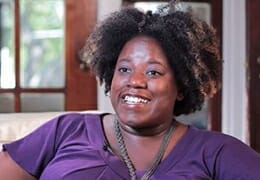
As an education reporter for The Times-Picayune, the daily newspaper in New Orleans, Aesha Rasheed felt frustrated. Her exposure to the city’s mismanaged school district left her wanting to do more to directly help the community. She quit her job in 2005 and began exploring ways to help students and families trapped in an inequitable education system.
(Photo courtesy of Learning Matters)
Then, that year on August 29, Hurricane Katrina hit. “Suddenly, it was a different world in New Orleans,” says Rasheed. “I had been focused on the right to equal education. After Katrina, all of our 128 public schools closed. More than a year later, fewer than 10 had reopened.”
To help displaced and underserved families in New Orleans find out what schools had reopened – and the quality of those schools – Rasheed began to publish the “New Orleans Parent’s Guide.” Now in its seventh edition, the annual guide is widely regarded as the go-to source of data on New Orleans’ public and charter schools.
“Families were trying to return to the city,” Rasheed says. “For those with children, the right to return was inextricably tied to the right to quality education.”
Eighty percent of New Orleans’ schools are now charter schools, with a quilt of organizations providing funds, from national school reform groups to local organizations started by citizens. Rasheed says publishing the “Parent’s Guide” to detail those schools was no easy task. First she considered putting it online, but there were still hundreds of families living in the Superdome, the city’s enclosed football stadium, and other emergency housing, with no access to the Internet.
“For the first few years, the only way to reach families was through a printed guide distributed by organizations and volunteers,” says Rasheed. “We have published 10,000 guides per year, and the response from parents and the school district has been overwhelming” In 2012, Rasheed adds, the school district donated funds to help put out the guide’s seventh edition.
This year, a nonprofit organization developed and donated a smart phone application that gives parents access to the guide. And Rasheed has more ambitious goals for 2013, hoping to put out a multilingual edition.
“I can’t solve the New Orleans school problem by myself,” says Rasheed. “We should all be doing the work of making sure that children are nurtured. The New Orleans Parent’s Guide is simply my piece.”
Challenger Center for Space Science Education
On January 28, 1986, the seven-crew members of the Space Shuttle Challenger/STS-51L “Teacher in Space” mission set out to broaden educational horizons and advance scientific knowledge. Their mission exemplified man’s noblest and most wondrous qualities – to explore, discover, and teach.
To the nation’s shock and sorrow, their Space Shuttle exploded 73 seconds after liftoff.
In the aftermath of the Challenger accident, the crew’s families came together, firmly committed to the belief that they must carry on the spirit of their loved ones by continuing the Challenger crew’s educational mission. In April 1986, they created Challenger Center for Space Science Education.
Challenger Center for Space Science Education offers dynamic, hands-on exploration and discovery opportunities to students around the world. These programs equip students with the knowledge, confidence, and skills that will help better our national, social and economic well-being. The center gives students the chance to become astronauts and engineers and solve real-world problems as they share the thrill of discovery on missions through the Solar System. Using space simulation and role-playing strategies, students bring their classroom studies to life and cultivate the skills needed for future success. Learning Centers reach into communities around the globe, engaging more than 400,000 middle school-age students and 40,000 educators each year.
Cindy Angulo
Dream B.I.G (Believing in Girls)
Thomas Walters
Thomas Walters has dedicated his life to the empowerment of his community. Thomas has been actively engaged in two consecutive AmeriCorps terms for the SilverCorps and Veteran Leader Corps programs; he participated in both programs through Hands On Atlanta. He is also actively involved with his church, AARP, and the Lupus Foundation. Through his service he has addressed the needs of the retired, the military community, low-income families and individuals, hunger and homelessness, and individuals with the Lupus disease.
Thomas volunteers for food distributions for low-income families in the Metro Atlanta area through the nonprofit organization SWEEAC. He leads support groups for other individuals diagnosed with Lupus through the Lupus Foundation. He has educated the retired population on car safety through his efforts at AARP. He has also served on various nonprofit boards including his church and SWEEAC.
Stephanie Reagan
Stephanie Reagan, currently serving as the Director of GC Miracle in a volunteer capacity, has devoted her college career to addressing the needs of The Children’s Hospital at the Medical Center of Central Georgia. The Children’s Hospital is the only dedicated children's facility between Atlanta, GA and Gainesville, FL, making it the main source of healthcare for over 49,000 children from 29 counties in South and Central GA. Since the hospital never turns anyone away for lack of funds, it is always in need of funds for its programs and equipment. As Director, Stephanie led an executive board of 12 students in a yearlong fundraising activity, culminating in the 2013 Space-themed Dance Marathon that exceeded expectations by engaging 300 volunteers to raise more than $42,000. Additionally, she has broadened the organization’s scope to include a wider swath of the community than ever before and has ensured the sustainability of her efforts through her ability to instill a sense of dedication and commitment in the members of her staff. Stephanie’s tremendous versatility, visionary thinking and extraordinary passion have raised the organization to new heights. She has made volunteerism with GC Miracle a priority throughout her college career, despite the fact that she is a full time Mass Communications student in her senior year.
Amy Granillo
Amy Granillo founded USMC Families, a nonprofit organization staffed by a multi-state network of volunteers providing support to Marine Corps families living both on military installations and within military impacted communities. The military community has an urgent need for family support programs. Amy and her volunteers help fill the gap between the government funding allocated to these programs and the need that is still there after funds are gone. Amy’s organization runs a literacy program, the Book Battalion, which provides an outlet for children to let their imaginations run wild with stories from books. The Book Battalion offers read aloud events, fun reading swag, books, summer reading cultivation workshops, and an online members-only area with downloadable reading activities, a secure educational gaming portal, and learning tools. Additionally, they have developed a Marine Corps Spouse Academy that offers a variety of professional and personal development opportunities for Marine Corps spouses who want to advance on their path to success.
Overall, Amy has spent thousands of hours working with the military community. Her mission is to help as many military spouses and children as she can in any way that she can.




 Volunteer dental professionals see patients at a Roanoke Mission of Mercy clinic.