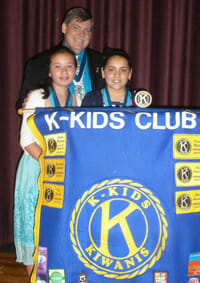
Bowling Green K-Kids is a student led community-service club made up of third through fifth grade students at Bowling Green Elementary School in Westbury, New York. The Bowling Green K-Kids has engaged in more than 33 service projects this past year. Kiwanis International has recognized the club as a Distinguished Club every year since being chartered five years ago. Recently, the club won a $10,000 grant from IKEA to furnish a newly constructed arts center and library at Kamp Kiwanis, a summer camp for needy children in New York.
Jack Fussell
At the age of 62, Jack Fussell is running in memory of his father, whom he lost to Alzheimer’s disease on June 30, 2000.
In an effort to raise funds and awareness for the Alzheimer's Association, Fussell has walked, jogged and inspired countless people on a cross-country journey which began in January 2013 on Skidaway Island, GA and has continued to Monterey, CA.
On his journey, Fussell has spoken at nursing homes, Alzheimer’s care facilities, Association offices, and roadside with anyone who had an interest in Georgia, Alabama, Mississippi, Tennessee, Arkansas, Oklahoma, Texas, New Mexico, Colorado, Utah, and Nevada.
He has captured photos of his journey at www.acrosstheland2013.com and the stories of the people he has encountered whose lives Alzheimer has also affected.
Thus far, Jack has raised more than $26,000 along the way. With an ultimate fundraising goal of $250,000 to be donated to the Alzheimer’s Association, Fussell hopes to leave a lasting legacy that contributes to research and the delivery of essential programs and services that benefit patients, caregivers and their families.
Desiree Mancuso
After many years of working at a variety of jobs, Desiree Mancuso was never really happy or productive at anything she did. After losing everything she owned to Hurricane Katrina in 2005, and seeing the countless animals that either died in the storm or were displaced and left homeless, she knew she had to do something.
Mancuso and a friend decided to start Paws in the Park, a nonprofit that raises funds for local animal shelters, and rescues and finds homes for homeless and abused animals. Paws in the Park is located in St. Bernard Parish, in which majority of all homes were destroyed by Hurricane Katrina. In seven years, recovery has been slow and the population is approximately half of what it was pre-Katrina. Many of the residents that have returned are low-income families and cannot afford the high cost of private veterinary services for their pets.
Now, Mancuso spends countless hours holding benefits and events raising funds to help local animal shelters. Through Mancuso’s hard work and unending dedication, Paws in the Park is able to sponsor events so low-income families can afford shots, neutering and supplies for their beloved pets. She works all week at the local animal shelter, volunteers with outside rescue groups and manages Paws in the Park too.
Mancuso answers phone calls 24 hours a day concerning stray or abused animals and responds to each call for help. She is especially involved in pitt bull rescues and recently received 12 staples in her head because she threw her body over a dog that was being attacked by another and though she was traumatized by the event, she went right back to work, doing her best to save each and every one.
Mancuso has finally found her place in life and these animals have given her as much new life as she gives them.
Waterloo Community School District: Reconnect To Graduate Volunteers
Concerned about high school dropout rates, Waterloo, Iowa, school officials decided to plead their case to dropouts face-to-face by going door-to-door.
Last year, the school district partnered with a variety of community organizations and local businesses to form Reconnect to Graduate, a program designed to engage community members in reaching out to high school dropouts ages 16 to 21 and help them find ways to return to school.
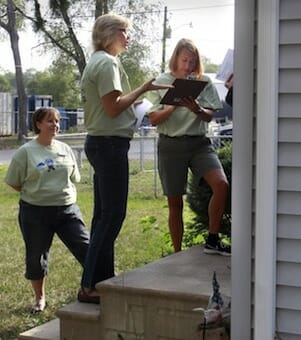
From left, Kelly Knott, Jane Lindaman and Sue
Flynn visit the home of a former high school
student. (Waterloo Cedar Falls Courier)
This past summer, 90 Reconnect to Graduate volunteers – divided into 25 teams of school district workers, translators, community activists and city government representatives, including the police chief and the mayor–made personal visits to 170 homes in a day. As a result, 60 former Waterloo students re-enrolled in high school as of Oct. 1.
“We re-enrolled twice as many students as we did in our first year,” says Ellen Vanderloo, who is a mentor and volunteer coordinator for the school district.
Reconnect to Graduate had its genesis when Vanderloo read articles about similar programs in Des Moines, Iowa, and Houston. She brought the idea to district administrators, then lined up support from businesses and civic organizations.
“I believed we could succeed, but I knew it would be very difficult,” says Vanderloo. “We have one of the most diverse school district populations in Iowa, including many immigrants with language barriers. Our teams this year included translators fluent in Spanish, Bosnian and Marshallese (spoken on the North Pacific Marshall Islands).”
According to Adriane Carlson, a school district student services specialist active in Reconnect to Graduate, the program must prove to families that it can help students overcome a host of other barriers as well.
“These kids have heard many people tell them to get back in school,” says Carlson. “But they’ve left school for reasons. Some are working to help support their families. Some are taking care of children at home. We have to convince them that we have programs in place to eliminate these barriers – programs that will allow them to work and earn a diploma at the same time.”
The Expo Alternative Learning Center, for example, offers online learning and a school based at a local shopping mall teaches courses after hours and on weekends. Forty-three of the 60 students who re-enrolled this year will attend Expo.
“I’m excited about getting the new students into our programs,” says Kory Kelchen, dean of students at Expo. “They will have unique needs, but we’re never afraid to start new programs or take on new challenges. We’re always looking to expand and to see more students graduate.”
After seeing the success of this year’s program, Vanderloo is not only excited about the future of Reconnect to Graduate, but is eager to see more school districts launch similar programs.
“This program can be replicated anywhere,” says Vanderloo. “We had just one staff member, Lindsey Jackson, who oversaw the job of matching the right translators and teams with the right neighborhoods. Once our teams hit the streets, they finished making all their visits in three hours. They succeeded so well because they were from the community. Any district can duplicate Reconnect to Graduate – if they make it a community effort.”
Allison Meyaard
Allison Meyaard serves at Burton Health Center, a school based medical and dental clinic serving the community in Grand Rapids, MI. She works with the students who attend Burton Elementary and their parents. Those students and their parents often cannot find rides to other health centers, and the school center ensures that all can be seen by a provider.
Meyaard assists patients with Medicaid applications and other government assistance applications, allowing the clients to be healthier, not only by seeing a doctor, but by helping improve their way of life.
Meyaard leads classes for overweight children and manages the school’s Girls on the Run chapter, a program that provides pre-adolescent girls with the necessary tools to embrace their individual strengths and successfully navigate life experiences.
Meyaard has dedicated herself to the service of others and does it well. She is always joyful and happy to help, even when others have stopped. Meyaard is an outstanding individual who has demonstrated a heart for service and has inspired many others team at the Burton Health Center to serve better.
Barrett Roell
In 2011, after transferring to Georgia College and State University (GCSU) as a sophomore, Barrett Roell donated blood at an American Red Cross blood drive hosted by GCSU. After donating, he became interested in other ways he could become involved with the blood drives.
GCSU had been hosting blood drives for years, five per year. However, each drive has been small, inadequately staffed and organized, and poorly advertised. Roell changed that. He became a volunteer at the drives, making himself available in whatever way he could. He clocked hundreds of hours in his volunteer work with the drives.
In April 2012, Roell became the president of the GCSU blood drives. In his new role, Roell made tremendous changes in the structure of the drives. He completely overhauled and expanded the drives, turning them into a smooth, efficient process, greatly increasing the amount of blood collected, and hugely spreading campus awareness of the importance of donating blood. He organized a huge advertising campaign to promote the blood drives and used social media for marketing, posters, email lists, and tabling. He made advance sign-ups for the drives possible by tabling all day every day for a week prior to each drive.
Roell 's work with the blood drives serves three populations: the donors, developing student leaders, and, most importantly of all, individuals in need of blood. The blood drive program that existed on the GCSU campus prior to Roell's arrival was in need of a strong leader, and he became that leader. Many people wanted to donate blood on the GCSU campus, but did not have and easy or convenient way to do so. Roell made it easy and convenient for them. When Roell became president of the drives, he began working one-on-one with student volunteers at the drives, and helped them find ways to use their abilities for the good of the community.
Essentially, Roell galvanized the campus community, helping people who had a generalized desire to do something for the world, channel their energy into a concrete way of helping people. As far as his own plans after graduation: Roell says that no matter where he goes, if there is not a blood drive there already, there will be.
Team Martina
Music has the power to inspire. One song in particular moved Sheila Jones so deeply that the Madison, Ala., woman has made it her mission to help others, namely cancer patients, through volunteerism and the healing power of music.
The song? “I’m Gonna Love You Through It,” performed by country singer Martina McBride, about a husband who supports his wife during her bout with breast cancer.
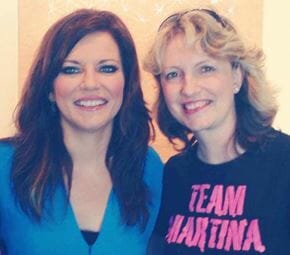
McBride and Jones
“I had often thought about doing something positive with one of Martina’s songs,” says Jones, a longtime McBride fan who had worked for years as a fundraiser for cancer research. “Then one day I was listening to ‘I’m Gonna Love You Through It’ and a light bulb went off in my head. Martina had been active in the fight against cancer, and it was a special cause for me. I decided to reach out to Martina’s other fans to see what we could do together.”
In 2011, Jones founded Team Martina, primarily using Facebook and other social media channels to recruit volunteers and solicit donations. More than 200 volunteers in 20 states and three countries have joined Team Martina. The organization, which has received McBride’s blessing, has raised more than $100,000 for cancer research and treatment.
This year, Team Martina created the Martina McBride Breast Cancer Research Grant at Vanderbilt University. The grant provides funding for research into triple negative breast cancer, an aggressive and rare form of the disease that strikes young women. In just six months, Team Martina volunteers have raised more than $42,000 to fund the grant and created a media campaign to increase awareness of this type of cancer.
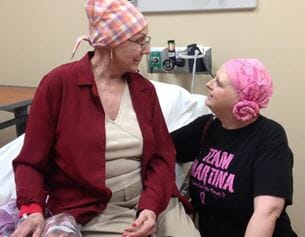
Team Martina member Taira Baughman, right,
comforts a cancer patient in Nashville, Tenn.
“Team Martina is committed to making the world a better place through volunteering and connecting with others,” says McBride on her website. “It’s a real community, and we are excited about growing it and having more and more people take part.”
Since Team Martina was founded, volunteers in various cities across the U.S. have formed about 20 chapters. Members of these local groups have made Christmas visits to more than 1,500 hospital patients receiving chemotherapy. Patients receive gifts as well as special chemotherapy hats made and donated by Halos of Hope. McBride herself joined in one such visit and sang Christmas carols to patients.
“You can just imagine what that was like,” says Jones. “Not only did the patients receive gifts, but there’s also Martina, a top star, singing just for them.”
McBride has also partnered with Team Martina in a fundraising program called “Sound Check For A Cure.” These are short performances, during which McBride sings to a small group of donors prior to a concert, when an artist or technicians would normally be testing the sound equipment.
“We limit the audience to 50, so it’s a very intimate environment,” Jones says. “When Martina finishes, she comes down to greet the audience and pose for photos.”
Jones emphasizes that Team Martina is not limiting its efforts to cancer research.
“Part of what we want to be is Martina McBride fans helping the overall community,” says Jones. “At one of the Sound Check concerts, we used the money raised to build a children’s playground in Atlanta. Also, many of our members have been exposed to domestic violence. Domestic violence is one of Martina’s causes, and as Team Martina grows, we’d like it to become one of ours.” (Domestic violence is a cause for Jones, too; her mother had been abused.)
Team Martina grew so quickly that Jones now oversees the organization full time, with the support of her husband and 11-year-old daughter.
“It’s been a grand adventure,” says Jones. “If you have an idea for a volunteer project, definitely go for it. You’ll be amazed by the good things that come into your life, and it won’t even feel like work.”
IVETTE CHAIDEZ
In July 2012, Ivette Chaidez of Hanford, California established Buckle Up For Itzy in memory of her younger sister of Itzayana “Itzy” Chaidez, tragically killed on Sept. 2, 2011 in a car accident in which she was not wearing her seat belt.
Through Buckle Up For Itzy, Chaidez has dedicated herself to raising seatbelt safety awareness by holding safety fairs, speaking to high school students, and establishing the Buckle Up For Itzy scholarship fund for graduating high school seniors in California’s Kings County who wish to pursue a career in the medical field.
Amy York
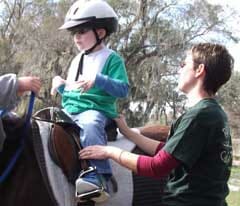
Amy York during a riding lesson performing side-walking duties and supporting a rider.
For the past three years, Amy has been volunteering with TiAnViCa Riding Academy in Bartow, Florida. She is a dedicated and steadfast volunteer who helps TiAnViCa Riding Academy provide educational and recreational therapeutic riding activities to physically, mentally and emotionally challenged individuals including veterans recommended by the local Veterans Affair office.
During the week, York works at a school for special-needs children and has a child with special needs as well. Once she realized how much her child benefited from TiAnViCa, Amy became a devoted and passionate volunteer for the program.
It takes three to four people to assist one rider per lesson in all kinds of weather. York’s knowledge of horses and devotion every week helps the staff at TiAnViCa safely serve special-needs riders. York manages a team of volunteers providing leadership and encouragement to ensure the safety and well-being of riders, volunteers, and horses. Additionally, York has become an advocate for the program speaking at events telling her own family’s story and participating in fundraisers.
Brian Pekari
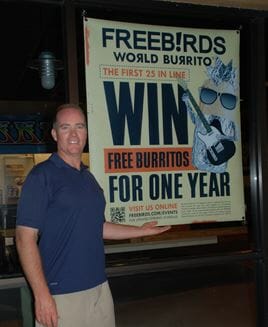
Many in Tracy, Calif., know Brian Pekari as “The Burrito Man.” Last year on a whim, when a new restaurant in town offered a year’s worth of free burritos as its grand opening prize, Pekari camped out in 100-degree weather for four days to ensure he would win. Victorious, he donated the prize to the city’s family homeless shelter. Moved by Pekari’s gesture, the restaurant gave him and his family another year’s supply – which Pekari donated to the Boys & Girls Clubs of Tracy.
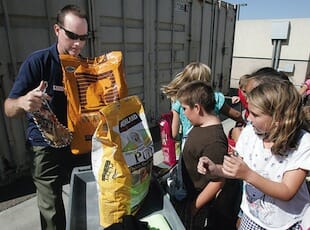
Brian Pekari helps students sort through donated
pet supplies. (Glenn Moore/Tracy Press)
When Pekari’s burrito campout received wide media coverage, he took advantage of his new local fame by founding Tracy United To Make A Difference, a community-building organization inspired by national Make a Difference Day, Oct. 26. (It’s not too late to register your volunteer project for Make a Difference Day. Click here.)
In just a year, Tracy United To Make A Difference has built a coalition of more than 100 schools, businesses, government agencies, religious groups and civic organizations and mobilized 5,000 volunteers to address community needs.
The organization has served more than 12,000 community members and 100 abandoned and injured animals. Pekari has become the local coordinator of Make a Difference Day and National Volunteer Week, and last year received the city’s Celebrate Service award for his volunteer efforts.
“My father died when I was 3, and my mother suffered from illnesses from the time I was born,” says Pekari. “My community – relatives, coaches, teachers, friends – helped to raise me. I learned the power of community at a young age, and this is my way of giving back.”
Brian Pekari stands in front of the
eatery where he gained his local celebrity.
Pekari emphasizes that he wants Tracy United To Make A Difference to be a channel through which anyone can find a cause they want to serve.
“In 2012, when we started, there were heated political races going on, and Tracy was divided exactly 50-50 between Democrats and Republicans,” says Pekari. “I wanted to make a strong statement that we are one community with far more that can unite us rather than divide us.”
According to Pekari, one of the organization’s most successful partnerships has been its collaboration with the Tracy Unified School District’s Anti-Bullying Committee; three school districts have declared their schools “No Bullying” zones. The group has recruited faculty members and 115 student leaders to facilitate presentations and discussions about the effects of bullying. Pekari estimates that the program has reached more than 21,000 students.
In addition, Tracy United To Make A Difference is collaborating on a diversity and ethics program that has brought together about 10 religious communities and representatives of ethnic groups to participate in events and discussions focused on racial and religious sensitivity.
The organization has also partnered with youth mentoring programs that include counseling, intervention services for at-risk kids and opportunities to integrate kids into performing community service. Seventeen high schools and grade schools participate. And the group has helped thousands of city residents in need through regular food and clothing drives and by providing assistance to the homeless through ongoing support of the McHenry House (the family shelter that received the free burritos from Pekari).
“Volunteerism is the best medicine,” says Pekari, who hopes to expand his group’s programs. “Individually, we can all make a difference. Collectively, we can create lasting change.”