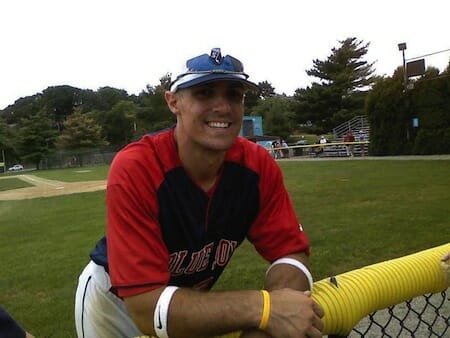
Meet Daily Point of Light Award honoree Pete Frates. Read his story and nominate someone you know as a Point of Light.
(Photo courtesy of the Frates family)
Looking back on 2014, the year brought so many compelling stories with ties to volunteerism. We confronted the perils of the Ebola virus. We watched with empathy as a community in Missouri, torn apart by racial tension, tried to heal.
And we rallied around a movement different from anything we’d ever seen – fueled largely by social media – that challenged us to help conquer a debilitating disease.
Indeed, one of the enduring memories from this year will be the millions of people across the globe – friends, celebrities, neighbors, former presidents, kids, CEOs, professional athletes, media correspondents and others – who drenched themselves in icy water as part of the ALS Ice Bucket Challenge.
The man who sparked this challenge, Pete Frates – a former baseball player at Boston College – was just 27 when he started experiencing symptoms of ALS, more commonly known as Lou Gehrig’s disease. But almost immediately after receiving the diagnosis that would alter his life, he rolled up his sleeves to fight.
Frates, now 30, was not the first person to dump a bucket of ice over his head. The stunt had been done before by professional athletes for various philanthropies. But a friend who also suffers from ALS took the challenge – the choice of donating $100 to ALS research or dumping ice water on one’s head – and passed it on to Frates via Facebook with a 24-hour deadline to respond and challenge someone else.
From there, it took off. In the last half of 2014, the Ice Bucket Challenge raised $115 million for ALS research, a tenfold increase over the prior year. Frates was recognized by Sports Illustrated as one of the most inspiring figures of the year.
What will be the next incarnation of a social media movement that calls us to action? And who are the change-makers in your community who will lead it? Make a difference by volunteering with an organization already making a difference.
Peter Samaroo
Today, when kids have spare time they turn on their televisions, computers, smartphones or iPads. Peter Samaroo of Charlotte, North Carolina, is volunteering his time to encourage youth to disconnect their electronics to reconnect with nature, by heading outdoors.
Samaroo’s passion for animals and the environment led him to share his expertise with the younger generations of his community. Samaroo dedicates his services to Shining Hope Farms, the Carolina Raptor Center and Friendship Gardens.
“I realized how many kids were out there that actually knew nothing about being outdoors or what nature was like,” Samaroo says.
Samaroo’s realization echoes the majority of opinion concerning American youth’s time spent outdoors, or more accurately the lack of time spent outdoors. Those aged between eight and 18 years old spend an average of 7.5 hours per day using electronics, according to a 2010 study by the Kaiser Family Foundation.
This time spent staring at a screen versus staring at clouds in the sky and birds in the trees, can can potentially negativity impact children’s physical and mental health.
This is what makes Samaroo’s work and mission, to reignite kid’s appreciation of nature, all the more important.
Samaroo has experience in gardening, planting and landscaping, which has helped him to build various structures at the Carolina Raptor Center, Friendship Gardens and Shining Hope Farms. But in addition to maintenance Samaroo is able to introduce students to animals, plants and other wonders of nature.
Samaroo says the core of appreciating the outdoors is simply sitting back and observing. Samaroo says of the students he leads on nature walks, “things are going on around them, nature is alive, but if you’re talking and not paying attention you will never notice it.”
Samaroo has always appreciated nature and wants others to be able to slow down to notice their surroundings. “I always enjoyed being outdoors, walks in the woods and quiet time,” says Samaroo.
Samaroo enjoys volunteering as a break from his work. He feels the benefit from volunteering is a worthwhile pursuit and encourages others to also use their skills to give to others.
“Anybody can give money, but to actually give your time is important too,” says Samaroo. “You’re helping and and a lot of time hopefully you’re learning something.”
Lauren Feyh
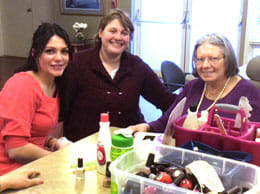
Feyh (center) and her fellow volunteers provide manicures for residents of local nursing facilities.
When she was a high school freshman, budding entrepreneur and self-described people person Lauren Feyh needed an outlet, so she turned to volunteering. “I knew I wanted to work with older adults because I’ve always had a good relationship with my grandparents,” says Feyh, who is bright and gregarious. “I talk to people constantly,” a skill she says is one of her greatest assets.
Today Feyh holds a degree in Gerontology from Bowling Green State University and has dedicated herself both professionally and personally to working with older adults and nursing facilities. But that wasn’t part of her original plan, she switched her major from Applied Health Sciences to Gerontology after speaking with her advisor who recommended she try it out as a course of study. The Gerontology program requires students to complete 50 hours of volunteer service with older adults and it was during that time that Feyh came to a realization, “the more time I spent working with nursing facilities the more I realized the sector is underrepresented with volunteers… that was a turning point for me.”
During her junior year, the University’s Student Gerontology Association appointed Feyh as volunteer coordinator where she helped enforce the spirit of volunteerism among the group’s members. There, she helped more than 15 facilities in the Wood County area recruit volunteers for their efforts, “the job was right up my alley… In a two year period I went from coordinating 10 volunteers to 33.”
This past year, Feyh, a proponent of intergenerational programming, established a program that pairs up high school students with residents of nursing facilities. She cites her network of mentors and supporters as the group responsible for helping her implement and expand this effort. The program which lasts for eight weeks pairs up 50 area high school students with 40 residents at Willow Brook Christian Community Campus based on their interests and personality profiles. Each week, the groups meet up, chat and do activities. And, after the eight weeks are up, the pairs present what they have learned from each other in creative and compelling ways at a program banquet. “The smiles are the greatest reward,” says Feyh, whose hopes for this program are not only to bring younger volunteers into the fold but also to make the program fun and engaging so that the students continue to come, of their own volition.
Feyh believes that the key to success is “to go out and make yourself known.” And Lauren Feyh, today’s Daily Point of Light Award winner has been doing just that: making herself known through volunteer service within her community for more than five years. “I have the drive to go out and ask for help because I have first-hand experience.” Feyh aspires to become the CEO of her own nonprofit, geared towards intergenerational programs but, for now, “I want to get as many volunteers into the [nursing] facilities as possible.”
Bailey Snow
Bailey Snow is a busy 17 year old. He’s a full time student with a part time job, and earlier this month, was accepted into his dream school, California Polytechnic State University, San Luis Obispo. Snow is the founder of BrickDreams, a project that collects, cleans and redistributes LEGO bricks to children in need.
A trivia buff, he came up with the idea one spring afternoon while riding in the car with his parents. “I had a trivia app on my phone and one of the facts that came up was ‘there are 62 LEGO bricks for every person on Earth’.” Snow began connecting the dots. “I had hundreds if not thousands of bricks of my own. And if the law of averages plays out then there are many kids who must not have any LEGOS. The idea just grew from there.” He officially began work in May 2012, his freshman year of high school, when his parents helped him set up a domain name.
To get the word out, he posted flyers, asking for LEGO donations. Says Snow, “That didn’t work so I called the local newspaper and asked if they can do an article on BrickDreams.” The Granite Bay Press Tribune complied and the donations started rolling in.
In April 2014, Snow was honored with USA Today’s ‘Make A Difference Day’ award. “Ever since the USA Today article we’ve been getting LEGO donations from all over the country.” In addition to LEGO donations, tennis clubs donate used tennis ball containers which BrickDreams uses to package the LEGOs for distribution. “We keep the donations in the house. The living room is now the LEGO room.” Snow doesn’t doubt that his parents want their living room back, “but at the end of the day they know we’re doing a good thing."
Snow is set to graduate from high school May 2015 but that doesn’t mean the end of BrickDreams. “After graduation I’ll pass Brickdreams on to my little sister and mom.” Snow wants to study Economics and isn’t sure he’ll be able to devote the necessary time (and storage space) to sustain the project. He has already begun transitioning his sister into more of a leadership role and is confident that the project will continue. Snow’s mother is considering registering BrickDreams as a 501c(3) nonprofit.
Most of the children BrickDreams helps are victims of domestic violence and felony abuse. Every now and then he hears a story of how one of his LEGO sets helped calm an especially scared child. “You never know what kind of effect the LEGOs will have on the kids, maybe [the kids] will be inspired to become engineers one day.”
Radical Mission
Organized by Radical Mission, the Warm Souls Christmas Celebration has been a major community event in Clarksville, Tenn. for nearly a decade. Warm Souls is presented on Christmas Eve by some 250 volunteers who help feed, clothe, and groom about 1,000 people in need.
Central to the event are free food, clothes, entertainment, haircuts and family photos, all handled by volunteers. How much goes into this production? While the main event takes place on Christmas Eve, Radical Mission volunteers are at work all throughout the year to handle everything from constructing equipment storage sheds to raising funds to cover hosting expenses.
The City of Clarksville provides free bus service to the event. In the season of giving, Warm Souls demonstrates the very best of community, bringing together volunteers through fellowship to make a difference in the lives of others.
Ramsey McCarthy
When most kids are only thinking about what gift may be under the tree for on Christmas morning, Ramsey McCarthy of Knox County, Ohio is spending time thinking about the elderly in his community and whether they have a gift, sometimes their only gift, at Christmas time.
Ramsey started Stockings4Seniors when he was 13 years old as part of his Eagle Scout Leadership Service Project, and it is now in its fourth year of operation. Ramsey works with and leads a team of people who carry out various aspect of the work necessary to advertise, collect donations, fill and deliver stockings. He leads the efforts of over 30 youth and 50 adults. To date, over 2,000 stockings have been delivered.
Craig Smith
Through Goodwill of Western North Carolina, Craig Smith has assisted with the Project Re-entry program, helping former prison inmates re-establish themselves in the community through job training and placement.
Project Re-entry establishes a system of pre- and post-release services that begin with inmates up to eighteen months prior to their release. Long-term services then continue after the inmates are released. Goodwill partners with the Criminal Justice Department of the Piedmont Triad Regional Council and its partner prisons within the Department of Public Safety to offer employment and training services that help former offenders find jobs and become productive members of the community.
Craig's efforts have specifically assisted inmates in job placement following parole, securing positions in the medical field, graduating CNAs and Med Techs.
Mariah Smith
Mariah Smith started Blankets for the Homeless when she was only 17 years old. She remembers eating at a fast food restaurant and seeing a homeless man nearby, shivering in the autumn night. Mariah felt called to grab a blanket out of her car, collect up the food she’d just ordered and run over to aid him. That sparked her passion to help others and galvanize her community. She and her adoptive mother drive the streets of Hampton Roads, VA four times a week, distributing blankets, bagged lunches, clothes, toiletries and other items to area homeless people.
Mariah feels a special bond with the people she supports: she was abandoned by her birth mother on the day she was born, Christmas Eve. Because of her past, she says that she, too, was once homeless.
Mariah and Blankets for the Homeless have distributed more than 80,000 blankets, lunches, hats, gloves, hoodies, and back packs to the homeless. The groundswell for this effort happened when she posted flyers around town asking for blankets. The immediate response from the flyers showed Mariah she could do something big.
Through her work, she encounters all sorts of groups interested in hearing about the problem and the solution. Mariah garners support for her cause through speaking engagements at schools, businesses, and every Sunday she speaks at a different church. She also maintains several drop boxes throughout the community where people can donate new or used items to be distributed. This allows people to help without having to do it themselves and enables Mariah to give the homeless things that they need. She also created a campaign encouraging the public to put five non-perishable food items and five blankets in their cars to have on hand when they encounter homeless people seeking help on the road.
Having started her cause at a young age, Mariah sees how she has grown and developed skills that can make her successful in the future. She has had to learn how to make her case for support and ask for donations. She has given public speeches in front of large audiences and appeared on The 700 Club, telling her story about the loss and confusion she felt from being abandoned. Learn more about her efforts at http://www.blanketsforthehomeless.org
Mariah has had to step outside her comfort zone to help others be more comfortable. She draws strength for this enterprise from her adopted mother and says they have grown closer through their service, done side-by-side. “She is my partner and my biggest supporter,” Mariah says. “She is incredible.” Mariah’s story drew national interest in 2014 when she was named a semi-finalist in the L’Oreal of Paris Women of Worth program.
In addition to positively impacting people who are homeless, Mariah has motivated local Girl Scouts and elementary school students to help make lunches to distribute. “There is an amazing community here, and so many have stepped forward to help,” says Mariah. “I see young people getting inspired so they can make a difference. I see adults changing their perceptions about homelessness.”
Who are the people in your community quietly leading positive change? Nominate an exceptional volunteer for a Daily Point of Light Award at https://www.pointsoflight.org/programs/recognition/dpol/nomination
Eastern AHEC Youth Health Service Corps
Eastern North Carolina is a rural region with high rates of chronic diseases such as diabetes, obesity, and hypertension. Many of the counties in this area have limited access to healthcare and fall into health professional shortage areas.
The Eastern Area Health Education Center Youth Health Service Corps provides volunteer training and education to high school students in economically disadvantaged communities in eastern North Carolina. Students complete six educational modules related to healthcare, health career exploration, health disparities, and vulnerable populations, as well as become CPR certified as part of the Youth Health Service Corps curriculum. Students are then required to do a minimum of 50 hours of volunteer service in their community that addresses one of the disparities and/or vulnerable populations they learned about in class.
The Youth Health Service Corps program was launched in eastern NC high schools 4 years ago to recruit young people into health careers, and raise awareness of the health disparities that exist, including the shortage of minority healthcare professionals. In this short period, YHSC students have contributed 12,024 hours of volunteer service in underserved communities. Some of the volunteer activities include organizing fundraisers for breast cancer research, educating middle school students about the importance of exercise, and conducting free vision and blood pressure screenings.
Sandra Tucker
Growing up with an autistic brother, Sandra Tucker felt she needed to protect him from those who didn't understand him. The topic of special needs was awkward for those on the outside, and Sandra felt she had to keep her hopes and fears quiet. It just wasn’t something she could talk about with others outside her family. She also had to contend with her brother’s nearly daily outbursts. Rather than live silent and angry, Sandra created Sibling Tree, a support group for caretakers who have a brother or sister with a special need.
Sibling Tree provides resources, safe places to talk and be understood, and activities just for the siblings of children with special needs. These brothers and sisters understand that more attention has to be given to their siblings and they help protect them. Sibling Tree is just a place for siblings to meet with other siblings to laugh and share. Currently, Sandra holds support group sessions for children in Denver and Boulder, CO.
There are numerous organizations to help children and people with special needs. Their siblings, however, are often the "forgotten" children. Inspired by an activity Sandra started when she was a teen, Sibling Tree participants create two journals: one for themselves, and one to share with their parents to help them voice their feelings and open up a line of communication. Years ago, Sandra started keeping a journal for herself, a paper-bound catharsis to vent all her feelings about being a caretaker for her autistic brother. She felt anger and worry and fear and loneliness. But there were also moments of joy and things she could laugh about. She made another journal that she shared with her mom. It was a composed way to check in with her mom, see how she was doing and thank her for being so strong.
Sandra has brokered many partnerships with groups in Colorado that work on autism issues, giving voice to siblings of autistic people. The organization began in 2013 and has grown to a presence in two cities. Sibling Tree now has 8 volunteers serving 85 children and adults, and the group has opened more lines of support to include siblings of people with Down Syndrome, Fragile-X and other developmental disabilities. Sandra is now getting involved in efforts to reshape policymaking and legislation related to autism and caregiving. Sandra’s efforts on the issue of caregiving support garnered national attention in 2014 when she was named a semi-finalist in the annual L’Oreal of Paris Women of Worth program.
“I know what I’m going through,” Sandra explains, “and I know I can make a difference.”
Who are the people leading transformative change in your community through exceptional volunteer service? Nominate a difference maker for a Daily Point of Light Award at https://www.pointsoflight.org/programs/recognition/dpol/nomination




 (Photo courtesy of the Frates family)