Lamman Rucker, center, visits kids at a Stephanie Starks Hope Foundation gathering in Los Angeles.
Lamman Rucker says his work with young people has saved his life.
Known for his roles in the hit movie, “Why Did I Get Married?” and the popular TV show, “Tyler Perry’s Meet the Browns,” Rucker started humbly in high school as an original member of the Washington Area Improvisational Teen Theater in D.C., which taught teens about the risks of teen pregnancy and sexually transmitted diseases.
And as he became an established actor on television and film, Rucker maintained that desire to help young people make good choices. In 2007, the year “Why Did I Get Married?” came out, Rucker co-founded The BLACK GENTS – an all-male, African-American theater company in Los Angeles – to resurrect and redefine the positive image of the black male through programs for young people and service to the community.
Rucker calls the ensemble “an African-American male collective of artists, scholars, entrepreneurs and community servants whose focus is to entertain, educate and empower through the arts, serve our community, uplift our young people and illuminate and project the positive images of black men in all facets of life.”
Though the emphasis is with black male youth, the theater company also provides support to young boys and girls from all backgrounds.
Rucker says he and his co-founders “have been amazed by the spirit and drive of them all when they have been given a chance to be involved in the process to make a difference. We not only live to inspire them but have been overwhelmingly blessed to have been inspired by them. My work with young people has saved my life.”
Rucker has been involved in youth programs in 10 middle schools, 30 high schools, 20 colleges and two leadership and arts programs in Barbados and South Africa. His tells young people about the vital role of education and the power of chasing your dreams.
“I know that simply the attendance and presence of children in school every day makes a huge difference on the education they receive,” Rucker says. “When a student is not just physically present but is fully present in school – meaning they are focused and on task – how much they can learn expands exponentially.”
He adds, “As a teacher, role model and mentor, I also recognize that my presence counts in encouraging and empowering the young people within my reach to work hard, to dream big and to be courageous.”
Tyler Perry
Today at the Points of Light Conference on Volunteering and Service in Atlanta, filmmaker, actor and philanthropist Tyler Perry received the Daily Point of Light Award. Read about how Perry has helped communities across the country and nominate someone you know as a Daily Point of Light.
Tyler Perry
Though one of the most successful figures in entertainment today, Tyler Perry’s early life was one of struggle.
He grew up in poverty in New Orleans, as a child suffering regular and severe physical abuse. Perry says his life changed when he heard Oprah Winfrey on television advise suffering people to “write it down.” He began writing about his life, using fictional characters, and eventually developed a play.
In the early 1990s, he moved to Atlanta, hoping to become a successful playwright, but he was left broke and homeless when his first play failed. Finally, in 1998, Perry’s play, “I Know I’ve Been Changed,” became a hit, as did subsequent plays. By the mid-2000s, Perry was an A-list celebrity – the man behind the saucy matron Madea (whom he portrays in several films and plays), a catalogue of movies that blend comedy with drama and hit TV shows.
But he’d never forgotten what it meant to live in need. After Hurricane Katrina devastated the Gulf Coast in 2005, Perry funded the construction of 20 homes in New Orleans. The community has since been named Perry Place in his honor.
Tyler Perry helps unload food he donated to Hosea Feed the Hungry in Atlanta.
Through his Tyler Perry Foundation, Perry also donated $1 million for relief after an earthquake struck Haiti in 2010. The year before, he gave $1 million to the NAACP, which was commemorating its 100th anniversary. In 2012, Perry was a key benefactor of a project to buy and renovate the Dare to Dream House in Staten Island, N.Y. The house acts as a temporary home for children from around the world undergoing treatment for injuries sustained as a result of war and disaster.
Perry’s philanthropy is not limited to such large-scale efforts. In 2013, he was scheduled by chance to appear for a local radio interview on the same day that the station was interviewing members of Atlanta’s Booker T. Washington High School band. Mold at the school – the result of backed-up sewage – had destroyed the band’s uniforms. Band members were trying to raise money for new ones. When Perry heard their story, he pledged $100,000 on the spot to their cause.
When asked by Atlanta’s WSB-TV how it felt to help the students, Perry replied, “It’s more important how it makes them feel. I want to make sure that I’m doing what I can to help people, so it’s awesome that these kids are getting together.”
In 2009, when Perry learned that a private club in Pennsylvania had revoked pool privileges for 65 kids because of their race, he sponsored a trip to Walt Disney World for the children.
“This is awful, and for anyone who has grown up in the inner city, you know that one small act of kindness can change your life,” Perry later wrote on his website.
Through his generosity, Perry is living the mission of the Tyler Perry Foundation, transforming “tragedy into triumph by empowering economically disadvantaged youth, seniors and families to overcome adversity by achieving a better quality of life.”
Rachel Humphries
Rachel Humphries, of Charlotte North Carolina, founded Refugee Support Services of the Carolinas, Inc. to pick up where refugee resettlement agencies leave off in the efforts to help newcomers to the United States become productive, self-sufficient residents and, ultimately American citizens. After the resettlement agencies, bring refugees to the country and help them find housing, employment, education, and basic health care, they are often lost and alone. Refugee Support Services gives them support they need to live day-to-day in the U.S.
Joy of Sox volunteers hand out socks to the homeless next to Love Park in Philadelphia.
Socks are among the most needed items at homeless shelters, yet among the least-often donated. According to Tom Costello Jr., founder and “Chief Sock Person” at the Philadelphia-based nonprofit The Joy of Sox, even regular donors of clothing such as coats and pants will usually wear their own socks until they have holes and then throw them away. Because of the shortage, the nation’s homeless population is constantly at risk of serious foot disease and, during winter months, in severe danger posed by the cold.
Since Costello founded The Joy of Sox in 2011, the organization – which he operates from the back of his house – has distributed about 157,000 pairs of new socks to the homeless population of the Philadelphia metropolitan area.
Hundreds of volunteers, including students from more than 40 high schools and from Villanova University and Cabrini College, have helped the organization by holding sock drives. In addition, The Joy of Sox raises funds that it uses to purchase new socks at discounts from various suppliers.
Tom Costello
Costello says the chief goal of the organization in Philadelphia can be summed up by its initiative known as 1.2 Million Happy Toes.
“There are 10,000 homeless people in the Philadelphia area,” says Costello. “We want to grow to the point where we are able to supply all of them with a new pair of socks each month. That’s 10 toes on 10,000 people 12 times a year, or 1.2 Million Happy Toes.”
Costello says the gratitude he has witnessed from homeless people served by the organization has been overwhelming.
“Many people tell me that socks are the most important clothing item,” says Costello. “One homeless man named Kiwi told me socks are more important than food. He said that he knows of many pantries and shelters where he can get food, but that there’s no way he can walk the streets of Toronto without socks.”
In 2012, The Joy of Sox was featured in O, the Oprah Magazine. (Read the piece here.) Comcast, which has supported The Joy of Sox with donations, has interviewed Costello about the organization on its program, “Comcast NewsMakers.” (Watch the segment.) The Joy of Sox also received a 2013 Top-Rated Nonprofit Award from GreatNonprofits, a national organization that rates charitable groups.
President George H. W. Bush donated these socks to The Joy of Sox to raise money. The card reads, “With the compliments of President George Bush.”
Last December, The Joy of Sox received a surprise contribution, a framed pair of socks with a tropical design from someone known for his colorful taste in socks, President George H. W. Bush. The group plans to auction the item to raise funds for new sock purchases.
Costello, who says his next goal is to open a new chapter of The Joy of Sox in a second large urban area, explains that he was an unlikely person to found the organization.
“For much of my life, I was ‘homelessphobic,’” says Costello. “I had a real fear of being around homeless people, and years ago, my wife had to drag me to volunteer at a local soup kitchen and shelter.”
It was his wife, Nancy, who later told Costello about the problems the homeless face from lack of socks. A few years after his first attempt, he returned to the same shelter at Christmas to give out socks.
“One woman started crying and told me no one had ever given her socks before,” says Costello. “Then she hugged me and I hugged her back. It was the first time I had ever touched a homeless person. It was my epiphany moment. I knew immediately that I had to be the sock guy.”
Operation Cuppa Joe Project Soldier
Operation Cuppa Joe Project Soldier serves and supports service members and military families through volunteerism. Kaya Cook lives in Orange County, California, the center of southern California’s largest military community. Cook started Operation Cuppa Joe Project Soldier, a free military support program, at Pioneer Middle School to bring students together to serve and support service members and their families. These students participate in community outreach activities including food distribution to homeless veterans, Veteran’s Day concerts, school spirit rallies, card signings and making veteran quilts. Thus far, Cook has engaged 1,250 in the support club that meets weekly. Club members have collected, assembled and distributed over 150,000 troop support cards.
Sarah Bell
Sarah Bell of Seaford Delaware addresses the issue of illiteracy and functional illiteracy. After listening to a lecture in high school about the problem, she was shocked at the statistics and did more research about her own community and state. Bell’s research showed many low-income homes have few or no children’s books and access to children’s books. As a result, Bell started the Read to Succeed Delaware project, which tackles illiteracy and functional illiteracy locally, and statewide by educating parents about ways they can help their child achieve greater literacy skills and increasing the amount of children’s books in the homes of low-income children. Through the project, she formed and led a team of 12 adults and youth. Using her research, they helped her create and install literacy centers in all 15 Delaware State Service Centers, where families go when they need financial assistance. Each literacy center consists of a tub of children’s books and a bulletin board containing suggestions of activities that parents can do to increase their child’s brain development and literacy skills.
Freida Hecht
Freida Hecht, of Norwalk, Connecticut, is the mother of 11 children, an educator, speaker and founding director of Circle of Friends program for children, teens and young adults with special needs. She has made extraordinary contributions towards enhancing the quality of life and increasing inclusion and knowledge of individuals with disabilities.
In 1985, Hecht initiated Mommy and Me, a parent and child participatory class fostering socialization and beginning independence for young children. At the time, few mothers in the United States had such a program available as a developmentally appropriate learning resource. Today, Mommy and Me programs exist throughout Fairfield County, Connecticut and in fact, are popular domestic and international programs.
In the frenzied pace of today’s world, people often worry more about over-scheduled children than the fragility of the future. In 2002, Hecht created a women’s discussion group designed to pave pathways from discovery to understanding, and to accelerate the translation from conceptual understanding to action. The group, comprised of women of all backgrounds, meets monthly in different homes. Study, analysis, hands-on activities, laughter and camaraderie provide insight to family, children, personal happiness, juggling work and home, world affairs and a more enlightened and meaningful life.
Additionally, Hecht’s newest project is Circle of Friends, a volunteer service program designed to reach out to families with children and teenagers with special needs in Fairfield County. The program assists individuals of all ages with developmental and mental challenges and is free to participant families, involving them in a full spectrum of social experiences, home visits and play dates. In addition to helping those in need, Circle of Friends empowers and enriches its network of volunteers by enabling them to reap the vast rewards of participating in a program that strengthens their personal connections to the community by giving back to that community.
The direct beneficiaries of the program are the children with special needs and their families as well as the teens and adults who participate as volunteers. In the first year of launching this program in 2004, Hecht began with eight families, 16 teenage volunteers and five adult volunteers. In 2013, she engaged over 100 families and more than 130 teenage and adult volunteers.
Hecht’s passion is to better the world. To this end, she has spoken eloquently about the driving force of in fueling her passion for the community, particularly young people. Through her intelligence, hard work, persistence and example, Hecht serves as a wonderful role model for students, colleagues, and the community. More importantly, she embodies this commitment through innovative program design.
New York City native Donna Mahon knows financial adversity. In her youth, she worked full time at a bank – and three part-time jobs on the side – to put herself through college. She eventually earned an MBA and achieved a success, but she never forgot the hard work it took to build her career in banking.
For the past 25 years Mahon, now a Bank of America vice president and senior business support specialist, has volunteered her time conducting free financial workshops through a variety of community organizations to help others overcome economic obstacles.
Recently, Mahon relocated to the Atlanta area and soon began looking for new community service opportunities. She learned that Catholic Charities Atlanta was seeking volunteers for the Financial Opportunity Corps program, which recruits and trains volunteers as financial coaches who then help people from low- and moderate-income households achieve financial stability. The program, a partnership between Points of Light, Bank of America and the Corporation for National and Community Service, is run locally by Catholic Charities Atlanta.
Mahon thought the program sounded like a perfect fit for her and began volunteering in January. In just her first six months, she taught workshops in finance, budgeting and credit to more than 70 people. She has also given her time to train 11 Catholic Charities Atlanta volunteers as financial coaches and works one-on-one as a financial coach with a client of her own.
Mahon has already become a fixture at Catholic Charities Atlanta, where she is widely praised by staff and fellow volunteers, not just for her service ethic, but also for her kindness, generosity and warmth.
“I just have a passion for helping people,” says Mahon. “If anyone’s in need, I’m there.”
Mahon’s own financial coaching client is a woman who recently escaped an abusive relationship and who must often bring her child along to coaching sessions. Gradually, Mahon is helping the woman climb out of more than $200,000 of debt.
“It’s very humbling to know that you can help,” says Mahon. “These people are often in circumstances beyond their control, and they’re trying hard to improve them. It makes my day if I can improve a situation or give them an avenue they haven’t looked for.”
In addition to volunteering with the Financial Opportunity Corps, Mahon has helped the program evolve to meet broader needs. She has worked with the bilingual coordinator at Catholic Charities Atlanta to help translate workshops for clients who are Spanish speakers. And she has tailored workshops on credit to meet the needs of women in the Microenterprise Program of the Refugee Women’s Network, a partner of Catholic Charities Atlanta.
“It’s nice to be recognized,” says Mahon. “But the greatest recognition is helping the people who need to be helped.”
Trekkers, Inc.
With the help of more than 100 adult volunteer mentors, Trekkers, Inc. provides out-of-school expeditionary learning programs, academic support and mentoring services to local youth.The nonprofit, located in Thomaston, Maine, serves youth in a mostly rural area of the most rural state in the nation. However, Thomaston youth encounter many of the challenges inner city youth experience across the country.
Thomaston youth face significant challenges, and are in need of the educational and mentoring support that Trekkers provides. They consistently register the highest rate of adolescent drug abuse and teen pregnancy in Maine with many of them from low-income households. Median household incomes are lower than the state average. Adding to these local challenges for area youth are deep cuts to education budgets across the state, along with a state-mandated consolidation that recently combined and relocated the student bodies of two separate school districts in larger regional facilities. Of the two schools that were consolidated, one is on Maine’s low-performing list; the other is in the lowest 8% in the state with regard to graduation rate. The youth in this county have the lowest post-secondary aspirations in the state.
Trekkers, an outdoor-based mentoring program, serves seventh through 12th grade students from six villages in mid-coast Maine. The organization uses a unique mentoring model to connect young people with caring adults through expeditionary learning, community service and adventure-based education. Students join Trekkers in seventh grade and progress from grade to grade and year to year with their mentors’ support, on a six-year journey that leads to high school graduation. Students learn valuable life skills, develop leadership abilities and collectively design, plan and execute a grade-specific educational expedition each year.
Shannon McNicholas
Shannon McNicholas of Mission Viejo, California is passionate about helping teens affected by domestic violence. At Mission Viejo High School, McNicholas started the Not Just Another Bad Day Club. The club raises awareness about teen dating violence. Members meet monthly and organize events in the community that educate others about teen dating violence.
In addition, McNicholas volunteers as a childcare worker at a domestic violence shelter to assist families dealing with abuse. She has secured more than $2,500 worth of donations for the shelter and helped over 15 families in the shelter’s childcare department.
McNicholas’s primary goal is to make a difference. She feels that by educating teens about domestic violence, it may help them avoid a domestic violence shelter altogether.




 Lamman Rucker, center, visits kids at a Stephanie Starks Hope Foundation gathering in Los Angeles.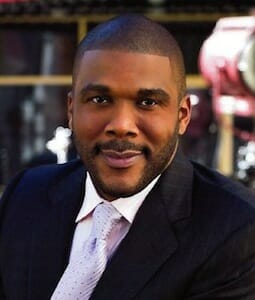
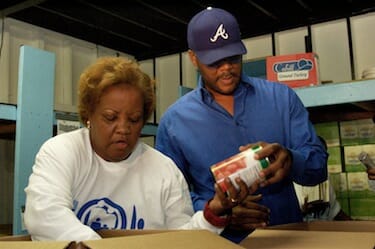 Tyler Perry helps unload food he donated to Hosea Feed the Hungry in Atlanta.
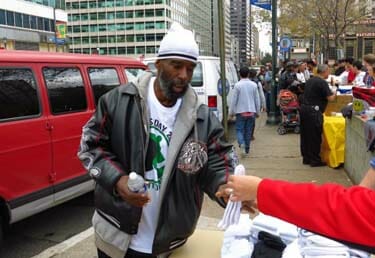 Joy of Sox volunteers hand out socks to the homeless next to Love Park in Philadelphia.
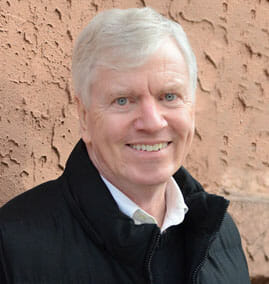 Tom Costello
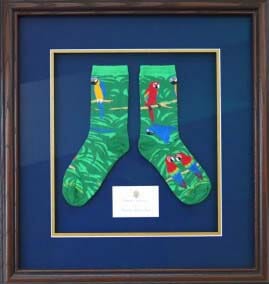 President George H. W. Bush donated these socks to The Joy of Sox to raise money. The card reads, “With the compliments of President George Bush.”